
This site is supported by our readers. We may earn a commission, at no cost to you, if you purchase through links.

Walk the forests of southern New Hampshire on a quiet winter morning, and you’ll likely hear them before you see them—a sharp, rhythmic knock echoing through bare maples, or a slow, resonant drumming rolling out of the deep woods.
Eight woodpecker species call this state home, from the sparrow-sized Downy Woodpecker to the crow-sized Pileated, and each one has carved out a distinct ecological niche.
Some, like the Red-Bellied Woodpecker, have been pushing steadily northward since 2000, making sightings that would have surprised birders a generation ago.
Whether you’re trying to identify what’s hammering your oak tree or hoping to draw more species into your yard, knowing who these birds are—and what drives them—changes everything.
Table Of Contents
- Key Takeaways
- Woodpeckers Found in New Hampshire
- How to Identify New Hampshire Woodpeckers
- Woodpecker Habitats Across New Hampshire
- Woodpecker Behavior, Diet, and Nesting Habits
- How to Attract Woodpeckers to Your Yard
- Frequently Asked Questions (FAQs)
- What woodpeckers are in New Hampshire?
- What is the most common woodpecker in New England?
- What is the big woodpecker in NH?
- Are woodpeckers protected in New Hampshire?
- How do you tell woodpeckers apart?
- How do woodpeckers avoid brain damage while pecking?
- What are common woodpecker predators in New Hampshire?
- How long do woodpeckers typically live?
- Can woodpeckers cause damage to house siding?
- What do woodpeckers eat besides insects?
- Conclusion
Key Takeaways
- New Hampshire hosts eight woodpecker species, each filling a distinct ecological niche — from the sparrow-sized Downy (Picoides pubescens) working your suet feeder to the crow-sized Pileated (Dryocopus pileatus) excavating deep into old-growth snags.
- Size, bill length, and drumming rhythm are your three fastest field-ID tools — a stubby bill means Downy, a bill as long as the head means Hairy, and a slow, heavy drum almost always signals Pileated.
- Red-Bellied Woodpecker (Melanerpes carolinus) has quietly pushed north since 2000 and is now a regular south of the White Mountains, a range shift worth tracking as winters grow milder.
- Dead trees do more work than most people realize — a single standing snag can host cavities for eight or more species and fuel the insect communities that keep woodpeckers fed year‑round.
Woodpeckers Found in New Hampshire

New Hampshire is home to eight woodpecker species, ranging from the tiny Downy to the crow-sized Pileated. Each one has its own look, habits, and favorite haunts across the state’s forests and neighborhoods.
From the tiny Downy to the striking Pileated, this complete guide to woodpecker species in Virginia captures the full range of behaviors and habitats these birds call home.
Here’s a closer look at all eight.
Downy Woodpecker
The Downy Woodpecker (Picoides pubescens) is New Hampshire’s smallest woodpecker — just 6 to 7 inches long — and probably the one you’ll spot first at your backyard feeder. Its Bill Morphology is a dead giveaway: that short, stubby bill is barely half the length of its head.
- Stays year-round; winter feeding visits to suet feeders are common
- Males show a small red nape patch; females don’t
- Territorial Drumming bursts last only 1–2 seconds but happen often in spring
The species has a stable or increasing population across its range.
Hairy Woodpecker
If the Downy is the feeder regular, the Hairy Woodpecker (Picoides villosus) is its bigger, bolder cousin — about 9 to 10 inches long with serious Bill Strength behind that chisel-like bill.
| Feature | Hairy Woodpecker |
|---|---|
| Size | 9–10 inches |
| Bill length | ≈ head length |
| Back pattern | Black with white stripe |
| Male marking | Red nape patch |
| Outer tail feathers | Pure white, unspotted |
A key to identifying woodpecker species in New Hampshire is the Hairy’s Outer tail feathers — Pure white, unspotted — which separate it cleanly from the Downy. Watch for Territorial Displays in early spring and suet visits through winter.
Northern Flicker
Unlike its bark-drilling cousins, the Northern Flicker (Colaptes auratus) spends most of its time on the ground — a quirk that surprises many backyard birders.
Its Ant Foraging Strategy is surprisingly effective: a long, brush-tipped tongue pulls ants straight from soil.
Watch for these field marks:
- White Rump Flash Display visible during takeoff
- Yellow-Shafted Color Morphs dominate New Hampshire
- black chest bib
- Brown scalloped body, roughly 12 inches long
Pileated Woodpecker
From a distance, the Pileated Woodpecker (Dryocopus pileatus) looks almost prehistoric — and at 16 to 19 inches, it’s the giant of New Hampshire’s woodpecker species distribution.
That blazing Red Crest Signaling rivals a cardinal for drama.
Males add a red malar stripe for Mating Displays, while both sexes drum slowly and deeply, reinforcing Territory Size.
These vivid displays are part of a broader pattern seen across birds with striking red plumage, where bold coloration signals fitness to potential mates.
Population Growth has steadily followed forest recovery across the state.
Red-Bellied Woodpecker
The Red-Bellied Woodpecker (Melanerpes carolinus) is a genuine New Hampshire success story. Its Range Expansion has pushed steadily northward — rare before 2000; it’s now a regular sight south of the White Mountains.
- Belly Coloration: Despite the name, the red on the belly is faint and often invisible in the field
- Head markings: Males show red from forehead to nape; females only on the nape
- Cache Behavior: It tucks acorns and seeds into bark crevices, then retrieves them through winter
- Nesting Height: Cavities are usually excavated below 50 feet in dead wood
Yellow-Bellied Sapsucker
Yellow-bellied Sapsucker (Sphyrapicus varius) brings a fascinating twist to sap feeding ecology — it’s the only New Hampshire woodpecker that drills sap wells for a living.
Both sexes wear bold red crown markings, though males also sport a red throat patch.
Watch for juveniles in duller, browner juvenile plumage during fall migration.
Riparian zones and maple-rich forests see spring feeding peaks, and hummingbirds genuinely rely on these sap wells too.
Black-Backed Woodpecker
The Black-Backed Woodpecker (Picoides arcticus) is a specialist built for fire-driven succession habitats — charred snags are its grocery store.
Here’s what defines this bird:
- Solid black back, white underparts, males with a yellow crown patch
- Bark foraging method involves peeling large strips from dead conifers
- Low nest height — cavities often just 2–15 feet up
- Clutch size ranges from 3–4 eggs
- Winter irregularities push birds south unpredictably
Forest fires genuinely shape where it lives.
Red-Headed Woodpecker
Few birds stop you cold like the RedHeaded Woodpecker (Melanerpes erythrocephalus) — that bold tri-color pattern of crimson, black, and white is practically its own identification guide.
Range Edge Dynamics place New Hampshire near its limits, making sightings rare and Breeding Irregularity common here. Historical Records favor river valleys.
It shows Food Storage Behavior, wedging acorns into bark.
Conservation Status warrants attention; check feeding stations in fall.
How to Identify New Hampshire Woodpeckers
Getting woodpeckers sorted out in the field takes a little know-how, but it’s easier than you’d think.
A few key things — size, bill shape, plumage, and sound — are usually all you need to tell them apart. Here’s what to look for.
Size and Bill Length Comparisons
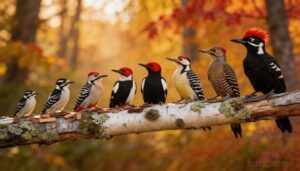
Size is your first clue in the field. The species size gradient here runs from the tiny Downy Woodpecker — just 6 inches, with a bill barely 1 cm long — up to the crow-sized Pileated at 40 cm, whose chisel-like bill takes up nearly a third of its body.
That length-to-body ratio tells you a lot.
Differences between Downy and Hairy Woodpeckers often trip people up, but bill size difference settles it fast.
Plumage, Markings, and Sexual Dimorphism
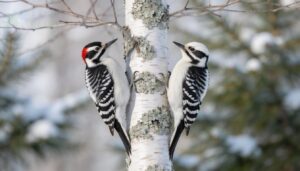
Once you know the size, let the plumage seal the deal.
Male crown coloration is your go-to marker — male Downies carry a red nape spot, while females show none.
Sexual dimorphism patterns are subtle but consistent: males display bolder female facial mask contrast, sharper black back-to-white belly transitions, and stronger plumage contrast variations.
Sexual marking variation is small, but reliable once your eye is trained.
Drumming Patterns and Distinct Calls
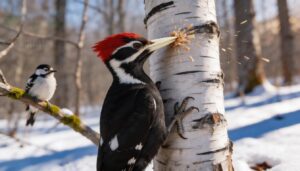
Plumage gets you close — sound closes the gap.
Each species carries its own Individual Rhythm Identity: Downies rattle off quick, brisk bursts; Pileateds swing slower with heavy, deliberate beats. That’s Species Drum Speed working as a field marker.
- Call Response Dynamics reveal territory boundaries without confrontation.
- Temporal Signature Variation lets you distinguish individuals at a distance.
- Seasonal Tempo Shifts reflect breeding hormones — spring drums hit differently.
Woodpecker Habitats Across New Hampshire

New Hampshire’s woodpeckers don’t all live in the same neighborhood — each species has a very specific type of forest, yard, or woodland it calls home. Where you look matters just as much as what you’re looking for.
Here’s a breakdown of the habitat types where you’re most likely to find them.
Deciduous and Mixed Forest Species
Deciduous and mixed forests in New Hampshire are prime woodpecker territory, shaped by dominant tree species like red maple, American beech, and white oak. The canopy light regime shifts dramatically with seasonal leaf phenology — those brief spring windows before leaf-out drive insect activity upward, pulling foragers like Downy and Hairy Woodpeckers into the canopy.
Rich understory plant communities and snag-filled edges make these stands especially productive.
Coniferous and Post-Fire Forest Specialists
Shift from deciduous stands to coniferous forests, and the rules change entirely. Species like the Black-backed Woodpecker (Picoides arcticus) aren’t just habitat specialists — they’re fire ecology followers, zeroing in on post‑fire habitat within years of a burn.
Here’s what makes these forests tick for woodpeckers:
- Fire-Induced Snags attract Black-backed Woodpeckers through beetle-outbreak foraging on charred bark
- Mosaic Burn Habitat creates structural diversity that facilitates conifer cavity succession across multiple seasons
- Sap‑well drilling by Yellow-bellied Sapsuckers targets living spruce and fir for tree sugars
- Fire ecology and Black‑backed Woodpecker colonization follows beetle surges within eight years post‑burn
- Mature forest requirements for large woodpeckers like the Pileated depend on snag density in older coniferous forests
Suburban Yards and Urban Green Spaces
You don’t need deep wilderness to attract woodpeckers — suburban backyards and city parks work surprisingly well. Native tree species selection, like oak and maple, builds insect habitat enhancement right outside your door.
Urban development impact does reduce canopy cover, but artificial cavity boxes compensate where snags are scarce.
Noise pollution effects can limit activity, so quieter yard corners see more visits.
Role of Dead Trees and Snags
Dead trees pull more weight than most people realize. A single large standing dead tree can host cavities used by eight or more species — owls, ducks, even small mammals.
Dead and dying trees support dead wood ecology by feeding saproxylic insects, which woodpeckers depend on year-round.
They also offer Microclimate Moisture and act as Seedling Nurse Trees, driving Biodiversity Enhancement, Insect Support, and long-term Carbon Storage.
Woodpecker Behavior, Diet, and Nesting Habits

Knowing where woodpeckers live is just part of the picture — how they actually spend their days tells an even more interesting story. Each species has its own approach to finding food, building a nest, and staying put (or heading south) when winter hits.
Here’s a closer look at the behaviors that shape their lives throughout the year.
Foraging Techniques by Species
Each woodpecker species has its own foraging style, shaped by bill length adaptations and the food it’s chasing.
- Bark Surface Pecks – Downy and Hairy Woodpeckers tap shallow crevices, listening for beetle larvae in the outer sapwood.
- Sap Well Drilling – Yellow-Bellied Sapsuckers tap maples, creating sap wells that also trap insects.
- Ground Ant Foraging – Northern Flickers probe soil and ant hills using rapid tongue projections.
- Deadwood Beetle Extraction – Pileated and Black-Backed Woodpeckers dig deep into rotting logs, pulling out wood-boring larvae.
Beyond insects, some species round out their insect diet with suet, seeds, or fruit depending on the season.
Cavity Excavation and Nesting Cycles
Once excavation begins — often weeks before egg‑laying — both parents chip away at dead or softened wood, shaping a chamber that’s snug but functional. Nest chamber design usually includes a wood‑chip cushion at the base.
Parents share incubation and actively defend the entrance from rivals. Many pairs return to the same tree cavity nesting site, reusing and enlarging it each breeding season.
Seasonal Migration and Year-Round Residents
Not every New Hampshire woodpecker packs its bags for winter — but some do shift surprisingly far.
- Migration Timing varies: Yellow-bellied Sapsuckers head south by October, tracking sap flow.
- Partial Migration means younger birds move while older residents hold territory.
- Resident Territory stays defended year-round by Downy, Hairy, and Pileated.
- Snow Influence pushes Flickers to lower elevations when frozen ground blocks ant foraging.
- Winter Roosting shifts between conifers and mixed stands for thermal cover.
Ecological Role in Forest Health
Think of woodpeckers as the forest’s maintenance crew. Their insectivorous diet targets wood-boring beetles and bark beetle larvae, making pest control a natural outcome of their daily foraging.
Cavity creation opens nesting real estate for owls, bats, and small mammals. Deadwood cycling speeds decomposition.
Forest diversity follows. Their presence is a reliable habitat indicator — where woodpeckers thrive, the forest usually does too.
Where woodpeckers thrive, the forest usually does too
How to Attract Woodpeckers to Your Yard
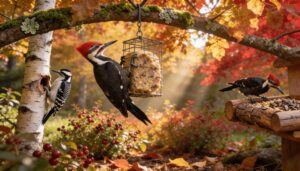
Getting woodpeckers to visit your yard isn’t as complicated as it might seem.
A few targeted changes can make outdoor space genuinely appealing to several New Hampshire species. Here’s what actually works.
Best Feeders, Suet, and Seed Mixes
The right setup makes all the difference. Stock your woodpecker feeder with these proven options:
- Seasonal Suet Types — beef or peanut butter suet in winter; no-melt suet cakes in summer
- Suet Recipe Variations — mix in berries, insects, or cornmeal for variety
- Seed Mix Ratios — prioritize black oil sunflower seeds for high fat content
- Mess-Free Seed Options — hulled sunflower hearts attract downy and hairy woodpeckers with zero shell waste
- Feeder Placement Strategies — mount feeders near tree trunks at varying heights, adding peanuts to attract woodpeckers to your backyard reliably
Water Sources and Bird Bath Tips
Food draws them in — water keeps them coming back.
Set up a shallow bird bath, about 1 to 2 inches deep for smaller species, and place it in partial shade for seasonal maintenance. Bath placement near dense branches gives quick predator safety retreats.
Add a dripper for water movement, since woodpeckers, like most backyard visitors, trust splashing water sources for birds over still basins.
Preserving Snags and Native Plants
Water works — but snags and native plants do the heavy lifting for long-term woodpecker habitat.
Aim for snag density guidelines of 5 to 10 dead and fallen trees per hectare, mixing decay stage diversity so something’s always rotting just right. Space them with safety buffer zones of roughly 20 meters apart. Underplant with native understory planting for insects, and commit to long-term habitat monitoring to keep New Hampshire woodpecker habitat and feeding habits thriving.
Peak Times and Spots for Observation
Once your snags and natives are in place, timing your visits matters just as much as location.
- Dawn Drumming Hotspots: Hit the trail before sunrise — Weekday Dawn Quiet means less noise interference, and Morning Edge Foraging peaks along forest clearings.
- Afternoon Snag Activity: Between 1–3 pm, Pileated Woodpeckers work sun-warmed dead trees hard.
- Twilight Creekside Listening: Creekside corridors enhance calls beautifully during seasonal migration of woodpeckers in NH.
Frequently Asked Questions (FAQs)
What woodpeckers are in New Hampshire?
New Hampshire hosts 8 species of woodpeckers, from the tiny Downy to the crow-sized Pileated — each carving out its own niche across the state’s forests, suburbs, and open woodlands.
What is the most common woodpecker in New England?
The Downy Woodpecker (Picoides pubescens) holds that title easily. At roughly 6 inches, it’s the smallest of the bunch — and almost certainly the first woodpecker you’ll spot at your feeder.
What is the big woodpecker in NH?
Pileated Woodpecker (Dryocopus pileatus) is the largest NH woodpecker, stretching up to 19 inches.
Its flaming red crest, loud drumming behavior, and rectangular cavity excavation in mature forests make it unmistakable.
Are woodpeckers protected in New Hampshire?
Yes, all woodpeckers in New Hampshire are protected under the federal Migratory Bird Treaty Act and state laws — covering the birds, their nests, and eggs year-round.
How do you tell woodpeckers apart?
Start with size and bill shape — those two clues narrow it down fast. Then check crest color, wing bar patterns, and tail feather markings.
Sound helps too; each species drums and calls differently.
How do woodpeckers avoid brain damage while pecking?
Nature basically built woodpeckers with a built-in helmet.
Skull fusion, a hyoid cushion, beak shock damping, neck muscle buffer, and energy dissipating tissue all work together — so rapid drumming never rattles the brain.
What are common woodpecker predators in New Hampshire?
Raptors like Cooper’s hawks and great horned owls top the threat list. Raccoons and squirrels raid nest cavities. Rat snakes climb trees for eggs. Urban cats add surprising danger year-round.
How long do woodpeckers typically live?
Lifespan variability is real — most woodpeckers live 4 to 12 years, but first-year mortality hits hard. Longevity records show Hairy Woodpeckers reaching 15 years, while survival factors like food and habitat matter most.
Can woodpeckers cause damage to house siding?
Yes, woodpeckers can damage house siding. They peck for insects, nesting spots, or territorial drumming.
Cedar and stained wood face the highest siding vulnerability. Watch for fresh holes, chips, or repeated hammering as damage signs.
What do woodpeckers eat besides insects?
Beyond insects, woodpeckers eat fruit and berries, nuts and seeds, and tree sap. At feeders, they’re drawn to suet, peanut butter, and seed offerings — easy, reliable fuel year-round.
Conclusion
As I recall a winter morning spent tracking woodpeckers in New Hampshire, the rhythmic drumming of a Pileated Woodpecker still echoes in my mind. This experience underscores the importance of understanding these birds’ habits and habitats.
By embracing their presence, we can foster a deeper connection with nature. With this knowledge, you’re now equipped to identify and attract these fascinating creatures, enriching your outdoor experiences and contributing to their conservation in the Granite State’s diverse landscapes.