
This site is supported by our readers. We may earn a commission, at no cost to you, if you purchase through links.
Those neat rows of holes drilled into your backyard birch aren’t damage — they’re a feeding strategy thousands of years in the making. The bird responsible, the yellow bellied sapsucker, taps sap wells with the precision of a surgeon, then returns to harvest both the sap and the insects it lures in. You’ll spot one by its black-and-white barring and a wash of pale yellow across the belly, though males add a splash of red on the forehead and throat.
This woodpecker does more than feed itself. It shapes forest habitats for chickadees, hummingbirds, and flying squirrels alike. Understanding how it lives reveals a small architect at work in the woods around you.
Table Of Contents
- Key Takeaways
- Yellow-Bellied Sapsucker Identification
- Habitat, Range, and Migration
- Diet and Sap-Feeding Behavior
- Breeding and Nesting Habits
- Ecological Role and Conservation
- Frequently Asked Questions (FAQs)
- What is the difference between a yellow-bellied sapsucker and a woodpecker?
- Are yellow-bellied sapsuckers bad for trees?
- Where can I find yellow-bellied sapsucker?
- How do you get rid of yellow-bellied sapsucker?
- What are the benefits of the yellow-bellied sapsuckers diet?
- Do yellow-bellied sapsuckers ever feed on the ground?
- How do yellow-bellied sapsuckers benefit other species?
- How does climate change impact this bird?
- How long do yellow-bellied sapsuckers live?
- When do sapsuckers typically begin breeding season?
- Conclusion
Key Takeaways
- The yellow-bellied sapsucker creates neat rows of sap wells in tree bark, attracting both insects and other wildlife to feed.
- Males show red foreheads and throats, while females have a white throat patch, and juveniles display muted plumage and softer markings.
- This woodpecker’s nest cavities and feeding sites support chickadees, hummingbirds, flying squirrels, and many other forest species.
- Breeding occurs in northern boreal forests, with migration extending as far south as Costa Rica, and the species remains stable and widespread.
Yellow-Bellied Sapsucker Identification
Spotting a Yellow-Bellied Sapsucker takes a trained eye, since its markings shift between sexes and life stages. You’ll want to know exactly what to look for before you head into the woods. Here’s what sets this bird apart, feature by feature.
For a closer look at their striking head pattern, check out this guide to birds with black-and-white heads.
Size and Body Shape
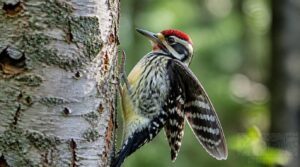
Picture a bird barely longer than your hand: 7 to 8.7 inches, with a wingspan near 13 to 15 inches. Weight hovers between 1.5 and 1.9 oz, shifting seasonally through body mass fluctuations as fat reserves build before migration.
A stout straight bill anchors sturdy torso drilling support, while zygodactyl foot grip and tail balance mechanics keep it steady on vertical bark.
Black-and-white Barring
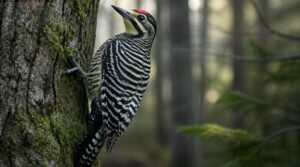
Once that sturdy body settles onto bark, the plumage takes over. Sharp black-and-white stripes run head to tail, breaking up its outline against dappled forest light. Bar width shifts by feather type, coarser on wings and tail, crisper after molt.
Beyond camouflage, black bars aid heat absorption in cool climates, while alignment helps birds recognize their own kind mid-flight.
Pale Yellow Belly
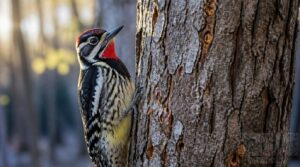
Look for a pale yellow wash low on the belly, easy to miss when the bird clings upright against bark. Morning light or an angled chest view reveals it best.
Sap intake can deepen this hue, while shade or overcast skies wash it out. Some individuals simply run paler than others, so treat it as a helpful clue, not a certainty.
Male and Female Markings
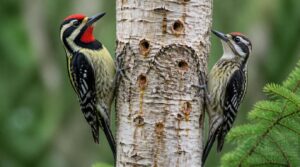
Once you’ve spotted that yellow wash, check the head for the real giveaway: red foreheads and red throats mark the males, while females show a plain white throat patch instead.
Males also carry sharper black-and-white stripes and bolder facial contrast overall. Females look softer, with more diffuse barring. These gendered coloration patterns hold steady across the breeding range.
Juvenile Appearance
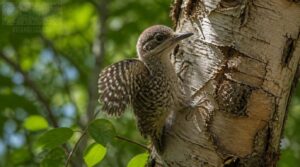
Young sapsuckers won’t show that crisp adult pattern right away. Their plumage contrast stays muted, with diffuse barring and duller feathers that lack sheen in sunlight.
- Softer, less defined facial markings
- Shorter bill relative to body size
- Rounder tail, chunkier head-to-neck look
- Clumsy, erratic early flight behavior
As molt progression advances through summer, streaking sharpens and yellow underparts emerge, slowly revealing the adult bird beneath.
Habitat, Range, and Migration
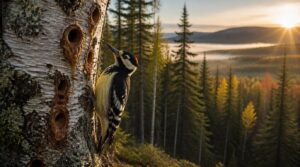
Once you can spot a sapsucker, the next question is where to find one. This bird covers a lot of ground, from dense boreal forests to tropical wintering sites far south. Here’s what shapes its range, its travels, and the forests it calls home.
Preferred Wooded Habitats
Ask which tree the sapsucker prefers, and the honest answer is: almost any of them. This bird thrives across hardwood and conifer forests, boreal stands, and open woodlands alike.
| Forest Type | Key Feature | Sapsucker Benefit |
|---|---|---|
| Deciduous | Seasonal canopy | Insect access |
| Mixed | Structural diversity | Year-round foraging |
| Riparian | Moist edges | Rich prey base |
Riparian woodland benefits and disturbance-driven dead wood keep habitats productive. Protecting ancient woodland habitats is essential for maintaining biodiversity.
Breeding Range
Head north far enough, and you’ll find where this sapsucker actually raises its young: boreal forests spanning all of Canada, up to 6,500 feet elevation.
Unlike the sapsucker’s remote breeding grounds, chickadees, nuthatches, and bluebirds will readily use backyard boxes if you follow this guide to proper nesting box placement for height, orientation, and habitat.
Nesting site fidelity brings pairs back yearly, defending territories through tapping and calls. Arrival timing shifts with latitude, while habitat resource availability and geographic gene flow shape breeding grounds across this vast northern range.
Wintering Range
Winter tells a different story for this woodpecker species: milder forests, lower ground, and steady food.
Wintering grounds stretch as far south as Costa Rica, with birds settling between sea level and 3,200 meters. You’ll find them favoring:
- Mature deciduous stands
- Mixed woodlands with birch or maple
- Sheltered, low-elevation forests
- Sites with active sap wells
Elevation shifts downward, food stays reliable, and winter habitat suitability depends on it.
Seasonal Migration Routes
Northwestern breeders trace a looped migration, tracking the Yellow-Bellied Sapsucker southeast toward wintering grounds rather than retracing spring’s path exactly.
Routes follow river valleys and mountain passes, with stopover refueling sites timed to resource pulses along the way.
This woodpecker species shows a migratory split too: some individuals travel far, others stay put, depending on local food availability that season.
Elevation and Forest Types
Climb a mountainside and you’re really walking through time-lapse climate change. Elevation drives altitudinal forest shifts, from deciduous tree stands lower down to boreal forest conifers up high. Slope aspect creates microclimate pockets, warm ridges versus moist valleys.
You’ll notice vertical canopy layers shift with elevation and nutrient cycling too. The Yellow-Bellied Sapsucker adapts, following these moisture regime variations across wooded habitat.
Diet and Sap-Feeding Behavior
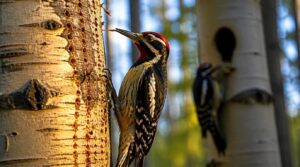
This bird doesn’t just eat what it finds—it engineers its own food supply. Watch a sapsucker at work and you’ll see a feeding strategy built on patience and precision. Here’s how that process unfolds, from the first drill mark to the last bite fed to a hungry chick.
How Sap Wells Work
A sapsucker drills tiny holes into bark to tap tree sap, relying on vascular pressure to push fluid outward through xylem channels. These sap wells expose sap-transporting tissue without harming deeper bark anatomy.
Sap flow shifts throughout the day, with diurnal fluctuations tied to temperature swings. Seasonal sap cycles determine yield, making sap-feeding birds most active when trees run richest.
Tree Bark Drilling Patterns
Look closely at the trunk and you’ll spot the pattern: neat horizontal rows of tiny drilled holes, spaced evenly across the bark. This grid often crosses natural vertical fissures in the bark, creating a reticulate look where sap wells meet existing cracks.
Bark texture varies by tree species, so drilling patterns and sap well geometry shift depending on the trunk’s own patchwork of ridges and patches.
Insects and Cambium
Sap isn’t the whole menu. Nesting season shifts your bird’s dietary habits toward protein, with insects making up half the adult diet during breeding months. Foraging behavior expands beyond sapwells into bark crevices, targeting:
- Beetles
- Ants
- Cambium miner larvae
- Spiders
- Soft-bodied grubs
Cambium tunneling causes vascular tissue damage, triggering host tree defense and opening pathogen entry points.
Fruits and Berries
Beetles and cambium miners aren’t the only fallback food. Berries and fruits round out the sapsucker’s diet year-round, with winter foraging concentrated in fruiting trees when insects grow scarce.
This seasonal harvesting method utilizes the same berry antioxidant benefits and fruit nutritional value that make wild fruit a smart, energy-dense choice for any forager—feathered or otherwise.
Feeding Nestlings
Chicks in the cavity don’t just get sap — parents pack their bills with sap-soaked insects for extra protein. Growth this fast demands constant fuel, which is why nestlings need:
- Frequent small feedings
- Protein-rich insects
- Steady hydration
Watch a nestling’s crop: fullness tells you everything about its next meal.
Breeding and Nesting Habits
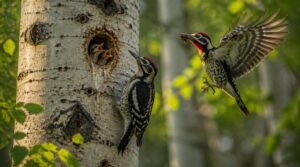
Once you’ve watched a sapsucker feed, its next chapter of life gets even more interesting. Breeding season brings out behaviors you can actually watch unfold, from courtship to caring for young. Here’s what to look for as these birds raise their chicks.
Courtship Tapping Displays
Courtship in the Yellow-bellied Sapsucker isn’t subtle. Males point their bills to flash red throat patches, then break into ritualized tapping synced with soft calls.
| Signal | Sender | Function |
|---|---|---|
| Bill-pointing | Both sexes | Display throat patch |
| Tapping | Both sexes | Strengthen pair bond |
| Vocalizing | Both sexes | Multimodal signaling |
An attentive mate triggers faster, longer bouts — a clear audience effect.
Nest Cavity Excavation
Watch a sapsucker chisel into a tree, and you’ll see stout, chisel-like bills removing wood in thin chips.
Excavation runs about two weeks, starting early spring when sap flow slows for easier drilling. Entrance holes start small, widening as the chamber deepens. Debris piles at the tree’s base — a telltale sign of active nest excavation underway.
Preferred Nesting Trees
Not every tree makes the cut. Sapsuckers favor trunks over 40 cm in diameter, often standing dead, where decaying heartwood allows faster, deeper excavation.
Hardwoods like aspen and birch beat conifers for this softness. Cavities run 15–30 cm deep, and mature, senescent stands offer the nesting site stability needed to survive storms and support cavity reuse across seasons.
Eggs and Incubation
Five to six white eggs usually fill the cavity, though clutch size can range from 3 to 7 depending on female condition.
Both parents share incubation over 12–13 days, with males covering night shifts. Success hinges on:
- Stable temperature near 37–38°C
- Regular egg turning to prevent sticking
- Proper humidity control
- Minimal handling stress
- Consistent parental attentiveness
These conditions guide healthy embryo development toward hatching.
Fledgling Development
Twenty-five to twenty-nine days after hatching, young sapsuckers leave the cavity, though flight feather growth and pectoral muscle development continue afterward.
Parents keep feeding fledglings for up to two weeks while foraging skill acquisition and predator avoidance training take hold. Social learning cues from adults guide this fledgling stage, shortening parental care as independence builds—completing the avian reproductive cycle.
Ecological Role and Conservation
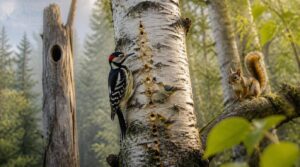
This bird’s influence stretches well beyond its own nest hole. Other creatures, tree health, and even the sapsucker’s own population numbers all tell part of the story. Here’s what you should know about its wider role in the forest.
Keystone Forest Species
Drill a hole, and you shape an environment. The Yellow-Bellied Sapsucker counts as a true habitat engineer, chiseling sap wells and nest cavities that ripple through forest environments as biodiversity cascading effects.
By drilling a single hole, the Yellow-Bellied Sapsucker reshapes the whole forest around it
Its work helps:
- Nutrient cycling processes
- Forest succession patterns
- Cavity formation for other species
- Sap access for insects and mammals
That’s environment stability drivers at work — one bird, many beneficiaries.
Wildlife Using Old Cavities
Once a Yellow-Bellied Sapsucker moves on, its old tree hollow doesn’t sit empty for long. Secondary cavity users—bluebirds, chickadees, nuthatches—move right in. Flying squirrels and bats den there too, drawn by microhabitat temperature stability.
Winter dens for small mammals often depend on these cavities. Bigger holes support more species, proving this nature’s architect role stretches well beyond one nesting habitat or nest site.
Hummingbirds and Sap Wells
Old cavities aren’t the only gift this woodpecker leaves behind. Ruby-throated Hummingbirds time their migration food synchronization to sap wells, sipping fluid with rapid tongue movements and grabbing trapped insects for protein-rich foraging.
Many even choose nesting site selection near active wells, cutting travel time to fuel their high energy intake. It’s seasonal resource dependency at its clearest.
Effects on Trees
Every gift has a cost. Sap wells expose living tree bark, and those wounds can become entry points for pathogens, weakening the tree’s defenses over time.
Repeated tapping suppresses growth near feeding sites and disrupts water and nutrient flow. Most trees tolerate this fine, but young saplings and drought-stressed trees face real growth suppression risks from chronic sap withdrawal.
Population and Conservation Status
Roughly 14 million yellow-bellied sapsuckers range across North America today, earning a Least Concern status from the IUCN. Population Monitoring through citizen science tracks regional shifts, though trends stay stable overall.
Climate Impact and Forest Management remain key watchpoints. Since about 39% of bird species face decline globally, this sapsucker’s ability to bounce back offers a hopeful note for conservation-minded birders tracking avian plumage and range health.
Frequently Asked Questions (FAQs)
What is the difference between a yellow-bellied sapsucker and a woodpecker?
Rather than random pecking, this species drills neat horizontal sap wells in tidy rows. Its tongue has hairlike tips for lapping sap. Drumming cadence, plumage contrast, and foraging style all set it apart from typical woodpeckers.
Are yellow-bellied sapsuckers bad for trees?
Not usually. Healthy trees, especially aspens, recover well from sap wells, though thin-barked species stay vulnerable to lasting tree health impacts, disease entry points, and stress if drilling repeats year after year.
Where can I find yellow-bellied sapsucker?
Deep boreal woods in summer, quiet suburban yards in winter — this bird bridges both worlds. You’ll spot it nesting in aspen stands across Canada, then wintering as far south as Costa Rica, favoring elevations from sea level to 3,000 meters.
How do you get rid of yellow-bellied sapsucker?
Wrap trunks with burlap during peak feeding, then add reflective tape or scare devices as visual bird deterrents. Diversify plantings, avoid stressed trees, and apply bark protection techniques to shield ornamental trees from repeated sap wells.
What are the benefits of the yellow-bellied sapsuckers diet?
A diet built for a thousand tiny miracles: sap fuels migration, insects supply protein for chicks, and berries round out nutrition. This sap-insect connection boosts foraging efficiency while feeding nestlings and other sap-feeding birds nearby.
Do yellow-bellied sapsuckers ever feed on the ground?
Yes, though it’s rare. You’ll spot ground foraging near fruiting trees, where fallen fruit and leaf litter searching turn up insects. It’s mostly juveniles exploring, supplementing their sap and insect diet when wells run dry.
How do yellow-bellied sapsuckers benefit other species?
Your tree sap becomes a lifeline for others: hummingbirds use sap wells as nectar substitutes, while insects drawn to the wells feed warblers and chickadees. Old nest cavities later shelter bluebirds, squirrels, and bats—true habitat engineering at work.
How does climate change impact this bird?
Range shift patterns push breeding northward while phenological timing mismatches disrupt sap flow and insect emergence.
Sap production volatility and nesting habitat fragmentation from deadwood loss threaten fledging success across arboreal habitat and shifting predator communities.
How long do yellow-bellied sapsuckers live?
Like most woodland dwellers, survival is a gamble stacked against you. Wild lifespan factors put yellow-bellied sapsuckers at 6 to 7 years on average, though favorable habitat longevity links can push some individuals past 9, dodging predation survival risks along the way.
When do sapsuckers typically begin breeding season?
Breeding season kicks off in late April or early May as spring temperatures rise and sap flow increases. Peak activity lands in May and June, when insect abundance and leaf buds support nestlings in tree hollows or dead wood.
Conclusion
Imagine the forest as a living web, each thread woven by creatures like the yellow bellied sapsucker. Its drilled rows form pathways for life, guiding nectar seekers and sheltering small mammals.
You might see a flash of yellow or hear a sharp tap, a sign of its hidden influence. In every tree it visits, the sapsucker leaves a mark. Understanding its habits is like tracing the roots of the woods—every detail shapes the story.
- https://www.allaboutbirds.org/guide/Yellow-bellied_Sapsucker/overview
- https://greentowsonalliance.org/come-on-get-sappy-yellow-bellied-sapsuckers-and-why-everyone-should-bird
- https://www.friendsofrachelcarsonnwr.org/education/yellow-bellied-sapsucker
- https://ncwf.org/blog/yellow-bellied-sapsucker
- https://blog.nature.org/2021/05/10/more-cool-facts-about-the-yellow-bellied-sapsucker