This site is supported by our readers. We may earn a commission, at no cost to you, if you purchase through links.
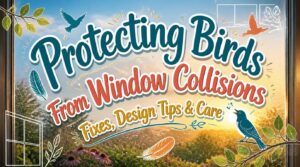
Nearly a billion birds die each year in the U.S. alone, hitting glass they never saw coming. Your window doesn’t look like a barrier to a warbler in flight — it looks like open sky, a mirror image of clouds and canopy. That mismatch between what you see and what a bird sees turns ordinary homes into hazards.
Protecting birds from window collisions starts with understanding why the strikes happen, then applying fixes that actually work — decals spaced right, screens, timed lighting, native plantings. You’ll also want to know what to do if a bird hits your glass anyway, because quick, calm action often makes the difference between recovery and loss.
Table Of Contents
- Key Takeaways
- Why Birds Hit Windows
- Best Window Treatments to Prevent Collisions
- Low-Cost DIY Bird-Safe Window Fixes
- Bird-Friendly Home Design and Lighting
- What to Do for Injured Birds
- Frequently Asked Questions (FAQs)
- How to stop birds from colliding with windows?
- How can I help a bird that crashed into my window?
- What is the 2×4 rule for bird strikes?
- Do bird anti-collision stickers work?
- Is there anything you can do to help a bird that hit a window?
- How do weather conditions affect bird collision rates?
- Which bird species are most vulnerable to window strikes?
- Are bird-friendly building ordinances required in my city?
- How does LEED certification address bird-safe glazing?
- What is the American Bird Conservancys Threat Factor system?
- Conclusion
Key Takeaways
- Birds see glass as open sky or reflected trees, not a barrier, which is why nearly a billion birds die from window strikes in the U.S. each year.
- Spacing visual markers like decals, tape, or cords, no more than 2 inches horizontally and 4 inches vertically, on the exterior of glass can cut collisions by up to 70-90%.
- Turning off nonessential exterior lights from 11 p.m. to 6 a.m. during migration season and switching to warm bulbs (≤3000K) reduces nighttime strikes by 44%.
- If a bird hits your window, place it in a dark, ventilated box without food or water and get it to a licensed wildlife rehabilitator within 24 hours, since roughly 80% recover fully.
Why Birds Hit Windows
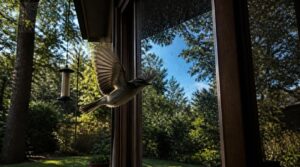
Birds don’t see glass the way you do, and that gap causes millions of collisions every year. It’s not carelessness on their part, it’s biology, timing, and a handful of design factors working against them. Here’s what actually puts birds on a collision course with your windows.
Their eyes are built for wide-angle awareness, not sharp focus straight ahead, which is a big part of why birds can’t see glass as a barrier.
Reflections of Sky and Trees
A pane of glass can look like open sky to a bird — that’s the trap. Sky mirroring effects create false horizons; calm water does the same, doubling trees and clouds into a symmetrical scene. Research on glass reflectivity ties this straight to bird mortality. Fixes:
- Visual markers on windows
- Reduce glass transparency
- Break up reflections
- Add exterior contrast
- Test at multiple angles
Transparent Glass Flyways
Two glass walls meeting at a corner can trick a bird into seeing a clear corridor illusion — an open flyway straight through the building. Glass panel intersections near sanctuaries or dense vegetation make this worse, since birds already flying toward cover won’t expect solid glass.
Breaking the illusion means placing visual markers right at these junctions, not just anywhere on the pane. Using transparent bird‑friendly glass can reduce bird collisions while preserving clear views.
Large Window Risk
Size matters more than most homeowners realize. Glazing surface area above 25% of a wall face raises strike rates by up to 59%, with floor-to-ceiling hazards topping the charts.
You’ll see the worst numbers during dawn dusk activity, when low light hides window edges. Frames get mistaken for perches, too — those misleading perch edges invite repeated, riskier approaches you don’t want near your birdsafe glass goals.
Interior Plants and Blinds
Frame edges aren’t the only trap—what’s behind the glass matters too. Leafy houseplants near windows read as open canopy, luring birds straight into collisions.
Close your blinds during peak hours, or add diffusing fabric shades that soften the illusion. Cellular shade microclimates work double-duty, cutting glare while keeping foliage healthy—true bird-friendly window treatments.
- Ferns silhouetted like an inviting grove
- Fatal impact against invisible glass
- Preventable deaths from simple choices
- Trust broken between backyard and home
- Silence where birdsong should be
Migration and Weather Timing
When rising atmospheric pressure lines up with a tailwind, birds launch in droves, funneling through the same migration corridors night after night. Cloudy nights push them lower, closer to lit windows.
Simple fixes like applying window decals to break up reflections can spare exhausted migrants from fatal collisions during these peak nights.
Spring and fall migrations bring the heaviest traffic, and light pollution confuses navigation—drawing exhausted, disoriented birds straight toward your glass.
Best Window Treatments to Prevent Collisions
Once you know why birds hit glass, the fix comes down to breaking up that deadly reflection. You’ve got several solid options, ranging from quick DIY additions to full glass replacements. Here’s what actually works, starting with the simplest.
Exterior Decals and Dots
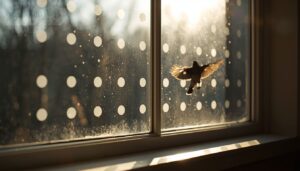
A window covered in dots looks odd to you, but to a bird it screams "solid object, don’t fly here."
Apply decals spaced 2-4 inches apart using weatherproof adhesive tech, and you’ll cut strikes by up to 70%.
Whether you choose branding pattern aesthetics or plain anticollision stickers, these visual markers work as simple, DIY window decal solutions for birdproofing windows fast.
Bird-Safe Window Tape
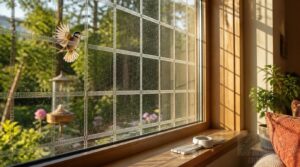
Grid patterns do the heavy lifting here. Bird tape windows use 1-2 inch spacing, small enough that birds read the glass as solid.
Apply to clean exterior surfaces with a smoothing tool—no bubbles, no gaps. Adhesive weather resistance holds through heat and freezing alike.
Clear or tinted options preserve your view. Damaged sections peel off easily, keeping long-term maintenance simple without replacing the whole roll.
UV-Reflective Window Film
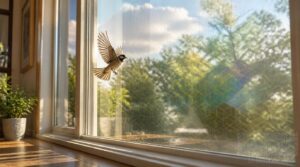
UV-reflective window film does double duty: it stops bird strikes and cuts heat gain, all while staying invisible to you.
Applied to clean glass, it blocks up to 84% of collisions and rejects 99% of UV rays, guarding furniture from fading.
You’ll get daytime privacy and glare control too. Installation takes a few hours—clean, squeegee, done. Maintenance stays simple with gentle, non-abrasive cleaning.
External Screens and Netting
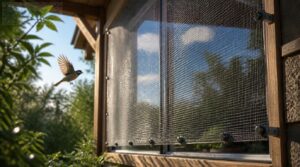
Think of it as a net you cast for birds’ safety, not fish. Install external screens or netting a few inches off the glass, mesh sized ¼–1 inch, and you’ll break up reflections while keeping views clear.
Polyester or HDPE netting resists weather; UV coatings stop fading. Mount with corrosion-resistant brackets, clean with mild soap, and expect 5–10 years of service—up to 90% fewer strikes.
Fritted or Etched Glass
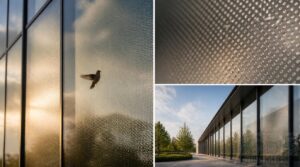
Some fixes are temporary. Fritted or etched glass isn’t—it’s baked in for life.
Ceramic frit durability beats etching hands-down: fused ceramic particles won’t scratch off, while acid-etched finishes just frost the surface. Custom pattern design lets you brand a facade while cutting strikes up to 90%, like at the Javits Center.
- Light diffusion softens harsh reflections
- Firing processes bond patterns permanently
- Bird-safe window film works as a budget alternative
Low-Cost DIY Bird-Safe Window Fixes
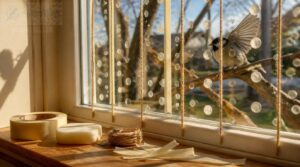
You don’t need a big budget to make your windows safer, just some stuff you probably already have at home. Soap, tape, paper, even string can break up reflections enough to keep birds from flying into the glass. Here are five simple fixes you can try this weekend.
Soap or Tempera Patterns
Grab what’s already under your sink: a bar of soap, a sponge, and some water.
Dab dots or lines 2–5 cm apart across the whole pane—dark colors for contrast. Tempera lasts longer indoors but washes off with rain.
Check weekly, reapply as needed.
Cheap, non‑toxic, and genuinely effective window collision prevention.
Tape Stripes and Grids
Tape stripes and grids take that same soap idea and make it permanent. You’re applying strips 1–3mm wide in a grid, spaced 2–4 inches apart (apply decals spaced 24 inches apart for larger dot patterns instead), using:
- UV reflective tape
- Low-residue acrylic adhesive
- Straight-edge installation
- Seasonal reapplication
- Storm inspection checks
Material UV resistance keeps strips from fading for months.
Paper Cutouts That Work
Grids aren’t the only low-cost fix — paper cutouts work too, and they’re cheaper than tape.
Cut high contrast shapes (black on white works best), laminate for weatherproof coating benefits, and space them 2–4 inches apart along the sill. This exterior placement strategy covers 20% of glass without clutter. Stagger sizes for visual markers birds notice from any angle. Replace every 6–12 months as colors fade.
Hanging Cords or Ribbons
Got a spool of ribbon lying around? String it up. Space cords vertically every 4 inches for effective visual markers — this bird-friendly window treatment works with minimal effort.
- Use thin cords for lightweight ornaments (under 50g)
- Tie double overhand knots for security
- Choose colorfast, weather-durable materials
Inspect cords monthly; swap frayed ones fast. Simple, breezy, effective.
Budget-Friendly Retrofit Tips
If money’s tight, prioritize affordable decal spacing — vinyl dots every 4 to 6 inches cost pennies and cut collisions fast.
Layer in DIY film application on one problem window, add temporary pattern methods like tape stripes, and try low-cost screen installation for extra coverage.
Don’t skip budget window sealing while you’re at it — birdsafe window film and turned-off lights round out cheap, birdfriendly window treatments protecting birds and your wallet.
Bird-Friendly Home Design and Lighting

Your window treatments matter, but they’re only part of the picture. What surrounds your home—and how you light it—shapes bird safety just as much. Here’s what to adjust outside your glass to keep birds out of harm’s way.
Feeder Placement Near Windows
Where you put the feeder decides whether your yard becomes a haven or a hazard. Keep it within three feet of the glass—close enough that birds can’t build deadly speed—or push it beyond thirty feet entirely.
Choose sturdy, low-vibration mounts and perches set slightly back, guiding slower, angled approaches. During migration, consider relocating feeders temporarily, since fatigued birds strike more often, and reflections deceive them most at dawn and dusk.
Native Plant Buffer Zones
Since birds read glass as open sky, planting dense native buffers 10–15 feet out gives them a safe visual barrier and landing zone instead.
Layer trees, shrubs, and groundcovers for structure—this diversity also filters runoff, boosts soil microbial activity, and cuts nutrient pollution reaching nearby streams.
Done right, your buffer doubles as a habitat corridor, linking fragmented spaces for wildlife passing through.
Awnings and Overhangs
A well-placed overhang does double duty: it breaks up mirror-like reflections and keeps peak sun off your glass. Shade angle benefits shift with the seasons, blocking harsh summer light while letting winter sun through.
Retractable awnings add flexibility—extend them for solar heat reduction, retract for daylight.
Durable materials, like aluminum or treated wood, hold up as lasting bird-friendly architectural elements.
Lights-Out During Migration
Every lit window is a beacon pulling migrants off course. Flip off nonessential exterior lights from 11 p.m. to 6 a.m. during spring and fall migration seasons, when nocturnal flights peak and skyglow disorients birds most. This cuts nighttime strikes by 44%.
Close your blinds, too—it hides indoor scenes, birds mistake for open sky. Cloudy nights heighten the pull, so consistency matters more than you’d think.
Warm Bulbs and Timers
Not all outdoor lighting has to go dark—swap harsh LEDs for warm-colored bulbs (≤3000K), which cut short-wavelength light that disorients migrating birds.
Pair them with automated timers or motion detectors for hands-off, bird-friendly lighting practices:
- Use warmer bulbs near windows and entryways
- Set timers for dusk-to-11 p.m. schedules
- Add motion detectors for occasional-use areas
- Choose dimmable smart bulbs to reduce skyglow
What to Do for Injured Birds
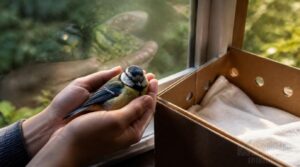
A window strike doesn’t always mean the end for a bird, but what you do in the next few minutes matters more than you’d think. Most victims survive if someone acts fast and cares for them the right way. Here’s exactly what that looks like, step by step.
Safe Handling After Impact
Approach from behind or the side, using thick gloves or a soft towel, gently securing the bird without squeezing its chest. Most collision victims are stunned, not dead, so gentle handling matters.
Place it in a dark, quiet container immediately, keeping pets and kids away. Note the time and location of impact, watch for labored breathing or ataxia, and wash your hands afterward to prevent zoonotic disease spread.
Dark Ventilated Recovery Box
Once secured, keep the bird in a dark, ventilated box — a shoebox with air holes works fine. Darkness reduces stress and limits movement, which matters if concussion symptoms like disorientation are present.
Line it with soft towels, skip the pet carrier’s wire mesh, and keep the box warm, quiet, and away from household noise until you reach a rehabilitator.
Food and Water Warnings
Resist the urge to offer food or water — even a few drops can trigger aspiration, with risk exceeding 30% in stressed birds. Their swallowing reflex shuts down under shock, much like a person too winded to sip water safely.
Skip feeding attempts entirely. Hydration and nutrition aren’t your job right now; stabilization is. Let the rehabilitator handle intake once the bird’s condition is properly assessed.
Finding Wildlife Rehabilitators
Once the bird’s stabilized, get it to a licensed wildlife rehabilitator within 24 hours. Search "wildlife rehabilitator" plus your city, or call a local vet — most connect to regional networks with accredited centers running proper triage and intake protocols.
These networks follow strict transport standards and rely on trained volunteers. Release success rates average 80%, so your quick action genuinely matters.
Trained volunteers and strict transport standards help injured birds recover, with release success rates averaging 80 percent
Release and Recovery Expectations
Once past initial shock, most birds bounce back fast: 24 to 72 hours for mild cases, though concussion signs mean 3–7 days. Rehabilitators track weight, hydration, and alertness—clear eyes, steady perching, normal breathing—before clearing release.
Good sites offer cover and food, timed for daylight, calm weather. Test flights confirm strength first. Many programs log location and monitor briefly afterward, refining care for future collisions.
Frequently Asked Questions (FAQs)
How to stop birds from colliding with windows?
Break up reflective glare with exterior decals spaced 2 inches apart, apply UV-reflective film for pattern visibility, or install durable mesh netting a few inches out. These birdsafe design guidelines cushion impacts and cut collision mitigation risks by up to 90%.
How can I help a bird that crashed into my window?
Gently cup the stunned bird, assess for concussion signs or bleeding, then place it in a dark, ventilated box—no food or water. Contact a wildlife rehabilitator within 24 hours; roughly 80% recover fully.
What is the 2×4 rule for bird strikes?
Simply put, it’s pattern spacing logic: markers spaced no more than 2 inches horizontally and 4 inches vertically. This collision prevention geometry creates visual deterrence standards dense enough that birds recognize glass as solid, not open sky.
Do bird anti-collision stickers work?
A window doesn’t lie—it’s the reflection that fools the bird. Yes, stickers work: spaced 2 inches apart on the exterior surface, with UV-reflective or high-contrast patterns, they cut collisions by up to 70%.
Is there anything you can do to help a bird that hit a window?
Yes — place the bird in a dark, ventilated box, skip food and water, and watch for concussion signs. Note the species and behavior, then call a wildlife hotline or rehabilitator within 24 hours for proper assessment.
How do weather conditions affect bird collision rates?
Picture a clear, warm spring dawn with south winds — migration traffic spikes, and reflections turn deadly.
High pressure sharpens visibility, glass mimics open sky, and dry, sunny mornings with shifting winds push nighttime migrants straight into windows at sunrise.
Which bird species are most vulnerable to window strikes?
Ground foragers like Ovenbirds, warblers, thrushes, and hummingbirds top high-risk species lists.
Seasonal migration patterns and foraging habitat near reflective glass drive avian mortality — these migratory birds face compounding dangers during fall and spring bird window collisions in urban corridors.
Are bird-friendly building ordinances required in my city?
Depends on where you live — over 25 U.S. cities enforce bird-friendly municipal codes. Run a local ordinance search or check zoning rules and permit processes; requirements often hinge on facade glass percentage, building size, and proximity to water or open space.
How does LEED certification address bird-safe glazing?
LEED v5 uses a Bird Collision Rating, combining Glazing Area Calculation and Threat Factor Scoring, awarding Sustainable Habitat Credits for compliant façades.
Regional Implementation Standards let you use local bird-friendly glass technologies, meeting wildlife-friendly building certification without requiring specialized suppliers or costly retrofits.
What is the American Bird Conservancys Threat Factor system?
Like a scoring methodology born from tunnel testing (think wind-tunnel science, minus the fighter jets), Threat Factor ranks glass by collision risk—lower numbers mean better bird strike mitigation and smarter product comparison for your windows.
Conclusion
A quiet pane of glass or a silent killer—your window is both, depending entirely on what you do with it.
Protecting birds from window collisions doesn’t take a fortune, just decals spaced right, dimmed lights, a few native shrubs. You’ve got the tools now.
What’s left is action: a strip of tape today, a lights-out habit tomorrow. Small choices add up, and birds you never see will fly past your house instead of into it.
- https://abcbirds.org/strategies/solutions-for-homes
- https://www.detroitbirdalliance.org/bird-window-collision-prevention
- https://news.cornell.edu/stories/2025/09/protect-birds-windows-change-human-behavior
- https://www.guardianglass.com/us/en/why-glass/build-with-glass/applications-of-glass/glass-for-facades/bird-friendly-glass
- https://glas-pro.com/products/bird-safe-glass/ultraviolet-reflective-pattern