This site is supported by our readers. We may earn a commission, at no cost to you, if you purchase through links.
Two birds land in the same shrub, both small, both brown, both gone before you get a good look. That frustration is where songbird identification either clicks or falls apart.
North America hosts over 200 songbird species, and dozens share overlapping ranges, similar colors, and habitats close enough to make even experienced birders pause.
The difference between a Song Sparrow and a Lincoln’s Sparrow isn’t obvious—until you know what to look for. Bill shape, trill rate, rump color, superciliary stripe: each one narrows the field.
Getting songbird species differences explained comes down to reading a handful of physical and vocal clues with confidence.
Table Of Contents
- Key Takeaways
- Songbird Comparison Chart Essentials
- Physical Traits That Separate Species
- Songs, Calls, and Syrinx Differences
- Habitat, Range, and Migration Clues
- Comparing Common Songbird Families
- Frequently Asked Questions (FAQs)
- Why do songbirds have a large repertoire?
- What is the scientific name for a songbird?
- Why do male songbirds mimic other species songs?
- What is the classification of a songbird?
- How does bird song vary by species?
- How many different songbird species exist?
- Why are crows considered songbirds?
- How do songbirds behave differently during winter months?
- Which songbirds are most affected by urban noise pollution?
- How does diet change songbird coloration over time?
- Conclusion
Key Takeaways
- Bill shape, trill rate, and plumage zones like rump color and superciliary stripe are your sharpest tools for telling similar songbird species apart in the field.
- A bird’s syrinx lets each side work independently, which is why two species can sound completely different even when they look nearly identical.
- Habitat acts as a first filter — where a bird lives, forages, and nests often narrows your shortlist before you even raise the binoculars.
- Seasonal changes in plumage, song intensity, and range mean the same species can look and sound noticeably different depending on the time of year you’re watching.
Songbird Comparison Chart Essentials
A good comparison chart turns a confusing moment in the field into a quick, confident ID. Knowing what each column is actually telling you makes all the difference.
Each column clicks into place faster when you already know your target species, so browsing a Colorado blue bird identification guide before heading out gives you a real edge.
Here’s what every useful songbird chart should cover.
Essential Identification Criteria
Every confident ID starts with the same core checklist. Lock in these criteria before reaching for your field guide:
| Identification Criterion | What to Look For |
|---|---|
| Field marks & plumage patterns | Eye ring contrast, streaking, wing bars |
| Bill color pattern & shape | Upper/lower bill tone, thickness |
| Vocal signatures | Pitch, trill rate, mimicry |
| Habitat & seasonal range | Habitat acoustic signature, flyway timing |
Understanding head field marks helps distinguish similar species.
Flight silhouette and leg pad texture round out the picture.
Size, Shape, and Weight Categories
Once you’ve locked in field marks, size becomes your next anchor. Body mass tells a quiet story — a 9-gram kinglet moves nothing like a 35-gram grosbeak. These morphological traits drive size-dependent flight patterns, foraging reach, and even size‑vocal range.
| Weight Class | Mass Range | Typical Examples |
|---|---|---|
| Light | Under 15 g | Kinglets, warblers |
| Medium | 15–28 g | Sparrows, finches |
| Heavy | Over 28 g | Thrushes, grosbeaks |
Mass habitat use and body profile silhouettes sharpen every ID.
Plumage Colors and Field Marks
Size gives you structure, but plumage seals the deal. Learn to read plumage zones systematically — head, breast, wing, tail. Superciliary Stripe presence, and Malar Markings separate look‑alikes fast. Tail Edge Contrast and Rump Color Patches flash in flight. Understanding seasonal plumage differences helps avoid misidentification between breeding and winter forms.
| Field Mark | Example Species |
|---|---|
| Superciliary Stripe | White-throated Sparrow |
| Malar Markings | Song Sparrow |
| Rump Color Patches | Yellow-rumped Warbler |
| Tail Edge Contrast | Dark-eyed Junco |
These visual cues and color patterns work together.
Bill Shape, Habitat, and Season Columns
Plumage narrows the field — but bill shape, habitat, and season close it. A cone bill in a winter field almost certainly means a seed-eater. A slender bill in dense shrubs during migration signals an insectivore.
These Shape Season Correlations and Seasonal Column Insights work best together.
| Column | What It Tells You |
|---|---|
| Bill Habitat Match | Feeding style by environment |
| Habitat Driven Bill | Forest, grassland, wetland clues |
| Seasonal Habitat Cue | Breeding vs. winter presence |
| Seasonal Migration | Passage timing and range shifts |
How to Read and Use The Chart
Start with the title axis, then decode the legend — that’s your foundation for any songbird comparison chart. Match field marks and plumage patterns to the scale, then spot trends across habitat columns.
Once you’ve got the basics down, a songbird field marks and habitat comparison guide helps you cross-reference voice patterns and plumage details in one place.
| Step | Action | Goal |
|---|---|---|
| Axis Interpretation | Read size and unit scales | Set your baseline |
| Legend Decoding | Match color to species | Clarify categories |
| Outlier Identification | Flag unusual scale gaps | Catch look-alikes |
Scale Comparison and Trend Spotting sharpen bird identification using comparison charts quickly.
Physical Traits That Separate Species
Once you get past the song, the body tells you everything. Songbirds carry their identity in plain sight — in the curve of a bill, the length of a tail, or the flash of a wing bar.
Here’s what to look for when you’re trying to pin down a species.
Body Size and Overall Silhouette

Before you even notice color, a bird’s silhouette shape tells you a lot. Body profile — the overall size ratio, head proportion, and posture variation — helps you rule out whole families instantly.
Compare an unknown bird to a sparrow or robin first. Size and shape categorization in bird ID works best as a relative tool, not a fixed measurement, because distance and posture shift everything.
Tail, Wing, and Leg Proportions

Three proportions reveal faster IDs than color ever will: wing pointedness, tail length ratio, and leg length adaptation.
- Pointed wings signal long-distance migrants; rounded wings mean dense-cover maneuvering
- Tail length variations reveal agility versus flight efficiency
- Wing-tail balance separates look-alikes when field marks are subtle
- Longer legs indicate ground-foraging habits
- Proportion field cues work best combined, not alone
Bill Types and Feeding Adaptations

A bird’s bill is basically its toolkit.
Finches and grosbeaks rely on seed-cracking mechanics — their short, deep, conical bills handle the bill force-velocity tradeoff beautifully, crushing hard seeds with precision.
Warblers use insect probing precision, slipping slender bills between leaves.
Orioles demonstrate nectar bill morphology with long, curved feeding shapes.
Fruit feeding versatility shows up in robins, whose moderate bills match a flexible diet and foraging behavior across habitats.
Plumage Patterns, Streaking, and Wing Bars
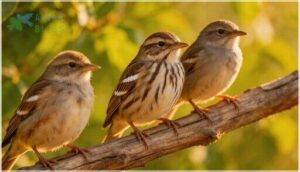
Plumage is one of your sharpest tools in bird identification. Streak orientation types — whether markings run straight down the breast or angle across the flanks — can separate look‑alike sparrows instantly.
Wing bar numbering matters too; one bar versus two points you toward different species.
Watch for juvenile pattern softness, where markings look blurry. Seasonal contrast fading dulls edge feather highlighting as feathers wear, softening plumage zones over time.
Male, Female, and Juvenile Differences
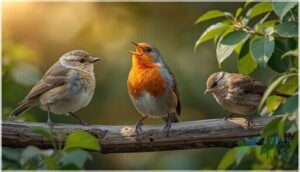
Young males often look female before adult plumage fills in — that’s where bill color cues and eye color shifts save you. Juvenile plumage tends toward dull, streaky patterns, and juvenile begging behavior keeps them close to cover.
Sexual dimorphism notes vary widely by species.
Combine plumage patterns, song analysis, behavioral ecology cues, and nesting role differences to read age and sex accurately.
Seasonal Molt and Breeding Plumage Changes

Molt timing tells you more than you’d expect. Prebreeding Molt begins weeks before breeding season, pushing out brighter field marks right when males need them most. Postbreeding Molt renews worn feathers after nesting. Some species use Partial Feather Replacement instead — just the crown or throat shifts.
- Prebreeding Molt sharpens color patterns before courtship
- Postbreeding Molt restores flight feathers after nesting
- Seasonal Color Shift can vary between coastal and inland populations
- Habitat-Driven Display favors bolder plumage in open environments
- Field marks and plumage pattern analysis confirm identity across molt stages
Songs, Calls, and Syrinx Differences

A bird’s voice is as unique as its feathers, and understanding why starts with one small but powerful organ: the syrinx. Each species produces a mix of pitch, tempo, and tone — shaped by anatomy, behavior, and even geography.
Here’s what to listen for when you want to tell one singer from another.
How The Syrinx Shapes Species-specific Songs
The syrinx sits where your trachea splits in two — and that location is everything. Each side operates independently through Neural Lateralization, with distinct muscle groups controlling Membrane Stiffness and Muscle Tension.
Bilateral Phonation lets some species layer two notes simultaneously, while Air Pressure Modulation fine‑tunes each syllable in real time. That’s why syrinx anatomy produces songs as unique as fingerprints across species.
Syrinx anatomy lets birds layer two notes at once, producing songs as unique as fingerprints
Pitch, Tempo, Trill Rate, and Note Structure
Once the syrinx fires, its pitch and tempo that define a species. Small warblers hit frequencies above 5 kHz, while thrushes stay mellower around 2–4 kHz.
Frequency Modulation sweeps — sometimes spanning 2 to 7 kHz — separate species quickly.
Trill Rate Variation is equally telling: wrens trill at 3–6 Hz, certain finches push 15–20 Hz.
Note Harmonic Structure and Tempo Seasonal Patterns shift with breeding peaks too.
Territorial Songs Versus Contact and Alarm Calls
Pitch and tempo tell you what a species sounds like — but why it’s singing matters just as much.
Territorial singing is a Territory Broadcast: loud, long-range, and built for Perch Visibility. A bird climbs high and belts it out so rivals hear clearly.
Compare that to Contact Coordination calls — soft, brief, practical. Just enough acoustic communication and territorial defense to keep a flock aligned.
Alarm Specificity takes it further. Songbirds often produce different calls for aerial versus ground threats, triggering completely different responses in nearby birds.
Seasonal Usage ties it together:
- Territorial songs peak during breeding competition
- Contact calls stay active during daily foraging
- Alarm calls appear instantly when danger arrives
- Flight calls coordinate mixed flocks during migration
- Winter territory holders keep singing outside breeding season
Bird vocalizations aren’t random — they’re layered signals. Once you understand songbird behavior and communication this way, bird calls and alarms start making real sense in the field.
Mimicry in Mockingbirds, Catbirds, and Starlings
Three species stand out regarding mimicry.
Northern Mockingbird uses dual syrinx streams to layer imitations — over 200 sounds, from sparrows to car alarms.
Gray Catbirds produce scattered, nasal bursts through sharp catbird vocalization.
European Starlings, shaped by urban noise influence, copy mechanical sounds convincingly.
All three rely on auditory learning, seasonal repertoire expansion, and mimicry for territory defense.
Male and Female Song Differences
Most birders assume only males sing — but that’s only half the story. Around 71 percent of surveyed songbird species include females that vocalize regularly.
In northern cardinals, females mastered their repertoire in less than one-third the time males needed, reflecting a shorter learning period. Dawn singing peaks and syllable pause ratio differences reveal tempo dimorphism, you can measure through basic vocalization and song analysis techniques.
Regional and Seasonal Song Variation
A White-crowned Sparrow in coastal California doesn’t sound quite like one in the Pacific Northwest — and that gap is real. Geographic dialects form through cultural song drift, where young birds learn local syllable structure variation early and lock it in.
Climate acoustics shape those patterns too. Seasonal song shifts add another layer, since song intensity drops outside the breeding season, changing what your recordings capture entirely.
Habitat, Range, and Migration Clues

Where a songbird lives tells you almost as much as what it looks like or sounds like. Habitat, range, and migration patterns are powerful clues that can cut through confusion when two species look nearly identical.
Here’s what to look for.
Forest, Grassland, Wetland, and Urban Songbirds
Habitat is the first filter you should apply.
Forest songbirds use vertical stratification — ground, shrub, and canopy layers — to divide space and reduce competition.
Grassland species need mosaic habitat, a patchwork of open ground, scattered shrubs, and low cover.
Wetland birds depend on emergent vegetation for nesting.
Urban songbirds face noise adaptation challenges, shifting pitch to cut through traffic.
Edge effects attract generalists.
Resident Versus Migratory Species
Knowing whether a species stays put or moves changes everything about identification.
- Winter Survival rates differ: migratory Eurasian blackbirds survive winter ~16% better than residents, yet residents breed earlier due to Behavioral Plasticity and local familiarity.
- Diet Flexibility keeps residents alive when insects vanish — seeds, berries, feeders fill the gap.
- Brain Size tends to be smaller in migrants, an energy-saving tradeoff for long flights.
- Breeding Timing compresses sharply once migrants arrive north.
Breeding Range Versus Winter Range
A bird’s address changes with the calendar. During breeding season, territory size shrinks as males defend tight patches of forest edge or shrubland. Come winter, that same species may shift entirely — a microhabitat shift toward denser thickets or open savannas where food resource availability stays reliable.
| Species | Breeding Range | Winter Range |
|---|---|---|
| American Robin | Northern forests, lawns | Southern U.S., Mexico |
| Yellow Warbler | Canadian woodlands | Central America |
| House Finch | Year-round U.S. resident | Microhabitat shift only |
Migration connectivity links those two worlds, and climate range shifts are already nudging breeding grounds poleward.
Flyway Timing and Seasonal Identification
Migration timing isn’t just calendar-watching — it’s reading the landscape.
Spring Arrival Shifts happen earlier now, as warming temperatures pull species northward ahead of schedule.
Autumn Wind Effects slow or accelerate passage depending on tailwinds versus headwinds. Watch for:
- Dawn Chorus Peaks signaling active migration overnight
- Feather Wear Indicators revealing recent long-distance flight
- Stopover Habitat Use intensifying before major transits
Nesting Habitat and Cover Preferences
Where a songbird chooses to nest tells you a lot.
Ground nesters tuck cup nests into leaf litter insulation beneath dense grasses. Shrub edge nests hide in tangled hedgerows just meters up. Reed bed nests anchor among cattails in riparian zones.
Snag platforms and elevated tree cavities attract cavity nesters — especially where nesting boxes or habitat restoration projects for songbirds supplement areas hit by habitat loss and fragmentation.
How Habitat Narrows Similar-species Comparisons
Habitat does a lot of the identification work for you. Microhabitat Segregation keeps look-alikes separated — one species works in the dense understory, another stays in the open canopy. Vertical Foraging Layers add another filter. Seasonal Niche Shifts matter too: Edge vs interior habitat use often switches between breeding and wintering.
- Habitat Plumage Contrast sharpens field marks and plumage pattern analysis
- Habitat preferences of North American songbirds predict which species you’ll realistically encounter
- Seasonal niche shifts guide habitat and seasonal range assessment
- Comparative analysis of similar species becomes faster when habitat narrows your shortlist
Comparing Common Songbird Families
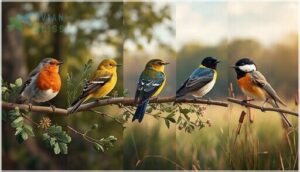
Once you know what habitat a bird prefers, the next step is learning how different songbird families actually compare to each other. Each family has its own set of physical traits, vocal habits, and feeding strategies that make identification click.
Here’s a closer look at the families you’re most likely to encounter.
Finches, Sparrows, and Grosbeaks
These three families look similar at a glance, but seed specialization tells them apart quickly.
Finches show impressive finch species diversity and song patterns — short, melodic phrases tied to vocal learning and territory defense.
Sparrows rely on sparrow vocal diversity and field identification through streaked plumage and quick chips.
Grosbeaks bring grosbeak and cardinal singing behaviors: bold whistles, powerful bills, and surprising urban adaptation wherever seeds are plentiful.
Thrushes, Wrens, and Warblers
Each of these families rewards close attention.
Thrush family song identification starts with those flute-like, rising phrases drifting from woodland edges — pure vocal learning in action.
Wrens pack a complex vocal repertoire into a tiny frame, shifting song dialects by region.
Warblers lean on plumage and habitat preferences to separate look-alikes, with seasonal variation in bird song sharpening your ear during courtship displays and predator avoidance calls alike.
Cardinals, Buntings, and Tanagers
Cardinals, buntings, and tanagers share a bold visual language worth knowing.
The Northern Cardinal’s crested head display and white tail corners set it apart instantly, while bill color variation helps confirm age and sex.
Tanagers spread across North America with distinct plumage patterns and high-pitched phrases tied to riparian habitats.
Buntings favor brushy edges, choosing nesting shrubs carefully — their birdsong sharp and compact.
Orioles and Other Nectar-feeding Songbirds
Orioles are among the most striking examples of seasonal diet flexibility — shifting from insects to fruit and nectar as resources change. Baltimore Orioles and the compact Orchard Oriole both benefit from smart nectar feeder placement near fruiting shrubs and flowering trees.
Their courtship color signaling is hard to miss. Beyond energy budgeting, they support pollination mutualism across songbird habitats, reinforcing how habitat preferences of North American songbirds shape everything they do.
Crows, Magpies, and Other Unexpected Songbirds
Most people don’t picture crows when they think of songbirds — but technically, they qualify. Crows and magpies belong to the order Passeriformes, sharing complex bird vocalizations and mimicry strategies with warblers and thrushes.
Their cognitive abilities, tool use, and social hierarchy set them apart.
Urban adaptation lets them thrive where others struggle, making habitat and song identification surprisingly complex for these unexpected members of the group.
Best Birdwatching Tips for Separating Look-alikes
Look-alikes trip up even experienced birders — but a solid system makes all the difference.
- Use binocular focus on bill shape and field marks first, not overall color.
- Jot quick sketch notes of body proportions before the bird disappears.
- Try audio recording to compare calls later.
- Run a multi-trait comparison — habitat, season, and voice together.
- Log sightings in citizen science apps for pattern recognition over time.
Frequently Asked Questions (FAQs)
Why do songbirds have a large repertoire?
It’s no coincidence that the males with the biggest song repertoires also tend to attract the most mates — sexual selection pressure, open-ended learning, and syrinx mechanical capacity all converge to reward vocal variety.
What is the scientific name for a songbird?
Songbirds follow binomial nomenclature, using a Latin genus species name. Take Turdus migratorius — that’s your American Robin.
All songbirds sit within order Passeriformes, suborder Passeri, the backbone of ornithology’s taxonomic hierarchy.
Why do male songbirds mimic other species songs?
Male songbirds mimic other species primarily to boost their mating display. A larger, more diverse repertoire signals strength and adaptability — exactly what females look for when choosing a mate.
What is the classification of a songbird?
A songbird sits within a precise taxonomic hierarchy: order Passeriformes, suborder Passeri. That’s the scientific home of roughly 4,000 species across 35 to 55 families, shaped by ongoing molecular phylogeny research.
How does bird song vary by species?
No two species sound alike — that’s nature’s rule.
Repertoire size, vocal complexity, and song learning shape every call. Acoustic niche, mating call variation, and regional dialects make songbird vocalizations endlessly distinct.
How many different songbird species exist?
4,000 songbird species exist globally, though taxonomic revisions shift that tally regularly.
Regional diversity hotspots like South America and Southeast Asia account for much of that richness, with family count variability reflecting ongoing classification debates.
Why are crows considered songbirds?
Crows sneak under the songbird label because of their oscine classification — they belong to suborder Passeri, share syrinx muscle complexity, and show vocal learning and mimicry capabilities just like finches do.
How do songbirds behave differently during winter months?
Winter reshapes their whole routine. Flocking dynamics improve foraging and cut predation risk. Roosting strategies conserve heat overnight. Feeding shifts toward seeds and berries.
Territorial singing drops off, though residents may defend patches quietly.
Which songbirds are most affected by urban noise pollution?
Low-frequency singers like Northern Cardinals and Gray Catbirds take the hardest hit.
Urban noise masks their songs, forcing pitch shifts and narrowing bandwidth — a quiet crisis unfolding beneath the city’s roar.
How does diet change songbird coloration over time?
Diet shapes plumage through Carotenoid Pigmentation during molt. Feather Growth Nutrition determines brightness — birds eating carotenoid-rich foods grow more vivid feathers.
Once set, color stays fixed until the next molt cycle.
Conclusion
Every songbird is a puzzle that rewards patience. Once you train your eye on silhouette, bill shape, and field marks—and your ear on pitch, tempo, and trill rate—species that once blurred together start to separate cleanly.
That’s how songbird species differences explained in the field stop feeling like guesswork and start feeling like recognition.
You’re not memorizing birds anymore. You’re reading them, the same way a skilled tracker reads prints left in soft ground.
- https://www.ncbi.nlm.nih.gov/pmc/articles/PMC8905160/
- https://www.allaboutbirds.org/news/the-basics-how-why-and-where-of-bird-migration/
- https://www.merriam-webster.com/dictionary/resonance
- https://premium.britannica.com/premium-membership/?utm_source=premium&utm_medium=inline-cta&utm_campaign=basics-2026
- https://pmc.ncbi.nlm.nih.gov/articles/PMC3526523/