This site is supported by our readers. We may earn a commission, at no cost to you, if you purchase through links.

Most backyard bird setups treat every species the same—one shallow dish, one height, one chance to attract whatever shows up. The problem is that finches and jays don’t share the same bathing preferences any more than they share a menu.
A multi level bird bath design changes that completely, giving small songbirds a safe shallow splash zone up top while larger birds claim the deeper basins below. It’s a small engineering decision with a surprisingly big payoff: more species, more activity, and a garden that actually looks like someone thought it through.
Here’s how to build one from the ground up.
Table Of Contents
Key Takeaways
- Tiered bird baths with different water depths attract far more species than a single basin — small birds claim the shallow upper levels while larger birds settle into the deeper basins below.
- Your material choice (stone, ceramic, or polyresin) shapes how long your bath lasts, how easy it is to clean, and whether it fits your garden’s look.
- Moving water is your biggest advantage — a simple recirculating pump or even a floating tennis ball pulls birds in from up to 300 feet away and keeps the water fresher for longer.
- Weekly cleaning and smart placement near shrubs (but not too close) turn a one-time bird visit into a steady, species-rich backyard routine.
Plan The Tier Configuration

Before you buy a single stone or mix a drop of concrete, the real work happens on paper. Getting your tier configuration right from the start saves you a ton of headaches later, and honestly, it’s the most fun part of the whole project.
What to think through before you build anything.
Choose Two, Three, or Four Levels
Three levels are usually the sweet spot for most gardens — enough variety to welcome different bird sizes without overwhelming your space. But the right number really comes down to your setup.
If you’re looking to mix things up, browsing unique bird houses designed for every garden style can spark some great ideas for spreading feeders across your space.
- Two tiers — great for small gardens and beginner DIY bird bath projects
- Three tiers — balances bird size compatibility with aesthetic proportion beautifully
- Four tiers — maximizes multiple levels for high-traffic yards with strong wind resistance needs
- Taller multitiered systems — boost predator protection through elevation
- Compact designs — respect space constraints without sacrificing tiered bird bath designs‘ charm
Set Shallow and Deeper Water Zones
Once you’ve settled on your tier count, depth becomes your next design move. Keep upper basins shallow—around 1 inch at the edges—for finches and sparrows. Lower tiers can slope to 2 inches deep, creating species depth zones that welcome robins and jays too.
That gradient slope naturally deters mosquitoes through water circulation, while edge texture keeps every landing safe.
Decide Overall Height and Footprint
Now that your depth zones are mapped out, height scaling and footprint shape become your next critical decisions. A sweet spot sits between 2 and 3 feet—tall enough to protect birds while remaining stable.
Here’s what to prioritize:
- Height Scaling — Maintain a range of 24–36 inches for optimal bird visibility and stability.
- Footprint Shape — Wider bases enhance wind resistance, especially in multilevel bird bath designs.
- Space Allocation — Ensure ample landing space around each tier.
- Elevated Bird Bath on a Wooden Platform — Provides natural stability on uneven terrain.
- Impact of Height and Placement on Bird Visibility — Taller structures are more visible from a distance.
Sketch Basin Shape and Spacing
Once your height is locked in, use grid paper to sketch your design. A baseline grid setup ensures spacing remains visual and adjustable. This foundational step simplifies layout planning before physical construction begins.
Circular basins (18–24 inches) provide birds with 360-degree access, while oval shapes naturally direct water flow between tiers. Choose basin geometry based on functional needs and spatial constraints.
Use a compass for offset measurements to ensure precision, then fold your sketch to verify symmetry. Finally, mark overflow notches at each rim to manage water levels effectively.
Add Stepped Ledges for Different Birds
Stepped ledges turn your DIY garden project into a five-star destination for every bird in the neighborhood. Think of it like designing a coffee shop with seating for everyone — from the sparrow who wants a quiet corner to the blue jay claiming the big booth.
- Use Step Height Gradients that rise gradually, not sharply
- Build Species-specific Perches matching each bird’s size
- Add Textured Landing Surfaces for secure footing
- Include Ledge Width Variations — narrow up top, broader below
- Install Protective Overhead Shelter on exposed upper tiers
Choose Materials and Base

Once you’ve mapped out your tiers, it’s time to think about what everything is actually made of.
Each tier’s durability and safety will depend heavily on the material you choose, so it’s worth reviewing safe bird bath materials and what to avoid before you commit to anything.
The right materials will keep your bath sturdy, safe for birds, and looking good for years to come. Here’s what to keep in mind before you buy or build anything.
Compare Stone, Ceramic, and Polyresin
Each material brings something different to your multi-level bird bath configurations. Stone offers serious weight-handling capability and weather resilience—it barely flinches in the wind. Ceramic provides gorgeous color and ease of cleaning. Fiber-reinforced polyresin excels in cost efficiency and durability, resisting impact and cracking.
| Material | Best Strength |
|---|---|
| Natural stone | Weather resilience, stability |
| Ceramic | Cleaning ease, finish quality |
| Fiber-reinforced polyresin | Cost efficiency, crack resistance |
| All three | Long-lasting bird baths |
All three materials contribute to creating long-lasting bird baths.
Select a Heavy, Tip-resistant Base
The base is what holds everything together — literally. A wide footprint prevents wobbling, even when a robin lands hard on one side. Pair that with a low center of gravity design, internal ballast, and rubber foot pads for solid ground contact, and you achieve weighted base stability that laughs at the wind.
Choose rustproof, weatherproof coating materials for long-term weather resistance and durability. This ensures the structure withstands the elements while maintaining its integrity over time.
Use Textured, Non-slip Basin Surfaces
Wet basins get slippery fast — and people notice. The good news is a few smart design features keep every tier safe and inviting.
- Pebble Basin Bottom – Small stones create grip-friendly surfaces with real traction underfoot.
- Matte Finish Advantages – Matte and unglazed surfaces beat glossy ones every time for nonslip edges.
- Anti-slip Coatings – Textured edge rims and permanent treatments add micro-grip without changing the look.
Pick Detachable Bowls for Easier Cleaning
Cleaning a fixed basin is like trying to wash a salad bowl bolted to the table — frustrating. Detachable bowls change everything. Quick-release fasteners let you lift each tier, scrub it at the sink, and snap it back into place. That simple design feature makes maintenance faster and preserves the algae-resistant coating longer.
| Feature | Benefit | Best Material |
|---|---|---|
| Quick-release fasteners | Fast removal, secure reattachment | Polyresin, metal |
| Slip-resistant grips | Safe handling when wet | Textured polyresin |
| Nonporous surface | Algae-resistant coating stays effective | Ceramic, polyresin |
Match Materials to Your Garden Style
Your garden style is the blueprint — let your bird bath speak the same language.
Material choices for long-lasting bird baths always start with context.
- Modern Minimalist — brushed aluminum or smooth concrete creates clean lines with zero visual noise, perfect for modern minimalist garden water features.
- Rustic Charm — natural stone and ceramic craftsmanship add warmth and texture, nodding to English country or Mediterranean style.
- Coastal Fresh — whitewashed polyresin keeps things breezy and light.
Assemble The Multi-Level Bath
This is where your bird bath really starts to come together. Getting the assembly right makes all the difference between a sturdy, long-lasting centerpiece and a wobbly disappointment after the first rainstorm.
Here’s how to build it solidly, step by step.
Prepare a Level Foundation

Before anything goes up, the ground beneath it needs to be solid. Grab your leveling tools and check the base in multiple directions — even a slight tilt throws off your entire footprint layout.
Compact loose soil or add a gravel drainage layer to prevent settling after rain. Good soil compaction here makes your stability assessment simple, and your whole installation timeline shorter.
Build or Stack The Center Support
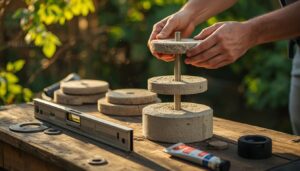
With your foundation set, it’s time to stack the spine of your design. Material Selection drives everything—concrete and cast stone add ballast, while polyresin keeps things moveable.
Follow this DIY installation sequence:
- Dry-fit all support pieces first
- Run a threaded connection through each tier
- Use a Threaded Connection rod for Anchoring Strategies in wind
- Check Alignment Checks at every level
- Apply waterproof sealant at joints for Load Distribution
Attach Each Basin Securely

Once your support is stacked, fastener selection becomes your best friend. Use corrosion-resistant bolts with washer usage in mind—spreading the load prevents cracking delicate ceramic.
Tighten gradually, recheck alignment after each basin is seated, then finish with sealant application around every joint edge. Think of it as the final handshake between structure and function.
Check Alignment Between Tiers
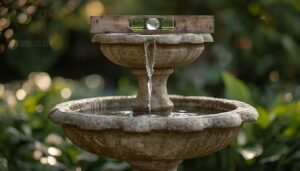
Now grab your spirit level and check every rim—front, side, and diagonal. One pass isn’t enough. Ensure the center post remains plumb to align multiple levels in a true vertical line.
Rim matching between tiers controls water flow, directing the cascade cleanly into each basin.
Consistent tier spacing transforms a stacked bird bath into a structure that looks intentional.
Seal Joints and Test Stability
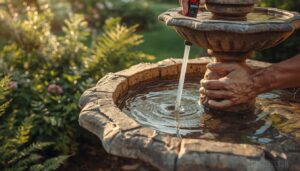
Once alignment looks solid, sealing those joints is what separates a bath that lasts a decade from one that wobbles apart by fall. Your elastomeric sealant choice matters here — it flexes with temperature swings instead of cracking.
Seal your joints with elastomeric sealant — it flexes through seasons instead of cracking apart
Follow this protocol for optimal results:
- Clean joint edges until bone dry
- Apply backing rod for proper joint geometry design
- Use low-modulus sealant for load flexibility
- Bond two sides only — never three
- Run your stability testing procedure fully loaded with water
Add Water, Placement, and Care
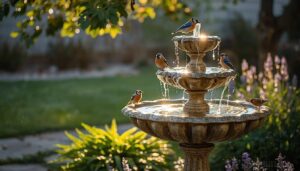
Your bird bath is built — now it’s time to bring it to life. A few simple steps will keep the water fresh, the birds coming back, and the whole setup looking great season after season.
Here’s what to focus on next.
Install a Gentle Recirculating Pump
Moving water is what pulls birds in from across the yard. A submersible pump manages recirculation systems quietly and keeps things simple.
Match your Power Source Selection to your setup — solar works great in full sun, electric near shaded spots. Use Flow Rate Control to dial down spray pressure into a gentle trickle.
| Pump Feature | Why It Matters |
|---|---|
| Pump Positioning | Sits hidden on basin floor |
| Flow Rate Control | Adjustable trickle vs. spray |
| Power Source Selection | Solar or electric options |
| Intake Screening | Blocks debris, protects motor |
| Seasonal Pump Care | Store indoors before first frost |
Set Water Depth for Safe Bathing
Depth matters more than most people realize. For your multilevel bird bath, keep upper tiers at about 1–1.5 inches — that’s well within safe depth guidelines and drowning risk thresholds for small birds. Lower basins can go a bit deeper, around 2–3 inches.
Hip-height limits help medium species bathe comfortably. Temperature monitoring keeps water fresh, and consistent water circulation prevents stagnation.
Place Near Shrubs and Feeders
Where you place your multilevel bird bath configurations matters just as much as how you build them. Think of it as setting the stage for a bird-friendly garden design that actually works.
- Shrub distance: Keep cover 10–15 ft away — close enough for fast retreat, far enough to maintain predator sightlines.
- Visibility corridor: Birds won’t land where they can’t see trouble coming, so avoid dense plantings blocking the feeder approach angle.
- Cover balance: Nearby native shrubs provide shelter without crowding the open space birds need to feel safe.
- Feeder proximity: Integrating bird baths into garden landscaping near your bird feeding station boosts visits and elevates overall garden aesthetics.
Reduce Algae and Mosquito Buildup
Still water is essentially a welcome mat for mosquitoes. Maintain water movement using aeration systems or recirculating pumps, as constant flow simplifies prevention. Oil surface treatments safely suffocate larvae without harming birds.
To combat algae blooms, implement shade structures to limit sunlight and reduce fuel for growth, while nutrient buffering curbs excessive development. For natural mosquito control, introduce mosquito fish to target larvae.
Address seasonal buildup through routine seasonal maintenance and enzyme cleaners to disrupt organic accumulation. Prioritize water efficiency via optimized recirculation systems and conservation practices.
| Algae & Mosquito Problem | Solution |
|---|---|
| Stagnant water | Aeration systems + water flow adjustment |
| Mosquito larvae | Oil surface treatment or mosquito fish |
| Algae blooms | Shade structures + nutrient buffering |
| Seasonal buildup | Seasonal maintenance + enzyme cleaners |
| Water efficiency | Water recirculation efficiency and conservation |
Clean Each Tier on a Weekly Routine
A clean bath keeps birds coming back — and it’s easier than you think. Thorough scrubbing once a week, using safe cleaning agents and good tool organization tips, makes the whole job take about 15 minutes.
- Drain and refill each basin fully
- Scrub algae using a soft brush
- Rinse thoroughly — leftover soap harms birds
- Apply enzyme cleaner for algae control
- Repeat seasonal maintenance before first frost
Top 3 Bird Bath Products
If you’d rather skip the DIY route, there are some really solid ready-made options worth knowing about.
Each one brings something a little different to the table, whether it’s style, function, or just pure convenience. Here are three bird baths that consistently stand out.
1. Metal Standing Bird Bath Feeder
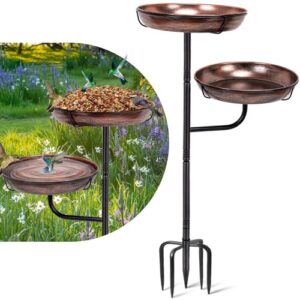
This product serves double duty as a bird bath and feeder, featuring a detachable, non-slip bowl with a 1.39-liter capacity.
The five-prong powder-coated metal base stakes firmly into soil, ensuring stability. Assembly takes just two minutes and requires no tools. At 4.33 lb, the unit is lightweight for easy repositioning.
Note that soft ground may cause tipping, so secure the stake thoroughly.
| Best For | Backyard bird lovers who want a simple, low-maintenance bath and feeder combo that looks good in a garden without a big setup hassle. |
|---|---|
| Material | Stainless steel & cast iron |
| Assembly | Tool-free snap assembly |
| Water Capacity | 1.39 L (0.37 gal) |
| Rust Resistance | Black powder-coat finish |
| Cleaning Ease | Detachable bowl |
| Bird Type Suitability | Outdoor wild birds |
| Additional Features |
|
- Pulls double duty — works as both a bird bath and a feeder, so you get more birds without needing two separate setups.
- No tools, no fuss — stakes into the ground and snaps together in a couple of minutes.
- The detachable bowl makes cleaning easy, which keeps your birds healthy and coming back.
- Some units have shown up with bent or poorly welded arms, so quality control can be hit or miss.
- The bowl is on the smaller side — if you’ve got a busy backyard with lots of birds, it fills up (and empties) fast.
- Soft or loose soil is its enemy — without a solid stake, a gust of wind or a chunky grackle can tip the whole thing over.
2. Nobgum Cage Bird Bath with Mirror
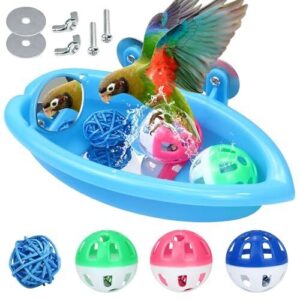
If your feathered friend lives in a cage rather than a garden, the Nobgum Cage Bird Bath with Mirror is worth a look. It hooks straight onto cage bars, holds enough water for small birds like budgies or cockatiels, and comes with a mirror that keeps solo birds company.
The clear body lets you check water conditions at a glance — no guesswork needed.
| Best For | Small bird owners — especially those with a solo budgie, lovebird, or cockatiel — who want an all-in-one bath, feeder, and enrichment station that clips right onto the cage. |
|---|---|
| Material | Polypropylene (PP) |
| Assembly | Hook-on cage attachment |
| Water Capacity | Small basin (~90g unit) |
| Rust Resistance | PP plastic construction |
| Cleaning Ease | Removable from cage |
| Bird Type Suitability | Small caged birds |
| Additional Features |
|
- Hooks onto cage bars easily and stays stable thanks to its low-centered design, so splashing and tipping are kept to a minimum.
- Comes loaded with extras — a rattan toy, two bells, and a double-sided mirror — great for keeping a solo bird entertained and less lonely.
- Made from thick, odor-free PP plastic that holds its shape and is easy to pull out and rinse clean.
- It’s on the snug side, so medium birds may feel cramped and struggle to turn around comfortably.
- Metal parts like the mirror frames and decorative balls can rust fast once they’re sitting in water regularly.
- The protective film on the mirror is a pain to remove — most people end up soaking it just to get it off.
3. Daoeny Vintage Double Metal Bird Bath
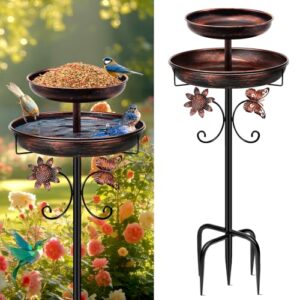
Double Metal Bird Bath for a garden setup, the Daoeny Vintage is a solid pick.
two bowls at once — a 12-inch bath and a 7.9-inch feeder — both sitting at a safe 2-inch depth.
5-pronged base keeps things upright in soil, and the bowls detach for easy cleaning.
compact, antique bronze accent that pulls double duty without taking over your yard.
| Best For | Gardeners who want to attract birds (and the occasional bee or squirrel) without cluttering their yard with multiple feeders and baths. |
|---|---|
| Material | Iron with powder coat |
| Assembly | Tool-free stake assembly |
| Water Capacity | 2 in deep, 12 in bowl |
| Rust Resistance | Black powder-coat finish |
| Cleaning Ease | Detachable bath bowl |
| Bird Type Suitability | Outdoor wild birds |
| Additional Features |
|
- Two bowls in one — a bath and a feeder — so birds have everything they need in a single spot.
- Tool-free setup means you’re up and running in minutes, no hardware store run required.
- Detachable bowls make cleaning quick and painless, which matters more than you’d think.
- Some users found the build feeling flimsy, with bolts that don’t fit snugly and a top bowl that sits noticeably off-level.
- At a listed weight of 0.2 kg, it’s lighter than you’d expect for a 42-inch metal structure — strong wind could be a problem.
- A few buyers reported the top bowl couldn’t hold up under a bird’s weight, which is kind of a dealbreaker for a bird bath.
Frequently Asked Questions (FAQs)
Why put a tennis ball in your bird bath?
Something so simple shouldn’t work this well —
but a floating tennis ball keeps water moving just enough to delay freezing, giving birds access to open water all winter without electricity or effort.
Do birds prefer birdbath in sun or shade?
Partial shade wins every time.
Birds love a spot with morning sun and afternoon shade — it keeps the water cool, slows algae, and gives them clear sightlines to watch for predators.
Do birds like deep or shallow bird baths?
Birds strongly prefer shallow water — about 1 to 2 inches deep. It lets them stand, wade, and bathe without feeling unsafe. Deep water often scares small birds off completely.
Including multiple depth zones attracts a wider variety of birds.
How far can cascading water sounds attract birds?
Cascading water can carry sound roughly 300 feet in a quiet yard. That’s about the length of a football field — pretty impressive for a simple backyard feature.
Do tiered baths attract more species than single basins?
Yes — and it’s not even close. A tiered bath offers multiple depths, heights, and perches at once, giving more species exactly what they need.
That variety pulls in far more visitors than a single basin ever could.
Conclusion
Funny how a single shallow dish was supposed to satisfy every winged visitor—as if a sparrow and a blue jay ever agreed on anything.
Your multi level bird bath design finally settles that argument without anyone losing a feather. Each tier do their jobs quietly, drawing in species that would’ve skipped your yard entirely.
Build it solid, keep it clean, and the birds will handle the rest. They’re not picky—just specific.
- https://enviroliteracy.org/do-birds-like-baths-in-the-sun-or-shade/
- https://www.birdful.org/is-it-better-to-put-a-birdbath-in-the-sun-or-shade/
- https://www.homesandgardens.com/gardens/where-to-place-a-bird-bath
- https://www.southernliving.com/how-to-attract-birds-to-birdbath-11923551
- https://www.allaboutbirds.org/news/attract-birds-with-birdbaths/