
This site is supported by our readers. We may earn a commission, at no cost to you, if you purchase through links.

Watch a robin at a birdbath long enough, and you’ll notice something telling: it steps in slowly, pauses at the edge, and tests the depth before committing.
That hesitation isn’t timidity—it’s precision.
Most small birds won’t touch water deeper than two inches, and many prefer even less.
A poorly designed water feature sits empty while birds fly past to find something safer.
The difference between a bath that draws a crowd and one that collects leaves often comes down to slope, depth, and texture—details that matter more than most people realize.
Getting these right opens your yard to a surprising range of species, from warblers threading through shrubs to shorebirds passing through on migration.
Table Of Contents
Key Takeaways
- Most small birds won’t wade into water deeper than two inches, so keeping your basin between one and two inches—with shallower edges for tiny species like warblers and finches—is the single most important design choice you can make.
- Slope, surface texture, and traction matter just as much as depth; a gradual incline lined with river pebbles gives birds the confidence to step in rather than fly past.
- Moving water—whether from a dripper, bubbler, or mister—draws more species from farther away and naturally disrupts mosquito larvae, making your feature safer and more inviting at the same time.
- Year-round access depends on consistent upkeep: daily refills, weekly scrubbing, and a heated or solar-powered setup in winter keep birds returning long after fair-weather visitors stop by.
Why Birds Prefer Shallow Water
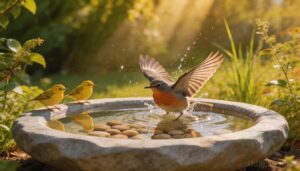
Birds are surprisingly particular about the water they’ll actually use. A few simple design choices — depth, slope, surface texture, and movement — can mean the difference between a bath that sits empty and one that’s busy all day.
Placement matters just as much as design — shady, sheltered spots tend to attract far more visitors, as covered in this guide to bird bath placement for shade and shelter.
Here’s what draws them in.
Safe Depths for Small Birds
Most small birds stay safest when water sits between 1 and 2 inches deep — that’s your core depth zone guideline. Leg length considerations matter more than people realize; a chickadee simply can’t stand in 3‑inch water.
For bird‑friendly water features, keep these depths in mind:
- Under 1 inch for finches and warblers
- 1–2 inches for sparrows and chickadees
- Shallow edges on every bird bath for fledglings
Gentle Slopes and Easy Entry
Depth alone doesn’t make a bird bath welcoming — the approach matters just as much. gradual incline design lets birds read the water before committing, stepping in at a shallow edge rather than guessing the bottom.
Low edge lips and broad landing platforms give them a confident place to pause. When birds can see a visible water surface clearly and trust non‑slippery materials underfoot, they stay longer.
Traction From Pebbles and Stone
Even the best slope won’t hold a nervous bird if the footing feels slippery.
That’s where Pebble Grip makes all the difference — rough stones and flat-topped rocks give tiny feet something real to hold onto.
Stone Ramp of staggered river pebbles, Edge Perches above the waterline, and Safe Stone Placement across your shallow basin turn a simple feature into a trustworthy microhabitat creation.
Benefits of Still Vs Moving Water
Still water gives birds a clear read on depth before they step in, which goes a long way toward Bird Stress Reduction at your bird bathing spots.
Moving water, though, adds Aesthetic Appeal and draws birds from farther away through shimmer and sound.
A bird friendly mist fountain or bird friendly waterfall also promotes Water Conservation and Seasonal Flexibility, while circulation offers real Energy Savings by keeping shallow edges naturally cleaner.
Songbirds That Use Shallow Baths
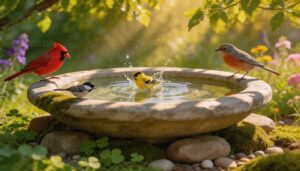
Songbirds make up the bulk of most backyard visitors, and they’re pretty particular about where they’ll stop for a drink or a bath. Most of them want shallow, calm water with a surface they can actually grip.
Here are some of the species you’re most likely to spot at a well-designed shallow bath.
Robins
Robins are one of the most rewarding bird species to watch at shallow edges — they wade in boldly, splashing with visible satisfaction. Their 8–11 inch frame suits water depths of about 1–2 inches perfectly.
- Prefer gradual basin slopes for easy wading
- Visit bird bathing spots most during morning hours
- Diet seasonal shift drives late-summer bathing frequency
- Use water features during Migration timing stopovers
- Territorial song often rings out near favored baths
Sparrows
Sparrows bring their flock dynamics right to the shallow edges of a bird bath, hopping in together with the same easy confidence they show while seed foraging along the ground.
Their urban adaptability means they’ll use almost any basin, though they prefer about an inch of water with pebble traction.
Territorial singing often follows a good soak — habitat enhancement at its liveliest.
Finches
Finches bring a kind of quiet energy to the bird bath — compact and quick, arriving in the small flocks typical of their seasonal habits. Their finch seed preferences keep them busy foraging, but they’ll pause reliably for shallow and moving water zones.
A gentle dripper or fountain keeps the water moving — which, as attracting cardinals with the right bird foods notes, creates the kind of active setup that draws more species while naturally discouraging mosquito larvae.
Watch for these three things:
- Preference for 1–2 inches of water with pebble traction
- Alert, scanning posture reflecting strong finch predator vigilance
- bright bursts of finch song structure between splashes
Warblers
Warblers are among the most rewarding visitors you’ll attract with shallow, moving water zones. These small, quick-moving birds shift between canopy foraging and low understory cover, especially during migration stopovers when they need reliable hydration.
Their distinctive plumage and song variations make each sighting memorable. Designing shallow edges with pebbles gives them the traction and comfort they need to linger.
Chickadees and Titmice
Few birds reward a well-placed bird bath quite like chickadees and titmice. Their cap crest markings make them easy to spot, and their vocal alarm calls will actually alert other species to danger nearby.
These cavity nesting birds thrive in winter flock dynamics, visiting shallow and moving water zones together.
Keep your birdfriendly water features clean — they’ll return daily, almost like cache retrieval on a reliable schedule.
Hummingbirds and Moving Water
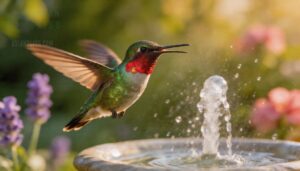
Hummingbirds have a different relationship with water than most backyard birds — they rarely sit and soak, but they love moving through a fine mist or brushing against a gentle drip.
Hummingbirds rarely soak — they bathe on the wing, darting through mist rather than wading into still water
Getting the setup right means thinking about movement, placement, and scale in ways that suit such a tiny, fast-moving bird.
Here’s what makes water features work for hummingbirds.
Why Hummingbirds Prefer Misters
Hummingbirds aren’t built for standing water. At barely three inches long, they’ve evolved around hover bathing — darting through gentle mist rather than wading into a basin.
A bird-friendly mist fountain suits them perfectly because it mirrors the light hydration they’d naturally find in rain-wet leaves. Moving water draws them in visually, too.
A misting water feature offers three real benefits:
- Feather cooling without soaking plumage, preserving the aerodynamic precision they need for sustained flight
- Energy efficiency, since brief mist passes cost far less effort than landing and bathing in shallow and moving water zones
- Gentle mist contact that lets them shake and preen quickly, keeping feathers flight-ready
Drippers and Fine Spray Features
A copper dripper or fine spray head takes that mist concept further. Both use low flow rates — often under 1 GPH — with pressure compensation that keeps output steady even on long runs.
Look for clog resistance built around turbulent flow paths and solid filtration requirements.
Anti-drain valves prevent wasteful drip-out between cycles, making your dripping water feature efficient and consistently inviting for tiny visitors.
Perching Spots Near Water
After the drip, think about where hummingbirds actually land. Natural rock ledges, driftwood perches, and angled branch perches placed close to your mister create a wildlife landing strip they’ll return to it daily.
Strategic stone placement at sunlit water edges, layered across multi-height platforms, gives these tiny birds both security and sightlines, turning your water feature into a genuine microhabitat.
Best Depth for Tiny Birds
Perching spots set the stage, but water depth seals the deal.
For tiny birds, shallow edges for small songbirds matter more than most people realize — keep the center no deeper than 1.5 inches, with edges near 1 inch.
That ideal edge gradient lets fledglings wade safely.
Add pebbles for microhabitat depth variation, and your bird-friendly water feature becomes irresistible.
Ground Birds and Low Basins
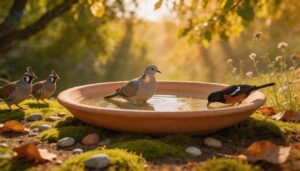
Some birds never really took to the pedestal bath — they’d rather have water right at ground level, where they spend most of their time foraging and resting. Mourning doves, quail, and towhees are exactly that kind of bird, and designing for them means thinking low and open.
Here’s what you need to know to bring them in safely.
Mourning Doves
Mourning doves are creatures of quiet habit — arriving at the water’s edge shortly after sunrise, drinking deeply in seconds with their distinctive sipping style. Their reliable water source makes a reliable water source for birds essential every single day.
- Flat, low basins suit their ground-feeding comfort
- Shallow and moving water zones encourage longer visits
- Low-maintenance water features fit their unhurried morning drinking routine
- Calm surroundings let their soft mating coos carry undisturbed
Quail
Quail thrive in coveys, and their covey social structure means they approach water together — cautiously, with a lookout posted nearby.
A low, pebble-lined basin fits their quail foraging techniques perfectly, letting them wade and drink without hesitation.
| Feature | Why It Matters | Bird Benefit |
|---|---|---|
| Low basin | Suits ground movement | Easy access |
| Pebble traction | Provides quail nest site proximity | Confident footing |
| Moving water | Microhabitat creation | Draws the whole covey |
low-maintenance water feature doubles as a reliable water source for birds traversing seasonal habitat shifts.
Towhees
Towhees are creatures of the understory — large, bold sparrows that spend their days in Dense Shrub Habitat and deep Leaf Litter Foraging along forest edges.
Their Ground Nesting habits keep them low, so a ground-level basin with pebbled edges suits them perfectly.
Watch for their signature Tail Flick Display near water.
Seasonal Diet Shift draws them reliably to moving water zones year-round.
Ground-Level Safety Considerations
Because ground birds approach in short, quick hops, a stable base matters more than you might expect. Choose Stable Base Materials like stone or weighted resin, and use Ground Stakes to anchor lightweight baths against wind.
A Non-Slip Rim and Wobble Prevention keep the basin steady when birds land.
Clear Approach Paths and thoughtful placement and safety considerations give them the confidence to stay.
Open Sightlines Around Water
Think of clear sightlines as a gift of confidence. Maintaining Predator Visibility Zones and a Clear Perimeter Buffer of roughly 10–15 feet around your basin removes the dense cover where cats hide.
Strategic Perch Placement on fence posts or low branches creates Elevated Viewing Platforms, letting birds scan their surroundings before descending.
Minimal Vegetation Zones around shallow and moving water zones make ground birds feel genuinely safe.
Ensuring a depth of 1–2 inches helps small birds bathe safely.
Shorebirds and Shallow Pond Edges

Shorebirds have a different relationship with water than your backyard songbirds — they’re built for wading, probing, and picking through shallow margins rather than splashing in a basin. If you’ve ever watched a sandpiper work the edge of a pond, you already know what draws them in.
Here’s what your water feature needs to welcome these visitors.
Sandpipers
Sandpipers are wired for water edges — their bill sensory adaptations let them detect buried prey through touch alone, making shallow and moving water zones genuinely irresistible.
For mudflat foraging strategies to work, they need:
- Water depth management kept under 4 inches
- Exposed mudflat margins for wading
- Camouflage plumage patterns blending into bare substrate
- Open ground nesting sites nearby along long-distance routes
Plovers
Plovers read the landscape differently than sandpipers do — they hunt by sight, using a run-stop-peck rhythm and foot-patting feeding to coax small invertebrates to the surface.
Their camouflage plumage melts into gravel and sand, so you’ll often miss them until they move.
Near a wildlife pond, creating shallow and moving water zones with open sightlines enhances their predator vigilance and draws them in reliably during migration timing peaks.
Mudflat-Style Margins
Where plovers hunt by sight, mudflat-style margins invite shorebirds through texture and feel. Fine sediment grain size and tidal flow dynamics shape how invertebrate prey abundance concentrates near the water’s edge. You can beautifully mimic this at home by creating shallow and moving water zones.
Here’s how to build one:
- Layer fine silt near the edge, coarser pebbles outward
- Add a gentle drip to simulate tidal movement
- Keep edges open and exposed for easy wading
Seasonal Use During Migration
Migration brings waves of shorebirds through, on flyway timing shaped by temperature cues, photoperiod shifts, and wind patterns — sometimes arriving overnight. Spring migration pulses fast, while fall migration staggers in gradually.
A reliable winter water source keeps your feature working year-round. Stopover quality truly matters here: shallow, clean edges give tired travelers exactly what they need to refuel and move on.
Exposed Edges for Wading
What draws wading birds to an edge isn’t just water — it’s the whole package.
Exposed margins with gentle slopes, pebble beds, and clear sightlines create a microhabitat that shifts with Seasonal Prey Shifts through the year.
Pair those edges with Microhabitat Plantings, thoughtful Water Flow Patterns, and Edge Material Durability in mind, and your Stepping Stone Pond becomes a reliable bird habitat stopover worth returning to.
Best Shallow Water Feature Designs
Once you know what birds need, the next step is finding a design that actually delivers it. Some features do this better than others, and a few small differences in structure can make a big impact on who shows up to drink and bathe.
Here are the designs worth considering.
Pebble-Lined Birdbaths
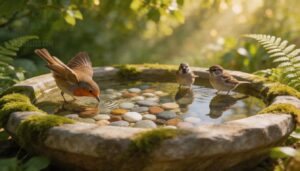
Few features match the quiet elegance of a pebble water basin — and birds seem to agree. The rounded stones create natural traction, varied depth zones, and visual cues that draw birds right in. Thoughtful pebble color schemes and integrated plant borders make these low-maintenance water features blend seamlessly into your garden’s bird habitat.
- Smooth river pebbles prevent slipping during quick drinking cycles
- Shallow 1–2 inch depth suits most songbirds safely
- Noise dampening pebbles soften water sounds, keeping the setting calm
- Seasonal pebble replacement maintains texture and hygiene
- Drainage channel design keeps water fresh and circulating naturally
Sloped Stone Basins
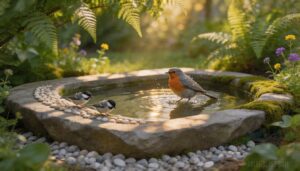
Sloped stone basins take bird bathing behavior seriously. The gentle gradient — shallow edges for small songbirds at the front, deeper toward the back — mirrors a natural streambank.
Stone Color Matching helps the basin disappear into your bird habitat beautifully.
Hidden Drain Channels keep water fresh, while Gravel Border Integration and Moss Edge Accents add texture.
UV-Resistant Sealant makes these low-maintenance water features last for years.
Drippers and Bubblers
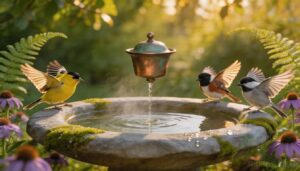
Drippers and bubblers bring moving water to life in ways still basins simply can’t. A copper dripper — with its adjustable flow rate — releases a steady, soft trickle that birds detect from surprisingly far away.
Self-cleaning mechanisms and UV-resistant housings make maintenance minimal, while pressure compensation ensures consistent output.
Even a simple DIY dripping rock feature transforms any corner into a bird-friendly mist fountain.
Tiered Fountains With Shallow Shelves
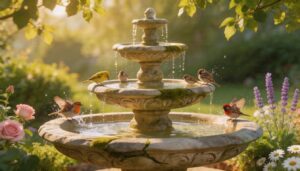
Tiered cascading fountains offer one of the most adaptable setups you can add to a garden. Each shelf, kept no deeper than two inches, gives songbirds of every size a comfortable entry point.
Shelf angle design and flow rate tuning guarantee water moves gently across every level. Material durability holds up through seasons, and optional LED accent lighting plus winter cover solutions keep the feature welcoming year‑round.
Pond Edges With Gradual Depth

A pond edge that slopes gently from shore outward is one of the most welcoming structures you can build for visiting birds. Designing shallow edges for small songbirds means thinking like a sandpiper — gradual, forgiving, and textured.
- Seasonal depth shifts naturally with rainfall, creating temporary shallow pools that attract wading species during migration.
- Microhabitat layering through edge vegetation and marginal plantings facilitates sediment trapping, erosion control, and invertebrate biodiversity.
- Water depth variation — from barely an inch near shore to several inches out — suits nearly every bird species’ preferences for water sources.
Keeping Water Features Bird-Friendly
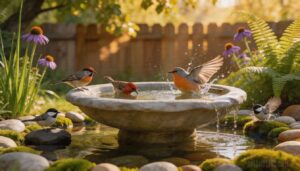
Getting birds to visit is one thing — keeping them safe and coming back is another. A well-placed, clean water feature does more for local biodiversity than almost any other backyard addition.
Here’s what you need to know to maintain yours the right way.
Safe Placement Away From Predators
Where you place your bird bath matters as much as what’s in it. Keep it at least 15 meters from dense shrubs — that Shrub Distance Buffer removes ambush cover for cats and foxes.
An Elevated Pedestal Height of 1.5 to 2 meters improves sightlines considerably.
Add Predator Guard Mesh around the base, favor Open Approach Routes, and use Low Glare Lighting at dusk.
Daily Refilling and Fresh Water
Fresh water is one of the simplest gifts you can offer to wildlife. Build a Morning Refill Routine — empty the basin, then refill before dawn activity peaks.
Make a Seasonal Refill Adjustments in heat, rejuvenating daily.
Quick Water Quality Checks keep drinking water for birds clean and appealing.
For a low-maintenance water feature, consider Refill Automation Options like simple drip timers that sustain Fresh Water Appeal effortlessly.
Weekly Cleaning to Limit Algae
Even with daily refills, algae quietly claims a neglected basin within days.
A simple Surface Brushing Routine each week — scrubbing walls and Shaded Corner Maintenance where growth anchors first — keeps buildup from spreading. Pair that with a Debris Skimming Schedule, Water Chemistry Checks, and monthly Filter Backwashing Procedure, and your bird bath stays genuinely clean, not just clear‑looking.
Mosquito Control With Circulation
Clean water and moving water aren’t the same thing. Stagnant surfaces invite mosquito larvae; moving water disrupts them.
Aerator Bubbles and Dripper Flow create constant Surface Ripples that interrupt Larval Disruption at the source. Pump Timing — running circulation during peak activity hours — delivers effective mosquito control through moving water without much effort.
Low-maintenance water features with steady water circulation keep your bird bath safe naturally.
Winter Water Access for Birds
Winter water access for birds matters more than most gardeners realize. When natural sources freeze, birds like titmice, finches, and robins will travel far for an open drink.
A heated bath setup keeps water available without fuss — just make sure it stays shallow, around one to two inches. Solar pump options with battery backup work well in sunny spots, while a winter deicer manages the harder freezes.
Skip ice melt additives entirely; most contain chemicals that harm birds. Instead, focus on water temperature monitoring to keep things just above freezing.
That steady, bird-friendly insulation around your basin makes all the difference on bitter mornings.
Frequently Asked Questions (FAQs)
Which plants attract birds to water features?
Like a welcome mat rolled out just for them, the right plants draw birds straight to your water.
Native nectar plants, aquatic perching flora, water-loving berries, and seasonal bloom attractors all play a role.
Do birds share baths with other wildlife?
Yes, birds do share baths with other wildlife.
Cross-species interactions are common, especially at dawn and dusk, when mammals, amphibians, and insects all visit the same wildlife pond in brief, surprisingly orderly turns.
How does sunlight affect water feature placement?
Morning sun with afternoon shade hits the sweet spot — it slows the evaporation rate, helps algae suppression, and gives birds thermal balance.
Shade placement also improves your viewing comfort without sacrificing predator detection.
Can solar-powered pumps run in cloudy weather?
A solar pump runs even when clouds roll in. Battery storage and MPPT controllers keep water moving at reduced flow, so your Solar-Powered Fountain stays quietly active through overcast days.
What materials resist freeze-thaw damage best?
Granite stone and copper naturally shrug off freeze-thaw cycles.
Air entrained concrete, silica fume mix, and polypropylene fiber reinforcement add serious durability.
Hydrophobic coatings protect ceramic and terracotta from cracking through repeated winter freezes.
Conclusion
A yard with the wrong water feature stays silent; one built for shallow water features, birds love, becomes a place worth watching.
The difference lives in details—an inch of depth here, a pebbled slope there, the soft pull of moving water. What looks simple to you feels like a lifeline during migration or a midsummer heat wave.
Get those details right, and birds won’t just visit.
They’ll return, season after season, like old friends who know the door’s always open.