This site is supported by our readers. We may earn a commission, at no cost to you, if you purchase through links.
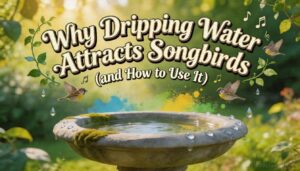
A warbler can detect the sound of a single drip from over 50 meters away—farther than most backyard feeders ever reach. That’s not instinct working in vague, mysterious ways; it’s acoustic biology at work. The frequency pattern of steady drips carries through ambient noise in a way that static water never does, and the ripples catch sunlight in a shimmer that doubles as a visual beacon.
Still water sits. Moving water signals.
For songbirds exploring unfamiliar territory—whether crossing migration corridors or scouting a new neighborhood—dripping water attracts songbirds the way a lit window draws a traveler toward shelter on a dark road.
The right setup makes all the difference between a bath that collects leaves and one that pulls warblers, thrushes, and finches into your yard with genuine consistency.
Table Of Contents
Key Takeaways
- Warblers and finches can hear a single drip from over 50 meters away, meaning sound — not sight — is what pulls songbirds to your yard in the first place.
- Moving water signals safety: circulation prevents bacterial buildup, disrupts mosquito breeding, and gives small birds the clean, oxygenated water they need to replace up to 25% of their daily body‑mass loss.
- Placement matters as much as the water itself — position your dripper 3–5 feet from shrubs, with open sight lines on all sides, so birds can spot threats and commit to landing without hesitation.
- A simple weekly scrub with a water‑vinegar solution, combined with consistent dripper flow, is all it takes to keep your setup healthy and songbirds returning reliably through every season.
Why Dripping Water Attracts Songbirds
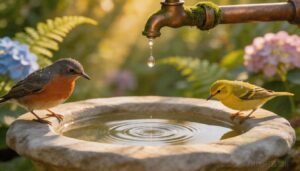
Songbirds don’t find water by luck — they find it by sound.
They follow acoustic cues to locate streams and puddles, showing up in predictable spots you can track using seasonal songbird location maps by habitat and region.
A single drip hitting a still surface carries farther than you’d think, and birds are wired to notice it.
Here’s why simple movement makes all the difference.
Sound and Ripples Draw Birds From Afar
Songbirds don’t stumble onto water by accident — they follow acoustic cues for birds with impressive precision. A dripper’s steady frequency pattern carries farther than you’d expect, creating sound-driven approach behavior in warblers and thrushes from well beyond your yard.
Meanwhile, ripple visuals shimmer in sunlight, triggering motion perception that pulls birds down from above.
Together, auditory cues and water movement stimuli make moving water nearly impossible to ignore.
Moving Water Signals Fresher, Safer Drinking
Sound draws them in — but it’s the freshness cue that keeps them coming back. Moving water signals safety in ways still puddles simply can’t match. The oxygenated moving water further boosts bird attraction.
- Pathogen Deterrence: Circulation prevents the bacterial buildup that stagnant water invites.
- Mosquito Suppression: Constant flow disrupts larval breeding cycles entirely.
- Evaporative Cooling: Fresh, cool water helps small songbirds replace up to 25% of daily body‑mass loss.
Your dripper isn’t just attractive — it’s genuinely offering clean water songbirds can trust.
Drips Encourage Bathing, Cooling, and Feather Care
Bathing in moving water does more than rinse feathers — it drives three overlapping health processes. A dripper’s gentle flow encourages songbirds to splash repeatedly, which provides parasite flushing benefits, preening efficiency boost, and feather oil distribution from the preen gland.
A dripper’s gentle flow doesn’t just clean songbirds — it flushes parasites, boosts preening, and distributes protective feather oils simultaneously
| Function | What Happens | Why It Matters |
|---|---|---|
| Cooling Drips | Wet feathers enable evaporative heat loss | Replaces up to 25% daily body-mass loss |
| Parasite Removal | Water flushes mites between feather layers | Reduces irritation, improves plumage condition |
| Feather Conditioning | Bathing softens debris; preening restores alignment | Keeps flight and insulation efficient |
Evaporative cooling through bathing is especially critical in heat — songbirds lack sweat glands entirely.
Flowing Water Helps Migration Stopovers
Moving water doesn’t just serve the birds already in your yard — it pulls in migrants passing through.
Think of your dripper as one link in a Migration Stopover Network; warblers and finches rely on Staging Wetland Refueling stops, River Corridor Connectivity, and Energy Replenishment Stops to survive long flights.
Your backyard water circulation can genuinely become a Seasonal Habitat Linkage that tired songbirds depend on.
Best Drippers, Misters, and Pumps
Once you know why moving water works, the next step is picking the right gear to create it. The good news is no shortage of options — from simple gravity drippers to solar-powered pumps — and each one suits a slightly different setup or bird.
Here’s a closer look at the tools worth considering.
Birdbath Drippers for Steady Attraction
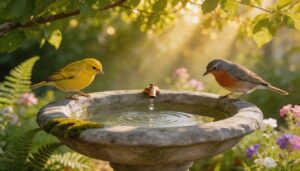
A well-designed birdbath dripper doesn’t just add water movement — it turns your backyard into a destination songbirds trust. Commercial drippers deliver roughly 1–2 ml per second, creating steady ripples and that soft, irresistible drip sound birds hear from a distance. Material durability matters too; rust-proof stainless steel outlasts plastic through seasonal water temperature swings.
Three things a quality dripper delivers:
- Consistent dripper flow rate — steady rhythm that keeps attracting songbirds all day
- Noise frequency optimization — a soft, natural drip that birds recognize as fresh, safe water
- Energy efficiency — many models connect to existing faucets, no electricity needed
Fine Misters for Warblers and Hummingbirds
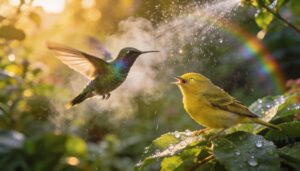
Fine misters work differently than drippers — they’re built around droplet size optimization, producing ultra-fine spray that hummingbirds hover through mid-air while warblers exploit the leaf surface wetting below.
Pairing a mister with decorative bird bath bowls gives birds a place to land and preen once the misting session winds down.
microclimate cooling effect matters most in heat; songbirds prioritize these spots.
mist timing schedule during peak activity hours, keep sight lines open for predator detection cues, and position your mister over foliage, not open air.
Solar Pumps for Off-grid Water Movement
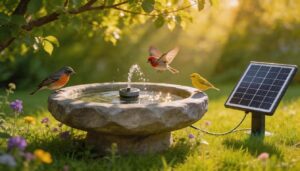
If your backyard sits far from an outlet, a solar pump solves the wiring problem entirely. Battery-free operation means the pump runs directly off a 50–100 W panel during daylight — no inverter, no battery bank, no ongoing cost.
Panel sizing matters: a 10–30 W DC pump paired with adequate solar input keeps moving water circulating reliably.
Weatherproof installation and strong pump efficiency make this the smartest long-term setup for attracting songbirds.
DIY Drip Systems for Backyard Birdbaths
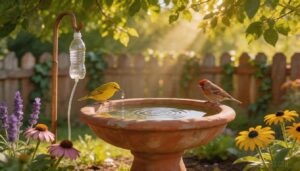
You don’t need a pump or a power outlet to give songbirds the moving water they crave. A simple DIY birdbath dripper — plastic bottle, pin-hole, flexible tubing — delivers real results:
- Bottle Reservoir Setup keeps water dripping for hours
- Needle Valve Calibration fine-tunes one drop every few seconds
- Tubing Seal Techniques eliminate leaks at drilled openings
Eco-friendly construction, near-zero cost, genuine bird impact.
Choosing Shallow Basins and Perch Stones
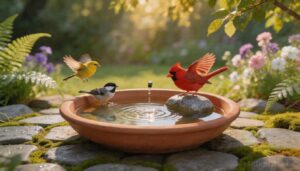
Even the best dripper falls flat if the basin beneath it doesn’t suit small birds. Depth and slope matter more than aesthetics — a 1–2 inch shallow water depth with a gradual basin slope lets finches, chickadees, and cardinals wade in confidently.
| Feature | Recommendation |
|---|---|
| Stone height | Just above waterline |
| Basin slope | Gradual rim-to-center |
Weight considerations and sealing maintenance determine longevity; granite wins on material durability, though it needs periodic sealing. Position perches within easy reach.
Where to Place Moving Water
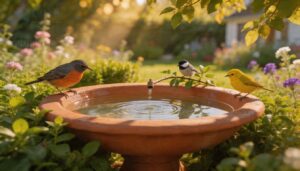
Getting placement right matters just as much as choosing the right dripper or pump. A well-placed water feature pulls in far more birds than one dropped wherever it’s convenient.
Here’s what to think through before you set yours up.
Ideal Depth for Small Songbirds
Most songbirds won’t touch water deeper than 2 inches — and for chickadees or kinglets, even that’s too much. Keep your birdbath at 0.5 to 1 inch along the edge, creating depth gradient zones that let each species find its species‑size matching sweet spot.
Flat perch stones add water level stability, while your dripper’s shallow moving water delivers a temperature‑cooling effect that small birds genuinely need.
Safe Distance From Shrubs and Trees
Place your dripper 3–5 feet from shrubs or trees — close enough for quick cover, far enough to maintain predator visibility. Fire-safe spacing matters here too: building buffer zones and vertical ladder clearance principles apply equally to water feature placement.
On slopes, widen those gaps; fire and cats both move faster uphill than most people expect.
Open Sight Lines for Predator Awareness
Spacing your dripper in the open isn’t just aesthetic — it’s functional. Birds rely on Unobstructed Perimeters and Clear Flight Paths to scan for hawks and cats before committing to a landing.
A Vigilance Friendly Layout works like this:
- Keep Open Approach Angles clear on all sides.
- Use Elevated Viewing Perches nearby for pre-flight scanning.
- Eliminate dense ground cover within 3 feet.
Predator visibility near water directly determines how often birds return.
Pairing Water With Feeders and Perches
Once you’ve nailed your Predator Vigilance Layout, think about what sits nearby. Position bird feeders 10–15 feet from your dripper — that Feeder Water Spacing keeps spilled seed and droppings out of the basin.
Perch Placement Strategy matters too: sticks and flat stones adjacent to the bath let songbirds scan before they drop in, naturally supporting an Integrated Station Design that draws finches, cardinals, and warblers together.
Adding Shelter Near The Water Source
Shelter completes the setup. Dense Shrub Cover — native shrubs, brush piles, dense evergreens positioned 3–5 feet back — gives songbirds a quick escape route without boxing them in.
Open Escape Space around the basin so birds can spot threats and launch fast.
Windbreak Placement on the exposed side and a Partial Shade Buffer overhead help birds stay comfortable, while Low Perch Zones let them linger safely.
Keeping Water Clean Year-Round
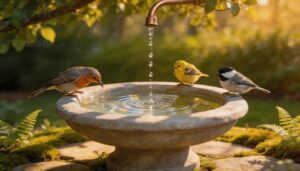
moving water feature only stays effective if it actually stays clean — birds won’t drink from a green, grimy basin any more than you’d drink from one. The good news is that a simple routine keeps things fresh without much effort.
Here’s what that looks like across the seasons.
Weekly Birdbath Cleaning Routine
Think of your birdbath as a kitchen counter — you wouldn’t leave it dirty for weeks. A regular cleaning schedule keeps birds safe and water genuinely clean.
- Empty, scrub with a stiff brush, and apply a vinegar solution (9 parts water, 1 part vinegar)
- Use rinse techniques that flush every surface at least twice — no residue, no film
- Do a safety inspection for cracks, rough edges, or slippery buildup while you’re at it
- Refresh water every other day between full cleanings
Soap strips feather oils — don’t use it.
Preventing Algae in Moving Water
Moving water already gives algae a tough fight — but light, nutrients, and surface texture decide who wins. Shade your basin to block photosynthesis; smooth, non-porous materials resist slime far better than rough stone. Seasonal flushing clears mineral buildup before it feeds new growth.
| Algae Control Methods | What It Does | Best For |
|---|---|---|
| Light Shading | Blocks photosynthesis | Open sunny yards |
| Smooth Surfaces | Reduces slime adhesion | Dripper basins |
| Nutrient Filtration | Removes organic inputs | High-debris sites |
| Flow Uniformity | Disrupts algae settling | All moving water |
Clean water keeps songbirds coming back.
Reducing Mosquitoes With Shallow Circulation
Still water is a mosquito nursery — your shallow basin becomes a breeding ground within days without Flow Consistency. Dripper circulation and surface agitation interrupt larval breathing, making it harder for mosquitoes to survive.
Keep depth under two inches, trim surrounding vegetation for better predator access, and run your dripper consistently. Preventing mosquitoes is one of the clearest Benefits of moving water for songbirds.
Flushing Dripper Nozzles and Tubing
Mineral deposits and algae are the quiet enemies of consistent dripper flow — and a blocked nozzle means less clean water reaches the birds that depend on it.
Flush nozzles monthly using a vinegar-water solution, following flush velocity guidelines to carry sediment out cleanly.
Check end cap installation at each lateral’s terminus, and consider automatic flush valves to simplify your regular cleaning schedule for birdbaths year‑round.
Winter Freeze Protection and Seasonal Storage
Winter is the breaking point for birdbath dripper setups — concrete and ceramic crack when trapped water expands, metal corrodes, and pumps fail if left exposed.
Empty your basin completely before the first hard freeze. Store pumps cleaned and wrapped indoors.
In freezing climates, a heated bath keeps water accessible without heat stress mitigation, for small birds becoming a concern. Cover what stays outside with a weatherproof tarp.
Top 6 Dripping Water Products
Once you know what moving water does for birds, the next step is finding gear that actually works. These six products cover the full range — from fine misters that attract warblers to simple drippers that keep chickadees coming back daily.
Here’s what’s worth your attention.
1. ExtremeMIST Bird Mist Sprayer
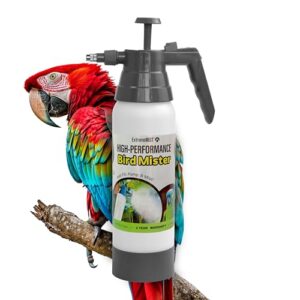
The ExtremeMIST High-Performance Bird Mister delivers exactly what migrating warblers and hummingbirds respond to: an ultra-fine mist that coats foliage and triggers instinctive bathing behavior.
Six to twelve pumps pressurize the 20 oz tank to 100 psi, producing a steady spray without constant squeezing — the stay-on button takes care of the rest.
Twist the brass nozzle between fine mist and jet stream depending on whether you’re bathing birds or rinsing the cage.
It’s durable, adaptable, and backed by a limited lifetime warranty.
| Best For | Bird owners who want an easy, low-fatigue way to mist and bathe their parrots, cockatiels, conures, or other pet birds — and keep cages clean without a lot of elbow grease. |
|---|---|
| Primary Use | Bird misting/bathing |
| Material | Polyethylene/brass |
| Water Interaction | Mist/jet spray |
| Outdoor Suitable | Yes |
| Wildlife Benefit | Bird feather health |
| Maintenance Required | Refill/repump |
| Additional Features |
|
- The pump-and-hold system means you’re not constantly squeezing — your hand will thank you after a long misting session.
- The brass nozzle switches between a gentle mist and a strong jet, so it works for both bird baths and cage cleanouts.
- Built tough — the leak-resistant pump holds up over time, so you’re not replacing cheap bottles every few months.
- The tank runs out of pressure fairly quickly, so you’ll need to repump more often than you might expect.
- The stay-on button can stick sometimes, which means a little jiggling to get it to stop spraying.
- It’s bigger and heavier than a standard spray bottle, and the price reflects that — it’s not the budget option.
2. YISHU Surge Protector Power Strip
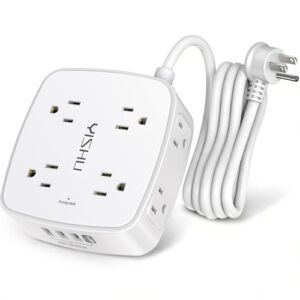
Running a solar pump, dripper, or misting system means you’ll need reliable power nearby — and that’s where the YISHU Surge Protector Power Strip earns its place.
Its 8 widely spaced AC outlets and 6-foot flat-plug cord let you position pumps, timers, and heated birdbath elements without fighting over sockets.
Four USB ports handle phones or cameras while you’re monitoring your setup.
At 600 joules of surge protection, it keeps your water hardware safe from unexpected voltage spikes.
| Best For | Gardeners and hobbyists who need flexible, well-spaced power access for pumps, timers, and outdoor setups without cluttering their workspace. |
|---|---|
| Primary Use | Device power management |
| Material | ABS plastic |
| Water Interaction | None |
| Outdoor Suitable | Limited |
| Wildlife Benefit | Indirect/none |
| Maintenance Required | Overload reset |
| Additional Features |
|
- Eight widely spaced outlets mean bulky adapters actually fit without blocking each other
- The 45° flat plug and 6-foot cord make it easy to tuck behind furniture or along a wall
- Built-in USB-A and USB-C ports let you charge devices without sacrificing an outlet
- 600 joules of surge protection is decent but may not cut it for expensive or sensitive gear
- Total USB output caps at 4.2 A, so charging multiple devices at once can get slow
- Some users report the overload protection trips a little too easily, requiring a cooldown before it resets
3. ZOUPW Portable Foldable Solar Panel
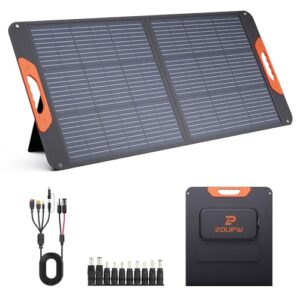
If you want to cut the cord entirely, the ZOUPW Portable Foldable Solar Panel makes that possible. Rated at 450W with N-type monocrystalline cells hitting up to 25% conversion efficiency, it delivers serious output for running pumps, drippers, and misters off-grid.
The IP68-rated ETFE surface manages rain without complaint, and the foldable frame — about 26.78 lb unfolded — sets up quickly wherever the sun hits best.
For backyard birding setups far from an outlet, it’s a clean solution.
| Best For | Campers, RV travelers, and off-grid enthusiasts who need a reliable, weatherproof solar panel to keep their power stations and USB devices charged without access to shore power. |
|---|---|
| Primary Use | Solar charging |
| Material | ETFE/nylon fabric |
| Water Interaction | IP67 waterproof |
| Outdoor Suitable | Yes |
| Wildlife Benefit | Off-grid power |
| Maintenance Required | Panel cleaning |
| Additional Features |
|
- 23.5% efficiency Grade A monocrystalline cells and a 45° adjustable kickstand mean you’re squeezing more power out of every sunny hour
- The 5-in-1 universal connector works with nearly every major power station brand, so you’re not hunting for adapters
- IP67-rated and ETFE-laminated — rain, humidity, marine air — it handles whatever the outdoors throws at it
- At 9.5 lb it’s on the heavier side, so ultralight backpackers will want to look elsewhere
- The kickstand locks at a fixed 45°, which isn’t ideal if your site needs a different angle to catch the sun
- Actual output is limited by your power station’s max input, so a 60W-capped unit won’t pull the full 100W no matter what
4. Erva Starling Proof Bluebird Feeder
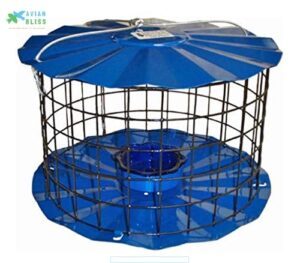
Once your water source is drawing birds in, a dedicated mealworm station nearby can seal the deal — and the Erva Starling Proof Bluebird Feeder does that job well. Its vinyl-coated wire cage, with 1½-inch mesh openings, lets bluebirds and Carolina wrens pass through while keeping starlings and squirrels out.
The dishwasher-safe glass cup inside makes daily cleaning straightforward.
At $83.99, it’s a solid, USA-made investment for anyone serious about supporting cavity-nesting insectivores through breeding season.
| Best For | Backyard birders who want to attract bluebirds and Carolina wrens without fighting off starlings and squirrels at every refill. |
|---|---|
| Primary Use | Bird feeding |
| Material | Metal/vinyl/glass |
| Water Interaction | Open cup exposure |
| Outdoor Suitable | Yes |
| Wildlife Benefit | Bluebird feeding |
| Maintenance Required | Daily refill |
| Additional Features |
|
- The vinyl-coated wire mesh does a solid job keeping larger birds and squirrels out, so your mealworms actually go to the birds you want.
- The glass cup pops right out and goes in the dishwasher — cleaning takes about 30 seconds.
- Metal build with powder-coat finish holds up through rain, snow, and sun without rusting out.
- Some larger male bluebirds might struggle to squeeze through the mesh openings.
- The glass cup can break if a squirrel knocks it around or it takes a hard fall.
- The cup is small, so during cold snaps you may find yourself refilling it more than once a day.
5. Zoo Med Little Dripper
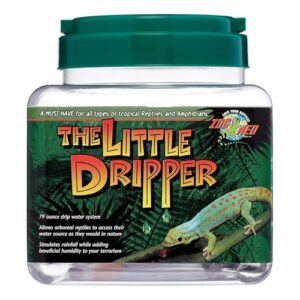
If bluebirds are your focus, the Zoo Med Little Dripper meets a different need — keeping the water itself moving. Designed for reptile enclosures, it works surprisingly well above birdbaths too.
Its gravity-fed reservoir holds about 165 ml and releases a steady drip through an adjustable valve, creating exactly the kind of audible, rippling water that draws finches and warblers in.
It’s compact, USA-made, and runs without electricity — a quiet workhorse for small backyard setups.
| Best For | Backyard birders who want to attract warblers and finches with moving water — especially in small setups where a full misting system would be overkill. |
|---|---|
| Primary Use | Reptile hydration |
| Material | Food-grade plastic |
| Water Interaction | Gravity drip system |
| Outdoor Suitable | Yes |
| Wildlife Benefit | Reptile hydration |
| Maintenance Required | Regular refill |
| Additional Features |
|
- Runs on gravity alone — no cords, no pump, no fuss
- The steady drip creates just enough sound and ripple to pull in birds that ignore still water
- Compact and low-profile, so it fits easily over most standard birdbaths
- The tiny reservoir (~165 ml) means you’ll be refilling it often, sometimes daily in warm weather
- The flow dial is tricky — it’s basically on or off, so dialing in a slow, gentle drip takes patience
- Some units have reported pin-hole leaks or a sticky valve, which can turn a steady drip into an unexpected flood
6. St Francis Garden Bird Feeder Statue

Not every water feature has to be mechanical.
The St. Francis Garden Bird Feeder Statue by BOLVOUD doubles as décor and a functional feeding bowl — its shallow basin holds seed or water, and at 11.7 inches tall, it fits neatly into a garden corner or patio edge.
The resin construction keeps it lightweight at 1.7 lb, though you’ll want to refill the small bowl frequently.
It’s a quiet, grounded addition for anyone who wants beauty and bird function in one piece.
| Best For | Gardeners, nature lovers, or anyone who wants a low-key religious accent that actually does something useful — like feed the birds. |
|---|---|
| Primary Use | Bird feeding/decor |
| Material | Resin |
| Water Interaction | Open bowl exposure |
| Outdoor Suitable | Yes |
| Wildlife Benefit | Bird feeding |
| Maintenance Required | Frequent refill |
| Additional Features |
|
- Pulls double duty as décor and a bird feeder, so it’s not just sitting there looking pretty
- Light enough (1.7 lb) to move around the patio or garden whenever you feel like switching things up
- The faux wood texture gives it a natural, weathered look that blends well outdoors
- The bowl is small, so if you’ve got a busy bird crowd, you’ll be refilling it constantly
- Resin can crack or fade over time, especially through harsh winters or strong sun
- At under 12 inches tall, it might feel tinier in person than it looks in photos
Frequently Asked Questions (FAQs)
Do birds like dripping water?
Yes — though a still birdbath sitting quietly in your yard might get ignored all morning.
Add a single drip, and finches, chickadees, and cardinals show up within minutes, drawn by sound alone.
Which songbird species visit drippers most frequently?
Warblers, chickadees, cardinals, and finches top the list. Eastern bluebirds, cedar waxwings, and rose-breasted grosbeaks are reliably close behind — especially during spring and fall migration peaks.
How does dripping water affect bird territoriality?
Dripping water acts like a shared watering hole on the savanna — it compresses territories, sparks acoustic competition, and reshapes how males defend space, often forcing birds to sing louder or shift boundaries.
Can dripping water attract birds in urban settings?
Absolutely — urban birds are often working with far less water than their rural cousins.
A simple dripper cuts through city noise and heat, pulling in songbirds that need reliable water the most.
Does water temperature influence songbird bathing behavior?
Temperature matters less than you’d think. What songbirds really need is liquid, fresh, and accessible water — unfrozen in winter, not sun-scorched in summer. Comfort and safety beat any specific degree.
How do native plants complement a dripping water setup?
Native plants do the quiet work your dripper can’t: elderberry and serviceberry within 3 feet turn a water stop into a full feeding station.
While layered shrubs give birds safe cover to approach and escape.
Conclusion
Ancient Roman augurs read the future in birdsong—proof that humans have always known birds carry meaning. Today, you don’t need omens; you need a dripper.
Dripping water attracts songbirds because it speaks their language: sound, shimmer, and safety layered into one signal. Set it shallow, keep it clean, place it where sight lines are open.
Do that consistently, and your yard becomes the kind of place warblers remember.
- https://wildbirdsforever.com/2020/09/22/water-for-birds/
- https://elmcreekltd.com/blog/46850/the-importance-of-a-water-source-for-birds
- https://georgiawildlife.com/out-my-backdoor-moving-water-acts-bird-magnet
- https://nature-niche.com/blogs/news/birdbath-drippers-a-complete-guide
- https://backyardwildlifeconnection.com/2019/04/18/a-great-way-to-attract-migrating-songbirds-to-your-yard/