This site is supported by our readers. We may earn a commission, at no cost to you, if you purchase through links.

A warbler singing from deep inside a hedgerow might as well be invisible—you hear it, you know it’s there, but without the right optics, it stays a mystery. The gap between hearing a bird and actually seeing it is where most birdwatchers spend far too much of their time. Good binoculars collapse that distance, pulling a distant silhouette into a living creature with visible eye rings, wing bars, and the subtle rust blush on the breast that confirms your identification.
They don’t elevate the experience of birdwatching so much as reveal it—turning frustrating glimpses into confident, documented sightings. Understanding how to choose and use them changes everything about what you notice in the field.
Table Of Contents
Key Takeaways
- Quality binoculars don’t just bring birds closer—they reveal field marks like eye rings, wing bars, and beak shape that make the difference between a guess and a confirmed ID.
- Specs matter: an 8×42 setup hits the sweet spot between magnification, light-gathering, and a wide enough field of view to track fast-moving birds without constant repositioning.
- Comfort and ergonomics aren’t extras—features like eye relief, balanced weight, and a smooth focus wheel directly affect how long you can stay in the field and how much you actually see.
- Your optics are only as good as your care routine—regular lens cleaning, proper storage, and monthly checks on focus and alignment protect the investment across seasons.
See Distant Birds Up Close
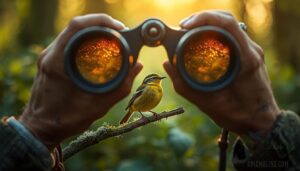
A good pair of binoculars doesn’t just bring birds closer — it changes what you actually see.
Subtle details like eye rings, wing bars, and bill shape suddenly pop — which is why brushing up on bird identification using binoculars can turn a good outing into a great one.
Suddenly, a distant shape in the treetops becomes a bird with a story: its markings, movements, habits.
Here’s what you can expect once you raise them to your eyes.
View Birds Clearly From Far Away
Good binoculars close the distance between you and a bird without closing the physical gap. With the right magnification power and objective lens size, long-distance viewing becomes genuinely seamless. A wide field of view coverage also helps you follow fast-moving birds more easily across changing backgrounds.
- Long-Range Clarity pulls distant subjects into sharp relief.
- Edge-to-Edge Sharpness keeps detail crisp across the full frame.
- Distant Color Fidelity accurately reveals true plumage tones.
- Background Contrast separates birds from busy surroundings.
- Horizon-Level Detail tracks birds across open sky or water.
Observe Plumage, Markings, and Beak Shape
Once you’re pulling subjects into sharp relief, the real work of bird identification begins. Binoculars with strong magnification power reveal details like facial stripe cues, wing bar details, and tail band patterns that disappear from the naked eye.
Beak proportion clues instantly separate seed-crackers from insect-hunters.
Seasonal plumage shifts add another layer—breeding colors transform familiar birds entirely, making attentive observation through quality optics genuinely rewarding for serious bird watching.
Watch Feeding, Nesting, and Flight Behavior
Beyond markings, binoculars open a window into how birds actually live.
Dawn feeding frenzies happen fast — parents making rapid parental provisioning trips to nestlings.
Aerial hawking captures insects mid-flight, while flock foraging ripples across wetlands.
Your magnification power and close focus work together, letting you track birds in motion through a wide field of view without missing a single beat of nest construction.
Birdwatch Without Disturbing Shy Species
Shy species don’t give second chances. Bird watching binoculars and long-distance viewing change everything — you stay back, downwind, using natural cover like shrubs or tree lines while your optics do the work.
Silent movement and reading alert signals, like a sudden head turn or raised crest, tell you when to freeze.
Good hide ethics mean the bird never knows you were there.
Identify Birds More Accurately

A distant bird is one thing — knowing exactly which bird it takes a sharper eye. That’s where good binoculars stop being just helpful and start being essential.
Good binoculars transform a distant bird from a mystery into a confirmed sighting
Here’s how they give you the edge when identification really counts.
Spot Subtle Field Marks Quickly
Field marks disappear fast if your optics can’t keep up. With 8x magnification power and quality lens coatings, you can lock onto Eye Line Contrast, Alula Patch Cues, and Wing Bar Details before a bird shifts position. Tail Notch Shapes and Bill Shape Clues become readable in seconds.
A wider field of view and sharp optical quality means plumage patterns reveal themselves — not guess at them.
Notice Color Variations and Patterns
Plumage patterns don’t stay constant — Seasonal Plumage Shifts, Molt Stage Changes, and Regional Color Morphs mean the same species can look surprisingly different week to week.
Lighting Color Effects shift reds and oranges dramatically at dawn versus midday, complicating identification.
ED glass and fully multicoated lenses boost light transmission and optical quality, so Distance Pattern Clarity improves enough to catch those fleeting color differences before the bird moves on.
Separate Similar-looking Species
Two species can look nearly identical until your binoculars reveal what matters. Eye Stripe Width, Tail Tip Contrast, and Head Shape Cues separate birds that stump even experienced observers. Strong optical quality and a generous field of view make bird identification challenges manageable in real time.
- Spot Habitat Range Clues and Behavior Pattern Clues instantly
- Use close focus for nearby perched birds
- Catch tail tip contrast before the bird flushes
- Confirm head shape cues at treetop distance
Improve Confidence for Life-lists and Records
Every entry in your life list only holds weight if you can back it up. Strong optical quality turns uncertain glances into confident sightings worth logging. Pair your birdwatching binoculars with solid sighting documentation and evidence logging — note the date, location, and conditions.
Use checklist cross-checking against regional guides, maintain digital backups, and apply consistent bird identification techniques to keep your record verification airtight.
Track Birds With Less Strain

Tracking a warbler darting through a canopy or following a heron’s low glide across the water takes more than good eyesight — it takes the right optics working with you, not against you.
The best binoculars don’t just show you the bird; they keep up with it, stay steady in your hands, and remain comfortable through hours in the field. This is what makes the difference when tracking birds with less strain.
Wider Field of View for Moving Birds
A wide field of view is your secret weapon for Flight Path Tracking when birds won’t hold still. Bird-watching binoculars covering 300–420 feet at 1,000 yards give you room for Continuous Sky Scanning and Flock Movement Awareness without constant repositioning.
Peripheral Motion Cues alert you before a bird changes direction, while Landing Spot Prediction becomes instinctive — keeping birds in motion inside your frame longer.
Faster Focusing on Active Species
Fast birds don’t wait for slow focus — and neither should your binoculars. Predictive Focus Systems pre-align your optics before a Warbler even commits to its next branch.
Modern Binocular Focusing Systems with Low-Lag Autofocus and Internal Focus Elements make this happen near-instantly:
- Servo Focus Tracking anticipates direction changes
- Central focus wheels with tactile grip enable quick corrections
- Instant Refocus Speed cuts lag to milliseconds on birds in motion
- Diopter adjustment locks your personal calibration so focus mechanisms stay responsive
Steadier Viewing for Longer Sessions
Steady hands matter more than most birders realize. Breathing control and viewing posture alone can cut micro-tremors considerably — but pairing those habits with proper weight balance and strap adjustment takes you further.
Lightweight models reduce fatigue fast, while image stabilization manages the rest.
Eye breaks every 20 minutes preserve sharpness longer.
| Stability Factor | Practical Benefit |
|---|---|
| Tripod mounting | Eliminates hand vibration completely |
| Ergonomics and ease of use | Sustains comfort across long sessions |
| Lightweight models | Reduces arm fatigue noticeably |
Better Comfort for Eyeglass Wearers
Wearing glasses doesn’t mean settling for a compromised view. Look for Extended Eye Relief of 16–20mm — this distance prevents lenses from pressing against your eyecups. Glasses-Safe Eyecups and adjustable eyecups twist down to align perfectly, while Adjustable Nose Pads conform to your face for a stable, pressure-free fit.
Diopter Fine-Tuning and Anti-Fog Compatibility complete the eyeglass-friendly features, ensuring all-day ergonomics and ease of use feel seamless.
Reduced Fatigue With Ergonomic Designs
Beyond eyeglass comfort, ergonomic design addresses the full-body strain of long sessions. Contoured Handgrips and Balanced Weight Distribution keep your arms steady without fighting gravity, while Shoulder Strap Support shifts the load off your neck entirely.
Low-Effort Controls and Pressure-Reducing Eyecups mean less fidgeting, more watching. With custom-fitted gear fitting and adjustable eyecups, binocular weight considerations practically disappear into the field experience.
Choose The Right Birding Binoculars
Not all binoculars are built the same, and the wrong pair can quietly work against you in the field. A few key specs make the real difference between a frustrating outing and one where every bird comes in sharp and clear.
Here’s what to look at before you buy.
7x, 8x, and 10x Magnification Trade-offs

Choosing between 7x, 8x, and 10x magnification is one of the most consequential decisions you’ll make regarding binocular specifications. Each step up in detail reach comes with real magnification balance tradeoffs.
- 7x: widest field of view, minimal shake amplification, easiest to track moving birds
- 8x: the sweet spot—solid focus precision without sacrificing too much field of view
- 10x: maximum reach, but 10x magnification narrows your view by up to 40% and demands steadier hands
- Depth Perception: shallower at higher powers, making fast-moving birds harder to keep sharp
For most bird-watching binoculars, 8x manages magnification tradeoffs best across varied conditions.
Objective Lens Size and Brightness

The objective lens diameter drives how much light your binoculars gather. A 42mm lens pulls in considerably more light than a 30mm, improving image illumination and brightness uniformity across your field of view. This aperture brightness balance matters most in dense canopy or overcast skies.
However, bigger isn’t always better — the objective diameter’s impact on weight is real. Thus, 40–42mm hits the sweet spot for light-gathering power without excessive bulk.
Exit Pupil and Low-light Performance

Exit pupil basics come down to one simple formula: divide your objective lens diameter by your magnification. For example, an 8×42 yields a 5.25mm exit pupil — closely matching natural eye pupil matching at dusk.
This twilight brightness balance maintains sharp dusk detail retention as light fades.
For shadow contrast performance, prioritize low-light capability through quality light transmission over raw magnification alone.
Roof Vs. Porro Prism Designs
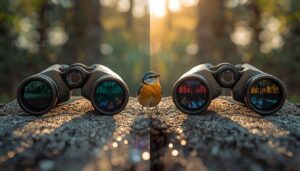
The prism type comparison you’ll face boils down to two distinct designs — each with real trade-offs worth understanding.
- Body Shape Differences: Porro prisms create a Z-shaped light path, giving you a wider, more three-dimensional view; roof prisms run straight and slim.
- Weather Sealing Benefits: Roof prism bird watching binoculars integrate tighter seals naturally.
- Cost Value Tradeoffs & Alignment Precision: Porro designs forgive manufacturing tolerances; roof prism binocular design demands exactness, raising the price.
Lens Coatings and Glass Quality
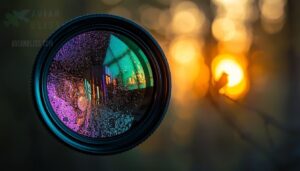
Glass quality and lens coatings quietly determine everything you see. Anti-Reflective Coatings push light transmission to 98%, while ED Glass eliminates color fringing on high-contrast edges.
Phase-Correction Layers sharpen contrast in roof prisms, and Dielectric Mirror Coatings boost brightness.
| Coating Type | Key Benefit | Best Condition |
|---|---|---|
| Anti-Reflective Coatings | 98% light transmission | Low light/dawn |
| Hydrophobic Lens Protection | Repels rain and oils | Wet weather |
| Extra-low Dispersion Glass | Reduces chromatic fringing | High-contrast scenes |
| Phase-Correction Layers | Sharpens contrast | All conditions |
Close Focus for Nearby Birds
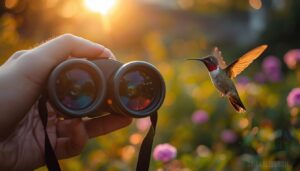
Some of the most intimate bird watching moments happen within arm’s reach. Close-focus binoculars with a minimum focus distance of 1.5–2.5 meters reveal details you’d otherwise miss entirely:
- Hummingbird beak curvature at under 2 meters
- Warbler wing bars through near-range sharpness
- Smooth internal focus design prevents balance shifts
- Focus bracketing locks onto restless shorebirds cleanly
- Quiet close approaches stay undisturbed with a steady technique
Improve Viewing in Any Conditions

Good glass only takes you so far — conditions do the rest. Whether you’re out at first light or scanning a sun-drenched coastline, your setup needs to match what nature throws at you.
Here’s what makes the difference in the field.
Better Performance at Dawn and Dusk
Dawn and dusk are prime birding hours — and your optics make or break them. Low-light contrast drops quickly as twilight fades, making Twilight Image Brightness critical.
Key optical features enhance performance during these challenging conditions:
| Feature | Why It Matters at Twilight |
|---|---|
| Large objective lens size | Maximizes light transmission into the barrel |
| Wide exit pupil | Preserves edge clarity retention as light fades |
| Antireflective coatings | Controls stray light that washes out silhouette detail recognition |
| Phase-corrected prisms | Sustains low-light performance across the full field |
Waterproof and Fog-proof Protection
Waterproof binoculars built with O-Ring Seals and Airtight Housing block rain, mist, and humidity before they reach your optics.
Nitrogen Purging replaces interior moisture with dry gas, keeping lenses fogproof through rapid temperature swings.
IPX Ratings — IPX4 through IPX7 — tell you exactly how much weather resistance and durability you’re actually getting.
Glare Control in Bright Sunlight
Bright sunlight can wash out everything you’re trying to see. That’s where anti-reflective coatings and multicoating stacks earn their keep — suppressing up to 99% of stray light bouncing between lens elements.
Polarized lens benefits go further, cutting horizontal glare off water or open ground. Add a sunshade accessory, tilt your binoculars slightly downward, and those optical lens coatings keep your view sharp and true-colored.
Habitat-based Choices for Woods, Wetlands, and Coastlines
Where you’re birding shapes what your binoculars need to do. Dense Woodland Canopy Density calls for a wider field of view and strong close focus — birds vanish fast in layered cover. Wetland Edge Cover and Riparian Corridor Routes reward low-light performance at dawn. Intertidal Mudflats and Coastal Roost Sites demand habitat-specific optics that are fully waterproof and binoculars-grade tough.
- Spot warblers flickering through tangled understory without losing them
- Track herons wading silently along wetland margins at first light
- Scan mudflats where thousands of shorebirds feed during migration
- Follow riparian corridors connecting woodland to open water
- Find roosting seabirds clustered on exposed coastal ledges before dusk
Tripod Mounting for Extra Stability
Coastal scanning is where a tripod earns its place. High magnification amplifies every tremor in your hands, so mounting your binoculars on a stable base with solid leg locking systems makes the difference between blur and detail.
A centered column balance keeps binocular weight manageable, while quick release plates enable fast setup swaps. Wind resistance features become critical when gusts roll in off open water.
Maintain Binoculars for Better Birding
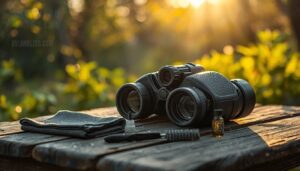
Good binoculars are an investment, and how you care for them determines how long they’ll keep performing in the field. A little routine attention protects your optics from the wear that accumulates over seasons of birding.
Here’s what you need to know to keep them in top shape.
Clean Lenses Safely Without Scratches
A scratched lens won’t forgive you in the field. Begin every binocular maintenance session with pre-rinse dust removal using lukewarm water to loosen grit before touching the glass.
Follow this with soap-safe washing: apply a drop of mild dish soap to clean the lenses gently.
Finally, employ the blot drying method using a clean microfiber cloth to ensure a streak-free finish.
This coating-safe approach keeps your optical equipment cleaning routine damage-free.
Use Proper Cloths and Optics Solution
Even the sharpest optics fail when cleaned with the wrong materials. For proper Optical Equipment Cleaning, your Binocular Maintenance Tips start with Dust-First Prep — inspect lenses under bright light, then use a soft brush before touching any surface.
Follow these Birding Equipment Care essentials:
- Use Lint-Free Fabrics only — microfiber or lint-free cotton prevent residue.
- Apply Non-Ammonia Cleaners to protect multi-coated and dielectric lens surfaces.
- Practice Center-Out Wiping, misting the cloth lightly; never the lens directly.
Store cloths in Dedicated Cloth Storage to avoid contamination between cleaning sessions.
Store Binoculars in Protective Cases
After a long day in the field, where you store your binoculars matters as much as how you use them. Hard Shell Cases made from polycarbonate or ABS plastic guard against crushing pressure during transport, while Foam Insert Fit keeps optics immobile inside.
Tuck a Desiccant Pack inside for moisture control, ensuring protection against humidity.
Quick Access Closures and Modular Gear Compartments round out smart birding equipment care, combining convenience with organization.
Inspect Focus, Armor, and Lenses Regularly
Monthly checkups keep your binoculars performing like day one.
Run a Focus Ring Check — rotation should feel smooth, never gritty. Do an Armor Seal Inspection for cracks or peeling rubber. Your Lens Coating Review catches delamination early, while a Collimation Drift Test confirms alignment stays within tolerance. Check Hinge Tension too.
Consistent maintenance protects build quality and extends reliable field use.
Prevent Dust, Moisture, and Internal Fogging
Dust and moisture are quiet enemies — they sneak in slowly and fog your optics at the worst moment. Look for waterproof binoculars built with features that combat these elements.
Sealed Housing Design, O-Ring Seals, and Internal Dust Barriers block particulates at every joint, ensuring a solid defense against external intruders.
Nitrogen Gas Filling and nitrogen-purged, fogproof chambers prevent internal condensation, maintaining clarity in varying conditions.
Hydrophobic Coatings shed water from lenses instantly, ensuring unobstructed views even in wet environments.
These weather-sealed devices deliver solid weather resistance, keeping your view sharp whatever the sky throws at you.
Frequently Asked Questions (FAQs)
Can I see Saturn’s rings with binoculars?
Like spotting a warbler through dense canopy, seeing Saturn’s rings demands the right tool.
Standard binoculars fall short — you’ll need at least 40x magnification and dark sky timing for any hint of ring visibility.
Can binoculars help identify bird calls and songs?
Binoculars don’t detect sound, but they sharpen Vocal Source Tracking by confirming which bird is actually singing.
Watching Beak Movement Clues, Singing Posture Cues, and Perch Habitat Context together makes Song Behavior Matching far more reliable.
How do harness systems reduce neck strain during birding?
A support system transfers binocular weight considerations to your torso load transfer system, providing shoulder pressure relief and centered balance for carrying.
Strap tension tuning and binocular swing control prevent neck fatigue during long birding sessions.
What accessories pair best with birding binoculars?
The best birding accessories pair function with freedom: Binocular Harnesses, Pocket Field Guides, Waterproof Notebooks, Gel Ink Pens, and Birding Phone Apps.
These accessories transform solid birdwatching gear into complete birdwatching equipment essentials for serious Outdoor Observation Gear setups.
Are budget binoculars worth it for beginners?
Yes. A starter budget range of $50–$150 gets you solid value for money.
For beginner expectations, 8×42 budget binoculars handle most bird watching needs well.
Upgrade timing comes naturally after a year of regular use.
How does magnification affect handheld image stability?
Higher magnification amplifies hand tremor amplification noticeably—at 10x, every small shake becomes obvious. Body Bracing, Breathing Control, or Monopod Support help.
Optical Stabilization in quality bird watching binoculars, like 8×42 binoculars, keeps the field of view steadier.
Conclusion
Most birders assume better technique comes with years of field experience—but the real shift happens the moment you raise a quality pair of binoculars and the world snaps into focus. Understanding how binoculars improve bird watching experience isn’t just about seeing farther; it’s about seeing fully.
The rust on a redstart’s tail, the flicker of a warbler’s eye ring—details that once slipped past you become the sightings you remember longest.