This site is supported by our readers. We may earn a commission, at no cost to you, if you purchase through links.
Managing nutrition across a mixed aviary is nothing like feeding a single pet bird. When a dozen species share the same water source, one poorly calibrated vitamin formula can mean deficiency for your smallest finches and toxicity risk for your larger parrots—simultaneously. That’s the razor’s edge avian vitamins for flock environments have to walk.
Seed-based diets make it worse, quietly stripping birds of vitamins A, D3, and B-complex without a single obvious symptom until feather quality drops or breeding season collapses. The right supplement changes that equation entirely.
Table Of Contents
- Key Takeaways
- 7 Best Avian Vitamins for Flocks
- Choosing Vitamins for Mixed Flocks
- Key Nutrients for Flock Health
- Vitamin a for Vision, Immunity, and Feather Quality
- Vitamin D3 for Calcium Absorption and Bone Strength
- Vitamin E for Reproduction and Antioxidant Protection
- Vitamin K for Normal Blood Clotting
- B-complex Vitamins for Energy and Nerve Function
- Calcium, Phosphorus, and Trace Mineral Balance
- Amino Acids and Probiotics for Overall Condition
- Best Delivery Methods in Aviaries
- Safe Dosing and Product Evaluation
- Frequently Asked Questions (FAQs)
- What vitamins do chickens need in the winter?
- What is the best multivitamin for birds?
- Do seasonal changes affect flock vitamin requirements?
- How do antibiotics interact with avian vitamin absorption?
- Which vitamins support feather regrowth after plucking?
- Are organic vitamin sources safer than synthetic formulas?
- Conclusion
Key Takeaways
- In a mixed aviary, one-size-fits-all dosing doesn’t work — fat-soluble vitamins like A and D3 can build up to toxic levels in small finches while your larger parrots still come up short.
- Seed-based diets quietly rob your flock of vitamins A, D3, and B-complex long before you notice symptoms, so targeted supplementation isn’t optional — it’s damage control.
- How you deliver supplements matters as much as what’s in them — powder mixed into soft food beats a dusted seed bowl, and water-soluble options need refreshing every two to three days to stay potent.
- During molting, breeding, or illness, your birds’ nutritional demands spike hard, so bump up vitamin E, calcium, and protein support during those windows rather than sticking to your baseline routine.
7 Best Avian Vitamins for Flocks
Finding the right vitamin for your flock doesn’t have to feel overwhelming. These seven products cover a solid range of needs, from daily maintenance to targeted support during molting or breeding.
For a deeper look at what each one does, the best supplements for bird feathers breaks down the top picks side by side.
what made the cut.
1. VITOFARMA Bird Multi Vitamin Supplement
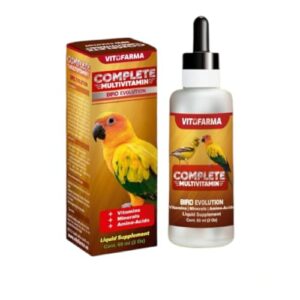
VITOFARMA’s Bird Multi Vitamin Supplement is a practical liquid option worth having in your aviary toolkit. At just 3–4 drops for small birds — mixed into water, sprinkled over dry feed, or given directly — it fits easily into your daily routine without disrupting the whole flock.
It covers a full spectrum of vitamins, minerals, and amino acids, making it especially useful during molting, illness recovery, or cold months when natural vitamin D synthesis drops. Just dose carefully — precision matters here.
| Best For | Bird owners with small-breed pets who want an easy, daily supplement to support immune health, feather quality, and appetite — especially during molt or winter months. |
|---|---|
| Form | Liquid |
| Target Species | Small pet birds |
| Key Benefit | Immune & plumage support |
| Price | $17.99 |
| Net Weight | 2.0 oz (57 mL) |
| Admin Method | Water or dry feed |
| Additional Features |
|
- Full-spectrum formula covers vitamins, minerals, and amino acids in just a few drops
- Flexible dosing — works in water, dry feed, or given directly, so picky birds aren’t a problem
- Genuinely useful during cold months or recovery when birds need an extra nutritional boost
- Color varies batch to batch, which can be confusing and make it hard to know if something’s off
- Benefits tend to be subtle and slow — don’t expect overnight results
- Getting the dose right takes some care; too much or too little can cause more harm than good
2. Avi VIT Multivitamin for Birds
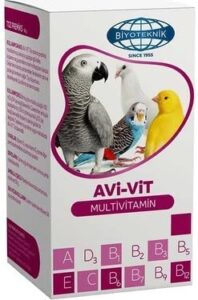
Another solid option for mixed flocks is Avi VIT Multivitamin — a powder you dissolve directly into drinking water, which makes flock-wide dosing refreshingly straightforward.
At 1 g per 80–100 ml for smaller birds and 2 g per 250 ml for pigeons or larger species, you’re getting precise, size-appropriate nutrition without guesswork.
It also promotes gut health through prebiotic-like components, which matters during stress or reduced feeding periods.
Just refresh the water every two days to keep potency intact.
| Best For | Bird owners with mixed flocks — especially those keeping parrots, canaries, budgies, and pigeons together — who want a simple, no-fuss way to cover daily vitamin needs. |
|---|---|
| Form | Powder |
| Target Species | Parrots, canaries, budgies, pigeons |
| Key Benefit | Growth & feather health |
| Price | $9.99 |
| Net Weight | 2.39 oz (68g) |
| Admin Method | Drinking water |
| Additional Features |
|
- Dissolves right into drinking water, so dosing the whole flock takes seconds — no chasing birds around
- Works for all life stages and multiple species, with clear size-based dosing so you’re not guessing
- Users have noticed real improvements in feather color and overall energy in their birds
- It’s a supplement, not a medicine — won’t help if a bird is actually sick
- Can’t be used alongside Vitamin D₂ or any premix that contains it, which limits stacking options
- Water needs refreshing every two days, and non-English packaging may be missing key instructions
3. Missing Link Avian Color Shine Powder
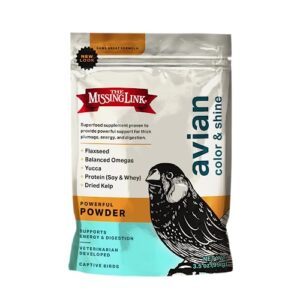
If feather quality is your focus, the Missing Link Avian Color Shine Powder earns its spot in your supplement rotation.
Built on a ground flaxseed base, it delivers omega fatty acids, B vitamins, yucca extract, and dried kelp — ingredients that genuinely support plumage, digestion, and energy.
Just sprinkle it over seed, soft food, or fresh produce daily.
At 3.52 oz, it’s compact but concentrated.
Soy and whey are present, so watch birds with known sensitivities.
| Best For | Bird owners who want to boost feather color, shine, and overall health in pet birds like parakeets, cockatiels, or parrots. |
|---|---|
| Form | Powder |
| Target Species | Parakeets, budgies, cockatiels, parrots, pigeons |
| Key Benefit | Feather color & shine |
| Price | Not listed |
| Net Weight | 3.52 oz (100g) |
| Admin Method | Food or liquid |
| Additional Features |
|
- Flaxseed base packed with omegas and B vitamins that genuinely support plumage and digestion
- Easy to use — just sprinkle over seed, pellets, or soft food
- Vet-formulated with cold-process manufacturing to keep nutrients intact
- Contains soy and whey, which can be a problem for birds with sensitivities
- Small 3.52 oz size means frequent reorders if you have multiple birds
- Some birds may reject the powder texture, so mixing it in food or liquid might take some trial and error
4. Hari Hagen Prime Parrot Vitamin Supplement
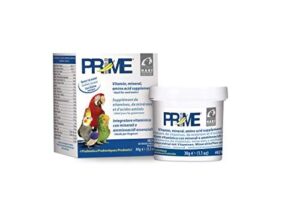
When your flock runs mostly on seeds, nutrient gaps pile up fast. Hari Hagen Prime fills those gaps directly — 14 vitamins, 9 minerals, plus lysine and methionine to round out dietary protein.
What makes it stand out is the enzyme and acidifier blend, which helps your birds actually absorb what they’re getting.
Micro-encapsulated probiotics support gut health on top of that.
Just sprinkle the ultra-fine powder over soft food or fresh produce. At $14.40 for 1.4 oz, restock it regularly for larger flocks.
| Best For | Bird owners whose parrots or seed-eating companions are showing signs of nutritional deficiencies like dull feathers, low energy, or poor feather growth. |
|---|---|
| Form | Powder |
| Target Species | Parrots, seed-eating birds |
| Key Benefit | Feather & digestive health |
| Price | $14.40 |
| Net Weight | 1.4 oz (40g) |
| Admin Method | Seeds or soft food |
| Additional Features |
|
- Covers a wide nutritional base with 14 vitamins and 9 minerals, plus amino acids to boost protein quality
- Digestive enzymes, acidifiers, and probiotics help birds actually use what they’re eating — not just pass it through
- Easy to use — the fine powder coats seeds and soft foods without a fuss
- At 1.4 oz, the container goes fast if you’re supplementing multiple birds
- Some owners pick up a banana-like scent despite the "banana-free" marketing, which not all birds tolerate well
- No third-party lab testing or certification to back up the label claims
5. Morning Bird Hearty Bird Daily Multivitamin
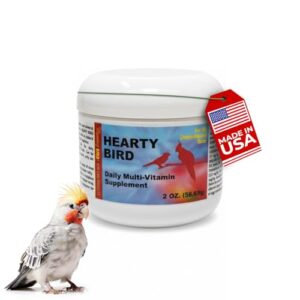
Morning Bird Hearty Bird Daily Multivitamin keeps things refreshingly simple — mix 1 teaspoon into five quarts of drinking water, and your whole flock gets vitamins A, D3, C, E, a full B-complex, plus trace minerals like zinc, copper, and iron daily.
At $17.99 for 3.5 oz, it’s a cost-effective routine for mixed aviaries.
One catch: you’ll need to discontinue any other vitamin supplements while using it to avoid nutrient overload — but that’s actually a smart safeguard built right into the label.
| Best For | Bird owners who want a simple, no-fuss daily multivitamin that works across all species — from budgies to macaws — especially those feeding seed-heavy diets. |
|---|---|
| Form | Powder |
| Target Species | Budgies to macaws |
| Key Benefit | Immune & energy support |
| Price | $17.99 |
| Net Weight | 3.5 oz (99g) |
| Admin Method | Drinking water |
| Additional Features |
|
- Covers the big bases (vitamins A, D3, C, E plus B-complex and trace minerals) in one easy water-soluble dose
- Human-grade ingredients with no fillers — mixes clean, no clumping
- Works for a wide range of birds at all life stages, including those recovering from illness
- You have to stop all other vitamin supplements while using it, which takes some juggling if you have a complex routine
- Intended only for birds — can’t double up for other pets in the household
- Needs careful storage (cool, dry, sealed) or it loses effectiveness over time
6. Oasis Multivitamin Drops For Small Birds
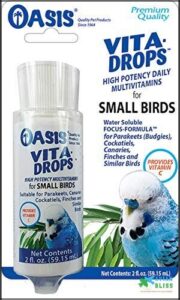
If you’re managing small birds — parakeets, budgies, canaries, finches — Oasis Vita-Drops keeps supplementation genuinely straightforward.
Add one drop per ounce of water for hookbills, or one drop per two ounces for canaries and finches.
The liquid formula carries vitamins A, D3, C, E, and a full B-complex directly into every sip.
For sick or stressed birds not drinking, you can dose one drop straight into the beak.
Refresh the water every one to three days to maintain potency.
| Best For | Small bird owners — parakeets, budgies, canaries, finches, and similar species under 200g — who want a simple, daily multivitamin without the hassle of powder or pill supplements. |
|---|---|
| Form | Liquid |
| Target Species | Small cage birds under 200g |
| Key Benefit | Growth & feather quality |
| Price | Not listed |
| Net Weight | 3.47 oz (98g) |
| Admin Method | Water or moist food |
| Additional Features |
|
- Covers all the essential vitamins in one liquid formula, including a full B-complex and added vitamin C for immune support
- Super easy to use — just a few drops in the water or food, no mixing or measuring complicated amounts
- Made in the USA with almond-free ingredients, which matters for birds with sensitivities
- The bottle is small, so if you have multiple birds you’ll be reordering pretty often
- Exact vitamin concentrations aren’t listed, so you can’t verify precise dosing
- Requires a clean, covered water source — open dishes can introduce contaminants that weaken the supplement’s effectiveness
7. Lafeber AviEra Bird Vitamin Powder
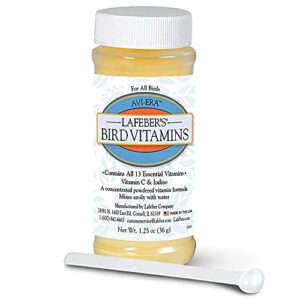
Lafeber AviEra covers all 13 essential vitamins your birds need, including vitamins A and D3 — the two most likely to be missing from seed-heavy diets.
Developed by avian veterinarians, this powder mixes into water or moist food without artificial colors or flavors.
One small scoop per two cups of water does the job daily; for food mixing, you’ll only need half that amount.
At 1.25 oz per container, it’s a clean, trustworthy option for keeping your whole flock nutritionally covered.
| Best For | Bird owners whose feathered friends are on seed-heavy or picky diets and need reliable daily vitamin support without the hassle. |
|---|---|
| Form | Powder |
| Target Species | All bird species, all ages |
| Key Benefit | Feather condition & health |
| Price | Not listed |
| Net Weight | 1.25 oz (35g) |
| Admin Method | Water or moist food |
| Additional Features |
|
- Covers all 13 essential vitamins plus A and D3 — the ones most commonly missing from seed-based diets
- Easy to give daily, just mix into water or moist food, no forcing it on your bird
- Developed by avian vets with no artificial colors or flavors, so you know what you’re putting in their bowl
- Powder can be slow to dissolve and may need extra stirring, or a second water bowl
- The measuring scoop is sometimes missing from the package, which is a small but annoying problem
- It’s a supplement, not a diet fix — you’ll still need vet check-ins and a well-rounded feeding routine
Choosing Vitamins for Mixed Flocks

Feeding a mixed flock isn’t one-size-fits-all — a macaw and a finch don’t share the same nutritional playbook. The right supplement depends on your birds’ sizes, diets, and what life stage they’re in right now.
Here’s what to look for when choosing vitamins that actually work for the whole flock.
Matching Supplements to Bird Size and Species
Not every bird in your aviary has the same nutritional demands—size, species, and metabolic rate differences matter enormously. Taxon-tailored formulas and size-based dosing aren’t optional extras; they’re how you avoid fat-soluble vitamin toxicity in smaller birds sharing space with larger ones. Ensuring a proper calcium‑to‑phosphorus ratio is essential for bone health and egg quality.
- Match labels to your species group, not just "all birds"
- Apply weight-adjusted portions for finches versus large parrots
- Account for age and size when scaling daily amounts
- Follow species-specific dosing guidelines for bird vitamins consistently
- Never layer multiple supplements without checking overlapping fat-soluble content
Filling Gaps in Seed-based Flock Diets
Seed-based diets look complete on paper, but the seed nutrient ratios tell a different story—your flock’s missing vitamins A, D3, B-complex, lysine, and methionine daily. Without essential vitamins for tropical bird health, chronic deficiencies quietly drive fatty liver prevention failures and obesity risk management problems.
Targeted seed-based diet supplementation closes those nutritional gaps in seed-based diets before clinical signs appear.
Supporting Breeding, Molting, and Stress Periods
Breeding, molting, and stress periods hit your flock hard—hormonal support, thermal regulation, and immune support all spike in demand simultaneously.
Egg food supplements for breeding birds should deliver calcium magnesium D3 alongside vitamins A and E for embryo viability. Your molting supplement needs extra protein supplementation and antioxidants.
Photoperiod management and stress reduction help lower circulating stress hormones, keeping recovery on track.
Selecting Formulas for Daily Flock Use
Once breeding and molt demands ease up, your daily routine becomes the foundation. Look for ingredient transparency—clear labeling of vitamin forms and dosage scalability per bird size.
Formulation compatibility matters when mixing species: verify shelf-life monitoring on packaging and run a quick cost-effectiveness analysis before committing. Consistent supplement dosage consistency, aligned with safety and regulations for avian supplements, keeps your flock covered without guesswork.
When Flock-wide Supplements Beat Individual Dosing
Group feeding efficiency and stress-free administration are where flock-wide supplementation truly earns its place. When you’re managing multiple birds, minimized dose variability beats chasing each bird down for individual treatment.
- Uniform nutrient distribution reaches assertive and timid birds alike
- Efficient scheduling keeps supplement dosage consistency easy
- Reduced handling aligns with guidelines for supplement use in multibird households
- Cost-effective supplementation for exotic birds improves long-term flock outcomes
Key Nutrients for Flock Health
Your birds can only thrive when they’re getting the right building blocks — and vitamins alone don’t tell the whole story. A well-rounded flock needs specific nutrients working together, from fat-soluble vitamins to probiotics and minerals.
Here’s what actually matters for keeping your flock strong and healthy.
Vitamin a for Vision, Immunity, and Feather Quality
Vitamin A is one of those nutrients that quietly does everything — supporting night vision, retinal regeneration, mucosal defense, and feather pigmentation all at once.
Without adequate vitamin A, your birds can develop cloudy eyes, dull feathers, and compromised immune modulation.
Think of it as the foundation of vision support and immune support for avian species, directly influencing feather quality from the follicle up.
Vitamin D3 for Calcium Absorption and Bone Strength
If vitamin A is the foundation, think of D3 as the contractor that actually gets calcium where it needs to go. Without adequate vitamin D3, intestinal calcium uptake stalls — even when your calcium supplement looks perfect on paper.
D3 drives bone remodeling balance and regulates calcium and phosphorus equilibrium in avian diets. This fat-soluble vitamin relies on fat-enhanced absorption, meaning pairing it with dietary fats is crucial for optimal uptake.
Carefully monitor D3 toxicity limits, as excessive intake poses risks despite its critical role in nutrient utilization.
Vitamin E for Reproduction and Antioxidant Protection
Think of vitamin E as your flock’s cellular shield. As a lipid-soluble antioxidant, it halts lipid peroxidation inhibition within membranes before oxidative damage spreads.
During breeding season supplementation, demand rises sharply — gamete oxidative defense depends on consistent intake. Egg yolk antioxidants transfer directly to embryos, delivering an embryo viability boost before their own defenses mature.
This bird dietary supplement enhances egg production support without vitamin toxicity risk when dosed correctly.
Vitamin K for Normal Blood Clotting
Without adequate vitamin K, your flock’s liver production mechanism stalls — clotting factor synthesis depends entirely on the gamma carboxylation process converting glutamic acid into calcium-binding residues. Factors II, VII, IX, and X become inactive without it.
Vitamin K recycling keeps this loop running continuously. Watch deficiency signs like prolonged bleeding after minor injuries, and make sure your vitamin supplementation maintains consistent avian health.
B-complex Vitamins for Energy and Nerve Function
B-complex vitamins are your flock’s mitochondrial cofactors — the quiet engines behind ATP production pathways and nerve myelination support. Thiamine hydrochloride, riboflavin, niacin, and pyridoxine hydrochloride all serve as energy metabolism enzymes that birds can’t bank for later.
- Thiamine drives carbohydrate conversion into usable fuel.
- Riboflavin facilitates electron-transfer chemistry for cellular energy.
- Pyridoxine allows neurotransmitter synthesis, preventing tremors and ataxia.
Keep B-complex consistent daily.
Calcium, Phosphorus, and Trace Mineral Balance
Bone integrity hinges on more than just calcium — your flock’s calcium-phosphorus ratio matters enormously. Aim for roughly 1.2:1; tipping that balance risks metabolic bone disease.
Phytate phosphorus binding in seed-heavy diets quietly steals absorption.
Zinc-phosphorus interaction and trace mineral synergy — via zinc oxide and manganese sulfate — directly reinforce hydroxyapatite formation.
Kidney electrolyte constraints mean excess phosphorus compounds cause problems fast.
| Mineral Issue | Flock Risk |
|---|---|
| Low calcium source for birds | Thin eggshells, fractures |
| Excess phytate phosphorus | Reduced calcium uptake |
| Zinc-phosphorus imbalance | Weakened bone matrix |
| Poor calcium and phosphorus balance in avian diet | Metabolic bone disease |
Amino Acids and Probiotics for Overall Condition
Your flock’s condition from the inside out starts in the gut.
- Gut Microbiome Balance — Probiotic powder shifts intestinal pH, crowding out pathogens
- Barrier Integrity Enhancement — Glutamine promotes rapid gut lining turnover
- Protein Synthesis Support — Essential amino acids fuel feather and muscle repair
- Feather Growth Optimization — Complete essential amino acid profile for birds drives keratin production
- Stress Resilience Boost — Digestive health stabilizes nutrient absorption under pressure
Best Delivery Methods in Aviaries
Getting vitamins into your birds consistently is half the battle, and how you deliver them matters just as much as what’s in the bottle. Every aviary setup is a little different, so the right method really depends on your flock size, feeding routine, and how picky your birds are.
Here are the delivery approaches that actually work in shared environments.
Powder Vitamins Mixed With Seed or Soft Food
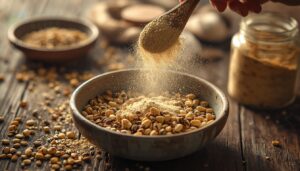
Powder vitamins work best when you commit to Uniform Mixing — don’t just dust the top of the bowl. For seed-based diets, Adhesion Techniques, like blending powder into a soft binder dramatically improve nutrient absorption compared to loose coating.
Moisture Management matters too: prepare small batches, and use Batch Timing to keep potency intact.
Spread fortified food across multiple stations for reliable Feeder Distribution.
Liquid Vitamins in Water for Small Flock Setups

Liquid multivitamins simplify your bird health regimen when you’re managing a small flock. Add them directly to a clean waterer — Mixing Uniformity depends on it.
Check Waterer Compatibility with your system, since residue blocks even doses. Replace treated water every 2–3 days for Stability in Water.
Small Flock Scaling is straightforward: most products dose per gallon, so Dosage Timing stays consistent with daily liquid supplementation.
Food-based Supplementation for Steadier Intake
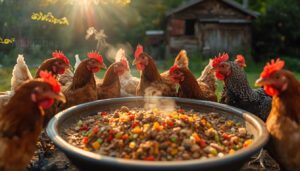
Mixing vitamins into soft food or wet mash beats water dosing when you want Batch Mixing Consistency across your whole flock. Food-based delivery suits seed-based diets especially well — just blend into a measured batch and offer it as the primary food during Group Feeding Timing windows.
Heat Stability Guidelines and serve promptly. Fermented Feed Benefits and Matrix Compatibility help close nutritional gaps safely.
Palatability and Intake Consistency Across Multiple Birds
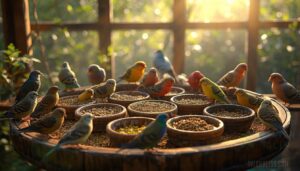
Getting Matrix Preference right matters more than most keepers expect. Birds don’t consume supplements uniformly — age-based palatability shifts mean younger birds may reject the same powdered vitamin that older birds accept readily.
Feeding Time Scheduling and Mix Homogeneity Techniques help narrow that gap. Competition Dynamics at shared feeders mean some birds eat first, others don’t, disrupting intake consistency across your seed-based diet flock.
Preventing Waste and Uneven Access in Shared Spaces
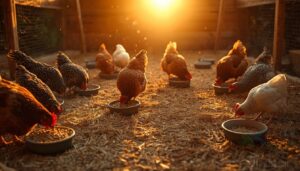
Even access starts with smart setup.
Multiple feeding stations break dominant-bird bottlenecks, while rotating bowl placement ensures no single bird claims first rights every day.
Portion-controlled dosing reduces leftovers that spoil or get wasted in bedding. Equitable dish design — shallow rims, non-slip bases — keeps weaker birds feeding confidently.
Stick to firm cleaning protocols, and your whole flock gets a fair share.
Safe Dosing and Product Evaluation
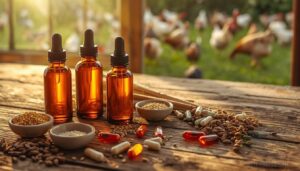
Getting the dose right can make or break your supplementation routine, and with a mixed flock, the margin for error is smaller than you’d think.
Fat-soluble vitamins, especially, don’t forgive careless measuring, so knowing what to watch for matters.
Here’s what you need to think about before you buy, dose, or store anything.
Species-specific Dosing for Flock Environments
No two birds in your flock metabolize vitamins the same way. Weight-based Scaling matters here — a finch and a cockatoo sharing a drinker won’t absorb equal doses. Species Metabolic Rates, Water Consumption Differences, and Seasonal Intake Variations all shift how much each bird actually gets.
Track accordingly:
- Match labels to species size categories
- Log Individual Dose Tracking per bird type
- Adjust for seed-based diet gaps regularly
Avoiding Fat-soluble Vitamin Toxicity
Fat-soluble vitamins — A, D3, E, and K — don’t flush out daily; they build quietly in liver and body fat. That’s why Vitamin Overlap Auditing matters: cross-check every product your flock receives.
Fat-soluble vitamins build silently in fat and liver, making supplement overlap your flock’s quietest threat
Fortified feeds plus a multivitamin can silently stack.
Use Feed Rotation Strategies and Flexible Dosing Adjustments to prevent accumulation, and keep a Toxicity Symptom Checklist — lethargy, appetite loss, weakness — ready.
Tracking Deficiency Signs Across The Flock
Spotting deficiency signs early means watching your whole flock, not just the birds acting sick. Use Feather Condition Scoring, Weight Trend Tracking, and Behavioral Observation together — they tell a fuller story.
Intake Monitoring and Dropping Analysis flag nutrient deficiencies before they escalate. When patterns persist, bloodwork confirms what your eyes suspect.
Early detection keeps bird health ahead of the problem.
Storage Practices That Protect Vitamin Potency
Your vitamins are only as good as how you store them. Use Airtight Containers and Light‑Proof Packaging to block oxidation and photo-degradation.
Cool Dark Storage slows chemical breakdown, while Moisture Control prevents clumping and potency loss.
Always use Dry Measuring Tools — wet scoops introduce humidity directly into the formula. These supplement safety and storage practices protect vitamin stability and your high‑potency formula concentration long-term.
Comparing Label Quality, Ingredients, and Value
Not all labels tell the same story. Check ingredient transparency first — ingredients are listed by weight, so if non-nutrient additives like maltodextrin appear early, that’s a red flag.
Nutrient quantification matters too; vague "multivitamin" claims without actual amounts make honest comparison of top bird multivitamins impossible. Always calculate cost per dose, not package price, and verify form stability and additive disclosure before committing.
When to Consult an Avian Veterinarian for Supplementation
Some situations call for more than good instincts — they call for a professional.
- Sudden illness like lethargy, vomiting, or neurologic signs within 72 hours of starting supplements needs immediate veterinary evaluation.
- Reproductive issues or mixed species risk in shared aviaries warrant bloodwork and veterinary exams before continuing any regimen.
- Monitoring deficiency signs matters — kidney disease or risks of vitamin toxicity in pet birds demand expert guidance.
Frequently Asked Questions (FAQs)
What vitamins do chickens need in the winter?
Like trees pulling inward for winter, your chickens shift their metabolism too.
Cold months demand vitamin D3, A, E, K, and B-complex to cover lost UVB exposure, immune barrier maintenance, and calcium absorption.
What is the best multivitamin for birds?
Nekton S Bird Multi Vitamin and Lafeber AviEra Bird Vitamin Powder top the list for complete avian vitamin and mineral supplement coverage — both offer ingredient transparency, veterinary endorsement, and solid shelf life stability.
Do seasonal changes affect flock vitamin requirements?
Yes — photoperiod influence, temperature intake shifts, molting nutrient surges, and reduced UVB exposure all alter your flock’s vitamin D3 needs and widen nutritional gaps in seed-based diets seasonally.
How do antibiotics interact with avian vitamin absorption?
Antibiotics work like a double-edged sword—clearing infection while disrupting gut microbiome balance, causing Microbial Vitamin Synthesis loss, Chelation Interference, pH Stability Shifts, and Gut Barrier Disruption.
Apply Timing Separation Strategies and probiotic benefits to restore nutrient bioavailability.
Which vitamins support feather regrowth after plucking?
Biotin Keratin synthesis, vitamin A follicle regeneration, vitamin E cellular repair, B-complex metabolic support, and vitamin C antioxidant protection all drive feather integrity and feather regeneration — with L-Lysine reinforcing structural protein rebuilding post-plucking.
Are organic vitamin sources safer than synthetic formulas?
Not a single ingredient—organic or synthetic—is automatically safer than the other. Purity Standards and Contaminant Testing matter far more than sourcing labels when protecting your flock’s avian health.
Conclusion
Think of your flock like a symphony—every species plays a different part, and avian vitamins for flock environments are the conductor keeping everyone in tune.
single overlooked deficiency can silence the whole performance.
You don’t need excellence, just consistency: right formula, delivered reliably, matched to your birds’ real needs.
When you get that balance right, you’ll hear it—in brighter plumage, stronger clutches, and a flock that genuinely thrives.
- https://zoomed.com/category/avian-products/vitamins/
- https://dyno.ca/produit/avian-plus-vitamin-and-mineral-supplement-for-birds-zoo-med/?lang=en
- https://www.aves-avian.com/vitamins-supplements.html
- https://birdbuddyguide.com/pet-bird-care/nutrition-diet/5-essential-nutrients-for-pet-birds/
- https://www.northernparrots.com/hagen-hari-prime-30g-vitamin-mineral-amino-acid-supplement/