This site is supported by our readers. We may earn a commission, at no cost to you, if you purchase through links.
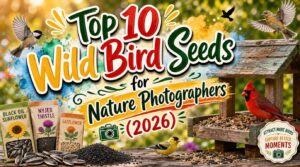
The difference between a forgettable bird photo and a frame-worthy shot often comes down to one variable you control before picking up your camera: what’s in the feeder. Black oil sunflower seeds draw 40+ species year-round, while Nyjer lures finches into predictable, repeatable placements. Safflower deters grackles, allowing cardinals to linger long enough to nail your focus.
Seed choice isn’t just about feeding birds—it’s about engineering your scene. Strategic selections transform a backyard setup into a controllable studio, where species behavior, perch dynamics, and lighting conditions align with your creative vision.
By tailoring seeds to target specific birds, photographers gain unprecedented control over their subjects’ movements and positioning. This deliberate approach ensures optimal framing opportunities, turning fleeting moments into capturable masterpieces.
Table Of Contents
- Key Takeaways
- Best Wild Bird Seeds for Photography
- Top 10 Wild Bird Seed Products
- 1. Lyric Supreme Wild Bird Seed
- 2. Audubon Park Cardinal Sunflower Safflower Seed
- 3. Wild Delight Bugs and Berries Bird Food
- 4. Blue Seal Wild Bird Seed
- 5. Lyric Fruit and Nut Bird Seed
- 6. Lyric Fine Tunes Bird Seed Mix
- 7. Audubon Park Cardinal Blend Bird Seed
- 8. Audubon Park Songbird Blend Birdseed
- 9. Audubon Park Wild Bird Seed Mix
- 10. Kaytee Songbird Wild Bird Seed
- Choosing Seeds by Bird Species
- Feeder Setups for Better Photos
- Positioning Feeders Near Natural Branch Perches
- Placing Feeders for Clean Morning Light
- Separating Feeder Types to Reduce Crowding
- Hiding Feeder Hardware With Natural Props
- Creating Safe Approach Routes With Shrubs
- Using Ground Feeding Areas for Natural Scenes
- Preventing Window Collisions Near Photo Stations
- Seed Quality, Storage, and Safety
- Frequently Asked Questions (FAQs)
- What is the 5 7 9 rule for bird feeders?
- What is the best bird seed for all wild birds?
- Why put a potato in your bird feeder?
- How does weather affect bird feeding activity?
- Which seasons offer the best bird photography?
- Can supplemental food attract rare migrating species?
- Do bird calls help draw subjects to feeders?
- How do predators impact feeder bird behavior?
- Conclusion
Key Takeaways
- Black oil sunflower seeds attract 40+ species year-round thanks to their 40–50% oil content, making them the single most effective seed for maximizing subject diversity at your feeder.
- Seed choice is a creative decision, not just a feeding one—safflower filters out grackles and squirrels so cardinals linger, while Nyjer concentrates finches in one predictable zone for repeatable, tight compositions.
- Feeder placement does as much work as seed selection—spacing stations 5–10 meters apart, positioning them at 4–6 feet high, and orienting them east for morning light turns a backyard into a controllable shooting environment.
- Fresh, filler-free seed stored below 15% humidity keeps birds returning consistently; cheap mixes with milo or wheat pile up uneaten, clutter your frame, and quietly kill your setup before you ever raise the camera.
Best Wild Bird Seeds for Photography
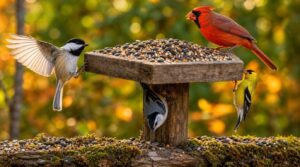
The seed you put out shapes every bird that shows up in your frame—get it wrong and you’re stuck photographing house sparrows all afternoon. Different seeds pull in different species, and a few smart choices can turn a quiet backyard into a busy portrait studio.
Planting the right mix is just as powerful—these seed-bearing plants that attract birds for photography can bring in far more interesting subjects than any feeder alone.
The seed you choose determines which birds fill your frame—choose wisely
Here are the seeds worth knowing about.
Black Oil Sunflower Seeds for Diverse Bird Portraits
Black oil sunflower seed is the single best starting point for feeder photography. With 40–50% high oil content by weight, these nutrient-dense seeds fuel oil-rich energy reserves that keep birds active and perched longer. Thin-shell accessibility means even small-beaked species can crack them easily, driving multi-species feeding and strong bird visitation rates year-round.
During winter, heated birdbaths provide water to keep birds hydrated even when natural sources freeze.
Why photographers love them:
- Attract cardinals, chickadees, nuthatches, finches, and woodpeckers simultaneously
- High oil content promotes feather health and plumage vibrancy—better portraits
- Year-round appeal keeps your station consistently active in any season
- Species diversity means you’re never waiting long for your next shot
Nyjer Seed for Finches and Siskins
Where black oil sunflower draws a crowd, Nyjer seed pulls in specialists. That high oil content—roughly 35–40% fat per seed—makes Nyjer seeds energy-rich food built for cold-weather finch flock dynamics.
Small-port feeder design keeps larger birds out, concentrating goldfinch and siskin activity in one predictable zone.
Seasonal seed demand spikes sharply in winter, so keep your supply fresh and your camera ready.
Safflower Seed for Calmer Cardinal Setups
Finches demand precision. Cardinals reward patience—and safflower seeds are your best tool for earning it. That hard shell slows feeding down, stretching each visit long enough to hone your focus. The mild bitterness keeps grackles and starlings away, leaving cleaner, calmer frames.
- Mount feeders at mid-height—3 to 4 feet—for feeder height optimization and relaxed cardinal posture
- Space perches wide to eliminate crowding and aggressive posturing
- Use cardinal perch design with natural wood for authentic-looking portraits
- Time sessions around morning and late afternoon for low-light feather contrast on red plumage
- Rely on seasonal feeding timing—safflower seed demand peaks in winter when cardinals need nutrient-dense seeds most.
Striped Sunflower Seeds for Larger Birds
Safflower filters the scene, while striped sunflower seeds expand it. The shell thickness impact is real: smaller beaks struggle to crack them, shifting the visitor list to jays, woodpeckers, cardinals, and grosbeaks instead of sparrows. These seeds offer energy density benefits, making them ideal for winter feeding when birds linger longer over nutrient-rich options.
The following birds excel at accessing striped sunflower seeds due to specialized beak adaptations:
| Bird | Beak Adaptation |
|---|---|
| Blue Jay | Strong, crushing beak |
| Red-bellied Woodpecker | Chisel-point precision |
| Northern Cardinal | Thick conical cracker |
| Rose-breasted Grosbeak | Heavy seed-splitting bill |
| Nuthatch | Short, forceful wedge |
Cache behavior kicks in fast—jays grab extras and stash them elsewhere, returning repeatedly. For optimal setup, use hopper feeders to accommodate these seeds. During winter, the high-fat content keeps birds visiting long enough for sharp, well-lit photography opportunities.
Millet for Ground-feeding Photo Subjects
Ground-level action starts with millet scattering techniques for clean compositions. Begin by scattering white proso millet to attract birds while maintaining natural foraging cycles.
To optimize results:
- Use Minimal Millet Quantities to keep foraging cycles steady
- Exploit Ground Texture Contrast with leaf litter backdrops
- Rotate Seasonal Millet Varieties for species diversity
- Observe Bird Foraging Behaviors—heads lift right after pecking, creating natural eye contact
Sparrows, doves, and juncos reward the patient birdwatching photographer with dynamic interactions.
Seed Blends Versus Single-seed Feeding Strategies
Choosing between a seed blend and a single seed setup is like deciding between a buffet and a specialty restaurant—both work, but for different goals.
| Strategy | Best For |
|---|---|
| Blend Diversity Benefits | Multiple species, energetic sessions |
| Single Seed Predictability | Targeted portraits, consistent behavior |
| Seasonal Strategy Flexibility | Migrating species, shifting populations |
| Cleanup Efficiency Contrast | Single seeds win on maintenance |
High-quality blends optimize species diversity; single seeds sharpen your focus.
Top 10 Wild Bird Seed Products
Not every seed bag pulls double duty as a photography tool, but the right ones absolutely do. These 10 products were chosen for their ability to draw the species you actually want in front of your lens.
With minimal filler and maximum bird activity, each one ensures optimal results at the feeder. Let’s look at what each brings to the table.
1. Lyric Supreme Wild Bird Seed
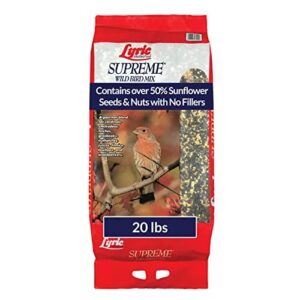
Lyric Premium packs a lot into one bag — and that’s exactly why it earns a top spot. The blend contains more than 50% black oil sunflower seed, layered with safflower, nyjer, white proso millet, and shelled peanuts. This diverse mix attracts chickadees, jays, cardinals, finches, and woodpeckers to a single feeder, making it a versatile choice for bird enthusiasts.
The absence of milo ensures less waste and a cleaner ground beneath your setup, addressing a common frustration with generic mixes.
At $30.99 for 20 lbs, Lyric Premium costs more than standard blends. However, the bird diversity it delivers justifies the investment, offering exceptional value for wildlife observers.
| Best For | Backyard bird lovers who want to attract a wide variety of songbirds with one quality blend and don’t mind paying a little extra for it. |
|---|---|
| Weight | 20 lb |
| Price | $30.99 |
| Feeder Compatibility | Tube, hopper, tray, window |
| Filler Free | Yes |
| Squirrel Deterrence | Low |
| Life Stage | All stages |
| Additional Features |
|
- Over 50% sunflower seeds plus a diverse mix of nuts and seeds draws in a great range of birds — cardinals, jays, woodpeckers, finches, and more
- No milo means less waste on the ground and fewer weeds sprouting under your feeder
- Works with pretty much any feeder style, so no need to juggle multiple seed types
- At $30.99 for 20 lbs, it’s pricier than most store-brand blends
- Peanuts and tree nuts can bring unwanted guests like squirrels and rodents to the party
- The 20 lb bag is heavy and seed spillage can mean more cleanup around your feeder area
2. Audubon Park Cardinal Sunflower Safflower Seed
 View On Amazon
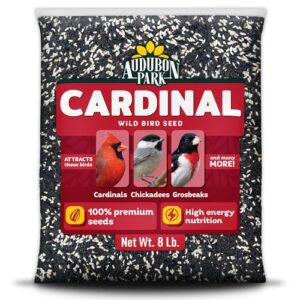
Cardinals linger in this blend, not just visit. Audubon Park’s 8-lb Cardinal Sunflower Safflower mix ($13.85) combines black oil sunflower seeds with shell-free safflower, creating a high-fat, low-waste setup that keeps vibrant birds perched longer—ideal for photographers seeking extended shooting opportunities.
To keep those cardinals coming back healthy, stay on top of feeder cleaning and bird disease prevention—shell-free mixes mean less debris and fewer bacteria hotspots.
The safflower component naturally deters squirrels and grackles, ensuring a cleaner, distraction-free environment. Meanwhile, the mix reliably attracts chickadees, grosbeaks, and titmice, adding diversity to your avian visitors.
Its versatility shines through compatibility with tube, tray, and platform feeders, seamlessly integrating into nearly any backyard setup or photography station.
| Best For | Backyard birders and bird photographers who want to attract colorful songbirds like cardinals and limit squirrel interference. |
|---|---|
| Weight | 8 lb |
| Price | $13.85 |
| Feeder Compatibility | Tube, tray, hopper, platform |
| Filler Free | Yes |
| Squirrel Deterrence | High |
| Life Stage | All stages |
| Additional Features |
|
- Shell-free safflower keeps feeders cleaner with less mess and wasted seed
- Naturally deters squirrels, so more seed goes to the birds you actually want
- Works with almost any feeder type — tube, tray, hopper, platform, you name it
- Pricier per pound than your typical bargain seed mix
- No corn, milo, or millet, so some species just won’t be interested
- An 8-lb bag might be more than you need if you only feed occasionally
3. Wild Delight Bugs and Berries Bird Food
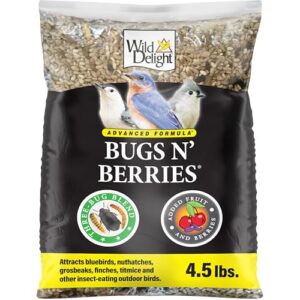
Most seed mixes ignore insect-eaters entirely. Wild Delight Bugs N’ Berries fixes that. At $11.99 for 4.5 lb, this no-filler blend combines dried black soldier fly larvae, mealworms, and darkling beetles with mixed berries—no millet, milo, or corn to push around.
That protein-berry combination pulls in bluebirds, wrens, robins, and grosbeaks—species you won’t see clustering around a standard sunflower feeder.
The result? Longer perch times, more varied subjects, and cleaner trays.
For photographers wanting something different in the frame, this one earns its spot.
| Best For | Bird photographers and backyard birders who want to attract a wider variety of insect-eating species beyond the usual finch-and-sparrow crowd. |
|---|---|
| Weight | 4.5 lb |
| Price | $11.99 |
| Feeder Compatibility | Standard feeders |
| Filler Free | Yes |
| Squirrel Deterrence | Low |
| Life Stage | All stages |
| Additional Features |
|
- Three-bug blend (black soldier fly larvae, mealworms, darkling beetles) brings in bluebirds, wrens, robins, and other species most seed mixes miss
- No filler grains—every bite counts, with added vitamins and minerals for all life stages
- Resealable, see-through bag makes storage and monitoring leftovers genuinely easy
- At $11.99 for 4.5 lb, you’re paying more per pound than a standard seed mix
- Contains artificial flavor, which may be a dealbreaker if you prefer a clean ingredient list
- Squirrels will likely show interest, so a sturdy or squirrel-resistant feeder is worth the investment
4. Blue Seal Wild Bird Seed
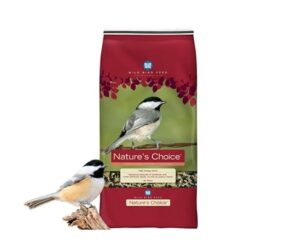
Blue Seal’s Nature’s Choice blend is built around what actually works: black oil sunflower and white safflower as the foundation, with striped sunflower, sunflower chips, and no filler seeds crowding the bag.
The added orange oil keeps seeds fresh and aromatic—small detail, real difference.
Cardinals, finches, chickadees, and nuthatches all respond well to this mix.
It comes in a 40 lb bag, making it a cost-effective option for photographers running feeders through long winter sessions.
| Best For | Backyard birders and wildlife photographers who want a low-waste, shell-free mix that attracts a wide variety of songbirds through the winter months. |
|---|---|
| Weight | 8 lb |
| Price | $20.31 |
| Feeder Compatibility | Tube, hopper, tray, platform |
| Filler Free | Yes |
| Squirrel Deterrence | Low |
| Life Stage | All stages |
| Additional Features |
|
- Shell-free blend means less mess under the feeder and more of what birds actually eat
- High-energy seeds like black-oil sunflower and safflower draw popular species like chickadees, nuthatches, and titmice
- No filler seeds means the bag goes further and birds aren’t picking around the stuff they don’t want
- Fine cracked corn gets ignored by many birds, so you may end up with waste despite the "no filler" marketing
- Sunflower seed proportion may be lower than competing blends, which could make it less appealing to heavy sunflower eaters
- Subscription pricing can be inconsistent—what you pay on your first order might not match later deliveries
5. Lyric Fruit and Nut Bird Seed
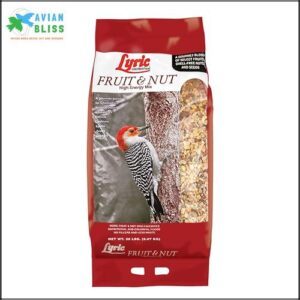
If cost-per-pound matters, the Lyric Fruit and Nut mix earns its $40.70 price tag. At nearly 20 lbs, it packs shelled peanuts, almonds, pecans, cashews, pistachios, dried cranberries, raisins, sunflower kernels, and pumpkin seeds into one bag—zero filler.
This ingredient list attracts cardinals, woodpeckers, jays, waxwings, and chickadees to the same feeder.
The dried fruit adds visible color contrast at close focus distances, while larger nut pieces keep birds perched longer, giving you more time to nail the shot.
| Best For | Bird photographers and backyard watchers who want to pull in a wide variety of species without dealing with filler seed waste. |
|---|---|
| Weight | 19.75 lb |
| Price | $40.70 |
| Feeder Compatibility | Hopper, tray, tube, mesh |
| Filler Free | Yes |
| Squirrel Deterrence | Low |
| Life Stage | All stages |
| Additional Features |
|
- Pure nuts, seeds, and dried fruit — no filler means birds actually eat what’s in the feeder
- Attracts a great mix of species (cardinals, woodpeckers, jays, waxwings, and more) all at once
- Larger nut pieces keep birds perched longer, giving you a better chance to watch or photograph them
- Big pieces can clog feeders with small slots or mesh openings
- Squirrels love it just as much as the birds do, so a squirrel-proof feeder is pretty much a must
- At $40.70 a bag, it costs more than basic seed mixes — frequent feeders will feel that over time
6. Lyric Fine Tunes Bird Seed Mix
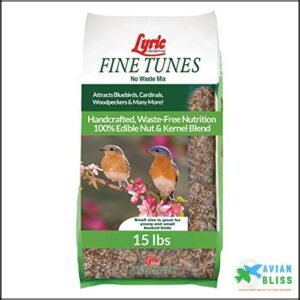
Where the Lyric Fruit and Nut mix leans on variety, the Lyric Fine Tunes ($39.04 for 15 lbs) bets on precision. Every ingredient—peanut pieces, sunflower kernels, almond and pistachio pieces, hulled millet, shelled pumpkin seeds—is hull-free.
This eliminates waste on the ground and visual clutter below your frame, crucial for tight compositions.
Chickadees, finches, bluebirds, and cardinals consistently visit, drawn to the finely cut pieces that flow through tube feeders without jamming, ensuring steady, predictable bird activity.
| Best For | Bird photographers and backyard birders who want a clean, mess-free feeding setup that draws in a wide variety of small-beaked species like chickadees, finches, and cardinals. |
|---|---|
| Weight | 15 lb |
| Price | $39.04 |
| Feeder Compatibility | Tube, hopper, tray |
| Filler Free | Yes |
| Squirrel Deterrence | Low |
| Life Stage | All stages |
| Additional Features |
|
- Completely hull-free mix means zero shell debris under your feeder—great for keeping things tidy.
- Finely cut pieces work well in tube and hopper feeders without clogging, so you get steady bird traffic.
- Attracts a solid range of species, from bluebirds to woodpeckers, including migratory birds passing through.
- At $39.04 for 15 lbs, it’s noticeably pricier than most standard seed mixes on the market.
- Millet tends to be the last thing birds eat, so the bottom of the bag can sit untouched for a while.
- Larger nut pieces may attract unwanted visitors like starlings, and the tiniest birds can struggle to handle them.
7. Audubon Park Cardinal Blend Bird Seed
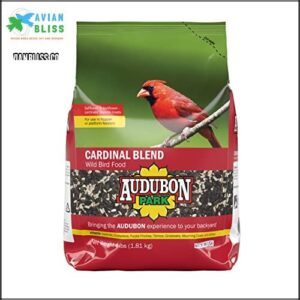
If Audubon Park Cardinal Blend (model 12231, $7.99 for 4 lbs) prioritizes focus, its simplicity defines it: two seeds only—black-oil sunflower and safflower—with no filler, no surprises. This deliberate composition delivers results, as Cardinals, chickadees, titmice, and finches arrive swiftly, often within a day.
The blend’s safflower content naturally deters squirrels, maintaining a cleaner feeder frame and calmer avian visitors. This design ensures minimal disruption, letting birds feed undisturbed.
With a fat content of around 33%, the seeds provide sustained energy, encouraging birds to linger longer at the feeder. These extra moments offer photographers critical time to capture the perfect shot, transforming fleeting visits into framed precision.
| Best For | Backyard bird watchers who want to attract cardinals and songbirds without dealing with squirrels or filler seeds cluttering the feeder. |
|---|---|
| Weight | 4 lb |
| Price | $7.99 |
| Feeder Compatibility | Hopper, tube, platform |
| Filler Free | Yes |
| Squirrel Deterrence | High |
| Life Stage | All stages |
| Additional Features |
|
- Two-seed blend with no fillers means birds get straight nutrition — and cardinals, chickadees, and finches tend to show up fast, sometimes within a day.
- Safflower naturally puts squirrels off, so you spend less time chasing them away and more time actually watching birds.
- High fat content keeps birds energized, especially through winter, and encourages longer visits at the feeder.
- At $7.99 for 4 lbs, it costs more per pound than most generic seed mixes — it adds up if you’re refilling often.
- No millet, nyjer, or cracked corn means birds that prefer those seeds won’t get much out of this blend.
- Squirrels may still give it a shot despite the safflower — it’s a deterrent, not a guarantee.
8. Audubon Park Songbird Blend Birdseed
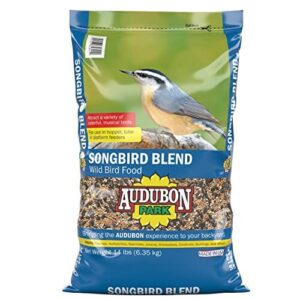
Where the Cardinal Blend keeps things minimal, the Audubon Park Songbird Blend (model 12241, $17.97 for 14 lbs) goes broad. Its seven ingredients—white proso millet, black oil sunflower, cracked corn, safflower, hull-free chipped sunflower, peanuts, and striped sunflower—work together to pull in finches, cardinals, juncos, chickadees, nuthatches, and sparrows into your frame.
This species range means more composition options across a single session. The blend runs equally well in hopper, tube, and platform feeders, ensuring you’re not locked into one setup.
| Best For | Backyard birders and wildlife photographers who want to attract a wide mix of songbird species year-round without juggling multiple seed types. |
|---|---|
| Weight | 14 lb |
| Price | $17.97 |
| Feeder Compatibility | Hopper, tube, platform |
| Filler Free | No |
| Squirrel Deterrence | Low |
| Life Stage | All stages |
| Additional Features |
|
- Seven-seed blend draws in a big variety of birds—cardinals, finches, chickadees, juncos, and more—all to one spot.
- Works with hopper, tube, and platform feeders, so you’re not stuck buying new equipment.
- Great for year-round feeding, keeping bird activity steady no matter the season.
- At $17.97 for 14 lbs, it runs a bit pricier than some competing mixes.
- Sunflower hulls can pile up under your feeder and make a mess over time.
- Peanuts in the mix may attract squirrels, which could crowd out the birds you actually want to see.
9. Audubon Park Wild Bird Seed Mix
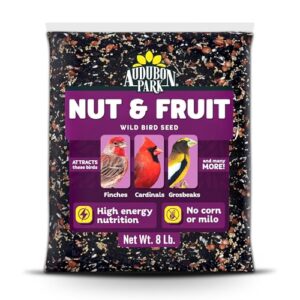
The Audubon Park Wild Bird Seed Mix packs a lot into 8 lbs. Sunflower seeds—black oil, striped, and hearts make up over half the blend, supported by peanuts, safflower, millet, raisins, and dried papaya. This fruit-and-nut combination attracts orioles, Cedar Waxwings, cardinals, woodpeckers, and chickadees.
The mix works cleanly in tube, hopper, tray, and platform feeders. One limitation: fruit pieces settle toward the bottom, so shake the bag before filling to ensure even distribution.
| Best For | Backyard birders who want to attract a wide variety of birds—from cardinals and woodpeckers to orioles and chickadees—with one versatile, nutrient-rich mix. |
|---|---|
| Weight | 8 lb |
| Price | Not listed |
| Feeder Compatibility | Tube, tray, hopper, platform |
| Filler Free | No |
| Squirrel Deterrence | Low |
| Life Stage | All stages |
| Additional Features |
|
- Sunflower seeds make up more than half the blend, giving you a solid base that appeals to tons of bird species
- The added fruit (raisins and dried papaya) brings in birds you wouldn’t normally see at a basic seed feeder
- Works with almost any feeder type—tube, hopper, tray, platform, you name it
- Fruit pieces sink to the bottom of the bag, so you’ll need to shake it up before each fill
- Peanuts and tree nuts are a handling risk if you have nut allergies
- It’s pricier than basic mixes, and squirrels will absolutely find it
10. Kaytee Songbird Wild Bird Seed
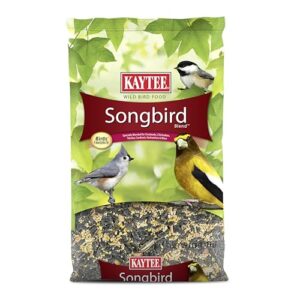
Kaytee Songbird Wild Bird Seed keeps things simple—and that’s exactly why it works. The 7 lb bag combines black oil sunflower seeds, millet, cracked corn, and peanuts into a 22–23% crude fat blend designed for year-round energy. Cardinals, chickadees, finches, and nuthatches frequently visit, drawn to the nutritious mix.
Larger shells do create ground waste, so plan your cleaning routine accordingly.
It fits hopper, tray, and platform feeders cleanly, offering a low-commitment way to maintain consistent activity at your feeding station. At $13.49, it’s an accessible choice for bird enthusiasts.
| Best For | Backyard birdwatchers who want to attract a solid variety of songbirds—cardinals, chickadees, nuthatches, and more—without overthinking their feeder setup. |
|---|---|
| Weight | 7 lb |
| Price | $13.49 |
| Feeder Compatibility | Hopper, tray, platform |
| Filler Free | No |
| Squirrel Deterrence | Low |
| Life Stage | All stages |
| Additional Features |
|
- Pulls in a wide range of songbirds thanks to a well-rounded mix of sunflower seeds, millet, peanuts, and cracked corn
- Works with hopper, tray, and platform feeders, so it fits whatever you’ve already got
- High fat content gives birds the energy boost they need, especially through colder months
- Large sunflower shells pile up fast on the ground, so you’ll need to clean up more often
- Tiny finches and smaller birds may skip it since the mix leans toward bigger seeds
- Dominant birds like cardinals and jays can crowd out smaller species at the feeder
Choosing Seeds by Bird Species
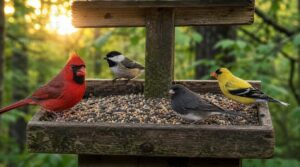
Different birds are picky eaters, and knowing what each species prefers puts the right subjects in front of your lens. Seed choice is really just targeting—pick the wrong one and you’re waiting all afternoon for a shot that never comes.
Here’s a breakdown of the best seeds for each bird group you’re likely trying to photograph.
Best Seeds for Cardinals
Northern Cardinals are creatures of habit—and that habit runs on fat. Safflower seeds and black oil sunflower seeds are your two non-negotiables: both are nutrient-dense seeds that match their strong beaks perfectly.
Set Cardinal Perch Height at 5–6 feet, use Ground Feeding Zones with white millet below, and practice Seasonal Seed Rotation to keep visits predictable.
Energy-Dense Seeds equal longer perch times—longer perch times equal sharper shots.
Best Seeds for Finches and Goldfinches
Finches are picky eaters—and that precision works in your favor. Nyjer seeds hit roughly 30% fat and 20% protein, delivering the nutrient density goldfinches seek during seasonal rotation cycles. White proso millet naturally attracts ground feeders.
For feeder efficiency and feather health, keep these on hand:
- Nyjer in small-port tube feeders
- Fresh black oil sunflower seeds—check plumpness as freshness indicators
- White proso millet scattered below
- Safflower for species variety
Best Seeds for Chickadees and Titmice
Chickadees and titmice are built for precision—they grab, fly, and shell seeds in seconds. Black oil sunflower seeds are your best starting point: their thin shells make them easy-husk varieties both species process effortlessly.
Add safflower seeds for a calmer feeder environment. A winter energy mix using fat-dense seeds keeps visits consistent when temperatures drop and photoperiod activity peaks.
Best Seeds for Jays and Woodpeckers
Jays and woodpeckers reward patience—and the right seed stack. Black oil sunflower seeds give both species quick cracking access without effort. Shelled peanuts hold them at the feeder longer, giving you extra frames.
Add thick-shell sunflower and safflower seeds on a platform feeder to filter out smaller birds. This setup ensures larger species dominate the feeding area.
Cold-weather suet and a High Energy Wild Bird Seed Mix keep them coming back reliably. These options provide essential nutrients during harsh seasons, boosting visitation consistency.
Best Seeds for Sparrows, Doves, and Juncos
White proso millet is the anchor seed for sparrows, doves, and juncos. Scatter it in millet scatter zones beneath elevated feeders, and ground-feeding behavior becomes immediate.
Dove ground trays concentrate mourning doves predictably, ensuring targeted feeding.
Juncos’ winter blends lean toward small millet and chopped corn, catering to their seasonal preferences.
House sparrows respond well to sparrow perch proximity—shrubs within 6 feet tighten composition fast.
Using Multiple Seeds to Increase Species Variety
Sticking to one seed type limits your frame. Multi-seed microhabitats pull in 3–5 additional species by covering complementary feeding niches—ground, branch, and shrub levels simultaneously. Seasonal seed rotation keeps that variety shifting as species move through the area.
Think of it as balancing seed proportions like a recipe: the right blend formulation turns a quiet feeder into a genuinely diverse, unpredictable scene worth waiting for.
Matching Seed Choices to Local Bird Populations
Regional seed preferences shift faster than most photographers expect. Adding nyjer can boost attendance by 40 percent during migration windows.
Local species monitoring reveals which habitat-specific blends are effective.
Climate-adapted feeding—rotating safflower in winter, millet in summer—keeps your station productive year-round.
Match your seed to what’s moving through, and your frame fills itself.
Feeder Setups for Better Photos
Where you place your feeder matters just as much as what you put in it. A few smart setup choices can mean the difference between a cluttered snapshot and a shot worth printing.
Here’s what actually works: thoughtful placement and strategic adjustments transform ordinary results into standout images.
Positioning Feeders Near Natural Branch Perches
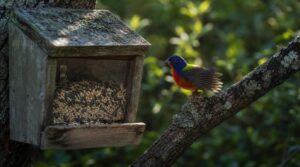
The feeder is just half the setup—where you place the perch decides the shot. Keep your perch distance between 2 and 6 feet from the feeder, using branches with rough bark texture for stable footholds. A 20–40 degree branch inclination opens up expressive postures.
- Anchor branches securely within 2–6 feet
- Use rough-barked, irregular vertical perches
- Position near shrubs for predator shelter and escape routes
- Keep backdrop clear for clean subject isolation
Placing Feeders for Clean Morning Light
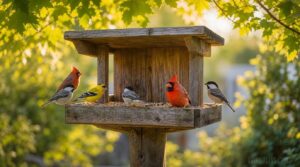
Light makes or breaks the shot. Eastward Feeder Orientation puts soft morning sun at your back, not in your lens. Aim for Ideal Feeder Height between 4 and 6 feet—birds settle naturally, you shoot level.
| Element | Recommendation | Why It Works |
|---|---|---|
| Soft Shade Cloth | Partial canopy above feeder | Prevents seed overheating, diffuses harsh rays |
| Reflector Placement | Offset 45° from subject | Bounces fill light onto plumage shadows |
| Minimal Background | Muted greens, pruned branches | Isolates bird color cleanly |
Feeder placement optimization starts with sightlines—your bird feeding station needs open sky approach angles for birdwatching and framing both.
Separating Feeder Types to Reduce Crowding
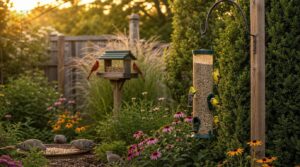
Crowding kills shots. Space your tube feeder placement and hopper feeder spacing at least 5–10 meters apart—that single move breaks up dominance by aggressive species.
Height differentiation matters too; ground versus hanging seed offerings pull different birds to different levels simultaneously.
Species-specific stations using safflower, Nyjer, or sunflower reduce competition naturally.
Designing multifeeder setups with visual barriers between zones gives you cleaner, calmer compositions.
Hiding Feeder Hardware With Natural Props

Disguising hardware transforms your setup into a scene that looks genuinely wild.
- Branch Camouflage – Weave flexible twigs loosely around the feeder housing
- Bark Disguise – Wrap housings in burlap with bark patterns for natural feeder placement
- Leaf Shroud – Layer evergreen clusters above ports for bird-friendly backyard depth
- Ground Mulch Ring – Scatter pine needles to blend the base into garden wildlife enrichment
- Stone Fern Shield – Stack flat stones with ferns for a cohesive stone fern shield effect
Creating Safe Approach Routes With Shrubs
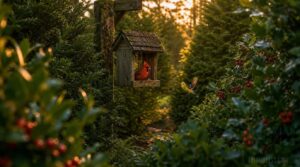
Plant dense evergreen barriers 2–4 meters from your feeder to build a natural shrub screening corridor birds trust. A 3–4 foot low hedge creates pathway camouflage that reduces open-space anxiety in approaching birds.
Seasonal pruning keeps a 3-foot passage clear without compromising predator concealment.
Use native species like juniper or holly—tight branching delivers year-round cover for outdoor bird habitat enhancement and cleaner, undisturbed shots.
Using Ground Feeding Areas for Natural Scenes
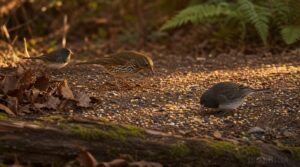
Ground feeding flips the script entirely. Scatter seeds using the Seed Scatter Technique—thin, irregular layers across bare soil—to trigger natural Bird Movement Patterns: slow treads, grain nudges, deliberate pauses.
Ground Texture Contrast between soil and seed helps your autofocus lock faster. A Sunlit Patch Spotlight draws birds into the frame naturally.
Add Natural Prop Perches nearby, and ground versus hanging seed offerings together pull sparrows, thrushes, and juncos simultaneously.
Preventing Window Collisions Near Photo Stations
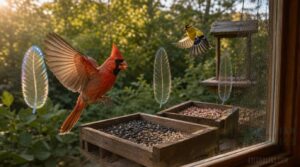
Window collisions can quietly undo your best feeder setup. Space decals no more than 2 inches apart, or apply UV film—birds see it clearly, you barely notice it. Netting barriers cushion impacts without blocking your frame.
Keep feeders either within 3 feet of glass or beyond 10 yards—no middle ground. Control lighting at dawn to cut dangerous reflections near your station.
Seed Quality, Storage, and Safety
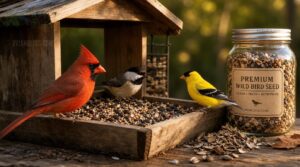
Good seed doesn’t stop at the bag—how you store and handle it matters just as much as what’s in it. Bad seed drives birds away and ruins your setup before you even pick up the camera.
To maintain an effective feeding station, focus on cleanliness and freshness. Keep your feeders clean, fresh, and working in your favor by monitoring seed quality and storage practices.
Checking Seed Freshness Before Feeding
Fresh seed is the difference between a thriving feeder and an empty perch. Before filling up, run these three quick checks:
- Expiry Label Review — discard anything past date
- Visual Mold Scan — reject powdery or discolored seeds
- Sample Size Inspection — test 20 seeds for firmness
A quick Germination Trial and Moisture Spot Check confirm seed oil retention and viability above 70%.
Avoiding Moldy, Damp, or Spoiled Seed
Visible mold—fuzzy white, green, or black filaments—signals seed moisture content has crossed the danger zone. Even perfectly fresh seed can turn bad quickly, making vigilance essential.
Humidity monitoring keeps internal storage RH below 15 percent, a critical threshold for preservation. Pre-storage drying for 24–48 hours significantly reduces mold growth, addressing risks before they escalate.
Ventilated containers and desiccant use together form the strongest defense against preventative failures that lead to feeder waste and missed opportunities. This dual approach ensures long-term seed viability.
Storing Seed in Airtight Containers
Once mold risk is addressed, your next move is locking in freshness long-term.
Seed oil content—what birds actually need—degrades fast without proper seed storage.
- Glass jars or metal tins deliver temperature stability and block light
- Vacuum sealing extends seed shelf life by removing air exposure
- Desiccant inclusion fights moisture between fills
- Label rotation tracks material durability and purchase dates
Reducing Hull Waste and Feeder Mess
Hull waste builds up faster than you’d think—and a cluttered feeder zone ruins clean compositions.
Hull Catcher Trays cut ground debris by up to 70 percent. Single-Seed Feeders significantly reduce spillage. Shelled Seed Options eliminate hulls entirely. Weekly Hull Cleaning prevents mold. Mulch Barrier Zones contain scatter.
For serious feeder maintenance and hygiene, no mess seed reduces waste and spoilage in backyard feeding setups worth photographing.
Avoiding Low-value Filler Ingredients
Cheap mixes are the silent enemy of a clean feeder shot. If the label lists wheat, milo, or red millet near the top, put it back. Birds reject these fillers, seeds pile up, and your setup turns into a mess fast. Stick to filler-free labeling and targeted high-quality blends.
- Choose single seed blends or no-grain mixes with ingredient transparency—two to four nutrient-dense seeds maximum.
- Exclude millet-heavy products when targeting cardinals or finches; reducing waste starts at the bag.
- Opt for multiple seed types only when each one fulfills a specific species goal.
Cleaning Feeders for Healthier Bird Activity
A dirty feeder doesn’t just look bad—it actively harms the birds you’re trying to photograph. Weekly disinfection keeps pathogens from spreading fast between visits.
| Task | Bleach vs Vinegar | Drying Techniques |
|---|---|---|
| Scrub surfaces | Bleach (10% solution, 10 min) | Air dry fully before refilling |
| Material-specific cleaning | Vinegar (50/50) for wood | Towel-pat metal; air-dry plastic |
| Cleaning schedule | Weekly during wet seasons | Dry in sunlight when possible |
| Port/perch cleaning | Bottle brush + either solution | Confirm zero moisture in ports |
| Feeder maintenance | Rotate two feeders | Never refill a damp feeder |
Consistent feeder hygiene and bird disease prevention strategies protect your subjects and keep your setup photo-ready.
Choosing Premium Seed for Long Photo Sessions
Picking premium seed isn’t just smart—it’s what keeps birds coming back flock after flock. Seeds lose their aroma within 6–9 months, so shelf-life planning matters. Oxygen-blocking packaging preserves oils and retains aroma longer, while consistent seed size prevents feeder clogs.
High-quality blends packed with nutrient-dense, energy-rich food drive species diversity straight to your lens.
- Choose seeds with clear purity labels and no filler grains
- Prioritize oxygen-limiting packaging for maximum seed freshness over long periods
- Rotate stock every 6 months to keep natural oils—and bird visits—consistent
Frequently Asked Questions (FAQs)
What is the 5 7 9 rule for bird feeders?
The 5-7-9 rule covers ideal feeder placement: mount feeders 5 feet high for elevation guidelines, position them 7 feet from structures for safety spacing and predator deterrence, and maintain 9 feet of clearance below overhead obstacles to limit squirrel access.
What is the best bird seed for all wild birds?
Feed one bird well, and you feed your whole yard. Black oil sunflower seeds — with roughly 40% fat and 16% protein — are your best all-species blend for maximum species diversity.
Why put a potato in your bird feeder?
Cooked potato chunks give birds an energy boost on cold mornings—think of it as winter warmth on a plate.
Plain, unsalted pieces support bird health through ground foraging, adding texture variety alongside your regular seeds.
How does weather affect bird feeding activity?
Cold snaps trigger sharp spikes in feeder visits as birds burn more calories staying warm.
Snow clustering, rainy day feeding surges, and wind-protected feeders all shape when and where birds show up.
Which seasons offer the best bird photography?
Spring bird migration and Fall migration bring peak species variety.
Summer plumage pops brightest for portraits. Winter silhouettes shine against snow.
Each season shifts your seasonal backdrops and shapes your best shots.
Can supplemental food attract rare migrating species?
Yes — the right supplemental food genuinely attracts rare migratory birds. Oil-rich seeds fuel migratory birds during stopovers, and varied seed types aligned with species-specific preferences can dramatically increase the variety of species visiting your station.
Do bird calls help draw subjects to feeders?
Bird calls do work. Pairing species-specific calls with feeders during dawn windows attracts more subjects faster.
Keep playback ethics in mind—short intervals, natural pauses, low-volume management.
Results improve noticeably.
How do predators impact feeder bird behavior?
Predator cues cut feeder visits by up to 40%. Hawks trigger instant departures; cats cause jittery, hesitant hops.
Cover-based feeder design with dense shrubs restores bird confidence and keeps your subjects returning within minutes.
Conclusion
The best camera is the one you have with you—but the best shot belongs to the photographer who prepared the scene. Choosing the right wild bird seeds for nature photographers isn’t luck; it’s strategy.
Black oil sunflower seeds pull 40+ species, creating dynamic, diverse frames. Nyjer locks finches into predictable perches, ensuring reliable compositions. Safflower clears the clutter, inviting cardinals to linger in uncrowded settings.
Every seed decision reshapes your frame before you ever lift your lens. Stock deliberately, shoot confidently.
- https://forthebirds.com/collections/smart-feeder-bird-seed/smart-bird-feeder?srsltid=AfmBOoqnoyFkR05c3HirtTO6IfurJt3XTjl1Zy6j2boZhsJHW5QMt2DP
- https://www.kaytee.com/learn-care/ask-the-wild-bird-experts/backyard-birds-favorite-bird-seed
- https://www.audubon.org/magazine/who-likes-what-favorite-birdseed-of-feeder-regulars-and-rarities
- https://www.feathersnapcam.com/blog/post/best-bird-food-for-cam
- https://www.flockingaround.com/post/which-birdseed-is-best-for-attracting-birds