This site is supported by our readers. We may earn a commission, at no cost to you, if you purchase through links.
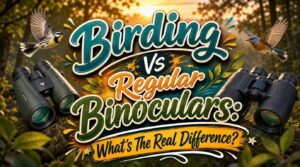
Most people assume binoculars are binoculars—glass is glass, and a higher price tag just means fancier branding. Then they take a pair of general‑purpose 10× optics into a forest at dawn, watch a warbler vanish into the canopy before they can even focus, and wonder what went wrong.
The difference between birding and regular binoculars isn’t cosmetic; it’s built into every specification that determines whether you find the bird or lose it. Birding optics are engineered around a specific problem: small, fast‑moving subjects in unpredictable light, at distances ranging from six feet to six hundred.
Understanding what separates purpose‑built birding glass from general optics changes how you shop, how you see, and ultimately how much you get out of every hour you spend outdoors.
Table Of Contents
Key Takeaways
- Birding binoculars aren’t just a pricier version of regular ones — they’re built around a specific problem: finding and identifying small, fast-moving birds in tricky light, so specs like wide field of view and close focus matter far more than magnification alone.
- 8x magnification hits the sweet spot for most birders because it keeps images steady without a tripod, holds fast‑moving birds in the frame longer, and gathers more light than 10x — which sounds powerful but actually makes quick target acquisition harder.
- Features like ED glass, fully multi-coated lenses, and weather-sealed housings aren’t luxury add-ons — they’re what let you see true feather colors at dawn, stay sharp in rain, and keep your optics fog‑free when humidity spikes.
- Comfort details you might overlook — weight, eye relief length, eyecup adjustment, and focus wheel feel — end up defining how long you can actually stay in the field before fatigue cuts your session short.
Birding Binoculars Vs Regular Binoculars
Not all binoculars are built for the same job, and that gap matters more than most people expect.
For backyard birding specifically, the specs that matter most are quite different from what you’d need in the field—this guide to choosing binoculars for backyard birding breaks down exactly what to look for.
specific demands on your optics — fast movement, tricky light, dense cover — that general‑purpose pairs simply aren’t designed to handle.
the two stack up across the areas that actually count in the field.
Purpose and Viewing Needs
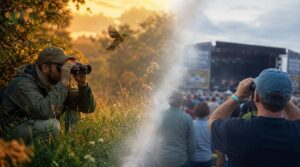
Birding binoculars and regular binoculars look similar, but they’re built for completely different jobs.
| Feature | Birding Binoculars | Regular Binoculars |
|---|---|---|
| Color Accuracy | Tuned for plumage detail | General use |
| Rapid Scanning | Wide field of view | Narrower focus |
| Dawn Observation | Optimized low-light optics | Limited brightness |
General binoculars handle landscapes and events fine. Birding equipment, though, prioritizes target acquisition and bird identification — spotting a warbler mid-flight demands precision that standard optics simply can’t match.
Bird Movement Challenges

Birds rarely hold still. A warbler darting through branches or a hawk banking on a thermal updraft gives you maybe two seconds before it’s gone — and standard binoculars simply can’t keep up.
| Movement Challenge | Why It Matters |
|---|---|
| Obstacle navigation | Birds weave through dense foliage unpredictably |
| Wind shear effects | Sudden gusts shift flight paths mid-track |
| Urban route adjustment | Birds reroute around buildings, changing angles fast |
| Thermal updraft impact | Altitude shifts rapidly, breaking your line of sight |
| Maneuver coordination | Tight turns demand instant refocusing and reacquisition |
That’s why speed focusing and a wide field of view aren’t luxury features — they’re what separates a clean ID from a missed bird entirely.
Habitat-based Performance Differences
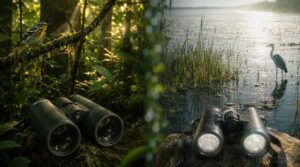
Where you’re birding shapes everything. A dense forest floor — with dappled light flickering through canopy gaps — demands forest light adaptation and strong low light performance that standard binoculars simply don’t offer. Shade edge contrast collapses fast when your optics can’t compensate.
| Habitat | Key Challenge | What You Need |
|---|---|---|
| Dense forest | Understory visibility blocked by layers | Wide field of view |
| Wetland edges | Glare washing out plumage detail | Anti-reflective coatings |
| Rocky terrain | Terrain stability needs constant refocusing | Fast focus wheel |
| Shrubland | Dappled light impact on color marks | ED glass, optical clarity |
| Rainy woodland | Wet conditions obscuring details | Full weather resistance |
Each habitat demands something different from your glass.
Identification Versus General Viewing
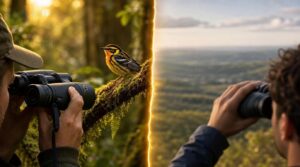
Habitat shapes how you see — but your purpose shapes what you need to see. General binoculars get you a closer look. Birding binoculars help you confirm what you’re looking at.
Matching glass to habitat — not just magnification — is exactly what choosing the best binoculars for birdwatching really comes down to.
General binoculars get you closer; birding binoculars help you confirm what you are seeing
| Viewing Purpose | What Matters Most |
|---|---|
| General observation | Basic magnification, wide view |
| Species identification | Optical clarity, fine color detail |
| Behavioral analysis | Fast focus wheel, field of view |
| Sound-to-visual confirmation | Edge-to-edge sharpness, close focus |
Magnification and Lens Differences
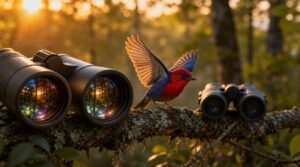
Magnification and lens size shape everything about how well you’ll spot and follow a bird. Getting these two specs right means the difference between a clear, steady view and a frustrating blur. Here’s what actually matters when you’re comparing your options.
Why 8x Works Best
Regarding magnification, 8x is the sweet spot for most birders — steady enough to hold comfortably, detailed enough to catch field marks. At this power, you get a natural perspective that doesn’t exaggerate distance or compress depth. Images stay stable without a tripod, and reduced shake means less strain during long sessions.
Here’s what makes 8x magnification consistently reliable:
- Wide field of view keeps fast birds in frame longer
- Balanced handling suits both casual walks and all-day outings
- Fine detail at medium range reveals plumage without eye fatigue
- Adaptable applications — woodland, open sky, or water — all covered
- 8×42 binoculars offer the best mix of light-gathering and portability
That’s why birding binoculars built around 8x magnification remain the most recommended choice for improving your optical performance in the field.
8x Versus 10x Birding
Two numbers — 8 and 10 — sit at the center of almost every magnification debate in birding. Both are popular, but they don’t behave the same in the field. 10x magnification pulls distant birds closer, which sounds great until a warbler darts through the brush and you’ve lost it completely. Target acquisition — finding a bird quickly in your view — gets noticeably harder at higher power.
With 8x magnification, your field of view stays wider, so you spend less time hunting and more time watching. Image shake matters here too: at 10x, even a slight hand tremor gets amplified, blurring fine feather detail. The magnification vs field of view tradeoff is real — more zoommeans a narrower window. For most birding situations, that tradeoff doesn’t favor 10x.
The 8× option benefits from a larger exit pupil that enhances low‑light performance.
Objective Lens Brightness
The objective lens — the big front glass — is what determines light gathering ability. A 42 mm objective collects considerably more light than a 30 mm one, and that difference shows up as a brighter, clearer image.
Fully multi-coated optics push transmission to around 95%, squeezing nearly all available light through to your eye instead of losing it to reflections.
Low-light Habitat Viewing
Dense foliage can drop light levels to near-darkness — that’s where low-light performance separates birding optics from basic ones. A 42 mm lens gives you real light gathering ability, and when paired with high transmission efficiency, you lose almost nothing. Exit pupil size directly affects brightness, while contrast enhancement helps you catch shape and edge when color accuracy fades.
- Luminance under canopy drops as low as 0.1 lux
- Larger objectives outperform small lenses in shade
- Wide exit pupils match your dilated eye in dim conditions
- Better coatings reduce glare and boost image clarity
Field of View and Focus
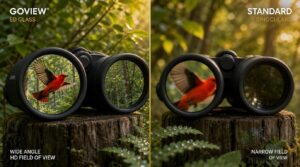
Field of view and focus might not sound exciting, but they’re often what separates a good birding experience from a frustrating one. Regular binoculars weren’t built with fast, unpredictable birds in mind — and that gap shows up fast in the field. Here’s what actually matters when you’re trying to keep up.
Tracking Fast-moving Birds
A warbler darting between branches can vanish from your view in under a second — that’s the real test of rapid target acquisition. Birds in open sky move with high angular velocity, meaning even a slight pan of your wrist sends them flying out of frame.
| Challenge | What Helps |
|---|---|
| High angular velocity | Wide field of view |
| Motion camouflage | Edge-to-edge clarity |
| Quick handshake demands | 8× magnification |
| Panning stability | Smooth focus wheel |
Panning stability and a wide field of view work together here. Unlike image stabilized binoculars, standard 8× models keep things light enough for fast, instinctive tracking without fighting the optics.
Wide Views in Foliage
Foliage is where a wide field of view earns its keep. When birds move through layered branches, a narrow view forces you to chase — a wide one lets the scene come to you.
Panoramic Foliage Scanning helps you:
- Spot movement across multiple perches at once
- Keep habitat context framing — bark, vines, understory shrubs — in frame
- Benefit from light gathering coatings in shaded forests where canopy filters the light
Edge clarity performance ties it together, keeping subjects sharp even at the frame’s edges.
Close-focus Advantages
Close Focus Distance makes a real difference when a bird lands just a few feet away. Most regular binoculars blur out at 15–20 feet — birding models often focus down to 6 feet or less.
That means near field clarity when a chickadee hops along a branch right in front of you, letting you read leg color and tail patterns without stepping back.
Feeder Bird Observation
Feeder watching is where close focus really earns its keep. When a goldfinch lands two feet from your window, you want crisp detail — not a blurry smudge.
Birding binoculars focusing down to 6 feet let you catch seed preference and plumage shifts across seasons, and even read aggression dynamics between a nuthatch and a chickadee sharing the same tray.
Edge-to-edge Clarity
Sharp center focus means little if the edges blur into mush.
Edge sharpness depends on prism alignment, multilayer coating quality, and how well the housing holds tolerances under field conditions.
Binoculars with strong edge performance keep feather detail crisp from center to corner — a real advantage when scanning a crowded hedgerow at dusk.
Comfort for Long Birding Sessions
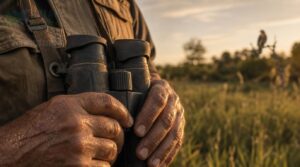
A great pair of binoculars can still wear you out if they’re not built with your body in mind. After a few hours in the field, small design choices — weight, eyecup fit, focus wheel feel — start to matter a lot more than the spec sheet suggests. Here’s what to look at before you commit.
Weight and Neck Strain
Heavier binoculars do more damage than you might expect. Your neck already holds up 10–12 pounds just holding your head up — add even 2 extra pounds of optics, and that load compounds fast. Here’s what drives neck strain during long sessions:
- Sustained static muscle load from holding binoculars at eye level
- Forward head tilt — even 15 degrees doubles muscular neck effort
- Poor strap design that concentrates weight on one pressure point
A wide, padded neck strap spreads the load across your shoulders instead of digging into your cervical spine. Better yet, a binocular carrier shifts weight onto your torso entirely. Either way, take a 5–10 minute break every hour — your neck will thank you.
Full-size Versus Compact
Once the weight starts adding up, size becomes a real factor in how long you’ll last on a trail. Full-size binoculars — usually 25 to 40 ounces — deliver leading light transmission and exit pupil, making them ideal for dawn birding. Compact binoculars at 12 to 20 ounces trade that brightness for genuine portability.
| Feature | Full-Size | Compact |
|---|---|---|
| Weight | 25–40 oz | 12–20 oz |
| Objective Lens | 42–50 mm | 25–32 mm |
| Low-Light Performance | Excellent | Limited |
Eye Relief for Glasses
If you wear glasses, eye relief length is the spec you can’t ignore. It’s the distance — measured in millimeters — between the eyepiece and your eye when you’re getting a full, clear picture. Too short, and your glasses push you too far back, cutting off the edges.
Look for these key markers:
- 15–20 mm eye relief minimum for glasses wearers
- Long eye relief prevents vignetting — that dark ring around the edges
- Diopter compensation helps fine-tune sharpness without removing glasses
- Glasses-friendly design reduces lens smudging and temple pressure
Adjustable Eyecup Fit
Eyecups do more than cushion your face — they control exactly how far your eye sits from the lens, which directly affects what you see.
| Feature | What It Does | Why It Matters |
|---|---|---|
| Twist Adjustment | Extends or retracts eyecup height | Matches your face without glasses or with |
| Locking Mechanism | Holds eyecup position firmly | Prevents drift during active birding |
| Eyecup Material | Rubber or silicone cushioning | Reduces pressure over long sessions |
| Interchangeable Cups | Swap between fold-down or rigid styles | Customizes for different viewing scenarios |
| Cleaning Routine | Wipe sweat and oils regularly | Preserves seal quality and longevity |
Proper eyecup adjustment keeps the full exit pupil aligned with your eye — skip this step and you’ll notice vignetting creeping in at the edges. For glasses compatibility, twist the eyecup down fully so your lenses sit close enough to capture the complete field.
Focus Wheel Responsiveness
The focus wheel is where speed meets precision — and in birding, that balance matters more than most people realize. Micro Adjustment Precision lets you fine-tune sharpness without overshooting, so a perched warbler stays sharp instead of blurring past.
Tactile Feedback Control and Backlash Reduction Design mean every directional change registers instantly, even during cold mornings when stiff wheels cost you the shot.
Birding Features Worth Paying For
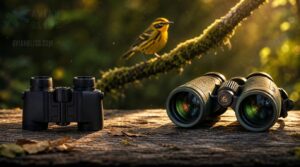
Not every upgrade on a birding binocular is worth the extra cost — but some genuinely change what you can see and how long you’ll last in the field. Knowing which features pull their weight helps you spend smarter, whether you’re starting out or stepping up. Here’s what’s actually worth your money.
ED Glass and Coatings
ED glass — short for extra-low dispersion glass — reduces color fringing so feathers and field marks appear true to life.
Paired with multi-layer anti-reflection coatings, it pushes light transmission close to 95%, keeping images bright in shade or overcast skies.
Dielectric coatings add contrast and reduce glare, making edge sharpness noticeably better at mid-to-high magnifications.
Roof-prism Durability
Roof prisms earn their reputation through structural toughness. The housing — commonly magnesium alloy or reinforced polycarbonate with rubber armoring — absorbs bumps and drops without knocking internal prisms out of alignment. Nitrogen-sealed barrels keep moisture out, preventing internal fogging when you move from cool shade into humid air.
Alignment stability matters more than most beginners expect. Precision-machined mounts hold the prism block steady across rough terrain and temperature swings, so your image stays sharp session after session.
Weather-sealed Protection
That structural toughness only holds up long-term if moisture can’t sneak past the seals.
Weather-sealed binoculars use O-rings around the eyepieces and objective barrels, plus nitrogen-filled chambers that block internal fogging entirely.
Most quality models meet IP6x dust resistance standards and handle brief submersion up to one meter — real protection for coastal spray, rain showers, or humid forest mornings.
Beginner Price Ranges
All that weather-sealing and optical quality does come at a cost — but beginner price ranges are more accessible than most people expect.
Entry level pricing starts around $80–$120 for basic birding binoculars. Stepping up to mid range costs of $150–$300 gets you noticeably better coatings and close-focus performance. Some accessory bundles under $180 include a case and strap — solid value for any first-time buyer.
Vortex Diamondback HD 8×42
If your budget stretches a bit further, the Vortex Diamondback HD 8×42 is worth serious consideration.
Its HD lens elements and fully multi-coated glass deliver sharp, color-accurate images, while ArmorTek protection and magnesium housing handle real field conditions.
The 1.5 m close focus, 17 mm eye relief, tripod compatibility, and Vortex warranty make it a capable, practical choice.
Frequently Asked Questions (FAQs)
Can regular binoculars damage your eyes over time?
Regular binoculars won’t damage your eyes — unless you aim them at the sun. Diopter misalignment and poor eye relief can cause strain, but taking regular breaks keeps your eyes comfortable during long sessions.
Do birding binoculars work well for stargazing?
Birding binoculars can pull double duty under the stars. An 8×42’s exit pupil of ~25 mm pairs well with dark-adapted eyes, giving decent night sky brightness for casual stargazing.
Are waterproof binoculars worth the extra cost?
Waterproof binoculars are worth it if you bird in rain, coastal areas, or wetlands. Nitrogen-purged, fog-proof seals prevent internal damage over time — easily justifying the 20–40% price increase through fewer repairs.
How do I clean binocular lenses without scratching them?
Start with dust removal first — hold the binoculars upside down, then use a blower. Wipe with a microfiber cloth in gentle circles. Never spray liquid directly onto the objective lens or eyepiece.
Can children use adult birding binoculars comfortably?
Adult birding binoculars can technically work for kids, but weight above 500g causes neck strain fast. Look for compact, adjustable designs with padded straps and easy focus wheels — your child’s comfort makes all the difference.
Conclusion
Picking the perfect pair starts with understanding the real difference between birding and regular binoculars—and now you do.
Birding glass isn’t built on branding; it’s built around how birds actually behave: fast, fleeting, and rarely in ideal light.
Wide fields, close focus, and weather-sealed clarity aren’t luxury features—they’re tools that turn a frustrating blur into a clean, confident look.
Choose specs that match the birds you chase, and every outing delivers more.
- https://www.allaboutbirds.org/news/six-steps-to-choosing-a-pair-of-binoculars-youll-love
- https://hawkwatch.org/how-to-select-the-right-binoculars-for-birdwatching
- https://www.audubon.org/gear/binocular-guide
- https://www.bestbinocularsreviews.com/birdwatching-binoculars.php
- https://www.birdcollective.com/blogs/news/why-binoculars-matter-and-how-to-choose-the-right-pair