This site is supported by our readers. We may earn a commission, at no cost to you, if you purchase through links.
Each spring, a male house wren can complete a rough nest framework in under 48 hours—then tear it down and start over if a female rejects it. That kind of relentless effort tells you something about how high the stakes are.
Spring bird nesting habits aren’t just instinct running on autopilot; they’re a tightly coordinated sequence of hormonal shifts, territorial battles, and architectural decisions made under real pressure. Understanding what drives those choices—from the first surge of daylight in February to the moment a fledgling leaves the nest—changes how you see your backyard entirely.
Table Of Contents
Key Takeaways
- Lengthening spring days trigger a hormonal chain reaction in birds—starting with melatonin suppression and ending in full breeding readiness—long before you see the first nest goes up.
- Where a bird builds matters as much as how it builds: height, dense cover, and south-facing slopes all work together to protect eggs from both predators and bad weather.
- Courtship isn’t just singing and pretty feathers—males that bring food and demonstrate nest-building skills signal to females that they’ll hold up when chicks need constant feeding.
- Your backyard can make a real difference: a cedar nest box with a 1½-inch entrance hole, a predator baffle on the pole, and cats kept indoors give cavity-nesting birds a genuine shot at success.
Spring Breeding Season Triggers
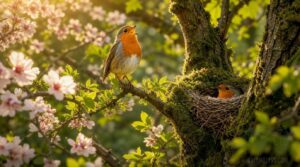
Every spring, birds don’t just show up randomly — something specific flips the switch. A handful of biological and environmental cues work together to tell birds it’s time to breed. Here’s what actually triggers the season.
Once the cues align, birds move fast — launching into the courtship displays and pair bonding behaviors that kick the whole breeding cycle into gear.
Longer Daylight Cues
Before a single egg is laid, daylight does the heavy lifting. As days grow longer in spring, birds track the cumulative light exposure — called photoperiod timing — to sense that breeding season is near.
Longer evenings suppress melatonin, nudging their internal clocks forward. You’ll notice this as a dawn chorus shift: birds singing earlier each morning, right on cue.
Hormonal Breeding Changes
Once melatonin drops, the brain’s hypothalamus ramps up GnRH pulse frequency, signaling the pituitary to release gonadotropins.
Kisspeptin neurons fire more frequently as days lengthen, accelerating follicle development.
Thyroid hormones rise alongside a sharp estrogen surge, priming reproductive tissues for ovulation.
Corticosteroids quietly adjust too, fine-tuning energy investment as the breeding season locks in.
The photoperiod length trigger initiates hormonal activation that drives the onset of breeding.
Migratory Arrival Timing
Once those hormonal shifts kick in, migratory birds face a second challenge: arriving at the right moment. Timing matters enormously.
Many passerines now arrive roughly 0.1 to 0.2 days earlier each year, driven by warmer springs. Birds in better condition — higher fat reserves — tend to lead the way, while first-year birds often trail behind.
Resident Bird Nesting Patterns
Unlike migrants racing the clock, nonmigratory species work on their own quiet schedule. Resident birds like House Sparrows and Blackbirds don’t need to arrive — they’re already home.
That head start lets them begin nest building weeks earlier, often claiming the best spots before competition heats up.
Many return to the same microhabitats each spring, showing strong seasonal nest fidelity.
Food Abundance Signals
Timing matters more than instinct alone. When fruiting trees suddenly flush and insect emergence spikes after warm spells, birds read those cues as a green light to breed. Arthropod prey availability tells them food provisioning for chicks is sustainable.
- Insect emergence signals reliable protein for nestlings
- Green vegetation growth unlocks nectar and seeds for sparrows
- Puddle feeding opportunities concentrate invertebrates after rain
- Synchrony with food resources maximizes chick survival odds
Territory and Nest Site Selection
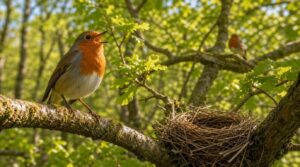
Once a bird commits to breeding, its next job is staking out the right piece of ground. Where a bird nests determines nearly everything — food access, shelter, and how many chicks survive. Here’s what drives those choices.
Defending Nesting Territories
Once a bird claims a breeding territory, it defends every inch of it. Males call from exposed perches at dawn and dusk, using boundary marking calls to signal ownership.
If a rival pushes too close, the defending bird may escalate quickly—much like how chickens establish and protect their home range throughout their lives.
When a rival gets too close, chest-puffing and wing-spreading follow fast. Familiar neighbors get lighter treatment — that’s the "dear enemy" effect — but strangers trigger full territorial aggression immediately.
Choosing Safe Nest Sites
Once a territory is secured, the next question is where exactly to build. Most birds aim for 1.5 to 5 meters above ground — high enough to reduce ground predator access, low enough for quick parental returns.
Cavity-nesting birds like Eastern Bluebirds often rely on nest boxes when natural snags are scarce, balancing elevated nest placement with easy food proximity nearby.
Predator Refuge Factors
A nest hidden in thorny shrubs isn’t an accident — it’s strategy. Birds reduce nest predation risk through deliberate microhabitat selection, placing nests where predators struggle to approach undetected.
Here’s what drives those choices:
- Refuge availability concentrates nesting in safer spots, lowering predator encounter rates
- Dense shrubs and thorny vegetation create escape routes and concealment
- Higher predator density pushes birds toward more inaccessible nesting sites
- Structural complexity around the nest provides concealment features from both aerial and ground threats
- Cliffs, tall trees, and human structures offer reliable predator exclusion
Weather Protection Needs
Weather doesn’t forgive a poorly placed nest. Birds factor in thermal insulation, rain shielding, and wind exposure during nest site selection just as carefully as predator risk. Dense shrubs buffer cold mornings, while solar nesting on south-facing slopes gives eggs a consistent warmth advantage. Canopy cover can cut temperature swings by up to 6°C on sunny days.
Birds choose nest sites like architects, where dense shrubs, south-facing slopes, and canopy cover can mean the difference between survival and loss
| Weather Factor | Bird’s Solution |
|---|---|
| Cold temperatures | Thick nest lining for thermal insulation |
| Heavy rain | Natural drainage and waterproofed nest rims |
| Strong winds | Wind breaks like hedges or sturdy branch angles |
| Humidity fluctuation | Moss and feathers for humidity control |
| Overheating | Ventilation holes and adjusted material weight |
Nest construction materials do a lot of heavy lifting here. Flexible grasses adapt to wind gusts without collapsing. Moss layers buffer humidity, keeping conditions around 55–70% for developing eggs. Even a sloped roof on a nest box and drainage holes underneath mirror what nature already figured out: water has to go somewhere, and it shouldn’t be on the eggs.
Human Structure Nesting
Some birds don’t bother with trees at all. Eave nesting sites and sheltered ledges on buildings offer the same elevated protection—usually 1 to 5 meters up—that a sturdy branch provides.
House Sparrows and Barn Swallows are especially drawn to these spots, weaving urban nest materials like string, fabric scraps, and dry grass into snug cups tucked against rafters or gutters.
Courtship and Mating Behaviors

Once a bird has staked out its territory, the real work begins — winning a mate. Birds use some surprisingly specific tactics to signal they’re worth choosing, from the way they look to what they bring to the table. Here’s what those courtship behaviors actually look like.
Breeding Plumage Displays
Watch a male American Robin puff up in spring and you’ll see breeding plumage doing exactly what it evolved to do. Carotenoid pigments intensify his deep orange breast, creating high color contrast against duller parts.
That brightness peaks during courtship and fades once eggs hatch — a reliable signal of health and timing females read instinctively.
Spring Birdsong Signals
Plumage gets a female’s attention, but song seals the deal. Dawn chorus patterns kick in at first light each spring — multiple males singing together, their voices carrying farther through cool morning air as they compete for mates and mark territory boundaries.
Here’s what makes spring song so purposeful:
- Song repertoire shifts expand dramatically, signaling territory quality
- Spring song tempo accelerates as peak breeding activity approaches
- Acoustic frequency adjustment helps songs cut through dense foliage
- Breeding call complexity reflects stamina, fitness, and readiness to parent
Males sing longest and loudest from prominent perches, using territorial defense and courtship displays together as a combined signal females actively evaluate.
Food Offering Rituals
Song draws a female in — but food closes the deal. Courtship feeding rituals start early in spring, with males delivering caterpillars, beetles, and other high-protein prey directly to prospective mates.
Robins and bluebirds do this regularly. It signals parental potential: if he provisions well now, he’ll provision well when nestlings demand it most.
Nest-building Demonstrations
Feeding a female shows potential — but some males go further. House Wrens and certain cavity-nesting birds stage nest-building demonstrations, carrying avian nesting material into nest boxes to prove their worth.
- Males place twigs inside nest boxes
- Females inspect and judge the effort
- Juveniles copy adult model building
- Technique showcase attracts serious mates
- Learning through observation sharpens skills
Monogamy and Polygyny
Not every bird plays by the same rules. Most songbirds practice social monogamy — one partner per season — sharing incubation and chick-rearing duties. But even "faithful" pairs aren’t always genetically exclusive; extra-pair paternity turns up in DNA studies across many monogamous species.
| Mating System | Example Species | Key Trait |
|---|---|---|
| Social Monogamy | American Robin | Shared parental care |
| Polygyny | Red-winged Blackbird | Male holds prime territory |
| Polyandry | Wilson’s Phalarope | Female defends multiple mates |
Harem polygyny patterns emerge when one male controls a resource-rich territory attractive enough to draw several females. Female mate choice drives this — she picks the best real estate, not just the loudest singer. That’s why male reproductive variance runs high in polygynous species: a few males father many offspring, while others breed rarely.
Nest Building, Eggs, and Incubation
Once a pair bonds, the real work begins. From the style of nest they build to how they divide incubation duties, every choice shapes whether the eggs survive. Here’s what’s actually happening during this stage.
Common Nest Types

Birds build five main nest types, each shaped by the species using it.
Cup nests — the most familiar — are bowl-shaped structures roughly 5–15 cm across, cradled in tree forks by robins and bluebirds.
Dome nests offer a fully enclosed chamber with a small entrance, woven tight with grasses and spider silk for weatherproofing.
Platform nests, used by ospreys and herons, are broad stick structures on branches or ledges that grow larger each season.
Cavity nests sit inside tree holes, cliff gaps, or nest boxes, providing strong shelter from weather and predators.
Ground nests are simple depressions, relying on camouflage to stay hidden.
Natural Nesting Materials
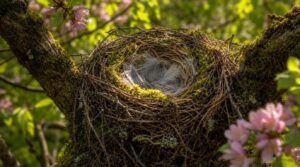
Think of a bird’s nest as a tiny house built in layers. Twigs form the outer framework, locking the structure in place.
Inside, plant fiber cup layers add flexibility. Soft moss insulation traps warmth. A final feather lining cushions eggs.
Spider silk binding holds it all together, naturally flexible and strong — no dead‑tree snags required.
Clutch Size Differences
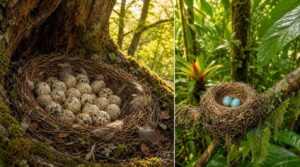
Not every nest holds the same number of eggs — and that gap tells you a lot about a bird’s world. Clutch size shifts based on food availability, predation pressure, and territory quality.
Wood Ducks may lay up to 15 eggs, while many tropical songbirds manage just 2–3. When resources are abundant, birds invest more. When predators are active, smaller clutches reduce risk.
Incubation Role Sharing
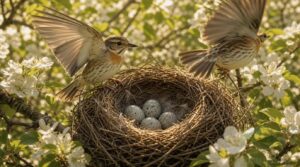
Once the eggs are laid, keeping them warm becomes a full-time job. In many songbird species, biparental incubation means both parents share that work — trading off in shifts that usually run 15 to 60 minutes each.
Here’s what that looks like in practice:
- Shift relay dynamics keep egg temperatures between 36–40°C
- One parent forages while the other broods
- Soft calls or wing adjustments signal an upcoming exchange
- Cooperative nest warming improves hatchability, especially in cooler climates
This kind of parental turn-taking isn’t just practical — it’s essential.
Hatching Timing Patterns
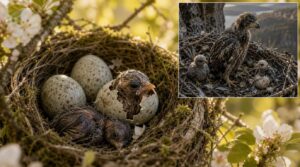
When incubation wraps up, hatching doesn’t always happen all at once. Synchronous hatching is common in most songbirds — the whole clutch emerges within 24 to 48 hours. That tight window is driven by temperature influence and nest microclimate.
Raptors, though, show asynchronous development, with chicks hatching days apart. Environmental cues like warmth align the clutch hatch window for better breeding season timing.
Chick Care and Backyard Support
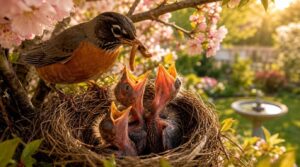
Once the eggs hatch, the real work begins. Chicks have very different needs depending on the species, and how you set up your backyard can make a genuine difference in their survival. Here’s what you need to know about caring for young birds and supporting them through their most vulnerable weeks.
Altricial Versus Precocial Chicks
Not all chicks enter the world equally prepared.
Altricial nestlings hatch blind and featherless, fully dependent on parental care for warmth and protection. Precocial chicks, like ducklings, arrive with open eyes, down feathers, and immediate foraging ability.
That difference comes down to egg nutrient load — precocial eggs invest more upfront, while altricial species shift that energy into intensive post-hatch feeding the young.
Nestling Feeding Demands
Once hatching is done, the real work begins.
Altricial nestlings need high-protein feeding almost constantly — insects, caterpillars, and larvae delivered dozens of times daily.
Parental provisioning scales with brood size and chick age. A single nestling can double its weight within days when energy intake stays consistent, making reliable food delivery the difference between a healthy fledgling and one that doesn’t make it.
Fledging and Juvenile Survival
Once nestlings leave the nest, survival gets harder before it gets easier. Fledgling predation risk peaks in the first ten days — limited flight makes young birds easy targets. They instinctively seek dense vegetation for cover, staying close to familiar territory while gradually building strength.
- Foraging skill growth improves steadily over weeks
- Habitat use shifts toward more open areas as flight develops
- Juvenile dispersal expands as independence increases
Safe Nest Box Design
A well-designed nest box can give cavity-nesting birds a real leg up. Entrance hole size matters most — a 1½-inch opening suits Eastern Bluebirds and blocks larger competitors. Use untreated cedar or pine at least ¾ inch thick, and include recessed floors with drainage holes to keep things dry.
| Feature | Recommendation |
|---|---|
| Mounting Height | 5–6 ft for bluebirds |
| Ventilation Design | Holes near top panels |
| Box Materials | Untreated cedar/pine |
| Entrance Hole Size | 1½ in for bluebirds |
Predator Protection Strategies
Predators are the biggest threat to a successful nest. A predator guard or baffle mounted on your nest box pole stops climbing mammals.
Pair that with hardware cloth buried 12 inches underground to block diggers.
A weatherproof nest cam with infrared night vision lets you monitor activity without disturbing the birds — and motion alerts mean you can act fast.
Frequently Asked Questions (FAQs)
Do birds reuse the same nest each year?
It depends on the species. Eagles reuse nests for decades, adding material each season. Most songbirds build fresh each year. Cavity-nesting birds often return to the same site if it’s intact and safe.
How do pesticides affect spring nesting success?
Pesticides quietly undermine the spring nesting season at every stage. Eggshell thinning effects and poor hatching success follow even low-level exposure, and chick growth impairment compounds the damage from there.
Can weather delays shift peak nesting timelines?
Yes, weather delays absolutely shift peak nesting timelines. Cold springs, heavy rain, and wind storms slow egg laying by days or even weeks, pushing the entire breeding season later than expected.
Which bird species nest latest into summer?
Not every bird races the calendar. American Goldfinches nest in late June through August, and cliff swallows often wait until July when insect blooms peak.
How does urbanization change nesting bird diversity?
Cities swap forests for pavement, pushing out specialists. Urban habitat loss favors adaptable cavity-nesting birds while ground nesters vanish. Green space fragmentation and artificial light further shrink diversity, leaving generalists to dominate.
Conclusion
It’s no coincidence that the February light reaching your window also triggers a cascade of hormonal changes in the birds just outside it. You share the same seasonal clock.
Understanding spring bird nesting habits doesn’t just make you a better observer—it makes you a more thoughtful neighbor to the species building their lives a few feet away.
Set up that nest box. Keep the cat indoors.
The season won’t wait.
- https://pmc.ncbi.nlm.nih.gov/articles/PMC4242575
- https://nestwatch.org/blog/what-kind-of-nest-materials-are-best-to-provide-for-birds
- https://efiling.energy.ca.gov/GetDocument.aspx?tn=262205&DocumentContentId=98719
- https://centerofthewest.org/2023/04/06/bird-nests-types-material-how-you-can-help
- https://www.frontiersin.org/journals/ecology-and-evolution/articles/10.3389/fevo.2023.1258185/full