This site is supported by our readers. We may earn a commission, at no cost to you, if you purchase through links.

A hummingbird weighs less than a nickel, yet it will chase a hawk twice its size out of its yard without hesitation.
That aggression isn’t random—it’s calculated. Hummingbirds burn through energy so fast, they need to eat almost constantly, and that makes every flower patch and feeder worth fighting for.
So yes, hummingbirds are territorial, and their behavior is more strategic than most people expect. Understanding why they fight, what they’re protecting, and how males and females differ can completely change how you set up your yard—and how much action you actually see at your feeders.
Table Of Contents
- Key Takeaways
- Yes, Hummingbirds Are Territorial
- Why Hummingbirds Defend Territory
- Hummingbird Territory Size Varies
- Male Hummingbirds Show Stronger Aggression
- Female Hummingbirds Also Defend Areas
- Common Territorial Behaviors
- Why Hummingbirds Fight at Feeders
- Reducing Feeder Aggression
- Native Flowers Reduce Competition
- Territoriality Changes by Season
- Frequently Asked Questions (FAQs)
- Are male hummingbirds territorial?
- Are hummingbirds aggressive?
- Why do hummingbirds defend their territories?
- Why do hummingbirds exhibit territorial behavior?
- What does it mean when a hummingbird stays around your house?
- Are hummingbirds territorial over feeders?
- Are hummingbirds territorial around their nests?
- Do hummingbirds mate?
- Why do hummingbirds fight each other?
- Why do hummingbirds chase each other away from the feeder?
- Conclusion
Key Takeaways
- Hummingbirds are territorial because their sky‑high metabolism means every flower patch and feeder is a survival resource worth fighting for, not just a preference.
- Males ramp up aggression during breeding season thanks to testosterone surges, using dive‑bombs, perch dominance, and gorget displays to control both food and mating opportunities.
- How you set up your feeders directly shapes how much fighting happens — spacing multiple small feeders apart and blocking sightlines can turn a war zone into a peaceful yard.
- Planting native red tubular flowers like cardinal flower spreads feeding activity across your yard naturally, which takes pressure off any single spot and reduces territorial conflict at the source.
Yes, Hummingbirds Are Territorial

Yes, hummingbirds are genuinely territorial — and they take it seriously.
Their fierce defense of feeders and flowers is really just survival instinct in action, as explored in this closer look at why hummingbirds guard their territory so aggressively.
These tiny birds defend specific areas with surprising intensity, and there’s more to it than just the feeder in your backyard.
Here’s what they’re actually protecting.
Feeding Area Defense
Watch a hummingbird for a few minutes near a feeder, and you’ll see feeding territories in action.
Using Perch Defense Tactics, a dominant bird claims a high branch and launches rapid aerial chases the moment a rival appears.
This territorial aggression is pure resource defense — driven partly by Testosterone-Driven Aggression in males — keeping intraspecific competition in check through aggressive tactics that burn far less energy than sharing ever would.
Nesting Site Protection
Feeding territory is just the beginning.
When breeding season arrives, females shift their territorial aggression toward something even more personal — their nesting sites.
They actively defend their nests using auxiliary perches positioned nearby for sharp surveillance, while predator guards and nest microhabitats offering thermal stability reduce outside threats.
Hazard inspection keeps the immediate area safe, making nesting territory defense as intense as any feeder battle.
Courtship Display Spaces
Males don’t just defend food — they also claim courtship display spaces. Think of these as visual arenas and acoustic spaces carefully chosen for maximum impact. They pick exposed perches with contrast backdrops, sunlit patches that ignite their iridescent gorgets, even spots near water mirrors that intensify color. Seasonal shifts reposition these stages as resources move.
Three things males refine in display perching:
- Visibility — open backgrounds highlight aerial displays and pendulum display swings
- Sound clarity — acoustic spaces reduce noise interference during courtship display calls
- Energy access — proximity to nectar lets them perform without burning out
Rival Exclusion Behavior
Beyond protecting display spaces, rival exclusion behavior is where territorial behavior gets real. An aggressive individual doesn’t wait — it uses acoustic warnings, flight blocking, and visual warnings to push competitors out before contact. These tactics reduce energy costs and keep patch quality high.
| Strategy | Purpose |
|---|---|
| Resource Partitioning | Divides patches among rivals |
| Flight Blocking | Cuts off feeder or flower access |
Resource competition shapes dominance hierarchy fast.
Why Hummingbirds Defend Territory

Hummingbirds don’t pick fights just to be aggressive — there’s real strategy behind every chase and patrol.
Each territorial behavior ties back to a specific survival need.
Here’s what’s actually driving that fierce little defender at your feeder.
High Nectar Demands
Think of nectar as premium fuel — and hummingbirds burn through it fast.
Their metabolic rates are among the highest of any vertebrate, pushing them toward constant energy budgeting.
Nectar sugar concentration usually runs 20 to 40 percent, and flower co-evolution keeps replenishment cycles quick.
That’s exactly why feeding territory matters: reliable nectar competition drives their territorial behavior, turning food defense into a survival strategy.
Insect Prey Access
Nectar isn’t the whole story. Hummingbirds rely heavily on their insect diet for protein — something sugar alone can’t provide.
Through sharp insect hunting techniques like midair snatching and leaf-gleaning, they target aphids, gnats, and spiders near flowering plants.
These plant-insect interactions make territory more than just food defense — it’s about locking down microhabitat preferences where seasonal prey shifts and predator-prey dynamics favor the most alert forager.
Safer Nesting Zones
Territory defense isn’t just about food — it’s also about keeping eggs and chicks alive. When hummingbirds claim breeding territory, they’re securing nesting sites with natural predator avoidance built in.
Buffer zones, smart nest placement, habitat tweaks like dense overhead cover, and regular nest checks all support survival. Predator cages add another layer.
Territorial behavior, fundamentally, is proactive parenting.
For hummingbirds, defending territory is not aggression — it is parenthood in action
Better Mating Opportunities
Holding a prime feeding zone isn’t just about eating — it’s a mating credential. During breeding season, female hummingbirds actively assess males through fitness signaling: who controls the best flowers, who wins chases, whose gorget display success stands out.
Resource defense mating is basically sexual selection in action. Mate attraction tactics like territorial male appeal and courtship rituals tell females one clear thing — this male delivers.
Energy Conservation
Defending a feeding territory is basically energy budgeting in feathers. Every aerial chase a hummingbird skips is calories saved — and, with a high metabolism burning through resources at a staggering rate, resource scarcity hits hard.
Think of it like smart thermostats or heat pumps: a well‑managed system costs less to run. Holding feeding territories means fewer costly fights and more fuel for what actually matters.
Hummingbird Territory Size Varies

Not every hummingbird stakes out the same amount of space—territory size shifts depending on the species and what’s happening in its environment. A Ruby‑throated might defend a modest backyard corner, while a Broad‑tailed can claim an area the size of several city blocks.
Here’s what actually drives those differences.
Species Differences
Not every hummingbird plays by the same rules. Aggression levels, size variations, and tactic differences split sharply across species:
- Rufous hummingbird — defends 0.25–4 acres with bold dive attacks and intense resource choices
- Anna’s hummingbird — holds firm, mid-sized territories using persistent perch displays
- Ruby-throated hummingbird — patrols 0.1–1 acres with quick aerial chases
- Broad-tailed hummingbird — covers up to 10 acres; plumage effects and wing-clap displays signal dominance. Allen’s hummingbird mirrors Rufous aggression closely.
Flower Abundance
Flower abundance directly shapes how large a hummingbird’s territory grows. When nectar source spikes hit — think a meadow bursting into bloom — birds quickly claim bigger patches. Bloom patch thresholds matter too: small clusters draw casual visitors, but dense displays trigger full defense mode.
| Flower Abundance Level | Territorial Response |
|---|---|
| Low bloom density | Smaller, loosely held zones |
| High urban blooms | Intense single-patch defense |
| Rural nectar-rich flowers | Wider, calmer territories |
| Abundance migration stopovers | Temporary but fierce guarding |
Red and orange tube-shaped native plants reduce pollinator competition effects by spreading feeding activity naturally.
Feeder Availability
Just like flower abundance reshapes territory size, your hummingbird feeder setup does too. A single feeder becomes prime real estate — one dominant bird locks it down fast.
But, spread multiple feeders around your yard, mind feeder placement strategy, and vary feeder height effects to break sightlines.
Seasonal feeder use, feeder color choices, and proper nectar sugar levels all influence how fiercely birds patrol and defend.
Ensuring a uniform draw for feeders can help maintain steady visitation.
Local Bird Density
More hummingbirds in one spot means smaller, more fiercely contested territories. Population density reshapes everything. Urban‑rural density gradients, resource clustering near water bodies, and habitat complexity all push birds closer together — and that friction shows.
- Wetlands and flowering corridors spike local numbers fast
- Feeder overcrowding triggers sharp intraspecific aggression
- Territorial spacing shrinks as competitors multiply
- Seasonal shifts bring sudden density surges during migration
Seasonal Habitat Quality
Seasonal shifts matter just as much as bird numbers. Bloom timing shifts and temperature fluctuations reshape where nectar concentrates — and territories follow.
During the breeding season, warm south-facing slopes with peak food availability and strong nesting site availability attract dense competition. Migration flattens that intensity.
Resource distribution patterns and microclimate influences effectively redraw the map every few months, making seasonal territoriality and habitat selection a moving target.
Male Hummingbirds Show Stronger Aggression
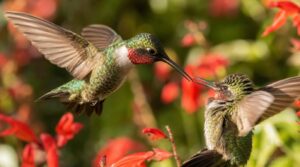
Male hummingbirds take territoriality to a whole different level, especially when breeding season hits. A mix of hormones, instinct, and competition drives them to defend their space more intensely than females do.
what that looks like in practice.
Breeding Season Hormones
Behind every dive-bomb and chase is a hormonal engine running at full throttle.
As days lengthen, seasonal hormone cycles kick into gear — testosterone levels surge in males, creating a direct Testosterone Aggression Link that sharpens territorial behavior and mate guarding instincts.
Females follow their own track, with Estradiol Fertility Peaks priming receptivity, LH Courtship Triggers timing ovulation, and Prolactin Parenting Shift supporting nest care once eggs arrive.
Courtship Territory Defense
Once testosterone kicks in, a male hummingbird’s courtship territory defense becomes remarkably deliberate. He controls access to his display zone through Territory Defense Rituals — aerial chasing rivals, using aggressive displays, and Visual Fitness Cues like his flashing gorget to signal dominance.
These Mating Signal Displays and Display Zone Tactics aren’t random aggression; they’re Courtship Resource Control in action, ensuring only he earns a female’s attention.
Elevated Lookout Perches
high perch, a male hummingbird runs his whole operation. His vigilance perch—whether a bare branch or an artificial perch nearby—shapes his territory defense entirely.
Perch Material Choice, Ideal Perch Height, and Perch Spacing Strategies all affect how well he spots rivals early.
He favors sunny Thermal Perch Preferences in the morning, enabling aggressive displays that reinforce territorial behavior before intruders even land.
Rival Male Chases
When a rival crosses the line, male hummingbirds don’t hesitate.
Chase Initiation Cues are almost instant—a boundary breach triggers a lunging pursuit through shrubs and perches.
These aggressive hummingbirds rely on Tactical Adaptations like vertical climbs and sharp twists. Territory defense burns real Chase Energy Use, so Post‑Chase Dynamics matter: the resident returns, perches high, and watches for the next intruder.
Female Choice Signals
Territory isn’t just about food — it’s also a résumé. Females read Plumage Contrast Signals, Iridescence Mating Cues, and Song Complexity Appeal during courtship displays to assess a male’s fitness.
Flight Synchrony Choices and Nest Advertising Behaviors reveal his reliability as a partner. Dominance displays and territorial behavior directly shape reproductive strategy — a male who controls resources signals he’s worth choosing.
Female Hummingbirds Also Defend Areas

Female hummingbirds don’t sit on the sidelines in defending what matters. They’re surprisingly fierce protectors of their own space, especially once nesting season kicks in.
Here’s what that defense actually looks like in practice.
Nest Protection
Female hummingbirds treat nest sites like a personal fortress. Nesting behavior revolves around constant vigilance — she selects locations using nest camouflage techniques, tucking the breeding territory into dense foliage to support predator avoidance. Her perimeter patrols aren’t random; they’re deliberate.
- She defends nest material defense actively, chasing rivals who approach.
- Nest sites are chosen to minimize line-of-sight exposure.
- Brood parasite avoidance shapes where and how she builds.
- Nest relocation triggers kick in when disturbance risk spikes.
Egg and Chick Safety
Once the nest is built, the real work begins. Egg microclimate regulation becomes a quiet priority — she shields the clutch from direct the sun and rain, keeping temperatures stable. Nest camouflage techniques do part of that job too, hiding chicks from predators.
As fledglings grow, fledgling predator avoidance shapes her parental shift patterns, keeping chick feeding safety central to every decision she makes.
Feeder Guarding Behavior
Protecting chicks takes everything she’s — and that instinct doesn’t stop at the nest.
Some females extend their guard to nearby hummingbird feeders, using sharp Perch Monitoring Tactics to watch every approach.
Feeder Access Dynamics shift fast when she’s involved: she’ll hover to block access, initiate dive bombing runs, and apply Access Blocking Techniques that force Intruder Retreat Strategies.
Guard Duration Variations depend on how hungry her chicks are.
Flower Patch Defense
Beyond the feeder, she’ll guard flowering patches just as fiercely. Nectar Source Competition around dense tubular blooms triggers full Resource Defense Strategies — aerial chases, Visual Defense Signals like wing flicks, and Patch Boundary Dynamics, she enforces through Aggressive interactions.
- Circles patch perimeters to mark Feeding territories
- Uses alarm calls to warn rivals
- Launches chases during peak bloom hours
- Shifts boundaries with nectar availability
- Minimizes Territorial Energy Costs through quick deterrence
Predator Deterrence
She doesn’t just guard flowers — she guards lives. Predation pressure near nests pushes females into active defense using every tool available.
| Deterrent Type | Method | Example |
|---|---|---|
| Reflective Surfaces | Flash predators away | Foil near feeders |
| Scent Repellents | Disrupt hunting cues | Essential oil zones |
| Acoustic Alarms | Warning sounds, vocalizations | Buzzing dive-bombing calls |
| Physical Barriers | Block access points | Mesh around nest |
| Habitat Design | Reduce ambush cover | Open sight lines |
Common Territorial Behaviors
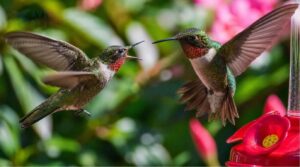
Hummingbirds don’t just feel territorial — they show it in ways you can actually see and hear. Their defensive moves are fast, bold, and surprisingly varied for such a small bird.
Here’s what those behaviors actually look like in action.
Fast Aerial Chases
When a rival enters the zone, it’s over in seconds. Aggressive hummingbirds hit chase speeds of 25–30 mph, executing tight mid-air maneuvers and 180-degree turns within a single body length. Visual tracking skills keep them locked on a moving target throughout. Energy chase costs are real, so chase break timing matters — they stop the moment the intruder retreats.
- Flight speed spikes instantly at the first sign of intrusion
- Territorial behavior kicks in hardest near nectar-rich feeding spots
- Aerial combat unfolds in zigzag bursts lasting under five seconds
- Wingbeat frequency rises sharply, producing an audible buzz during pursuit
- Midair grappling rarely happens — the chase alone usually does the job
Dive-bombing Intruders
When the chase isn’t enough, aggressive hummingbirds escalate fast. Dive Attack Mechanics follow a simple pattern: steep drop, sudden wing flare, loud disruption — then a quick ascent to reset. Territorial Dive Triggers kick in the moment an intruder crosses into the defended zone. Dive-Bombing Effectiveness is high; most intruders retreat after just one or two passes.
| Dive Behavior | What It Means |
|---|---|
| Steep vertical descent | Maximizes speed and impact |
| Wing flare at bottom | Creates startling noise |
| Quick post-dive ascent | Resets attack position |
| Repeated passes | Escalates pressure on intruder |
| Gorget flash on ascent | Signals dominance visually |
Seasonal Dive Variations are real — breeding season brings sharper, more frequent attacks. Species Dive Differences also matter; Rufous hummingbirds defend their territory with considerably higher intensity than most. Understanding hummingbird aggression helps you see why this behavior isn’t random — it’s calculated, efficient, and almost always works.
Buzzing Vocal Warnings
Not every threat needs a physical response. When an intruder crosses within a meter or two of a defended feeder, male hummingbirds shift to Close-Range Signals — rapid buzzing territorial songs that escalate in speed and volume the longer the rival lingers. These Escalation Sound Patterns often sync with wingbeats (Wingbeat Synchronization), amplifying the effect.
Watch for these vocal cues:
- A single sharp buzz that builds into repetitive chattering
- Species-Specific Calls that identify the defender’s identity
- Individual Buzz Variations reflecting each bird’s boldness level
These aggressive interactions let hummingbirds defend their territory without burning energy on a chase.
Wing and Tail Displays
Before a chase even starts, hummingbirds throw up a visual warning. Wing Flutter Patterns — rapid beats with altered wingtip paths — create a shimmering outline that signals aggression clearly.
Tail Fan Posture spreads rectrices wide, amplifying perceived body size. Motion Timing Precision matters: these bursts last fractions of a second.
| Display Signal | Function |
|---|---|
| Wing flutter | Projects aggressive postures |
| Tail fanning | Enlarges visual profile |
| Colorful Display Contrasts | Reinforces territorial behavior |
| Display Geometry | Optimizes visual cues at distance |
Brief Midair Grappling
When warnings fail, things get physical — but only barely. Midair grappling happens in a split second: two birds lock wings, disrupt each other’s flight path, then separate. It’s avian aggression stripped down to its most efficient form.
- Flight Clash Dynamics end almost as fast as they start
- Species-Specific Tactics favor brief contact over sustained fights
- Visual Intimidation Tactics often precede the actual touch
- Environmental Triggers like crowded feeders increase clash frequency
- Evolutionary Advantages favor energy-saving, nonlethal intruder chase resolution
Why Hummingbirds Fight at Feeders

Feeders might seem like a peaceful solution, but they can actually make hummingbird aggression worse. The way a feeder is set up plays a big role in how much fighting happens around it.
A few key factors consistently trigger conflict at feeders.
Concentrated Nectar Source
Feeders pack a serious punch of energy into one small spot. Nectar sugar concentration ranges from 15 to 65 percent depending on plant species’ nectar profiles — far richer than scattered natural nectar sources. That density triggers intense territorial behavior around hummingbird feeders.
Nectar Viscosity Effects slow consumption, but high-sugar sugarwater feeders still reward the effort. Amino Acid Influence adds nutritional value, and Evaporation Impact with Seasonal Concentration Shifts keep energy rewards fluctuating — making feeding territories worth fighting for.
| Factor | Natural Flowers | Hummingbird Feeders |
|---|---|---|
| Sugar Concentration | 15–40% typical | ~20–25% standard mix |
| Nectar Viscosity Effects | Variable by species | Consistent, slightly thick |
| Amino Acid Influence | Present, species-specific | Absent in plain sugar water |
| Evaporation Impact | Moderate outdoors | Higher in heat/sun |
| Seasonal Concentration Shifts | Tied to bloom cycles | Stable unless neglected |
Dominant Bird Control
One dominant male often claims an entire feeder as his own. Through Dominance Rituals — perching high, flashing his gorget, and Perch Dominance tactics — he enforces Resource Predictability on his terms.
Plumage Advantage and Display Diversity make rivals think twice before any takeover attempt. The result? Feeding territories become tightly controlled zones where territorial disputes and aggressive hummingbird behavior keep subordinates circling at a distance.
Limited Feeding Ports
The number of ports on your feeder shapes everything. Fewer openings mean tighter feeding territories and sharper territorial disputes.
Here’s what happens with limited ports:
- Narrow Port Benefits — Precise beak insertion deters crowding
- Rim Defense Perches — Birds guard openings from the edge
- Staggered Ports — Height variation cuts head-to-head clashes
- Port Plug Use — Adjust access without replacing the feeder
Wingbeat spacing between ports also matters—too close, and aggressive hummingbird behavior escalates fast.
Clear Feeder Visibility
Clear Feeder Materials and Distortion-Free Designs play a bigger role in territorial behavior than most people expect. When a dominant bird can see nectar through transparent panels from its perch, it treats the feeder like prime real estate worth defending.
Nectar Level Gauges and smart Feeder Mounting Angles reduce that sightline advantage—limiting Bird Visibility Response and softening the urge to claim every port.
High Hummingbird Traffic
Heavy traffic is one of the strongest Environmental Triggers for territorial behavior at your feeder. When migration peaks, local birds and passing migrants overlap, turning a quiet yard into a contested space. More arrivals mean more Stress Responses, more chasing, and less Feeding Efficiency for everyone.
Watch for these Queue Strategies subordinate birds use:
- Hovering near ports while the dominant bird feeds
- Circling back seconds after being chased off
- Staging on nearby perches to watch for openings
- Sneaking in from opposite sides of multi-port feeders
Rufous hummingbirds arrive, outcompeting others with sheer aggression to secure feeding territories and meet their high energy requirements.
Reducing Feeder Aggression
The good news is that feeder aggression isn’t something you just have to live with. A few simple setup changes can make a real difference in how many birds actually get to feed.
Here’s what works.
Space Feeders Widely

Distance is your best tool against territorial behavior. Place each bird feeder 15–20 meters apart to break up a dominant bird’s range and encourage coexistence. Hang multiple hummingbird feeders across your yard to build a foraging network that dilutes competition naturally. This habitat-wide resource distribution respects territorial boundaries while giving every hummingbird fair access.
| Feeder Design | Placement Range | Coexistence Benefit |
|---|---|---|
| Single small feeder | Every 15–20 m | Reduces monopolization |
| Multi-port feeder | Varied heights | Spreads foraging activity |
| Native flower integration | Throughout habitat | Improves connectivity |
Block Feeder Sightlines
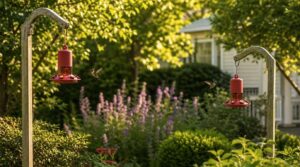
Blocking a bully’s view breaks their grip.
Thoughtful vegetation management—trimming branches within a 10-foot radius—opens sightlines without giving any single bird a commanding lookout.
Reflection reduction matters too: swap shiny surfaces for matte feeder materials to prevent startling flashes that trigger chases.
Feeder elevation at five to six feet aids sightline expansion, softening territorial behavior and making bird feeder placement far more peaceful.
Use Several Small Feeders

Several small feeders placed at varying feeder heights can quietly discourage territorial overlords from monopolizing your yard.
Spacing them out creates natural micro-territories, giving each bird equal access without constant conflict — a key reason why hummingbirds fight over the feeder in the first place.
Rotating feeder locations seasonally and maintaining cleaning ease across each station keep nectar fresh and territorial behavior noticeably calmer.
Avoid Single Large Feeders
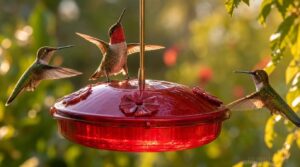
single large feeder is fundamentally a throne — and one dominant bird will claim it. aggression thresholds higher and enabling competitor exclusion of every other visitor.
- Feeder design impact shapes micro-territory formation instantly
- Multiple ports invite monopolization, reducing foraging equity
- Resource dispersion drops when one feeder controls the yard
Swap it out. Smaller feeders win.
Clean Feeders Regularly

dirty feeder can quietly undermine all your other efforts. Mold and pathogens turn nectar sources toxic fast, stressing birds and discouraging visits.
Weekly hygiene practices make a real difference: scrub feeders with hot water and mild soap, soak them in a 10% bleach solution for five to ten minutes, rinse completely, then dry before refilling. Regular maintenance checks also reveal cracks where bacteria hide — spots that fuel territorial instinct by reducing reliable bird feeding stations.
Native Flowers Reduce Competition

Feeders aren’t the only way to bring hummingbirds in — native flowers can do a lot of the heavy lifting too. Planting the right blooms spreads feeding activity across your yard, which naturally takes pressure off any single spot.
Here’s what to focus on when adding flowers to your setup.
More Nectar Sources
Native flowers are basically nature’s answer to feeder gridlock.
When you plant a mix of nectar plants—including Climate-Resilient Species, Night-Blooming Plants, and Migration Corridor Flora arranged through Vertical Layering Techniques—you create multiple feeding hotspots instead of one.
That naturally dilutes a hummingbird’s territorial instinct.
With nectar sources spread across your Urban Nectar Garden, no single spot is worth fighting over, and territory size pressure drops.
Spread Feeding Activity
When you spread nectar sources across your garden, something interesting happens to foraging behavior. Birds start rotating through patches—visiting one flower cluster, then another 10 to 20 meters away—a pattern called Nectar Intake Staggering.
This Resource Partitioning Strategy shifts Foraging Patch Dynamics so no single spot triggers intense resource competition. Temporal Feeding Patterns emerge naturally, and Territorial Influence Shifts follow: territory size pressure drops because there’s simply less worth guarding.
Red Tubular Blooms
Red tubular blooms are one of the smartest tools against feeder territoriality. Their Bloom Visibility Science is simple: hummingbirds spot red and orange flowers from a distance, so they investigate before crowding a feeder.
Top picks for your garden:
- Cardinal flower (Lobelia cardinalis) — a wetland native offering Wetland Soil Stabilization and perfect Hummingbird Pollination Mechanics
- Tube-shaped flowers concentrate nectar deep inside, matching long beak anatomy
- Garden Cluster Planting in groups of 3–5 pulls birds away from feeders
- Red and orange flowers attract pollinators while reducing feeder pressure
- Seasonal Pollination Sync aligns blooms with peak hummingbird activity
Seasonal Flower Planning
Timing matters just as much as plant selection.
When red tubular blooms fade, seasonal aggression often spikes again — birds compete harder for fewer sources.
That’s where Seasonal Plant Selection and Bloom Timing Strategies come in.
Plan a Migration-Aligned Garden using succession planting every 2–3 weeks to keep nectar-rich flowers available from spring through fall.
| Season | Recommended Plants | Bloom Timing |
|---|---|---|
| Spring | Salvia, Columbine | March–May |
| Summer | Bee Balm, Trumpet Vine | June–August |
| Fall | Cardinal Flower, Agastache | September–November |
Climate-Adaptive Planting and Pollinator Succession Plans support tube-shaped flowers and red and orange flowers — including the occasional blooming tree — keep birds spread out and calm all season.
Pollinator-friendly Gardens
pollinator-friendly garden doesn’t just feed hummingbirds — it calms their territorial edge by spreading resources naturally. Here’s what makes one work:
- Plant nectar-rich flowers in layered clusters to support diverse feeding ecology
- Add water features through thoughtful Water Feature Design for year-round wildlife-friendly gardening
- Use Native Grass Benefits to enable Microhabitat Creation for ground-nesting pollinators
- Embrace Pesticide-Free Practices to protect pollination services across species
- Include Night Pollinator Gardens with scented blooms for moths and nocturnal visitors
Territoriality Changes by Season

Hummingbird territoriality isn’t the same year‑round — it shifts with the seasons in ways that are actually pretty predictable once you know what to look for. The time of year shapes how aggressively a bird defends its space, and how much energy it’s willing to spend doing it.
Here’s how that behavior plays out across the calendar.
Peak Breeding Aggression
Breeding season is when male hummingbird aggression peaks hardest. Rising testosterone levels drive marked territoriality — more patrols, more chases, more dive displays.
Resource scarcity impact is real: fewer flowers mean fiercer fights. These seasonal aggression tactics carry genuine aggression energy costs, but the reproductive success link makes it worthwhile.
Female breeding intensity increases too, especially near nests. Once eggs hatch, that urgency quietly fades.
Lower Migration Defense
Once the breeding season winds down, territoriality in birds like the Rufous hummingbird shifts gear rather than disappearing. Seasonal aggression drops noticeably, but Migration Roost Defense and Nectar Patch Fidelity still matter.
At each migration stopover, Stopover Site Competition drives birds to guard reliable flower patches, favored perches, and Nocturnal Rest Defense sites.
Corridor Territoriality keeps energy expenditure manageable by protecting predictable routes between feeding areas.
Winter Food Guarding
Winter doesn’t soften a hummingbird’s territorial instincts — it sharpens them. When natural flowers disappear, Scarce Nectar Defense kicks in hard.
Your feeder becomes a high-stakes resource, triggering Cold Weather Survival behavior that mirrors breeding-season aggression. Perch Defense Strategies stay active as dominant birds guard feeding ports through Winter Feeder Dynamics.
Seasonal Guarding Adaptations keep avian territoriality alive even when temperatures drop.
Juvenile Behavior Differences
Young hummingbirds don’t arrive knowing the rules — they learn them.
Through Parental Influence Dynamics and social cues from adult neighbors, juveniles develop Boundary Development Stages over their first two breeding seasons.
Their Provisional Territory Formation involves shorter chases and tentative claims near natal areas.
This Aggression Progression Pattern reflects the gradual nature of Learning Territorial Skills within avian territoriality’s broader behavioral ecology.
Species-specific Patterns
No two hummingbird species play by the same territorial rulebook. Each brings its own species‑specific behavior shaped by biology and ecology:
- Bill Morphology Defense — bill shape determines which flowers a bird claims, driving territory establishment around compatible blooms.
- Aggression Timing Windows — peak bird aggression hits early morning when nectar flow is highest.
- Species Recognition Methods — birds identify rivals through plumage, calls, and flight patterns before dive‑bombing or weaving pursuit begins.
- Metabolic Territory Links — larger, faster‑burning species maintain bigger, less stable ranges tied to territory stability variations across seasons.
Frequently Asked Questions (FAQs)
Are male hummingbirds territorial?
Yes, male hummingbirds are fiercely territorial.
Hormone triggers during the breeding season sharpen rival recognition and drive divebombing displays.
Through plumage signals and shifting boundaries, territoriality theory plays out daily in your backyard.
Are hummingbirds aggressive?
Don’t let the tiny size fool you. Hummingbirds are genuinely aggressive — divebombing rivals, beak fencing at feeders, and chest poking intruders without hesitation. That territorial edge is pure evolutionary survival.
Why do hummingbirds defend their territories?
Hummingbirds defend territories to secure food, protect nesting sites, and boost mating success. Food availability and mating season drive most of this behavior, making territorial control essential for survival.
Why do hummingbirds exhibit territorial behavior?
Territorial behavior boils down to survival.
They defend feeding patches, nesting sites, and display spaces because their metabolism leaves zero margin for sharing—food availability and breeding territory access directly shape who thrives.
What does it mean when a hummingbird stays around your house?
A hummingbird lingering around your house is a resource abundance indicator — your yard offers a reliable food source, a safe nest site, or both. That’s territorial commitment in action.
Are hummingbirds territorial over feeders?
Yes — these tiny birds treat your feeder like prime real estate. One dominant bird often claims the whole thing, chasing off every rival with dive-bombs and buzzing aerial sprints.
Are hummingbirds territorial around their nests?
Absolutely. Both parents treat the nest like a fortress.
Female hummingbirds lead nest defense, repelling threats during incubation and chick-rearing, while territory size variation depends on local resource density and nesting behavior patterns.
Do hummingbirds mate?
They do mate, but don’t expect lifelong romance.
Males perform flashy aerial displays; copulation lasts just seconds, and females raise chicks completely alone — classic short-term reproductive strategy, no pair bond required.
Why do hummingbirds fight each other?
They fight mainly over food. Resource Scarcity drives most conflicts—when nectar feeding spots run low, population density spikes aggression.
Hormonal Triggers, reputation building, and age-based conflicts over home range do the rest.
Why do hummingbirds chase each other away from the feeder?
A hummingbird treats your feeder like a private pantry.
Dominance hierarchies, resource scarcity triggers, and evolutionary advantages drive chasing behavior — species-specific behavior rooted in protecting nectar feeding from interspecific competition to sustain energy consumption.
Conclusion
Picture a single male Ruby‑throated hummingbird holding three feeders hostage from dawn to dusk—that’s not unusual. It’s exactly what territorial instinct looks like in action.
Now that you understand why hummingbirds are territorial, you can stop fighting that behavior and start working with it.
Space your feeders, add native blooms, and block sightlines.
A smarter setup means more birds feeding peacefully—and a yard worth watching every single day.
- https://www.birdsandblooms.com/birding/attracting-hummingbirds/are-hummingbirds-territorial
- https://www.allaboutbirds.org/news/why-do-hummingbirds-fight-so-much
- https://www.cmu.edu/dietrich/philosophy/news/2024-2025/female-hummingbirds-game-theory.html
- https://www.birdfy.com/blogs/blogs/why-hummingbirds-are-so-territorial-and-how-to-solve-territorial-problems-at-your-feeders
- https://www.kuow.org/stories/hummingbirds-fight-seattle-washington-jerks