This site is supported by our readers. We may earn a commission, at no cost to you, if you purchase through links.
Spotting a flash of red darting through your yard stops you cold. Texas hosts five distinct red bird species, and most people spend years thinking they’re all the same bird. They’re not even close.
A Northern Cardinal and a Scarlet Tanager look nothing alike once you know what to look for—different body shapes, wing patterns, and habitats entirely.
Some of these birds live here year-round; others are just passing through on a schedule tighter than most flight itineraries. Knowing which species you’re watching—and why it chose your yard—transforms casual bird-watching into something far more satisfying.
Table Of Contents
- Key Takeaways
- Red Birds Found in Texas
- How to Identify Texas Red Birds
- Where Red Birds Live in Texas
- When to Spot Red Birds
- Attracting Red Birds to Backyards
- Frequently Asked Questions (FAQs)
- What is the red bird in Texas?
- What is a small red bird not a cardinal in Texas?
- What’s the difference between a cardinal and a red bird?
- How rare is it to see a cardinal in Texas?
- What is a Redbird in Texas?
- What birds are red in Texas?
- What birds live in Texas?
- Do Red Birds live in Texas?
- What bird has a red chest in Texas?
- Are red robins common in Texas?
- Conclusion
Key Takeaways
- Texas has five distinct red bird species — Northern Cardinal, Summer Tanager, Scarlet Tanager, Vermilion Flycatcher, and Painted Bunting — each with unique markings, body shapes, and habitats that make them easy to tell apart once you know what to look for.
- A bird’s vivid red color comes directly from carotenoid pigments in its diet, meaning the brighter the male, the better he’s been eating — and females actually use this as a health signal when choosing a mate.
- Not all red birds stick around year-round; Cardinals and Vermilion Flycatchers are permanent Texas residents, while tanagers and buntings pass through on tight seasonal schedules tied to migration corridors and cold fronts.
- You can reliably attract red birds to your backyard by combining sunflower and safflower seeds, a clean shallow bird bath, and native berry shrubs like elderberry or red chokeberry that double as food and nesting cover.
Red Birds Found in Texas
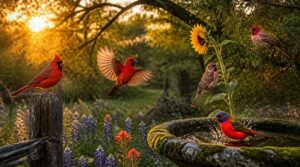
Texas is home to some seriously striking red birds — and spotting one feels like a little gift from the outdoors. Whether you’re a backyard birder or just starting to look up, knowing which species to expect makes all the difference.
From bold cardinals to stunning red-shouldered and red-tailed hawks of Texas, the Lone Star State rewards patient watchers with some truly unforgettable sightings.
Here are the five red birds you’re most likely to cross paths with in the Lone Star State.
Northern Cardinal
If there’s one bird that defines backyard birding in Texas, it’s the Northern Cardinal (Cardinalis cardinalis). That bold, uniform red plumage — accented by a distinctive crest and black facial mask — makes the male impossible to miss. The Northern Cardinal has been the designated Kentucky state bird since 1926. Here’s what makes this species special:
- Dietary carotenoids from berries and seeds fuel that vivid red coloration
- Territorial song patterns ring out year-round from shrubby perches
- A thick conical bill cracks sunflower seeds effortlessly at your bird feeding station
Females are brownish with warm reddish tones — equally beautiful, just subtler. Juvenile development brings gradual color change through the first year, shifting from olive-brown to vibrant red.
Summer Tanager
Meet the Summer Tanager (Piranga rubra) — the only North American bird where breeding males are entirely bright red, no black wings, no markings, just pure crimson from bill to tail. That makes identification refreshingly straightforward.
Listen for its robin-like, rolling song drifting down from the canopy, and scan the treetops carefully — these birds forage high, hunting bees and wasps mid‑flight with surprising skill.
Scarlet Tanager
Now here’s a bird that turns heads — the Scarlet Tanager (Piranga olivacea) pairs a blazing red body with jet-black wings and tail, making it unmistakable. It’s a migrant through Texas in spring and fall, not a breeder. Spot it high in the canopy, quietly gleaning beetles and caterpillars from the leaves.
Vermilion Flycatcher
If the Scarlet Tanager is Texas’s flashiest migrant, the Vermilion Flycatcher (Pyrocephalus rubinus) is its year-round showstopper. That blazing red head and chest against a brown back looks almost painted on.
Watch for it perched low near water or desert scrub, then launching into quick aerial insect catches — a tiny flame darting across open sky.
Painted Bunting
Few Texas birds stop you cold like the Painted Bunting (Passerina ciris). The male’s blue head, green back, and red chest look almost unreal — like someone grabbed every color at once.
That vivid red comes from carotenoid pigments woven into the feather structure itself.
Females stay olive-green, blending invisibly into brushy cover where cowbird parasitism threatens their nests.
How to Identify Texas Red Birds
So you’ve spotted a flash of red in the trees, but which bird is it? Good news: telling these species apart gets easy once you know what to look for. Let’s break down the key clues, starting with that gorgeous red plumage itself.
Bright Red Plumage
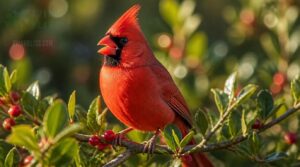
That bold splash of red isn’t random — it’s a masterpiece built from food. Carotenoid pigments from berries, seeds, and insects get absorbed during molt and deposited directly into growing feathers. The brighter the male, the better his diet. Three things drive intensity:
Females seem to notice too — studies show they consistently favor the most vividly colored males, who also tend to be the most vocal, as explored in this deep dive into why birds sing through the night during breeding season.
A male bird’s vivid red plumage is simply a diet report written in feathers
- Dietary pigment quality
- Efficient feather deposition
- Microscopic light-reflecting structure
Color literally signals health to potential mates.
Wing and Tail Markings
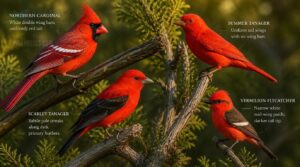
Once you see red in the field, markings become your real decoder.
Wing bar contrast is your first clue — Cardinals flash two bold white bars, while Summer Tanagers show almost none. Scarlet Tanagers reveal subtle pale streaks along the primaries. Vermilion Flycatchers carry a narrow white mid-wing patch.
Tail tip patterns also help: Painted Buntings show darker tail tips; Cardinals stay uniformly red.
Size and Body Shape
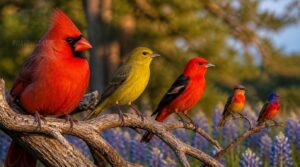
Size matters more than you’d think when you’re scanning a tree. The Northern Cardinal is the largest of the group at up to 9.1 inches, with a chunky, broad‑chested build.
Summer and Scarlet Tanagers are slimmer and mid-sized. The Vermilion Flycatcher and Painted Bunting are noticeably tiny — compact little shapes barely over five inches long.
Male Versus Female Colors
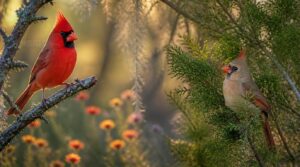
Here’s a fun rule of thumb: if it’s flashy, it’s probably a guy. Sexual dimorphism runs strong in red birds — males flaunt carotenoid-fueled color to signal health, while females stay drab for camouflage nesting.
This pattern shows up again and again:
- Male Cardinals glow red; females wear soft reddish-brown.
- Male Tanagers blaze red; females turn greenish-yellow.
- Male Buntings shine red-blue; females stay olive.
Songs and Calls
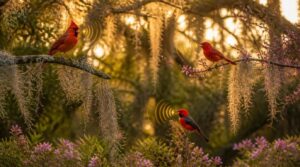
Can’t see the bird? Listen instead. Melodic song patterns reveal species fast: cardinals whistle "what-cheer," tanagers add a fluting cadence, buntings trill loosely.
| Species | Song Style | Call Style |
|---|---|---|
| Cardinal | Whistled "cheer" | Sharp chip |
| Summer Tanager | Rising, fluting | High chirp |
| Vermilion Flycatcher | Stuttering, descending | Quick cheep |
Songs defend territory; instinctive call functions handle alarms and contact—pure songbird behavior!
Where Red Birds Live in Texas
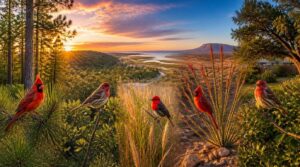
Texas is a big state, and that means red birds don’t all hang out in the same place. Where you live changes who shows up at your feeder. Let’s break down the five habitats where these red beauties love to call home.
Backyard and Suburban Habitats
Your own backyard might be more of a red bird hotspot than you think. Northern Cardinals thrive in suburban yards year-round, especially where dense shrubs offer safe cover from cats and hawks.
Place your bird bath near shrubs to cut predation risk.
Skip the pesticides — cardinals and Painted Buntings need insects to feed their chicks.
East Texas Woodlands
Want denser woods than your backyard? Head into the East Texas Pineywoods, where loblolly pines and creek bottomlands shelter Cardinals, Tanagers, and migrating Buntings.
- Tall pine-oak canopy hides nests from predators
- Creek bottomlands offer year-round insects
- Fire-shaped understory boosts plant diversity
- Humid climate sustains lush shrub cover
It’s a real-deal bird identification guide come to life.
Central Texas Brushlands
From dense pines, picture rolling hills covered in thorny shrub diversity instead. Central Texas brushlands mix mesquite, cenizo, and prickly pear, with arroyos channeling moisture for thirsty wildlife.
These drought resilient ecosystems rely on fire-adapted plants to thin brush naturally. Set up a bird feeding station camera near mesquite cover, and you’ll likely catch Cardinals and Painted Buntings using these tough little habitats.
South Texas Scrub
Head further south, and the landscape shifts into something wilder. South Texas scrub is a sun-baked tangle of mesquite, lotebush, and thorny brush growing across shallow, well-drained soils. It’s harsh out here — hot summers, unpredictable rain, and dry spells that test every creature living in it.
That toughness is exactly what the Vermilion Flycatcher loves.
West Texas Open Country
Out west, the landscape opens up into something vast and unforgiving. Creosote, mesquite, and baked arid soils stretch toward dramatic horizons.
This is prime Vermilion Flycatcher country — watch for that vivid red flash from a fence post or desert wash.
The scrappy Pyrrhuloxia lives here too, thriving where most birds wouldn’t dare.
When to Spot Red Birds
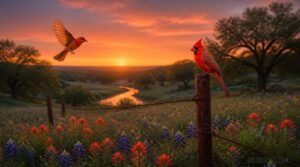
Timing really does matter when you’re chasing red birds across Texas. Some species are out there year-round, while others swing through only briefly during migration or show up as rare surprises. Here’s a breakdown of when you’re most likely to cross paths with each one.
Year-Round Residents
Some red birds in Texas don’t go anywhere — they’re here every single month.
Year-round residents like the Northern Cardinal and Vermilion Flycatcher hold their territories through summer heat and winter chill alike. They keep singing, foraging, and defending the same familiar patches of shrubs and woodland all year long.
That consistency makes them the most reliable Texas wildlife sightings you’ll ever find.
Spring Breeding Season
Spring is when Texas red birds truly come alive. From late February onward, males burst into courtship song duets, flooding woodlands with sound to claim territory and win mates.
Nest building follows fast — sometimes within days. Incubation runs 11–14 days, then nestlings demand constant protein: caterpillars, beetles, insects.
Parents stay fiercely alert, alarm-calling at any predator that dares creep close.
Fall Migration Windows
Fall is when the Texas sky quietly becomes a highway. Peak migration runs late September through early November, funneling Summer Tanagers and Painted Buntings along Gulf Coast corridors.
Watch for northerly cold fronts — they push birds south overnight.
Tools like BirdCast track nocturnal radar movement, so you’ll know exactly when to step outside at dawn.
Winter Finch Visitors
Winter finches don’t visit Texas every year — they show up during irruption years, when boreal forests north of the state experience mast failures and conifer seed crops collapse. That food scarcity pushes species like Pine Siskin, House Finch, Purple Finch, Red Crossbill, and Cassin’s Finch southward in search of alternatives.
Here’s what makes irruption years special:
- Sightings peak December through February
- Conifer stands in East Texas become hotspots
- Feeders offering nyjer and sunflower seeds attract acrobatic flocks
- Document your sightings through local bird clubs to help track patterns
Rare Texas Sightings
Sometimes Texas surprises even seasoned birders. While tracking red birds across Texas avifauna, you might stumble onto something truly unexpected — a rare vagrant blown far off its migration route.
The Scarlet Tanager, already uncommon here, occasionally turns up in spots far outside its typical corridor. Keep your checklist handy, because Texas rewards the patient watcher.
Attracting Red Birds to Backyards
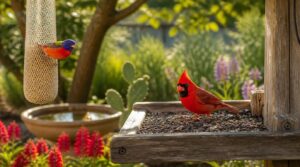
The good news? You don’t need a fancy setup to bring red birds right to your yard. A few simple changes can make your outdoor space genuinely irresistible to cardinals, painted buntings, and more. Here’s what actually works.
Sunflower and Safflower Seeds
Two seeds rule the feeder world for Texas red birds: sunflower and safflower. Cardinals love both. Painted Buntings prefer sunflower. Here’s why they work so well:
- Sunflower seeds pack 20–25% protein and healthy fats birds need for energy
- Safflower offers a milder, slightly sweeter option Cardinals especially favor
- Both deliver vitamin E and minerals like magnesium and copper
- Safflower’s bitter coating deters squirrels — big win for you
- Store seeds cool and dry to keep them fresh and rancid-free
Nyjer Seed Feeders
Nyjer seed feeders are a smart next step beyond sunflower and safflower. Painted Buntings especially go wild for Nyjer.
These bird feeders use tiny feeder port sizes — around 3/16 inch — perfect for small beaks. Look for weight-sensitive perches that snap shut on squirrels automatically.
Clean monthly and check for moisture. Simple, effective, and worth it.
Native Berry Shrubs
Seeds will only get you so far. Native berry shrubs take your backyard from a pit stop to a proper destination for red birds.
Here are four standout shrubs to plant:
- Red chokeberry – Bright red clusters persist into winter
- Spicebush – Fat-rich drupes fuel migrating birds in fall
- Elderberry – Birds strip it fast; plant multiples
- American cranberrybush – Multi-season food and cover in one
Fresh Bird Baths
Once your berry shrubs are pulling birds in, a fresh bird bath seals the deal. Change the water daily, keep the depth between 2.5 and 4 cm, and position it 10 feet from windows to prevent collisions.
A small dripper keeps water moving, which discourages mosquitoes.
Skip the soap — plain water and a soft brush are all you need.
Safe Nesting Cover
Safe nesting cover makes your backyard a place where red birds actually want to raise a family.
Tuck in native shrubs like yaupon holly or hawthorn — their thorny branches naturally deter predators. Keep loose dry grasses nearby for nesting material.
Prune lightly in spring to maintain concealment without disturbing active nests.
That simple effort can make all the difference.
Frequently Asked Questions (FAQs)
What is the red bird in Texas?
Texas is home to several red bird species, including the Northern Cardinal, Summer Tanager, Vermilion Flycatcher, Painted Bunting, and Scarlet Tanager — each bringing stunning color to the state’s diverse landscapes year-round.
What is a small red bird not a cardinal in Texas?
Good things come in small packages. Texas hosts several small red birds beyond the Cardinal — like the Painted Bunting, Vermilion Flycatcher, House Finch, and Summer Tanager, each offering vibrant color in a compact frame.
What’s the difference between a cardinal and a red bird?
A cardinal is a red bird — but not all red birds are cardinals. The Northern Cardinal stands out with its prominent crest, thick orange beak, and all-red plumage year-round.
How rare is it to see a cardinal in Texas?
Spotting a Northern Cardinal in Texas is like finding a sunny day in June — almost guaranteed. Year-round residents, cardinals are common statewide, though northwest Texas sightings are rarest.
What is a Redbird in Texas?
A redbird is any bird with striking red plumage — in Texas, that usually means species like the Northern Cardinal, Summer Tanager, or Vermilion Flycatcher, each bringing vivid color to the landscape.
What birds are red in Texas?
Texas is a bird lover’s jackpot. You’ll find five stunning red species here: Northern Cardinal, Summer Tanager, Scarlet Tanager, Vermilion Flycatcher, and Painted Bunting — each with a unique look.
What birds live in Texas?
Texas is home to over 650 bird species — more than any other U.S. state. From woodland songbirds to coastal shorebirds, Texas avian diversity is truly peerless, making it a paradise for birdwatchers.
Do Red Birds live in Texas?
Ever wonder what’s flashing through your yard? Yes, Texas avian diversity includes plenty of red birds!
From resident Cardinals to migratory tanagers, Texas bird populations offer year-round birdwatching, with habitat preferences ranging from suburban feeders to desert scrub statewide.
What bird has a red chest in Texas?
Several Texas birds sport a red chest. The Vermilion Flycatcher shows vivid crimson from throat to belly, while the Northern Cardinal and male Summer Tanager display rich red across the entire breast.
Are red robins common in Texas?
You might be surprised — American robins aren’t exactly rare in Texas, but they’re not year-round regulars everywhere either. They’re most common in winter, when migratory flocks push south.
Conclusion
flash of red in your yard is the same bird? That theory falls apart fast once you’ve spotted a Vermilion Flycatcher hovering beside a Northern Cardinal.
Each of the red birds in Texas has its own personality, preferred zip code, and seasonal schedule.
Set out the right seeds, add a water source, and let native shrubs do the rest.
Your yard won’t just attract birds—it’ll earn them.