This site is supported by our readers. We may earn a commission, at no cost to you, if you purchase through links.

That pigeon on your window ledge? It might be on its way home to the same partner it’s had for three years. Pigeons form social monogamous pair bonds that regularly last five to ten years—longer than many human relationships, and far longer than most people assume about a bird we’ve collectively decided is a flying rat.
What makes this even more striking is that only about 9% of mammal species bother with social monogamy at all, yet pigeons have quietly mastered it while raising families on city rooftops and train station ledges. Their bonds aren’t just romantic sentiment, either—shared incubation duties, coordinated chick defense, and mutual loyalty translate directly into better survival odds for their young.
The science behind how pigeons choose partners, stay faithful, and rebuild after loss reveals a surprisingly intricate social life hiding in plain sight.
Table Of Contents
- Key Takeaways
- Do Pigeons Mate for Life?
- How Pigeon Pair Bonds Form
- Are Pigeons Truly Monogamous?
- What Happens if a Mate Dies?
- When Do Pigeons Start Mating?
- Pigeon Nesting and Egg Laying
- How Pigeon Parents Raise Chicks
- Why Pair Bonding Helps Survival
- Top 3 Supplies for Pigeon Pairs
- Common Pigeon Mating Myths
- Frequently Asked Questions (FAQs)
- How often do pigeons mate?
- Do pigeons die after mating?
- Are pigeons monogamous?
- Will a pigeon mate for life?
- How Do Pigeons Mate?
- Do Pigeons Reuse the Same Nest?
- How Long Do Pigeons Live?
- What are the Predators of Pigeons?
- Do pigeons experience jealousy in their pair bonds?
- How long do pigeon pairs remain bonded?
- Conclusion
Key Takeaways
- Pigeons form pair bonds that regularly last five to ten years — and sometimes a lifetime — sharing incubation shifts, nest defense, and chick-rearing so effectively that their offspring genuinely have better survival odds than those raised by solo or unstable parents.
- While pigeons are socially monogamous (meaning they commit to one partner for all parenting duties), occasional extra‑pair mating does happen in a small percentage of cases, offering a quiet genetic diversity benefit without breaking the core partnership.
- When a mate dies, the surviving pigeon mourns briefly — just a few days — then actively re‑enters the mating market, with males typically re‑pairing faster by claiming prime nest sites and launching into courtship displays.
- Cities actually make pigeon pair bonds stronger , not weaker: urban heat, reliable food scraps, and sheltered ledges on tall buildings extend breeding seasons, reduce foraging effort, and let bonded pairs focus their energy on raising more clutches per year.
Do Pigeons Mate for Life?

If you’ve ever watched two pigeons side by side on a ledge, constantly grooming each other and cooing like they’ve got the whole world figured out, you’ve probably wondered whether that bond is the real deal.
Pigeons are actually one of nature’s more devoted partners, forming pair bonds that often last years — and sometimes a lifetime. Here’s what’s really going on beneath those ruffled feathers.
Unlike many birds that pair up seasonally, pigeons commit to the same mate for life, returning to shared nests and reinforcing their bond through mutual preening and courtship displays year after year.
Social Monogamy Explained
Ever wonder why two pigeons stick so close on your windowsill? That’s social monogamy in action: a bonded pair sharing nest building, territory defense, and chick-rearing duties together. This teamwork means:
- Better offspring survival through shared protection
- Smarter resource distribution between partners
- Stronger social bond stability over time
Cooperative parenting and steady mate fidelity make pigeon pairs surprisingly reliable partners in the bird world. In the animal kingdom, only about 9% of mammals exhibit social monogamy.
Lifelong Pair Bonds
That teamwork doesn’t fade after one nesting season — it often becomes lifelong mating. Pigeon pairs stay monogamous behavior for years, sometimes for life, building real long-term compatibility along the way.
Why does this matter? Bond longevity benefits everything: nesting coordination, mate fidelity, and breeding success all improve when partners truly know each other’s rhythms, season after season.
Same Mate, Multiple Seasons
Spring after spring, the same two pigeons often show up at the same ledge, ready to pick up right where they left off.
They repeat their courtship rituals, rebuild old nests instead of starting fresh, and sync their breeding cycles like clockwork.
This nest site fidelity isn’t sentimental — it’s smart, cutting down on wasted time and predator risk.
Pair Bonds in Cities
That ledge loyalty looks even sharper in the city, where monogamous pigeons thrive despite constant noise and foot traffic. Urban pairs rely on:
- Urban roosting stability near reliable shelter
- Metropolitan mate recognition through coos and billing
- City scavenger defense, guarding nests together
- Urban resource proximity to food and water
Their human disturbance tolerance keeps breeding pair stability strong, proving pair bonding in birds adapts beautifully to skyscrapers and sidewalks alike.
How Pigeon Pair Bonds Form

So how does a pigeon actually land "the one"?
It turns out their romance follows a pretty charming playbook, full of head bobs, soft coos, and a few sweet gestures that would make any matchmaker proud.
Let’s walk through exactly how these bonds get built, one courtship step at a time.
Choosing a Compatible Mate
Picking a mate isn’t random for pigeons—it’s a careful audition.
Birds rely on Compatibility Signaling, watching how a potential partner reacts to Synchronized Rituals like matched nodding and cooing. Behavioral Suitability matters too: attentive, responsive birds score higher. Add in early Mutual Feeding gestures, and you’ve got the recipe for Selection Success—the foundation every stable, monogamous pigeon pair is built on.
Male Courtship Displays
When a male spots a promising mate, he doesn’t just walk up and hope for the best—he puts on a show.
Expect rhythmic head bobbing, puffed-up neck feather inflation, and rapid wing beats that create a visual shimmer effect, all wrapped into the classic bowwalk: bowing and cooing while strutting with synchronized calling patterns and a flashy nestward dance.
Female Acceptance Signals
If she’s interested, she won’t keep him guessing for long. Reciprocal nodding cues answer his bow-walk, while receptive body angling brings her closer instead of away.
Watch her eyes, too: steady visual eye contact and soft vocal tones signal real engagement. Things heat up with mutual allopreening rituals, where she preens his feathers—female participation that seals this courtship ritual before pair bonding even begins.
Beak Kissing and Billing
Think of a pigeon kiss as a handshake that also says *I trust you completely.
*
- During billing, both birds make light, rhythmic beak-to-beak contact — slow, deliberate taps accompanied by soft cooing and mutual eye contact that act as tactile communication cues strengthening their bond. This gentle avian courtship ritual triggers bonding neurochemical release in both partners, quietly cementing mate recognition that carries through every shared breeding season ahead.
Courtship Feeding Behavior
Right after the pigeon kiss comes something even sweeter — courtship feeding, where the male regurgitates crop milk directly into the female’s beak.
It sounds odd, but it’s basically him proving he can provide.
This nutritional egg support helps her produce healthier clutches, while she quietly evaluates his reliability as a future co-parent — all through one intimate, repeated gesture.
Are Pigeons Truly Monogamous?

Pigeons are famously loyal, but "monogamous" is actually a word that needs a little unpacking when you’re talking about birds. There’s a difference between staying faithful to your partner and, well, actually staying faithful — and pigeons, it turns out, live somewhere in between. Here’s what science says about where their loyalty really stands.
Social Versus Genetic Monogamy
Here’s something that might surprise you: social monogamy and genetic monogamy aren’t the same thing. Pigeons pair up and share every parenting duty — incubation, feeding, nest defense — but that partnership doesn’t always guarantee mating exclusivity. Think of it as paternity vs. partnership. Studies confirm most squabs match their social pair genetically, meaning genetic fidelity rates among pigeons are genuinely high.
- Social bonds provide stability across breeding seasons
- Shared parental duties reinforce pair bond loyalty
- Most offspring reflect true reproductive strategy fidelity
Extra-pair Mating Exceptions
Even the most devoted pigeon couples aren’t completely immune to outside temptation. A small percentage of squabs do result from extra-pair paternity, where a female mates with a male beyond her social partner.
These rare extrapair copulations can boost genetic diversity benefits for the brood, producing chicks with broader immune resilience — a quiet biological insurance policy tucked inside an otherwise faithful pair bond.
Mate Guarding Behavior
So if pigeons occasionally stray, how do they protect their pair bond the rest of the time? Through mate guarding — and they’re surprisingly good at it. Males stay physically close to their partners, puffing up feathers and vocalizing to warn off rivals, a classic example of territorial defense in birds that keeps competing males at a respectful distance.
Here’s what coordinated pigeon guarding actually looks like:
- Intruder Deterrence Tactics — Males chase approaching rivals and use aggressive posturing to signal "this partner is taken."
- Shared Vigilance Cues — Both partners exchange calls and posture signals to communicate incoming threats.
- Resource Protection Strategies — Males defend favored feeding spots, keeping females anchored to the existing pair bond.
- Urban Rivalry Dynamics — Dense city populations intensify guarding, with pairs roosting closer together to reduce mate switching.
- Coordinated Defense Rituals — Mutual preening and side-by-side movement reinforce courtship behavior while simultaneously deterring rivals.
This layered system of avian monogamy maintenance makes interference energetically costly for outsiders — which is exactly the point.
Why Loyalty Benefits Chicks
All that mate guarding pays off in one of the most meaningful ways possible—healthier chicks. Stable pair bonds mean both parents share incubation duties reliably, keeping eggs consistently warm during those critical 17–19 days.
That reliable incubation pattern alone dramatically reduces early mortality, giving each squab a genuinely better shot at surviving to fledge.
What Happens if a Mate Dies?

Losing a partner is a turning point for any pigeon, and what happens next might surprise you. These birds do grieve, but they don’t stay that way forever — and the path forward looks a little different depending on whether it’s the male or female left behind. Here’s what the science tells us about how pigeons move on.
Short Mourning Period
When a pigeon loses its bonded partner, something quietly heartbreaking unfolds — the surviving bird enters a brief mourning period lasting just a few days, during which it shows clear behavioral changes: reduced activity, less eating, and a subdued presence.
This disruption to the pigeon reproductive cycle reflects just how deeply monogamous pair bonds are woven into a pigeon’s daily rhythm.
Searching for Another Mate
Once the mourning period passes, something quietly purposeful begins: the surviving pigeon re-enters the mating market, often within days to weeks. Urban environments actually speed this up, since dense roosts and crowded ledges put potential partners in constant close proximity. Here’s what shapes how quickly a pigeon finds a new pair bond:
- Season and daylight — Spring triggers a surge in courtship activity, making it the busiest window for mate replacement after loss.
- Roost density — Larger flocks mean more candidates nearby, shortening the search considerably.
- Food availability — Reliable resources close to a nest site attract more potential mates and encourage faster pairing.
- Experience level — Seasoned breeders recognize compatibility cues faster than younger birds still learning the signals.
- Personality and history — A pigeon’s prior breeding success and boldness influence how eagerly it pursues a new partner.
Notably, researchers note that social vs. genetic monogamy plays a role here too — while most chicks result from the established social pair rather than extra-pair copulations, a newly unpaired bird is briefly more open to extrapair mating as it reassesses compatibility cues and settles into a fresh bond.
Males Re-pair Faster
Surprisingly, male pigeons tend to re-pair noticeably faster than their female counterparts after losing a mate.
| What Males Do | Why It Works |
|---|---|
| Occupy prime nest sites quickly | Attracts ready females fast |
| Perform vigorous courtship displays | Signals fitness and readiness |
Their rapid nesting occupation and bold courtship vigor — head-bobs, cooing, billing — compress the mate replacement timeline from weeks into days.
Female Re-pairing Patterns
Females take their time — and for good reason. Rather than rushing into a new pairing, a female pigeon carefully evaluates territory safety and nesting prospects before accepting a new mate. She prioritizes three key factors:
- Nest site fidelity — staying close to a familiar, proven location
- Consistent male presence during day and night shifts
- Evidence of reliable crop milk provisioning
When Do Pigeons Start Mating?

Pigeons are ready to start a family sooner than you might think, and once they get going, they rarely slow down. A few key factors shape exactly when and how often a pair decides to breed. Here’s what influences their mating timeline from the very start.
Sexual Maturity Age
Most pigeons hit sexual maturity surprisingly early — somewhere between four and six months of age, depending on their environment and access to food.
In cities, where seeds and grains are practically always available, some young birds start showing courtship displays and testing out pair bonds as early as four months, well before their first winter.
Year-round Breeding Potential
Unlike most birds that follow strict seasonal schedules, pigeons have year-round breeding potential — and yes, that’s as exceptional as it sounds. As long as a stable mate, a sheltered ledge, and steady food exist, a bonded pair can cycle through successive clutches across every season.
Climatic influence factors like daylight and temperature do nudge hormonal rhythms, but urban warmth and consistent shelter soften those cues considerably.
Food Availability Effects
Food is practically the starting pistol for pigeon mating. Urban food abundance increases pair bonding activity by roughly 18 percent in spring, because when energy isn’t spent searching for every meal, it gets redirected toward courtship. Here’s what steady resource availability actually unlocks for a bonded pair:
- Nutrient-dense food patches boost beak-to-beak interaction rates during courtship
- Predictable anthropogenic food sources like bread and seeds create longer social pairing periods
- Food-driven mating readiness peaks whenever foraging energy savings free up time for nest activity
Food scarcity, by contrast, loosens pair bonds noticeably — mate switching increases when resources dry up.
Seasonal Nesting Patterns
Spring is fundamentally nature’s green light for pigeon nesting. As daylight lengthens each February and March, hormonal shifts trigger courtship and nest-building almost automatically. Most pairs begin nesting in late winter to early spring, timing their first clutch so chicks hatch when food is abundant.
Heavy rain or cold snaps, though, can delay egg-laying and quietly chip away at seasonal nesting success.
Urban Breeding Advantages
Cities are, in many ways, a pigeon’s paradise. Urban heat islands keep temperatures warmer year-round, nudging pairs to breed earlier and more often than their rural counterparts — sometimes achieving year-round breeding that rural pigeons simply can’t match.
- Concentrated anthropogenic food sources like street scraps reduce daily foraging effort
- Tall buildings offer protected urban nesting sites away from ground predators
- Warmer nights accelerate egg and squab development
- Food subsidy benefits lower energy costs between nest visits
- Consistent resources strengthen breeding success across multiple clutches
Pigeon Nesting and Egg Laying
Once a pigeon pair bonds, they don’t just need love — they need a solid address. Nesting is where their partnership really gets to work, and pigeons are surprisingly deliberate about the whole process, from picking the right spot to laying their eggs. Here’s a closer look at how it all unfolds.
Preferred Nest Locations

In selecting a home, pigeons are surprisingly strategic. They strongly prefer elevated, sheltered spots — eaves, rooftops, building ledges, and bridge beams — because height naturally discourages ground predators.
In cities, balconies and window ledges work just as well, though balcony nests carry higher risks from curious pets.
Some pigeons even nest in dense ground cover like shrubs, using camouflage instead of height.
Male Gathers Materials

Once a pigeon pair has claimed their spot, the male gets straight to work — and honestly, watching him is like seeing a tiny, feathered contractor on the job. Male gathering roles are clear-cut: he scouts nearby trees and surfaces for twigs, pine needles, and grasses, prioritizing moisture-resistant materials that won’t rot under eggs.
- Twig selection strategy — he favors stiffer, durable stems over flimsy scraps
- Material quality signals — fresh or aromatic plant matter helps deter pests naturally
- Nesting resource management — he stockpiles near the site, reducing time away from his mate
This focused foraging success isn’t random. As partners committed to their pair bonds, both birds share parental responsibilities from the very start — and nest building begins with him laying the groundwork, literally.
Female Shapes The Nest

While the male hauls in raw materials, it’s the female who turns that loose pile into something functional.
She shapes the nest bowl by pressing her body inward and adjusting the rim, so eggs can’t roll freely.
Her choices about insulating nest linings — moss, soft fibers, feathers — help regulate humidity and keep hatchlings warm, a quiet but essential contribution to their monogamous pair bond.
Two White Eggs

Each pair lays two white eggs per clutch, placed one day apart — a rhythm your monogamous pigeons keep throughout their lifelong bond. Those shells are pure calcium carbonate, smooth and bright white, protecting the embryo inside.
For healthy development, the eggs need steady warmth around 37.5–38.5°C, which both mates take turns maintaining with commendable dedication.
Reusing Old Nests

Here’s something that might surprise you: once your bonded pair claims a nest site, they’ll often return to that exact same spot season after season.
Reusing old nests saves real energy — less gathering, faster incubation starts — but watch for parasites hiding in older materials, since accumulated debris can quietly threaten your squabs’ early health.
How Pigeon Parents Raise Chicks

Once a pigeon pair has laid their eggs, the real teamwork begins. From taking turns keeping those eggs warm to producing a special milk that most people don’t even know birds can make, pigeon parents are surprisingly hands-on. Here’s a closer look at how they pull it off, step by step.
Shared Incubation Duties
What if parenting were a perfectly timed relay race? That’s fundamentally what pigeon incubation shift coordination looks like.
One parent warms the eggs while the other forages, and they swap roles with notable consistency — usually females overnight, males through the day.
These visual communication cues, like subtle feather ruffling and beak touches, signal "your turn," keeping egg temperature stability without a single missed shift.
Seventeen to Nineteen Days
Seventeen to nineteen days — that’s all the time a pigeon egg needs to go from a fragile shell to a wriggling squab.
Thanks to those consistent parental duty shifts, the egg temperature never wavers, and those incubation period milestones tick along like clockwork, setting the stage for the explosive early growth cycle that follows.
Crop Milk Feeding
Here’s something that might surprise you: pigeons produce their own "milk" — not from mammary glands, but from their esophageal crop.
When squabs are fed crop milk, both parents regurgitate this nutrient-rich crop secretion directly into their chicks’ mouths, driven by a surge in prolactin hormone that triggers the JAK2-STAT5 pathway, kick-starting rapid growth acceleration through high protein, healthy fats, calcium, and phosphorus — beak-to-beak nourishment that quietly deepens the parent-squab bond with every feeding.
Squab Growth Stages
From the moment crop milk hits their crops, squabs transform at a pace that’s almost hard to believe. Hatchlings weigh just 20 to 30 grams — barely heavier than a few grapes — yet double that within a week.
By day 14, pin feathers emerge, and contour feathers steadily replace loose down, wrapping their small bodies in real plumage.
Fledging at Four Weeks
By four weeks, squabs are barely recognizable as the tiny, helpless hatchlings they once were. First flight attempts begin as short, wobbly hops off ledges — part experiment, part instinct — while their wing feathers continue filling in, replacing the last stubborn bits of down with proper contour plumage built for lift and control.
Fledglings don’t venture far, though. They stay close, watching their parents forage and quietly learning the ropes.
Why Pair Bonding Helps Survival

Pair bonding isn’t just romantic for pigeons — it’s genuinely a survival strategy that shapes everything from how their chicks grow to how safely they can nest in a busy city. Two dedicated parents working as a team mean the odds of raising healthy squabs go up dramatically, and that consistency pays off season after season.
Here’s a closer look at exactly why sticking together makes such a difference for these birds.
Shared Chick Protection
When two pigeon parents team up, their shared parental responsibilities create a surprisingly strong defense system for the nest. Here’s what that looks like in action:
- Predator alarm calls alert the partner instantly
- Sentinel nest behavior keeps one adult on watch at all times
- Sibling survival strategies reduce risky solo movement among chicks
Constant Nest Attendance
Think of constant nest attendance as the pair bond’s quiet superpower.
Because pigeons mate for life and share responsibilities, one parent is almost always present — the male often handling daytime guarding while keeping egg temperatures stable.
This incubation temperature stability directly promotes embryo development success, making monogamous parental care in pigeons far more effective than going it alone.
Efficient Food Gathering
When a bonded pigeon pair shares territory, urban foraging becomes remarkably efficient. Rather than competing with their mate, each bird benefits from social feeding — gleaning scattered seeds from sidewalks and plazas while flock members signal productive food patches nearby.
Paired pigeons also memorize reliable feeding sites, returning daily at consistent times, which means less energy wasted searching and more reserved for raising squabs.
Stronger Breeding Success
Here’s something worth appreciating: stable pair bonds genuinely translate into better breeding outcomes for pigeons. When partners stay synchronized — sharing incubation shifts, coordinating nest defense, and maintaining efficient feeding routes — their chicks have a measurably stronger shot at surviving.
| Pair Bond Advantage | Breeding Outcome |
|---|---|
| Synchronized courtship timing | Eggs laid on consistent schedule |
| Coordinated nest defense | Lower predation on eggs and squabs |
| Balanced parental care | Faster squab growth rates |
| Efficient feeding routes | More energy reserved for provisioning |
| Monogamous commitment across seasons | Maximized fledgling survival rates |
Pigeons that truly mate for life aren’t just being romantic — they’re running a finely tuned parental care system that consistently outperforms solo or unstable pairings.
Safer Urban Nesting
City life actually works in a bonded pair’s favor. Urban green spaces, textured brick facades, and sheltered ledges give pigeon pairs a surprisingly rich toolkit for safe nest site selection. Here’s what makes urban nesting genuinely safer for committed pairs:
- Moderate human activity deters raptors and scavengers near nesting sites
- Textured building surfaces mimic natural cliff faces, anchoring nests securely
- Shallow water sources support parents during chick provisioning
- Noise management near active nests reduces squab stress during hatching
Top 3 Supplies for Pigeon Pairs
If you’re keeping a bonded pigeon pair at home, having the right supplies on hand makes a real difference in keeping them comfortable and well-fed.
From feeders that work for both birds to a seed mix that actually matches their nutritional needs, a few good picks go a long way.
Here are three supplies worth having for your pigeon pair.
1. Kiwibit 4K Solar Bird Feeder

If you want to watch pigeon pairs up close without scaring them off, the Kiwibit 4K Solar Bird Feeder makes that remarkably easy.
Its 132° HDR lens captures every billing, head-nod, and courtship display in sharp 4K detail, day or night, while the built-in AI identifies visiting species instantly.
Solar-powered and weatherproof, it runs year-round with almost zero fuss on your end.
| Best For | Bird enthusiasts, families with kids, and hobbyists who want a low-maintenance, high-tech way to observe and identify backyard birds year-round. |
|---|---|
| Primary Use | Smart bird feeding & monitoring |
| Target Birds | 10,000+ species via AI ID |
| Capacity | 1.5 L dual-compartment seed container |
| Maintenance | Detachable bins for easy cleaning |
| Durability | IP65 weatherproof, –4°F to 122°F rated |
| Versatility | Modular mounts and optional accessories |
| Additional Features |
|
- Stunning 4K HDR video with a wide 132° lens means you catch every detail, even in low light
- Solar-powered with a large backup battery, so it mostly takes care of itself without daily charging
- AI species identification makes it genuinely educational and fun for kids and adults alike
- Only works on 2.4 GHz Wi-Fi, which can be a dealbreaker if your router doesn’t broadcast that band
- The best features — extended AI recognition and cloud storage — sit behind a paid subscription
- Hummingbird feeding requires a separately purchased add-on kit, so it’s not quite all-in-one out of the box
2. Gray Bunny Outdoor Ground Feeder

Pigeons prefer to feed at ground level, which makes the Gray Bunny Outdoor Ground Feeder a natural fit.
Its 7×7-inch steel mesh tray lets rainwater drain right through, so seed stays fresh instead of turning into a soggy mess.
It’s sturdy enough for rooftops or decks — exactly the elevated spots pigeons already love — and simple to keep clean between visits.
| Best For | Backyard bird enthusiasts who want to attract ground-feeding birds like doves, sparrows, cardinals, and juncos up close on a deck, rooftop, or garden bed. |
|---|---|
| Primary Use | Ground bird feeding |
| Target Birds | Doves, juncos, sparrows, cardinals, jays, quail |
| Capacity | ~1 cup (~240 ml) seed tray |
| Maintenance | Regular mesh cleaning required |
| Durability | Rust-resistant steel coating |
| Versatility | Deck, rooftop, or garden placement |
| Additional Features |
|
- Mesh bottom drains rainwater so seed stays fresh and doesn’t clump or rot
- Rust-resistant steel frame holds up well outdoors over time
- Works great on elevated surfaces like decks and rooftops where ground-feeding birds already like to hang out
- The 7×7-inch tray is pretty small, so only a few birds can feed at once
- Squirrels can still get into it if they’re determined enough
- Needs regular cleaning to keep the mesh clear and draining properly
3. Sunseed Dove Pigeon Mix
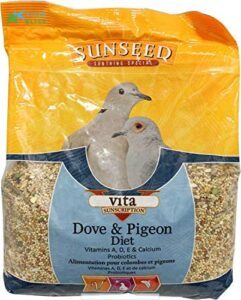
If you want your pigeon pair to truly thrive, their diet matters as much as their bond. Sunseed Dove Pigeon Mix packs white millet, oat groats, split peas, and milo into one bag — then fortifies it with chelated minerals, probiotics, and omega fatty acids to support feather health, digestion, and energy.
It’s a genuinely complete foundation for any pigeon pair, year-round.
| Best For | Pigeon and dove owners who want a nutritionally complete, all-in-one feed that supports feather health, digestion, and energy across all life stages. |
|---|---|
| Primary Use | Bird nutrition & health |
| Target Birds | Doves and pigeons |
| Capacity | 5 lb bag |
| Maintenance | Reseal after opening to preserve freshness |
| Durability | US manufactured, all-natural ingredients |
| Versatility | Suitable for all life stages, base or supplement |
| Additional Features |
|
- Fortified with chelated minerals, probiotics, and omega fatty acids for well-rounded nutrition
- Suitable for all life stages, making it easy to feed a mixed-age flock
- Made in the USA with all-natural ingredients and no artificial additives
- Pricier than basic seed blends, which may not suit budget-conscious buyers
- Some birds may take time to warm up to the mix, especially if switching from a different feed
- Bag must be resealed carefully after each use to preserve freshness and nutrient potency
Common Pigeon Mating Myths

Pigeons have been living alongside humans for centuries, and somewhere along the way, a handful of stubborn myths took root about how they mate, bond, and behave.
Some of these ideas are harmless misunderstandings, while others are just plain wrong in ways that might surprise you.
Let’s clear the air on the most common pigeon mating myths you’ve probably heard at least once.
Do Pigeons Die After Mating?
Here’s a myth worth squashing: no, pigeons don’t die after mating. This popular misconception belongs firmly in the category of Mating Mortality Myths — dramatic, but completely unsupported by biology.
In reality, the lifespan of a pigeon stretches several years, and normal breeding season activity doesn’t shorten it one bit.
Do Pigeons Cheat?
So if pigeons don’t die after mating, do they at least stay faithful? Mostly yes — but with fine print.
Pigeons practice social monogamy, meaning they commit to one partner for nesting, incubation, and chick-rearing. Genetically, though, occasional extra-pair copulations do occur, especially in dense urban flocks.
Think of it as a committed partnership with rare, quiet exceptions — not full-blown betrayal.
Same-sex Pigeon Pairings
Here’s something that might surprise you: same-sex pigeon pairings aren’t just a quirk — they’re a documented, fascinating part of urban colony dynamics.
Female-female pairs, in particular, form genuine stable pair bonds, complete with mutual preening, billing, and cooperative nest defense. They take turns guarding territory, share nesting duties, and demonstrate real social role flexibility that rivals traditional monogamous bird species partnerships.
Why Baby Pigeons Hide
Here’s a mystery that puzzles even regular pigeon-watchers: where do baby pigeons actually go? You rarely spot a squab waddling around the park, and that’s completely by design.
Pigeon chicks stay hidden in elevated, concealed nesting sites — tucked into rooftop alcoves, bridge ledges, and eaves — where predators can’t easily reach them, and curious humans won’t accidentally disturb them while they develop.
Are Pigeons Affectionate?
Affectionate might actually be the perfect word for pigeons.
Watch a bonded pair long enough and you’ll notice mutual preening rituals — called allopreening — where mates groom each other’s neck feathers with surprising tenderness.
Add in beak touching gestures, shared body warmth on a cold ledge, and synchronized daily routines, and these birds start looking less like city nuisances and more like devoted companions who genuinely chose each other.
Pigeons don’t just share a ledge — they share a life, choosing each other through touch, warmth, and synchronized devotion
Frequently Asked Questions (FAQs)
How often do pigeons mate?
During peak breeding seasons, a bonded pair commonly engages in one to two mating events daily. Warmer months, longer daylight, and steady food access drive this rhythm, keeping pairs active across multiple clutches each year.
Do pigeons die after mating?
No, pigeons don’t die after mating. They’re built for the long haul — surviving multiple breeding seasons, raising brood after brood with the same partner, and living several healthy years post-mating.
Are pigeons monogamous?
Yes, pigeons are socially monogamous, meaning they usually keep the same mate across multiple breeding seasons. Most chicks are fathered by the bonded pair, making their loyalty both emotional and genetic.
Will a pigeon mate for life?
Like swans gliding side by side, pigeons form monogamous pair bonds that often span a lifetime — staying loyal through seasons, sharing every nest, and rarely straying unless a partner is lost.
How Do Pigeons Mate?
Cloacal contact — a brief, seconds-long touch between both birds’ cloacas — transfers sperm and completes copulation. Afterward, the pair resumes mutual preening, reinforcing their bond.
Do Pigeons Reuse the Same Nest?
Yes — they absolutely do. Pigeons routinely return to the same nesting site, layering fresh material atop old structure rather than starting over, saving energy while gradually building a sturdier, multi-generational nest.
How Long Do Pigeons Live?
In the wild, most pigeons live 3 to 6 years, while well-cared-for captive birds routinely reach 10 to 15 years — proof that environment shapes longevity more than almost anything else.
What are the Predators of Pigeons?
Pigeons face threats from all angles. Peregrine falcons strike mid-flight at high speed, while great horned owls hunt roosting birds nocturnally, and house cats, foxes, and rats raid nests targeting eggs and squabs.
Do pigeons experience jealousy in their pair bonds?
Yes, they do! Bonded males show mate guarding aggression, shielding females and chasing rivals away. It’s not jealousy by name, but the protective instinct behind it looks remarkably familiar.
How long do pigeon pairs remain bonded?
Pair bonds can last years — often the length of both birds’ lives. With a stable territory and reliable food, the same two pigeons will return to each other season after season, reliably.
Conclusion
That pigeon returning to the same ledge, the same partner, season after season, is carrying something heavier than breadcrumbs—it’s carrying proof that loyalty isn’t uniquely human.
When you ask do pigeons mate for life, the honest answer is: mostly yes, and beautifully so. Their bonds are built on shared duty, not just instinct. So next time one lands near you, maybe give it a little more credit than "flying rat".