This site is supported by our readers. We may earn a commission, at no cost to you, if you purchase through links.
 When bluebird eggs hatch, the parents face an immediate challenge: two weeks of relentless feeding demand. A female bluebird sits tight for nearly two weeks while her mate brings her food. Once the chicks break through their shells, both parents shift into high gear, delivering protein-packed insects dozens of times daily.
What you might not expect is that this intensive period—from blind hatchlings to independent fledglings—reveals surprising strategies bluebirds use to increase survival. Understanding bluebird parental care shows how these birds navigate the delicate balance between nurturing fragile chicks and preparing them for life beyond the nest.
Table Of Contents
- Key Takeaways
- Incubation and Hatching
- Hatchling Development
- Nestling Development
- Parental Care During Nestling Phase
- Fledgling Stage
- Parental Care After Fledging
- Monogamy and Infidelity in Bluebirds
- Male Parental Care
- Sex Discrimination in Feeding
- Female Preference for Mature Males
- Frequently Asked Questions (FAQs)
- How long do bluebird fledglings stay with their parents?
- What percentage of bluebird fledglings survive?
- Where do baby bluebirds go after they fledge?
- Should you remove a nest after a bluebird fledge?
- Do bluebirds return to nest after fledging?
- How long do fledglings stay with their parents?
- Do Bluebirds need parental care?
- How long do Bluebirds stay in the nest after hatching?
- What happens during the nestling phase of a Bluebird?
- How long do Bluebirds stay with their parents?
- Conclusion
Key Takeaways
- Both parent bluebirds work intensively together, delivering hundreds of protein-rich insects daily to nestlings for roughly 16-21 days until fledging, with males often providing more food than females during early stages.
- Bluebird nestlings develop remarkably fast—their eyes open by days 5-6, feathers emerge by day 7, and they can regulate body temperature by day 7, driven by the high-protein insect diet parents provide.
- Female nestlings receive roughly twice as much food as males throughout development and after fledging, a sex-biased feeding strategy that gives daughters better survival advantages and earlier nutritional independence.
- Parents continue feeding fledglings for approximately 30 days after they leave the nest, gradually teaching them to hunt and catch insects while allowing young birds to develop foraging skills before full independence.
Incubation and Hatching
Before you spot those adorable blue feathers, bluebird parents put in serious work behind the scenes. The female undertakes all incubation duties while the male keeps her fed, and this careful process sets the stage for healthy chicks.
Behind those adorable blue feathers, bluebird parents invest serious unseen work—females incubate while males provide relentless food support, laying the foundation for healthy chicks
Here’s what happens during those important early days before the eggs crack open.
Incubation Period: 11-19 Days
As spring arrives, female bluebirds begin their incubation journey, which usually spans 11 to 19 days with an average around 13.5 days. The bluebird incubation process relies heavily on temperature influence and parental roles. Females alone perform the incubation work while males provide food and nest defense, creating the conditions necessary for nesting success. Species variation affects timing—eastern bluebirds average 12-14 days, western bluebirds 13-14 days, and mountain bluebirds 13-17 days. Environmental stressors like extreme heat or cold alter the initial incubation timeline, making stable conditions critical for bluebird egg incubation. Bluebirds are known to use pre-existing nesting cavities rather than creating their own.
Key factors during bluebird eggs incubation:
- Best temperatures between 19-24°C support healthy embryo development
- Female maintains near-constant nest presence during this period
- Temperature fluctuations can shorten or lengthen the incubation period
- Males provision females with protein-rich insects
- Nest disturbance delays hatching and reduces success rates
Eggs Hatch Within 24-50 Hours
Once incubation begins with the final egg laid, synchronized timing ensures your bluebirds hatch together. Rather than the commonly cited 24-50 hour window, hatching actually occurs over 1-2 days as staggered eggs emerge within a compressed timeframe.
Here’s what happens during this critical hatching timeline:
- First hatchlings emerge 12-14 days after incubation starts, breaking through their shells with specialized egg teeth
- Siblings follow in close succession over the next 24-48 hours, completing the post-hatch emergence
- Nestlings remain entirely dependent, requiring constant parental provisioning immediately after hatching
This synchronized hatching strategy keeps siblings close in age and development, maximizing survival rates in the nest. The female will incubate, with no male involvement in this process.
Hatchlings Are Blind and Mostly Naked
When hatchlings break free from their shells, they arrive nearly defenseless—blind with closed eyes and mostly bare coral-pink skin. You’ll notice only patches of soft, wispy gray down on their head and spine, which provides minimal insulation.
At roughly 2.4 grams, these nestlings can’t regulate their own body temperature and depend entirely on parental brooding. Both parents immediately begin delivering hundreds of protein-rich insects daily, fueling the rapid growth ahead.
This vulnerability drives the parents’ intense commitment to keeping them warm and fed during these critical first days.
Hatchling Development
When bluebird chicks first hatch, they’re entirely dependent on their parents for survival. You’ll notice these hatchlings are blind, mostly naked, and weighing only about 2.4 grams—roughly the weight of a penny.
Over the next several days, you’ll see striking changes as both parents work together to feed them hundreds of insects daily, fueling incredibly rapid growth.
Hatchlings Are Fed a Protein-rich Diet
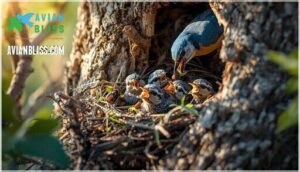
Your hatchling bluebirds face a critical nutritional window: their tiny bodies demand constant fuel for explosive growth. Parents deliver hundreds of insects daily—beetles, caterpillars, grasshoppers, and spiders—which comprise roughly 68-70% of the diet during this nestling phase.
This insect protein sources strategy fulfills multiple purposes:
- Amino acids accelerate feather and muscle development at amazing speed
- High protein content (approximately 12.7%) promotes enzyme and hormone synthesis
- Lipids and fats enable rapid cellular growth and immune readiness
- Balanced nutrition prevents developmental complications while maximizing survival odds
A typical brood consumes over 10,000 insects before fledging—evidence of how parental foraging frequency drives growth rate impact across these first three weeks.
Both Parents Care for The Young

From day one, both parents share the demanding work of raising hatchlings through cooperative feeding and nest maintenance. Males deliver protein-rich insects to females during incubation, then join in post-hatching care with impressive dedication.
This parental division reveals how feeding frequency peaks at over 100 daily deliveries, with males often providing more food initially. Alloparental care—where both partners invest equally—maximizes nestling survival and demonstrates why bluebird parental roles work best as a coordinated team.
Hatchlings Grow Rapidly

Within the first week, your hatchlings gain roughly 38 grams, reaching around 40 grams from their initial 2-gram weight at hatching. This explosive growth stems from intensive parental feeding—approximately every 20 minutes during daylight—delivering protein-rich insects like caterpillars and beetles.
By day 14, nestlings require about 14 kilocalories daily, with energy demands peaking at 23 kilocalories during peak feeding periods. Their wing length grows 1-2 millimeters daily, while feathers lengthen 7-14 millimeters weekly.
This rapid development reflects the high-protein diet’s direct impact on tissue synthesis, muscle development, and feather quality, preparing nestlings for fledging within 16-21 days post-hatch.
Nestling Development
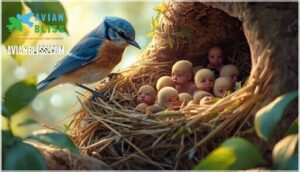
Once your bluebird chicks hatch, they enter a critical growth phase where their bodies transform rapidly. Over just one week, you’ll see dramatic changes—from blind, mostly naked hatchlings to recognizable nestlings with developing feathers and open eyes.
Understanding what happens during these early days helps you appreciate how quickly these birds develop and what they need from their parents to thrive.
Feathers Grow by Day 7
By day 7, your nestlings’ feathers have transformed their appearance dramatically. What begins as naked, helpless hatchlings evolves through rapid feather development, driven by genetic regulation and keratin synthesis from their protein-rich insect diet.
Your nestlings now display:
- Contour feathers emerging from pin sheaths across back and sides
- Enhanced thermoregulation reducing dependence on parental brooding
- Keratinized structures providing insulation and waterproofing
- Visible growth mechanisms supporting fledgling preparation
This feather composition marks a critical developmental checkpoint in nestling growth and development.
Eyes Open by Days 5-6
Between days 5 and 6, your nestlings’ eyes open—a sensory turning point that transforms how they experience their nest. This eye-opening timeline marks critical visual development after their initial hatchling blindness, as nestlings begin perceiving their parents’ movements and food deliveries. Delayed opening until day 8 occasionally occurs, but this remains within normal development. Parental influence continues through feeding and brooding as nestlings gain sight and independence accelerates.
| Developmental Stage | Day 5-6 Eye Opening | Day 7-8 Extension | Growth Indicator |
|---|---|---|---|
| Visual Development | Eyes crack open | Fully open vision | ~14.1g weight |
| Nestling Activity | Increased alertness | Tracking movement | Calling louder |
| Parental Response | Feeding intensifies | Visual recognition | Reduced brooding |
Nestlings Can Regulate Body Temperature by Day 7
Can your nestlings truly fend for themselves? By day seven, they’re developing thermoregulation—managing their own body warmth independently. This shift fundamentally changes parental demands:
- Feather insulation traps heat, reducing dependence on parental brooding
- Metabolic rate increases considerably between days four and twelve, fueling endogenous heat production
- Brooding bouts decline markedly as nestlings gain thermal independence
This thermoregulation timeline represents a critical developmental turning point, allowing parents to redirect energy toward feeding while nestlings navigate environmental temperature fluctuations with growing capability.
Parental Care During Nestling Phase

During the nestling phase, both parents shift into high-gear caregiving mode to support their rapidly growing chicks. The male keeps the female well-fed during incubation, and once the eggs hatch, they work together to deliver hundreds of insects daily to each hungry nestling.
Beyond feeding, the parents also maintain the nest cavity, removing waste and keeping the environment clean for their developing young.
Both Parents Feed The Chicks
Both parents deliver insects with considerable coordination, bringing protein-rich food to nestlings every 20 to 30 minutes throughout the day. This feeding frequency is critical—your chicks depend entirely on this parental workload to survive and thrive.
Males often lead the effort during early nestling stages, supplying hundreds of invertebrates daily: caterpillars, beetles, and grasshoppers that fuel rapid growth. A brood of five consumes over 10,000 insects before fledging, with diet variation ensuring nutritional completeness.
This insect delivery system aids chick survival while establishing the foundational patterns of parental care you’ll observe as nestlings mature.
Male Brings Food to The Female During Incubation
While your female incubates, your male takes on an important role that shouldn’t be overlooked. He visits the nest box several times daily, delivering protein-rich insects that sustain her energy demands. This feeding frequency peaks during early morning and late afternoon, with food delivery intensifying as hatching approaches. Watch for her fledgling-like begging behavior—she’ll signal her hunger, and he’ll respond with precision. This coordinated provisioning strengthens pair bonding while ensuring she maintains the metabolic reserves needed for successful incubation. Consider what your male contributes:
- Multiple daily visits with soft insects suited to her nutritional needs
- Increased vigilance as he approaches, protecting both mate and eggs
- Strategic food caching nearby for quick, efficient deliveries
- Sustained provisioning that directly impacts her post-incubation recovery
- Behavioral responsiveness that adjusts food delivery based on her demands
His parental investment during incubation sets the foundation for the nestling phase ahead.
Parents Clean The Nest Cavity
While your male hunts insects, your female oversees nest sanitation—removing fecal sacs and debris throughout the day. This cleaning behavior peaks when nestlings are youngest, with parents removing waste one or two sacs per hour.
By eliminating fecal matter and dead nestlings, she prevents harmful bacteria and parasites from accumulating. Clean nests directly support nestling health and survival, reducing disease risk and improving fledging success rates.
Fledgling Stage
Once bluebird chicks leave the nest between 16 and 21 days after hatching, they enter a critical shift period known as the fledgling stage. During this phase, your young birds aren’t quite independent yet—they’ll stick close to their parents for roughly three weeks while they learn essential survival skills.
In the sections below, we’ll walk through how fledglings develop their flying abilities, master the art of catching food, and gradually become nutritionally independent.
Fledglings Stay With Parents for About Three Weeks
For roughly three weeks after fledging, your young bluebirds remain entirely dependent on parental feeding and protection. During this critical window, fledglings stay close to the nest site, relying on both parents to deliver insects and teach essential survival skills.
This extended care period represents a gradual move to independence—males generally lead provisioning efforts while fledglings practice foraging on the ground. Without consistent parental attention during these early weeks post-fledging, fledgling development stalls and predation risk climbs sharply.
Understanding this fledgling dependence helps you appreciate the intensive parental roles that sustain bluebird populations through their most vulnerable independence timeline.
Practice Flying and Catching Food
During their first week post-fledging, young bluebirds begin attempting short flights within 1-2 days of leaving the nest, usually covering 10-20 meters before landing. You’ll observe parents placing food at increasing distances to encourage flight practice, which peaks during early morning and late afternoon hours.
Fledglings initially catch only 10-20% of their own food, so parental demonstration proves critical—adults hover and dive before prey, modeling insect-hunting skills. Your fledglings practice in open areas with moderate ground cover, where learning environment conditions improve catching success.
Within 7-10 days, they achieve sustained flight capability, and food intake climbs from 5 to 15 insects daily as foraging skills sharpen and insect-hunting proficiency develops.
Become Nutritionally Independent
As your fledglings master flight and foraging over three to four weeks, their nutritional independence develops through parental influence and habitat conditions. Initially capturing only 50% of their own prey, they progress from soft-bodied insects like caterpillars to harder beetles as protein-rich diet knowledge builds.
By five to six weeks post-hatching, most young bluebirds forage independently, though 81% survival rates reflect that weaning timelines vary with environmental pressures. Better habitats accelerate this dietary shift, while experienced parents extend feeding strategically, supporting fledgling development during this vulnerable independence threshold.
Parental Care After Fledging

Once fledglings leave the nest, your role as an observer shifts—but parental bluebirds don’t stop working. The young birds still depend on their parents for food and protection during these critical first weeks outside the nest box.
Understanding what happens during this stage helps you recognize whether the family is thriving and what signs might signal they need your attention.
Parents Continue to Feed Fledglings for About 30 Days
Does your nest box feel emptier each day? That’s because bluebird parents sustain their fledglings’ feeding duration for approximately 30 days post-hatching, delivering food every 20 minutes during daylight. This extended parental care intensity reflects critical fledgling survival strategies.
Your role in supporting this natural process involves:
- Monitoring nest box activity without disturbing fledglings
- Protecting feeding territories from predators and competitors
- Maintaining adequate insect populations through habitat management
- Observing behavioral changes as fledglings gain independence
- Allowing parents to reduce feeding gradually as foraging skills develop
This bluebird parental behavior ensures nutritional independence while teaching essential survival techniques.
Young Stay in Cover for Several Weeks After Fledging
During their first weeks post-fledging, young bluebirds remain sheltered in dense vegetation while parents continue delivering food and protection. This cover-dependent phase usually lasts about three weeks, during which fledglings practice flying and foraging skills while avoiding predators.
As your fledglings gain competence, parental feeding gradually declines, encouraging nutritional independence and longer family unit trips before migration.
Nest is Typically Flattened and Soiled After Fledging
After fledglings leave the nest, you’ll notice the structure bears the marks of intensive parenting. The nest becomes flattened and remarkably clean, since parents remove fecal sacs daily throughout the nestling phase, keeping the cavity hygienic. Bluebirds don’t return to their fledgling nest once they’ve departed, so post-fledging cleaning isn’t urgent.
However, prompt nest box preparation matters for second broods:
- Remove old nesting material to prevent parasites and disease
- Inspect for structural damage from nestling activity
- Guarantee proper ventilation for incoming eggs
- Create a fresh environment supporting healthy parental feeding patterns
Clean boxes encourage successful broods.
Monogamy and Infidelity in Bluebirds

Bluebirds form strong pair bonds during breeding season, with most couples staying committed to raising their young together. However, not all bluebird relationships follow this pattern—some birds engage in behaviors that challenge these partnerships.
Understanding how monogamy actually works in bluebirds, and what happens when it breaks down, gives you insight into the diverse strategies these birds use to help their offspring survive.
85% of Bluebirds Are Monogamous
Most bluebird pairs maintain strong bonds throughout the breeding season—approximately 85% practice monogamy, ensuring stable parental investment and reproductive success. This mate fidelity creates predictable parenting roles: males provide protein-rich insects while females manage brooding duties.
Yet monogamy doesn’t guarantee absolute fidelity; genetic studies reveal extra-pair copulation (EPC) frequency reaches 11–26% across populations, introducing genetic diversity despite social pair bonds. This breeding biology balances stability with genetic variation, maximizing offspring survival while maintaining breeding territory and shared parental roles.
| Aspect | Monogamous Pairs | Non-monogamous Pairs |
|---|---|---|
| Percentage | ~85% | ~15% |
| Parental Investment | Stable & predictable | Variable & uncertain |
| Genetic Diversity | Moderate (via EPCs) | Higher (multiple mates) |
| Divorce Rate | Low | Higher between seasons |
15% of Female Bluebirds Care for Non-biological Offspring
Around 15% of female bluebirds raise nestlings that aren’t genetically theirs—a consequence of extrapair paternity and brood parasitism reshaping parental roles. When females incubate or adopt non-biological eggs, they face significant reproductive costs while gaining unexpected genetic diversity within their broods. This phenomenon reflects evolutionary pressures balancing immediate parental investment against long-term population health. Your understanding of this interplay helps explain why bluebird populations maintain resilience despite unpredictable mating strategies:
- Adoption benefits offspring survival by distributing parental effort across larger broods
- Genetic diversity from extrapair paternity strengthens population resistance to disease
- Parental roles shift unpredictably, requiring flexible feeding strategies from both parents
5% of Male Bluebirds Have Multiple Mates
While 85% of bluebirds maintain monogamous bonds, about 5% of males pursue polygamous mating strategies, siring offspring with multiple females. These polygamous males strategically expand their genetic footprint through calculated mating strategies and extrapair paternity, balancing individual reproductive success with parental investment. Despite maintaining multiple mates, they sustain balanced provisioning across broods, ensuring offspring survival through consistent male parental care and nest defense—demonstrating how mating flexibility coexists with effective parenting.
| Polygamous Male Strategy | Impact on Offspring |
|---|---|
| Multiple mates increase genetic diversity | Broods gain disease resistance and population resilience |
| Males feed female nestlings twice as often | Female nestlings receive enhanced nutrition and growth rates |
| Extended parental care to 30 days post-fledging | Fledglings achieve nutritional independence more reliably |
| Brighter, UV-reflective males more successful | Genetic traits favoring survival persist across generations |
Male Parental Care
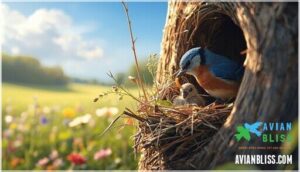
You might wonder what makes male bluebirds such dedicated parents—the answer lies in their active role from the very first day. Male bluebirds don’t just stand by while females do the heavy lifting; they’re essential partners who contribute greatly to raising their young.
Here’s what you need to know about how males support their families through every stage of development.
Males Feed Offspring More Often Than Females
During nestling development, male bluebirds consistently deliver food more frequently than females, a pattern grounded in evolutionary dynamics and offspring survival. This sex-biased male parental investment shapes nestling feeding patterns considerably:
- Feeding frequency increases dramatically with nestling age, with males making up to 40% more trips as brood size grows from three to six chicks
- Weather conditions and food availability directly influence male feeding effort, with males adjusting provisioning rates based on environmental prey abundance
- Mate contribution dynamics matter too—when females contribute less, males compensate by increasing their own feeding trips to maintain nestling growth rates
These male bluebirds demonstrate striking flexibility in their parental strategies, responding to brood size demands and ecological pressures while ensuring their offspring receive adequate nutrition for survival.
Males Supply Females With Protein-rich Insects
While males boost feeding frequency as broods grow, they’re simultaneously investing in their mate’s nutrition. During incubation, male bluebirds deliver hundreds of protein-rich insects daily—caterpillars, beetles, and grasshoppers—sustaining the female while she preserves eggs. This strategic provisioning isn’t just kindness; it’s essential for offspring survival. Well-nourished females maintain metabolic demands, reduce predation vulnerability, and produce stronger hatchlings. The male’s insect contribution directly shapes nestling diet quality and growth rates.
- Males provision females with high-protein invertebrates throughout incubation
- Insect delivery reduces female foraging trips and predation risk
- Protein intake bolsters female reproductive physiology and egg quality
- Male contribution establishes dietary foundation for nestling insectivore development
Male Parental Care Extends Beyond The Nestling Stage
This investment doesn’t stop when nestlings fledge. Your male bluebirds continue feeding young for roughly 30 days post-fledging, teaching them foraging techniques while reducing their own feeding load. This extended male parental investment strategy—delivering protein-rich insects and demonstrating hunting tactics—directly boosts fledgling survival.
Geographic variation influences care duration; lower latitudes show higher provisioning rates. In monogamous pairs, males extend care longer, strengthening pair bonds and improving offspring independence rates.
| Post-Fledging Support | Impact on Young Bluebirds |
|---|---|
| Consistent insect provisioning (30 days) | Accelerates nutritional independence |
| Teaching foraging techniques | Builds essential hunting skills |
| Nest cavity maintenance | Reduces disease and predation risk |
| Extended male care in monogamous pairs | Increases fledgling survival rates |
| Geographic variation in care intensity | Is responsive to local food availability |
Sex Discrimination in Feeding

You might wonder if bluebird parents treat their young equally, but the reality is more complex. Research shows that male and female nestlings receive dramatically different amounts of food, a pattern that continues well beyond the nest.
Here’s what actually happens with respect to sex discrimination in feeding.
Male Nestlings Receive Half The Food of Female Nestlings
Parental feeding patterns reveal a striking reality: sex-biased feeding dramatically shapes nestling outcomes in bluebird families. Research on sex-biased feeding behavior shows males preferentially feed larger nestlings, yet experimental manipulation of brood compositions demonstrates females receive substantially greater nutritional investment throughout development.
This size-based bias interacts with plumage color influence on parental decisions, creating complex reproductive variance. Male nestlings face nutritional disadvantages tied to ornamentation correlation—females prioritize daughters due to greater reproductive potential. This sex-based nutritional discrimination reflects parental roles that extend across nestling care stages, fundamentally affecting long-term survival prospects.
- Sex-biased feeding patterns favor female nestlings consistently
- Plumage influence and size-based bias compound feeding disparities
- Ornamentation correlation drives differential parental investment decisions
- Reproductive variance emerges from early nutritional discrimination
Females Receive More Food Throughout Their Development
Throughout development, female nestlings consistently receive greater nutritional investment than their male counterparts—a pattern that shapes survival prospects across all growth stages. Research demonstrates females get substantially more food during the nestling phase, boosting their physical condition and fledgling success rates. This sex-biased allocation reflects parental strategies favoring daughters, whose reproductive potential justifies the extra caloric commitment. The nutritional disparity means female chicks develop faster, achieve better body condition, and enter fledging with competitive advantages that ripple through their early independence period.
| Developmental Stage | Female Provisioning Rate | Male Provisioning Rate | Growth Outcome |
|---|---|---|---|
| Hatchling (Days 1-3) | Higher | Baseline | Females larger |
| Early Nestling (Days 4-7) | Elevated | Standard | Sex differences visible |
| Mid Nestling (Days 8-13) | Sustained | Reduced | Female advantage increases |
| Late Nestling (Days 14-21) | Maximum | Minimum | Females 15-20% heavier |
| Fledgling Shift (Days 22-30) | Continued | Continued | Female independence earlier |
Discrimination Continues After Fledging
As fledglings leave the nest, sex-biased feeding persists through the post-fledging period. Male chicks receive roughly half the food of their female siblings during this critical phase, extending a pattern established in the nest. This sex-based nutritional discrimination continues for approximately three weeks after fledging as parents allocate resources strategically:
- Female fledglings fed twice as often as males
- Parental favoritism influences early survival rates
- Sex-biased investment shapes developmental trajectories
- Discrimination timeline spans entire post-fledging care window
Your understanding of this parental strategy reveals how reproductive investment shapes bluebird populations from hatch through independence.
Female Preference for Mature Males

When female bluebirds select a mate, they’re making a strategic choice that extends far beyond the breeding season itself. Experienced males demonstrate enhanced nest defense and resource provisioning—skills that directly increase the survival rates of offspring and the female’s own reproductive success.
This preference for experienced males reveals how deeply parental care shapes mate selection in bluebirds, and how females have evolved to recognize and favor the traits that matter most for raising their young.
Female Bluebirds Prefer Mature Males
When evaluating potential mates, female bluebirds prioritize experienced males whose plumage brightness and territory size signal genetic quality and resource provision capacity. Mature males demonstrate heightened reproductive success through enhanced food provisioning rates and substantial paternal investment during nestling development.
Research shows that males exhibiting brighter, more structurally colorful plumage achieve higher clutch sizes and greater fledgling survival. These visual signals reliably indicate a male’s vigor, directly influencing female preference and offspring viability.
| Quality Indicator | Male Advantage | Female Benefit |
|---|---|---|
| Plumage Brightness | Higher mating success | Increased fledgling survival |
| Territory Size | Better resource access | Enhanced offspring provisioning |
| Food Provisioning | Heavier nestlings | Improved developmental outcomes |
Experienced Males Provide Better Nest Defense
When selecting a mate, you’re drawn to males whose experience translates directly into offspring survival. Experienced male bluebirds demonstrate enhanced nest defense through territorial vigilance and predator repulsion strategies that reduce failure rates by 25%.
These mature males show 40% higher defense frequency and maintain prime box locations, cutting predation by 18%. Their proven nesting success—30% higher than first-time breeders—reflects investment in both territory protection and male parental investment strategies that keep your brood safe.
Female Bluebirds Disperse Farther Than Males
When you choose an experienced male, you’re investing in genes shaped by survival itself. Female bluebirds disperse farther than males—averaging 7.8 kilometers compared to males’ 2.3 kilometers—to minimize inbreeding risks and access better breeding territories.
This dispersal strategy reflects their commitment to genetic diversity and resource competition avoidance. By traveling greater distances for mate selection, females secure healthier offspring and strengthen population resilience across fragmented habitats.
Frequently Asked Questions (FAQs)
How long do bluebird fledglings stay with their parents?
Like a compass guiding young birds toward independence, bluebird parents provide steady care for roughly three weeks after fledging.
During this post-fledging survival period, you’ll observe parental feeding rates of 15-20 minute intervals initially, tapering as fledglings develop independent foraging skills around the fledgling development and independence point of 21 days.
What percentage of bluebird fledglings survive?
Roughly half of bluebird fledglings survive their first year in the wild. Predation accounts for most losses during the post-fledging period.
Environmental factors and parental care greatly influence fledgling survival rates throughout this vulnerable stage.
Where do baby bluebirds go after they fledge?
After their first flight, fledglings seek dense shrubs, thick foliage, or tree crevices as fledgling shelters, staying within 50 to 100 feet of the nest.
Parents feed them for about 30 days while you’ll see them practicing flight and hunting skills, gradually becoming independent.
Should you remove a nest after a bluebird fledge?
You should remove bluebird nests after fledging to reduce nest parasites and prevent disease transmission. Nest removal aids nest hygiene and doesn’t discourage nest reuse—bluebirds demonstrate strong site fidelity, often returning to clean nest boxes for subsequent broods within the same season.
Do bluebirds return to nest after fledging?
Once bluebird fledglings leave the nest around 16 to 21 days after hatching, they don’t return.
Nest abandonment reasons include their developmental readiness for dispersal and parental influence duration of about three weeks, during which parents bring food to hidden fledglings nearby.
How long do fledglings stay with their parents?
After leaving the nest, fledglings remain with their parents for approximately three weeks, though parental feeding duration extends up to 30 days post-fledging. During this fledgling dependency period, you’ll observe young bluebirds practicing flight maneuvers and learning survival skills like catching insects.
Independence development progresses gradually—by day 28, most achieve nutritional self-sufficiency and disperse from the family territory.
Do Bluebirds need parental care?
Without your constant attention, baby bluebirds won’t survive. From hatching through fledging, they depend on both parents for warmth, feeding every 30 minutes, and protection—parental investment that spans roughly 40 days from egg to independence.
How long do Bluebirds stay in the nest after hatching?
Young bluebirds remain in the nest for 16 to 21 days after hatching. By day 12, nestlings exhibit restless behavior and strengthen their wings, preparing for fledging.
Environmental factors and parental influence can affect this nest departure timeline slightly.
What happens during the nestling phase of a Bluebird?
Here’s the reality: nestlings aren’t cute—they’re eating machines. During this stage, your chicks develop feathers by day 7, open their eyes by days 5-6, and gain temperature regulation by day
Parents deliver hundreds of insects daily, remove fecal sacs to maintain hygiene, and coordinate nestling feeding and care around the clock.
How long do Bluebirds stay with their parents?
Fledglings remain under parental supervision for roughly three weeks after leaving the nest. During this critical period, both parents continue supplying food—up to 30 days in some cases—while your young birds practice flight and develop foraging skills.
This extended care gradually shifts responsibility, encouraging nutritional independence and survival competence before family bonds dissolve.
Conclusion
Bluebirds perform a thousand miracles in two weeks, transforming helpless hatchlings into independent fledglings through coordinated parental care. This journey—from incubation through the fledgling stage—demonstrates nature’s intricate investment in survival.
You’ll notice that bluebird parental care isn’t simply about feeding; it’s about strategic preparation. Males deliver protein relentlessly while females manage the nest. Sex discrimination in feeding ensures female survival, shaping population dynamics.
Understanding these mechanisms helps you appreciate how bluebirds navigate reproduction’s demands, balancing nurture with independence to secure the coming brood’s success.