This site is supported by our readers. We may earn a commission, at no cost to you, if you purchase through links.
Most owls vanish the moment daylight hits. The northern hawk owl doesn’t get that memo.
While its relatives press themselves against tree bark and wait for dark, this species hunts openly across the boreal forest like a small falcon—perched at a treetop, scanning for movement, then dropping fast and precise onto a vole buried under a foot of snow.
It looks wrong for an owl: long tail, flat head, no ear tufts, built for speed rather than silence.
Understanding what drives those design choices—and what they reveal about life at the edge of the northern wilderness—makes every field sighting click into place.
Table Of Contents
- Key Takeaways
- Northern Hawk Owl Overview
- Northern Hawk Owl Identification
- Northern Hawk Owl Habitat and Range
- Northern Hawk Owl Diet and Hunting
- Northern Hawk Owl Breeding and Conservation
- Frequently Asked Questions (FAQs)
- Are Northern Hawk Owls rare?
- Why is it called a hawk owl?
- Is the Northern Hawk Owl endangered?
- What is the difference between a Northern Hawk Owl and a boreal owl?
- What are the predators of the hawk owl?
- What does it mean when you see an owl and a hawk?
- How do Northern Hawk Owls communicate with each other?
- What is the lifespan of a Northern Hawk Owl?
- Do Northern Hawk Owls migrate seasonally?
- How fast can a Northern Hawk Owl fly?
- Conclusion
Key Takeaways
- northern hawk owl hunts in full daylight using vision-first tactics—a sharp break from the nocturnal habits most owls rely on.
- Its long tail, pointed wings, and falcon-like flight aren’t quirks; they’re purpose-built tools for fast, precise hunting across open boreal terrain.
- Voles and lemmings drive nearly everything about this owl’s life, from how many eggs it lays to whether it stays put or moves south for winter.
- Despite living in some of the world’s most remote forests, it’s not rare—but climate-driven snowpack loss and shrinking boreal habitat are quietly narrowing its range.
Northern Hawk Owl Overview
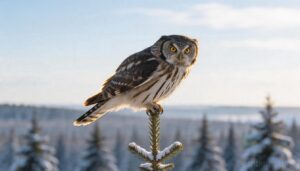
The Northern Hawk Owl isn’t your typical owl — it hunts in daylight, perches like a falcon, and shows up in places most owls never bother with. Understanding what makes it tick starts with knowing the basics: its name, its roots, and what sets it apart from every other owl you might encounter.
Its sharp daytime vision gives it a serious edge — a trait explored further among the owls spotted across Michigan’s diverse habitats.
Here’s a closer look at the key facts that define this species.
Scientific Name and Taxonomy
The northern hawk owl’s scientific name is Surnia ulula — a label that unlocks its entire evolutionary story. Classified within Strigiformes and the family Strigidae, it stands alone in a monotypic genus introduced by André Duméril in 1805.
Linnaeus first described it in 1758 as Strix ulula, but taxonomic revision and phylogenetic placement research eventually gave it its own genus. The species follows the hierarchical classification system used in modern taxonomy.
- Its genus authority traces back over 200 years
- Molecular studies link it closely to pygmy owls
- Every ornithological field guide lists it uniquely as Surnia ulula
Common Names and Meaning
Beyond its scientific label, this owl carries names that describe exactly what you’re looking at. "Northern Hawk Owl" follows classic descriptive naming patterns — region, behavior, appearance, all in three words.
In Spanish, it’s Lechuza Gavilana, a regional naming variant echoing the same hawk-like identity. The etymology of names like these isn’t decorative; it’s a field guide in itself, embedded right in the language.
Why It is Called a Hawk Owl
The name isn’t accidental. This owl earned it through behavior — diurnal hunting from exposed perches, rapid wingbeats, open-winged glides, and a long tail that gives it an unmistakable falcon resemblance in flight.
What drives birdwatcher perception most:
- Visual hunting over hearing
- Long pointed wings built for speed
- Hawk-like flight across open clearings
- Daylight activity most owls avoid
Key Traits That Make It Unique
What really sets this owl apart is the full package. You’re looking at a boreal forest specialist that hunts by day, navigates open terrain with rapid low flight, and dives through snow using acute hearing alone.
That long tail, white face, and unusual human tolerance make it instantly recognizable.
Add a distinctive territorial song and habitat preferences tied tightly to vole cycles — and you’ve got one genuinely singular bird.
Northern Hawk Owl Identification
Spotting a Northern Hawk Owl in the field is surprisingly straightforward once you know what to look for. This bird has a handful of distinct features that set it apart from other owls — and from most raptors in general.
Here’s what to pay attention to when you’re trying to make a confident ID.
Size, Wingspan, and Weight
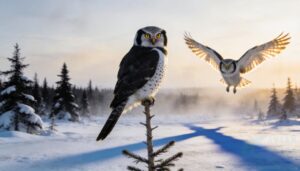
At first glance, you might mistake this medium-sized owl for a small falcon — and that’s no accident. The Northern Hawk Owl physical characteristics include a body length of 36–45 cm and a wingspan reaching up to 84 cm. Sexual dimorphism is clear in body mass range: males top out around 360 g, females near 454 g.
- Length variation runs 36–45 cm — roughly crow-sized
- Wing loading suits fast, agile flight through open boreal gaps
- Size comparison: larger than a Boreal Owl, smaller than a Great Horned
Plumage and Facial Markings
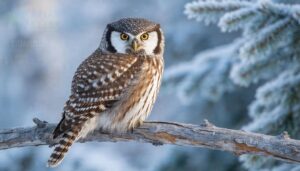
What makes this owl instantly recognizable is its bold Facial Disk Contrast — a white face framed by a sharp dark border that gives it an almost masked look.
That striking face is just the start — explore the full story of Colorado’s nocturnal owls and their remarkable hunting adaptations to see how form and function come together in these silent predators.
The whitish facial disc pops against the crown densely spotted whitish over dark gray-brown feathers.
Below, you’ll notice horizontal brown stripes creating Underparts Barring Variation, while Tail Bar Markings and Crown Spotting Patterns complete a uniquely striking field portrait.
Long Tail and Hawk-Like Shape
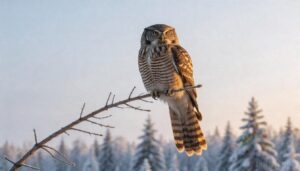
One feature that sets this medium-sized owl apart is its long, tapered tail — something you’d rarely expect on an owl. The tail is long and graduated, with no ear tufts disrupting the clean silhouette.
This long tail morphology delivers real aerodynamic advantages and serious flight maneuverability through open terrain. That sleek hawk mimicry, reinforced by pointed wings and tail feather structure, makes silhouette identification surprisingly straightforward.
Yellow Eyes and Bill Color
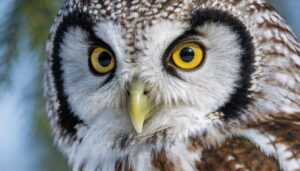
Look closely at the face — the pale yellowish-green bill and lemon-yellow eyes do most of the identification work for you. That Eye-Bill Contrast against the whitish facial disc is striking even at a distance.
Yellow Eye Visibility is sharp because the facial disc is whitish, framed by a bold black border that creates Facial Mask Emphasis.
Key markers include:
- Yellow eyes: reliable in both adults and juveniles
- Pale Bill Significance: the light-colored bill stands out against darker facial borders
- Juvenile Eye Hue: young birds show warmer golden-yellow tones
How to Tell It From Similar Owls
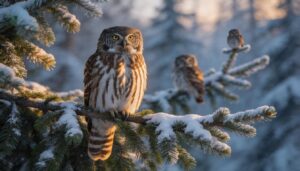
Separating this species from its neighbors comes down to few sharp details. The Boreal Owl Contrast is immediate — rounder head, streaked underparts, nocturnal habits. Saw-whet Owl Differences include tiny size and no bold barring. Screech Owl Distinction: Ear tufts and vertical streaking. The Pygmy Owl Comparison reveals a much smaller bird.
In flight, the Cooper’s Hawk Similarity — long tail, direct speed — is your strongest visual identification mark.
Northern Hawk Owl Habitat and Range
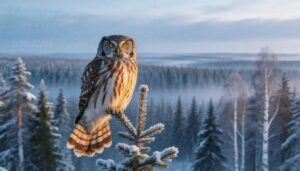
The Northern Hawk Owl doesn’t stay in one tidy corner of the world — it ranges across some of the most remote landscapes on the planet.
Where it lives and how it moves tell you a lot about what it needs to survive.
Here’s what you should know about its range and the habitats it calls home.
Boreal Forest Distribution
The Northern Hawk Owl calls the boreal forest home — but don’t picture dense, shadowy spruce interiors.
This species thrives in open conifer forests, muskeg distribution patterns, and fire-driven succession zones where sightlines stay clear. Boreal edge zones near wetlands and recently burned snags are key.
Conifer species composition and habitat fragmentation metrics both shape where you’ll realistically find this owl hunting.
North American and Eurasian Range
This owl’s geographic range across North America spans Alaska to Canada, with the subspecies Surnia ulula caparoch holding the Nearctic side. Across Eurasia, S. u. ulula covers Norway to Kamchatka. These cross-continental comparisons reveal matching boreal footprints on both landmasses — a true circumpolar species.
Key subspecies distribution facts worth knowing:
- North American birds: caparoch
- Eurasian nominate: ulula
- Central Asian form: tianschanica
- All share similar northern hawk owl habitat preferences
Preferred Semi-Open Habitats
Where a species lives tells you a lot about how it hunts. The Northern Hawk Owl doesn’t settle for just any forest — it needs an Edge Habitat Mosaic, a patchwork of open coniferous or mixed forests, spruce trees, birch scrub, bogs, and Muskeg Proximity that keeps sight lines clear.
| Habitat Feature | Why It Matters |
|---|---|
| Burned Area Preference | Dead snags and open ground support hunting |
| Aspen-Birch Mix | Stays open enough for low, fast flight |
| Muskeg and Bogs | Attracts voles; adds open viewing ground |
| Snag Density | Provides elevated perches and nest cavities |
High Snag Density, prominent trees and shrubs, and mixed forests edge together into exactly the semi-open structure this owl seeks.
Perch Selection and Visibility
Once you understand the habitat mosaic, perch selection makes perfect sense. The Northern Hawk Owl relies on Perch Height Preference and Edge Tree Usage to command Open Sight Lines across open coniferous or mixed forests.
It perches on prominent trees and shrubs — spruce tops, broken snags — fully exposed. That visibility aids your Human Detection Risk awareness too, since Predator Exposure cuts both ways in plain sight.
Winter Irruptions and Nomadic Movements
That exposed perch isn’t just a hunting post — it’s a launchpad for something far less predictable. When rodent cycles crash, prey-driven migrations kick in, pushing these nomadic predators well beyond their usual boreal strongholds.
Weather-triggered dispersal compounds the pressure. Irruption timing varies — some years, Finland sees birds by September — and irruptive migration patterns can extend the winter range of Northern Hawk Owl deep into the northeastern United States.
Northern Hawk Owl Diet and Hunting
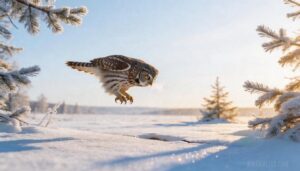
Northern Hawk Owl is one of the most active and visible hunters in the boreal forest. Unlike most owls, it doesn’t wait for darkness — it works the daylight hours like a seasoned predator with a plan.
Here’s what drives its hunting strategy, from its favorite prey to the clever tricks it uses to catch a meal.
Daytime Hunting Behavior
Unlike most owls, the Northern Hawk Owl is a true daytime hunting owl — a diurnal raptor that doesn’t wait for darkness.
It hunts throughout the day, with peak Dawn-Dusk Activity when Light Level Preference shifts to lower intensities.
Using Open Edge Scanning across muskegs and clearings, it also relies on Acoustic Prey Detection, plunging into snow to catch hidden small mammals.
Perch Hunting and Low Flight
Watch how this diurnal bird works: it perches on prominent trees or snags, using Visual Prey Scanning to lock onto movement below.
Then comes the Rapid Dive Attack — a burst of Low Flight Maneuvers skimming close to the ground.
It can hover briefly with a Hovering Technique before striking, then rotate through spots using a Perch Rotation Strategy until prey appears.
Main Prey: Voles and Lemmings
Voles and lemmings are the engine behind this owl’s entire lifestyle. In some study areas, these small mammals make up nearly 88% of its diet — and that number tells you everything.
Rodent Cycle Dynamics and Predator-Prey Synchrony directly shape how well the owl breeds and hunts.
- Voles dominate in boreal and meadow zones
- Lemmings fuel prey acquisition during Arctic Seasonal Population Peaks
- Habitat Preference Overlap means both species are often available in the same territory
Seasonal Diet Changes
Prey Cycle Dynamics drive almost everything about what this owl eats throughout the year.
When Spring Rodent Rebound kicks in, vole numbers surge and prey acquisition becomes almost easy. Summer Insect Opportunism fills gaps — frogs and insects supplement the diet composition.
Come autumn, Autumn Bird Prey increases as juveniles migrate through.
Winter Food Scarcity pushes seasonal movement south, shifting seasonal abundance trends noticeably.
Snow Diving and Other Hunting Adaptations
Snow doesn’t stop this owl — it hunts through it. Using acoustic snow detection, it pinpoints rodents moving up to 12 inches below the surface, then strikes.
The Northern Hawk Owl hunts through snow itself, detecting prey up to 12 inches below the surface by sound alone
Here’s what makes its hunting toolkit so effective:
- Rapid dive mechanics drive talons through snow in a single committed plunge
- Wing stiffness adaptation allows fast, hawk-like pursuit with energy-efficient flight
- Hovering and open-winged glides extend visual snow tracking over open terrain
- Diurnal hunting timed to peak small-mammal surface activity maximizes success
Northern Hawk Owl Breeding and Conservation
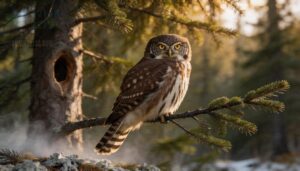
Breeding season is when the Northern Hawk Owl’s behavior gets especially interesting to watch. From courtship calls to fledging chicks, each stage follows a remarkably consistent pattern across its boreal range.
Here’s what you need to know about how this owl breeds, communicates, and holds its ground as a species.
Breeding Season and Courtship
Breeding kicks off as early as March in interior Alaska.
Male Display Flights — stiff-winged circles followed by loud advertising calls — signal both territory and fitness.
Food Gift Dynamics matter too: a male that hunts well wins trust.
Rodent Cycle Influence is real — poor prey years can shut down breeding entirely.
Pair Bond Duration usually lasts one season, sealed through billing and mutual calls.
Nest Cavities, Snags, and Nest Boxes
Once a pair bonds, finding the right nest site is everything. Northern Hawk Owls nest in cavities shaped by decay — old woodpecker nests, broken snags, and hollow stubs. Cavity Tree Selection often favors visible rot, since the Decay Process Benefits include a ready-made chamber.
Key Snag Height Preference and nest box features to know:
- Snags 3–12 m tall with broken tops
- Large-diameter trunks with existing cavities
- Box Entrance Design sized to the owl’s body
- Rough interior boards for fledgling grip
Artificial Nest Success is real where natural options are scarce.
Egg Laying and Incubation
Once the nest cavity is secured, egg laying begins — and Clutch Size Variation indicates the season’s prey abundance. Females typically lay 5 to 7 eggs, though this number can reach 13 during boom years.
The Female Incubation Role is exclusive: she alone tends the eggs for 25 to 30 days. Meanwhile, Male Food Provision sustains her, ensuring consistent Egg Temperature Regulation through frigid boreal nights.
This dynamic exemplifies Prey-Driven Reproduction, where environmental resources directly shape reproductive strategies.
Nestling Care and Fledging
Once those eggs hatch, the real work begins. Hatchlings emerge helpless, covered in white down, and depend entirely on Thermal Regulation through brooding — the female stays with them for roughly 13–18 days. Meanwhile, the male manages Parental Food Caching near the nest cavity, keeping voles within reach.
Sibling Competition intensifies as chicks grow. Predation Threats stay real until Dispersal Timing kicks in around 2½ to 3 months post-hatch.
Vocalizations and Contact Calls
Once the young leave the nest, you’ll notice the family stays connected through sound. The Northern Hawk Owl’s vocal toolkit is surprisingly varied:
- Courtship Whistle – The male delivers a rapid melodious purring trill, a rolling kiiiiirrl or kestrel-like kwikikikikkik, lasting up to 14 seconds.
- Pair Contact Calls – Soft "uhg" notes maintain Female Call Variation during close-range coordination.
- Alarm Call Structure & Fledgling Begging – Sharp "rike-rike" warns of threats; fledglings answer with drawn-out "chchchiep" begging calls.
Population Trends and Least Concern Status
Despite its Least Concern IUCN Status, population monitoring for this species isn’t straightforward. Monitoring gaps tied to remote breeding grounds create real data confidence level challenges — even citizen science data from Christmas Bird Counts show only moderate confidence in a ~40% increase since 1970.
| Metric | Detail |
|---|---|
| Canadian Population | ~59,000 individuals |
| Population trends | Largely stable since 1970 |
| Regional Status Differences | Montana lists it as a species of concern |
Provincial conservation attention still matters here.
Climate Change and Habitat Threats
Climate change is quietly reshaping the world, this owl depends on. Boreal Forest Loss, Fire Regime Shifts, and Snowpack Decline are hitting hardest at the southern edge — exactly where Range Edge Vulnerability is already highest:
- Warming shrinks Manitoba and Minnesota breeding habitat by 2080
- Nest Site Scarcity grows as salvage logging removes critical snags
- Prey cycles destabilize when winter snowpack thins
Habitat fragmentation impact makes recovery between losses much harder.
Frequently Asked Questions (FAQs)
Are Northern Hawk Owls rare?
Think of them as hidden in plain sight. Northern Hawk Owls aren’t rare — they’re just remote.
Their Least Concern conservation status and estimated 200,000 global population confirm a stable, widespread species across boreal North America.
Why is it called a hawk owl?
It’s called a hawk owl because of its raptor hunting tactics and diurnal predation pattern — it hunts by day, uses a long tapered tail, and flies with direct, purposeful wingbeats unlike most owls.
Is the Northern Hawk Owl endangered?
Like a shadow that blends into the boreal trees, this owl stays off the endangered list. Its IUCN assessment places it firmly in the Least Concern classification — no immediate threat.
What is the difference between a Northern Hawk Owl and a boreal owl?
The biggest difference comes down to size, shape, and when you’ll see one hunting.
The Northern Hawk Owl is larger, boldly barred, and unmistakably diurnal — while the Boreal Owl stays hidden and hunts at night.
What are the predators of the hawk owl?
Great Horned Owls and Northern Goshawks pose the biggest raptor predator threats. Peregrine falcons and gyrfalcons target exposed adults.
Martens and weasels handle nest predation. Territorial defense keeps most threats at bay.
What does it mean when you see an owl and a hawk?
Two birds of prey, one message: balance.
Spotting an owl and hawk together blends hidden truth with sharp alertness insight, symbolizing dual vision — a direction shift nudging you to notice what’s obvious and what isn’t.
How do Northern Hawk Owls communicate with each other?
They rely on a varied call repertoire — mate advertising calls, alarm call repertoire, and fledgling warning signals — with the typical male call being a piercing kiiiiirrl or kestrel-like kwikikikikkik depending on context.
What is the lifespan of a Northern Hawk Owl?
Northern Hawk Owl’s average lifespan is around 10 years, though the maximum age on record reaches 2 years.
Adults surviving past their first winter stand the best chance of reaching that age.
Do Northern Hawk Owls migrate seasonally?
No, they don’t follow a fixed migration route. These owls move nomadically, driven by prey cycle influence and irregular dispersal — irruptive migration triggered by food scarcity, not seasons.
How fast can a Northern Hawk Owl fly?
Flight speed estimates vary, but this owl’s hawk-like flight reaches roughly 40–50 mph.
Its straight, purposeful path, open-winged glides, and hovering show deep and powerful wingbeats — and unlike most owls, its flight isn’t completely silent.
Conclusion
Few owls rewrite the rulebook as completely as the northern hawk owl.
Where other species hide, it hunts in broad daylight. Where others drift silently, it drops with falcon-like precision through a foot of snow.
Every field mark—the long tail, flat face, fierce yellow eyes—tells the same story: this bird is built for the open boreal edge, not the shadows.
Spot one on a treetop scan, and you’ll understand exactly why evolution broke the mold.