This site is supported by our readers. We may earn a commission, at no cost to you, if you purchase through links.
The mountain plover carries one of birding’s best contradictions in its name.
It’s a shorebird that avoids the shore entirely, spending its life on dry grasslands and bare plains where water is nowhere in sight.
This small brown bird blends into open terrain so well that you can walk within a few feet of one before it moves.
It doesn’t hide in reeds or wade through marshes like its relatives. It thrives in dust.
Found across the Great Plains and into the American West, this compact traveler has adapted to some of the continent’s harshest open landscapes—and its story is worth knowing.
Table Of Contents
- Key Takeaways
- What is The Mountain Plover?
- Physical Characteristics of Mountain Plovers
- Habitat and Geographic Range
- Behavior, Diet, and Breeding
- Conservation Status and Observation
- Frequently Asked Questions (FAQs)
- Where does the Mountain Plover live?
- What is another name for a plover?
- What do mountain plovers eat?
- What is the lifespan of a Mountain Plover?
- Where do mountain plovers live?
- Why is it called a mountain plover?
- What is a sand-colored mountain plover?
- What is a mountain plover in Oklahoma?
- How do I find a mountain plover?
- Do mountain plovers live in wetlands?
- Conclusion
Key Takeaways
- Despite its name, the mountain plover is a grassland bird that avoids mountains and water entirely, living on dry short‑grass prairies across the Great Plains and the American West.
- Its double clutch breeding system — where each parent raises a separate nest alone — is a rare survival strategy that helps offset its high juvenile mortality rate.
- Population numbers dropped nearly two‑thirds between 1966 and 2004, leaving only 11,000–14,000 birds today, mostly due to habitat loss from prairie conversion and changing land‑use.
- Your best chance of spotting one is at prairie dog colonies or bare, overgrazed fields in places like Pawnee National Grasslands between April and May — scan slowly, because this bird blends in almost perfectly.
What is The Mountain Plover?
The Mountain Plover is a small, unassuming shorebird that actually spends most of its life far from any shore.
Despite its name, this grassland-dweller feels right at home on open plains — much like the Red-necked Phalarope, another surprisingly landlocked shorebird.
To really understand this bird, it helps to look at where it fits in the animal kingdom, how it got its name, and how it stacks up against its closest relatives. Here’s what you need to know.
Taxonomy and Classification
The Mountain Plover (Charadrius montanus) is a shorebird in the family Charadriidae — the same family as killdeers and other plovers. Its phylogenetic placement has sparked a genus debate, with some scientists moving it to Anarhynchus using molecular markers.
Despite this, taxonomic stability holds: most agencies still use **Charadrius montanus***. No subspecies exist, making it one clean, unified species.
This terrestrial species is also known to be present in Idaho, though its regularity is accidental or nonregular.
Historical Naming and Misconceptions
The name "Mountain Plover" is a bit misleading. John Kirk Townsend first collected specimens in 1837 near Wyoming’s Sweetwater River — within sight of the Rockies — giving ornithology its original designation: Rocky Mountain plover. The mountains were just a backdrop, not home. This species, scientifically known as Charadrius montanus, belongs to the Charadriidae family.
Here’s what shaped the name evolution:
- Townsend Discovery happened on flat Laramie Plains prairie
- Misleading Name stuck from proximity, not actual habitat
- Plover Etymology traces to Latin pluvia, meaning rain
- Charadrius montanus replaced the longer original designation over time
- Conservation interest later revealed the bird’s true grassland identity
Comparison to Other Plover Species
So how does this bird stack up against other shorebirds?
Size Differences are subtle — Killdeer can reach 28 cm, while the Mountain Plover tops out at 23 cm.
Plumage Contrasts are the clearest telltale: Killdeer sports two bold chest bands; Semipalmated Plover shows one. The Mountain Plover has none.
Habitat Divergence, Leg Proportions, and Nesting Strategies all differ too, making each Plover genuinely distinct.
Their overlapping conservation status, despite such varied habitats and body plans, is worth exploring through a closer look at Plover breeding ranges and nesting behavior.
Physical Characteristics of Mountain Plovers
The Mountain Plover has a look all its own — modest but unmistakable once you know what to watch for.
Physical traits make this bird stand out from the crowd, whether you spot it in a grassland or a bare, open field.
Here’s what you’ll want to know about its size, coloring, seasonal shifts, and field marks.
Size, Shape, and Posture
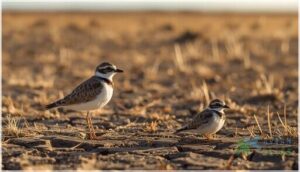
At 21–23 cm long and weighing under 110 grams, the Mountain Plover (Charadrius montanus) is a compact shorebird with a surprisingly upright stance.
Its leg structure gives it an elevated, alert posture on open plains.
Round head proportions pair with short bill features for clean bird species identification.
When threatened, it squats flat — earning its Prairie Ghost nickname through squat camouflage.
Distinctive Coloration and Markings
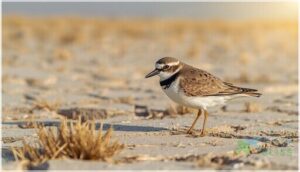
Its sandy brown back and white underparts are built for upland camouflage — think dry prairie blending into pale soil. Unlike most plovers, you won’t spot a breast band here.
Look instead for these key markers:
- Black forecrown and loral stripe (breeding season)
- White wing stripe in flight
- Muted leg color — straw yellow
- Dark, slim bill
Seasonal Changes in Appearance
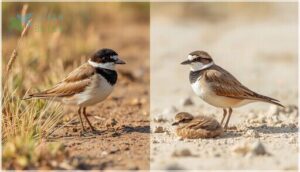
Plumage cycles shift noticeably across the year. By early March, breeding season brings bold head markings — a black forecrown and sharp eyelines — plus warmer buff tones on the flanks.
Come midsummer, molt schedules kick in and those crisp patterns soften into plain sandy brown. Juvenile plumage looks even subtler, almost scaly.
These camouflage adaptations help with bird identification: seasonal status alone can change how different this shorebird looks.
Key Identification Features
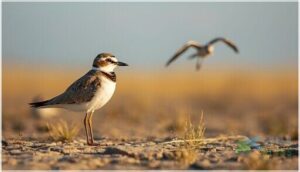
When you spot a Mountain Plover (Charadrius montanus), a few shorebird characteristics lock in the identification fast. The short black bill, pale yellow-brown legs, and clean unstreaked chest set it apart from other plovers.
Watch for its stop‑run rhythm on bare ground, the thin wing tip stripe in flight, and that upright posture profile — together, these make bird identification straightforward even for newer birders.
Habitat and Geographic Range
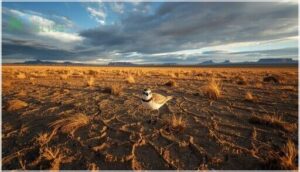
The Mountain Plover isn’t your typical shorebird—it’s built for wide open spaces, not coastlines.
Where it lives, breeds, and travels tells you a lot about how this bird survives.
Here’s a closer look at the key areas that make up its world.
Preferred Habitats and Upland Environments
Mountain plovers don’t just live anywhere — they need open, sparse ground to thrive. You’ll find them in shortgrass prairie with bare soil patches, often where vegetation stays under 10 centimeters tall. They favor prairie dog colonies, shrub steppe flats, and grazed cropland.
These grasslands carry deep prairie legacies, and understanding this habitat helps guide meaningful habitat restoration efforts today.
Breeding and Wintering Grounds
Breeding happens mainly across the Great Plains — from Montana and Wyoming south through Colorado and New Mexico. Prairie Dog Influence shapes these sites heavily, where Grazing Disturbance and Prescribed Burn Effects keep vegetation low.
Wintering birds head to California’s Imperial Valley and southern Texas, relying on Alkali Flat Use and tilled cropland. Site Fidelity Patterns mean these birds return to the same Grasslands yearly, making Habitat loss especially damaging to their Breeding status and Distribution.
Migration Routes and Regional Presence
Each fall, these birds trace regional pathways southwest through Colorado and New Mexico, hitting stopover hotspots in eastern Colorado and southwest Kansas along the way.
Spring corridors bring them back by early March.
Wyoming and Nebraska host regular migrants during seasonal timing shifts.
Shorebird migration distribution stays concentrated along western Great Plains edges, though vagrant sightings occasionally turn up along eastern coasts.
Behavior, Diet, and Breeding

The Mountain Plover’s daily life is more interesting than its quiet appearance suggests.
From how it hunts insects to how it raises its young, this bird has some genuinely clever strategies worth knowing.
Here’s a closer look at the behaviors that shape its survival.
Foraging Strategies and Feeding Habits
Watching a Mountain Plover hunt is like watching a tiny athlete work a field. It uses run‑stop foraging — sprinting a few feet, freezing, then striking at insect prey with a quick peck.
This technique suits habitat microstructure perfectly: bare ground and short‑grass prairies reveal movement easily. Prairie dogs help by keeping vegetation short. Seasonal diet shifts track insect availability, supporting smart energy budgeting year‑round.
Social Behavior and Daily Activities
Beyond solo foraging, these grassland birds are surprisingly social. Outside breeding season, you’ll find them in loose flocks — sometimes over 1,000 birds strong during migration.
Territorial displays shift dramatically once males claim breeding territories in April, using ruffled feathers and sharp calls.
Roosting strategies are simple: ground depressions, often on burned fields.
Alarm calls like harsh krrrp keep the whole flock alert.
Breeding Strategies and Chick Development
When breeding season begins, the Mountain Plover uses a rare Double Clutch System.
Males build two nests on shortgrass prairies — often near Prairie Dog towns — and females lay three eggs in each.
Then each parent practices Uniparental Care, incubating one clutch alone.
Nest Camouflage using cow dung hides eggs well.
Precocial Chicks leave the nest quickly, and Fledging Success averages around 0.7 chicks per nest.
Conservation Status and Observation

The Mountain Plover faces real challenges, and understanding them is the first step toward making a difference. Whether you’re a backyard birder or a seasoned naturalist, there’s something here for everyone.
Here’s what you need to know about the threats this bird faces, the efforts underway to protect it, and where you can spot one yourself.
Threats and Population Trends
The Mountain Plover’s historic decline tells a quiet, troubling story. Survey data show numbers dropped nearly two-thirds between 1966 and 2004 — mostly driven by prairie conversion, shifting farming practices, and energy development across shortgrass prairies.
The Mountain Plover lost nearly two-thirds of its population between 1966 and 2004, erased quietly by vanishing prairies
Today, only around 11,000–14,000 birds remain. Habitat loss and current vulnerability keep its conservation status listed as Near Threatened, making every remaining patch of open grassland count.
Conservation Efforts and Protections
Protecting this small bird takes real teamwork across public and private lands. Five key efforts make a difference:
- Safe Harbor Agreements give ranchers legal certainty to act
- Prescribed Burning keeps grass short for nesting
- Grazing Incentives through Working Lands Funding support habitat preservation
- Prairie Dog Coordination maintains bare‑ground nesting sites
- Conservation Plans align Bird Conservation goals across state lines
Best Locations and Tips for Birdwatching
For the best chance at spotting a Mountain Plover, head to Pawnee National Grasslands in Colorado or prairie dog towns across the Southwestern US between April and May. Timing searches to early morning improves results.
Use habitat tactics like scanning bare, overgrazed fields with a scope. Check eBird Reports for recent sightings. Ethical viewing means staying on roads and keeping your distance during nesting.
Frequently Asked Questions (FAQs)
Where does the Mountain Plover live?
Far from any shoreline, these birds call dry grassland ecosystems home — from Wyoming and Colorado plains to New Mexico’s desert flatlands, alkaline lakebeds, overgrazed pastures, elevated plateaus, and prairie dog colonies.
What is another name for a plover?
Plovers go by many names. You’ll find them called lapwings, dotterels, or shorebirds depending on the species.
Upland variants earn local appellations like "prairie ghost" among grassland bird enthusiasts and Audubon Field Guide readers alike.
What do mountain plovers eat?
Think beetles rule their menu year‑round? Not quite.
These grassland birds shift from beetle preference in spring to a grasshopper seasonal shift by late summer, balancing ant consumption rates, scorpion occurrence, and notable invertebrate diversity.
What is the lifespan of a Mountain Plover?
Most wild individuals live around 9 years on average, though maximum recorded age reaches 10 years.
Adult survival rates are near 68 annually, while juvenile mortality remains high, especially in drought years affecting habitat quality.
Where do mountain plovers live?
Like a ghost of the open plains, it haunts shortgrass prairies, arid plains, and heavily grazed pastures.
Prairie dog towns, Montana’s flatlands, Wyoming’s sweeps, and California’s southwest wintering valleys define its grassland ecosystem’s home.
Why is it called a mountain plover?
The name comes from early explorer observations near the Rocky Mountains, creating a Rocky Mountain association that stuck.
It’s a misleading common name — this grassland bird actually haunts flat prairie dog towns, earning its "prairie ghost" nickname instead.
What is a sand-colored mountain plover?
Sand-colored describes a bird species whose sandy brown upperparts and whitish underparts blend into dry grassland ecosystems — a camouflage adaptation that facilitates ground nesting strategy and habitat survival across open terrain.
What is a mountain plover in Oklahoma?
In Oklahoma, you’ll find this grassland bird mainly in the Panhandle, where land management and prairie dog association create the bare, open habitat it needs.
State monitoring tracks its presence near Rita Blanca National Grassland.
How do I find a mountain plover?
Scan wide, open grasslands slowly — prairie dog colonies and sod farms are your best bets.
Use eBird hotspot search, a spotting scope, and run-stop scanning to catch this master of camouflage.
Do mountain plovers live in wetlands?
No, they don’t. Mountain plovers show a strong dry prairie preference, avoiding wetlands entirely.
These birds thrive in bare-ground nesting sites on arid grassland ecosystems — a true water-scarcity adaptation that surprises most people.
Conclusion
Long before birdwatching apps existed, naturalists tracked the mountain plover with nothing but field notes and patience—and that same quiet attention still matters today.
This bird doesn’t ask for much: open land, short grass, and room to move.
But its survival depends on people who notice it exists.
If you spend time in grassland country, keep your eyes low and your pace slow.
The plover is out there, doing its best in the dust.