This site is supported by our readers. We may earn a commission, at no cost to you, if you purchase through links.
Deep in a tangle of cottonwoods along a slow river, a bird sits motionless, watching. Most people walk right past the yellow-billed cuckoo without ever knowing it’s there—and that’s exactly how it prefers things.
Slim, unhurried, and built for the shadows of riparian forest, this species leads a life shaped by precision rather than spectacle. Its stomach literally sheds its own lining to process hairy caterpillars that would gag most other birds.
Declining across much of its range, the yellow-billed cuckoo rewards patient observers with behaviors unlike almost anything else in North American woodland.
Table Of Contents
- Key Takeaways
- Physical Characteristics of Yellow-Billed Cuckoos
- Yellow-Billed Cuckoo Habitat and Range
- Diet and Foraging Behavior of Yellow-Billed Cuckoos
- Breeding and Nesting Habits of Yellow-Billed Cuckoos
- Vocalizations and Communication of Yellow-Billed Cuckoos
- Conservation Status and Threats to Yellow-Billed Cuckoos
- Interesting Facts and Behaviors of Yellow-Billed Cuckoos
- Protecting and Preserving Yellow-Billed Cuckoo Populations
- Frequently Asked Questions (FAQs)
- How rare are yellow-billed cuckoos?
- Where do yellow-billed cuckoos nest?
- Do cuckoos live in the USA?
- Are yellow billed cuckoos secretive?
- What is a yellow billed cuckoo?
- Are yellow billed cuckoos rare?
- Do yellow billed cuckoos parasitize other birds?
- How rare are Yellow-Billed Cuckoos?
- What are the predators of Yellow-Billed Cuckoos?
- Are Yellow-Billed Cuckoos parasites?
- Conclusion
Key Takeaways
- The yellow-billed cuckoo’s slim, shadow-hugging build and two-tone bill make it a distinctive find in dense riparian corridors, yet most people walk right past it without a second glance.
- Its stomach literally sheds and regenerates its own lining to digest hairy caterpillars that would stop most birds cold—a digestive trick found in almost no other North American species.
- Over 90 percent of its historical riparian habitat is gone, and the western population is now federally listed as threatened, meaning habitat loss isn’t a distant concern—it’s already reshaping where this bird can survive.
- Patient, slow observation in cottonwood-willow corridors during summer gives you your best shot at spotting one, especially when you tune in to its hollow, wooden "kak-kak-kow" call before you ever see the bird itself.
Physical Characteristics of Yellow-Billed Cuckoos
Once you spot a yellow-billed cuckoo, you don’t forget it — there’s something distinctly put-together about the way it looks.
That bold yellow bill pairs perfectly with its sleek markings — a combination covered well in this Oklahoma backyard bird identification guide.
A handful of specific physical traits make this bird surprisingly easy to identify in the field. Here’s what to look for.
Body Size and Shape
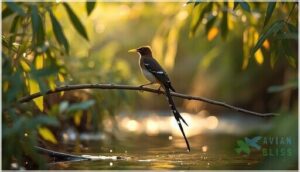
The yellow-billed cuckoo (Coccyzus americanus), or Coulicou à bec jaune, carries a surprisingly slim profile for a bird its size.
Three measurements define this Cuculidae member’s body proportions:
- Length: 26–30 cm tip to tail
- Weight: 55–65 grams
- Wingspan: roughly twice its body length
That long tail length accounts for nearly half its total size, giving it a distinctly stretched, elegant silhouette on the branch. The species’ survival depends on understanding its riparian habitat needs to inform conservation efforts.
Plumage Color and Pattern
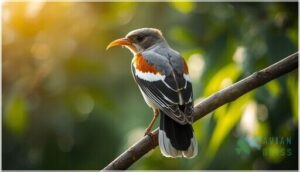
If you’re scanning for bird species characteristics, pay close attention to feather coloration and plumage variation. The yellowbilled cuckoo’s upperparts are smooth gray-brown, with rufous tones flashing in the wings. Its white spots on the tail create bold contrast, especially in flight. Below, crisp white underparts catch the light.
Here’s a quick comparison:
| Feature | Description |
|---|---|
| Wing Patterns | Rufous, gray-brown |
| Tail Spots | Bold white, black |
| Plumage Variation | Seasonal fading |
| Beak Color | Yellow, black |
Bill Color and Length
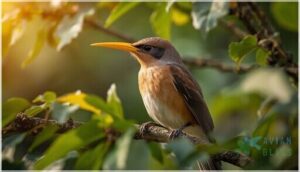
The bill alone tells you a lot about this bird species’ characteristic. The yellow-billed cuckoo’s upper mandible runs dark gray to black from base to tip, while the lower mandible glows bright yellow-orange — that two-tone color pattern is your clearest clue for species identification and differentiation from the black-billed cuckoo.
Bill structure is practical too: roughly 22–27 mm long, gently curved, slim-tipped for plucking caterpillars cleanly.
Facial Markings
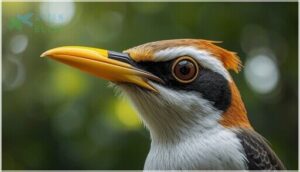
Move from that two-tone bill up the face, and Coccyzus americanus gives you two more reliable field marks. A narrow dark facial mask runs cleanly through the eye toward the ear coverts, framing a bright yellow orbital skin ring — your key bird identification anchor.
That sharp contrast between white throat and dark eye stripe makes Yellowbilled Cuckoo head patterns unmistakable, even in dappled woodland light. The bird’s distinctive size and shape can be further understood by studying its relative size comparisons.
Wing and Tail Characteristics
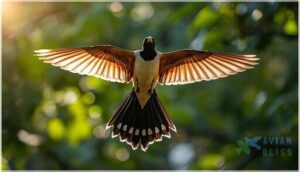
Once you shift your gaze to the wings and tail, Coccyzus americanus becomes easier to track in dense cover. Wing shape and tail length together define this bird species’ aerodynamic features:
- Wingspan spans 42–50 cm, with rufous tones on inner flight feathers
- Folded wings reach nearly to the tail base
- Tail length equals roughly half the total body length
- Feather patterns below show six crisp white spots against black
These flight mechanics make avian ecology observation genuinely rewarding.
Juvenile Characteristics
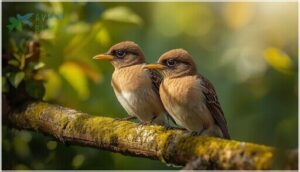
Young yellow-billed cuckoos are deceptively mature for their age. Within just 7 to 9 days of hatching, these Cuculiformes nestlings go from nearly naked to fully feathered — one of the fastest nestling growth timelines in North American avian ecology. Juvenile plumage closely mirrors adult coloration, with brown upperparts and white underparts, though the feather development produces a softer, more even tone across the back.
Here’s what sets juveniles apart:
- Beak coloration appears duller, with less vivid yellow on the lower mandible
- Fledging patterns begin with short, cautious branch-to-branch hops
- Facial markings show a softer eye-ring contrast than adults
- Siblings often perch together, awaiting parental feeding visits
Understanding these traits strengthens wildlife conservation identification efforts for this bird species.
Yellow-Billed Cuckoo Habitat and Range

Where a yellow-billed cuckoo chooses to live tells you a lot about what it needs to thrive. These birds are particular about their surroundings, and that selectiveness shapes where you’ll find them across the continent.
Here’s what defines their habitat and range.
Preferred Wooded Habitats
Yellow-billed cuckoos don’t wander far from water. You’ll find them tucked inside dense riparian forests where cottonwoods and willows press close to river corridors, forming the thick, layered woodland ecology these birds depend on. They favor tree canopy cover that blocks more than half the open sky, with a well-developed midstory beneath for quiet movement and nesting concealment.
Small, isolated woodland areas rarely hold them — habitat fragmentation pushes them out fast. Continuous deciduous woodlands stretching several kilometers along a waterway are where populations persist.
Protecting these riparian areas isn’t optional; habitat preservation of wide, connected forest corridors is what keeps this species on the map.
These corridors connect to a much larger story — famous bird migration routes across the globe show just how far intact habitat networks stretch beyond our backyards.
Types of Vegetation and Landscapes
Cuckoos aren’t picky about one landscape — they’re surprisingly adaptable across several:
- Riparian Forests and Wetland Edges where cottonwood and willow form tall, shaded canopies
- Shrub Thickets of dense deciduous woodlands with tangled understory reaching 2–6 meters high
- Orchard Landscapes and Desert Riparian corridors connecting woodland areas near water
Each habitat shares one trait: layered, continuous vegetation dense enough to conceal movement.
Regional Variations in Habitat
Where a bird calls home depends heavily on where you’re on the map. Western birds anchor themselves to wide riverine landscapes — dense cottonwood-willow corridors along rivers like the Colorado, where riparian habitat stretches broad and continuous. Eastern birds tolerate smaller, fragmented woodlots.
Elevation effects, hydrological patterns, and habitat fragmentation shape both populations differently, making wildlife habitat preservation critical across every ecological habitat they occupy.
Migration Patterns and Wintering Grounds
Few avian migration patterns rival this Neotropical migrant’s seasonal movements. Starting in late April, these birds push north, then reverse course by July. Migration routes span a broad flyway — no single corridor, but a wide sweep through Mexico and Central America toward wintering habitats in the Amazon Basin.
- Nocturnal travel across broad migration routes
- Stopover ecology in riparian and shrubby corridors
- Flyway conservation along degraded river systems
- Wintering habitats from Colombia south into Bolivia
Geographic Distribution Across North America
From those broad migration flyways, breeding grounds spread across much of North America — dense eastern forests, Gulf Coast bottomlands, and Appalachian valleys.
In the West, habitat fragmentation has shrunk the range dramatically; California’s Central Valley and Arizona’s riparian corridors hold only scattered pairs now.
Range maps tell a clear story: regional variations in habitat quality, not distance, determine where these birds actually settle.
Diet and Foraging Behavior of Yellow-Billed Cuckoos
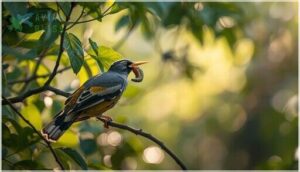
The yellow-billed cuckoo is a surprisingly strategic eater, and watching one forage through dense foliage tells you a lot about how it survives.
Its diet shifts with the seasons, the landscape, and what’s crawling on the nearest branch. Here’s a closer look at what it eats, how it hunts, and the clever adaptations that make it so effective.
Primary Food Sources
Caterpillars dominate the yellow-billed cuckoo’s insect prey list, making up the bulk of its caterpillar diet during the breeding season. Your best chance of spotting one is near willow or cottonwood trees crawling with larvae. During outbreaks, a single bird may consume over a hundred caterpillars daily.
Cicada feeding surges in summer too, and these foraging strategies place the species firmly at the center of forest food chain dynamics.
Supplemental Food Sources
Beyond insects, the yellow-billed cuckoo’s feeding behavior shows real flexibility. Fruit consumption picks up in late summer — elderberries, wild grapes, and blackberries along river corridors offer quick energy. Their vertebrate prey includes small frogs and lizards, while bird eggs appear occasionally as opportunistic meals.
These insect alternatives round out their dietary habits across seasons:
- Berry foraging in cottonwood-willow floodplains
- Small reptiles and amphibians near stream edges
- Opportunistic egg-taking from songbird nests
- Seed eating on South American wintering grounds
Foraging Techniques and Strategies
The yellow-billed cuckoo’s foraging style is methodical and surprisingly patient. Perch hunting defines much of its feeding behavior — it sits still, scanning nearby foliage before striking with purpose.
Foliage gleaning rounds out its dietary habits:
- Slow branch-walking to inspect leaf undersides for caterpillars
- Short, direct flights between productive insect capture spots
- Repeated visits to high-yield trees during active foraging circuits
Adaptations for Finding and Eating Prey
Every structural detail of this bird’s body aids the hunt. Its long, slightly downcurved bill reaches prey tucked beneath leaves, while zygodactyl feet lock onto thin branches during precise, targeted strikes. Visual hunting relies on large, motion-sensitive eyes built for shaded canopies.
| Adaptation | Feature | Function |
|---|---|---|
| Bill Structure | Downcurved, wide-gaped | Swallows bulky prey whole |
| Perching Traits | Zygodactyl feet, long tail | Balances during angled reaches |
| Digestive Adaptations | Mucous-coated stomach lining | Safely processes hairy caterpillars |
| Prey Handling | Beats prey against branches | Stuns insects before swallowing |
Avian biology rarely combines bill structure, perching traits, and digestive adaptations this efficiently.
Seasonal Variations in Diet
Their diet shifts with the seasons in ways that track insect availability almost perfectly. During spring, caterpillar outbreaks drive the bulk of feeding activity, with tent caterpillars dominating the menu through June.
Summer brings food source shifts toward cicadas and katydids. By late summer, fruit consumption increases markedly — mulberries, wild grapes, and elderberries supplement these dietary adaptations as migration approaches.
Breeding and Nesting Habits of Yellow-Billed Cuckoos
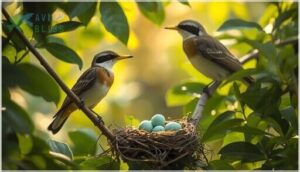
Regarding raising young, yellow-billed cuckoos have a surprisingly deliberate approach to the whole process. From where they build their nests to how they share parenting duties, every step follows a recognizable pattern worth knowing.
Here’s a closer look at what their breeding season actually looks like.
Nest Placement and Location
Nest site selection shapes everything about this bird species’ breeding success. Yellow-billed cuckoos follow reliable nesting strategies, placing nests within riparian corridors in willow, cottonwood, or sycamore — usually 1 to 5 meters up, tucked near the trunk for stability.
- Tree Species: Willows and cottonwoods dominate western nesting habitat
- Nest Height: Most nests sit 2–3 meters high, shaded and sheltered
- Habitat Fragmentation: Broken corridors reduce suitable nesting and breeding sites markedly
Nest Description and Materials
What you’ll notice first is how deliberately rough this bird species builds its nest. Both adults share the work — the male ferries thin twigs while the female manages twig arrangement and platform construction. Nesting strategies here favor speed over elegance; the whole structure goes up in one to three days.
Material selection draws from nearby willows or cottonwoods, with fresh leafy sprigs woven into dry sticks. The result is a loose, open-weave platform where nesting habits and habitat practically overlap — gaps in the lattice are entirely intentional.
Egg-Laying and Incubation
Yellow-billed cuckoo egg-laying patterns follow a rhythm tied closely to food availability — clutches of two to three pale bluish-green eggs appear from late May through midsummer, often timed to caterpillar outbreaks. Nesting strategies here are unusually efficient: incubation periods run just 9 to 11 days, with both parents sharing brooding duties from the very first egg. Embryo development moves fast enough that late-laid eggs nearly catch up to earlier ones.
- Hatching successes depend heavily on synchronized food surges
- Breeding habits shift earlier in warmer southern ranges
- Bird behavior during incubation keeps eggs rarely uncovered
Parental Care and Chick-Rearing
Once the eggs hatch, both parents throw themselves into brood care with striking efficiency. Parental roles split evenly — one adult watches while the other forages, delivering caterpillars and soft insects directly into gaping mouths. Nestling development moves fast, with chick growth visible almost daily.
- Fledging process begins just 7–9 days after hatching
- Bird behavior shifts from brooding to active feeding as chicks strengthen
- Nesting habits include nest cleaning and close predator watch
Brood Parasitism and Nesting Success
Fast chick development doesn’t always guarantee success. Brown-headed cowbirds sometimes slip eggs into cuckoo nests, and their chicks hatch early, outcompeting native young — a textbook case of parasite adaptation. Intraspecific brood parasitism adds another layer, with some females dumping eggs into neighboring nests, swelling clutches past the typical 2–5 eggs. Both behaviors can trigger brood reduction and nest failure.
| Nesting Strategy | Threat | Breeding Habits Impact |
|---|---|---|
| Cowbird parasitism | Egg rejection or abandonment | Fewer cuckoo fledglings |
| Intraspecific dumping | Brood reduction | Uneven chick survival |
| Wide riparian corridors | Reduced parasite pressure | Higher nesting success |
Bird conservation work targeting cowbird control has measurably improved fledging rates — a real win for conservation status efforts.
Vocalizations and Communication of Yellow-Billed Cuckoos

The yellow-billed cuckoo has a voice that’s hard to forget once you’ve heard it in the field. Its calls do more work than you might expect, carrying meaning across dense riparian thickets and open woodlands alike.
Here’s a closer look at how this bird communicates, from its signature sounds to the subtle shifts you’ll notice across different regions.
Types of Calls and Sounds
Step into a riparian grove in midsummer and the yellow-billed cuckoo practically writes its own field guide through sound. Its vocal repertoire spans soft "kowlp" contact calls, a distinctive hoarse cooing song, and sharp knocking calls that carry through dense foliage. These acoustic signals are essential for species identification and birdwatching alike.
- Hollow, wooden contact notes
- Loud advertising calls
- Sharp alarm bursts
- Intimate courtship sounds
- Insistent nestling begging calls
Call Patterns and Structures
Each call bout runs 2–4 seconds—stuttering "kak-kak-kak" notes up front, then slower, heavier "kowlp" knocks trailing behind. That shift in Temporal Structure gives the hoarse cooing song its signature rhythm. Pitch Contours stay low and flat until the final notes drop slightly, while Loudness Patterns build toward the middle. Think of it as one wooden rattle with a deliberate, weighted ending.
| Call Feature | Detail |
|---|---|
| Call Rhythm | Stuttering to spaced across 2–4 seconds |
| Syllable Shape | Short, percussive, down-slurred knocks |
| Pitch Contours | Low, flat, slight drop at end |
| Loudness Patterns | Builds mid-sequence, peaks centrally |
Functions of Different Calls
Just as the rhythm of their calls shifts, so do their purposes. You’ll hear yellow-billed cuckoos use:
- Loud knocker calls for Territorial Spacing
- Abrupt Alarm Signals to warn neighbors
- Soft Contact Calls for keeping track in dense foliage
- Brief Migration Communication to coordinate movement
Each vocalization shapes avian behavior and ecology, supporting Wildlife Conservation efforts.
Vocalizations During Breeding and Courtship
During breeding season, male yellow-billed cuckoos pour energy into courtship calls, delivering loud "ku-ku-ku-kow" series from exposed branches along river corridors. These mating songs drive pair bonding and establish presence on breeding grounds. Watch for four vocal behaviors:
- Males repeat kuk series to attract receptive females
- Females respond with shorter, softer breeding chirps
- Pairs exchange quiet contact notes at close range
- Both birds alternate calls during active pair bonding
Geographic Variations in Vocalizations
Across their range, yellow-billed cuckoos carry what ornithological research calls regional dialects — subtle but real. Eastern birds deliver the hollow kowlp with full, ringing force, while western birds offer a softer, more subdued version.
These geographic songs shift your approach to species identification in the field. During bird migration patterns, call patterns grow quieter still, making vocal range your most nuanced detection tool.
Conservation Status and Threats to Yellow-Billed Cuckoos
The yellow-billed cuckoo is facing real pressure from multiple directions, and the western population is already listed as threatened under the Endangered Species Act. Numbers have dropped sharply over the past few decades, and the causes aren’t hard to trace once you know where to look.
Here’s what’s driving the decline — and what’s being done about it.
Population Trends and Declines
Yellow-billed cuckoo population trends tell a sobering story. Decline analysis from the North American Breeding Bird Survey confirms steady species decline since the 1960s, with population shifts pushing the western distinct population segment onto the Endangered Species Act’s threatened list in 2014. Here’s what the numbers reveal:
- Western breeders have vanished from British Columbia, Washington, and Oregon
- Southwestern rivers now hold only dozens of territorial males
- Northeast and upper Midwest show steepest eastern declines
- Isolated breeding sites lose populations before larger landscape blocks
- Wildlife conservation efforts remain critical as fragmented species fragmentation accelerates range contraction
Conservation strategies and conservation status reviews continue shaping habitat loss responses.
Habitat Loss and Fragmentation
Habitat destruction has quietly dismantled the yellow-billed cuckoo’s world. More than 90 percent of historical riparian habitat along rivers like the Colorado and Sacramento is gone, leaving only narrow, disconnected strips behind.
Over 90 percent of the yellow-billed cuckoo’s riparian world is gone, replaced by narrow, disconnected strips of what once was
Forest fragmentation turns once-continuous wildlife corridors into isolated patches too small for stable breeding. Riparian erosion, agricultural conversion, and ecosystem disruption compound the loss.
Habitat preservation and restoring wildlife habitat connectivity remain the clearest path forward.
Collisions With Human-Made Structures
Every night flight carries real danger for the Yellow-Billed Cuckoo. Building Collisions, Window Strikes, Power Line Hazards, and Tower Collisions claim birds silently along migration corridors:
- Glass facades mirror open sky, pulling cuckoos into fatal strikes
- Guy wires and transmission lines cross riparian routes at wing height
- Roadway Threats intensify where highways parallel river valleys
Wildlife conservation efforts and Habitat Preservation — like marking lines and dimming lights — make a measurable difference.
Climate Change Impacts
Climate change is quietly rewriting the rules for this bird’s survival. Drying rivers shrink the Riparian Habitat cuckoos depend on for nesting, while Insect Shifts mean caterpillar peaks no longer align with the breeding season. Extreme Weather and Vegetation Changes compound the pressure across their fragmented western range.
| Climate Threat | Wildlife Ecology Impact |
|---|---|
| Riparian drying | Fewer nesting corridors |
| Insect timing shifts | Chick starvation risk |
| Extreme heat waves | Egg overheating, nest failure |
| Invasive vegetation | Lost canopy complexity |
| Wildfire increase | Mature forest destruction |
Conservation Efforts and Strategies
After those climate pressures, recovery depends on deliberate action. Conservation efforts center on restoring cottonwood-willow corridors, removing invasive saltcedar, and fencing livestock away from streambanks.
The Endangered Species Act gives wildlife management real teeth here, requiring federal review of dams and diversions in critical habitat.
Citizen scientists also contribute survey data that shapes habitat restoration priorities and strengthens ecological preservation planning across the species’ fragmented western range.
Interesting Facts and Behaviors of Yellow-Billed Cuckoos
The yellow-billed cuckoo is a bird that keeps surprising you the more you learn about it. Beyond its looks and diet, it has some genuinely fascinating traits and behaviors worth knowing.
Here’s a closer look at what makes this species stand out.
Unique Characteristics and Traits
Few birds in the Cuckoo family pack as many surprises as this one. Its stomach lining actually sheds in sheets to handle its Caterpillar Diet — digesting hairy, spiny larvae most birds won’t touch. Chicks show Rapid Growth, leaving the nest within nine days. Then there’s Rain Calls, Brood Parasitism, and Adaptive Traits that set it apart from even the Blackbilled Cuckoo:
- Nicknamed "Rain Crow" for calling before storms
- Occasionally lays eggs in other nests, including those of the Blackbilled Cuckoo
- Stomach lining regenerates to process spine-covered caterpillars
- Chicks develop flight feathers faster than most songbirds
Migration Patterns and Routes
What the stomach does with caterpillars is extraordinary — but what the whole bird does across two continents is something else entirely. Yellow-billed cuckoos follow distinct migration routes from their North American breeding grounds deep into South America, some covering nearly 9,500 kilometers one-way. Stopover sites along wooded river corridors are critical habitat corridors for refueling.
| Migration Stage | Key Detail |
|---|---|
| Departure timing | Late July through September |
| Wintering range | Southern Brazil to Argentina |
| Western flight patterns | Through interior Mexico, avoiding open ocean |
| Seasonal movements | October–March spent in South America |
Social Behavior and Interactions
Yellow-billed cuckoos are mostly solitary, but their social world has real structure once breeding season arrives. Pair bonding forms through courtship feeding — the male delivers caterpillars directly to the female’s bill.
Territorial displays keep rival pairs spaced along separate stretches of riverbank, while nest defense sharpens quickly when jays or crows approach.
Bird watching during June and July gives you a close look at these quiet but purposeful interactions.
Adaptations for Survival and Success
Few birds match the Western Yellow-billed Cuckoo’s survival toolkit. Its brown-and-white plumage delivers camouflage tactics that make it nearly invisible in dappled riparian foliage. Flexible migration patterns align arrival with caterpillar peaks, while adaptive breeding lets pairs fledge chicks in roughly 17 days.
- Insect foraging targets hairy tent caterpillars other birds won’t touch
- Feeding and diet shifts to berries before departure
- Habitat and distribution along cottonwood corridors shapes migration patterns
Cultural Significance and Folklore
Folklore gives Coccyzus americanus occidentalis a personality science rarely captures. Across Appalachia and the Ozarks, Rain Crow Legends treat this bird’s rough, rolling call as a genuine storm warning — and honestly, people weren’t wrong to listen.
Storm Crow Folklore, regional nicknames, and Indigenous Storytelling traditions all weave the western yellow-billed cuckoo into the living language of weather, season, and place.
Protecting and Preserving Yellow-Billed Cuckoo Populations

Protecting the western yellow-billed cuckoo starts on the ground — literally. Restoring wide belts of native cottonwood and willow along river corridors is the backbone of habitat preservation and restoration. Population monitoring tracks nesting success each season, directing conservation efforts where they’re needed most. Threat mitigation means cutting pesticide use, adjusting dam releases, and fencing grazed riparian patches.
- Restore native riparian strips at least 100–200 meters wide
- Reduce broad-spectrum insecticides near waterways
- Participate in standardized breeding-season surveys
- Support policies protecting critical habitat corridors
Frequently Asked Questions (FAQs)
How rare are yellow-billed cuckoos?
It depends on where you’re from. Globally, the species holds Least Concern IUCN Status with around 9 million birds, but Population Decline, Regional Trends, and the Western Yellowbilled Cuckoo’s threatened endangered species listing tell a sharply different story.
Where do yellow-billed cuckoos nest?
Unlike most birds, these secretive nesters tuck their flimsy stick platforms into dense willows and cottonwoods, usually 1–5 meters up, where thick foliage hides them perfectly within riparian habitats along western river corridors.
Do cuckoos live in the USA?
Yes, several cuckoo species breed across the United States. The yellow-billed cuckoo is the most widespread, nesting in over 30 states, while black-billed and mangrove cuckoos also call parts of the country home.
Are yellow billed cuckoos secretive?
Still waters run deep" — and so does the secretive behavior of this bird. Coccyzus americanus occidentalis relies on camouflage techniques and stealth habits, slipping through dense foliage and staying motionless, making its elusive nature a defining trait.
What is a yellow billed cuckoo?
Meet Coccyzus americanus — a slender, long-tailed forest bird roughly 30 cm long, known for its yellow bill, white underparts, and bold spotted tail.
This skilled cuckoo migration traveler hunts caterpillars across North American woodlands before wintering in South America.
Are yellow billed cuckoos rare?
The answer depends on where you look. In the East, they’re uncommon but present. Out West, habitat loss has made them genuinely scarce — threatened, not just rare.
Do yellow billed cuckoos parasitize other birds?
Brood parasitism is rare in ornithology — only about 1% of bird species use it. Yellow-billed cuckoos occasionally lay eggs in neighbors’ nests, but they’re not serial offenders like some relatives.
How rare are Yellow-Billed Cuckoos?
Globally, this species sits at Least Concern, but that label hides a complicated story.
Population trends across North America tell a sharper truth — widespread declines, shrinking ranges, and a western population now federally listed as Threatened.
What are the predators of Yellow-Billed Cuckoos?
Survival is never guaranteed in the wild. Hawks strike from above, owls hunt the dark, snakes raid nests, and corvids steal eggs — every day demands constant vigilance.
Are Yellow-Billed Cuckoos parasites?
Yes, but only sometimes. Yellow-billed cuckoos are facultative brood parasites — they occasionally slip eggs into neighboring nests, yet still build their own and raise chicks directly, making full parasitism the exception, not the rule.
Conclusion
Most birds reward the loud and the keen. The yellow-billed cuckoo rewards only the patient. It won’t announce itself, won’t perform, won’t meet you halfway—but stand still long enough in the right cottonwood corridor, and it reveals a life of quiet precision most birders never witness.
Understanding its habitat needs and threats isn’t just useful knowledge; it’s your part in keeping those shadowed riverbanks worth watching. Don’t let this one disappear unnoticed.
- http://www.kaufmanfieldguides.com/
- http://www.drecp.org/documents/%20docs/baseline_biology_report/05_Baseline_Biology_%20Report_Section_5.pdf
- https://www.allaboutbirds.org/guide/Yellow-billed_Cuckoo/maps-range
- https://science.ebird.org/en/status-and-trends/species/yebcuc/abundance-map
- https://www.iucnredlist.org/species/22684331/188608493