
This site is supported by our readers. We may earn a commission, at no cost to you, if you purchase through links.
You fill the feeder, step back to watch, and within hours the hummingbirds are gone—replaced by a steady column of ants marching straight to your nectar.
It happens fast, and it’s more than just annoying.
Ants contaminate the nectar, clog the ports, and drive away the very birds you set the feeder up for.
The science behind it is surprisingly simple: ants can detect sugar concentrations as low as 20%, and once a scout finds your feeder, it lays a pheromone trail that recruits the whole colony.
Breaking that cycle takes the right combination of barriers, placement, and feeder maintenance—all of which are easier than you’d think.
Table Of Contents
- Key Takeaways
- Why Ants Invade Hummingbird Feeders
- Use Ant Moats Effectively
- Improve Feeder Placement
- Clean, Repair, and Deter Ants
- Top 6 Ant-Control Feeder Products
- Frequently Asked Questions (FAQs)
- How to keep ants from ruining hummingbird feeders?
- How to prevent ants from accessing the hummingbird feeder?
- Do ants eat hummingbirds?
- Can ants swim in a hummingbird feeder?
- Will hummingbirds still feed if there are ants on the feeder?
- How do I keep ants away from my hummingbird feeder?
- Why wrap foil around hummingbird feeder?
- How do I keep ants away from my bird feeder?
- How do I keep ants out of a hummingbird feeder?
- Why do you put aluminum foil on hummingbird feeders?
- Conclusion
Key Takeaways
- Ants find your feeder on purpose — they can detect sugar concentrations as low as 20%, and once one scout arrives, it lays a pheromone trail that turns a trickle into a full colony invasion fast.
- An ant moat is your single best defense: a simple water barrier that ants can’t cross, and adding a few drops of vegetable oil slows evaporation so it keeps working even on hot days.
- Where you hang the feeder matters just as much as what you hang on it — keep it at least 10 feet from trees and walls, use thin fishing line instead of chain, and move it every few days to break established pheromone trails.
- Contaminated nectar isn’t just off-putting — it can cause mold, bacterial growth, and oral infections in hummingbirds, so fixing leaks, cleaning regularly with hot water, and skipping pesticides near the feeder protect the birds you’re trying to attract.
Why Ants Invade Hummingbird Feeders

Ants don’t stumble onto your hummingbird feeder by accident — they’re drawn in for very specific reasons. Once you understand what’s pulling them in, stopping them gets a whole lot easier.
From ant-proof moats to strategic feeder placement, keeping ants out of your hummingbird feeder comes down to a few clever tricks that work with nature, not against it.
Here’s what’s really going on.
Sugary Nectar as an Ant Food Source
Ants aren’t just wandering into your yard by accident — your feeder’s sugar water is practically a neon sign to them. Nectar hits that sweet spot of 20–40% sugar concentration, making it a prime energy metabolism fuel for entire ant colonies.
Here’s what draws them in:
- Sugar concentration – High glucose and fructose content means fast energy, fast recruitment.
- Foraging profitability – The closer and richer the source, the more workers show up.
- Amino acid influence – Trace nutrients in sweet nectar can shift colony behavior, keeping ants coming back.
The energy gain-cost ratio stays positive even with low‑quality nectar.
How Ant Pheromone Trails Spread Infestations
Once a scout finds your feeder, it lays a pheromone trail on the way back — and that’s where scout recruitment kicks in fast. More workers follow, reinforce the scent, and suddenly you’ve got a highway forming.
Trail reinforcement builds quickly in warm weather, but pheromone decay slows it down over time. Disrupt that ant trail once, and the whole branching network collapses.
Why Spilled Nectar Attracts More Ants
A spill doesn’t just sit there — it works against you.
That sugar concentration gradient pulls foragers quickly, and moisture retention effects keep the nectar pliable longer than you’d expect.
Spill‑induced scent cues trigger ant recruitment amplification almost immediately.
Watch for these four spill red flags:
- Nectar viscosity changes in heat spread the spill further.
- Sticky residue becomes a sugar solution attractant on contact.
- Humidity extends forager activity windows substantially.
- Pheromone buildup compounds without leak prevention in place.
How Ants Clog Feeder Ports
Once a spill invites them in, the real damage starts at the feeder ports.
Ant species with sticky feet exploit port-shaped edges, packing sugar residue and moisture into tiny openings. Nectar viscosity thickens under temperature impact, helping plugs form faster.
Poor seal integrity makes it worse — gaps become ant highways.
An ant moat or water barrier stops them before that ever happens.
Effects of Contaminated Nectar on Hummingbirds
Contaminated nectar isn’t just unpleasant — it’s genuinely dangerous for hummingbirds. When ants travel through feeders, they accelerate spoilage quickly. Here’s what that means for the birds you’re trying to help:
Ants in your feeder don’t just annoy hummingbirds — they poison their food
- Mold spores from fermentation alcohol trigger respiratory infections and crop irritation
- Bacterial bloom causes digestive upset, rapid weight loss, and weakened flight
- Oral infections from tongue rot block feeding entirely
Maintaining nectar quality is a non‑toxic ant control strategy number one.
Use Ant Moats Effectively
An ant moat is one of the simplest fixes you can make today, and it works surprisingly well. The idea is straightforward — put a water barrier between the ants and the nectar, and they can’t get through.
Here’s what you need to know to use one in the right way.
How Water Barriers Stop Ants
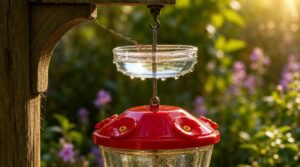
A simple cup of water is one of the most effective ant moat solutions you’ll find. The surface tension effect makes crossing nearly impossible—ants face a real ant drowning risk the moment they hit the liquid. Barrier height optimization matters here: keep it deep enough to deter them, but manageable for daily refills.
| Factor | Why It Matters | Quick Tip |
|---|---|---|
| Water depth | Maintains barrier height optimization | Refill daily in heat |
| Moat edge design | Prevents ants from gripping sides | Wipe edges clean weekly |
| Non-toxic water additives | Slows evaporation safely | Add a few drops of vegetable oil |
This water barrier method is straightforward, bird-safe, and genuinely works.
If you want feeders designed with both protection and freshness in mind, unique hummingbird feeders built for bird safety pair perfectly with this approach.
Built-in Versus Hanging Ant Moats

Choosing between a built-in or hanging ant moat comes down to your feeder setup and how much fuss you want at installation. Both use the same water barrier as an ant control technique — ants simply can’t cross it. Here’s how they compare:
- Installation Complexity: Built-in moats need no extra hardware; hanging moats require mounting above the feeder.
- Water Capacity: Hanging moats like the AMAURAS Red Glass Ant Moat offer adjustable reservoir sizes for hot climates.
- Cleaning Accessibility: Hanging moats lift off easily; built-in designs can be trickier to scrub thoroughly.
- Material Durability: Both work best with UV-resistant materials outdoors.
- Cost Comparison: Built-ins come with your feeder; standalone hanging moats usually run under two dollars.
Pick whichever fits your feeder without overthinking it.
DIY Ant Moat Construction Ideas
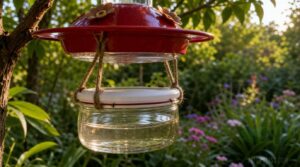
You don’t need to spend money to build an effective DIY ant moat — a bottle cap moat, silicone sealed jar, or recycled condiment container drilled with a hanging cord work just as well.
Fill it with oil treated water to slow evaporation.
These DIY ant barrier options are cheap, fast, and surprisingly reliable as water barriers for ant control.
Keeping Moats Filled During Hot Weather

Hot days are the enemy of a good water barrier — ant moat evaporates fast, and a dry moat is basically a welcome mat. Keep yours working with three smart habits:
- Check levels every 12–24 hours during heat waves
- Prioritize moat depth optimization — deeper holds more reserve
- Use wind shield covers to cut splash and sun exposure
Scheduled refill alerts on your phone make this easy.
Using Vegetable Oil to Slow Evaporation
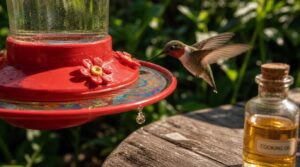
A few drops of vegetable oil on your ant moat water does something clever — it creates a thin film that slows evaporation considerably. Viscosity selection matters here; standard cooking oil works fine. Keep the oil film thickness light, just enough to coat the surface.
Sunlight degradation can break it down, so factor reapplication into your regular feeder maintenance routine. Always prioritize bird safety considerations — never let oil touch the nectar ports.
When Ants Bypass Water Moats

Even a well-filled moat isn’t foolproof.
Ants are surprisingly clever — scout groups practice adaptive trail mapping, splitting into sub-patrols to find gaps.
Heat-induced bypass happens when rising temperatures accelerate evaporation, shrinking the water barrier.
Debris accumulation impact is real too; fallen leaves create stepping stones across moat edge tension zones, enabling ant bridge formation.
Clean the moat rim daily.
Improve Feeder Placement
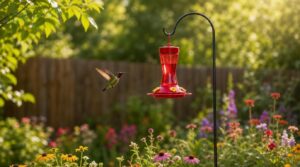
Where you hang your feeder matters more than most people realize. Ants are surprisingly resourceful climbers, and even a well-maintained feeder becomes an easy target if it’s positioned near the wrong surfaces.
These placement tweaks can make a real difference.
Hang Feeders Away From Trees and Walls
Think of feeder as an island — the more water (or open air) around it, the better. Hang your feeder at least 10 feet from tree trunks and 12 feet from walls. Ideal Height sits around 6 feet off the ground.
Use smooth cable materials or fishing line as an ant deterrent for feeders, since ants can’t grip it. Check clearance measurements seasonally, because branches grow.
Avoid Fences, Posts, and Climbing Routes
Fences, lattice, and wooden posts are like ant highways — skip them entirely. Even a nearby trellis gives ants a direct bridge to your feeder.
Instead, raise feeder setups on non-climbable poles and create a clear buffer zone around them. Combine fishing line suspension with an ant moat for layered water barriers as ant control, and you’ve cut off almost every climbing route ants rely on.
Choose Partial Shade to Reduce Leaks
Shade temperature control does more than keep your feeder cool — it’s quiet feeder leakage prevention. Cooler nectar means less expansion inside the reservoir, fewer drips, and fewer ants showing up for the spill.
Smart shade placement benefits your whole setup:
- Pick a spot with morning sun and afternoon shade
- Use dappled light under tree canopies for even cooling
- Choose heat-resistant materials that hold shape when temperatures shift
- Position with 1.5 meters of wall clearance for airflow
Sunlight timing matters — afternoon shade keeps nectar fresh longest.
Move Feeders to Disrupt Ant Trails
Moving your feeder every two to four days is one of the simplest ant trail disruption strategies you can use. Ants rely on pheromone trails to navigate, so relocating the feeder at least three meters from its previous spot breaks that invisible highway completely.
Wipe the old spot with diluted vinegar to erase residual scent cues.
Consistent relocation frequency, paired with smart ant trail monitoring, keeps ants guessing all season long.
Use Thin Fishing Line for Hanging
Swapping your feeder’s metal chain for thin fishing line is a surprisingly effective ant deterrent. Line thickness selection matters — stick to 0.2–0.25 mm clear nylon for the best visibility impact. Ants can’t grip its smooth surface.
Prioritize knot security with a double overhand knot and check for weather durability regularly. Installation safety is simple: confirm your anchor point holds twice the feeder’s weight.
Keep Feeders Clear of Ground Contact
Even a well-protected feeder becomes an easy target if it’s hanging too close to the ground. Aim for 5 to 6 feet using Elevated Mounting Techniques and Adjustable Height Brackets for steady clearance.
Sturdy Pole Bases prevent wobble that lets ants sneak past barriers. Scheduling Ground Clearance Monitoring monthly keeps things honest.
Anti-Ant Skirts around the base add one more line of defense.
Clean, Repair, and Deter Ants
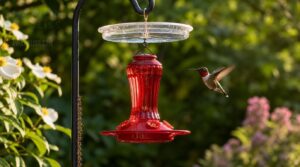
Even the best moat won’t save a feeder that’s dripping nectar or crusted with old sugar. A little maintenance goes a long way toward keeping ants from ever getting a foothold.
Here’s what to tackle first.
Fix Leaks That Attract Ants
A dripping feeder is basically an open invitation for ants. Make sure your feeders don’t leak — inspect connector joints regularly, and replace O-rings or gaskets the moment you spot seepage.
Seal bottle ports with food-safe silicone to close sneaky entry gaps.
Weatherproof caulk works well where mounts meet walls.
Leakproof feeders mean no sticky puddles, no pheromone trails, no ant army.
Tighten Loose Feeder Parts and Seals
Loose parts are just as bad as cracks. A wobbly cap or misaligned seal lets nectar seep out drop by drop. Gasket replacement keeps compression tight — use exact factory parts.
For port screws, torque wrench use prevents over-tightening and warping. O-ring lubrication maintains elasticity, and a seal alignment check confirms no gaps remain.
Solid feeder maintenance to avoid ant infestations starts here.
Clean Nectar Residue and Ant Trails
Sticky nectar is basically an open invitation — ants can’t resist it.
After each refill, do a quick hot water rinse (above 140°F) for effective residue removal and pheromone disruption. A vinegar soak on removable parts cuts through mineral buildup fast. Regular cleaning to maintain nectar quality also erases ant trails before they strengthen. Solid feeder maintenance to avoid ant infestations really starts with this habit.
Replace Cracked Reservoirs or Damaged Ports
cracked reservoir does more than drip — it rolls out the red carpet for ants. Check visible seams and ports carefully; even a hairline crack invites trouble.
When you replace parts, port thread matching and gasket seal inspection matter more than most people realize.
Make sure your feeders don’t leak by doing a quick leak test procedure after reassembly. Replace seal components whenever they look worn.
Use Bird-safe Natural Deterrents Carefully
Once your feeder is sealed up tight, you can add another layer of defense using natural ant repellent options. Cinnamon, crushed mint, and Essential Oil Dilution sprays — think thyme or tea tree — work well when applied at least 12 inches from ports. Capsaicin-Free Chili blends are another solid pick.
Smart Application Timing matters too: go early morning, observe for 48 hours, and watch for any changes in Monitoring Bird Response.
Avoid Pesticides Near Hummingbird Nectar
Natural deterrents work well, but skip the pesticide sprays near your feeder entirely.
Chemical drift prevention isn’t just a fancy term — it means one careless spray on nearby plants can contaminate nectar before you know it.
Stick to organic pest control methods away from the feeder zone.
Always run label compliance checks on any product, and choose only bird-friendly repellents and nontoxic ant solutions you trust completely.
Risks of Sticky Barriers Near Birds
There’s a real temptation to slather petroleum jelly or double-sided tape on your feeder pole and call it done. But those sticky barriers carry serious risks for hummingbirds.
Contact with Tanglefoot TangleTrap Sticky Coating or similar residues causes feather waterproofing loss, flight impairment, and entanglement hazard — leaving birds exposed longer to predators.
Residues also raise pathogen transmission risk. Skip the sticky fix entirely.
Yard Hygiene to Reduce Ant Activity
Think of your yard as the first line of defense. Raking up leaf litter, disposing of dead wood, and rotating garden beds regularly disrupt ant colonies before they ever reach your feeder.
Mulch management matters too — keep it thin near foundations.
Standing water elimination cuts off their moisture supply.
Clean the area around feeders often, and these simple organic pest control habits become your most reliable nontoxic ant control strategy.
Top 6 Ant-Control Feeder Products
Sometimes the easiest win is just having the right gear on hand. These six products cover the main approaches — moats, guards, barriers, and smart feeder designs — so you can pick what fits your setup.
Here’s what’s worth keeping on your radar.
1. Aspects HighView Hummingbird Feeder
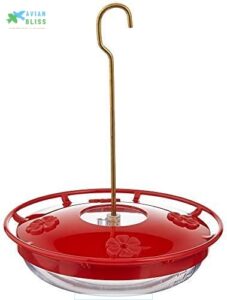
The Aspects HighView Hummingbird Feeder addresses ant problems before they start. Its built-in ant moat sits right above the nectar basin, creating a water barrier ants simply can’t cross.
The four drip-proof ports reduce spills that attract insects in the first place.
At just 12 ounces with a detachable red cover, cleaning takes minutes — no tools, no frustration.
It’s pricier than basic feeders, but the combination of ant protection, durable polycarbonate construction, and a perch for watching birds up close makes it worth considering.
| Best For | Bird lovers who want a low-maintenance, ant-resistant feeder and don’t mind paying a bit more for quality. |
|---|---|
| Ant Protection | Built-in ant moat |
| Material | Polycarbonate plastic |
| Price Range | Premium |
| Ease of Use | Dishwasher-safe parts |
| Durability | Year-round outdoor use |
| Insect Deterrence | Moat blocks ants |
| Additional Features |
|
- Built-in ant moat keeps bugs out without any extra accessories
- Easy to clean — dishwasher-safe and no fiddly parts to deal with
- Perch lets you actually watch hummingbirds sit and feed, not just hover
- Pricier than most basic feeders on the market
- The friction-fit lid needs gentle handling or it can crack over time
- Nectar needs swapping every 3 days, which adds up in warmer months
2. Aspects Jewel Box Window Hummingbird Feeder
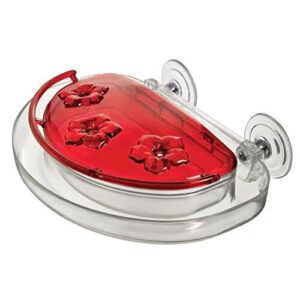
If window-watching hummingbirds is your thing, the Aspects Jewel Box delivers. It mounts directly to glass with dual suction cups, so you’re literally inches from the action.
The 8 oz reservoir is small by design — smaller capacity means fresher nectar, which is better for the birds.
Its optional ant moat and Nectar Guard tip compatibility give you layered protection against crawling insects.
The red polycarbonate lid does the attracting; the moat does the blocking.
Simple, effective, and genuinely fun to watch.
| Best For | Anyone who wants a front-row seat to hummingbird visits right from their window, without the hassle of hanging a traditional feeder. |
|---|---|
| Ant Protection | Optional ant moat |
| Material | Polycarbonate plastic |
| Price Range | Premium |
| Ease of Use | Easy refill reservoir |
| Durability | Stable suction mounting |
| Insect Deterrence | Moat and optional tips |
| Additional Features |
|
- Mounts flush to the glass so you get an up-close view that bigger, hanging feeders just can’t match
- Small 8 oz reservoir keeps nectar fresh and encourages regular refills, which is genuinely better for the birds
- Ant moat plus Nectar Guard tip compatibility gives you solid, layered bug protection without much fuss
- The 8 oz capacity means more frequent refills, which can feel like a chore during peak hummingbird season
- Suction cups need a perfectly clean, dry surface to hold — and they can lose grip in extreme heat or cold
- It costs more than most basic window feeders, so if you’re just testing the waters, the price might give you pause
3. AMAURAS Glass Ant Moat for Hummingbird Feeders
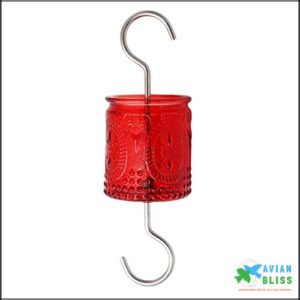
Glass and steel might seem like overkill for an ant moat, but the AMAURAS delivers where plastic ones crack and warp. The candy-apple red glass cup holds enough water for several days, and the stainless-steel hook keeps everything stable without rusting.
At 2.5 inches wide, the moat creates a solid water barrier, ants simply can’t cross.
It fits most standard feeders and installs without tools. At $12.95, you’re paying a bit more — but this one’s built to last.
| Best For | Anyone tired of ants ruining their hummingbird feeder who wants a durable, good-looking solution that doesn’t need constant replacing. |
|---|---|
| Ant Protection | Integrated ant moat |
| Material | Glass and stainless steel |
| Price Range | Budget-mid ($12.95) |
| Ease of Use | Simple assembly |
| Durability | Rust-free construction |
| Insect Deterrence | Water moat blocks ants |
| Additional Features |
|
- The glass body is tough — it won’t crack or warp like plastic moats do over time.
- The red finish actually helps draw hummingbirds in, so it’s pulling double duty.
- Holds water for several days, so you’re not out there refilling it every morning.
- At $12.95, it costs more than most plastic options — though you do get what you pay for.
- Glass can chip if you drop it or handle it roughly during setup.
- The moat still needs regular refilling, so don’t expect a totally hands-off experience.
4. BugSnub Ant Guard for Hummingbird Feeders
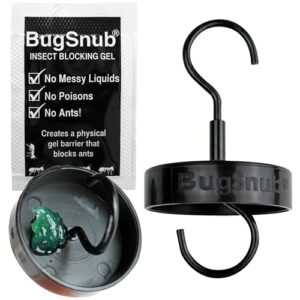
If water moats aren’t cutting it, BugSnub takes a different approach entirely. Instead of water, it uses a food-grade mineral oil gel — thick, sticky, and odorless — that ants simply can’t cross.
The cup faces downward, so debris can’t collect and form a bridge. It hangs in-line with your feeder, stays out of reach of birds, and holds up even in brutal summer heat.
One gel packet can last months. A single pack runs $9.99, or grab the 3-pack at $6.66 per unit.
| Best For | Anyone dealing with persistent ant invasions on their hummingbird feeders, especially in hot climates where water moats evaporate or overflow. |
|---|---|
| Ant Protection | BugSnub gel barrier |
| Material | Metal and food-grade gel |
| Price Range | Budget ($9.99–$19.98) |
| Ease of Use | Easy hook installation |
| Durability | Heat-resistant gel |
| Insect Deterrence | Gel blocks ants |
| Additional Features |
|
- The mineral oil gel is non-toxic and safe around kids, pets, and birds — no sketchy chemicals
- Holds up in serious heat without melting or running off, so it actually works all summer
- One application can last months, meaning you’re not out there messing with it every week
- At $9.99 for a single pack, it costs more upfront than a basic DIY ant moat
- Only one gel packet per hanger, so if you have multiple feeders you’ll need to buy extra gel
- Wide shepherd’s hooks over ¾ inch won’t fit, so check your setup before ordering
5. Vaseline Skin Healing Jelly
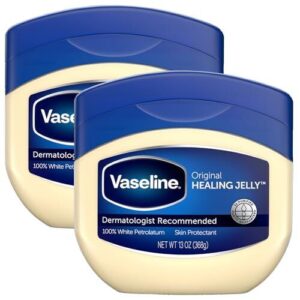
You probably already have this one in your medicine cabinet.
Vaseline Healing Jelly isn’t marketed for bird feeders, but a thin layer on your feeder pole creates a slippery surface that ants simply can’t grip. It’s made of triple-purified petrolatum, so it won’t harm curious hummingbirds if they brush against the pole.
One jar costs $17.99 and goes a long way. Just reapply every few days in summer heat, since it can melt and run.
| Best For | Anyone dealing with dry, cracked, or sensitive skin who wants a simple, no-fuss solution that also pulls double duty around the house. |
|---|---|
| Ant Protection | Petrolatum barrier (DIY) |
| Material | White petrolatum |
| Price Range | Mid ($17.99) |
| Ease of Use | Ready to use |
| Durability | Long-lasting formula |
| Insect Deterrence | Physical sticky barrier |
| Additional Features |
|
- Triple-purified and hypoallergenic, so it’s gentle enough for sensitive skin, babies, and post-procedure care
- One jar does a lot — chapped lips, eczema, tattoo healing, chafing, you name it
- At $17.99 for a jumbo jar, you’re getting a ton of product for the price
- The big jar isn’t exactly travel-friendly or easy to tuck into a small cabinet
- The pop-open lid can get finicky over time with heavy daily use
- It’s a barrier only — no SPF, no active healing ingredients, so it won’t replace prescription wound care
6. Hummingbird Feeder Ant Moat
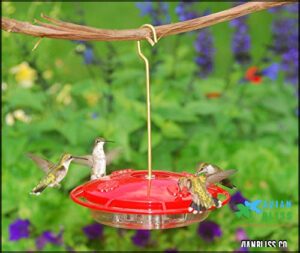
Sometimes the simplest fix is a dedicated moat built right for the job. This Hummingbird Feeder Ant Moat hangs directly above your feeder, creating a water barrier ants can’t cross.
Fill it with clean water, and you’re done — no gels, no chemicals, no mess.
It’s made from durable polycarbonate, costs under $25, and fits most standard hangers.
Just check it daily in hot weather, since evaporation can shrink that barrier fast and let ants sneak through.
| Best For | Anyone who wants to keep ants, bees, and wasps out of their hummingbird feeder without dealing with messy gels or constant maintenance. |
|---|---|
| Ant Protection | Built-in ant moat |
| Material | Polycarbonate plastic |
| Price Range | Mid ($25.96) |
| Ease of Use | Simple disassembly |
| Durability | Weather-resistant build |
| Insect Deterrence | Moat plus Nectar-Guard tips |
| Additional Features |
|
- Built-in ant moat and Nectar-Guard tips block both crawling and flying insects, so the nectar stays clean longer
- Drip- and leak-proof design holds up in sun, rain, and cold weather year-round
- Easy to take apart and clean, and the brass hanger plus polycarbonate body feel solid and built to last
- Nectar needs to be filled close to the top, or short-beaked hummingbirds may not be able to reach it
- The hanging hook can cause the feeder to tilt when full, so you might need to fiddle with the position a bit
- The decorative flowers are red instead of yellow, which a few users say slowed down initial bird attraction
Frequently Asked Questions (FAQs)
How to keep ants from ruining hummingbird feeders?
Keeping ants out starts with cutting off their access points.
Use an ant moat, fix any nectar leaks, and hang your feeder away from trees, fences, or walls they can climb.
How to prevent ants from accessing the hummingbird feeder?
Think of it as guarding a medieval castle — you control the bridges.
Use ant moats, move feeders away from walls, fix leaks, and clean trails regularly to block every route ants take.
Do ants eat hummingbirds?
No, ants don’t eat hummingbirds. They’re far too small to harm an adult bird. If anything, hummingbirds occasionally snack on ants for protein — not the other way around.
Can ants swim in a hummingbird feeder?
No, ants can’t swim. They won’t cross a water barrier to reach your feeder. That’s exactly what makes an ant moat so effective — it stops them cold.
Will hummingbirds still feed if there are ants on the feeder?
Yes, hummingbirds will usually still feed, but they may hesitate or visit less often.
Heavy ant activity can frustrate them enough to abandon a feeder entirely — which is the last thing you want.
How do I keep ants away from my hummingbird feeder?
Your best defense is a layered approach: use an ant moat, hang feeders away from trees and walls, fix any leaks, and clean regularly.
Together, these steps cut off every route ants use.
Why wrap foil around hummingbird feeder?
Wrapping aluminum foil around your feeder reflects heat, keeping nectar cooler and fresher longer.
It also creates a slippery surface ants struggle to grip, adding a simple physical barrier against invaders.
How do I keep ants away from my bird feeder?
Keep ants from "marching in" with a simple combo: hang a water moat above your feeder, fix any leaks fast, and move the feeder often to break their trail.
How do I keep ants out of a hummingbird feeder?
Hang your feeder on thin fishing line, add a water-filled ant moat above it, and fix any drips fast. Ants can’t cross water, and no spills means nothing to chase.
Why do you put aluminum foil on hummingbird feeders?
Aluminum foil reflects heat and light, which helps keep nectar cooler and deters bees and wasps.
The glare confuses pests and slows nectar spoilage, giving hummingbirds a cleaner, more peaceful feeding spot.
Conclusion
The smallest creatures can ruin the most carefully tended garden—yet they’re also the easiest to outsmart.
Keeping ants in hummingbird feeder setups away isn’t about constant battles; it’s about building a system that works quietly in the background.
Fill your moat, hang the feeder clear of climbing routes, and fix leaks before ants find them.
Do that consistently, and the hummingbirds get their nectar, the ants find food elsewhere, and you get the show.
- https://nationalzoo.si.edu/migratory-birds/hummingbird-nectar-recipe
- https://extension.missouri.edu/publications/g7392
- https://www.audubon.org/magazine/how-keep-your-hummingbird-feeder-free-pests
- https://www.pinterest.com/search/pins/?q=diy%20ant%20moat%20for%20hummingbird%20feeder&rs=rs&eq=&etslf=3581&term_meta[]=diy%20ant%20moat%20for%20hummingbird%20feeder%7Crecentsearch%7C0
- https://instars-ojs-tamu.tdl.org/instars/article/view/518