This site is supported by our readers. We may earn a commission, at no cost to you, if you purchase through links.
Step outside on a May morning in Montana, and something catches your eye before you’ve finished your coffee—a flash of orange across the lawn, a black‑and‑white blur rattling through the pines. That’s not an accident.
Montana hosts a notable mix of bird life, shaped by its grasslands, forests, wetlands, and elevation changes that few states can match.
The American Robin alone appears on 57% of summer checklists here, making it the most reliably spotted warm‑weather visitor in backyard after backyard.
Knowing which birds to expect—and what draws them in—turns every glance out the window into something worth stopping for.
Table Of Contents
- Key Takeaways
- Common Backyard Birds in Montana
- Seasonal Montana Backyard Birds
- How to Identify Montana Birds
- Attracting Birds to Montana Yards
- Montana Bird Habitats and Nesting
- Frequently Asked Questions (FAQs)
- What are the most common backyard birds in Montana?
- What birds can you see in Montana?
- How many bird species are in Montana?
- Do you see birds at feeders in Montana?
- Is Montana a good state for birding?
- What is the largest bird in Montana?
- How do I identify a bird in my backyard?
- What kind of birds are in Montana?
- What is the GREY bird in Montana?
- Which birds are found around your house?
- Conclusion
Key Takeaways
- The American Robin tops Montana’s summer bird charts, showing up on 57% of checklists, while the Black-billed Magpie dominates winter at 51%.
- A platform feeder stocked with black-oil sunflower seeds attracts nearly all of Montana’s common feeder birds and works through even the coldest months.
- Montana’s diverse habitats — grasslands, forests, wetlands, and suburban yards — support over 440 bird species, making it one of the richest birding states in the country.
- Simple additions like a shallow bird bath, native plants, and a well‑placed nest box can turn any Montana yard into a reliable year‑round stop for local and migratory birds.
Common Backyard Birds in Montana
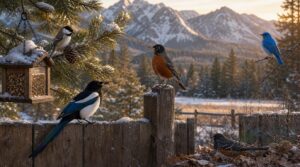
Montana’s backyards attract a surprisingly rich mix of birds, no matter where you live in the state. Some show up every single day, others drift in with the seasons. Here are five you’re most likely to spot right outside your window.
If you’re lucky enough to back up to timber or rocky slopes, Montana woodpeckers are some of the most reliable and entertaining regulars you’ll see year-round.
American Robin
Few birds announce spring’s return quite like the American Robin. You’ll spot it on 57% of Montana summer checklists — the most recorded summer species in the state.
Its brick-red chest and cheerful, whistled song make it easy to recognize on your lawn at dawn.
Robins forage for earthworms early, then shift to berries as summer fades.
both parents feed nestlings provide earthworms for rapid growth.
Black-billed Magpie
If the robin is Montana’s herald of spring, the Black-billed Magpie is its year-round showstopper. This bold corvid tops 51% of winter checklists — more than any other species. It’s hard to miss: black-and-white plumage, a tail nearly as long as its body, and iridescent blue-green wings that flash in sunlight.
- Magpies cache food in the soil for leaner days
- They forage on the ground, eating insects, carrion, seeds, and even ticks off deer
- Family groups stay together for months after nesting
Northern Flicker
Unlike the magpie’s bold black-and-white flash, the Northern Flicker wins you over quietly. Watch for its white rump patch in flight — a clean giveaway.
This woodpecker spends most of its time on the ground, probing for ants with its curved bill.
It appears on 31% of Montana summer checklists and 33% of winter checklists, making it a reliable backyard presence year-round.
House Finch
If the Flicker is Montana’s quiet regular, the House Finch is the cheerful constant at your feeder.
Males sport a bright red head and chest — the intensity varies by diet, so some look vivid, others more muted. Females are streaked brown with faint facial markings.
Both show up on 22% of summer and 27% of winter checklists.
Black-capped Chickadee
Few birds make themselves at home like the Black-capped Chickadee.
That bold black cap and bib, white cheeks, and soft gray back make it one of the easiest wins in any bird identification guide.
- Chickadee call variations signal real danger — more "dee" notes mean bigger threat
- It caches seeds in dozens of hidden spots for winter
- Nest boxes work great; add soft nesting material
- Winter foraging means hitting your suet and sunflower feeders daily
Put up a feeder in your Montana backyard, and this one won’t make you wait.
Black-capped chickadees and pine siskins show up fast—knowing which feeders attract which wild bird species helps you set up right from the start.
Seasonal Montana Backyard Birds
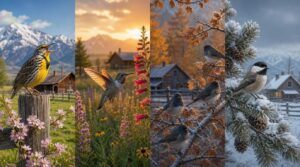
Montana’s birds don’t follow a fixed schedule — they shift with the seasons, and your backyard reflects that all year long. Some species show up only in summer, others hunker down through winter, and a few never leave at all. Here’s how the bird calendar breaks down across Montana’s seasons and elevations.
Summer Birds
Montana summers bring a wave of activity to your backyard. From May through August, American Robins dominate lawns, hunting earthworms and insects to feed nestlings. Northern Flickers probe sunny patches for ants and beetles, while House Finches sing cheerful warbles from shrubs.
| Species | Summer Behavior |
|---|---|
| American Robin | Nests by early May; raises 3–4 young |
| Northern Flicker | Excavates cavity nests in dead trees |
| Black-capped Chickadee | Feeds nestlings caterpillars and spiders |
Breeding season behaviors peak in June, so keep feeders stocked and water fresh.
Winter Birds
When winter settles over the Rockies, your backyard becomes a lifeline for birds. A few things worth knowing:
- Black-billed Magpies top winter checklists at 51%
- Suet cages deliver critical fat energy during cold snaps
- Birds fluff denser plumage to trap warmth against subzero winds
Keep feeders stocked. Dark-eyed Juncos and House Finches will reward you daily.
Year-Round Residents
Some birds don’t pack their bags when the cold hits — they simply dig in. In Montana, year-round residents like the Black-capped Chickadee and Downy Woodpecker stick around through every season.
Chickadees flock together in winter to conserve heat and cache seeds in tree crevices.
Downy Woodpeckers defend territories year-round, drumming on trees and visiting suet feeders regularly.
Migration Visitors
Every spring, your yard becomes a rest stop on one of nature’s longest journeys. Peak arrival runs April through May, when warblers, thrushes, and finches push through Montana along migration corridors linking riparian woodlands to open grasslands.
- Watch willows and cottonwoods for insect-hunting warblers
- Put out suet cages for early-spring energy boosts
- Keep bird baths filled to draw thirsty migrants
- Ornamental berry shrubs attract fruit-loving thrushes quickly
Elevation Shifts
Think of Montana’s mountains as a slow elevator — birds ride it up and down with the seasons.
As temperatures rise, upslope movement pulls species like chickadees and nuthatches into higher conifer forests. When summer fades, downslope retreat pushes them back toward your yard.
Elevation microrefugia — shaded ravines and north-facing slopes — give birds a foothold during tough transitions.
How to Identify Montana Birds
Getting good at bird ID doesn’t take years of field experience. You just need to know what to look for. A few simple clues will help you confidently name almost any bird that lands in your yard.
Size and Shape
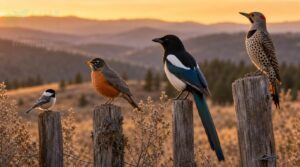
Size and shape are your fastest shortcuts to naming a bird before it flies off.
- Small sparrow-sized birds like chickadees span just 7–8 inches and show a compact, round silhouette with a large head
- Medium-sized robins have a rounded, loaf-like body with a moderately long tail
- Larger magpies stretch 14–16 inches across with a slim, elongated shape
- Northern Flickers appear upright and slender with a strong neck
Color Patterns
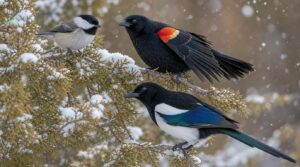
Once you know a bird’s size, color becomes your next big clue. Plumage contrast is surprisingly reliable.
A Black-capped Chickadee’s bold black cap against white cheeks pops even in a snowy yard. Red-winged Blackbirds flash a vivid red shoulder patch, you can’t miss.
Some feathers even shift hue with light—that’s iridescent feathers doing their work on Magpie wings.
Beak Shape
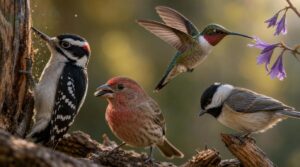
After color, beak shape seals the deal.
A woodpecker’s chisel-like bill is straight and sturdy — built to hammer into bark. A House Finch has a short, stout beak, perfect for cracking sunflower seeds.
Curved beaks suit nectar probing, while slender pointed ones pick insects from crevices.
Beak shape tells you exactly what a bird eats.
Feeding Behavior
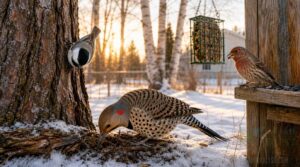
Beak shape tells you what a bird eats — behavior tells you how it hunts.
Watch where a bird feeds. Northern Flickers forage on the ground, probing for ants. Chickadees make quick, repeated hops along bark, gleaning insects. House Finches perch steadily at seed feeders, plucking with purpose.
In winter, suet and sunflower seeds draw the most action. That’s your next clue.
Songs and Calls
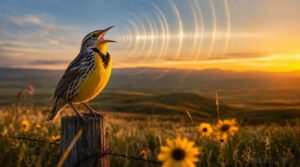
Sound is one of the sharpest identification tools you have. Birds use a specialized vocal organ called the syrinx to produce calls — and unlike your voice, it can create two tones at once. That’s why some Montana songbirds sound surprisingly rich.
Birds sing with a twin-voiced organ that lets a single throat create two tones at once
A short, sharp note usually signals an alarm call. A longer, repeating phrase? That’s a song.
Attracting Birds to Montana Yards
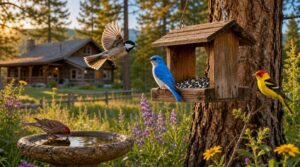
Getting birds to visit your yard doesn’t take much — just the right setup. Montana birds are creatures of habit, and once they find a reliable food source or water, they come back again and again. Here are five simple ways to make your yard their favorite stop.
Platform Feeders
A platform feeder is one of the easiest wins in backyard birding. Nearly all feeder birds in Montana — 92.5% of recorded species — will visit one.
Place it at least 4 feet from dense shrubs to limit predator cover. Cedar or recycled plastic builds last through Montana winters. A mesh floor drains moisture and keeps seed fresh longer.
Black-Oil Sunflower Seeds
If there’s one seed worth stocking in Montana, it’s black-oil sunflower seed. Birds go for it because the thin hull is easy to crack and the kernel inside packs 40–50% oil by weight — pure fuel for cold days.
- Chickadees and finches flock to it fast
- Works well in platform and tube feeders
- Stays palatable even in freezing wind
Load your feeders before winter hits.
Suet Cages
Suet cages are one of the best bird feeders you can hang in a Montana yard. Woodpeckers, chickadees, and nuthatches love them — especially when temperatures drop.
Look for cages made from rust-resistant or powder-coated steel. Bar spacing between 1/4 and 1/2 inch keeps larger birds out.
A hinged top makes refilling easy.
Clean yours monthly to keep it safe for visitors.
Bird Baths
A bird bath might be the single best upgrade for your Montana yard.
Keep the basin 1 to 2 inches deep and the water fresh — change it every one to three days in the summer. In winter, a heated bath prevents freezing.
Place it 10 to 30 feet from feeders, partly shaded, with nearby shrubs for quick cover.
Native Plants
Think of native plants as a living bird feeder that never runs empty.
Montana natives are adapted to local climate, so they thrive with little extra watering or fertilizer once established. They support the insects, seeds, and berries birds actually need — especially during nesting season.
- Native grasses and wildflowers feed insects that fuel songbirds
- Native shrubs produce berries for migrants and winter visitors
- Deep-rooted plants improve soil health and conserve moisture naturally
Montana Bird Habitats and Nesting
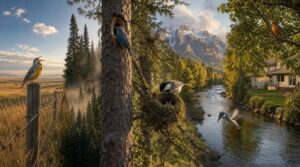
Where a bird lives shapes everything — what it eats, how it nests, and whether it’ll ever visit your yard. Montana’s landscape covers a lot of ground, from open grasslands to dense forests to suburban streets, and different birds have claimed each one.
Here’s a look at the five main habitat types and what’s nesting there.
Grasslands and Meadows
Montana’s open grasslands are some of the best bird habitat in the state. Western Meadowlark thrives here, nesting in shallow grass depressions and laying about five eggs.
Roughly 25 percent of Montana is grassland. Native grasses like bluebunch wheatgrass, alongside wildflowers, support the biodiversity these ground-nesting birds depend on.
Rotational grazing keeps that habitat healthy and intact.
Forested Backyards
A forested backyard works differently than open grassland. Mature trees and layered canopy give woodland birds nesting cavities, food sources, and year-round cover.
Leaf litter beneath the trees harbors insects that feed nestlings. In winter, dense canopy shelters birds from cold winds. Add native understory shrubs like serviceberry or chokecherry, and you’ll draw fruit-eating species through late summer.
Wetlands and Riparian Areas
Where trees give way to stream banks and marshy edges, a whole new set of birds takes over.
Riparian zones — those moist corridors along rivers and wetlands — host Red-winged Blackbirds, Common Grackles, and Brown-headed Cowbirds during the breeding season. Dense cattails and willows provide both nesting cover and rich insect habitat that keeps nestlings fed.
Urban and Suburban Yards
Your own yard might be more alive than you think.
Urban and suburban yards attract House Sparrows, European Starlings, and Eurasian Collared-Doves year-round. Small courtyard microhabitats, native shrubs, and feeders at three heights turn ordinary spaces into busy stops for backyard birding across Montana.
Nest Boxes and Cavities
A well-placed nest box can turn your yard into prime nesting territory. Cedar construction resists Montana’s wet springs and harsh winters best.
Match your entrance hole size to your target bird — 1¼ inches for chickadees, 1½ inches for Downy Woodpeckers, and 1⅝ inches for Hairy Woodpeckers.
Add ventilation holes near the top and mount boxes 5–15 feet high. Clean them out each fall.
Frequently Asked Questions (FAQs)
What are the most common backyard birds in Montana?
Montana’s backyard birds are a mixed bag year-round. American Robin tops summer checklists at 57%, while Black-capped Chickadee, House Finch, and Dark-eyed Junco stay active through winter.
What birds can you see in Montana?
Over 440 bird species call Montana home. You’ll spot familiar faces like the American Robin, Northern Flicker, Black-billed Magpie, House Finch, and Black-capped Chickadee visiting regularly throughout the year.
How many bird species are in Montana?
The state hosts over 448 bird species, with roughly 104 on a rare species review list and eight introduced by humans. That’s striking species richness for one state.
Do you see birds at feeders in Montana?
Yes, feeders attract dozens of species year-round. Chickadees, House Finches, and Northern Flickers visit regularly. In winter, Dark-eyed Juncos join them. Black-oil sunflower seeds and suet draw the widest variety.
Is Montana a good state for birding?
Think of Montana as a birding treasure chest — wide open and waiting. With over 440 species recorded statewide, year-round residents, and rich migration corridors, it genuinely rewards every level of birdwatcher.
What is the largest bird in Montana?
Montana’s largest bird is the Trumpeter Swan, weighing up to 26 pounds with a wingspan reaching 8 feet — bigger than a Bald Eagle and far outpacing the ferruginous hawk in sheer size.
How do I identify a bird in my backyard?
The devil is in the details." Start with size and shape, then check color patterns and beak type. Watch how it moves. Does it hop, peck, or hover? That narrows it down fast.
What kind of birds are in Montana?
Over 440 bird species call Montana home. That includes common favorites like the American Robin and Yellow Warbler, plus about 100 rare species. The Western Meadowlark has been the state bird since
What is the GREY bird in Montana?
Several gray birds visit Montana. The Gray Catbird hides in thickets. The Northern Mockingbird mimics other birds. The Great Gray Owl hunts silently at dusk. The Gray Partridge flushes in open fields.
Which birds are found around your house?
Your yard likely hosts American Robin, Black-capped Chickadee, House Finch, and Downy Woodpecker year-round. Dark-eyed Junco joins in winter. These local yard birds are Montana’s most reliable feeder visitors.
Conclusion
Next spring, that flash of orange across your yard will mean something more.
You’ll know it’s a robin working the soil, not just a blur.
Montana’s backyard birds of Montana reward patient watchers—the chickadee that finds your feeder first, the flicker that claims the old pine.
Put out the right food, add a water source, plant something native.
The birds will come.
And once you start noticing them, you won’t stop.
- https://southeastmontana.com/blog/eye-on-the-sky-birding-in-southeast-montana
- https://abcbirds.org/news/common-backyard-birds
- https://kempkerstruevalue.com/winter-tips-for-feeding-backyard-birds
- https://birdsandbeasleys.com/blogs/resources/backyard-birding-in-montana
- https://dansbirdbites.com/how-to-attract-26-montana-birds-to-your-feeders