This site is supported by our readers. We may earn a commission, at no cost to you, if you purchase through links.
Most people don’t realize Florida hosts eleven hummingbird species—ten more than the single one that actually breeds here.
The Ruby-throated Hummingbird stakes out gardens and woodland edges each spring, building walnut-sized nests from spider silk while beating its wings 80 times per second.
That impressive biology makes it Florida’s permanent resident, while species like the Rufous, Buff-bellied, and Black-chinned drift in during winter months, drawn by mild temperatures and coastal flowers.
Which species appears when—and what draws them to your yard—turns a fleeting flash of iridescent color into something you can reliably watch, identify, and attract season after season.
Table Of Contents
- Key Takeaways
- 11 Hummingbirds Found in Florida
- Ruby-throated Hummingbird: Florida’s Only Breeding Resident
- Black-chinned Hummingbird: Uncommon Winter Visitor
- Buff-bellied Hummingbird: Seasonal Gulf Coast Visitor
- Rufous Hummingbird: Aggressive Winter Migrant
- Anna’s Hummingbird: Rare Accidental Visitor
- Allen’s Hummingbird: Rare Winter Record
- Broad-tailed Hummingbird: Uncommon Western Vagrant
- Broad-billed Hummingbird: Rare Florida Visitor
- Calliope Hummingbird: Tiny Accidental Migrant
- Costa’s Hummingbird: Rare Non-breeding Visitor
- White-eared Hummingbird and Bahama Woodstar Records
- How to Identify Florida Hummingbirds
- Florida Hummingbird Seasons and Habitats
- Attracting Hummingbirds in Florida Yards
- Top 4 Florida Hummingbird Items
- Frequently Asked Questions (FAQs)
- How many types of hummingbirds are there in Florida?
- What hummingbirds live in Florida?
- When do hummingbirds come to Florida?
- How big is a hummingbird in Florida?
- How many types of hummingbirds are in Florida?
- What does it mean when a hummingbird hovers in front of your window?
- What month are hummingbirds in Florida?
- How do I attract hummingbirds to my feeder in Florida?
- Do hummingbirds stay in Florida all year round?
- When do hummingbirds return to Central Florida?
- Conclusion
Key Takeaways
- Florida hosts 11 documented hummingbird species, but only the Ruby-throated breed here — the other ten show up as seasonal visitors, winter wanderers, or rare storm‑blown strays.
- Knowing each species’ arrival window matters: Ruby-throated return in late February, Rufous and Buff‑bellied settle in during winter, and rare vagrants like Allen’s or Calliope can drift through almost any time.
- You can reliably attract hummingbirds by planting tubular native flowers like coral honeysuckle and scarlet sage, keeping feeders filled with a clean 1:4 sugar‑to‑water mix, and skipping red dye and honey entirely.
- Three field marks — throat color, bill shape, and tail pattern — cut through most identification confusion, especially when telling look‑alikes like Rufous and Allen’s apart at a busy feeder.
11 Hummingbirds Found in Florida
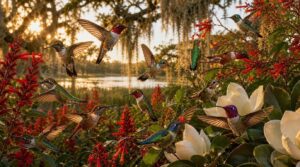
Florida has documented eleven hummingbird species, though your chances of spotting most of them are slim — only one actually calls the state home year-round. The rest are seasonal travelers or rare strays that show up just long enough to cause a stir on birding forums.
Florida’s bird diversity runs deeper than most people expect — much like the surprising range of pink birds that permanently reside in Florida.
Here’s a closer look at each species you might encounter.
Ruby-throated Hummingbird: Florida’s Only Breeding Resident
Of all the Florida hummingbird species, the Ruby-throated Hummingbird is the only one that actually breeds here.
Males arrive in March, launching into impressive territorial display flights to win mates.
Females handle nesting solo, weaving cups of spider silk in suburban gardens and woodland edges — classic nesting habitat preference.
Eggs incubate roughly two weeks, with juveniles fledging about three weeks after hatching.
Their rapid wingbeat frequency up to 80 beats per second enables agile hovering.
Black-chinned Hummingbird: Uncommon Winter Visitor
Unlike the Ruby-throated, the Black-chinned Hummingbird is a rare visitor — showing up in winter across Florida’s Gulf Coast counties, never to breed.
Males display a black chin with an iridescent purple gorget, while females blend in with pale, unmarked underparts.
Watch for them in:
- Sheltered garden edges as their preferred Winter Microhabitat
- Suburban yards with flowering shrubs for Feeder Attraction
- Scattered coastal counties, reflecting Irregular Migration patterns
- Greenish upperparts and slight bill curve for Florida hummingbird species identification
Buff-bellied Hummingbird: Seasonal Gulf Coast Visitor
Another seasonal guest worth knowing is the Buff-bellied Hummingbird, a Gulf Coast wanderer that drifts into Florida mainly during winter and migration. Its Spring Arrival Window usually aligns with coastal flowering peaks.
The buffy belly, iridescent blue-green throat, and notable Bill Length Variation make it recognizable at Urban Feeder Usage hotspots.
Seasonal migration patterns bring it irregularly to western Panhandle gardens — so keep your feeders fresh.
Rufous Hummingbird: Aggressive Winter Migrant
The Rufous Hummingbird brings a different energy to your yard. Despite weighing barely 3 grams, this copper‑orange winter migrant earns a reputation for fierce Territorial Feeder Defense — chasing off larger species with rapid aerial dives and sharp alarm calls.
At barely 3 grams, the Rufous Hummingbird fiercely defends feeders, diving at birds far larger than itself
Its Winter Aggression reshapes Nectar Competition at feeders during Florida’s cooler months. Migration Stopover Sites along the coast see the highest activity between December and March.
Anna’s Hummingbird: Rare Accidental Visitor
Spotting an Anna’s Hummingbird in Florida feels like catching lightning in a bottle. This rare accidental visitor wanders far from its Pacific Coast home, often pushed east by migration anomalies.
Males flash a vivid rose-pink gorget; females show duller plumage cues.
Urban feeder draws, and flowering shrubs tend to concentrate sightings.
If you find one, reporting sightings to local birding groups helps valuable conservation actions and confirms rare identification tips.
Allen’s Hummingbird: Rare Winter Record
Allen’s Hummingbird ranks among Florida’s rarest winter records, with most confirmed sightings tied to coastal habitat anomalies and unusual winter weather patterns pushing birds far from their normal California or Mexican wintering grounds.
Males display a coppery gorget and metallic green back — gorget color photography is essential here, since misidentification risks with Rufous Hummingbirds are real.
Follow observer reporting protocols and share your find with local birding groups.
Broad-tailed Hummingbird: Uncommon Western Vagrant
The Broad-tailed Hummingbird is an uncommon western vagrant in Florida, with rare observation records tied mostly to storm-driven dispersal during autumn migration windows. Vagrant arrival patterns cluster between late September and November, when wayward birds push east of their normal western range shift. Photographic documentation tips are essential here — snap clear shots of the rose-red gorget, white eye-ring, and rounded tail.
Key field notes for this rare visitor:
- Rose-red gorget visible in good light
- Green back with pale underparts
- Rounded tail shape, not forked
- Narrow, pointed bill
- Urban feeders and coastal scrub attract wandering individuals
Broad-billed Hummingbird: Rare Florida Visitor
Few hummingbirds test a Florida birdwatcher’s patience quite like the Broad-billed Hummingbird — a genuinely rare visitor with only a handful of credible state records. Vagrant patterns suggest late fall or winter arrivals, often near riparian foraging edges. Its bill morphology sets it apart: longer and more curved than most local species. Photo documentation is essential.
| Feature | Broad-billed Hummingbird | Ruby-throated Hummingbird |
|---|---|---|
| Bill shape | Long, curved | Short, straight |
| Throat color | Red-coral (male) | Ruby-red (male) |
| Florida status | Rare visitor | Breeding resident |
Calliope Hummingbird: Tiny Accidental Migrant
The Calliope Hummingbird holds a unique distinction — it’s the smallest bird that breeds in the U.S. and Canada, measuring just 3 inches long.
As a rare accidental hummingbird visitor in Florida, it drifts far outside its western range during seasonal migration patterns.
Watch for these field marks:
- Magenta gorget details — males show streaked magenta on a white throat
- Bill morphology adaptation — slender bill, long relative to head size
- Microhabitat usage — favors scrub edges and garden corridors briefly
- Observer documentation tips — photograph the gorget and note body size carefully
Costa’s Hummingbird: Rare Non-breeding Visitor
Costa’s Hummingbird barely shows up on Florida’s radar — and that’s what makes spotting one so memorable.
This compact desert species appears during late winter as a rare, accidental visitor, driven by climate-driven vagrancy rather than fixed routes. Males display muted throat plumage in violet-purple, subtler than you’d expect. Most sightings cluster in suburban riparian habitat near flowering gardens.
| Feature | Costa’s Hummingbird | Ruby-throated Hummingbird |
|---|---|---|
| Throat Color | Muted violet-purple | Vivid ruby-red |
| Bill Shape | Short, slightly decurved | Straight, slender |
| Florida Status | Rare non-breeding visitor | Year-round resident |
Document any sighting — citizen science reporting of vagrant migration patterns helps track how attracting hummingbirds to backyard gardens may be expanding Costa’s occasional Florida presence.
White-eared Hummingbird and Bahama Woodstar Records
Two more names round out Florida’s list: the White-eared Hummingbird and Bahama Woodstar. Both are extreme vagrants — no breeding, no established pattern. Winter wind influence likely nudges these birds off course.
If you spot either, photographic evidence tips the scales toward acceptance during regional checklist updates.
Record verification protocols apply strictly here, and conservation priority assessment remains ongoing as documentation accumulates.
How to Identify Florida Hummingbirds
Telling Florida hummingbirds apart can feel tricky at first, especially when a small green blur zips past your feeder in half a second.
But once you know what to look for — throat color, bill shape, tail markings, body size — the differences become surprisingly clear.
Here’s a closer look at the key features that’ll help you identify each species with confidence.
Male Ruby-throated Hummingbird Identification
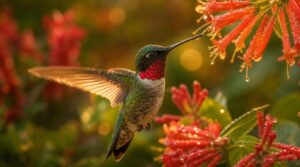
When a flash of ruby catches your eye at the feeder, you’re likely watching Florida’s most reliable species. The male Ruby-throated Hummingbird carries a vivid iridescent gorget that shifts from black to vivid red depending on light angle.
Notice the Facial Mask Contrast between his dark face and metallic green crown — that combination is diagnostic.
His territorial Perch Behavior signals ownership, while steep courtship displays and notable Wingbeat Frequency confirm the species instantly.
Female and Juvenile Ruby-throated Features
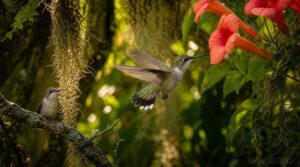
Unlike the male’s obvious ruby flash, females and juveniles are quieter and take a closer look to read. For birdwatchers building a species identification guide for Florida hummingbird species, these five field marks help:
- Facial Markings — dusky eye line, pale cheek stripe
- Wing Coloration — metallic green with bronze tones
- Tail Markings — white-tipped outer feathers
- Juvenile Size — roughly 3.5–3.75 inches
- Nesting Behavior — females stay close to cover
The Ruby-throated Hummingbird female’s white throat and subtle gorget make her blend right into Florida’s green canopy.
Black-chinned Versus Ruby-throated Hummingbirds
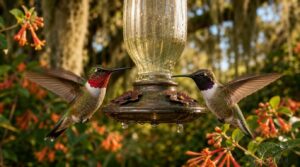
Side by side at a Florida feeder, the Black-chinned Hummingbird and Ruby-throated Hummingbird look deceptively similar.
Color iridescence is your best clue — the Ruby-throated male blazes red in sunlight, while the Black-chinned shows a dark chin with a subtle purple band.
Bill proportions, flight patterns, territorial displays, and vocal calls also differ subtly, helping you tell them apart when attracting hummingbirds to backyard gardens during migration.
Rufous and Allen’s Hummingbird Differences
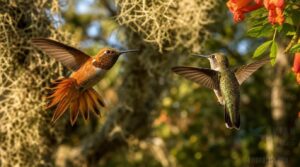
Spotting a Rufous Hummingbird versus an Allen’s Hummingbird in Florida takes a sharp eye. Both are rare winter visitors, but their differences are real.
Key field markers include:
- Plumage Contrast — Rufous shows a warm copper-orange back; Allen’s is greener.
- Tail Forking — Rufous males carry a longer, deeply forked tail.
- Aggressive Behavior — Rufous dominates feeders; Allen’s tolerates company.
- Bill Length — Rufous bills run slightly longer on average.
Bill Shape, Throat Color, and Tail Markings
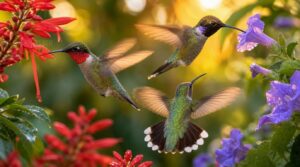
Three field markers cut through the confusion fast. Bill Length Variation separates probers from generalists — Ruby-throated Hummingbird bills are slim and straight, while Black-chinned Hummingbird bills curve subtly at the tip.
Gorget Color Shifts with light angle, so Sexual Dimorphism Cues matter most in direct sun.
Tail Edge Patterns clinch it: Broad-tailed Hummingbird outer feathers show bold white fringing.
Your species identification sharpens when Nectar Source Matching guides where you look.
Size and Weight Clues for Identification
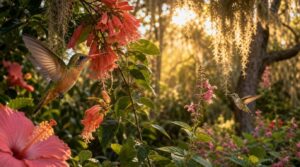
Size gives you a solid head start on species identification. The Buff-bellied Hummingbird, stretching 3.75–4.75 inches and weighing up to 5.5 grams, noticeably dwarfs the compact Calliope at just 2.4–3.3 grams.
Length Range Indicators and Mass Comparison Charts help reveal hummingbird species diversity in Florida at a glance — even before you spot throat color or tail markings.
Common Look-alikes at Florida Feeders
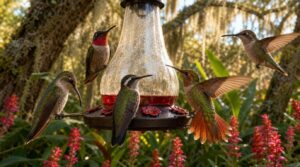
At a busy feeder, telling species apart can feel like a puzzle. Focus on these five clues:
- Throat Color Clues — Ruby-throated shows vivid red; Black-chinned reveals a violet band at the base.
- Bill Shape Differences — Black-chinned’s bill curves slightly; Costa’s tilts upward.
- Back Color Variations — Rufous displays copper-orange; Ruby-throated stays metallic green.
- Eyebrow Markings — Anna’s carries a pale white eyebrow stripe.
- Seasonal Plumage Shifts — Buff-bellied and Broad-tailed look duller outside peak season.
Florida Hummingbird Seasons and Habitats
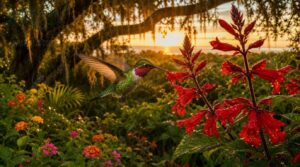
Florida’s hummingbirds don’t all follow the same schedule, and knowing when and where to look makes all the difference. The state’s varied habitats — from coastal scrub to suburban gardens — each draw different species at different times of year.
seasons and settings that shape Florida’s hummingbird activity.
When Ruby-throated Hummingbirds Arrive in Florida
The Ruby-throated Hummingbird’s return to Florida follows a Temperature Triggered Arrival pattern that rewards patient observers. Gulf Coast Firsts usually appear in late February, while Central Florida sees its March Migration Pulse from early to mid-March.
Southern Florida Early sightings hint at warming trends. Pattern Variability is real — weather shifts the window by days — so keep your hummingbird feeder ready before you expect them.
Spring and Fall Migration Timing
Spring migration runs February through March, with Arrival Peaks along Florida’s Gulf Corridor in late February and a broader pulse through central areas by early March. Temperature Shifts and wind patterns can nudge these Departure Windows by several days.
Fall migration centers on August through October — watch coastal stopover sites, especially in October, when migrating traffic along Hummingbird migration routes in North America peaks noticeably.
Winter Hummingbirds in Northwestern Florida
Once fall migration winds down, the story doesn’t end — it shifts.
Northwestern Florida quietly becomes a winter refuge, where Rufous and Buff-bellied hummingbirds settle near coastal gardens from December through February.
Vagrant patterns bring occasional Black-chinned and Costa’s visitors during cold snaps, and community monitoring has confirmed night roosting near sheltered nectar sources.
Nectar phenology tied to native Florida plants keeps seasonal abundance of hummingbirds surprisingly steady through winter.
Tampa Bay Hummingbird Observation Hotspots
The Tampa Bay region draws the highest concentration of hummingbird observations in Florida, and a handful of spots stand out.
Lettuce Lake platforms offer shaded boardwalk views near nectar feeders and native Florida plants during spring migration.
Fort De Soto, Circle B Bar, Cypress Point, and Riverhills Park round out a solid birdwatching circuit, each offering consistent seasonal abundance through well-timed morning visits.
Coastal Woodlands, Gardens, Scrub, and Parks
Beyond those hotspot parks, hummingbirds use a surprisingly wide range of Florida habitats. Coastal areas with pine flatwoods and scrub support arid‑adapted visitors, while native shrub plantings and pollinator corridor design turn ordinary gardens into reliable stops. State parks practicing fire regime management and invasive plant control keep habitats open.
Add water feature integration near nectar feeders, and you’re offering something most yards can’t match.
Gulf Migration Routes and Stopover Habitats
Ruby-throated Hummingbirds follow well-documented bird migration patterns across the Gulf of Mexico, sometimes flying 500 miles nonstop.
Seasonal migration patterns of hummingbirds in Florida peak March–May and August–October, shaped by wind-driven crossing conditions and seasonal stopover timing.
Top migration stopover sites along Florida’s Gulf shore include:
- Barrier Island Refuges with dune scrub and coastal pines
- Coastal Marsh Refueling zones rich in insects and nectar
- Breton National Wildlife Refuge complexes
- Tampa Bay’s restored shorelines
- Habitat Restoration Priorities areas connecting inland corridors
How Weather Affects Hummingbird Sightings
Weather shapes your hummingbird sightings more than you might expect. Temperature-driven migration pulls Ruby-throated Hummingbirds north in early spring, while wind-assisted flight along Gulf fronts steers rare and accidental visitors toward Florida’s coast.
Rainfall nectar availability spikes after storms, but drought feeder reliance concentrates birds at your yard.
| Weather Event | Effect on Birds | What You’ll Notice |
|---|---|---|
| Warm front | Early bloom, migration push | Increased feeder visits |
| Storm front | Storm-induced perch shifts | Birds clustering in shelter |
| Drought | Reduced nectar, feeder reliance | Longer feeder stays |
Attracting Hummingbirds in Florida Yards
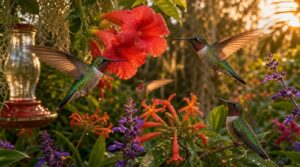
Getting hummingbirds to visit your yard is more straightforward than most people think. A few smart choices — from the right flowers to a clean feeder — can make your garden a reliable stop on their route.
Here’s what actually works.
Best Native Nectar Flowers for Florida Gardens
Native Florida plants for hummingbirds work harder than most gardeners expect.
Coreopsis nectar draws visits from early spring through fall, while Spotted Bee Balm and Blue Mistflower appeal to hummingbirds with tubular blooms that match their nectar feeding behavior perfectly.
Add Trumpetbush bloom for summer coverage, and Goldenrod late-season color — together, these native plant species for pollinators keep your garden active for months.
Hibiscus, Salvia, Trumpet Vine, and Coral Honeysuckle
Four plants punch well above their weight for attracting hummingbirds to Florida gardens.
Scarlet sage salvia coccinea offers impressive nectar yield from late winter through fall, thriving in full sun with minimal care.
Hibiscus blooms peak in hot months, while trumpet vine climbs trellises in summer.
Coral honeysuckle, a native Florida vine, adds bloom timing from spring onward and produces winter berries, birds rely on.
Safe Sugar-water Feeder Ratio
The right mix matters more than you’d think. For any sugar water feeder, stick to the Ideal Dilution Ratio: 1 part white granulated sugar to 4 parts water — that’s 20% concentration, closely matching natural flower nectar.
Three practices that protect your birds:
- Seasonal Sugar Adjustments — keep the 1:4 ratio year-round; Florida’s heat makes Nectar Fermentation Prevention critical, so refresh every 3–5 days.
- Feeder Temperature Management — place nectar feeders in shaded spots to slow spoilage and maintain consistent flow.
- Batch Labeling Practices — date your prepared syrup and refrigerate extras; discard anything cloudy or sour-smelling immediately.
Why to Avoid Red Dye and Honey
Skip the red dye — it does nothing useful. Your hummingbird feeder doesn’t need colored water to attract birds; the feeder itself does that job.
Red dye can cause digestive irritation, mask fermentation in your sugar water feeder, and disrupt normal feeding behavior. Honey is equally risky, fermenting fast and inviting insect contamination.
| Additive | Why to Avoid |
|---|---|
| Red dye | Fermentation masking, digestive irritation |
| Honey | Rapid fermentation, unnatural additives |
How Often to Clean Hummingbird Feeders
Florida’s heat turns a sugar water feeder into a science experiment — fast.
cleaning schedule should match the season: every 2–3 days in summer, weekly in cooler months.
Watch for cloudy nectar or a sour smell — those are your mold detection cues.
consistent feeder maintenance keeps Florida hummingbirds healthy and coming back.
Don’t skip it.
Providing Perches, Water, and Nesting Cover
Beyond feeders, your yard’s structure matters just as much.
Offer perch diameter variety — thin dowels or live branches ranging 0.5 to 1 inch — so small hummingbird feet get a comfortable grip.
Shallow water baths, just 1–2 inches deep, placed in seasonal water placement spots with dappled shade, keep birds refreshed.
Native nesting shrubs like wax myrtle provide nesting materials and habitat conservation, your yard genuinely needs.
Avoiding Pesticides to Protect Insect Food Sources
Pesticides quietly strip away the insects hummingbirds depend on just as much as nectar. Targeted spray timing and biological pest control — like introducing lady beetles — keep your garden’s food web intact.
Pollinator-friendly planting and habitat layering create natural pesticide-free zones that support insect prey for hummingbirds year-round, directly benefiting insect diet of hummingbirds and broader conservation of hummingbird habitats in Florida.
Top 4 Florida Hummingbird Items
Getting the right gear makes a real difference when you’re trying to attract hummingbirds to your yard. Whether you’re just starting out or fine-tuning your setup, a few well-chosen items go a long way.
Here are four products worth having on hand.
1. Complete Hummingbird Identification Guide
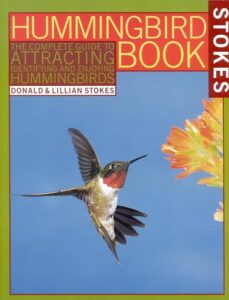
If you’re serious about identifying every species you spot in your Florida yard, this paperback guide from Little, Brown and Company is worth keeping close.
At just $10.09, it delivers full-color photographs, range maps, and detailed behavior notes covering North American hummingbirds — plus a bonus chapter on orioles. You’ll find feeder setup advice, sugar solution ratios, and even photography tips.
At 89 pages, it’s compact but genuinely useful, especially for sorting out tricky look-alikes like Rufous versus Allen’s at your feeder.
| Best For | Backyard birders in North America who want a simple, visual guide to identifying hummingbirds and setting up feeders the right way. |
|---|---|
| Primary Purpose | Species identification guide |
| Hummingbird Focused | Yes |
| Format | Paperback book |
| Insect Consideration | Not applicable |
| Ease of Use | Beginner-friendly guide |
| Durability | Prone to field wear |
| Additional Features |
|
- Full-color photos and range maps make species ID genuinely easy, even for beginners
- Covers the practical stuff too — feeders, sugar ratios, plant choices, and feeder hygiene
- Bonus oriole chapter gives you more bang for your $10
- Published in 1989, so some advice on feeders or nutrition may be out of date
- Only 89 pages, so don’t expect deep dives into advanced topics
- No digital version, which makes quick field lookups a bit of a hassle
2. Pink Turks Cap Hibiscus Seeds
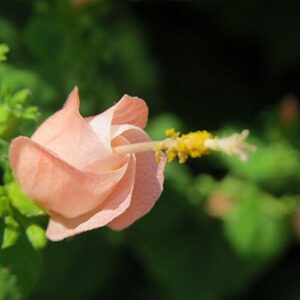
Want to go straight to the source? These Pink Turk’s Cap Hibiscus seeds from SVI give you 20 seeds per packet — enough to establish a reliable nectar patch that Ruby-throated Hummingbirds won’t ignore.
The tubular pink blooms are exactly the flower shape that hummingbirds seek out.
Plants tolerate full sun to partial shade and can reach 6–10 feet tall at maturity.
Seeds germinate within 7–21 days at 75–85°F, so starting them indoors before warm weather arrives gives you a solid head start.
| Best For | Gardeners who want to attract hummingbirds and don’t mind doing a little research to get their seeds started right. |
|---|---|
| Primary Purpose | Hummingbird garden plant |
| Hummingbird Focused | Yes |
| Format | Seed packet |
| Insect Consideration | Not applicable |
| Ease of Use | No instructions included |
| Durability | Minimal shipping protection |
| Additional Features |
|
- The tubular pink blooms are basically a hummingbird magnet — great natural nectar source
- Works in full sun or partial shade, so placement isn’t too fussy
- 20 seeds per packet gives you enough to fill out a nice garden patch
- Seeds come unlabeled, so you’ll need to keep track of what you planted yourself
- No planting instructions included — you’re on your own to figure out germination
- The cellophane-only packaging is pretty minimal and doesn’t offer much protection in transit
3. Perky Pet Window Mount Hummingbird Feeder
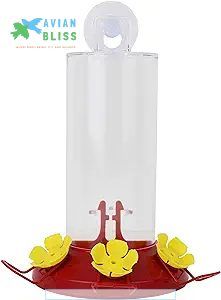
The Perky-Pet Window Hummingbird Feeder brings the action right to your glass — literally inches away. It mounts via suction cup or hangs from a nail, and its 8-oz reservoir stays manageable enough to keep nectar fresh between fills.
Three hollyhock-shaped ports with built-in perches let multiple birds feed comfortably, while the tapered openings deter bees.
Quick-release clips mean cleaning takes minutes, not a whole afternoon.
For close-up observation of Ruby-throated or winter Rufous hummingbirds, this feeder earns its spot.
| Best For | Anyone who wants hummingbirds up close — great for families, kids, or anyone who just wants to watch from the couch without stepping outside. |
|---|---|
| Primary Purpose | Window hummingbird feeder |
| Hummingbird Focused | Yes |
| Format | Plastic feeder |
| Insect Consideration | Bee-resistant ports |
| Ease of Use | Tool-free disassembly |
| Durability | UV-sensitive plastic |
| Additional Features |
|
- Mounts right on your window with a suction cup, so you get a front-row seat without going outdoors.
- Tapered ports keep bees out, which means less mess and fresher nectar for longer.
- Quick-release clips make cleaning and refilling genuinely fast and painless.
- The 8-oz reservoir is small — if you get a lot of visitors, you’ll be refilling it pretty often.
- The plastic clips can get brittle over time, especially with repeated use or sun exposure.
- Prolonged UV exposure can fade or crack the feeder, so you’ll want to bring it in during the off-season.
4. First Nature Hummingbird Flower Feeder
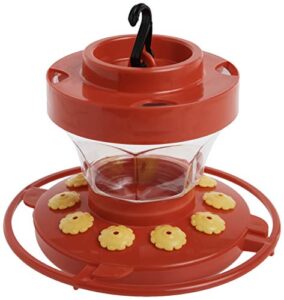
If you’re hosting multiple birds at once, the First Nature Hummingbird Flower Feeder accommodates the crowd well. Its 32-ounce reservoir and 10 feeding ports let several Ruby‑throated or wintering Rufous hummingbirds feed side by side without territorial squabbling.
The wide-mouth jar fills without spills, and the two‑part base separates cleanly for a quick scrub. Yellow flower accents help deter bees naturally.
At a practical size and straightforward design, it’s a reliable station for any Florida backyard during peak migration season.
| Best For | Backyard bird lovers who want to feed multiple hummingbirds at once without a lot of fuss. |
|---|---|
| Primary Purpose | Hanging hummingbird feeder |
| Hummingbird Focused | Yes |
| Format | Plastic feeder |
| Insect Consideration | Ant-guard moat |
| Ease of Use | No tools required |
| Durability | Multi-year lifespan reported |
| Additional Features |
|
- The wide-mouth reservoir and two-part base make filling and cleaning genuinely easy — no tools, no hassle.
- Built-in ant-guard moat helps keep insects out, so your nectar stays fresh longer.
- The perch rail lets several hummingbirds feed side by side, which cuts down on the usual territorial drama.
- The plastic can cloud up over time, making it tricky to tell when the nectar needs changing.
- The ant-guard moat dries out fast in hot weather, so you’ll need to top it off regularly.
- The plastic hook feels a bit flimsy — a lot of users swap it out for a sturdier cord.
Frequently Asked Questions (FAQs)
How many types of hummingbirds are there in Florida?
Florida has documented 11 hummingbird species, ranging from the Ruby-throated — the only year-round breeding resident — to rare vagrants like the Calliope and Bahama Woodstar that drift in during migration or after storms.
What hummingbirds live in Florida?
Eleven hummingbird species have been documented in Florida. The Ruby-throated Hummingbird is the only one that breeds here, while ten others appear as seasonal visitors, migrants, or rare accidentals.
When do hummingbirds come to Florida?
Ruby-throated hummingbirds usually arrive in late February to early March. Peak migration runs through April, and by May, most have settled into breeding territories or moved on.
How big is a hummingbird in Florida?
Picture a bird barely larger than your thumb. Florida hummingbirds measure around 3 to 5 inches long and weigh just 2 to 4 grams — small enough to perch on a pencil.
How many types of hummingbirds are in Florida?
Eleven hummingbird species have been documented in Florida. Only one — the Ruby-throated — actually breeds here. The rest are seasonal visitors or rare accidentals blown off course during migration.
What does it mean when a hummingbird hovers in front of your window?
A hovering hummingbird at your window is usually drawn by curiosity — it spots a bright color, a flower reflection, or your feeder nearby. It’s simply investigating a potential nectar source.
What month are hummingbirds in Florida?
Hummingbirds visit Florida nearly year-round. Ruby-throated arrivals begin in late February, peak through March and April, and taper off by September.
Winter species like Rufous appear December through March in the northwest.
How do I attract hummingbirds to my feeder in Florida?
Start with a 4-to-1 water-to-sugar mix, hang your feeder 4–6 feet high in morning sun, and clean it every one to two days — Florida’s heat spoils nectar fast.
Do hummingbirds stay in Florida all year round?
Yes, but not all of them. Ruby-throated Hummingbirds are Florida’s year-round anchors, while Rufous and Black-chinned species drop in during winter before heading back north by early spring.
When do hummingbirds return to Central Florida?
Ruby-throated hummingbirds usually return to Central Florida from late February through early March, with males arriving first to claim territory. Expect peak activity by April as more birds settle in.
Conclusion
Florida’s hummingbirds of florida don’t announce themselves—they arrive quietly, a flash of iridescence between salvia blooms, gone before you’ve fully registered the wings.
But understanding which species move through your region, and when, transforms those brief visits into reliable encounters.
Plant the right natives, keep your feeder clean, and stay patient during migration windows.
The birds are already making their way. You’re simply learning to be ready when they do.
- https://www.floridamuseum.ufl.edu/earth-systems/blog/tell-me-about-bird-plumage/
- https://www.allaboutbirds.org/guide/Ruby-throated_Hummingbird?utm_source=openai
- https://www.audubon.org/news/125th-christmas-bird-count-florida?utm_source=openai
- https://www.youtube.com/watch?v=abP9L9WAHIY
- https://pmc.ncbi.nlm.nih.gov/articles/PMC8455173/