This site is supported by our readers. We may earn a commission, at no cost to you, if you purchase through links.
A hunting barn owl can drop onto a mouse hidden under a foot of snow, guided by sound alone. Its ears sit at slightly different heights on its skull, letting it triangulate a rustle in total darkness with startling accuracy. That heart-shaped face isn’t just distinctive—it funnels sound like a satellite dish.
You’ll find this ghostly hunter on six continents, tucked into barn rafters and church steeples instead of forest canopies. Farmers have quietly relied on them for centuries to keep rodent populations in check.
From wingspan to breeding habits, understanding the barn owl reveals just how finely evolution can tune a predator.
Table Of Contents
- Key Takeaways
- What is a Barn Owl?
- Barn Owl Physical Characteristics
- Barn Owl Habitat and Range
- Barn Owl Diet and Hunting
- Barn Owl Breeding and Conservation
- Frequently Asked Questions (FAQs)
- Why isn’t a barn owl a true owl?
- What is special about a barn owl?
- Is it good to see a barn owl?
- Is it rare to see a Barn Owl?
- Where do barn owls live in the US?
- Are barn owls good or bad?
- Why isn’t a Barn Owl a true owl?
- Can barn owls see in complete darkness?
- How long do barn owls live in the wild?
- Are barn owls known to be aggressive birds?
- Conclusion
Key Takeaways
- Barn owls use their heart-shaped facial disc and asymmetrical ears to pinpoint prey by sound in complete darkness, making them highly effective nocturnal hunters.
- You’ll find barn owls on nearly every continent, favoring open fields, grasslands, and human structures like barns and church steeples for nesting and hunting.
- Their diet centers on small mammals such as voles and mice, with silent flight adaptations allowing them to approach prey undetected and maintain natural pest control.
- Habitat loss, agricultural fragmentation, and pesticide exposure threaten barn owl populations, but nest box conservation helps restore breeding sites and support their survival.
What is a Barn Owl?
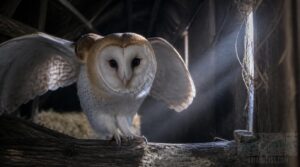
You’ve probably seen a barn owl’s ghostly white shape without knowing what you were actually looking at. This bird carries a specific name, a family history, and traits that set it apart from every other owl you might confuse it with. Here’s what makes it a species of its own.
That heart-shaped face isn’t just striking to look at—it acts like a satellite dish, funneling sound to help this owl hunt in total darkness, a trait shared by other night birds in Virginia.
Scientific Name and Classification
Tyto alba is the binomial name behind every barn owl you’ll encounter, whether in British Columbia or the African bush. It sits in genus Tyto, family Tytonidae—distinct from Strigidae’s "true owls"—within order Strigiformes.
That heart-shaped face? It’s the giveaway trait linking related Tyto species across the clade, all bound by Linnaean rules and standardized naming conventions biologists rely on globally. This classification helps organize the biological diversity found across the planet.
Common Names
Field guides may open with Tyto alba, but you’ll hear this bird called plenty else. Farmers gave it "barn owl" for obvious reasons—those grain-store nests. Others call it:
- Ghost owl, for its silent, pale flight
- White owl, describing bright plumage
- Harvest owl, tied to autumn folklore
Regional names vary widely, so always cross-check against misidentification risks before confirming species.
Key Bird Family Traits
Nicknames aside, Tyto alba still belongs to the broader bird world, sharing traits like a beakless jaw, feathered insulation, and a unique respiratory system with air sacs for efficient oxygen flow.
Its syrinx produces those eerie shrieks, while high metabolic demands fuel nighttime hunts. These shared traits in avian biology and bird taxonomy set the stage for comparing barn owls to their nocturnal cousins.
Barn Owl Vs. Other Owls
Line up a barn owl beside a Great Horned Owl and the differences jump out fast. That heart-shaped facial disc versus a rounder one isn’t cosmetic—it shapes how each hunts by sound.
- Screech vs. hoot vocalizations
- Open fields vs. forest cover
- Rodent-focused vs. varied prey
- Long, rounded wings vs. broader ones
- Ghostly pale face vs. mottled camouflage
These distinctions matter for quick identification among raptors.
Barn Owl Physical Characteristics
You’ll notice a barn owl before you hear it, and once you see one up close, its build tells you exactly how it survives. Every feature, from its wing shape to that unmistakable face, has a specific purpose in the field. Here’s what to look for.
Size and Weight
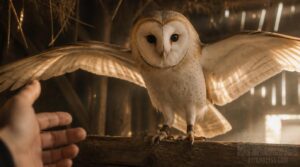
Don’t let those big eyes fool you—barn owls run surprisingly light for their frame, with body length spanning 32 to 40 centimeters but weight only 400 to 700 grams.
That lightweight build helps explain why, pound for pound, Michigan’s large bird species rankings often favor wingspan over raw body mass.
Sexual dimorphism shows clearly here: females average 570 grams versus 470 for males, since egg production demands extra mass.
Prey abundance and season shift these numbers too, meaning your local owl’s weight often reflects regional hunting conditions.
Wingspan and Body Shape
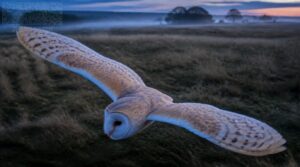
Stretch a barn owl’s wings tip to tip and you’ll measure somewhere between 107 and 110 centimeters—broad and rounded wings built for open-country cruising, not speed.
That morphology favors low wing loading efficiency over raw velocity: think maneuverability, not sprinting.
- Rounded tips for control
- Broad surface for lift generation mechanics
- Short tails for tight turns
This shape trades speed for aerodynamic stealth, letting them drift silently above fields.
Heart-Shaped Face
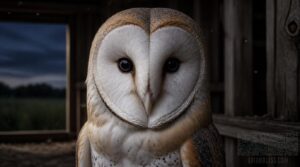
A whitish, concave disc dominates the barn owl’s face, and it isn’t decorative. This facial disc funnels sound toward asymmetrical ear openings, sharpening prey location to within 1–3 degrees.
Facial proportions matter here: a broad upper area tapers toward the beak, echoing the same silhouette definition prized in human cheekbone prominence and jawline tapering discussions—function first, aesthetic styling second, in true ornithology fashion.
Plumage Colors
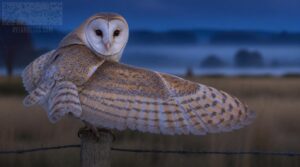
Buff and gray dominate the upperparts, thanks to melanin-based pigments producing those browns and grays, while facial discs stay pale and creamy for camouflage. Carotenoids add subtle warmth to wing edges.
Dorsal tones can shift with geography and age—rural birds often run warmer than urban ones. Seasonal molt keeps colors fresh, with juveniles paler than adults until repeated molts deepen their plumage colors over time.
Male and Female Differences
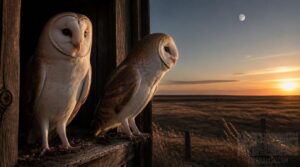
Pick out the bigger owl in a pair, and you’ve likely spotted the female. Sexual dimorphism stays modest here, but females edge out males in mass by year one and often show longer tarsi. Growth disparities emerge in adulthood, not the nest.
Parental roles diverge too—males patrol foraging patterns across open ground, while females hold nesting territory, driven by steep energetic demands during egg production.
Barn Owl Habitat and Range
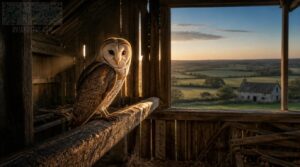
Barn owls turn up on nearly every continent, but where you’ll actually spot one comes down to a handful of favored settings.
From wide-open fields to old barn rafters, each spot offers something the species needs to hunt and nest successfully. Here’s a closer look at the specific places you’re most likely to find them.
Global Distribution
Few birds claim a range this vast: every continent except Antarctica hosts them, from British Columbia down to South America, and across Europe, Asia, Africa, and Australia.
Continental range variations show up as distinct taxonomic groups, including Tyto furcata subspecies in the Americas and Lesser Antilles populations.
- Grasslands
- Deserts
- Marshes
- Farmland
- Suburban edges
Elevation limits reach 13,000 feet in the Andes, proving impressive climate adaptability.
Open Country Habitats
That global range means little without the right terrain. Barn owls favor open country—grassy plains, rocky outcrops, shrublands—never dense forest.
These mosaics of grasses, forbs, and scattered shrubs sit at forest-urban edges, supporting ground-foraging birds and small mammals. Hedgerows create edge effect benefits and connectivity corridors, while agriculture and development risk fragmenting these patches, isolating populations across meadows, montane microhabitats, and open fields alike.
Farmland and Grasslands
Hay fields and cattle pasture aren’t just owl real estate—they’re working ecosystems. Sustainable grazing rotations keep grass dense enough to hide field voles while still growing forage.
That density does double duty: grassland carbon storage locks soil carbon underground, and deep roots curb soil erosion on sloped acreage. Legume-rich meadows boost forage nutrient density and pollinator habitat value, feeding both livestock and the small rodents owls depend on nightly.
Barns and Human Structures
Rodents thrive in grazed pasture, and that abundance draws owls straight to the barns overlooking it. Traditional barn architecture—open lofts, gapped siding, high rafters—mimics natural cavities almost perfectly.
Ventilation design meant for curing hay also keeps air moving through roosting sites, cutting humidity and parasites. As agricultural building evolution shifted toward metal sheds, owls adapted, favoring silos, church steeples, and abandoned structures offering similar shelter.
Nesting Site Preferences
Once inside a structure, owls don’t settle randomly. They pick spots offering microclimate stability—shielded from wind and direct sun, humidity buffered. A circular cavity entrance deters predators and regulates temperature better than open ledges.
Prey proximity still matters even indoors: nests near grain stores or pasture-facing lofts see higher success. Minimal human disturbance seals the deal, especially in quiet, abandoned buildings.
Barn Owl Diet and Hunting
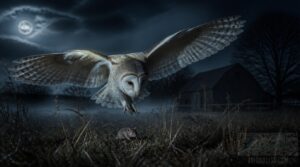
A barn owl doesn’t hunt by sight alone—it reads the dark through sound, scent, and sheer aerial precision.
Every part of its body, from wingtip to ear canal, has evolved for one purpose: catching prey without ever being heard. Here’s how that quiet mastery actually plays out in the field.
Small Mammal Prey
Voles, mice, and shrews make up the bulk of a barn owl’s diet, and their numbers rise and fall with the seasons. A single owl eats 3 to 4 prey items nightly—nearly a quarter of its body weight.
- Field voles
- House mice
- Shrews
- Ground squirrels
Prey mass matters: owls target animals weighing under 150 grams, keeping predatory behavior efficient across the food web.
Silent Flight Adaptations
Drop from a perch and you’d hear nothing—that’s the whole point. Feather microstructures with serrated leading edges break up airflow turbulence, while soft trailing fringes ease exit noise.
Combined with low wing loading, this wing morphology produces buoyant wingbeats at speeds as low as 2 mph. The result: near-total sound suppression, making barn owls true silent predators built for stealth maneuvering.
Hearing-Based Hunting
Picture total darkness, a rustle beneath dry leaves, and a strike that lands within inches. That’s acoustic localization precision at work.
In total darkness, a barn owl locates a rustle beneath dry leaves and strikes within inches
- Asymmetrical ears pinpoint elevation
- Facial disc funnels sound like a satellite dish
- Interaural timing narrows direction to a few degrees
- Sound-based prey mapping builds a 3D target
Low-light vision helps, but for these nocturnal hunters, sensory adaptation through hearing seals the kill.
Nocturnal Foraging Behavior
Dusk flips a switch: peak activity hits around midnight in open country, when voles and mice move freely under cover of dark. Moonlight suppresses hunting, since bright nights raise predation risk, while overcast skies boost success by dulling prey escape.
Wind, rain, and temperature shift effort too. You’ll find owls flexible—adjusting flight paths, pace, and prey selection as conditions change nightly.
Pellets and Digestion
Since barn owls swallow their prey whole, bones and fur travel intact through the digestive tract. Enzymes strip nutrients, leaving indigestible material compacted into a pellet within hours—digestive expulsion mechanics at work.
That castoff pellet becomes a research goldmine. Prey identification methods rely on intact teeth and jaw fragments, letting you conduct dietary analysis and ecological monitoring without ever trapping a single vole.
Barn Owl Breeding and Conservation
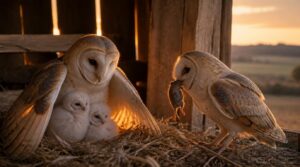
Once a barn owl finds a mate, the real work of raising their chicks begins. You’ll see this play out through a tight sequence of stages, from courtship to fledging, each with its own risks along the way. Here’s what that cycle looks like, and where humans can lend a hand.
Pair Bonds and Mating
Barn owls are primarily monogamous, often pairing for life once a bond proves successful. Courtship rituals—mutual calls, aerial chases, close roosting—build mate compatibility before breeding begins.
That familiarity pays off: parental coordination during incubation and feeding runs smoother, and bond stability boosts mating success factors like faster clutch timing and stronger nest defense in later breeding cycles.
Eggs and Incubation
Once a pair bonds, egg-laying follows within weeks. Females produce 2 to 18 eggs (average 4-7), incubating them at a stable 37-38°C.
- Shell porosity allows gas exchange
- Parents rotate eggs ~90° every few hours
- Embryonic development stages span roughly 29-34 days
This turning prevents membrane sticking, priming owlets for pipping and the altricial care that follows hatching.
Chick Growth and Fledging
Hatching happens asynchronously, every 2 to 3 days, so nestlings arrive at staggered sizes. This sets up sibling competition, with older owlets outcompeting younger ones for prey.
Rapid weight gain follows fast—up to 15% body mass daily. Down gives way to juvenile feathers within 10 days, with wing feathers emerging by day 5.
Fledging occurs between 50 and 70 days, once flight muscles mature enough for controlled flutter attempts.
Natural and Human Threats
Once fledglings scatter, survival hinges on more than flight skill. Agricultural habitat fragmentation and monoculture farming shrink hunting grounds, while pesticide bioaccumulation risks thin eggshells for the chicks to come.
Domestic cats and other invasive predator pressures take fledglings early. Add urban light pollution disrupting nocturnal foraging and shifting climate change impacts, and population decline becomes measurable—driving the species’ vulnerable conservation status across fragmented ranges.
Nest Box Conservation
Losing natural cavities to development doesn’t have to mean losing owls. A well-placed nest box restores what farmland and old barns once provided free of charge.
- Box Design: untreated wood, 3–4 cm entrance
- Placement Strategies: 3–6 meters high, sheltered orientation
- Predator Protection: metal guards, trimmed vegetation
- Habitat Connectivity: near hedgerows, grasslands, and reliable prey
Frequently Asked Questions (FAQs)
Why isn’t a barn owl a true owl?
Like Cinderella’s stepsisters, appearances can deceive: scientific classification splits owls into two families. You belong to Tytonidae, not Strigidae—true owls. That heart-shaped disc, absent ear tufts, and screeching call, versus hooting, mark you as genuinely distinct.
What is special about a barn owl?
Its facial disc acoustics funnel sound with pinpoint precision, while asymmetrical ear function allows for true three-dimensional hearing. Combined with silent flight mechanics, these sensory adaptations make it one of nature’s most refined stealth hunting nocturnal predators.
Is it good to see a barn owl?
Yes — spotting this silent nocturnal predator signals a healthy natural environment. You’re witnessing natural rodent control firsthand. Observe from a distance with binoculars or a telephoto lens, protecting nesting habitat while deepening your appreciation for wildlife conservation and quiet, respectful observation practices.
Is it rare to see a Barn Owl?
Not especially, if you know where to look. White plumage stands out against dusk skies, and winter sighting frequency rises as prey grows scarcer. Scan roadside perches, agricultural fields, and open habitats near natural or manmade structures for your best odds.
Where do barn owls live in the US?
A creature most at home in man-made barns thrives across wild, open country. You’ll find them hunting agricultural fields, desert margins, and suburban edges nationwide—wherever prey is thick and manmade structures offer shelter from coast to coast.
Are barn owls good or bad?
Good, hands down. As natural pest control, a single pair can eat hundreds of rodents yearly, easing crop damage.
Far from bad omens of folklore, these predatory birds support nature’s balance—proof their dietary habits benefit farms more than myths ever suggested.
Why isn’t a Barn Owl a true owl?
Think of two branches growing from an ancient tree—Tytonidae and Strigidae. The barn owl belongs to Tytonidae, marked by its heart-shaped face, unique asymmetrical ears, and distinct rasping screeches, unlike true owls.
Can barn owls see in complete darkness?
You won’t find vision alone guiding a hunter in complete darkness. Even with high rod density and binocular depth perception, owls rely on auditory localization once light drops below their scotopic threshold. Nocturnal behavior shifts entirely to hearing.
How long do barn owls live in the wild?
Wild populations rarely surpass 3–5 years, since juvenile mortality and prey scarcity trim survival. If you compare, captive birds often live 15 years or more. Regional averages vary—harsh winters, predators, and habitat loss shape the outcome.
Are barn owls known to be aggressive birds?
You won’t find barn owls behaving aggressively unless their nest site is threatened. Defensive tactics include aerial charges, dive bombing, and sharp vocalizations. Most aggression is brief, focused on protecting eggs or chicks, and rarely causes significant injury.
Conclusion
If a barn owl ever joined a moon landing crew, it wouldn’t need headlights. This bird’s heart-shaped face is engineered for sound, giving it an edge in darkness that rivals modern technology.
You can spot the barn owl in open fields or old barns, where its silent flight and precise hunting keep rodent numbers low. Every trait, from plumage to nesting sites, reveals adaptation shaped by centuries. Understanding its biology is like reading nature’s blueprint for stealth.