
This site is supported by our readers. We may earn a commission, at no cost to you, if you purchase through links.

That warbler won’t wait for you. It flits from branch to shadow to branch again, and by the time your binoculars find the tree, you’re staring at a soft gray blur where a bird used to be. Every birder knows this heartbreak.
The fix isn’t faster reflexes, it’s technique. Knowing how to focus binoculars quickly on birds comes down to a handful of habits: presetting your diopter, spotting with your naked eye first, and keeping one finger resting on that wheel like a trigger.
Master these moves, and blur turns into detail before the bird even thinks about leaving.
Table Of Contents
- Key Takeaways
- Choosing Binoculars Built for Quick Focus
- Calibrate Your Diopter for Sharp Focus
- How to Focus Binoculars Quickly on Birds
- Fixing Blurry or Slow Focus Problems
- Keeping Binoculars Ready for Fast Focusing
- Frequently Asked Questions (FAQs)
- How to focus binoculars for beginners?
- How to make binoculars focus?
- Which eye do you focus first on binoculars?
- How to make binoculars less blurry?
- What multi-coating do lenses need for sharper images?
- Do ED or HD glass lenses really matter?
- How much should quality birdwatching binoculars weigh?
- Whats the minimum eye relief for glasses wearers?
- Conclusion
Key Takeaways
- Calibrate your diopter once using the lens coverage method (cover one eye, focus with the center wheel, then adjust the diopter ring), then lock it in place so you never have to fight blurry edges again.
- Speed up focus in the field by spotting birds with your naked eye first, using the bullseye alignment method with a stationary reference point, and presetting your focus wheel to the bird’s estimated distance before raising your binoculars.
- Choose binoculars suited for quick focus by prioritizing specs like 8×42 magnification, central focus (versus individual focus) for one-handed speed, and lightweight open-bridge designs under 26 oz to reduce shake and fatigue.
- Maintain consistent performance through regular upkeep, including scratch-free lens cleaning, proper humidity-controlled storage, and monthly checks of the focus wheel for grinding, sticking, or misalignment.
Choosing Binoculars Built for Quick Focus
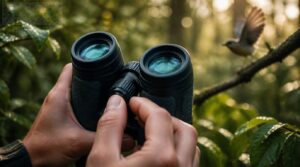
Before you can master any fast-focus technique, your binoculars need to be up to the job. Not every pair on the shelf is built for the quick, split-second adjustments birding demands. Here’s what actually matters when you’re picking gear that keeps up with a bird on the move.
If you’re still weighing your options, this guide on how binoculars improve your bird watching experience breaks down the features that make the biggest difference in the field.
Ideal Magnification and Lens Size
Why do fast-focusing binoculars start with the right numbers, not the right brand? 8×42 hits the sweet spot: a 336-foot field of view, 5.25mm exit pupil for dawn light, and 24 oz you can hold steady.
- 8x magnification
- 42mm objective lens
- 5.25mm exit pupil
- 6.4° field of view
- Under 26 oz weight
Using ED glass components can further improve color fidelity and minimize chromatic aberrations.
Bigger glass gathers light, but portability suffers—choose your trade-off.
Central Focus Vs. Individual Focus
Once you’ve nailed the right specs, the next decision is how you focus. Central focus uses one wheel for both eyes—fast, one-handed, ideal for birds in flight. Individual focus adjusts each eyepiece separately, offering tighter vision sync and closer range (8-12 ft vs. 15-25 ft).
| Feature | Best For |
|---|---|
| Central focus | Speed, ergonomics |
| Individual focus | Close-range precision |
| Diopter range | Wider on individual |
| Handling | One vs. two hands |
Lightweight Designs for Steady Handling
Weight matters more than most birders realize. Open bridge architecture strips away unnecessary bars, dropping models like Minox binoculars to just 340 grams, while compact dimension engineering shaves another half-pound off traditional 8×42 builds.
Since lighter frames often mean thinner coatings, pairing these featherweight binoculars with a proper lens cleaning kit for birding optics helps protect that investment for years of use.
Lighter binoculars mean steadier hands, faster focus, and less arm fatigue on long sessions. Look for ergonomic grip systems and a low center of gravity—both keep your image sharp instead of shaky.
Calibrate Your Diopter for Sharp Focus
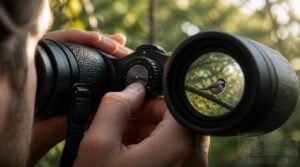
Once you’ve picked binoculars built for speed, the next step is making sure your eyes are actually working together, and that’s where the diopter comes in. This small ring gets overlooked constantly, yet skipping it means you’ll fight blurry edges every time you raise your optics.
Here’s how to set it correctly and keep it locked in place for good.
Locate and Set The Diopter Ring
Ever wonder why one eye stays crisp while the other looks soft? That’s the diopter’s job. On most binoculars, you’ll find the diopter ring on the right eyepiece, though some premium models place it on the center column instead.
Start at the zero position, then use the lens coverage method: cover the right lens, focus left with the center wheel, switch, and adjust the diopter ring until sharp.
Locking Diopter Settings in Place
Once you calibrate your binoculars, that diopter setting shouldn’t budge again. Locking mechanisms vary by brand: Vortex uses a push-pull ring with a satisfying click, Swarovski relies on a twist lock, Zeiss offers pull-up knobs or screw-down eyecup seals. Each gives an auditory locking cue confirming security.
Test it by feeling resistance, then trust your perfect focus stays put trip after trip.
How to Focus Binoculars Quickly on Birds
Once your diopter’s dialed in, speed becomes the name of the game, since a bird rarely waits around for you to catch up.
Getting from "I see it!" to a crisp, focused view takes a handful of small habits that work together like clockwork.
Here’s exactly how to lock onto your target fast, every single time.
Spot The Bird Before Raising Optics

Spot the bird with your naked eyes first, before your binoculars ever touch your face. Use soft focus to scan for motion, ripples, or leaf sway, then lock onto that spot and raise your optics straight up, keeping your eyes glued to the target the entire time.
Use The Bulls Eye Alignment Method
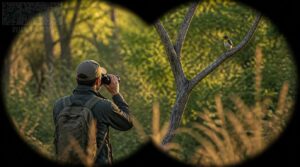
Pick a stationary reference point near the bird, something unmistakable like a forked branch, then square your feet and head toward it before raising your binoculars. Note whether the bird sits left, right, above, or below that spot.
Find the reference first through your optics, then follow that visual path until the bird appears, no guesswork needed.
Presetting Focus With Infinity Pre-Focus

Here’s the trick top birders swear by: guess the distance before you look. Sort the bird into a range zone—20 feet, 100 feet, 200 yards—then set your center focus wheel to roughly match that before raising your optics.
Guess the distance before you look, then preset your focus wheel so the bird arrives already sharp
This "infinity pre-focus" means you’re already near just about perfect focus when the bird appears. Practice this drill often, and you’ll cut adjustment time dramatically.
Keep a Finger on The Focus Wheel
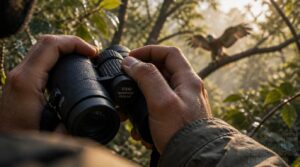
Ever notice how the best birders never seem to fumble with their gear? That’s because they never let go of the wheel.
Rest your index finger on the focus wheel mechanism the moment you raise your binoculars, adjusting in tiny 2-3 degree turns as birds shift distance. This one-handed operation keeps your other hand steady, cutting shake while you track flycatchers or hawks darting through branches.
Fixing Blurry or Slow Focus Problems
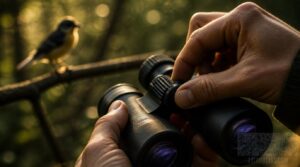
Even with great technique, focus problems still creep in from time to time, and most of them trace back to a handful of common culprits. Some show up as a blurry edge you can’t quite shake, others as a wheel that just won’t turn smoothly.
Here’s how to spot what’s going wrong and get your view back to crisp and fast.
Adjusting Eyecups for Eyeglass Wearers
Wearing glasses shouldn’t cost you a sharp view. Twist-up mechanisms let you dial in the right distance using click-stop precision—usually three to five settings matching your frame thickness. Retract eyecups fully if you wear glasses; extend them if you don’t.
The rubberized material cushions against your lenses comfortably, preventing pressure points while you track birds through dense brush.
Correcting Eye Relief and Blackout Zones
That "kidney bean" shadow drifting across your view? That’s a blackout zone, caused by mismatched eye relief. Fix it by fine-tuning eyecups until vignetting disappears and the eyebox fills your vision completely.
For eyeglass compatibility, extend eyecups one notch if edges still darken. A rubber band around the fold point works as a quick field modification hack, adding relief without permanently altering your binoculars.
Troubleshooting Center Focus Wheel Sticking
Sticking usually means seized grease inside the mechanism, hardened by cold storage followed by sudden warmth. Try this sequence:
- Heat the wheel gently (120-150°F) for 2-3 minutes
- Work it back and forth while warm
- Apply 2-3 drops Nyogel 767A after cleaning with alcohol
If stuck, unscrew objective barrels for disassembly access to the locking screw underneath the retaining cover.
Keeping Binoculars Ready for Fast Focusing
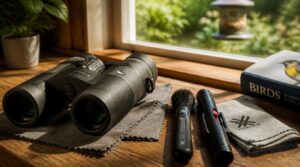
Speed on the trail starts with what you do at home, long before a bird ever shows up. Your binoculars need consistent upkeep to keep that focus wheel smooth and your view crystal clear every time you raise them. Here’s what regular maintenance actually looks like.
Cleaning Lenses Without Scratches
Never rub dry lenses, since grit acts like sandpaper. Brush or blow away debris first, then wipe in a spiral pattern with a quality microfiber cloth. Use isopropyl-based solutions made for coated optics, never Windex.
This keeps your birdwatching gear scratch-free and your optical quality sharp, trip after trip, so focusing stays fast and clear.
Proper Storage Between Birdwatching Trips
Between trips, stash your binoculars somewhere cool and dry, away from windows or heating vents. Humidity above 60% invites mold, so toss a desiccant pack inside a sealed, zippered case rather than the flimsy pouch it came with. Store them upright, lens caps snapped on.
Skip the attic or basement entirely, those temperature swings wreck seals fast.
Monthly Checks for Focus Mechanism Wear
Once a month, run your thumb across the focus wheel through a full rotation, feeling for grinding or uneven torque measurement accuracy.
Check the inspection port for dried, white lubricant, a sign of lubricant viscosity changes.
Peek for gear teeth wear, confirm focus shaft stability, and verify eyepiece alignment synchronization, since any wobble undermines proper binocular calibration and best focus.
Frequently Asked Questions (FAQs)
How to focus binoculars for beginners?
Worried it takes years to master? It doesn’t. Set your diopter adjustment ring once, then rely on the center focus wheel for everyday sharpness. Practice on stationary objects first, mastering close focus and image clarity before chasing live birds.
How to make binoculars focus?
Set your diopter ring first, then use the center focus wheel for the best focus. This achieves dual-eye synchronization, delivering that satisfying "3D pop" clarity birders rely on for fast, accurate target acquisition in the field.
Which eye do you focus first on binoculars?
Left eye first, right eye second: that’s the rule of thumb. Eye dominance testing guides this—most binocular barrel alignment assumes right-eye dominance, so you focus the left barrel via center wheel, then fine-tune the diopter ring for vision difference compensation.
How to make binoculars less blurry?
Wipe smudges with a microfiber cloth, check prism alignment for double vision, and confirm proper diopter adjustment. Quality lens coatings cut glare and chromatic aberration, boosting image sharpness so your best focus stays clear and detailed.
What multi-coating do lenses need for sharper images?
Picture sunlight bouncing off glass like glare off a lake — that’s what you’re fighting. You need fully multicoated lenses with phase correction, boosting light transmission to 90-95% and adding dielectric mirror reflectivity for crisp, true-color images.
Do ED or HD glass lenses really matter?
Yes, but check the glass, not the label. ED glass cuts chromatic aberration and boosts color accuracy; HD is often just marketing. Cheap HD models skip real optical coatings, so faster focus won’t fix blurry, fringed color underneath.
How much should quality birdwatching binoculars weigh?
Heavier doesn’t always mean better glass. Aim for 22 to 30 ounces—hikers should stay near 20-22 for less fatigue, while stationary birders can handle 26-30 ounces for bigger objective lenses and stronger low-light performance in the field.
Whats the minimum eye relief for glasses wearers?
15-16mm is the standard minimum, though thick frames need 17-18mm to avoid vignetting.
Thin frames handle 13-15mm fine, since less bulk means closer eye accommodation, better optical viewing distance, and fewer blackout zones ruining your view.
Conclusion
Blur is fleeting; detail rewards patience. That warbler you missed last spring? You’d catch it now, diopter set, eye already tracking before the glass ever rises.
Learning how to focus binoculars quickly on birds isn’t a one-time trick, it’s a habit built through repetition, much like tying a boot lace until your hands stop thinking about it.
Master the wheel, trust your naked eye, and every branch becomes a clear window, not a guessing game.
- https://flyinglessons.us/2020/08/13/beverlys-birding-basics-four-tips-for-getting-the-most-from-your-birding-binoculars
- https://www.celestron.com/blogs/knowledgebase/setting-the-diopter-compensation-adjustment-dial-on-a-binocular
- https://www.birdwatching.com/optics/education/diopter_setting.html
- https://www.thebirdinginsights.com/articles/binocular-focusing-speed-drills
- https://indianaaudubon.org/2025/05/29/birding-101-setting-sights-on-your-perfect-binoculars