This site is supported by our readers. We may earn a commission, at no cost to you, if you purchase through links.
A hummingbird burns through calories so fast that it must visit 1,000 to 2,000 flowers a day just to survive. That kind of metabolic demand means the food you offer matters far more than most backyard birders realize.
Get it right, and you’ll have iridescent wings flashing through your yard all season.
Get it wrong—wrong sugar, wrong ratio, spoiled nectar—and you’ll either drive them away or quietly harm the birds you’re trying to help.
The good news is that attracting hummingbirds comes down to a handful of straightforward choices about the right bird food, feeder placement, and a clean setup they can trust.
Table Of Contents
- Key Takeaways
- Choose The Best Hummingbird Food
- Make Homemade Hummingbird Nectar
- Avoid Harmful Nectar Ingredients
- Store Nectar for Freshness
- Place Feeders to Attract More
- Clean Feeders to Keep Nectar Safe
- Add Flowers and Insect Food
- Top 10 Hummingbird Food Products
- 1. Kaytee Hummingbird Nectar Food
- 2. Perky Pet Hummingbird Nectar Concentrate
- 3. Pennington Electro Nectar Hummingbird Food
- 4. Perky Pet Red Hummingbird Nectar Concentrate
- 5. Happy Wings Hummingbird Nectar Powder
- 6. Perky Pet Hummingbird Nectar Powder
- 7. Hummer Galore Hummingbird Nectar
- 8. Donaldson Farms Hummingbird Nectar Extender
- 9. Sapphire Labs Hummingbird Nectar Powder
- 10. Perky Pet Hummingbird Nectar
- Frequently Asked Questions (FAQs)
- What kind of bird food attracts hummingbirds?
- Should I stop feeding hummingbirds in September?
- What is a hummingbird’s biggest enemy?
- What do hummingbirds eat?
- How do you make homemade hummingbird food?
- How do you make hummingbird food & attract Hummers?
- How to attract hummingbirds?
- Do hummingbirds eat birdseed?
- Do hummingbirds eat red food?
- How long will it take for hummingbirds to find my feeder?
- Conclusion
Key Takeaways
- Plain white sugar mixed with water at a 4:1 ratio is the only safe homemade nectar — honey, brown sugar, and artificial sweeteners can seriously harm or even kill hummingbirds.
- Your feeder’s red color does the attracting, so skip the dyed nectar and keep the liquid clear, just like natural flower nectar.
- Fresh nectar matters more than most people realize — swap it every one to three days in summer heat, and clean your feeder regularly to prevent mold and fermentation.
- Pairing your feeder with native tubular flowers and leaving insects undisturbed gives hummingbirds the full diet they need, since up to 80% of what they eat is protein from small bugs.
Choose The Best Hummingbird Food
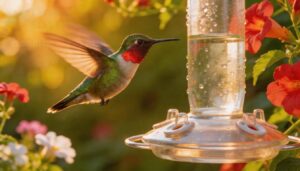
Not all hummingbird food is created equal, and the wrong choice can do more harm than good.
Getting the basics right starts with understanding what actually attracts these birds, and a good hummingbird habitat and housing guide can save you from common mistakes before they cost you visitors.
There are a few key things to think about before you pick up a bottle or bag. Here’s what to look at when choosing the best option for your feeder.
Ready-to-use Nectar Vs Concentrate
Ready-to-use nectar wins on convenience—just pour and go, no measuring needed. However, if you refill feeders frequently, concentrates offer better shelf-life control, waste reduction, and packaging sustainability. Powdered concentrate, in particular, remains stable until mixed with water, allowing you to prepare only what you need.
For nutrient consistency and temperature sensitivity, both options deliver reliable sugar ratios when used correctly. Concentrates typically contain high THC concentrations, which can produce a fast‑acting high.
Dye-free Options Vs Red Nectar
Color psychology explains why red nectar looks appealing — but hummingbirds don’t actually need dyed liquid to find your feeder. Natural flower nectar is clear, and bird health impact studies suggest artificial dyes offer zero nutritional benefit. Choosing dye-free hummingbird solutions is smarter for cost efficiency and environmental footprint too.
Here’s why dye-free wins:
- Natural vs artificial coloring in nectar — clear is what hummingbirds find in nature
- Red feeder parts do the attracting, making dye redundant
- Avoid artificial dyes to reduce avoidable health risks
- Natural red coloring from beetroot exists if you want color without synthetics
- Better brand perception goes to dye-free products among informed birders
White Sugar Nectar Basics
Just like dye-free nectar keeps things clean, so does your sugar choice. Plain white granulated sugar is the only ingredient worth using for DIY hummingbird nectar. It meets Sugar Purity Standards — pure sucrose, nothing added. The 4:1 ratio (4 cups of water to 1 cup sugar) nails the right sugar water concentration, matching real flower nectar.
| What to Use | Why It Works |
|---|---|
| Plain white granulated sugar | Pure sucrose, no additives |
| 4 cups water to 1 cup sugar | Matches natural nectar concentration |
| Warm water | Improves Sugar Dissolution Rate |
| Cool before filling | Ensures Feeder Compatibility |
| Adjust batch size seasonally | Facilitates Seasonal Adjustments |
This sugar water solution hits the right Nectar Viscosity — thin enough to flow freely, easy for hummingbirds to lap up fast.
Electrolytes and Hydration Support
Beyond sugar, some commercial nectars go a step further with added electrolytes. Electrolyte-Enhanced Nectar products like Kaytee and Pennington support Sodium Balance and fluid retention — similar to how athletes use electrolyte drinks after heavy exertion.
These formulas aid Electrolyte Absorption and offer Mineral Ratio Optimization without extra effort from you. Hydration Powder Extenders can deliver the same benefit while stretching your nectar supply further.
Cost, Convenience, and Refill Size
Budget matters just as much as what’s in the bottle. Whether you go with a ready-to-use liquid or a concentrate, each format has real trade-offs:
- Ready-to-use skips Mixing Effort but costs more per feeding
- Powders and concentrates offer Bulk Pricing Benefits over a season
- Refillable nectar packs and reusable packaging cut Packaging Waste Reduction
- Compact formats support Shelf Space Optimization in small storage areas
- Spill-proof Design makes refilling cleaner and less wasteful
Make Homemade Hummingbird Nectar
Making your own hummingbird nectar is easier than you might think, and you probably have everything you need in your kitchen right now. The key is knowing exactly what to use — and what to skip — so every batch is safe and effective.
Here’s how to get it right, step by step.
The 4:1 Sugar-to-water Ratio
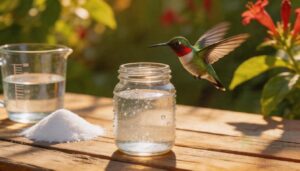
The magic number for homemade hummingbird nectar is simple: a 4:1 sugar water recipe ratio — four parts water to one part plain white sugar. This energy density matches what hummingbirds find in natural flowers, fueling those 80-beats-per-second wings.
| Batch Size | Sugar | Water |
|---|---|---|
| Small | ½ cup | 2 cups |
| Standard | 1 cup | 4 cups |
| Large | 2 cups | 8 cups |
Seasonal adjustments matter too — a slightly thinner mix helps with hydration on hot days.
Why Plain White Cane Sugar Works
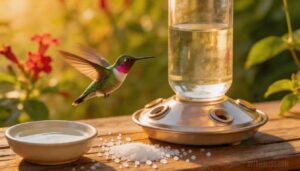
Plain white cane sugar is the yardstick for a reason. Its sucrose metabolism is perfectly suited to a hummingbird’s needs — rapid energy release without the risks other sweeteners bring.
Here’s why it works so well:
- Simple sugar digestion — sucrose breaks cleanly into glucose and fructose
- Ideal nectar concentration — mirrors natural flower nectar
- Low risk ingredients — no molasses, starch, or additives
- Clear solution monitoring — plain white granulated sugar dissolves spotlessly, so spoilage is easy to spot
It’s the cleanest energy source for hummingbirds you can make at home.
Boiling and Dissolving The Mixture
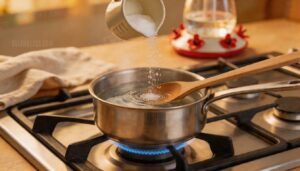
Boiling isn’t strictly required — hot water works fine if the sugar dissolves completely. That said, heat gently until the water is hot, then stir steadily using simple stirring techniques to prevent sugar crystallization at the bottom.
Heat transfer rate matters here: high heat speeds dissolving, but a rolling boil isn’t the goal. Clear, evenly mixed nectar is your sign that DIY hummingbird nectar preparation is done right.
Cooling Nectar Before Filling Feeders
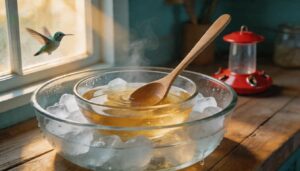
Hot nectar straight from the stove can warp your feeder and stress the birds. Cool it completely before you fill — here’s how:
- Use an ice water bath for the fastest results.
- Try shallow container cooling to release heat quickly.
- Practice stirring while cooling for even temperature drop.
Ambient air cooling works too, just takes longer. Aim for 60–80°F before you fill.
Small-batch Vs Large-batch Preparation
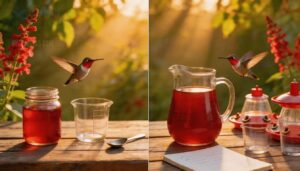
Small batches keep things simple — mix just enough for a few days, refrigerate after opening, and you avoid the inventory pressure of unused nectar going cloudy.
Large batches lower your setup cost trade‑off per cup, but only make sense when demand is steady.
For most backyard feeders, the scale decision is easy: small, fresh, and flexible win every time.
Avoid Harmful Nectar Ingredients
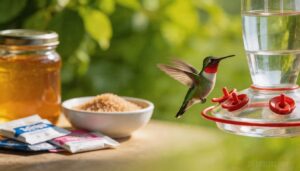
Not everything that looks like nectar is safe for hummingbirds. Some common kitchen ingredients can actually harm or even poison them. Here’s what to keep out of your feeder.
Why Red Dye is Unnecessary
Red dye in hummingbird nectar sounds harmless, but it’s a shortcut you don’t need. Your feeder’s red color already works as a natural visual cue — feeder color effectiveness is real, and the birds respond to it just fine.
Here’s why going dye-free makes sense:
- Dye health risks are real — no studies confirm Red Dye No. 40 is safe for hummingbirds
- Natural colors from your feeder’s trim attract birds without chemical exposure
- Avoid red dye in bird feeders to keep nectar closer to what flowers actually offer
- A red feeder provides the same visual signal as colored liquid
- Using natural colors to attract hummingbirds saves money and reduces environmental impact
Risks of Honey and Brown Sugar
If skipping red dye felt like a small win, avoiding honey and brown sugar is the bigger one.
Honey triggers fermentation toxicity within 48 hours and introduces fungal infection that swells hummingbird tongues — often fatal.
Brown sugar causes iron overload through molasses content, slowly damaging the liver.
Both leave sticky residue and drive pest attraction that keeps birds away.
| Ingredient | Risk |
|---|---|
| Honey | Fungal infection, fermentation toxicity |
| Brown sugar | Iron overload, pest attraction |
| Sticky residue | Clogs ports, coats feathers |
Never use honey or brown sugar in any DIY nectar recipe.
Safe feeding practices for hummingbirds start with plain white sugar — nothing else.
Problems With Raw and Unprocessed Sugars
Raw sugar seems harmless — it’s still sugar, right? Not quite.
For hummingbirds, the extra plant compounds in raw and unprocessed sugars interfere with your sugar water solution, speeding up mold growth and hindering fermentation prevention.
Plain white granulated sugar dissolves cleanly. Raw sugar doesn’t.
Stick with simple, and your feeder stays safer, longer.
Why Artificial Sweeteners Are Unsafe
Artificial sweeteners aren’t a safe swap — not for you, and definitely not for hummingbirds. These birds run on pure caloric energy, and safe ingredients for hummingbird food must deliver real fuel fast.
Here’s why sweeteners don’t belong in your feeder:
- They provide zero usable energy for a bird burning 80 wingbeats per second.
- Artificial sweeteners may cause metabolic dysregulation, disrupting how the body processes fuel.
- Gut microbiome disruption can follow even low-level exposure.
- Cardiovascular risk and neurological side effects have been flagged in ongoing research.
- Cancer classification concerns exist for common sweeteners like aspartame.
Stick to the sugar water recipe ratio — 4:1, always.
Common Homemade Nectar Mistakes
Even small slip-ups can turn good intentions into a problem for the birds you’re trying to help. Skipping boiling means impurities stay in the mix. Using tap water with heavy chlorine or storing nectar in non-sterile containers invites bacteria fast.
Over-diluting powder throws off the sugar water recipe ratio. Leaving nectar out accelerates fermentation. Avoid honey in hummingbird feed, keep containers clean, and you’re already ahead.
Store Nectar for Freshness
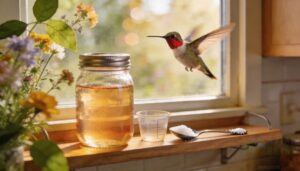
Making nectar is the easy part — keeping it fresh is where most people slip up. simple habits can make a real difference in how long your batch stays safe for hummingbirds.
Here’s what you need to know about storing nectar the right way.
Refrigerating Unused Homemade Nectar
Good storage starts the moment your nectar cools. Follow these four steps to refrigerate homemade hummingbird nectar safely:
- Pour cooled nectar into airtight containers to prevent condensation, prevention issues, and odor absorption.
- Practice batch portioning so you only pull what you need each visit.
- Use labeling dates to track freshness easily.
- Store toward the back for stable, temperature-sensitive nectar storage.
How Long Prepared Nectar Lasts
Nectar doesn’t last forever, and temperature is the main reason why. At room temperature, ambient temperature effects kick in fast — expect spoilage within 1 to 3 days in summer heat.
Refrigerated shelf-life stretches to 1 to 2 weeks when you refrigerate after opening and use an airtight container. Freezer storage limits cap around 30 days.
Seasonal shelf-life variations matter too — cooler weather buys you a little more time.
Signs of Spoilage and Fermentation
Your feeder is telling you something when the liquid turns hazy. Cloudy Appearance is your first warning — fresh nectar stays clear.
Watch for an Off Odor next, that sour, vinegar-like smell signals fermentation has started.
Surface Mold shows up as fuzzy patches, while Gas Bubbles mean microbes are active.
Sticky Texture inside ports confirms contamination.
When you spot any of these, dump it immediately — bird feeder hygiene isn’t optional.
Using Nectar Extenders Correctly
Think of a hummingbird nectar extender as a helper, not a replacement for good habits. Products like Hummingbird Nectar Extender follow a simple extender dilution — generally 1 tablespoon per quart.
Label adherence matters here, since each brand differs. Most use copper trace safety levels as a natural preservative.
Always refrigerate after opening, maintain batch consistency when mixing, and discard anything cloudy.
Extenders slow spoilage; they don’t prevent mold on their own.
Heat, Sunlight, and Shelf-life Concerns
Heat is nectar’s quiet enemy. When temperatures climb above 70°F, Temperature-Driven Fermentation can begin within 24 hours — and Sunlight-Induced Oxidation makes it worse by breaking down freshness even faster. Feeder Heat Retention in glass or clear plastic amplifies this.
Always refrigerate after opening, and never store at room temperature long-term.
Evaporation Concentration can also raise sugar levels, stressing tiny birds with every sip.
Place Feeders to Attract More
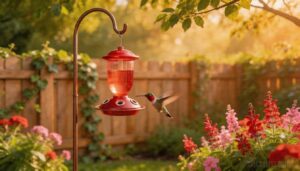
Where you hang your feeder matters just as much as what’s inside it. A good spot can mean the difference between a feeder that gets ignored and one that hummingbirds visit all day long.
Here’s what to keep in mind when choosing your placement.
Partial Sun Vs Full Sun Placement
Where you hang your feeder matters more than you’d think.
Full sun boosts feeder placement visibility, but it also ramps up fermentation speed and pest activity quickly.
Partial sun strikes the right balance — shade management for feeders keeps nectar temperature stable, improves bird comfort, and slows spoilage.
Aim for morning light with afternoon shade to get the best of both.
Hanging Feeders Near Trees and Shrubs
Once you’ve sorted out your sun and shade balance, it’s time to choose your feeder’s location wisely. Strategic placement of hummingbird feeders for visibility and protection comes down to four things:
- Branch Clearance — Hang up a hummingbird feeder about 10 feet from heavy cover for open flight paths.
- Strong Branch Selection — Pick a sturdy horizontal branch that won’t sway in wind.
- Predator Safety — Open sight lines let birds spot danger before landing.
- Maintenance Access — Choose spots you can reach easily for regular cleaning.
Nearby shrubs and trees help with weather shielding and provide perching and hiding areas, too.
Using Multiple Feeders for Territorial Birds
Feeder spacing makes a real difference once you understand territorial hummingbird behavior. Male hummingbirds are natural guarders — one bird can patrol several feeders from a single perch if they’re clustered too close.
Place feeders at least 15 feet apart, ideally in separate yard zones out of each other’s line of sight.
That spacing disrupts movement patterns and gives every visiting bird a fair chance.
Keeping Feeders Visible and Protected
Spacing feeders solves the territory problem, but placement also affects safety.
Keep your red feeder visible from open flight paths — birds spot color contrast fast.
Stay within 10–12 feet of shrubs for a solid predator buffer zone, but avoid dense cover where cats lurk.
Mount a rain guard design overhead, fill the ant moat protection daily, and you’ve built a genuinely safe setup.
When to Put Feeders Out Seasonally
Timing matters more than most people realize. Match your feeders to local migration patterns of hummingbirds, not a one-size calendar. Here’s a practical seasonal guide:
- Southeast/Gulf Coast – Keep feeders up year-round; Spring Arrival Timing starts in early March.
- Northeast – Set out feeders by late April using Fall Migration Schedule as your pull-back cue.
- Mountain West – Early March near the border; mid-May for northern Regional Climate Zones.
- Frost Prevention Strategies – Use Feeder Heater Use during cold snaps to keep nectar liquid.
- Northern Interiors – Follow seasonal hummingbird feeding windows: May 1 arrival through late fall departure.
Clean Feeders to Keep Nectar Safe
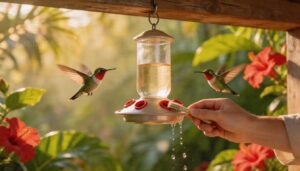
A dirty feeder can make hummingbirds sick faster than bad nectar ever could. Keeping things clean isn’t complicated, but the timing and method do matter.
Here’s what you need to know to stay on top of it.
How Often to Change Nectar
How often you change nectar depends on a few key factors: Temperature Guidelines, Sunlight Exposure, and Feeder Capacity all play a role.
Above 86°F, swap nectar daily. In mild weather, every two to three days works.
Low Traffic Adjustments still apply — mold doesn’t wait for birds.
A consistent feeder cleaning schedule is your best tool for nectar spoilage prevention.
Warm-weather Cleaning Frequency
Summer heat turns your feeder into a petri dish faster than you’d think. Heat‑accelerated bacteria and mold thrive when temperatures climb, making daily feeder swaps essential.
Follow this feeder cleaning schedule based on conditions:
- Above 86°F: clean daily
- Warm and humid: every 2–3 days
- Shaded feeders: shade cooling benefits slow spoilage slightly
- Rotating Feeder Stock: keeps service uninterrupted during rapid mold detection checks
Cleaning With Hot Water Only
Hot water does most of the heavy work — no boiling required. For routine feeder maintenance, start with Feeder Disassembly so hot water reaches every port and seam.
A thorough Hot Water Rinse loosens fresh sugar film fast. While cleaning, do a quick Seal Integrity Check for cracks.
Then Rapid Air Drying keeps moisture from shortening your next batch’s freshness.
Vinegar Soaking for Deep Cleaning
Once a month, go deeper. Mix one part white vinegar with two parts water, then soak all feeder parts for one to two hours. This takes care of acidic scale removal and mineral deposit dissolution that hot water alone can’t touch.
Always work in a ventilated space, rinse thoroughly after soaking, and check safe surface compatibility before you begin.
Consistent cleaning and disinfecting hummingbird feeders regularly keeps nectar fresh and birds safe.
Preventing Mold, Ants, and Bees
Mold grows fast when nectar sits warm and wet. Dry feeders, completely after every cleaning — leftover moisture is basically an open invitation.
Fill the ant moat and check it daily, since heat evaporates water quickly.
Use bee guard tips to block insects at the port.
Good ventilated feeder design and mold-resistant materials make all of this easier to maintain long-term.
Add Flowers and Insect Food
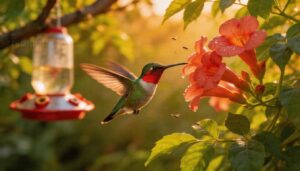
feeder alone only tells half the story. Hummingbirds also need flowers for natural nectar and insects for protein, and your garden can provide both.
Here’s how to build that kind of space, starting with what to plant and how it all fits together.
Planting Red and Orange Tubular Blooms
If you want hummingbirds showing up reliably, plant what they’re already wired to find.
Red cardinal flower, honeysuckle, and trumpet vine all offer long tubular flowers that attract hummingbirds best. Most thrive with full sun preference and well-draining soil.
Use trellis support needs for vines, try container planting tips for compact spots, and stagger bloom seasons so your yard stays busy all summer.
Choosing Native Hummingbird-friendly Plants
Native plants work best because they’re already tuned to your local climate, soil moisture needs, and seasonal rhythm. Use ecoregion plant lists to match perennial plant selection to your exact area — not just your general region.
- Bee balm – low water requirements, long tubular flowers that attract hummingbirds best
- Trumpet honeysuckle – native landscaping plants with staggered bloom timing
- Salvia – pollinator-friendly flora with reliable summer color
- Columbine – native and tubular flowers that bloom early in spring
Supporting Insects for Protein
Flowers bring hummingbirds in, but insects keep them coming back. These birds are true insectivores — up to 80% of their diet is protein from soft-bodied insects, larvae, and spiders.
Flowers lure hummingbirds in, but insects — making up 80% of their diet — are what keep them coming back
Skip pesticides entirely to protect native insect habitats and build pesticide-free zones around your feeders. Hang overripe fruit nearby as fruit fly attractors, and preserve spider webs — hummingbirds raid them for both prey and nesting silk.
Creating Layered Garden Shelter
Shelter shapes how long hummingbirds stay in your yard, particularly through edge habitat design. Layering windbreak shrubs, evergreen shelter, and small trees creates multi-tier perches for watching, resting, and nesting.
Leave natural branches intact to support nesting-branch selection. Dense foliage offers critical protection from wind and predators, transforming your garden into a genuine habitat.
Pairing Feeders With Flowering Plants
Think of your feeder as the anchor — and your flowers as everything that keeps hummingbirds coming back. Feeder-Flower Spacing matters: hang feeders close enough to tubular blooms that birds notice both, but not so close that foliage blocks access.
- Use Synchronized Bloom Timing across spring, summer, and fall
- Apply Sunlight Gradient Placement for visibility
- Practice Vertical Layer Integration with shrubs and perennials
- Follow Garden Edge Positioning near borders
- Choose red color cues with native tubular flowers
Top 10 Hummingbird Food Products
Finding the right nectar product doesn’t have to be overwhelming. There are solid options out there whether you want something ready to pour or a powder you mix yourself.
Here are ten worth your attention.
1. Kaytee Hummingbird Nectar Food
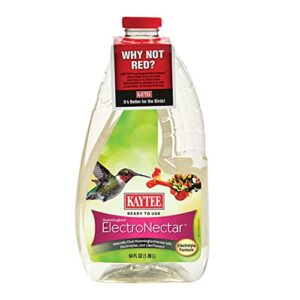
Kaytee ElectroNectar takes the guesswork out of feeding. It comes pre-mixed in a 64-oz bottle, so you just shake, pour, and you’re done — no measuring sugar or boiling water.
The clear formula skips artificial dyes entirely, since hummingbirds are drawn to your red feeder, not the liquid inside.
It also includes electrolytes like potassium and sodium bicarbonate to support hydration during those nonstop, 80-beats-per-second wing days.
Just refrigerate it after opening and clean your feeder first.
| Best For | Backyard bird-watchers who want a quick, no-fuss way to feed hummingbirds without mixing their own sugar water. |
|---|---|
| Form | Ready-to-use liquid |
| Package Size | 64 fl oz |
| Nectar Color | Clear |
| Boiling Required | No |
| Artificial Dye | None |
| Price (USD) | $9.99 |
| Additional Features |
|
- Ready to use straight from the bottle — just shake and pour, no prep needed
- Clear formula with no artificial dyes, plus added electrolytes to keep hummingbirds hydrated
- Convenient 64-oz size means fewer refills and less hassle
- Pricier than making your own nectar at home with sugar and water
- Needs refrigeration after opening, so you can’t just leave it by the feeder
- Some users report hummingbirds preferred homemade sugar water over this formula
2. Perky Pet Hummingbird Nectar Concentrate
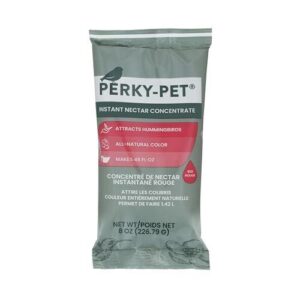
Perky-Pet’s Hummingbird Nectar Concentrate keeps things refreshingly simple. The 32-oz bottle mixes with water at a 1:1 ratio, making up to 96 oz of finished nectar — no boiling required.
It uses 100% sucrose, which mirrors what hummingbirds find in real flowers and is easier for them to digest than artificial sugar blends.
If you prefer a natural look, the red version gets its color from fruits and vegetables, not Red Dye 40.
Once opened, refrigerate it for up to a month.
| Best For | Backyard birders who want a quick, no-fuss way to keep their feeders stocked without spending much. |
|---|---|
| Form | Powder concentrate |
| Package Size | 8 oz |
| Nectar Color | Red |
| Boiling Required | No |
| Artificial Dye | Yes (red) |
| Price (USD) | $1.59 |
| Additional Features |
|
- Super easy to mix — just combine with lukewarm water, no boiling needed
- Makes a solid 48 oz of nectar from one small bag, so it stretches pretty far
- Preservatives help slow mold growth, meaning your prepared nectar stays usable longer than homemade batches
- Contains artificial red dye and preservatives, which isn’t ideal if you’re going the all-natural route
- Some users have found the resealable bag tears easily, making storage a headache
- The fixed 1:4 ratio doesn’t leave much room to adjust concentration if your feeder or birds prefer something different
3. Pennington Electro Nectar Hummingbird Food
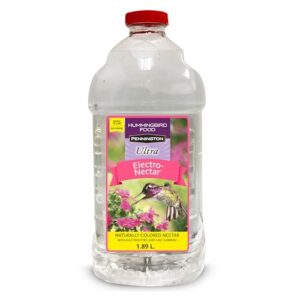
Pennington Electro-Nectar takes the guesswork out of feeding day. The 64-oz bottle comes ready to pour — no mixing, no measuring, no mistakes.
What sets it apart is the added electrolyte blend, which helps hydrate the way flower nectar naturally does. It’s completely clear and dye-free, so you can easily monitor fill levels and freshness at a glance.
Compatible with any standard feeder style, it’s a solid pick if you want a simple, science-backed option that just works.
| Best For | Backyard birders who want a fuss-free, ready-to-use nectar without the hassle of mixing sugar and water themselves. |
|---|---|
| Form | Ready-to-use liquid |
| Package Size | 64 oz |
| Nectar Color | Clear |
| Boiling Required | No |
| Artificial Dye | None |
| Price (USD) | $11.95 |
| Additional Features |
|
- Shake-and-pour convenience — no measuring or mixing required
- Added electrolytes mimic natural flower nectar for better hydration
- Works with any standard feeder style, top-fill, bottom-fill, or dish
- Needs refrigeration after opening, and cold nectar may turn hummingbirds away until it warms up
- Clear color looks natural but may be less eye-catching than red-tinted nectar some birds prefer
- No stated shelf life, so you’ll need to keep an eye on it and judge freshness yourself
4. Perky Pet Red Hummingbird Nectar Concentrate
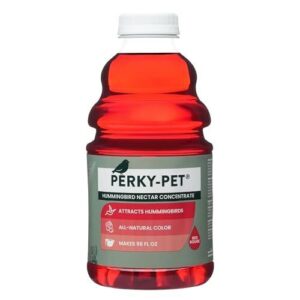
Sometimes simple is good enough — and that’s exactly where this concentrate shines. Perky-Pet’s red formula mixes easily with water at a 3:1 or 4:1 ratio, producing up to 96 fl oz from a single 32 oz bottle. No boiling needed. The red color, sourced from natural fruit and vegetable pigments rather than synthetic dye, mirrors the flowering plants hummingbirds already love.
At around $9.47 a bottle, it’s one of the more budget-friendly ways to keep your feeder full and the visits coming.
| Best For | Casual backyard birders who want a fuss-free, affordable way to keep their feeders stocked without any mixing or heating hassle. |
|---|---|
| Form | Liquid concentrate |
| Package Size | 32 oz |
| Nectar Color | Red |
| Boiling Required | No |
| Artificial Dye | Yes (Allura Red 40) |
| Price (USD) | $9.47 |
| Additional Features |
|
- Super easy to use — just mix with water, no boiling required
- One 32 oz bottle stretches to nearly 96 fl oz of finished nectar, so it lasts a while
- No refrigeration needed before mixing, making storage a breeze
- Contains Allura Red No. 40, a synthetic dye some bird experts flag as a potential health concern for hummingbirds
- A handful of users reported their feeders went unvisited, so results can vary
- Non-returnable once purchased, so you’re committed either way
5. Happy Wings Hummingbird Nectar Powder
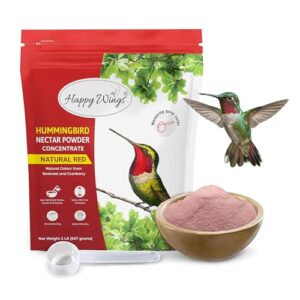
If you like keeping things simple in the backyard, Happy Wings Hummingbird Nectar Powder is worth a look. The 2 lb bag mixes quickly with warm water — no boiling required — and yields up to 192 fl oz of nectar.
Its natural red color comes from cranberry and beetroot powder, skipping the artificial dyes entirely. You get a measuring spoon included, so there’s no guesswork.
Just mix, fill, and watch. Store unused powder in its resealable bag to keep it dry between uses.
| Best For | Backyard birders who want a quick, no-fuss way to fill their hummingbird feeders without mixing plain sugar water from scratch. |
|---|---|
| Form | Powder concentrate |
| Package Size | 2 lb (32 oz) |
| Nectar Color | Red |
| Boiling Required | No |
| Artificial Dye | No (beetroot/cranberry) |
| Price (USD) | Not listed |
| Additional Features |
|
- No boiling needed — just mix with warm water and you’re done
- Natural red color from cranberry and beetroot, so no artificial dyes
- Comes with a measuring spoon, so the ratio is always right
- Some batches don’t dissolve fully, leaving a hazy or cloudy residue
- Plain sugar water works just as well nutritionally, so the "vitamins" claim is mostly marketing
- Must be refrigerated after opening, and may contain trace nuts — not ideal for everyone
6. Perky Pet Hummingbird Nectar Powder
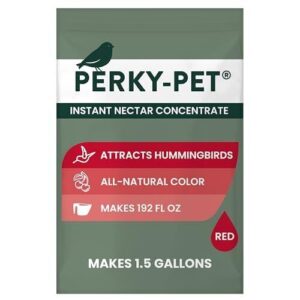
Another solid powder option is the Perky-Pet Hummingbird Nectar Powder. The 2 lb bag yields up to 192 oz of nectar — enough to keep several feeders running for weeks. It’s made from 100% sucrose, which closely matches what hummingbirds find in natural flowers.
No boiling needed; just measure, mix with water, and stir until dissolved. The red formula also gives you a built-in freshness signal — when the color fades, it’s time to refill.
| Best For | Backyard birders who want a fuss-free, long-lasting nectar supply without the hassle of boiling water or mixing their own sugar solution. |
|---|---|
| Form | Powder concentrate |
| Package Size | 2 lb (32 oz) |
| Nectar Color | Red |
| Boiling Required | No |
| Artificial Dye | Yes (cherry red) |
| Price (USD) | Not listed |
| Additional Features |
|
- One 2 lb bag makes up to 192 oz of nectar — that’s a lot of hummingbird happy hours before you need to restock
- Pure sucrose formula mirrors what hummingbirds sip from real flowers, so it’s a natural fit for their diet
- The red color doubles as a freshness timer — when it fades, you know it’s time for a refill
- The color fades fast, which means you’ll be swapping out nectar more often than you might expect
- Bags sometimes arrive torn, leaving a sticky powdery mess before you even get started
- High sugar concentration can drip and attract ants, bees, or leave a gooey residue on surfaces nearby
7. Hummer Galore Hummingbird Nectar
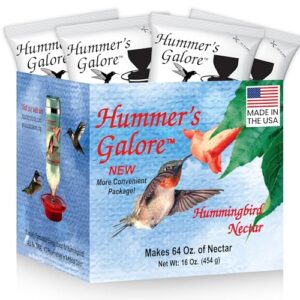
If you want something simpler than a big bulk bag, Hummer’s Galore Hummingbird Nectar might be exactly what you’re looking for.
Each box contains four pre-measured 4 oz packets — just add water, stir, and you’re done. No boiling, no guessing.
Each packet makes 16 oz of clear, dye-free nectar, totaling 64 oz per box.
The sucrose and dextrose formula skips artificial colors and preservatives, so you’re giving hummingbirds clean energy without the extras they don’t need.
| Best For | Casual backyard birders who want a quick, no-fuss nectar option without buying in bulk. |
|---|---|
| Form | Powder concentrate |
| Package Size | 12 oz (4 packets) |
| Nectar Color | Clear |
| Boiling Required | No |
| Artificial Dye | None |
| Price (USD) | $17.90 |
| Additional Features |
|
- Pre-measured packets take all the guesswork out of mixing — just add water and stir
- Clear, dye-free formula with no preservatives means clean, natural nectar every time
- Compact packaging is easy to store and keeps things fresh between uses
- One packet makes 16 oz, which is more than most small feeders hold — you may end up measuring out half anyway
- No preservatives means you’ll want to use opened packets fairly quickly
- Only works for hummingbirds — not a fit if you’re also trying to attract other backyard visitors
8. Donaldson Farms Hummingbird Nectar Extender
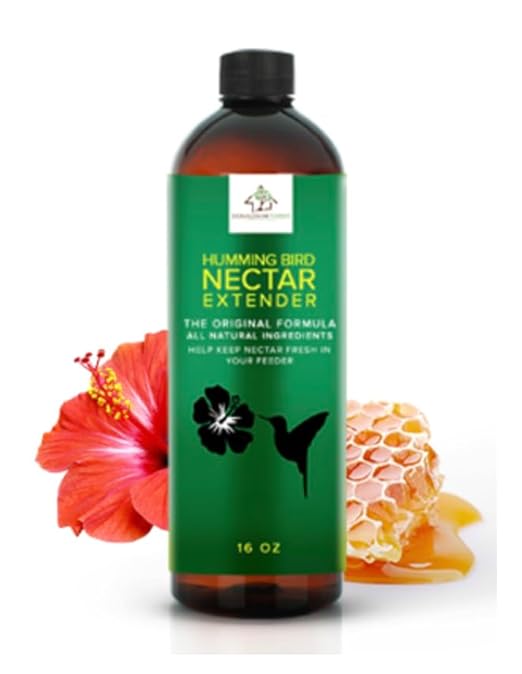
Fresh nectar is what keeps hummingbirds coming back, and that’s exactly what Donaldson Farms Hummingbird Nectar Extender is designed to protect.
Add just one tablespoon per quart of your homemade or store-bought nectar, and it can stay fresh for up to two weeks.
The plant-based, dye-free formula keeps things clear and odor-free without harsh chemicals.
At $24.99 for a 16 oz bottle, it’s a practical tool for anyone who wants cleaner nectar with fewer refills.
| Best For | Hummingbird enthusiasts who hate constant feeder maintenance, especially in hot climates where nectar turns fast. |
|---|---|
| Form | Liquid extender |
| Package Size | 16 oz |
| Nectar Color | Clear |
| Boiling Required | No |
| Artificial Dye | None |
| Price (USD) | $24.99 |
| Additional Features |
|
- Keeps nectar fresh for up to 14 days, so you’re not refilling every couple of days
- Plant-based formula with no synthetic additives — safe for birds and garden wildlife
- Simple to use: just one tablespoon per quart and you’re done
- Won’t replace regular feeder cleaning — mold can still sneak in if you skip that step
- Limited effect on bees and ants, so don’t expect it to keep pests away
- Some users had issues with the packaging, which is frustrating for a $24.99 product
9. Sapphire Labs Hummingbird Nectar Powder
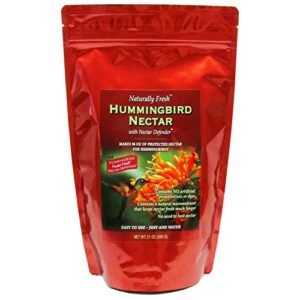
Sapphire Labs takes a different approach — instead of just extending nectar life, it builds freshness protection right into the powder itself. Mix it with water, skip the boiling, and you get 96 oz of clear, dye‑free nectar per package.
The secret is Nectar Defender, a micronutrient copper formula that naturally slows spoilage for up to two weeks. It’s practical, clean, and genuinely useful if you’re refilling feeders every few days in summer heat.
| Best For | Hummingbird enthusiasts who refill feeders often — especially in hot, humid climates where nectar spoils fast. |
|---|---|
| Form | Powder concentrate |
| Package Size | 1.31 lb |
| Nectar Color | Clear |
| Boiling Required | No |
| Artificial Dye | None |
| Price (USD) | Not listed |
| Additional Features |
|
- Nectar Defender copper formula keeps nectar fresh up to two weeks, cutting down on constant cleaning
- Clear, dye-free, pure cane sugar formula — nothing sketchy going into your feeder
- One package yields 96 oz, so you’re not mixing up small batches every other day
- Hot water is really needed to dissolve it properly, so the "no boiling" pitch is a bit misleading
- Costs more than just mixing plain sugar and water at home
- Once opened, the powder has a limited shelf life — you need to seal it tight or it loses its edge
10. Perky Pet Hummingbird Nectar
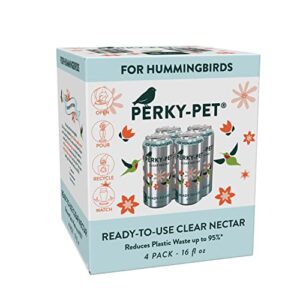
If convenience is what you’re after, Perky Pet’s ready-to-use nectar delivers. Each 4-pack contains four 16 oz aluminum cans of pre-mixed, clear nectar made with pure cane sugar — no boiling, no measuring, no mess.
The formula closely mimics natural flower nectar, and hummingbirds digest sucrose easily, so energy reaches them fast.
Cans are fully recyclable, which makes this a smart pick for eco-conscious feeders.
It costs more per ounce than homemade, but the trade-off in time saved is real.
| Best For | Anyone who wants zero-hassle hummingbird feeding — especially seniors, busy households, or campers who don’t want to deal with mixing and storing homemade nectar. |
|---|---|
| Form | Ready-to-use liquid |
| Package Size | 4 x 16 oz cans |
| Nectar Color | Clear |
| Boiling Required | No |
| Artificial Dye | None |
| Price (USD) | Not listed |
| Additional Features |
|
- Ready to pour straight from the can — no boiling, no measuring, no cleanup
- Made with pure cane sugar and no red dye, so it’s safe and close to natural nectar
- Aluminum cans are fully recyclable and easy to toss in a bag for travel or camping
- Costs noticeably more per ounce than a simple homemade sugar-water mix
- Some birders report fewer hummingbird visits compared to traditional recipes
- You’ll need to remove the label before recycling — a small but real extra step
Frequently Asked Questions (FAQs)
What kind of bird food attracts hummingbirds?
Hummingbirds are drawn to sugar-rich nectar — either homemade with white table sugar and water, or store-bought.
Red tubular flowers and clean feeders help too, giving them both energy and a reason to return.
Should I stop feeding hummingbirds in September?
No, don’t take feeders down in September. Hummingbirds migrate based on daylight, not food availability. Keeping feeders up through early October helps birds fuel up for their long journey south.
What is a hummingbird’s biggest enemy?
Cats are a hummingbird’s biggest threat. They wait quietly near feeders and strike fast, often before the bird can react. Keeping your cat indoors makes a real difference.
What do hummingbirds eat?
These tiny birds run on two main fuels: flower nectar for fast energy and small insects for protein. Spiders, gnats, and aphids fill nutritional gaps that sugar water simply can’t.
How do you make homemade hummingbird food?
Making homemade nectar is simpler than it sounds. Combine one part plain white sugar with four parts water, stir until dissolved, let it cool, then fill your feeder.
How do you make hummingbird food & attract Hummers?
Mix 1 part plain white sugar with 4 parts water, boil to dissolve, then cool completely before filling your feeder.
Skip red dye, honey, and artificial sweeteners — they do more harm than good.
How to attract hummingbirds?
Think of your yard as an open invitation.
To attract hummingbirds, hang a clean feeder with fresh sugar-water, plant red tubular flowers nearby, and keep everything consistently maintained so they keep coming back.
Do hummingbirds eat birdseed?
No, hummingbirds don’t eat birdseed. Their bills are built for sipping liquid nectar, not cracking seeds.
If you see one near a seed feeder, it’s chasing insects, not snacking on millet.
Do hummingbirds eat red food?
Red actually doesn’t need to be in the nectar at all. Your feeder’s red parts do the attracting.
The sugar water itself should stay clear — just like the natural flower nectar hummingbirds drink every day.
How long will it take for hummingbirds to find my feeder?
Most hummingbirds find a new feeder within one to seven days. In areas with active populations, your first visitor can show up in as little as 24 hours.
Conclusion
Like a garden that rewards patience, attracting hummingbirds comes down to doing a few simple things consistently well. The right bird food to attract hummingbirds is pure, fresh sugar water—nothing more.
Clean your feeders often, place them thoughtfully, and pair them with native blooms.
When you get those basics right, you’re not just filling a feeder. You’re building a yard hummingbirds return to, season after season, because they’ve learned they can trust it.
- https://www.birdwatchingdaily.com/beginners/birding-faq/how-to-attract-hummingbird/
- https://slimpickinskitchen.com/hummingbird-nectar-recipe/
- https://southgeorgiastyle.com/homemade-hummingbird-nectar/
- https://www.nature-anywhere.com/blogs/bird-feeding-academy/attract-hummingbirds-to-garden
- https://www.southernliving.com/best-hummingbird-feeders-8598173