
This site is supported by our readers. We may earn a commission, at no cost to you, if you purchase through links.
Spot a crow poking at something on the pavement and you might not think much of it. Watch long enough, though, and you’ll realize that bird isn’t just scrounging—it’s running a calculated foraging operation. Crows eat squirrels, but the full story is messier and more fascinating than a simple yes or no.
Most of the time, a crow dining on squirrel is working a roadkill scene, not executing a hunt. Live predation happens, but healthy adult squirrels are genuinely difficult targets—fast, sharp-toothed, and built to vanish up a tree in under half a second. Crows know this. They play the odds, shifting their attention toward nestlings, juveniles, and injured individuals when protein demand spikes during breeding season.
Understanding exactly when, how, and why crows go after squirrels reveals something worth knowing—especially if both species share your backyard.
Table Of Contents
- Key Takeaways
- Yes, Crows Sometimes Eat Squirrels
- When Crows Hunt Live Squirrels
- Why Adult Squirrels Are Rarely Prey
- Dead Squirrels Attract Hungry Crows
- Why Crows Attack Squirrels
- How Crows Target Vulnerable Squirrels
- Crow and Squirrel Interactions
- Protecting Backyard Squirrels Naturally
- Frequently Asked Questions (FAQs)
- Conclusion
Key Takeaways
- Crows eat squirrels far more often by scavenging roadkill than by hunting live ones, since a healthy adult squirrel is simply too fast, sharp, and tree-savvy to be worth the effort.
- When crows do hunt live squirrels, they target the vulnerable — nestlings, juveniles, and injured adults — especially in spring when their own chicks demand high-protein meals.
- Crows are calculated opportunists, not dedicated predators, shifting fluidly between insects, seeds, carrion, and small mammals depending on what costs the least energy to obtain.
- Despite occasional clashes over food and territory, crows and squirrels default to peaceful coexistence, even sharing alarm calls — making them rivals and reluctant neighbors more than true predator and prey.
Yes, Crows Sometimes Eat Squirrels
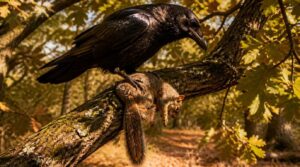
Yes, crows do eat squirrels — but the full picture is more complex than a simple yes or no. Their relationship with squirrels plays out across a few distinct feeding behaviors, each driven by different circumstances. Here’s what’s actually going on:
Interestingly, the dynamic works both ways — squirrels are opportunistic predators too, occasionally targeting bird eggs and nestlings when the chance arises.
Rare Live Predation
Live predation does occur, though crow hunting tactics favor vulnerable life stages over healthy adults.
- Juveniles with slower reflexes near nesting sites
- Injured adults exposed along forest edges
- Nestlings taken from active squirrel nests
- Weakened squirrels targeted during opportunistic feeding
- Squirrels distracted at open canopy gaps
Ambush success rates stay consistently low, because healthy, agile squirrels are almost never caught.
While crows mainly target vulnerable squirrels, other species use similar tactics—spiders, for instance, spin spiders spin orb webs to trap insects.
Mostly Scavenged Squirrel Carcasses
When live predation fails — or simply isn’t worth the effort — crows eat squirrels through a far more reliable route: scavenged carrion. Road-killed squirrels, abundant in urban zones with dense traffic and high squirrel populations, represent the majority of squirrel‑related feeding events.
Crows usually reach a fresh carcass within 24 hours, well before decay compromises nutritional value.
Opportunistic Feeding Behavior
What makes crows genuinely impressive isn’t that they eat squirrels — it’s how rarely they need to decide. Their diet shifts fluidly based on environmental food availability, season, and effort required.
When carrion is plentiful, active predation drops. When protein runs short, opportunistic feeding habits kick in. Crows simply make the most of energy gain per foraging effort, treating every meal as a contextual calculation rather than a fixed preference.
Crows don’t prefer carrion over prey — they simply choose whichever costs less energy to obtain
Small Mammals as Occasional Food
Squirrels aren’t the only small mammals crows occasionally target — mice, voles, and young rabbits can all end up on the menu when protein demand peaks during breeding season.
That said, mammal hunting remains rare within avian foraging patterns. Insects, seeds, and carrion satisfy most nutritional needs, making opportunistic feeding habits the rule and predation on squirrels or other small mammals is the clear exception.
When Crows Hunt Live Squirrels

Crows don’t hunt just any squirrel that crosses their path — they’re far more calculated than that. When live predation does happen, it’s almost always aimed at individuals who can’t fight back or flee effectively. Here’s exactly who ends up on a crow’s radar.
Nestling Squirrels
Baby squirrels are born blind, naked, and wholly dependent on maternal brooding for warmth — placing them squarely in the most vulnerable development stage crows can exploit.
- No escape speed
- Eyes remain sealed shut
- Protective fur not yet grown
- Confined entirely to the nest
- Zero physical defensive capability
Nestling nutrition relies entirely on milk, making them a concentrated, low-risk protein source.
Juvenile Squirrels
Once nestlings open their eyes and begin venturing out, they don’t instantly shed their vulnerability.
Juvenile squirrels, still developing reflexes and foraging skills, represent a window of opportunity crows don’t ignore. Their predator avoidance learning is incomplete, their escape reactions slower than adults, and their territorial boundaries untested — making them considerably easier targets than any seasoned adult.
Injured Adult Squirrels
When a squirrel’s speed fails — through fracture, head trauma, or soft-tissue injury — crows recognize the shift immediately.
Signs that flag vulnerability to opportunistic feeders:
- Abnormal gait or circling
- Failure to flee on approach
- Visible limb dragging
- Reduced alarm response
- Isolation from others
Injured adults become viable prey precisely because their defenses collapse.
This vulnerability is amplified in mixed-species flocks, where blue jays and cardinals share alarm call networks that can quickly expose a weakened individual to coordinated predator attention.
Sick or Weakened Squirrels
Illness strips a squirrel of its most reliable defense: speed. A sick individual moves slowly, rests through daylight hours, and fails to flee when approached — signals, crows read quickly.
Neurological symptoms like tremors or disorientation, visible fur loss, and sunken eyes mark a compromised animal. Crows don’t miss that. Weakness is the trigger, not aggression.
Squirrels Near Nests
Nests concentrate vulnerability in one place. Mother squirrels build dreys from twigs, bark, and dried moss high in deciduous canopies, but the kits inside — blind and hairless in early weeks — can’t flee.
Crows recognize this, targeting nest sites where defenseless young cluster together.
Even a vigilant mother emitting alarm calls and flicking her tail can’t always stop a coordinated approach.
Why Adult Squirrels Are Rarely Prey
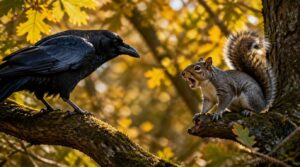
Adult squirrels aren’t easy targets — and crows know it. These animals come equipped with a surprising set of defenses that make a healthy adult a risky meal for even the most determined crow. Here’s what makes them so hard to catch.
Speed and Agility
A healthy adult squirrel is practically built to escape. Rapid acceleration and directional shifts make it nearly impossible for crows to land a successful strike.
- Instant reactive agility lets squirrels change course mid-stride
- Explosive plyometric bursts carry them out of reach fast
- Sprint velocity outpaces a crow’s dive through open terrain
- Mobility through branches neutralizes aerial attack angles entirely
Sharp Teeth and Claws
Speed isn’t the only deterrent. When a crow does close in, it risks meeting sharp incisors and curved claws capable of delivering real damage.
Squirrel teeth grow continuously, keeping edges keen, while keratinous claw sheaths maintain puncture strength.
That combination of bite force and slashing power makes even a hesitant attack costly enough to discourage most crows entirely.
Fast Tree Escapes
Even when a crow commits, the squirrel’s arboreal escape mechanics can end the encounter in under a second.
- Hind limbs launch the squirrel upward within 0.2–0.4 seconds
- Claws grip bark instantly, preventing slip during initial push-off
- Short aerial bursts cover neighboring limbs mid-flight
- Tail orientation stabilizes direction during midair maneuvering
- Burst energy depletes fast, so dense foliage offers recovery cover
Tail Puffing Displays
When a crow closes in, a squirrel doesn’t just bolt — it puffs. Small muscles at each hair follicle contract, raising fur along the entire tail and creating a visibly thicker silhouette. Blood flow increases, inflating the appearance further.
This involuntary arousal response makes the squirrel look larger than it is — a low-cost intimidation tactic that can stall a predator’s approach without burning escape energy.
Loud Alarm Calls
Tail puffing buys a moment, but sound carries further.
When a crow appears, squirrels emit sharp alarm calls — rapid bursts of high-frequency vocalizations peaking between 3 and 6 kHz — that cut through ambient noise and reach nearby animals instantly. Those calls don’t just warn; they trigger collective vigilance, pulling other squirrels into defensive awareness and sometimes prompting coordinated mobbing behavior that makes any crow rethink its approach.
Dead Squirrels Attract Hungry Crows
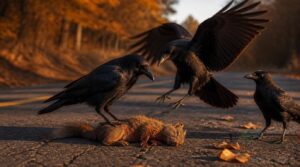
You don’t have to catch something to eat it — and crows know this better than most. When a squirrel ends up dead on the roadside, crows are often the first ones circling in. Here’s a closer look at exactly how and why dead squirrels draw crows in so reliably.
Roadkill Feeding
Urban roads function as reliable foraging corridors for crows, who scan roadsides for squirrels killed by passing vehicles.
Scavenging this carrion costs far less energy than hunting live prey, making it an efficient caloric strategy.
Crows often arrive within minutes of a kill, exploiting peak freshness before decomposition sets in — and before competing scavengers, like raccoons or opossums, claim the carcass.
Fresh Carrion Preference
Freshness matters more than you might expect. Crows show a clear preference for recently deceased carcasses, arriving within minutes of death to access peak nutrient density before decomposition degrades protein quality.
Warmer temperatures accelerate decay rapidly, narrowing that feeding window considerably. Cooler conditions extend it. Either way, odor and exposed tissue serve as the crow’s primary detection cues, drawing them in before competing scavengers can claim the meal.
Urban Scavenging Spots
Cities are basically an open buffet. Restaurant alleyways, stadium waste bins, and transit hub litter zones concentrate food scraps in predictable locations, letting crows develop reliable foraging routes without expending energy on active hunting.
Road corridors do double duty — city roadkill utilization peaks near busy intersections, where traffic regularly produces carrion that crows access during quieter morning hours.
Seasonal Food Shortages
When natural food sources thin out during lean seasons, carrion becomes critical.
Crows don’t suddenly develop a taste for squirrels — scarcity simply makes dead ones too valuable to ignore.
High carrion availability during these windows reduces the need for riskier hunting strategies, so a road-killed squirrel becomes exactly the low-effort, protein-dense meal a crow’s winter diet demands.
Low-risk Meal Source
Carrion strips out the danger entirely. A road-killed squirrel demands no chase, no coordination, no risk of those sharp teeth finding a wing.
Roadkill protein delivers concentrated fat and calories with almost zero effort — exactly what an opportunistic feeder needs when energy budgets are tight.
Juvenile crows learn this calculus early, watching adults exploit urban waste streams before they ever attempt a live hunt.
Why Crows Attack Squirrels
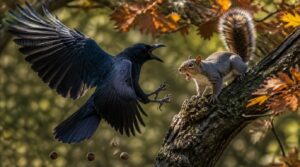
Crows don’t attack squirrels on a whim — there’s usually a clear biological reason driving the behavior. Most of the time, it comes down to survival pressures that make the risk worth the reward. Here’s what actually pushes crows to target squirrels in the first place.
Protein for Nestlings
Crow nestlings don’t just need food — they need the right food. Rapid growth windows demand dense animal protein to fuel muscle mass development and feather keratin synthesis, both of which rely on essential amino acids like methionine and lysine.
That’s why crows intensify squirrel predation during nesting season: a single juvenile squirrel delivers concentrated nutrition that seeds, fruit, and insects simply can’t match.
Breeding Season Demands
Spring doesn’t just change the weather — it rewires crow biology entirely. Hormonal breeding cues trigger gonadal development as daylight lengthens, pushing crows toward more aggressive foraging strategies to meet nestling growth support demands.
- Energy budgeting tightens as feeding trips multiply
- Protein intake necessity spikes during peak chick-rearing weeks
- Predatory behavior toward weak squirrels rises sharply in spring
Seasonal forage shifts make every calorie count.
Food Scarcity Pressure
When environmental protein runs thin, crows shift their food scarcity strategy dramatically. Insects vanish, seeds deplete, and suddenly opportunistic feeders like crows turn toward whatever moves — or doesn’t. Weak squirrels become viable targets precisely because the cost-benefit calculation changes.
| Scarcity Trigger | Crow Response | Squirrel Risk |
|---|---|---|
| Climate shock | Broadened prey search | Elevated |
| Carrion shortage | Active hunting increases | Moderate–High |
| Seed/insect crash | Predatory behavior toward weak squirrels rises | High |
Hunger, basically, lowers their standards.
Nest Defense Behavior
Scarcity isn’t the only driver.
Nest defense behavior pushes crows to attack squirrels even when food is adequate — a squirrel venturing too close to an active nest triggers immediate aggression.
Parents recognize nest predators specifically, responding with coordinated vocal alarm signals, visual defense displays, and direct physical strikes, treating the intruder as an existential threat rather than a competitor.
Opportunistic Meat Eating
Nest defense explains aggression, but opportunistic meat eating runs deeper — it’s a nutritional fallback strategy wired into crow behavior year-round.
When plant-based food declines seasonally, crows shift toward animal protein to cover gaps in essential amino acids, their regular diet can’t reliably supply.
A dead or vulnerable squirrel isn’t a target out of malice; it’s simply the most available, lowest-risk protein source in the vicinity.
How Crows Target Vulnerable Squirrels
Crows don’t just stumble into a squirrel encounter and hope for the best — they’re surprisingly calculated about the whole thing. When they do go after a squirrel, there’s usually a method behind the madness, and it involves more teamwork than you’d expect from a bird. Here’s a closer look at the specific tactics crows use to tip the odds in their favor.
Group Mobbing Tactics
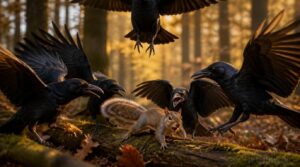
Crows don’t hunt like lone wolves — they hunt like a coordinated strike team.
When targeting a vulnerable squirrel, the group divides into clear roles: some birds create chaos while others move in for the attack. One crow draws the squirrel’s attention while its partner flanks from behind. Role specialization turns what looks like chaos into a calculated takedown.
Distracting The Squirrel
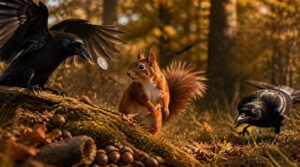
Before striking, crows engineer confusion. Visual stimuli — a shiny object, a sudden movement — pull the squirrel’s gaze away from the real threat. Noise cues like snapping branches spike arousal, scattering attention further.
Environmental clutter works the same way. Novel objects near feeding zones trigger curiosity, freezing the squirrel just long enough for a flanking crow to close the distance undetected.
Attacking Weak Points
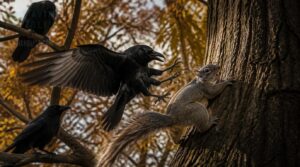
Once distraction clears the way, crows shift to precision targeting. Eye strikes disorient the squirrel instantly, while hits near the base of the tail disrupt balance, shortening escape arcs through branches.
The soft ventral surface offers little fur protection, making belly strikes especially effective. Joint attacks near the shoulder further reduce mobility, letting the group close in before the squirrel can recover grip.
Using Roads Strategically
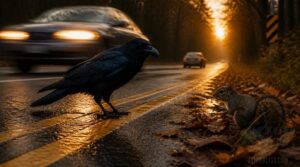
Roads aren’t just infrastructure — for crows, they’re hunting grounds. When a squirrel hesitates near traffic, crows have been observed luring prey toward moving vehicles, exploiting the chaos of collisions to create easy meals.
This environmental manipulation turns a passive landscape feature into an active hunting tool, reflecting a level of problem-solving that rivals primates.
Coordinated Hunting Roles

Think of it as a military operation with wings. Some crows flank from the sides, cutting off lateral escape routes, while centers drive the squirrel forward into the trap.
Role assignments shift mid-hunt based on how the squirrel moves — younger birds learn by watching seniors execute these coordinated roles, gradually absorbing the geometry of a successful group attack.
Crow and Squirrel Interactions

If you’ve ever watched a crow and squirrel share the same backyard, you already know things can get complicated fast.
Their relationship doesn’t fit neatly into predator-and-prey or peaceful neighbors — it’s actually a bit of both, depending on the situation.
Here’s a closer look at the different ways these two species cross paths.
Backyard Food Competition
Your backyard is fundamentally a wildlife feeding competition — crows and squirrels both eyeing the same scattered seeds.
- Crows dominate open ground
- Squirrels control elevated feeders
- Neither species yields easily
- Resource tension drives bold behavior
This backyard habitat rivalry mirrors organized cook-offs: roles emerge, strategies sharpen, and the boldest competitor wins. Crows eat squirrels opportunistically, but usually, both species simply negotiate access — one snack at a time.
Shared Urban Habitats
Beyond the feeder, crows and squirrels share overlapping urban greenspaces — parks, street tree corridors, and garden edges where both species forage across the same patchy resources. Human activity shapes these zones directly, with bird feeders and food waste pulling both into close proximity.
Seasonal resource pulses in spring and autumn intensify this overlap, raising encounter rates precisely when crows’ protein demands peak.
Nest Area Conflicts
Proximity intensifies tension. During breeding season, crow territorial boundaries expand, pushing them closer to squirrel nesting sites and triggering coordinated mobbing — dive-bombing, loud calls, and wing displays designed to displace squirrels from contested zones.
Urban habitat fragmentation compresses both species into shrinking patches, so these confrontations happen more frequently, especially where canopy density thins and nests become exposed and easier to target.
Predator-prey Moments
Those territorial clashes don’t vanish once the mobbing stops — sometimes they escalate into something sharper. Predator-prey moments unfold fast, often lasting only seconds to a few minutes, triggered by visual cues like a squirrel’s alarm bark or tail flash.
- Detection happens almost instantly in shared urban spaces
- Crows assess vulnerability before committing to pursuit
- Healthy adults usually escape; juveniles don’t always
- Rural encounters follow the same opportunistic logic
Mostly Peaceful Coexistence
Those flashpoints are genuinely rare. Most mornings, crows and squirrels move through the same yards without incident — crows claiming early surface scraps, squirrels exploiting midday caches tucked in branches where crows can’t easily follow. That’s resource partitioning in action, quiet and unspectacular.
Both species even share alarm signals, warning each other of approaching predators. Urban coexistence, it turns out, is their default setting.
Protecting Backyard Squirrels Naturally

If you’d like to give backyard squirrels a better shot at staying safe, a few simple habits go a long way. None of them require expensive gear or major changes to your yard. Here’s what actually helps:
Keep Feeding Areas Clean
Spilled seeds and rotting shells act as an open invitation for crows and opportunistic scavengers. Clean feeding stations daily to disrupt this cycle.
- Wipe surfaces with pet-safe cleaners
- Remove spilled seeds within 24 hours
- Sanitize bowls after each use
- Inspect weekly for mold growth
- Sweep the surrounding ground thoroughly
Bacterial buildup escalates fast in warm conditions, putting backyard squirrels at measurable risk.
Remove Unsafe Attractants
Crow activity often spikes when unsafe attractants quietly accumulate around your bird feeder. Securing pet food, eliminating standing water, and managing birdseed spills disrupts crow foraging near backyard squirrels.
| Attractant | Action |
|---|---|
| Pet food bowls | Bring indoors after meals |
| Birdseed spills | Clear within 24 hours |
| Standing water | Cover or drain |
| Dense brush | Clear yard edges |
| Home entryways | Seal gaps and screens |
Provide Tree Cover
Dense canopy gives squirrels what no feeder modification can: vertical escape routes. Mature trees with crowns exceeding 15 meters let squirrels dart between branches and disappear from pursuing crows within seconds.
That structural complexity also fosters biodiversity corridors, filters air pollutants, and reduces stormwater runoff — meaning tree cover pays dividends well beyond keeping your backyard squirrels safer.
Avoid Feeding Carrion
Leaving out animal remains — even accidentally — turns your yard into a scavenging hotspot. Carrion attracts crows rapidly, and decomposing tissue carries genuine risks: bacterial contamination from Clostridium species, pesticide residues, and pathogen exposure that can ripple through local wildlife.
Remove carcasses promptly, and you break the feedback loop that pulls scavengers into spaces where squirrels already live.
Support Balanced Wildlife
Think of your yard as one small link in a much larger chain. When you plant native species, minimize pesticides, and support wildlife corridors, you’re not just helping squirrels — you’re maintaining the predator-prey interactions that keep crows, squirrels, and dozens of other species ecologically balanced.
- Plant native fruiting shrubs
- Connect green spaces where possible
- Join local stewardship programs
Community involvement multiplies the impact.
Frequently Asked Questions (FAQs)
Why do crows attack squirrels?
Predators don’t always attack out of hunger — sometimes it’s survival. Crows attack squirrels primarily to secure protein during breeding season, defend nesting territory, or exploit weakened individuals when food scarcity forces opportunistic hunting beyond their typical diet.
Do crows chase squirrels?
Yes, crows do chase squirrels, particularly in urban areas where both species compete for food around feeders or roadkill. These pursuits often involve aerial dives or direct charges rather than sustained hunts.
Do Crows eat squirrels?
Crows are opportunistic omnivores — squirrels appear in their diet, but far less often than insects, seeds, or carrion. Live predation is rare; scavenging a dead squirrel is the far more common scenario.
What do Crows eat?
Omnivorous by nature, crows eat insects, seeds, fruits, carrion, small mammals, eggs, and scavenged waste. Their diet shifts seasonally, favoring insects in spring and seeds in winter, reflecting excellent foraging flexibility.
Who would win, a crow or a squirrel?
In most encounters, the squirrel wins. Healthy adults outpace crows with greater agility and tree-based escapes. Crows only gain the upper hand against juveniles, injured individuals, or when mobbing in coordinated groups.
What birds prey on squirrels?
Several birds of prey hunt squirrels regularly. Red-tailed hawks, great horned owls, and golden eagles are the most common predators, while Cooper’s hawks, barred owls, and peregrine falcons also take squirrels opportunistically.
Do crows eat live rodents?
Yes, crows do hunt and eat live rodents. They target small, vulnerable prey — mice, voles, and juvenile rats — using coordinated strikes, stealthy approaches, and opportunistic ambushes, particularly when fresh carrion isn’t available.
Why do Crows eat baby squirrels?
Baby squirrels offer crows a concentrated protein source at minimal risk. Their limited mobility and dependence on adults make them easy targets, especially during breeding season, when crow nestlings require dense, calorie-rich food to develop rapidly.
Do Crows kill squirrels?
Crows do kill squirrels, though rarely. They target nestlings, juveniles, and injured adults — not healthy ones. A fit adult squirrel’s speed and sharp defenses make it more trouble than it’s worth.
Are squirrels afraid of crows?
Squirrels don’t freeze in fear — they calculate risk. When crows appear nearby, squirrels shift into heightened vigilance, scanning, tail-flicking, and vocalizing warnings. That’s a measured threat response, not panic.
Conclusion
Crows rarely hunt what they can scavenge—yet when the moment’s right, they strike with precision.
Do crows eat squirrels? Technically yes, but the honest answer is that they’re opportunists first and hunters second. A healthy squirrel isn’t prey; it’s a competitor.
Vulnerability changes everything. Watch your backyard closely and you’ll see this interactive play out in real time—two species negotiating the same space, each calculating risk the only way nature knows how: constantly.
- https://aviancontrolinc.com/what-do-crows-eat
- https://abcbirds.org/news/something-to-crow-about-the-amazing-diet-eating-habits-of-american-crows
- https://www.mercurynews.com/2014/05/02/murder-of-crows-baby-squirrel-killers-or-just-innocent-bystanders
- https://en.wikipedia.org/wiki/Crow
- https://happybirding.com/do-crows-eat-squirrels/