
This site is supported by our readers. We may earn a commission, at no cost to you, if you purchase through links.

A toucan’s bill sheds up to 60% of its body heat through a network of blood vessels, working like a built-in radiator in the sweltering canopy. That single adaptation tells you everything about why exotic bird types found across the globe reward a closer look.
From Amazon understory to Himalayan alpine slopes, you’ll discover species shaped by extreme pressures: scarlet macaws flaunting iridescent plumage, shoebills wielding 24-cm bills like surgical clamps, kagus sniffing prey through specialized nasal corns. Each trait marks a survival strategy millions of years in the making.
You’re about to meet the rarest, strangest, and most resilient birds on Earth, and learn what it takes to protect them.
Table Of Contents
- Key Takeaways
- Colorful Exotic Bird Types Found Worldwide
- Exotic Bird Habitats by Region
- Rare and Endangered Exotic Birds
- Amazing Exotic Bird Adaptations
- Conservation and Responsible Bird Ownership
- Frequently Asked Questions (FAQs)
- What are the types of exotic birds?
- Which pet talks all day?
- What is the most exotic bird?
- What is the name of the exotic bird they find in UP?
- What is the 100 bird’s name?
- What permits are required for owning exotic birds?
- How much do exotic birds typically cost monthly?
- Which exotic birds can learn to speak words?
- What diseases can exotic birds transmit to humans?
- How long do most exotic bird species live?
- Conclusion
Key Takeaways
- Exotic birds like toucans, shoebills, and hornbills carry physical adaptations — heat-radiating bills, suction-hunting mechanics, multi-role casques — that solve multiple survival challenges with a single structure.
- Regional isolation shapes radically different bird strategies, from Amazon canopy frugivores and cloud forest quetzals to island-stranded flightless species like the Kagu, each reflecting millions of years of localized pressure.
- The illegal wildlife trade kills 75–80% of its roughly 500,000 annual parrot victims before any sale occurs, while habitat loss and climate-driven range shifts simultaneously compress the ecosystems these species depend on.
- Ethical ownership, CITES compliance, and captive breeding programs with tracked lineages are the practical levers available to you for reversing population decline — but only if wild-caught sourcing is refused entirely.
Colorful Exotic Bird Types Found Worldwide

You’ll find some of nature’s boldest color palettes painted onto feathers, beaks, and crests across the globe. Every region seems to claim its own showstopper, from rainforest canopies to mountain ridges. Here are five exotic birds whose colors and displays you won’t forget once you’ve seen them.
For a deeper dive into nature’s most vibrant species, check out this guide to colorful bird types from around the world.
Scarlet Macaw Colors
Few birds stop you mid-trail like the Scarlet Macaw. Its body blazes bright scarlet red across the head, neck, and chest, while the wings shift dramatically from yellow coverts into vivid blue flight feathers — a two-tone contrast that reads like a living flag.
Adults develop pale yellow eyes over time, replacing the darker juvenile iris as plumage intensity deepens with age. These highly intelligent birds require significant social interaction and large environments to thrive.
Rainbow Lorikeet Feeding
Where the Scarlet Macaw dazzles with color, the Rainbow Lorikeet wins on function. You’ll find these birds feeding almost entirely on nectar and pollen, using brush-tipped tongues that work like tiny mops across eucalyptus and grevillea blossoms. Their diet includes:
- Nectar — the primary carbohydrate fuel
- Pollen — rich in proteins for plumage
- Soft fruits like grapes and apples
- Occasional insects for supplemental protein
They forage in fast-moving flocks, rarely pausing long.
Paradise Tanager Behavior
A male paradise tanager doesn’t just perch and hope—he picks the canopy’s best stage. You’ll spot canopy courtship displays flashing emerald and cobalt at dawn, paired with whistled calls.
Mixed-species foraging keeps flocks fed and watchful, while nest defense and vocal learning shape the young birds. Real avian biology, right in the treetops.
Golden Pheasant Crest
Forget the canopy theatrics for a second—golden pheasants win attention with headgear alone. You’ll notice the golden crest catching light like spun metal, fanned forward during courtship to boost perceived size.
Crest function relies on:
- Light reflection
- Feather rigidity
- Fitness signaling
- Seasonal vibrancy
- Structural durability
Well-nourished males show brighter plumage—ornithology’s clearest case of adaptation meeting display.
Birds-of-Paradise Displays
Watch a Raggiana lek long enough, and you’ll spot full-body choreography, not just bright feathers. Multi-phase dance sequences unfold as perch hops, pivots, and tail fanning reveal hidden plumage panels.
This is sensory mate attraction at its peak: vocal calls sync with movement, while careful display arena selection maximizes contrast. Selection pressures keep refining every tilt, proving avian behavior can rival any choreographed performance you’ve seen.
Exotic Bird Habitats by Region

Every exotic bird carries the fingerprint of the place that shaped it. You’ll find that climate, terrain, and isolation push species toward wildly different survival strategies across the globe. Here’s a look at five regions where that evolutionary story plays out in striking detail.
Amazon Rainforest Birds
Roughly 1,300 species call this basin home, from raucous macaws to hovering hummingbirds. You’ll notice canopy niche diversity immediately—frugivores up top, insectivores below. Flock bonding vocalizations keep scattered groups connected while foraging.
Beyond this basin, adaptable species like orioles have settled into suburban yards far from the rainforest, as seen in this guide to spotting orioles across Florida’s neighborhoods.
These birds drive fruit dispersal mechanics and pollination, sustaining the forest itself. Yet habitat loss threatens this balance, making intact, vertically complex forest your best predictor of healthy bird diversity.
Central American Cloud Forests
Step into the lowlands’ edge and the air shifts — cool, fog-drenched, alive. Cloud forests at 4,000 to 10,000 feet sustain four interlocked layers:
- Canopy trees draped in orchids and bromeliads
- Epiphyte-rich midstory hosting endemic warblers
- Mossy understory sheltering amphibians
- Fog-fed streams sustaining year-round hydrology
You’ll find the Resplendent Quetzal here. Rising cloud ceilings now threaten this entire natural world.
Australasian Parrot Habitats
Australasia packs five distinct ecological niches into one region, and parrots have adapted to each.
Coastal Forest Nesting relies on eucalypt hollows along southeastern Australia; inland, Inland Woodland Foraging tracks acacia seeds through dry seasons. Temperate hardwood forests show Temperate Forest Fidelity to ancestral breeding sites, while grassland edges enable Grassland Edge Predation avoidance, and isolated islands drive striking Island Isolation Evolution.
East African Wetlands
East Africa’s wetlands aren’t just swamps—they’re carbon vaults and nurseries rolled into one.
You’ll spot papyrus swarming the Rift Valley while Kilombero floodplain patterns flood seasonally, feeding fish and birds alike.
- Rift Valley papyrus swamps
- Mangrove nursery habitats along the coast
- Kyoga-Victoria reed basins
- Montane bogs storing carbon
- Hydrological climate linkages shaping rainfall
This biodiversity hinges entirely on wetland preservation.
Island Bird Evolution
Cut off from the mainland, island birds rewrite their own rulebook. You’ll notice genetic isolation breeding strange traits fast—the Kagu’s flightlessness among them.
| Trait | Island Driver |
|---|---|
| Reduced wings | Predator release |
| Longer legs | Ground foraging |
| Unique beaks | Niche specialization |
That’s morphological diversification in action, fueling species endemism across isolated archipelagos worldwide.
Rare and Endangered Exotic Birds

Some of the world’s most astonishing birds are also its most imperiled, caught between shrinking habitats and growing human pressures.
You’ll find that rarity and beauty often go hand in hand in the avian world, making these species both fascinating and urgent to understand. Here are five rare and endangered exotic birds worth knowing.
Hyacinth Macaw Size
Spanning nearly 100 cm from beak to tail tip, the Hyacinth Macaw holds the title of world’s largest flying parrot. About half that total length is tail — long, pointed, and graduated.
Three defining measurements:
- Length: 95–100 cm
- Wingspan: 120–140 cm
- Weight: 1.2–1.7 kg
In managed care, weight monitoring keeps these birds from obesity, preserving strong, efficient flight.
Spix’s Macaw Status
Where the Hyacinth Macaw dazzles with sheer size, the Spix’s Macaw delivers a harsher truth. Declared extinct in the wild in 2000, this small blue parrot disappeared from Brazil’s Caatinga biome. Today, around 200 survive in captivity.
| Key Event | Detail |
|---|---|
| Extinct in wild | 2000 |
| Captive population | ~200 birds |
Reintroduction efforts launched in 2022, releasing captive-bred birds into restored Caatinga habitat, with post-release survival monitoring tracking pair bond formation and flock settling in.
Resplendent Quetzal Range
Captive breeding saves macaws, but the Resplendent Quetzal’s survival hinges on something harder to engineer: intact cloud forest.
You’ll find this emerald-and-crimson bird across its Central American distribution, from southern Mexico’s Chiapas through Guatemala into Costa Rica and western Panama. It favors montane forest niches between 1,500 and 3,000 meters, where fruit availability and highland habitat stability dictate whether populations thrive or vanish.
Kagu Unique Traits
While the Resplendent Quetzal needs intact cloud forest to survive, the Kagu faces a different kind of isolation — it’s stranded on a single island with nowhere else to go.
Endemic to New Caledonia, this bluish-gray, ground-dwelling avian species stands about 55 centimeters tall and weighs between 1.5 and 2.5 pounds. Its bright red legs and bill make it immediately recognizable against the forest floor.
You’ll find its adaptations genuinely unusual, even among flightless birds:
- Nasal corns — thick skin flaps covering the nostrils — prevent soil debris from entering while it probes leaf litter, a structure found in no other bird species
- Its large, binocular-vision eyes allow precise depth perception for locating invertebrates beneath dense undergrowth
- Wings serve display and balance, not flight — flashing bold dark-striped patterns to startle predators or impress mates
The kagu’s erectile head crest functions like a signal flag, rising sharply during courtship or alarm to make the bird appear larger. That crest, combined with its ghostly gray plumage, earned it the native name kagou — "ghost of the forest.
Himalayan Monal Conservation
The Himalayan Monal (Lophophorus impejanus) occupies alpine Himalayan habitat between 2,100 and 4,500 meters across Nepal, India, and Pakistan. Nepal’s population sits at just 3,500–5,000 individuals.
| Threat | Conservation Response | Key Locations |
|---|---|---|
| Poaching for crests | Anti-poaching patrols | Sagarmatha National Park |
| Livestock grazing impact | Grazing management zones | Langtang corridor |
| Climate migration shifts | Habitat connectivity corridors | Northwestern Himalayan range |
Community awareness programs and alpine habitat restoration remain the species’ strongest shields.
Amazing Exotic Bird Adaptations
Exotic birds don’t just look stunning — they’re built for survival in ways that go far beyond appearances. Each species carries a specific physical feature shaped by millions of years of pressure from its environment. Here are five adaptations worth knowing closely.
Toucan Heat-Regulating Bills

That bill isn’t just a colorful showpiece — it’s one of nature’s most precise thermal regulation tools, built right into a bird’s face.
The toucan’s keratinous bill structure is thin, uninsulated, and laced with a dense vascular network. When temperatures climb, toucans dilate blood vessels in the bill, flooding it with warm blood that radiates heat outward. That vascular heat exchange mechanism can account for 30–60% of the bird’s total heat loss.
Three reasons this adaptation stands out:
- Bill surface area covers roughly 40% of the toucan’s total body surface
- Thermal regulation efficiency rivals an elephant’s ears in heat-radiating capacity
- Avian metabolic cooling through the bill can dissipate nearly 5x resting heat production during flight
You’ll find the control is almost instant. Bill temperature can drop 10°C within minutes as toucans prepare for sleep — then they tuck the bill under a wing to conserve warmth overnight. In cooler conditions, vasoconstriction shunts blood away from the bill entirely, protecting body temperature. That’s why toucans don’t rely on panting the way many other birds do.
Lorikeet Brush-Tipped Tongues

Flip a lorikeet’s tongue under a microscope, and you’ll see something closer to a paintbrush than a bird part.
Dense, hair-like papillae at the tongue tip flare outward the moment the bird dips into a flower, acting collectively like a sponge to trap nectar and pollen. Grooves running along the tongue’s length then channel that nectar straight toward the throat, while mucus glands at the base keep the sticky mixture moving efficiently. That’s coevolution doing its quiet work — lorikeets pollinate eucalyptus and coconut palms as a direct byproduct of feeding.
You’ll find no comparable structure in most other parrots. Smooth-tongued species simply can’t access floral rewards at this speed or volume.
Shoebill Hunting Bill
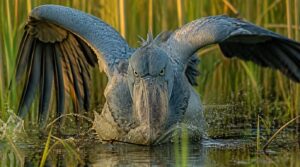
The Shoebill’s bill — up to 24 cm long with a hooked tip — isn’t just a striking visual. It’s a precision weapon built for one environment: the dense, oxygen-poor swamps of Central and East Africa.
You’ll notice the bill’s real genius in its suction mechanics. When the Shoebill collapses its full body weight forward onto prey, the wide, hollow bill creates a scooping effect that traps fish before they can escape. That hooked upper mandible then locks slippery lungfish in place instantly.
Patience is the other half of the strategy — sometimes hours of motionless waiting before a single strike.
Hornbill Casque Function
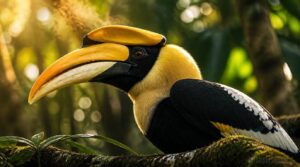
The hornbill’s casque is one of ornithology’s most fascinating multi-tool structures — part helmet, part radiator, part billboard.
You’ll find the casque’s keratin layer roughly 8 times thicker than standard beak keratin, backed by rod-like trabeculae dense enough to rival an elephant’s femur. That’s the combat shield — built for mid-air jousting collisions.
What surprises many observers is the casque thermoregulation role. Infrared studies confirm the large surface actively dissipates excess body heat, complementing other cooling mechanisms during activity.
Beyond function, you’ll notice the casque carries clear visual courtship signals — shape, size, and color vary between species and sexes, helping hornbills assess mates and rivals at a glance.
Three roles one structure controls simultaneously:
- Impact absorption during territorial combat, protecting the skull from serious injury
- Heat regulation, radiating warmth away from the body across varying temperatures
- Species recognition, signaling identity and fitness during social displays
This is evolutionary niche adaptation at its most elegant — avian anatomy solving several biological problems with a single growth.
Parrot Clay-Lick Visits

Think of a clay lick as a natural pharmacy carved into a riverbank — and parrots have been filling their prescriptions there long before scientists thought to ask why.
| Behavior | Purpose |
|---|---|
| Pecking sodium-rich clay | Supplements minerals scarce in seed-heavy diets |
| Peak visits between 9–11 AM | Maximizes safety through group numbers |
| Breeding-season surges | Helps with egg production and chick nutrition |
| Constant predator scanning | Offsets vulnerability during feeding exposure |
Macaws and Amazon parrots are the most frequent visitors across western Amazonian clay licks, where up to 18 parrot species may share a single exposed riverbank. The clay they target contains sodium levels roughly 40 times higher than the plant foods these birds eat daily. That gap matters most during breeding season, when females face serious nutritional stress producing eggs and feeding hatchlings simultaneously.
Toxin detoxification plays a secondary role. The clay binds alkaloids from ingested seeds and berries, neutralizing them before absorption — basically a built-in digestive filter.
You’ll notice the social dimension runs just as deep as the nutritional one. Birds don’t simply land and eat. Groups circle the lick in slow, deliberate flights first, scanning for predators before committing to descent. A single alarm call triggers immediate dispersal. Between feeding bouts, preening and pair-bonding behaviors strengthen social ties, making the lick a community gathering point, not just a mineral stop.
Conservation and Responsible Bird Ownership

Exotic birds face serious pressures from every direction — illegal trade, vanishing forests, and species introduced where they don’t belong.
Understanding these threats is the first step toward making choices that actually help, whether you’re a conservationist or someone considering ownership. Here’s what you need to know across five critical areas.
Illegal Wildlife Trade
The illegal wildlife trade generates an estimated $7–23 billion annually, making it the fourth-largest criminal enterprise on Earth — ranking just behind narcotics, human trafficking, and counterfeit goods. For birds alone, that translates to roughly 500,000 parrots pulled from the wild every year, with 75–80% dying before ever reaching a buyer.
The illegal wildlife trade earns up to $23 billion yearly — and kills 75–80% of its 500,000 annual parrot victims before a single sale
Trafficking network structures are deliberately layered. Local hunters capture birds, pass them to middlemen, and exporters move shipments through airport and seaport hubs concealed in ordinary cargo — sometimes inside luggage, sometimes packed so tightly that birds suffocate en route. Corrupt officials occasionally help secure those routes.
Digital market regulation hasn’t kept pace. Social media and online classified platforms now host live-animal listings with photos, prices, and direct contact details, and technology has consistently outrun the legal frameworks meant to stop it. CITES, the primary international treaty governing wildlife trade, has no centralized enforcement authority — each member country grips its own inspections and prosecutions, leaving significant gaps at borders and online.
One particularly damaging gap is wildlife laundering. Traffickers falsely declare wild-caught birds as captive-bred on export paperwork, and inspectors often lack the expertise to distinguish between species or verify breeding claims. That loophole quietly funnels endangered birds into legal-looking supply chains.
Zoonotic disease risks compound the conservation damage. Stressed birds packed in dense, unsanitary conditions along trafficking routes create ideal conditions for pathogens to jump species — a threat that extends well beyond the animals themselves.
Habitat Loss Threats
Trafficking routes aren’t the only thing working against exotic birds. On the ground — literally — habitat loss and fragmentation are quietly dismantling the ecosystems these species depend on.
Deforestation and agricultural expansion sit at the center of the problem. The Resplendent Quetzal lost nearly 80% of its cloud forest habitat in Chiapas alone between 1970 and 2000, cleared mostly for coffee farms and cattle pasture. Roads and expanding settlements then fragment whatever forest remains, cutting off the wildlife corridors young birds need to disperse and find mates.
Climate-driven range shifts compound the damage — rising temperatures push suitable habitat to higher elevations, and for species already confined to narrow altitude bands, that’s a shrinking margin. When extreme weather hits degraded patches, nesting success drops sharply.
Urban development adds pressure from a different direction, converting wetlands and woodlands into pavement that offers birds nothing — no foraging ground, no nesting cover, no shelter.
The encouraging news is that habitat restoration works. Where cloud forests have been protected as national parks or private reserves, Quetzal populations are holding steady or recovering. Connectivity corridors linking fragmented patches are equally important — without them, even protected areas can become isolated islands that slowly lose their most vulnerable species.
Invasive Species Risks
Restoration only works if you keep new threats out, and escaped exotic birds rank among the worst. A single pair of Monk Parakeets can found a colony that chews through power grids and crops within a few seasons. Ring-necked Parakeets outcompete native cavity-nesters for nesting holes, while House Sparrows and European Starlings spread fast through ecological competition and habitat alteration.
The deeper risks hide beneath the surface: disease transmission to native flocks, genetic hybridization that dilutes wild lineages, and disrupted seed-dispersal patterns that ripple through entire food webs. Left unchecked, this natural balance disruption compounds existing habitat fragmentation, pushing already vulnerable species closer to extinction.
Protected Breeding Programs
Behind every Spix’s Macaw success story sits a studbook, tracking lineage across facilities to prevent inbreeding. Programs pair unrelated individuals, sometimes using assisted reproductive technologies like artificial insemination or cryopreservation, to safeguard genetic diversity.
Strict husbandry standards, veterinary oversight, and ethical review boards guide breeding decisions—not popularity. You’ll find success measured by one number: self-sustaining wild populations within five to ten years.
Ethical Ownership Requirements
Owning a macaw isn’t just about love—it’s about legal considerations and accountability. Ethical exotic bird ownership demands:
- Federal permits and CITES compliance
- Transparency mandates on sourcing
- Avoiding illegal wildlife trade entirely
- Stakeholder inclusion with breeders, vets
- Benefit sharing toward conservation funding
Pet ownership responsibility means choosing captive-bred birds, never wild-caught ones.
Frequently Asked Questions (FAQs)
What are the types of exotic birds?
Like nature’s own paint palette splashed across the sky, you’ll find macaws, lorikeets, tanagers, pheasants, and birds of paradise — each showcasing distinct plumage patterns, beak shapes, and diets across tropical habitats worldwide.
Which pet talks all day?
African greys and cockatiels top the list, chattering for hours once trained. Their high intelligence drives rapid speech adoption, and consistent daily interaction keeps conversations flowing—rewarding you with endless mimicry, mood-driven phrases, and genuinely entertaining household chatter.
What is the most exotic bird?
A "feathered jewel" might top your list: the Resplendent Quetzal, with iridescent emerald plumage and three-foot tail feathers, embodies visual splendor and rare plumage patterns.
This sacred Mayan symbol thrives in Central America’s cloud forests, enchanting birders worldwide.
What is the name of the exotic bird they find in UP?
You’ll recognize that bird as Kevin, Russell’s name for a flightless, vividly plumed creature he and Carl meet in Pixar’s Up. Despite the masculine name, animators reveal her true gender mid-film—a playful twist on assumed avian identity.
What is the 100 bird’s name?
Kevin is the colorful tropical bird from Up. She’s a giant, vibrant species Charles Muntz pursued for years, visually inspired by the Himalayan Monal pheasant, known for its dazzling metallic plumage.
What permits are required for owning exotic birds?
Ownership freedom comes with paperwork. You’ll need CITES compliance, import documentation, and state holding permits.
Authorities require proof of legal origin plus avian health certification—since wildlife trafficking devastates wild populations, these layered protections genuinely matter for conservation status.
How much do exotic birds typically cost monthly?
Monthly costs for exotic bird care usually run $50–$300, covering premium pellets, fresh produce, toys, and routine vet visits. Larger species like macaws push toward the higher end, so budget a $10–$20 emergency fund monthly.
Which exotic birds can learn to speak words?
Funny enough, the bird most likely sitting in your local pet shop — the African Grey Parrot — ranks among the world’s top vocal learners, capable of acquiring thousands of words with daily training.
What diseases can exotic birds transmit to humans?
Exotic birds can carry psittacosis, salmonellosis, and campylobacteriosis — transmitted through inhaling aerosolized droppings or handling infected birds. Even healthy-looking birds shed pathogens, so wash hands thoroughly after any contact with cages or droppings.
How long do most exotic bird species live?
Most exotic birds live 15 to 80 years, depending on species. Small finches average 5–10 years, while large macaws can outlive their owners, reaching 60–80 years in captivity with proper diet and mental stimulation.
Conclusion
These birds don’t just wing it—every bill, feather, and behavior is precision-engineered by millions of years of pressure. The exotic bird types found across rainforests, wetlands, and alpine slopes tell a story written in adaptation, one species at a time.
Protect their habitats. Support ethical breeding programs. Stay curious about what each species reveals. The rarest birds on Earth aren’t just beautiful—they’re blueprints for survival that no textbook alone can replicate.