This site is supported by our readers. We may earn a commission, at no cost to you, if you purchase through links.
Florida packs more raptor diversity into one state than most birders expect—at least 20 species, from a tiny American Kestrel you could hold in one hand to a Bald Eagle with an 8.5-foot wingspan that commands every sky it enters.
That range isn’t luck. It’s the direct result of Florida’s wild geographic mix: Everglades wetlands, coastal estuaries, ancient pine scrub, and sprawling grasslands all stacked within a few hours’ drive of each other.
Each habitat draws a different predator, shaped by millions of years of evolutionary pressure into something almost perfectly designed for its environment.
Whether you’re scanning a prairie for a Crested Caracara or watching an Osprey fold its wings and knife into open water, Florida’s birds of prey offer some of the most exceptional wildlife watching in North America.
Table Of Contents
- Key Takeaways
- Florida Birds of Prey Overview
- Hawks, Eagles, and Vultures
- Owls, Falcons, and Kites
- Identifying Florida Raptors in The Field
- Habitats, Nesting, and Conservation
- Frequently Asked Questions (FAQs)
- What birds of prey are in Florida?
- What birds are hunted in Florida?
- What are the most interesting Florida Birds of prey?
- What do birds in Florida eat?
- Are there predatory birds in Florida?
- Do birds of prey live in Florida?
- How many birds of prey are in Florida?
- Are there birds in Florida?
- What is the large predatory bird in Florida?
- What is the rarest bird in Florida?
- Conclusion
Key Takeaways
- Florida packs at least 20 raptor species into one state because its wildly varied habitats — Everglades wetlands, pine scrub, coastal estuaries, open grasslands — each attracts a different predator shaped by millions of years of evolution.
- Size alone tells the story: the American Kestrel fits in your palm at under 10 inches, while the Bald Eagle stretches an 8.5-foot wingspan — and every species between them fills a specific role in keeping Florida’s ecosystems running.
- Spotting the right raptor starts with reading four quick field clues: tail shape, wing silhouette, flight pattern, and habitat — a Cooper’s Hawk threading a wooded yard tells a completely different story than an Osprey folding into a plunge dive over open water.
- Florida’s raptors face real, daily threats — powerline electrocution, lead poisoning from carcasses, rodenticide creeping up the food chain — but full protection under the Migratory Bird Treaty Act, active habitat restoration, and citizen science monitoring are pushing back hard.
Florida Birds of Prey Overview
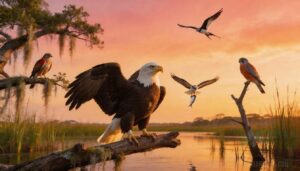
Florida is home to 20 raptor species — and each one is more fascinating than the last. From the tiny American Kestrel to the commanding Bald Eagle, these birds reveal a lot about how wild Florida actually works.
Coastal habitats are where many of these hunters truly shine — explore Florida Gulf Coast birds and the raptors that rule their skies to see which species call the shoreline home.
Here’s what you need to know before we break them all down.
How Many Raptor Species Live in Florida
Florida’s raptor inventory is genuinely impressive. The statewide species list includes at least 20 birds of prey, spanning everything from tiny falcons to massive eagles — a taxonomic richness that reflects the state’s exceptional habitat diversity.
From the Everglades to coastal estuaries, Florida raptor fauna thrives across wildly different landscapes.
For any raptor identification guide enthusiast, the Sunshine State is basically a dream destination.
The state maintains stable raptor populations, as noted in recent surveys.
Resident, Migratory, and Wintering Raptors
Not every raptor you spot in Florida calls it home year-round. The state hosts three distinct groups:
- Residents like the Red-shouldered Hawk show strong territory fidelity, returning to the same nest sites annually.
- Migrants pass through using stopover habitat selection tied to climate-driven migration timing.
- Winter visitors rely on Florida’s wetlands for winter roosting strategies.
- Juveniles wander widely through juvenile dispersal patterns before settling.
Smallest to Largest Florida Birds of Prey
From tiny to towering, Florida’s raptor size gradient is genuinely striking.
The American Kestrel barely fills your hand — just 8.5 to 9.5 inches long, with a wingspan of 20 to 24 inches. Compare that to the Bald Eagle, stretching 6 to 7.5 feet across.
That wing span range, body proportions, and weight variation make raptor size comparison and identification tips your sharpest field tool.
Why Raptors Matter in Florida Ecosystems
Size tells only half the story. The real power of Florida’s raptors lies in what they do.
Through Pest Control, Food Web Balance, and Carrion Cleanup, they quietly run the ecosystem.
Vultures handle Nutrient Recycling from carcasses. Eagles signal wetland health as a Habitat Indicator.
The Role of raptors in Florida ecosystems — from top predator role to raptor diet diversity across habitats — keeps nature honest.
Hawks, Eagles, and Vultures

Florida’s skies belong to some serious heavyweights — and this group is where the real drama unfolds. From broad-winged hunters riding thermals to scavengers that keep the landscape clean, hawks, eagles, and vultures each play a distinct role in the wild.
Here are nine species you’re most likely to spot across the state.
Red-tailed Hawk
The Red-tailed Hawk (Buteo jamaicensis) is widely considered Florida’s most recognizable raptor. Its signature rusty-red plumage on the tail makes identification easy — once you’ve seen it, you won’t forget it.
Females are larger due to size dimorphism, reaching 25 inches. Diet skews heavily toward rodents.
Their soaring mating displays and piercing call are unmistakable across open habitat.
Red-shouldered Hawk
Meet Florida’s own subspecies, Buteo lineatus extimus — a hawk built for wet woodlands. Its cypress swamp preference runs deep, drawing it to river edges and flooded pine forests year‑round.
Watch for its perch hunting technique: it sits quietly, scanning below.
Age-based plumage shifts from spotted juveniles to rich rust‑barred adults.
Its mammal‑reptile diet and loud territorial whistles make it unmistakable.
Cooper’s Hawk
The Cooper’s Hawk (Accipiter cooperii) is a master of stealth — built for threading through Florida’s wooded neighborhoods and forest edges like it owns the place. Its wing morphology (short, rounded wings; long rudder tail) makes tight turns through branches look smooth.
Watch for these field clues:
- Eye color change from yellow‑green in juveniles to deep red in adults
- Blue‑gray back, reddish‑barred chest, and a distinctly large‑looking head
- Ambush hunting style — surprise over speed
Population fluctuations since DDT’s removal have stabilized near one million birds.
Sharp-shinned Hawk
The Sharp-shinned Hawk (Accipiter striatus) is like the Cooper’s Hawk’s scrappier little sibling — smaller in size comparison, but just as fierce.
At just 10–14 inches long, this Sharp-shinned hawk visits Florida mainly from fall through spring, making migration timing everything for spotting one.
It hunts songbirds with explosive bursts, though prey diversity includes lizards, bats, and insects.
Banding data links Florida sightings to northern breeding forests.
Bald Eagle
Few raptors command attention like the Bald Eagle (Haliaeetus leucocephalus) — Florida’s undisputed dominant bird. Wing span records reach 8.5 feet, dwarfing nearly every other raptor in the sky.
Here’s what makes Florida eagles impressive:
- Fish Harvest Techniques — they dive, snatch, or pirate fish straight from Ospreys
- Juvenile Plumage — mottled brown for years before that iconic white head emerges
- Territorial Displays — dramatic aerial lock‑talons spirals defend prime nesting zones
- Population Trends — Florida recorded 1,488 nests across 55 counties in 2023–2024
Conservation efforts for the bald eagle reversed devastating impact of DDT on eagle populations, leading to full federal delisting by 2007. Understanding habitat preferences of Florida raptors and range mapping and distribution of Florida raptors show central wetlands — Lake Okeechobee, St. Johns River — remain eagle strongholds.
Osprey
If there’s one Florida raptor that’s basically a fishing machine, it’s the Osprey (Pandion haliaetus). Its M-shaped silhouette overhead is unmistakable. That distinctive wing bend pairs perfectly with a reversible toe and barbed foot pads — gripping slippery fish is literally built into its biology.
The Osprey is Florida’s ultimate fishing machine, built from the water up with a reversible toe and barbed pads to grip every slippery catch
With a fish diet exceeding 99%, impressive longevity records of 25+ years, and epic long migrations, Florida’s waterways are its domain.
Turkey Vulture
From the Osprey’s fish-first lifestyle, meet a bird with a very different table — the Turkey Vulture (Cathartes aura). Its superpower? Carrion Detection through a remarkable sense of smell, rare among birds.
Here’s what makes this master of Kettle Soaring fascinating:
- Smell Foraging — detects carcasses up to 8 miles away
- Thermal Riding — soars for hours with barely a wingbeat
- Ground Nesting — lays eggs in hollow trees or sheltered spots, no nest built
- Scavenging behavior of vultures — feeds mainly on fresh carrion along roadsides and pastures
- Habitat preferences of Florida raptors — farmland, forest edges, and open country statewide
Black Vulture
Meet the Black Vulture (Coragyps atratus) — the Turkey Vulture’s bolder, pushier cousin.
Where Turkey Vultures rely on smell for Carrion Detection, Black Vultures use sharp eyesight and Flock Dynamics, shadowing other vultures straight to the meal.
Cavity Nesting in hollow trees or abandoned buildings keeps eggs safe.
In Florida, Territorial Aggression near carcasses and occasional Human Conflict over livestock make this Scavenging bird impossible to ignore.
Crested Caracara
Now for something that’ll stop you mid-trail — the Crested Caracara (Caracara plancus). Unlike the Black Vulture’s aerial mob tactics, this bird walks its meals down.
Ground Foraging is its signature move across Florida’s Prairie Range. Watch for Cabbage Palm Nesting pairs defending territory with bold Territorial Displays. Its striking black-and-white identification marks are unmistakable — but Road Mortality threatens this federally protected species daily.
Owls, Falcons, and Kites
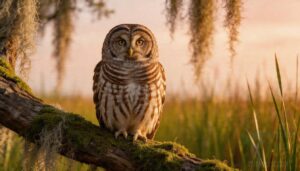
Florida’s owls, falcons, and kites are a different breed entirely — quieter hunters, faster fliers, and some of the most specialized predators you’ll ever spot in the wild. Each species here brings something unexpected to the table, from silent midnight ambushes to record-breaking aerial dives.
Here’s a closer look at the eleven that call Florida home.
Great Horned Owl
The Great Horned Owl (Bubo virginianus) is Florida’s top nocturnal predator — a master of stealth built for the dark.
Its wing morphology features serrated feather edges that silence flight completely.
Spanning up to 145 cm, it nests early in winter, reclaiming hawk nests without apology.
That haunting "hoo-hoo" — vocalizations of owls at their most primal — will stop you cold.
Barred Owl
The Barred Owl (Strix varia) haunts Florida’s swamp forests like a secret keeper. Its earless owl morphology — no tufts, just a round, dark-eyed face — sets it apart immediately.
Famous for its "Who cooks for you?" call, it pairs silent flight with fierce territory defense. It forages nocturnally for mammals, frogs, and fish, nesting in hollow trees deep in wooded wetlands.
Barn Owl
The Barn Owl (Tyto alba) is Florida’s ghostly farm guardian — pale, silent, and built for darkness. Its heart-shaped facial disc and asymmetrical ears together create nature’s perfect sound-targeting system.
Three reasons it matters:
- Expert rodent control on open farmland
- Benefits from artificial nest boxes, especially in the Everglades
- Can raise a second brood in southern Florida’s warm fall season
Burrowing Owl
Unlike most owls, the Burrowing Owl (Athene cunicularia) is a diurnal hunting specialist — those bright yellow eyes aren’t just striking; eye color significance runs deep, signaling sharp daytime vision.
In Florida, this tiny 9‑inch owl digs its own burrow construction for nesting, uses territory marking behaviors near entrances, and thrives in open habitat.
Sadly, rodenticide risks threaten urban populations across Florida’s diet‑rich suburban lots.
Short-eared Owl
The Short-eared Owl is a daylight hunter — rare for owls — making dawn activity your best window to spot it. It prefers open habitat use across grasslands, marshes, and agricultural fields.
Grassland hunting drives its rodent specialization, with voles forming nearly its entire diet.
Watch for its moth-like, floppy wingbeat low over fields.
It nests directly on the ground — true ground nesting simplicity.
American Kestrel
North America’s smallest falcon packs serious color into a tiny frame. The American Kestrel is a master of hovering technique — facing the wind, wings beating furiously — before dropping onto prey below. Sexual dimorphism is striking: males wear slate-blue wings, females lean rufous-brown.
Watch for these four field clues in Florida:
- Perch preference — fence posts, wires, utility poles
- Prey diversity — grasshoppers, voles, lizards, small birds
- Cavity competition — can’t excavate; needs woodpecker holes or nest boxes
- Habitat — open pine savanna, sandhill scrub
Merlin
The Merlin (Falco columbarius) visits Florida purely as a winter guest — no nesting, just seasonal hunting. Its Distinctive Plumage tells the story fast: blue-gray above in males, brown in females, streaked below on both.
| Feature | Detail | Why It Matters |
|---|---|---|
| Identification | Pointed wings, banded tail | Separates it from Sharp-shinned Hawk |
| Wintering Range | Coastal marshes, open grasslands | Prime Florida habitat |
| Prey Capture Tactics | Aerial pursuit of small birds | Explosive, low-altitude chases |
| Urban Presence | Towns near abundant sparrows | Surprisingly adaptable hunter |
| Reproductive Cycle | Breeds far north; 4–5 eggs | Absent from Florida in summer |
Peregrine Falcon
If the Merlin is fast, the Peregrine Falcon (Falco peregrinus) is physics‑defying. Stooping mechanics at 200 mph make it Earth’s fastest animal — it practically becomes a feathered missile. Florida sees them mainly as winter visitors during seasonal migration, hunting coastal mudflats with precision.
- Urban perch usage: Bridges and tall buildings substitute perfectly for cliffs
- Prey diversity: Pigeons, shorebirds, ducks — anything airborne qualifies
- Molt timing: Gradual feather replacement keeps hunting performance sharp year‑round
- Nesting material preference: Bare scrapes only — no nest construction needed
Swallow-tailed Kite
The Swallow-tailed Kite (Elanoides forficatus) makes the Peregrine look earthbound. This Swallow-tailed Kite masters Tail Rudder Mechanics — twisting its deep forked tail like a joystick to bank, circle, and pivot without effort. It’s the acrobat of wetland‑dependent raptors in Florida.
Aerial Insect Hunting happens entirely on the wing — dragonflies snatched mid‑flight, tree frogs plucked from branches without landing.
| Feature | Detail | Significance |
|---|---|---|
| Wingspan | 1.2–1.36 m | Smooth soaring ability |
| Seasonal Migration Window | March–September | Temporary Florida resident |
| Wetland Tree Nesting | Slash pine, bald cypress | Tied to healthy wetlands |
Habitat Degradation Impact is real — shrinking swamps shrink their future. Understanding the migration patterns of Florida kites and the habitat preferences of Florida birds of prey helps protect them before they’re just a memory over the Everglades.
Mississippi Kite
Another aerial artist worth knowing is the Mississippi Kite (Ictinia mississippiensis). Measuring just 12–16 inches, it packs serious performance into a compact frame.
Its Tail Morphology — that deeply forked shape — drives easy Flight Display and Group Soaring over Florida treetops.
Insect Diet dominates: cicadas, dragonflies, and grasshoppers snatched mid‑flight. Urban Nesting in parks fits its flexible habitat needs, before migration calls it south.
Snail Kite
If the Mississippi Kite hunts whatever flies by, the Snail Kite does the opposite — it picks one prey and masters it completely. Snail Prey Specialization defines this bird: its deeply curved bill extracts apple snails from freshwater marshes with surgical precision.
As Invasive Snail Shift and Habitat Water Level changes drive Range Expansion Trends, this federally endangered species — one of Florida’s most fascinating wetland-dependent raptors — keeps adapting.
Identifying Florida Raptors in The Field
Spotting a raptor in the wild is one thing — knowing exactly what you’re looking at is where the real magic happens.
Florida’s 20 raptor species each carry their own set of clues, from tail color and wing shape to the sounds they make and the places they hunt.
Here’s what to look for when you’re out in the field.
Plumage, Tail Shape, and Silhouette

Knowing what to look for transforms a confusing blur of feathers into a confident ID.
Start with these four visual clues:
- Tail Banding Patterns — Red-tailed Hawks show a bold rusty tail; Red-shouldered Hawks wear narrow white bands with a dark tip.
- M-Shaped Silhouette — Ospreys lock into that distinctive M-shape mid-glide.
- Wing Shape Indicators — Buteos look broad and bulky; accipiters run slim and long-tailed.
- Juvenile Plumage Differences — Young Red-shouldered Hawks look white with brown spotting, nothing like their rufous parents.
Flight Patterns and Hunting Behavior
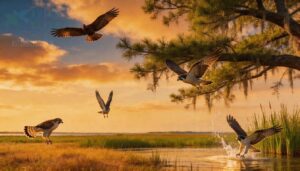
How a raptor flies tells you almost as much as its feathers do.
| Flight Style | Raptor | Hunting Behavior |
|---|---|---|
| Soaring Thermals | Turkey Vulture | Circles high, scans for carrion |
| Stealth Approaches | Cooper’s Hawk | Ambushes prey through dense cover |
| High-Speed Dives | Peregrine Falcon | Stoops on birds mid-air |
American Kestrels master Hovering Hunts over grasslands. Ospreys nail Ground Water Foraging with plunge-dives. Each flight adaptation reveals the hunter.
Calls and Vocal Clues
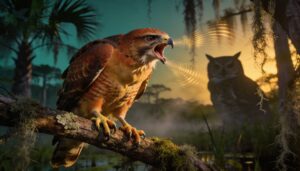
Before you even spot a raptor, its voice gives it away. The Red-shouldered Hawk’s bold "kee-aah" — repeated insistently — is one of Florida’s most reliable Acoustic Territory Markers. Peregrine Falcons clip sharp "klee-klee" bursts; owls shift their Vocalization patterns nocturnally.
Tuning into Seasonal Call Patterns and Frequency Range Comparison transforms your birdwatching tips toolkit — sound becomes your sharpest identification weapon.
Habitat-Based Identification Tips

Where you stand tells you half the story.
Water Edge Cues point straight to ospreys and bald eagles; Open Grassland Indicators like short scrub, scream kestrel or burrowing owl.
Spot Tall Perch Signals — a lone hawk on a utility pole near a marsh? That’s a Marsh Raptor Clue worth following.
City Perch Tips: tall buildings often host peregrines.
Comparing Similar Hawk Species
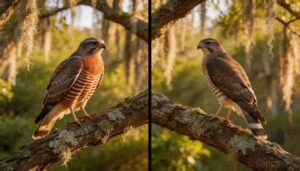
Cooper’s and Sharp-shinned Hawks trip up even seasoned birders.
Differentiating similar hawk species comes down to a few quick checks. Cooper’s shows a rounded Tail Tip, square Head Shape, and thicker Leg Thickness. Sharp-shinned looks sleeker with a squarer tail.
Compare Chest Pattern too — Cooper’s has neat reddish barring. Wing Span and plumage coloration seal the deal.
Juvenile Vs Adult Raptor Differences
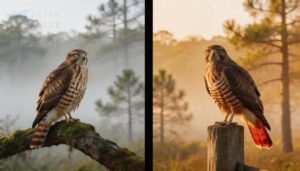
Young raptors are nature’s masterclass in disguise. Plumage Maturity transforms birds dramatically — juvenile Cooper’s Hawks wear streaky buff below, then shift to rufous barring as adults.
Watch for Tail Pattern Shift too: that iconic brick-red tail on a Red-tailed Hawk—purely adult.
Eye Color Change, Feather Shape Variation, and Molt Timing all reveal age — making every field encounter a living puzzle worth solving.
Habitats, Nesting, and Conservation

Florida’s raptors don’t just show up anywhere — every species has a place it calls home, a nesting strategy it swears by, and a set of pressures it’s up against. Where a bird lives shapes everything about how it hunts, breeds, and survives.
Here’s a closer look at the habitats, nesting habits, and conservation realities defining Florida’s birds of prey today.
Wetland Raptors of The Everglades
The Everglades isn’t just a swamp — it’s a living food web, and wetland-dependent raptors in Florida are right at the center of it. Hydroperiod Influence, Water Depth Preference, and Apple Snail Availability shape where species like the Snail Kite hunt daily.
Key zones include:
- Everglades National Park — core Snail Kite foraging ground
- Marsh Vegetation Structure drives Osprey nest placement
- Predator-Prey Dynamics shift with seasonal flooding
- Swallow-tailed Kite nests near open marsh edges
- Apple snail density dictates Snail Kite territory entirely
Forest, Scrub, and Grassland Species
Move away from open water, and Florida’s fire-dependent habitats tell a completely different story. Barred Owls rule the forest canopy, while grassland raptors like the American Kestrel patrol open fields, hunting lizards and grasshoppers across 300‑hectare territories.
Scrub‑jay ecology depends on periodic burns keeping oak shrubs low — and without that open ground, the whole system quietly unravels.
Coastal and Urban Birds of Prey
From forest edges to city skylines, Florida’s raptors follow the food. Ospreys nest on Artificial Nest Platforms above marinas, while Peregrine Falcons claim rooftop ledges like concrete cliffs.
Urban Prey Dynamics work in their favor — pigeons, rats, and bird feeder crowds keep them fed.
Coastal Foraging Strategies shift too, with eagles patrolling estuaries and beaches where prey stays concentrated and visible.
Nesting Sites and Breeding Habits
Nesting habits and breeding ecology of Florida raptors reveal as much personality as plumage does. Here’s what shapes nest site selection among Florida raptors:
- Site Fidelity — Bald Eagles return to the same nest for decades, enlarging it yearly.
- Nest Material Selection — Most species use sticks lined with softer grasses or feathers.
- Breeding Timing — Many raptors begin before spring songbirds, buying time for slow‑developing chicks.
- Clutch Size Variation — Smaller clutches mean intense, focused parental investment per chick.
- Parental Feeding Strategies — Adults hunt close to the nest, delivering prey directly until fledging.
Seasonal Movement and Migration
Florida’s skies don’t stay still for long. Fall Migration Timing peaks between late September and mid-October, when the narrowing peninsula funnels thousands of raptors through the Keys — a textbook example of Raptor Migration Corridors doing exactly what geography intends.
Flyway Overwater Crossings stretch roughly 350 km toward the Caribbean.
Migration Monitoring Methods at Curry Hammock track Seasonal Abundance of Raptor Species in Florida, including Wintering Raptor Patterns for species like Broad-winged Hawks that quietly stay behind.
Threats to Florida Raptors
Raptors here face a gauntlet of real threats.
Powerline collisions and electrocution kill birds daily, while lead poisoning from contaminated carcasses quietly devastates scavengers.
Rodenticide toxicity moves invisibly up the food chain.
Human disturbance near nests tanks breeding success, and avian influenza hit coastal Bald Eagles especially hard in 2022.
Add habitat fragmentation, and you’ve got a system under serious pressure.
Conservation Efforts and Protected Species
Despite the threats stacking up, there’s real momentum behind raptor recovery in Florida.
Every native raptor here carries full protection under the Migratory Bird Treaty Act — covering the birds, their nests, and eggs. That’s Legal Nest Protection with teeth.
Here’s what’s actively working:
- Recovery Planning guides species like the threatened Crested Caracara back from the edge
- Habitat Restoration targets wetlands, prairies, and corridors that raptors genuinely need
- Public Education programs build community stewardship around active nest sites
- Citizen Science networks track population shifts with surprising precision
- Conservation status monitoring — informed by hard lessons from DDT’s collapse of eagle populations — now shapes smarter, faster responses
Frequently Asked Questions (FAQs)
What birds of prey are in Florida?
You’ll find 20 impressive raptor species soaring across the Sunshine State — hawks, eagles, owls, falcons, kites, and vultures — each shaped by unique dietary specializations, prey capture techniques, and habitat preferences across Florida’s wildly diverse regions.
What birds are hunted in Florida?
Hunters in Florida can legally pursue mourning doves, ducks, snipe, woodcock, rails, and gallinules — each governed by strict Migratory Game Regulations, Game Bird Seasons, and Bag Limits to keep wetland ecosystems thriving.
What are the most interesting Florida Birds of prey?
Florida’s birds of prey are endlessly fascinating — from rare color morphs to surprising hybridization events, every species tells a story.
Predator-prey dynamics here shift with seasons, habitats, and climate change impacts in ways that’ll genuinely surprise you.
What do birds in Florida eat?
Seed Preferences, Insect Foraging, Fruit Consumption — birds here eat it all.
From nectar feeding hummingbirds to carrion feeding vultures, Florida’s avian diet is wildly diverse, shaped entirely by habitat, season, and species.
Are there predatory birds in Florida?
Yes — Florida is absolutely packed with predatory birds. The state hosts 20 raptor species, from tiny falcons to massive eagles, prowling wetlands, forests, and coastlines year-round.
Do birds of prey live in Florida?
Absolutely — the skies here are anything but empty. Florida hosts 20 raptor species, from tiny kestrels to massive Bald Eagles, spread across wetlands, forests, and coastlines throughout the Sunshine State.
How many birds of prey are in Florida?
Depending on the source, you’ll find anywhere from 26 to 37 raptor species recorded statewide — a gap that reflects real data source discrepancies in survey methodology and whether rare visitors get counted.
Are there birds in Florida?
Florida is a birder’s paradise — with 559 recorded species, it’s one of the richest states for birding tourism and citizen science programs in the entire country.
What is the large predatory bird in Florida?
The Bald Eagle reigns as Florida’s largest bird of prey, boasting a wingspan up to 8 feet, striking white-headed plumage development, and a near-exclusive fish diet — a true conservation success story.
What is the rarest bird in Florida?
The rarest bird in Florida is the Florida Grasshopper Sparrow — fewer than 100 remain wild.
For endangered raptors, the Snail Kite tops the list, its population tied directly to Everglades wetland habitat.
Conclusion
Something moves in the cypress shadows—wings spread, talons ready. That moment of stillness before a raptor strikes?
That’s Florida handing you something rare. Studying Florida birds of prey isn’t just birdwatching; it’s learning how wild systems actually work, predator by predator.
Every hawk circling a prairie or owl claiming the dark tells a deeper story. Once you start reading those stories, you won’t be able to stop looking up.
- https://en.wikipedia.org/wiki/Pandion_(bird)
- https://myfwc.com/wildlifehabitats/profiles/birds/raptors-and-vultures/peregrine-falcon/
- https://tickets.audubon.org/cbop/events/89120a27-206f-4ac7-447f-69e3338f6596
- https://act.audubon.org/Xk-VEkWkdEm-UCyeWEnZkg2
- https://www.yourobserver.com/news/2024/apr/20/birds-prey-control-rodent-populations/