This site is supported by our readers. We may earn a commission, at no cost to you, if you purchase through links.

A bird bath can turn green in as little as 48 hours during summer. Most people blame the sun or the birds, but the real culprit is standing water—a perfect incubator for algae that feeds on warmth, nutrients, and stillness.
Scrubbing the basin every few days works, but it’s a losing battle when the conditions that grow algae never change. Water circulation breaks that cycle at the source: moving water dilutes nutrients, cuts oxygen-starved dead zones, and physically disrupts algae before it anchors to the basin surface.
Understanding how water circulation prevents algae turns a frustrating maintenance problem into a manageable system.
Table Of Contents
- Key Takeaways
- Yes, Water Circulation Prevents Algae
- Why Stagnant Bird Baths Grow Algae
- How Moving Water Blocks Algae
- Oxygen’s Role in Cleaner Water
- Best Circulation Options for Bird Baths
- Choosing The Right Pump Size
- Solar Fountain Benefits for Algae Control
- Where to Place Circulating Bird Baths
- Maintenance That Keeps Water Moving
- Common Circulation Mistakes to Avoid
- Frequently Asked Questions (FAQs)
- Conclusion
Key Takeaways
- Moving water cuts algae growth by up to 40% by disrupting spore attachment, spreading nutrients evenly, and pushing dissolved oxygen above 90% in most small basins.
- Stagnant water above 25–30°C doubles algae biomass every 24–48 hours, especially when bird droppings, pollen, and leaf debris pile up unchecked.
- A 25–50 GPH pump sized to your basin — paired with partial shade placement and weekly scrubbing — handles most algae problems without any chemicals.
- Solar fountain pumps are the most practical all-in-one fix: they run continuously during daylight, cool the water through evaporation, and also cut mosquito breeding risk.
Yes, Water Circulation Prevents Algae
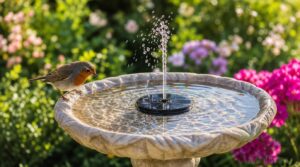
Water circulation is one of the most effective things you can do to stop algae before it takes hold. Moving water works against algae in several key ways, and understanding them helps you make smarter choices for your bird bath.
Research backs this up — moving water cuts algae growth by up to 40%, which makes circulation one of the simplest wins you can get.
Here’s what’s actually happening beneath the surface.
Reduces Stagnant Water
When water keeps moving, stagnation doesn’t get a foothold. Continuous water turnover through a pump creates aeration currents that refresh your basin constantly, supporting organic matter breakdown and temperature equalization before algae can establish itself.
- Prevents low-oxygen pockets where stagnant water triggers algae prevention failures
- Moving water dilutes nutrients through nutrient dilution across the entire basin
- Circulation flushes settled sediments that trap growth-fueling compounds
- Aeration currents reduce mosquito habitats naturally
- Water circulation keeps the whole basin consistently refreshed
Limits Algae Attachment
Moving water does more than prevent stagnation — it physically stops algae from taking hold. Hydrodynamic shear creates a scrubbing force along basin walls, reducing stable attachment sites. Surface microtexture below 1.0 micrometers, combined with anti-adhesion coatings, can cut algal settlement by up to 40 percent.
Low-nutrient surfaces and temperature regulation through surface agitation further weaken algae’s grip before colonies form. The principle of hydrodynamic manipulation alters nutrients further limits nutrient buildup, curbing algal growth.
| Attachment Factor | Circulation Effect |
|---|---|
| Algal spore contact | Flushed before adhesion |
| Surface biofilm | Sheared off by flow |
| Nutrient hotspots | Dispersed by movement |
| Surface temperature | Lowered through evaporation |
| Colony formation | Disrupted by constant agitation |
Improves Oxygen Levels
Circulation does something just as important beneath the surface: it raises dissolved oxygen levels. Through enhanced gas exchange and surface agitation, moving water drives oxygen saturation above 90 percent in most small basins. That’s where aerobic bacteria thrive and algae struggle.
- Pump aeration and microbubble infusion mix oxygen-rich surface water downward
- Outdoor water circulation eliminates low-oxygen dead zones through thermal mixing benefits
- Dissolved oxygen stability suppresses the hypoxic pockets algae quietly exploit
Disrupts Algae Spores
Beyond oxygen, circulation targets algae at the spore stage. Micro-turbulence disruption and shear stress physically remove spores from basin surfaces before they anchor.
Adjustable flow settings on your pump dilute nutrients consistently, starving spores early by disrupting nutrient accumulation.
Outdoor water circulation effectively prevents an algae bloom prevention cycle from ever starting in your bird bath.
Why Stagnant Bird Baths Grow Algae
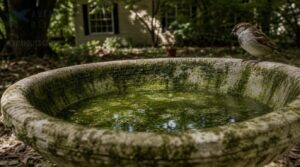
Stagnant bird baths are basically an open invitation for algae — and the conditions that cause it are more predictable than you might think.
A few key factors work together to turn still water into a green mess, sometimes within 24 hours.
Here’s what you’re actually dealing with.
Warm Still Water
Think of your bird bath as a slow cooker on a summer afternoon. When stagnant water sits above 25–30°C, metabolic acceleration occurs — algae double their biomass every 24–48 hours. Warm temperatures trigger nutrient release from settled debris and drive stratification effects that trap phosphorus near the surface.
These microbial shifts favor algae, turning clean water green surprisingly fast.
Sunlight Exposure
Sunlight exposure transforms your bird bath into a photosynthesis engine. Between 1 PM and 4 PM, Solar Heat Spike conditions and Daytime Light Peaks intensify, simultaneously driving Sunlit Nutrient Uptake and UV Photoinhibition cycles. Sun Angle Effects dictate how deeply light penetrates the basin.
Full sun accelerates algae doubling within 24–48 hours, while partial shade significantly slows photosynthetic activity.
- Full sun accelerates algae doubling within 24–48 hours
- Partial shade slows photosynthetic activity noticeably
- Clear water amplifies light penetration to basin walls
- A pump disrupts surface light absorption, aiding algae control
Clear water maximizes light penetration to basin walls, whereas a pump disrupts surface light absorption, directly supporting algae control efforts.
Bird Droppings
Every visit to your bird bath leaves behind more than splashes. Bird droppings carry a dense uric acid composition packed with nitrogen and phosphorus — the exact nutrients algae thrive on.
This nutrient buildup accelerates algae growth rapidly, raising real pathogen risks for visiting birds.
Consistent water quality management and smart pump reliability keep those droppings from turning your bath into a green mess.
Leaf and Pollen Buildup
Leaves and pollen are quiet troublemakers in stagnant water. Leaf particulate breaks down within 24 hours, and pollen deposition adds a surface film formation that traps more debris daily. This organic load triggers a microbial shift that accelerates nutrient buildup fast.
Your pump and water quality management strategy must account for:
- Pollen films doubling during heat waves
- Tannins from decomposing leaves discoloring water
- Debris patches creating algae-prone zones
Low Oxygen Zones
Stagnant water stratifies rapidly — warm layers sit atop, cold water sinks below, and dissolved oxygen plummets in between. This creates low-oxygen pockets that mirror coastal Oxygen Minimum Zones, where hypoxic stress enables algae dominance.
Thermal stratification blocks oxygen replenishment, while nutrient runoff from droppings unleashes unchecked biofilm growth.
| Condition | Effect | Risk Level |
|---|---|---|
| Thermal Stratification | Traps low dissolved oxygen | High |
| Nutrient Runoff | Accelerates algae growth | High |
| Zero Circulation | Creates hypoxic stress zones | Critical |
How Moving Water Blocks Algae
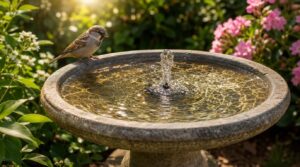
Still water gives algae everything it needs to take over — sunlight, nutrients, and time. Moving water changes that equation fast. Here’s exactly how circulation works against algae at every step.
Breaks Surface Stillness
A perfectly still bird bath is an open invitation for algae. Even gentle micro-wave action—the kind a small pump creates—disrupts surface film, preventing algae from anchoring. Edge ripple dynamics push water along basin walls, disrupting stagnation before it sets in.
Here’s what that movement actually does:
- Gentle wave patterns mix air and water continuously, raising oxygen levels across the bath.
- Air-water mixing prevents the warm, nutrient-rich surface layer that fuels algae growth.
- Edge ripple dynamics keep boundary walls clear of early biofilm attachment.
Even a modest motion-activated water spray eliminates the stagnant conditions algae depend on most.
Flushes Loose Algae
Moving water doesn’t just slow algae—it physically removes it. A 25–50 GPH pump creates enough current for suspended algae ejection and water column cleansing, carrying loose cells away before they reattach. Small submersible pumps handle this surface algae removal continuously, making loose cell displacement part of your bath’s daily rhythm.
Combined with daily water changes, an algae filtration boost happens naturally, without chemicals.
Spreads Nutrients Evenly
Circulation also manages nutrient control. When stagnant water sits still, nitrogen and phosphorus settle into concentrated pockets—exactly where algae thrives.
A 25–50 gph pump or small submersible pumps deliver consistent nutrient distribution throughout the basin, achieving even dispersion that denies algae any preferential feeding zones. Steady nutrient circulation keeps balanced resource mixing working in your favor, not algae’s.
Prevents Growth Hotspots
Even nutrient distribution only goes so far if warm pockets still linger in corners. That’s where Flow Pattern Design matters — your GPH pump needs to reach every inch of the basin. Shear Stress Zones created by a solar-powered fountain break up Microhabitat Disruption points before algae colonies anchor.
Consistent movement delivers:
- Nutrient Dilution across the full water column
- Temperature Uniformity that eliminates warm stagnant water corners
- Disruption of algae growth attachment sites
- Motion-activated water spray patterns that deny microhabitat formation
- Even pressure that prevents isolated dead zones
Supports Beneficial Bacteria
Oxygen-rich water from your pump doesn’t just slow algae — it actively feeds beneficial bacteria that act as a natural biofilter.
These microbes thrive on Prebiotic Substrates like fine organic traces, delivering Probiotic Bacterial Growth that crowds out algae.
| Factor | Still Water | Circulating Water |
|---|---|---|
| Microbial Diversity Boost | Low | High |
| Oxygen-enhanced Metabolism | Minimal | Active |
| Balanced Microbiome Health | Unstable | Stable |
Oxygen’s Role in Cleaner Water
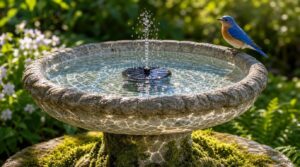
Oxygen is quietly doing a lot of heavy lifting in your bird bath. When circulation keeps it flowing through the water, it creates conditions that actively work against algae — in more ways than one.
Here’s exactly how that plays out.
Aerobic Bacteria Benefits
When your pump keeps water moving, it does more than fight stagnation — it quietly builds an invisible defense system. Higher dissolved oxygen levels fuel beneficial bacteria that drive organic waste degradation and nutrient mineralization, breaking down bird droppings and debris before algae can feed on them.
This process functions as a living biofilter, supporting ecosystem resilience and pathogen suppression without relying on algae prevention tablets.
Less Algae Competition
When aerobic bacteria thrive in well-oxygenated water, algae simply can’t win the nutrient race. Beneficial microbes consume nitrogen and phosphorus faster than algae can absorb them, disrupting the nutrient uptake hierarchy that fuels algae growth.
Aerobic bacteria outcompete algae by consuming nitrogen and phosphorus faster than algae ever can
A solar-powered fountain also prevents cyanobacteria dominance by eliminating the low-phosphorus conditions they exploit.
Without a chemical like algae prevention tablets, your pump does this work quietly and continuously.
Fresher Drinking Water
Birds drink what’s in that basin — so water quality matters more than most people realize. Circulating water, especially from a solar-powered fountain, keeps your bird bath fresher by aiding oxygen balance and natural taste neutralization.
- Stable mineral balance prevents flat, stale-tasting water.
- Odor reduction improves as algae growth slows down.
- Cooler water temperatures discourage bacterial multiplication.
- Higher dissolved oxygen indicates strong water purity.
- Consistent flow directly promotes bird health benefits.
Reduced Slimy Biofilm
That slippery coating on your basin wall isn’t just algae — it’s biofilm, a sticky matrix held together by extracellular polymeric substances. A solar-powered fountain disrupts this through surface shear dynamics and EPS disruption mechanisms, preventing biofilm formation before it grabs hold.
Water oxygenation boosts microbial competition, while biofilm quorum suppression keeps colonies from organizing. These processes work synergistically to inhibit biofilm development at its earliest stages.
Combined with regular maintenance, the shear stress effects of flowing water ensure surfaces remain clean. This integrated approach addresses both mechanical and biological factors to maintain basin hygiene effectively.
Best Circulation Options for Bird Baths
The good news is you don’t need a complicated setup to keep your bird bath moving.
There are several practical options, ranging from solar-powered fountains to simple drip systems, and each one suits a different budget or yard setup.
Here’s a look at the five most reliable choices.
Solar Fountain Pumps
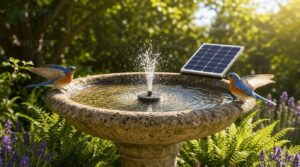
Solar-powered fountain pumps are one of the most reliable, chemical-free ways to keep your bird bath moving.
A small solar panel, ideally mounted with proper Solar Panel Tilt to optimize sunlight, powers a pump with UV-resistant housing built to handle outdoor conditions.
Battery Buffering keeps flow steady on cloudy days, while Smart Flow Adjustment and MPPT Controllers help your solar-powered fountain pump run efficiently all day.
Gentle Bubblers
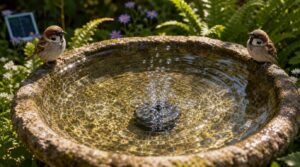
Gentle bubblers take a quieter approach than a solar-powered fountain pump — no dramatic spray, just steady, consistent motion across your bird bath surface.
Bubble Size Control and Adjustable Flow settings let you match the agitation to your basin depth, while Solar Compatibility and Low Energy Use keep running costs near zero. Quiet Operation means wildlife stays calm.
- Disrupts algae attachment without chemicals
- Maintains uniform oxygen exchange across the water feature
- Reduces sunlight penetration through surface turbidity
- Fits most standard basins with minimal setup
Low-flow Submersible Pumps
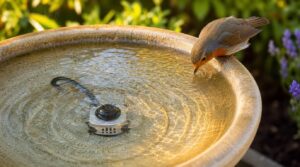
A low-flow submersible pump offers stronger, steadier circulation than bubblers, making it ideal for 2–3 gallon bird baths. These compact units operate at 25–50 GPH and consume only 2–20 watts, ensuring efficient performance.
Ceramic seals and corrosion-resistant housing guarantee minimal maintenance, while impeller efficiency ensures low noise levels, keeping birds undisturbed.
The continuous water movement discourages algae blooms, maintaining a healthier environment for birds without compromising comfort.
Battery Aerators
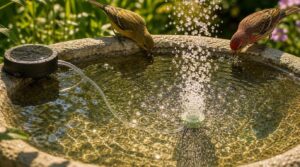
When no outlet is nearby, battery aerators step in. These compact units use a diaphragm pump to push air through an air stone, producing fine bubbles that break surface stillness and cut off algae blooms before they start. Quiet operation keeps birds comfortable, and portable power means flexible bird bath placement anywhere in your yard.
- Run on 2 C-cell batteries
- Discharge rates: 0.5–2.0 liters per minute
- 24-inch air hose included
- Assists in water temperature regulation through aeration
- Simple on/off switch for easy control
Simple Drip Systems
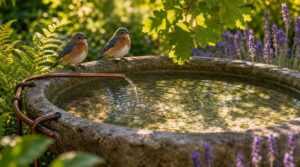
Not everyone wants a pump humming in their yard. A simple drip system — thin tubing, a pressure regulator, and a few drip emitters — keeps water trickling steadily into the basin.
That constant movement disrupts algae before it settles. A basic filtration setup prevents clogging, and seasonal flushing clears sediment.
DIY installation takes under an hour, and maintenance is minimal.
Choosing The Right Pump Size
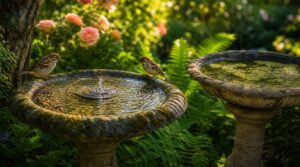
Getting the pump size right makes a bigger difference than most people expect. Too weak and you’ll still end up with stagnant pockets; too powerful and you’ll scare birds off with a miniature geyser.
Here’s what to match to your bath’s size.
Small Basin Flow Rates
For small basins under 5 liters, Flow Rate Optimization starts with matching Pump Wattage to basin size — a 2–5 watt pump hits the sweet spot. This ensures your water feature stays clear without overwhelming birds. Prioritize Quiet Operation and low Energy Consumption with these pump specs:
- Flow rate: 0.5–2.5 liters per minute
- Adjustable Nozzle for gentle, targeted output
- Tubing kept short to preserve circulating velocity
Small fountains and solar fountains work perfectly here.
Medium Bath Recommendations
Medium baths — those holding 40 to 60 gallons — need a pump with ideal capacity to match. A 10W solar panel paired with a 25–50 gph pump manages this range well.
Material choices like acrylic retain heat, so solar sizing matters more here.
| Feature | Specification | Tip |
|---|---|---|
| Pump Compatibility | 25–50 gph | Match to basin volume |
| Solar Sizing | 10W panel | Add battery for cloudy days |
| Installation Tips | 120V standard outlet | Use access panel for maintenance |
Large Bird Bath Needs
Large bird baths—18 to 24 inches in Basin Diameter—demand more power to stay clear. Match a 15 to 30W solar panel with a 50 to 150 gph pump for optimal performance.
Solar fountains work well here, using tubing routed along the Wide Rim. This setup ensures efficient water circulation without clutter.
UV‑Resistant Materials and an Elevated Stand help the system run efficiently, maintaining a Deep Water Level clean without chemical shortcuts.
Pump Lift Height
Your pump’s maximum lift determines how high it can push water from intake to nozzle — and getting this wrong means weak flow or dead spots. Match lift capacity to your actual tubing height, then add a 10–20% safety margin for head loss and friction.
Solar-powered fountain pumps lose flow as height increases, so multi-stage lift models handle taller displays more reliably.
Avoiding Dead Zones
Even a well-sized pump can leave corners untouched if you don’t plan your flow pattern mapping carefully. Position your pump and tubing to create multi-directional currents that reach every part of the basin.
Aim for full turnover timing within one to three hours. Adjustable flow rates let you fine-tune coverage and eliminate dead spots where algae quietly take hold.
Solar Fountain Benefits for Algae Control
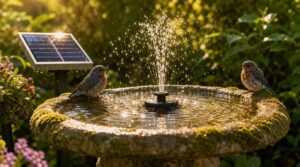
A solar fountain does more than keep your bird bath looking nice — it quietly works against algae without any chemicals involved.
The benefits stack up fast once you see how movement, temperature, and wildlife all connect.
Here’s what makes solar circulation worth adding to your setup.
Chemical-free Prevention
A solar-powered fountain keeps your bird bath clean without a single drop of algaecide.
It’s a genuinely eco-friendly water feature — one that relies on beneficial bacteria, natural physical movement, and eco-friendly filtration rather than harsh chemicals.
Non-toxic cleaning methods protect the birds drinking from it daily.
You’re in effect letting motion do the work, keeping water safe, clear, and completely chemical-free.
Continuous Daytime Movement
Think of a solar-powered fountain as your bath’s daytime engine. Every sunny hour, the solar panel drives buoyancy-induced currents that break thermal stratification, preventing warm surface layers from sitting undisturbed.
Daylight-induced mixing and temperature-gradient circulation create constant surface tension waves across the basin.
That continuous motion disrupts algae spores before they ever anchor — no timing, no effort on your part required.
Cooler Water Temperatures
Moving water doesn’t just circulate—it actively cools. Through evaporative cooling, your solar fountain keeps basin temperatures several degrees lower than still water under the same sun.
That thermal inertia slows algae’s metabolism, making blooms far less likely.
Temperature uniformity across the basin—no warm pockets, no cold corners—denies algae the hotspots they need to take hold.
More Bird Activity
Cooler water draws more visitors—and a solar powered fountain takes that a step further. Birds are most active during the dawn chorus and morning foraging, and flowing water catches their attention. Species that ignore still baths will stop for moving water.
This constant activity sustains a bird-friendly habitat, enriching the environment and transforming your garden into a reliable avian health hub.
Lower Mosquito Risk
Bird activity and mosquito risk are closely linked—still water is where mosquitoes lay eggs. A solar fountain’s constant surface agitation disrupts larval development before it begins, making it one of the most effective habitat elimination tactics available.
This method acts as a reliable mosquito deterrent without relying on non-chemical larvicides or complex drainage systems. Running your fountain at least 6 hours daily ensures the water surface remains agitated, preventing mosquito breeding cycles effectively.
Where to Place Circulating Bird Baths

Where you place your bird bath matters just as much as the pump you put in it. The right spot can work with your circulation system, not against it.
Here are the key placement factors to get right from the start.
Partial Shade Placement
Full sun is your bird bath’s worst enemy. Place your solar-powered fountain in a sheltered spot that receives morning light but stays shaded during peak afternoon heat—roughly 3 to 6 hours of sunlight daily works well.
Dappled light filtering through shade structures creates a cooler microclimate, facilitates pump cooling, and gives you real sunlight control without starving your fountain’s solar panel.
Away From Leaf Litter
Leaf litter close to your bath is a slow-moving threat. Decomposing leaves dump nitrogen and phosphorus directly into the water, feeding algae faster than your solar-powered fountain can fight back. Aim for at least 1 meter of debris-free perimeter around the base.
- Cleaner edge visibility lets you spot algae early
- Lower pest attraction means fewer biofilm-forming insects
- Stable water temperature from open airflow slows algal growth
- Enhanced bird preference — birds choose clear, uncluttered water edges
Stable Fountain Positioning
A tilted fountain wastes energy and kills flow consistency. Set your solar fountain on a level foundation — use a concrete pad or heavy paver — then verify alignment with a level before anchoring. An anchored base prevents pump strain from wind movement.
Vibration isolation further reduces stress on the pump. Adjustable mounts let you maintain a uniform waterline, maximizing solar panel efficiency and ensuring steady circulation throughout the day.
Safe Bird Access
Even with perfect circulation, birds won’t use a bath they can’t safely enter. Add non-slip perches along the rim and a shallow ramp or gentle slope so small birds wade in confidently. Keep edges rounded, with a wide entry point that prevents crowding.
A low-profile fence around the base deters ground predators, turning your setup into a genuinely bird-friendly habitat.
Adequate Solar Exposure
Your solar-powered fountain is only as strong as the sunlight it receives. Place the solar panel where morning sun hits it directly — morning sun angle is usually the most consistent for daily startup.
A raised location, angled south for ideal panel orientation, captures maximum daylight duration year-round.
- Position panels away from overhanging branches
- Adjust tilt seasonally as seasonal sun intensity shifts
- Aim for 6+ hours of unobstructed light daily
- Combine shade optimization with solar fountains for cooler, algae-free water
Maintenance That Keeps Water Moving

Even the best circulation system can’t do its job if the rest of the bath is working against it. A little routine care is what keeps the water moving, the pump running clean, and the algae from ever getting a foothold.
Here’s what that maintenance actually looks like.
Change Water Regularly
Stagnant water is an open invitation for algae. Partial water swaps — replacing 25 to 50 percent every 2 to 3 days — keep nutrient levels too low for blooms to take hold. Temperature matching matters too: cold water shocks birds away.
| Condition | Change Frequency |
|---|---|
| Mild weather | Every 2–3 days |
| Heat above 30°C | Daily |
Schedule your morning change routine and keep an algae monitoring log to track patterns over time.
Scrub Basin Weekly
Weekly scrubbing is your strongest defense against biofilm formation. Use a stiff-bristled brush — no metal — to remove mineral buildup from basin walls and drain areas. This consistent action prevents biofilm from taking hold.
Hot, soapy water works well for cleaning, but rinse the basin two or three times completely to eliminate soap residue. Proper rinsing is critical to avoid leaving behind residues that could promote bacterial growth.
Following a consistent maintenance schedule ensures algae cannot establish itself between circulation cycles. Regular upkeep is key to maintaining your solar fountain’s efficiency and appearance.
Clean Pump Filters
Your pump filter works hardest when you don’t notice it — which is exactly when clog detection matters most. Clean or backflush filters every 1 to 2 weeks, following a consistent backflush schedule to preserve media longevity. UV-resistant housings protect components outdoors year-round, and rinsing sponge filter media with non-chlorinated water keeps beneficial bacteria alive inside your water filtration systems.
- Check filter seal integrity after every reassembly
- Use no cleaning solutions or soap inside pump housings
- Mount clear housings to spot buildup without disassembly
- Log each cleaning date to track your maintenance schedule
Remove Organic Debris
Filters trap debris, but the real battle starts at the surface. Leaves, pollen, and twigs fuel organic matter decomposition, spiking nutrients that feed algae quickly.
To combat this, use a hand rake and pond net daily—especially during fall. A soft-bristle brush effectively loosens stuck material without scratching surfaces.
| Debris Type | Removal Method |
|---|---|
| Floating leaves | Pond net retrieval |
| Stuck residue | Soft-bristle brush |
| Overhanging sources | Trim overhanging branches |
| Organic waste | Compost debris properly |
Consistent removal of surface debris keeps beneficial bacteria in control, not algae.
Rinse Cleaners Thoroughly
Debris removal clears the path—but leftover soap or vinegar residue can feed algae just as fast. A complete rinse duration of 15–30 seconds removes chemical films before refilling.
- Direct nozzle direction away from cleaned surfaces
- Use a separate rinse cycle with cool water
- Run multiple rinses after deep cleaning treatments
Residue-free surfaces give algae nothing to grip.
Common Circulation Mistakes to Avoid

Even a well-chosen pump won’t do much if you’re making a few common setup errors. Small missteps — like running too weak a flow or ignoring summer heat — can quietly undo everything you’ve worked for.
Here are the five mistakes that most often let algae win.
Weak Pump Flow
A pump that barely trickles isn’t doing its job. When impeller wear, a blocked inlet, or air leakage cuts the flow, water turnover drops from every two hours to every six — and algae fills that gap fast.
Head loss from kinked tubing and low motor voltage quietly strangle output too. Weak circulation accelerates clarity loss, making regular checks essential.
Check your flow rate regularly; weak circulation is the fastest way to lose water clarity.
Full Sun Exposure
Placing your solar-powered fountain in full sun all day feels logical — the solar panel charges better, right? But unfiltered UV nutrient release from decomposing organic matter accelerates algal blooms, and heat spike control becomes critical when water temperatures climb past 30 °C within hours.
Surface temperature monitoring helps here. Add solar heat reflectors or partial shade to manage daytime evaporation reduction and slow algae’s relentless momentum.
Clogged Fountain Parts
Even a well-chosen solar-powered fountain loses its algae-fighting power when parts get clogged. Screen blockages cut flow by up to 40 percent, while impeller jamming from string algae or scale accumulation can halt circulation entirely. Nozzle obstructions change spray patterns, and seal failures let air in, killing pump pressure.
Regular maintenance — clearing tubing, descaling with vinegar, and inspecting seals — keeps your solar fountain working as intended.
Oversized Spray Height
Setting your solar-powered fountain’s spray too high creates more problems than it solves. Poor droplet trajectory means wind drift pushes water outside the basin, increasing evaporation loss and raising energy demand on your pump. Uneven coverage leaves still pockets where algae thrive.
Start low, adjust gradually, and monitor for consistent surface movement—this approach ensures nozzle wear and algae counts will both drop.
Ignoring Warm Weather
Warm weather is where most bird bath owners quietly lose the battle against algae. When temperatures climb past 30°C, four things hit at once:
- Evaporation spikes concentrate nutrients fast
- Temperature-driven biofilm coats surfaces overnight
- Sun-intensity boost turbocharges rapid algae bloom growth
- Dissolved oxygen drops, killing natural competition
Adjust your circulation daily in heat waves — it’s your best nontoxic cleaning method and eco-friendly algaecide alternative combined.
Frequently Asked Questions (FAQs)
Does water circulation prevent algae?
Yes, water circulation does prevent algae. Moving water disrupts spore attachment, spreads phosphate levels evenly, and boosts oxygen — cutting algae growth considerably through eco-friendly design without chemicals.
Why put a tennis ball in a bird bath?
A tennis ball acts as a Winter Ice Breaker and Budget Motion Tool — floating and shifting with the wind to create Chemical-Free Turbulence.
This turbulence keeps water from freezing solid and discourages algae from settling, offering a practical, eco-friendly solution.
Can algae develop resistance to constant water movement?
Algae don’t develop true resistance, but certain species form adaptive biofilms with strong shear tolerance, clinging to edges even in moving water by exploiting nutrient pockets where flow is inconsistent.
How does water pH affect algae growth rates?
pH lies at the center of algae’s growth window. Most green algae thrive between pH 7 and 5, where nutrient solubility, enzyme pH optima, and carbonate chemistry all align to fuel rapid cell division.
Can cold climates still benefit from water circulation?
Cold climates absolutely benefit from circulation. Frost-tolerant pumps, ice-breaker designs, and low-temperature aeration keep winter water moving.
Battery backup and solar panel options, combined with thermal insulation, guarantee uninterrupted cold-weather protection.
Are there plants that naturally help prevent algae growth?
Floating shade plants like water lettuce and duckweed naturally starve algae by blocking sunlight and absorbing nitrates.
Submerged nutrient absorbers, emergent edge filters, and root exudate inhibitors work together as aquatic plant combos to suppress growth.
Conclusion
Think of algae like a tenant that thrives when no one checks the lease. The moment you add circulation, you change the terms entirely. Moving water doesn’t just slow algae growth—it removes the conditions algae needs to exist.
This approach prevents algae in bird baths by making the environment inhospitable from the start, not by treating symptoms after the fact. Keep the water moving, and the problem rarely shows up.
- https://www.yahoo.com/lifestyle/articles/stop-algae-taking-over-bird-234300732.html
- https://www.npbcid.org/algae-in-the-waterways-and-how-you-can-minimize-its-growth
- https://igswater.com/2025/11/25/why-water-circulation-matters-in-preventing-algae/?srsltid=AfmBOopdWQh-Q9W3koIXuwErFRmBgFlC1D6QBkZPX8uhH-SVBkszcyaN
- https://www.epa.gov/caddis/dissolved-oxygen
- https://habitat.earthclinic.com/birds/prevent-algae-fountain-birdbath.html