This site is supported by our readers. We may earn a commission, at no cost to you, if you purchase through links.
Hummingbirds don’t nest in birdhouses the way robins or wrens do—they’re wired to build their own thumb-sized cups from lichen and spider silk. But they will use a well-placed shelter for roosting, especially during cold nights or nesting season.
That single fact changes everything about how you shop for a hummingbird house near me searches that flood garden forums every spring. Most buyers grab the prettiest option without knowing what actually works.
The right house, hung in the right spot, surrounded by the right plants, turns your yard into a place these birds return to year after year.
Table Of Contents
- Key Takeaways
- Best Hummingbird Houses Near Me
- Where to Buy Hummingbird Houses Locally
- Choosing The Right Hummingbird House
- Best Places to Hang a Hummingbird House
- Tips to Attract Hummingbirds to Your Yard
- Frequently Asked Questions (FAQs)
- Are hummingbird houses a good idea?
- When should you put out hummingbird houses?
- How do you attract hummingbirds to a hummingbird house?
- What is the best place to hang a hummingbird house?
- Where to hang a Hummingbird House?
- Can hummingbirds live near a feeder?
- Where do hummingbirds live?
- Are hummingbird houses good for birds?
- Where do hummingbirds build houses?
- How do you attract hummingbirds to Your House?
- Conclusion
Key Takeaways
- Hummingbirds will not actually nest in a house — they build their own open cup nests from spider silk, so any house you buy works better as a roosting spot than a true home.
- Placement beats product every time — hang your house 6 to 10 feet up, facing east, near native flowering plants, and away from spots where predators can lurk.
- Native plants like Cardinal Flower and Coral Honeysuckle, a clean 1:4 sugar-water feeder, and a pesticide-free yard do more to attract hummingbirds than any house on the market.
- If you’re buying local, specialty birding stores and garden nurseries are your best bet — staff there actually know your area’s birds and can point you toward what works.
Best Hummingbird Houses Near Me
Finding the right hummingbird house doesn’t have to feel like searching for a needle in a haystack. Whether you’re outfitting a backyard garden or a cozy balcony, there’s something on this list for you.
If you want something that looks as good as it functions, check out these unique hummingbird houses with charming decorative details that make any outdoor space feel a little more alive.
Here are six solid options worth checking out.
1. Hummingbird Wooden Bird House
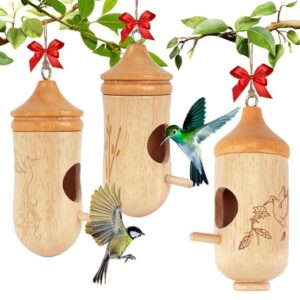
This little boxwood house punches above its weight. At just 1.9 x 5.2 inches, it’s compact enough to tuck into any garden corner without overwhelming your space.
The natural wood gives it an earthy look, and the built-in crossbar means hummingbirds actually have somewhere to land and linger. Fair warning though — it can be fragile in rough weather, so hang it somewhere sheltered.
Think of it less as a nest box and more as a stylish pit stop your garden visitors will actually use.
| Best For | Bird lovers and gardeners who want a charming, natural-looking accent that might just coax a hummingbird or two into sticking around. |
|---|---|
| Material | Natural Wood |
| Hanging Method | Red ribbon |
| Primary Color | Natural |
| Weight | 0.28 kg |
| Outdoor Use | Yes |
| Gift Suitable | Yes |
| Additional Features |
|
- Made from natural boxwood, so it looks and feels like it actually belongs in a garden
- The built-in crossbar gives hummingbirds a real place to perch and rest
- Small and compact — fits just about anywhere without taking over the space
- The finish isn’t great at blocking out harsh weather, so it can wear down fast
- A bit fragile, so rough conditions or clumsy handling can be a problem
- Hummingbirds might enjoy the perch but skip the nesting part entirely
2. Gute Natural Grass Bird House
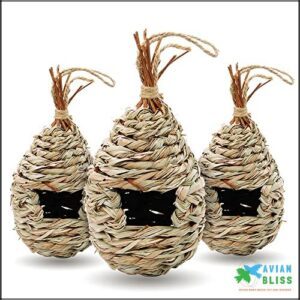
If wood feels too rigid for your vibe, the Gute Natural Grass Bird House brings something wilder to your garden. It is hand-woven from natural hibiscus grass, measures 4.7 x 4.7 x 9.4 inches, and hangs easily with its built-in hemp rope.
The woven walls breathe, stay cool in summer, and actually disappear into surrounding foliage. Honest heads-up though — hummingbirds rarely use enclosed houses, so wrens and finches will probably claim this one first.
| Best For | Bird lovers who want a natural, decorative nesting option that blends right into their garden. |
|---|---|
| Material | Hibiscus Grass |
| Hanging Method | Hemp rope |
| Primary Color | Natural |
| Weight | 0.36 lbs |
| Outdoor Use | Yes |
| Gift Suitable | Yes |
| Additional Features |
|
- Hand-woven from natural hibiscus grass, so it looks great hanging from a tree or fence
- The woven design keeps air flowing, which means birds stay comfortable even on warmer days
- Comes with a sturdy hemp rope, so hanging it up takes about ten seconds
- Not built to handle heavy rain or rough weather — it’ll wear down faster if left fully exposed
- Some buyers have noted quality control can be hit or miss, so it might not last as long as expected
- The hole size is a bit large for hummingbirds, so they’ll likely skip it in favor of wrens or finches
3. Wdefun Humming Bird House
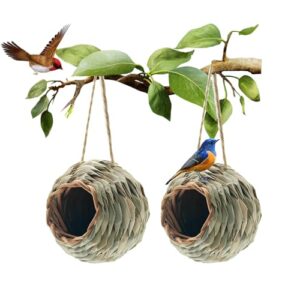
Next up is the Wdefun Humming Bird House, and it follows a similar grass-woven philosophy — but this one comes in a three-pack, so you can scatter shelters across your whole yard without overthinking it.
Each house weighs just over three ounces, measures 8 x 4 x 4 inches, and hangs easily from any branch or hook. Fair warning: hummingbirds won’t nest inside it, but wrens love it as a winter roosting spot, and honestly, that’s still a win.
| Best For | Gardeners who want to encourage backyard biodiversity and give small birds like wrens a cozy place to roost, especially through the colder months. |
|---|---|
| Material | Grass |
| Hanging Method | Hanging hook |
| Primary Color | Yellow |
| Weight | 3.03 oz |
| Outdoor Use | Yes |
| Gift Suitable | Yes |
| Additional Features |
|
- Lightweight and easy to hang just about anywhere in your yard
- Great winter roosting spot for wrens, which is a genuine bonus for bird lovers
- Comes in a three-pack, so you can spread them around without buying multiple listings
- Hummingbirds won’t actually nest inside despite the name, so don’t buy it expecting that
- Placement matters a lot — hang it too low and cats could become a problem
- Results vary depending on your local bird population and environment
4. Wooden Hummingbird House for Outside
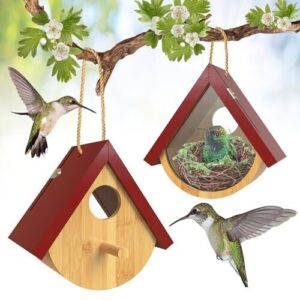
If you want something with a bit more structure, the DFANG Wooden Hummingbird House for Outside is worth a look. It’s built from wood, painted in a bold red that hummingbirds actually notice, and comes in at 4.2 x 4.2 x 8.2 inches — compact enough for a balcony, sturdy enough for a full garden setup.
The red finish isn’t just decorative — it’s doing real work, and if you want to lean into that, this guide on attracting hummingbirds with the right feeder colors and placement explains exactly why it matters.
The removable acrylic panels make easy cleaning possible, and it hangs securely with integrated hooks. Just know upfront: this works best as a decorative accent rather than an actual nesting spot.
| Best For | Nature lovers, hummingbird enthusiasts, and anyone looking for a charming decorative piece for their balcony, window, or garden. |
|---|---|
| Material | Wood |
| Hanging Method | Integrated hooks |
| Primary Color | Red |
| Weight | 11.7 oz |
| Outdoor Use | Yes |
| Gift Suitable | Yes |
| Additional Features |
|
- The bold red paint and transparent acrylic panels make it a genuinely eye-catching garden accent
- Removable panels make cleaning pretty straightforward
- Lightweight and easy to hang just about anywhere with the built-in hooks
- Hummingbirds won’t actually nest in it — they prefer open spaces, so this is more decor than habitat
- The door can be stiff, which makes cleaning a bit of a hassle
- May need some assembly before it’s ready to hang
5. Wooden Hummingbird House
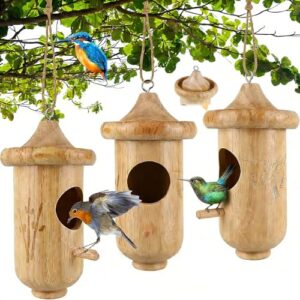
Sometimes simple works. This natural pine wooden hummingbird house keeps things clean — 4 x 2 x 2.5 inches, lightweight at 0.29 kg, and dressed in an honest, unfinished look that blends right into any yard or porch.
The roof groove holds bird food, a drain hole keeps moisture out, and hemp ropes make hanging a breeze. It won’t guarantee nesting — hummingbirds are picky that way — but as a decorative touch that invites curiosity, it genuinely delivers.
| Best For | Bird lovers and garden enthusiasts who want a charming decorative piece for their backyard or porch. |
|---|---|
| Material | Pine Wood |
| Hanging Method | Hemp ropes |
| Primary Color | Natural |
| Weight | 0.29 kg |
| Outdoor Use | Yes |
| Gift Suitable | Yes |
| Additional Features |
|
- Natural pine gives it a clean, rustic look that fits right into any outdoor space
- Roof groove and drain hole are thoughtful touches that show some real functional care
- Hemp ropes make hanging easy — no extra hardware needed
- Hole size and shallow design mean actual hummingbird nesting is unlikely
- Unfinished wood can attract mold or water damage over time if left unsealed
- Some users have flagged potential safety concerns for hummingbirds, so it’s better treated as decor
6. Humming Bird Wooden Nesting Box House
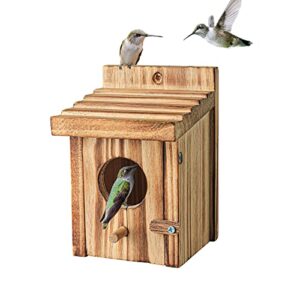
Think of this one as the no-frills workhorse of the lineup. The NATUREYLWL nesting box is solid wood, compact at 5.71 x 4.13 x 3.94 inches, and weighs just 0.45 pounds — easy to hang anywhere without fuss.
The 9/10” entrance keeps bigger birds out, and placement near dense shrubs or a feeder gives curious hummingbirds every reason to investigate. It won’t force a nest, but paired with good habitat, it’s a quiet invitation worth taking seriously.
| Best For | Bird lovers and gardeners who want to attract small birds like hummingbirds or bluebirds to their outdoor space. |
|---|---|
| Material | Solid Wood |
| Hanging Method | Easy hang install |
| Primary Color | Wood color |
| Weight | 0.45 lbs |
| Outdoor Use | Yes |
| Gift Suitable | Yes |
| Additional Features |
|
- Solid natural wood build that feels right at home in any garden setting
- Lightweight and easy to hang — no tools or headaches required
- The small 9/10” entrance is perfect for keeping the right birds in and the wrong ones out
- A bit small for larger birds, so don’t expect robins to move in
- May need some weatherproofing if you want it to last more than a season or two
- A few buyers felt the size and build quality didn’t quite match their expectations
Where to Buy Hummingbird Houses Locally
Finding a hummingbird house doesn’t have to mean scrolling through endless online pages.
There are more local options than you’d think, from garden nurseries to seasonal markets.
Here’s where to start looking in your area.
Local Garden Centers and Nurseries
Your local garden center is honestly one of the best-kept secrets for finding a hummingbird house without the guesswork. Nursery selection goes deeper than just plants — these spots connect you to real garden experts who live and breathe wildlife conservation.
- A&M Garden Center in Leesburg carries tools and bird-friendly products
- Meadows Farms offers trees, shrubs, and hummingbird feeder options
- Sunflower Gardens stocks unique varieties perfect for gardening for hummingbirds
- Local ownership means staff actually know your neighborhood’s wildlife
For more information on what defines a, visit this thorough resource.
Specialty Birding Stores in Your Area
Specialty birding stores are the real deal for hummingbird house hunters.
Wild Birds Unlimited in Ashburn brings serious staff expertise, glowing bird store reviews, and a loyalty program that rewards you for every visit. They don’t just sell hummingbird feeders — they’re a hub for local birding events and wildlife conservation conversations.
It’s birdwatching culture with a community soul. You can learn how to select the right feeder through their helpful guide on choosing a hummingbird feeder.
Home Improvement Stores With Birding Sections
Don’t overlook Home Depot or Lowe’s on your next furniture shopping or home decor inspiration run. Their birding aisles offer solid aisle organization, feeder variety, and nectar choices side by side — so you’re not hunting through the whole store.
Accessory availability is strong too, with hooks and poles ready to go. Many locations offer convenient pickup options, making grabbing a hummingbird house surprisingly easy.
Seasonal Farmers Markets and Garden Fairs
Farmers markets aren’t just about farm fresh produce anymore. You’ll find local artisans selling handcrafted hummingbird houses right alongside seasonal blooms and native plant starts — the perfect one-stop for gardening for wildlife.
- Community events often feature sustainable gardening talks tied to wildlife conservation
- Urban agriculture vendors champion nature preservation with every sale
- Native plant booths support hummingbirds better than any big-box shelf
Online Retailers Offering Local Pickup
Can’t make it to a market? No problem. Walmart, Home Depot, and Lowe’s all offer solid store pickup options for a hummingbird house — check local inventory online before heading out.
Most have zero pickup fees, and orders are often ready same-day. Retailer selection varies, so filter by “In Stock Today” to avoid a wasted trip chasing your perfect hummingbird nest.
Choosing The Right Hummingbird House
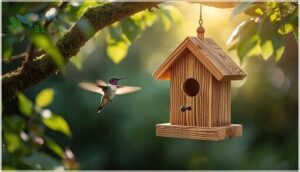
Not all hummingbird houses are created equal, and the wrong pick won’t do you much good if it doesn’t match how these birds actually nest.
There are a few key things worth knowing before you buy — materials, size, and build quality all play a role. Here’s a look at what to keep in mind when choosing the right one.
Popular Hummingbird House Types and Materials
Three materials dominate the hummingbird house market, and each brings something different to your yard.
- Wooden Materials — Hand-turned hardwoods like cherry or oak, sealed for outdoor durability
- Gourd Houses — Natural, hollowed shells with drainage holes and hand-painted hummingbird designs
- Natural Fibers — Woven grass huts, breathable and lightweight, blending into foliage naturally
- Decorative Blends — Mixed-material designs balancing Hummingbird Conservation aesthetics with garden charm
Features to Look for in Quality Houses
Beyond materials, the real tell is in the details. Look for predator guards, tight entrance sizes around 1 inch wide, and roof designs with solid overhangs that shed rain fast.
Safe nesting materials mean untreated wood interiors, no harsh fumes. These features quietly support hummingbird conservation and make your yard a genuine refuge — not just decoration.
Size, Ventilation, and Durability Considerations
Size matters more than you’d think. A compact housing design — around 6 to 8 inches tall — helps hummingbirds regulate temperature and feel secure. Nesting box design should include proper ventilation systems: small side holes near the roof let heat escape.
Material selection determines longevity, so choose cedar or poly lumber. The following points highlight the importance of a well-designed nesting box:
- Compact housing keeps chicks warm and protected
- Ventilation systems prevent dangerous overheating
- Durable materials mean seasons of hummingbird safety
- Smart nesting box design aids hummingbird rescue efforts
Best Places to Hang a Hummingbird House
Even the best hummingbird house won’t do much if it’s hanging in the wrong spot. Where you place it makes all the difference between a house that gets ignored and one that actually sees some action.
Here’s what to keep in mind before you pick your spot.
Ideal Locations in Your Yard or Garden
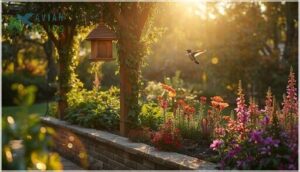
Where you hang your hummingbird house matters more than most people think. Ideal height sits between 6 and 12 feet, with a slope advantage if your yard runs uphill. Viewing angles improve when you mount near garden edges, not open lawn centers.
Structure mounting on a shed or pergola creates calmer yard zones than busy walls. The location of the hummingbird house in relation to the yard’s features is crucial for its effectiveness.
| Yard Zone | Ideal Height | Best Structure Mounting |
|---|---|---|
| Garden Edge | 8–10 ft | Pergola or arbor |
| Slope/Hillside | 6–8 ft | Fence post uphill side |
| Near Nectar Plants | 10–12 ft | Tree canopy edge |
| Patio/Balcony | 6–8 ft | Corner post or beam |
| Wildlife Corridor | 10–15 ft | Shed or gazebo eave |
Placement Tips to Avoid Predators
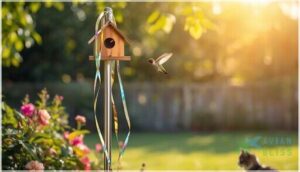
Predators don’t play fair — so your placement strategy shouldn’t either. These Safe Height Placement and Distance Guidelines keep hummingbirds protected and support broader Conservation goals.
- Mount 6–8 feet up using smooth metal poles as Mounting Options that block climbing predators.
- Keep a 10–15 foot open zone around Predator Free Zones to limit ambush spots.
- Add Deterrent Features like reflective ribbons to discourage cats and larger birds.
Sunlight, Shade, and Wind Protection
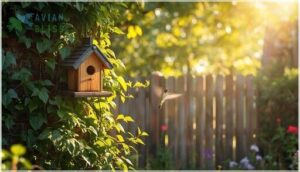
Think of solar exposure and shade patterns as your hummingbird’s personal climate control system. Mount the hummingbird house on an east-facing wall — morning light, afternoon shade. Wind barriers like dense shrubs or fencing create stable microclimates hummingbirds actually prefer.
Wildlife rehabilitation experts confirm it: nature preservation starts with smart placement, giving these tiny creatures the calm, sheltered home they need.
Smart placement is the first act of nature preservation, giving hummingbirds the calm shelter they need
Accessibility for Maintenance
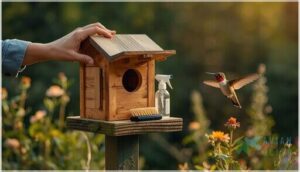
Mount the hummingbird house at 5 to 7 feet — chest to eye level — so you can actually reach it without a wobbly ladder situation. Good maintenance height, solid mounting hardware, and access doors that swing open wide aren’t just conveniences; they’re how nature preservation stays real.
- Clean tools ready: brush, scraper, water
- Access doors let you scrub every corner
- Safety features keep predators out, you in control
- Wildlife rehabilitation pros agree: easy access means healthier hummingbirds
Tips to Attract Hummingbirds to Your Yard
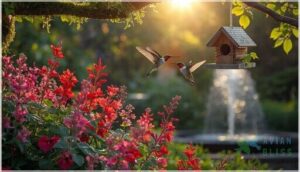
Getting hummingbirds to actually show up in your yard takes more than hanging a house and hoping for the best. The good news is a few simple changes can make your outdoor space genuinely irresistible to them. Here’s what works.
Native Flowering Plants That Draw Hummingbirds
Your yard can become a living buffet — no hummingbird feeders required. Native pollinator plants are the real MVP for nectar sources that fuel these tiny birds from spring through fall. Bold flower colors like red and coral aren’t just pretty — they’re a visual magnet.
| Plant | Bloom Season |
|---|---|
| Cardinal Flower | July–October |
| Bee Balm | Late June–Summer |
| Coral Honeysuckle | Spring–Early Summer |
| Eastern Red Columbine | Spring |
Using Feeders and Water Sources
Sugar water is your secret weapon — mix 1 part white sugar with 4 parts water, and you’ve got nectar recipes hummingbirds can’t resist.
Smart feeder placement matters too: hang feeders 4 to 6 feet up, in partial shade.
Add a mister for hummingbird hydration, since these pollinators love flying through fine water droplets to keep their feathers fresh.
Creating a Safe, Pesticide-Free Habitat
Beyond water and feeders, hummingbirds need a yard that won’t poison them. Skip the pesticides — neonicotinoids sneak into nectar and do real damage.
Go for Native Planting instead, layering blooms that support Insect Conservation, since roughly 80% of a hummingbird’s diet is tiny bugs.
Pesticide Free Zones, Eco Friendly Gardens, and Wildlife Friendly spaces aren’t just buzzwords — they’re how you actually protect biodiversity and ecological balance.
Frequently Asked Questions (FAQs)
Are hummingbird houses a good idea?
Honestly? They’re more garden decor than wildlife conservation tool.
Hummingbirds prefer open cup nests on branches, not enclosed boxes.
Native plants and clean feeders do far more for their nesting preferences and survival.
When should you put out hummingbird houses?
Put out hummingbird houses two weeks before your region’s typical first spring sighting. Regional timing matters — Gulf Coast birders aim for late February, while northern states can wait until mid-April.
How do you attract hummingbirds to a hummingbird house?
Start with a feeder nearby and tubular native flowers.
Match their nesting preferences with layered shrubs and fresh water.
That simple garden layout does more for wildlife conservation than any hummingbird house alone.
What is the best place to hang a hummingbird house?
Mount the hummingbird house 5–10 feet up, sheltered from wind and afternoon sun. Yard placement near nectar plants, away from predator perches, fosters hummingbird nesting and keeps maintenance access simple.
Where to hang a Hummingbird House?
The best spot feels hidden yet wide.
Hang the hummingbird house at ideal height, 5–8 feet up, near food, with weather shielding, predator safety in mind, and a clear window garden view.
Can hummingbirds live near a feeder?
Yes, hummingbirds can live near a feeder. They usually nest 10 to 40 feet away, balancing easy access with nesting habits and hummingbird safety from predators drawn by feeder traffic.
Where do hummingbirds live?
Hummingbirds live only in the Western Hemisphere, from Alaska to South America, across forest edges, deserts, backyards, and mountain habitats.
Their geographic range, migration patterns, and nesting sites vary by species.
Are hummingbird houses good for birds?
Not really. Despite the good intentions behind them, most hummingbird houses don’t match natural nesting preferences — these birds favor open branches, not enclosed boxes.
Better options exist for genuine bird conservation.
Where do hummingbirds build houses?
These tiny birds skip enclosed houses entirely — they build open cup nests on tree branches, in garden shrubs, urban spaces, and natural sanctuaries, weaving spider silk and plant fluff into their hummingbird home.
How do you attract hummingbirds to Your House?
Want to make your yard a hummingbird hotspot? Put out a nectar recipe of 1:4 sugar-to-water, skip the red dye, add bird friendly plants, and watch them arrive.
Conclusion
Finding the right hummingbird house near me isn’t just about picking something pretty off a shelf—it’s about understanding what these tiny, fearless birds actually need. Give them a well-placed shelter, surround it with native blooms, and keep the space chemical-free.
Do that, and you’re not just decorating a yard; you’re building a waypoint on a wild creature’s map. The hummingbirds that return each season? That’s not luck. That’s a habitat done right.
- https://www.homesandgardens.com/gardens/hummingbird-houses
- https://www.nature-anywhere.com/blogs/bird-feeding-academy/the-secret-guide-to-hummingbird-nests-in-your-garden
- https://dwr.virginia.gov/blog/ruby-throated-hummingbirds/
- https://sweet-seed.com/blog/best-nesting-material-for-hummingbirds/
- https://books.apple.com/us/book/fastest-things-on-wings/id1366736744