This site is supported by our readers. We may earn a commission, at no cost to you, if you purchase through links.
Most people walk past a dozen birds every winter morning without registering a single one. That’s not a lack of interest—it’s a lack of key patterns. A chickadee’s black cap, a junco’s white tail flash, a cardinal’s conical bill: once you know what to look for, identifying winter songbirds easily shifts from guesswork to something close to instinct.
The birds haven’t changed. Your eye has. This guide breaks down field marks, songs, habitats, and the tools that make cold‑weather birding faster and more satisfying than you’d expect.
Table Of Contents
- Key Takeaways
- Common Winter Songbirds to Know
- Spot Birds by Field Marks
- Identify Songs and Calls
- Match Birds to Winter Habitats
- Separate Similar Winter Sparrows
- Use Easy Identification Tools
- Frequently Asked Questions (FAQs)
- What is a common winter bird?
- How do winter songbirds survive extreme cold temperatures?
- Which feeder types attract the most winter songbirds?
- Do songbirds migrate at night or during daytime?
- Can juvenile birds be identified differently from adults?
- How does snow affect winter songbird foraging behavior?
- Conclusion
Key Takeaways
- reliable field marks—cap color, breast streaks, bill shape, and tail pattern—will get you to a confident ID faster than any app.
- Winter strips the landscape bare, which actually works in your favor: fewer leaves, clearer sightlines, and the same dozen species showing up like clockwork.
- Free tools like Merlin and BirdNET take the guesswork out of song ID, especially when you can’t get a clear visual on a bird.
- Start with five species, learn where each one feeds and perches, and your eye will do the rest—habitat narrows the field before you even raise your binoculars.
Common Winter Songbirds to Know
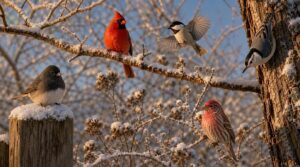
Winter narrows the bird world down fast—bare branches and cold air make the regulars easy to spot. handful of species show up again and again, almost like clockwork.
A winter backyard bird identification guide can help you put names to the regulars showing up at your feeders each season.
Here are the five you’re most likely to see at your feeder or backyard tree line.
Black-Capped Chickadee
The Black-capped Chickadee is a winter staple you’ll recognize instantly. Its visual field marks tell the whole story:
- Bold black cap and bib against crisp white cheeks
- Soft gray back with buffy sides
- Dark wings with pale edges
Watch for its diet shift toward seeds and its caching behavior — spatial memory helps it relocate hundreds of hidden stashes. Flocking benefits include safety in numbers. Try Merlin for quick bird call recognition of its song patterns. Their reliance on cavity nesting preference makes them frequent occupants of natural woodpecker holes and backyard birdhouses.
Dark-Eyed Junco
If the chickadee is winter’s social butterfly, the Dark-eyed Junco is its quiet, ground-hugging shadow.
Watch for white outer tail feathers flashing in flight — that’s your instant field mark.
Regional plumage differences mean some birds look grayer, others browner, but all share that white-belly contrast.
Juvenile markings are streakier and duller.
Log sightings on eBird to track migration patterns across the season.
Northern Cardinal
From the subtle flicker of junco tail feathers to something impossible to miss — Northern Cardinal is winter’s showstopper.
That blazing red isn’t seasonal. Red Plumage Genetics lock males into year‑round color through carotenoid pigment regulation.
Five field marks worth knowing:
- Bright red body with a pointed crest
- Black face mask around the bill
- Year‑Round Residency — no migration, no winter plumage swap
- Loud "cheer‑cheer" song patterns audible through snow
- Seed Diet Favorites: sunflower seeds draw them reliably to feeders
Range Expansion Factors like suburban shrubs keep pushing their territory northward. Log sightings in Merlin Bird ID to confirm Territorial Defense patterns near your yard.
White-Breasted Nuthatch
Now meet the upside-down bird. The White-breasted Nuthatch has a compact body, blue-gray back, and a bold black cap — easy field marks once you know them.
Watch for its head-first movement down tree trunks. That nasal call pattern is unmistakable.
It practices seed caching and cavity nesting year-round.
Log it instantly with Merlin Bird ID or BirdNET.
American Goldfinch
Don’t let the drab olive fool you. In winter, the American Goldfinch trades its bright lemon yellow for muted tones — a classic Seasonal Color Shift through Molting Patterns. Flight Identification still works beautifully: watch for pale wing bars and that notched tail mid‑air.
Key winter markers:
- Conical seed-eating bill
- Pale wing bars on dark wings
- Olive-yellow body, no chest streaks
- Flocking Dynamics near seed feeders
Track song patterns and Seed Preferences using Merlin Bird ID.
Spot Birds by Field Marks
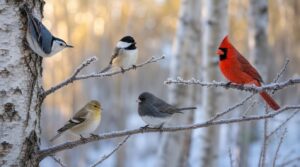
Field marks are your fastest shortcut to naming a bird — no app required. Once you know what to look for, a quick glance at the right spot tells the whole story.
These five features will sharpen your eye in the field.
Head Stripes and Caps
A bird’s head is basically its ID badge. Crown stripe shapes and cap vs. mask patterns are your fastest visual markers in winter.
The Black-capped Chickadee’s solid black cap never changes — no winter head molt confusion there.
White-crowned Sparrows show bold crown stripes, with stripe aging shifting black to brown in juveniles.
Symmetry in marks confirms a clean ID every time.
Breast Color and Streaks
Breast color is one of the most reliable field marks you’ll use all winter. A quick glance at the chest tells you a lot.
- Breast color and streak density signal age class markers — juveniles often look duller than adults due to molt stage effects.
- Field ID patches like a pale buff center help with finch color separation fast.
- Darker chest tones can even hint at aggression signals among resident species.
Wing Bars and Tails
Wing bars and tails are quiet giveaways hiding in plain sight. Pale covert tips form those narrow bands across a folded wing — your instant field marks without flipping through a field guide. Seasonal molt effects soften bar contrast in winter, so look in good sidelight.
| Feature | What to Look For | ID Value |
|---|---|---|
| Main wing bar | Bold pale band, greater coverts | Species-level |
| Secondary wing bar | Shorter, partly hidden | Age identification tips |
| Outer tail edges | White flash in flight | Flight pattern clues |
| Bar boldness | Males often bolder — sexual dimorphism signs | Sex/age |
| Winter fading | Camouflage adaptations reduce contrast | Seasonal cue |
Combine wing bar width with tail shape for reliable avian identification.
Bill Size and Shape
A bill tells you almost everything. It’s one of the sharpest field marks in avian identification — shape, size, curvature all signal what a bird eats and where.
A bird’s bill shape, size, and curvature reveal everything about how and where it survives
- conical bill like a cardinal’s crushes seeds — a classic shape identification for winter foraging tools.
- Size variations (9–20mm) reflect foraging adaptations across species.
- A nuthatch’s curved, pointed bill — curvature functions for bark probing — separates it instantly, even on Merlin.
Winter Plumage Changes
Winter changes a bird’s look more than you’d expect. Molt timing variations mean some species swap feathers gradually — chickadees start right after breeding, finches shift fast when daylight shortens.
New insulation feather structure adds density for warmth.
Camouflage color shifts mute bright tones against snow and bare branches.
Pattern seasonal adjustments and juvenile plumage maturation can blur field marks, so update your winter bird list accordingly.
Identify Songs and Calls
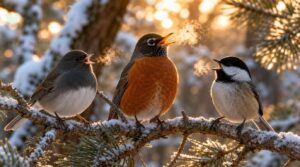
You don’t always need a clear view to know who’s out there.
Winter songbirds are surprisingly chatty, and their calls are often easier to learn than you’d expect.
Here are the key songs and phrases worth knowing first.
Chickadee “Fee-Bee” Song
Listen for two clean whistles — a high fee dropping into a lower bee. That’s the Black-capped Chickadee’s signature fee-bee song structure, one of winter’s easiest vocalization patterns to lock in.
Males use it primarily for territorial defense signals and mate attraction.
Regional dialects shift the pitch slightly, but the two-note shape stays consistent.
BirdNET and AI song identification tools confirm it almost instantly.
Cardinal “Cheer-Cheer” Calls
Now shift your ear from that soft two-note drop to something bolder. The Northern Cardinal’s "cheer-cheer" is a bright, three-note whistle — confident and carrying.
Call Structure Analysis starts here: steady rhythm, high pitch, crisp intonation. Territorial Timing Patterns peak at dawn and late afternoon. Courtship Call Variations tempo shifts during breeding.
Winter Flock Signals near feeders confirm presence instantly. AI song identification nails it fast.
Robin Dawn Whistles
The cardinal’s bold call fades — now comes something softer but just as purposeful. The American Robin opens dawn with a clear, rising-and-falling whistle centered around 2–4 kHz. That’s prime territory for Territorial Signaling.
Whistle Acoustics vary through Individual Variation and Seasonal Song Shifts, with winter songs mellowing noticeably. AI song identification tools and spectrograms make nailing these winter bird vocalizations during the Dawn Chorus Role surprisingly straightforward.
Wren “Teakettle” Phrases
Now for a voice that cuts right through dense brush — Carolina Wren’s Teakettle Origin Story practically tells itself. That rapid three‑syllable burst is pure Territorial Call Use in action.
Here’s what makes Field ID Audio so reliable for this species:
- Rhythm Variations shift tempo when defending territory
- Phrases repeat in tight bursts — classic winter bird vocalizations
- Wren Vocal Learning shapes individual song signatures over time
- Dawn and late afternoon are peak audio identification windows
- Spectrogram analysis confirms the rising-falling pattern instantly
Bird Song Mnemonics
Creating mnemonics turns tricky bird calls into something your brain can actually hold onto. Match the rhythm patterns and pitch variations of each song to a phrase you won’t forget.
| Bird | Mnemonic |
|---|---|
| Chickadee | "Fee-bee" (high, then low) |
| Cardinal | "Cheer-cheer-cheer" |
| Robin | "Cheer-up, cheerily" |
| Carolina Wren | "Teakettle-teakettle" |
BirdNET and Merlin confirm your guesses using spectrograms and QR‑linked calls.
Match Birds to Winter Habitats
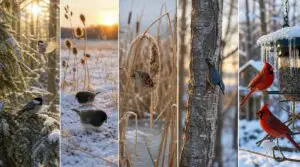
Knowing where to look is half the battle with winter birding.
Different species have strong habitat preferences, and once you learn them, you’ll stop scanning the whole landscape and start going straight to the right spot.
Here are the five key winter habitats worth learning first.
Backyard Feeders
Your backyard feeders are ground zero for winter bird watching. Smart seed selection makes all the difference — black oil sunflower draws chickadees and nuthatches, while nyjer attracts goldfinches and siskins.
Pay attention to winter traffic patterns: juncos scratch beneath feeders, cardinals prefer platform trays.
Mind feeder hygiene and squirrel deterrents, and your feeder placement becomes a reliable front‑row seat all season.
Forest Edges
Step away from the feeders — forest edges reward patient observers with a richer species mix. Edge microclimates run warmer and windier than deep woods, pulling in birds year‑round.
- Watch edge foraging zones where shrubs meet canopy gaps
- Note edge acoustic dynamics: songs carry farther here
- Use bird identification apps to match calls on the spot
- Track edge habitat transitions for shifting field marks
Weedy Fields
Weedy fields are goldmines for weed seed foragers like Dark-eyed Juncos and White-crowned Sparrows. These weed-adapted species thrive in winter weed habitats, scratching through dense seed-heavy stems along field edges.
Field edge birding rewards you with clear field marks and sharp audio identification opportunities. Try QR-linked calls and spectrograms to confirm what you’re hearing — bird-weed interactions make habitat preference obvious here.
City Parks
City parks are surprisingly productive spots for urban birdwatching. Mature trees — tree species impact matters more than you’d think — draw winter songbirds like chickadees and nuthatches.
Park bird feeders near water sources play a role in thermoregulation for cold‑weather birds.
Walk pathway birdwatching routes at dawn, use bird call recordings for audio identification, and check community birding events to sharpen your field marks skills fast.
Open Grasslands
Open grasslands feel endless — and that’s exactly what some birds need.
Western Meadowlarks perch high on fence posts, their flute‑like songs carrying far across native prairie. These open habitats are shaped by Grassland Fire Ecology, Grazing Management Impact, and Native Grass Restoration — all influencing which birds show up.
- Use Merlin or BirdNET for habitat filtering by grassland type
- Watch for Junco tail flashes as visual field marks
- Access spectrograms QR-linked calls to confirm meadowlark songs
Biodiversity Conservation Threats like woody encroachment quietly shrink these spaces. Dense grass roots also drive Soil Carbon Storage, keeping grasslands ecologically indispensable.
Separate Similar Winter Sparrows
Winter sparrows can feel like a puzzle — small, streaky, and always moving. But a few key marks separate them fast. Here’s what to look for.
White-Crowned Sparrow Stripes
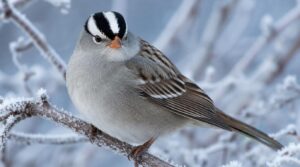
That bold helmet crown appearance is your fastest stripe identification key for the White‑crowned Sparrow. Two black stripes flank a crisp white central line — running bill to nape. Winter stripe clarity stays sharp even in flat light. Open Merlin and confirm in seconds.
| Age Class | Crown Color |
|---|---|
| Adult | Black and white |
| Juvenile | Brown and tan |
Juvenile stripe variations fool beginners, but the bold stripe function remains: contrast that stands apart from similar sparrows.
White-Throated Sparrow Markings
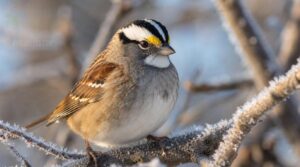
Switch from that helmet look — the White-throated Sparrow plays a different game. Yellow lores pop brightly between the bill and eye, making the yellow lores function as your fastest visual field mark. Crown stripe morphs split this bird into two forms:
- White-striped morph: crisp white crown stripe, bold contrast
- Tan-striped morph: softer tan crown stripe, subtler overall
- Malar stripe role: black whisker borders that create pure white throat patch variation
Winter identification cues lock in fast once you spot that throat patch.
Junco Tail Flashes
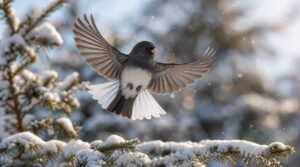
Now meet the Dark-eyed Junco — a bird that basically announces itself.
Those bright white outer tail feathers flash like a signal flag every time it takes off.
That’s the tail flash purpose in action: warning flock mates and deterring predators simultaneously.
Subspecies differences affect how much white shows, so Tail Pattern Variation matters.
Watch for Winter Flash Behavior increasing in open, exposed spots.
Breast Streak Comparisons
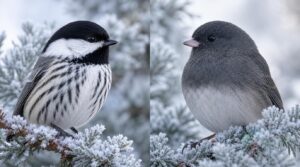
Tail flashes grab your eye, but breast streaks close the deal. Streak Visibility Factors, like lighting and angle, matter here.
Chickadees show dense, evenly spaced streaks on a compact frame — high contrast palette, easy to read.
Dark-eyed Juncos? Subtle chest shading, not sharp lines.
Pattern Contrast Analysis helps separate them fast. Streak density combined with body size tells the real story.
Ground-Feeding Behavior
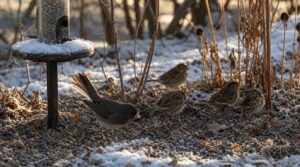
Watch how a bird moves on the ground — it’s one of the sharpest Bird ID Skills you’ll develop.
Juncos hop and scratch beneath feeders, flashing white tails with every burst. Juncos, though, tend to feed solo.
Sparrows rake through leaf litter using similar Foraging Techniques, but linger longer in weedy patches. Group Foraging in loose clusters signals sparrows.
Use Easy Identification Tools
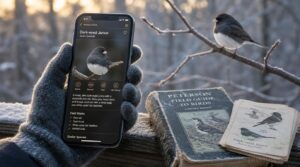
Good tools make the whole process faster and less frustrating. Whether you’re in the field or standing at your window, the right app or reference card can turn a mystery bird into a confirmed ID in seconds.
Here are a few worth keeping in your back pocket.
Merlin Bird ID App
Merlin is your pocket field guide — free from Cornell Lab, and surprisingly accurate. Sound ID listens to live ambient audio and matches species in real time, so your Bird ID Skills sharpen fast.
Offline Merlin Use means no signal, no problem.
Merlin Community Data and Merlin AI Updates keep suggestions tuned to your location and season, making every outing count.
BirdNET Song Matching
BirdNET takes AI Acoustic Analysis further than real-time listening — it digs into recorded audio using Embedding Similarity Search against a deep avian species database. Each 3‑second clip gets a Confidence Score used rating, so Winter Vocalization Detection stays honest.
Filter by location, cross‑check against spectrograms, QR‑linked calls, and export labeled lists for Citizen Science Integration.
Solid bird song analysis, quietly powerful.
Printable Bird Charts
Sometimes the simplest tools stick with you the longest. A native songbird identification chart — printed, laminated, tucked in your coat pocket — beats fumbling with a phone in freezing air.
- Chart Design Tips: Pair visual field marks with clean labels
- Accessibility Features: Use a high contrast palette and colorblind friendly palette
- Quick Reference Index: Find species fast by habitat or size
- Customization Benefits: Add personal sighting notes beside each bird
PDF format preserves color perfectly across any printer.
QR-Linked Bird Calls
QR Code Tech turns a printed chart into a living field guide.
Scan the code beside any species, and you get instant audio from sources like the Macaulay Library — no signal required if you cache files for Offline Audio Access.
Many Educational Kits pair spectrograms QR-linked calls with eBird integration, so BirdNET’s Sounds & Songs tools and Field Guide Integration meet you exactly where you’re standing.
Colorblind-Friendly Markers
Color vision differences shouldn’t keep you from the field. High-Contrast Designs use an 11:1 contrast ratio — bold blues, oranges, and blacks — so crown stripe, wing bars, and eye ring markers stay readable against snow.
Textural Pattern Use adds stripes and dots beyond color alone. Shape Recognition Systems, Accessible Color Palettes, and Universal Emblem Systems work together so conical bill, forked tail—nothing gets missed.
- Bold outlines improve legibility on bright snow
- Distinct shapes: circles, squares, diamonds per species group
- Pattern textures visible even in flat winter light
- Colorblind-friendly palette avoids red‑green confusion
- Alphanumeric labels back up every color marker
Frequently Asked Questions (FAQs)
What is a common winter bird?
The Dark-eyed Junco is one of winter’s most reliable visitors.
Watch for its white tail flash and ground-foraging habits — a classic example of smart winter survival tactics shaped by migration patterns and feather insulation.
How do winter songbirds survive extreme cold temperatures?
Winter songbirds survive by fluffing feathers for insulation, shivering to boost metabolic heat, and storing fat reserves.
Group roosting cuts heat loss. Counter‑current leg warmth tricks prevent frostbite. High‑fat foods keep them going all night.
Which feeder types attract the most winter songbirds?
Platform and tube feeders loaded with black oil sunflower seed mix attract the widest variety. Add suet feeders for woodpeckers and chickadees.
Squirrel-proof designs and weatherproof builds keep birds coming back.
Do songbirds migrate at night or during daytime?
Most songbirds migrate under cover of darkness. Nocturnal migration advantages include cooler air, calmer winds, and fewer predators.
Celestial navigation cues like stars guide their way.
Some species do mix diurnal migration exceptions into their seasonal timing triggers.
Can juvenile birds be identified differently from adults?
Yes — juveniles look noticeably different.
Juvenile camouflage, softer plumage maturation tones, breast streaks, and begging vocalizations set them apart.
Watch flight skills too; their wingbeats are tentative.
Plumage molt and moulting patterns eventually align them with adults.
How does snow affect winter songbird foraging behavior?
Snow depth impact hits hard.
When ground access disappears under heavy snow, birds shift to bark gleaning and microhabitat foraging.
Social foraging dynamics kick in, cutting energy expenditure costs while food source shifts keep flocks fed.
Conclusion
Winter birding has a way of finching you in—one curious call, one flash of white tail, and suddenly you’re hooked. Identifying winter songbirds easily isn’t about memorizing every species at once.
It’s about training your eye to catch the right details: a cap, a streak, a song. Start with five birds. Use Merlin. Step outside tomorrow morning.
The birds are already out there, waiting to be recognized.
- https://www.audubon.org/magazine/learn-fall-and-winter-colors-these-common-bird-species
- https://blog.mybirdbuddy.com/post/how-to-identify-birds-plumage
- https://chicagobirdalliance.org/blog/2025/1/3/back-to-basics-plumage-in-winter
- https://www.allaboutbirds.org/news/identification-guide-winter-sparrows-bird-feeder
- https://www.lycobirds.com/articles/identifying-sparrows-winter