This site is supported by our readers. We may earn a commission, at no cost to you, if you purchase through links.

bird box screwed to the wrong tree can lose its first clutch of eggs to a raccoon before you even notice breeding season has started.
Most people focus on the box itself—wood thickness, hole diameter, ventilation—while the mounting location quietly determines whether any of that effort pays off.
Tree mounting done right gives cavity‑nesting birds natural insulation, canopy microclimate buffering, and shorter foraging distances that accelerate chick development. Done wrong, it hands predators a highway straight to the entrance hole.
species, height, bark condition, hardware, and timing all matter. Get these right, and the tree does half the work for you.
Table Of Contents
- Key Takeaways
- Is It Okay to Mount a Bird Box on a Tree?
- How to Choose The Right Tree for Your Bird Box
- Tools and Materials You Need Before You Start
- Step-by-Step Guide to Mounting a Bird Box on a Tree
- Where Should You Not Put a Bird Box?
- Seasonal Timing, Maintenance, and Legal Considerations
- Frequently Asked Questions (FAQs)
- Is it okay to mount a birdhouse on a tree?
- Where should you not put a bird box?
- How far apart should two bird boxes be?
- What entrance hole size suits Eastern Bluebirds?
- Can metal or plastic boxes replace wooden ones?
- How does tree mounting affect bark over time?
- Which bird species benefit most from tree boxes?
- Conclusion
Key Takeaways
- Mounting location — not box quality — is what actually decides whether birds nest successfully or predators clean out the clutch first.
- Dead trees (snags) are often your best option: no sap to attract predators, no bark damage concerns, and structural integrity that can last decades.
- Orient entrance hole east or northeast, tilt the box forward 5–15 degrees, and install a stovepipe baffle at least four feet up the trunk — skip any one of these and you’ve left a gap in the system.
- Under the Migratory Bird Treaty Act, disturbing an active nest — even on your own property — carries real legal penalties, so get the box up before breeding season begins.
Is It Okay to Mount a Bird Box on a Tree?
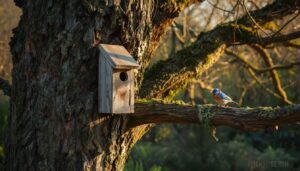
Yes, you can mount a bird box on a tree — but it’s not as simple as hammering in a nail and calling it done. Trees come with real trade-offs, from predator access to bark damage, and knowing when they work in your favor matters.
If you want to skip the guesswork, tree birdhouse mounting hardware lets you attach a box securely without gouging the bark or inviting wobble.
Here’s what you need to weigh before you pick your spot.
Benefits of Tree Mounting for Cavity-nesting Birds
Tree mounting works with nature rather than against it. Trees provide natural insulation that stabilizes egg temperatures overnight and buffers chicks from sudden shifts — that’s microclimate regulation doing real work.
Height discourages ground predators, directly improving fledgling survival. Foraging proximity means parents spend less energy traveling. Timing is critical, so install before breeding season to give birds time to locate the box.
Tree mounting techniques deliver four core advantages for cavity nesters:
- Natural Insulation mimics original cavity conditions
- Microclimate regulation shields eggs from temperature swings
- Foraging proximity accelerates chick development
- Extended breeding seasons result from stable, durable mounting sites
Risks of Predator Access When Using Trees
Those natural insulation benefits come with a trade-off.
Bark Texture Hazards create ready-made Climbing Mammal Routes — raccoons and squirrels exploit rough trunks effortlessly, especially within 1–2 meters of ground level.
Ground Proximity Threats double predation likelihood at low mounts. Visibility to Predators increases with open sightlines.
Guard Placement Effectiveness depends on installing stovepipe baffles or a squirrel baffle low on the trunk — predator protection that actually holds.
When to Choose a Tree Over a Pole
Baffles help, but sometimes a pole isn’t the right call at all.
Choose a tree when these conditions apply:
- Microclimate Advantages make seasonal temperature regulation more consistent than exposed metal or PVC poles allow.
- Aesthetic Integration matters — trees blend naturally into habitat edges without visual disruption.
- Ground Disturbance Reduction is real; no post-digging, no concrete.
- Long-term Stability holds when branch strength is sound and the trunk is healthy.
- Dead trees offer low-predator-access mounting with zero bark-damage concerns.
Best Tree Species and Trunk Conditions for Mounting
Not every tree earns the job. Oak trunk integrity makes it a top pick — thick, firm bark, no hollow sections.
Maple branch firmness holds boxes steady without wobble. Beech bark stability keeps fasteners tight over time.
Pine trunk diameter (20–30 cm minimum) gives hardware enough bite. Birch works for lightweight boxes only.
Whatever species you choose, press the bark — if it gives, move on.
How to Choose The Right Tree for Your Bird Box
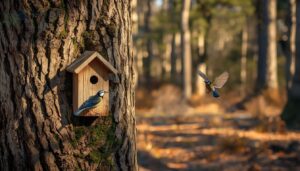
Not every tree makes a good landlord.
Before you grab your drill, there are a few things worth checking to make sure the tree you pick will actually hold up — and keep your birds safe.
Here’s what to look at.
Identifying Healthy Versus Rotting Branches
A branch that fails mid-season takes the box — and the brood — with it. Before you mount anything, run a quick tree health assessment on your candidate limb.
Check for soft wood, dead branches, or signs of disease before committing — this bird box mounting location guide walks you through picking a limb that’ll stay solid all season.
- Bark Integrity: Bark should grip the wood firmly, no peeling strips or fungal growth
- Core Resonance: Tap the branch — a solid, resonant knock means healthy wood; a dull thud signals decay
- Leaf Bud Health: Active buds and new shoots confirm the limb is alive and structurally viable
Check Branch Weight Distribution by sighting down the limb — uneven drooping flags internal weakness. Scratch the surface; green tissue underneath confirms a sturdy branch worth trusting. Wood Color matters too: pale, firm inner wood is good; brown and soft means deadwood selection only.
Avoiding Trees With Active Sap Flow or Cracks
Sap flow timing matters more than most people realize. Drill into a tree mid-spring surge and you’ll end up with sticky hardware, loosened fasteners, and a compromised mount within one season.
Your bark integrity inspection should flag active sap bleed points immediately — avoid them.
Crack detection techniques are equally critical: horizontal fractures tear under load, vertical ones channel water deep.
Use sap-resistant hardware regardless, and schedule seasonal sap monitoring each fall and early spring.
Canopy Density and Its Effect on Nesting Success
Canopy density quietly controls nesting success more than most backyard birders expect. When hanging a birdhouse from a tree, the surrounding canopy isn’t just scenery — it shapes microclimate regulation inside the box.
- Moderate canopy advantage: stabilizes temperature swings, protecting eggs and chicks
- Open canopy heat: raises interior box temps, stressing cavity nesters during incubation
- High canopy cover: increases hidden predator approach routes, cutting fledgling survival
- Canopy-nest density: intermediate cover consistently outperforms both extremes for nesting success
Dead Trees as Low-risk Mounting Options
Dead trees — snags, technically — are often your best mounting option. Without sap flow, sap scent reduction happens naturally, removing one chemical cue that attracts nest predators. Decay-resistant species like oak and pine retain structural integrity for 10–25 years.
Dead trees make the best bird box mounts — no sap, fewer predators, and decades of natural stability
Avoid large forked branches showing fungal growth, use corrosion-resistant mounting brackets or hanging kits, install a predator guard below the box, and position away from open wind exposure mitigation zones.
Tools and Materials You Need Before You Start

Before you climb a single rung, make sure you’ve got the right gear in hand. Using the wrong fasteners or skipping a key tool mid-installation can compromise the box — and the birds depending on it.
Here’s exactly what you need before you start.
Corrosion-resistant Screws, Nails, and Hardware
The fastener you choose outlasts the wood if you get it right. For most tree mounts, 304/305 stainless steel grades handle general outdoor conditions without rusting through.
Near coastlines, upgrade to 316 — higher molybdenum content, genuine marine environment selection. Ceramic coating benefits include resisting treated lumber chemicals that eat standard zinc plating alive. Silicon bronze usage suits coastal woodwork beautifully.
Skip galvanized screws in salty or acidic sites.
Ladder Safety and Non-slip Footwear Requirements
A fall at 8 feet ends your project fast. Stable ladder placement starts with firm, level ground — no soft soil, no guesswork.
Maintain proper ladder angle at 1:4, keep three-point contact on every rung, and store tools in a belt.
Footwear traction standards matter here: closed-toe, non-slip soles only. Add gloves and protective headgear.
Outdoor ladder safety isn’t optional gear — it’s the job.
Weather-resistant Straps, Ropes, and Chains
Good footwear keeps you on the ladder — good hardware keeps the box on the tree. Don’t cut corners here.
Choose mounting components built for years outdoors:
- UV-resistant fibers in weatherproof rope prevent sun degradation over multiple seasons
- Stainless steel straps with weather-rated load ratings handle coastal humidity without rusting
- Adjustable length buckles let you reposition without replacing hardware
- Non-slip bark interface surfaces stop the box from shifting during wind gusts
- Chain durability outlasts rope in high-moisture environments
Ratchet strap mounting works well when bark protection matters — pair it with weather-resistant material rated above 200 lbs.
Measuring Tape and Leveling Tools for Accurate Placement
Once your straps are locked in, precision tools seal the deal. A 25-ft measuring tape provides height recommendations for any species. Verify bark curvature measurement at multiple trunk points — irregular surfaces shift your numbers fast.
| Tool | Key Feature | Why It Matters |
|---|---|---|
| Measuring tape | Tape length selection up to 25 ft | Reaches owl box heights easily |
| Torpedo level | Level calibration within 0.029 in/ft | Confirms horizontal accuracy |
| Magnetic hook | Magnetic hook usage on fasteners | Frees one hand on the ladder |
Angle verification after mounting catches last‑minute shifts. Keep safety goggles on throughout — bark chips don’t announce themselves.
Step-by-Step Guide to Mounting a Bird Box on a Tree
Getting the box up is where good intentions either pay off or fall apart. Done right, the whole process comes down to five decisions — and each one directly affects whether birds move in or move on.
Here’s exactly what to do, in order.
Marking The Correct Height for Your Target Species
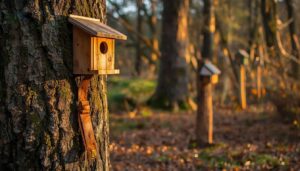
Before you drill a single screw, mark your mounting height using a species height chart — getting this wrong wastes a season. Bluebirds do best at 5–6 ft; chickadees prefer 6–15 ft; owls need 10–20 ft.
Use a measuring tape and a chalk mark or visual height indicator on the trunk.
Consistent reference marker placement across multiple boxes keeps your monitoring standardized and efficient.
Orienting The Entrance Hole East or Northeast
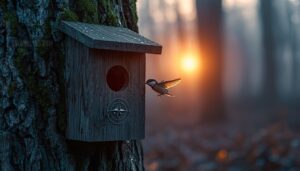
Once your height mark is set, rotate the box so the entrance faces east or northeast.
Morning sunlight triggers early nest activity and keeps afternoon heat from cooking the interior — a simple fix for thermal regulation that costs nothing. Northeast also shields the opening from prevailing westerly winds, cuts predator sightlines, and reduces frost risk during cold spring nights.
Tilting The Box Forward to Deflect Rain
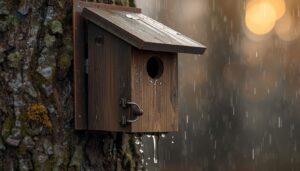
With your entrance oriented, tilt the front panel forward 5–15 degrees — that’s your Tilt Angle Range for effective Runoff Direction away from the cavity. Use Bracket Reinforcement to lock the angle after storms. Moisture Monitoring each season catches drift early.
- Shim the base to achieve consistent forward lean
- Position the Drip Zone Placement at the front lower edge
- Align tilt against prevailing rain direction
- Confirm nest box orientation holds after high winds
- Use weather-resistant material brackets only
Securing The Box Without Damaging The Bark
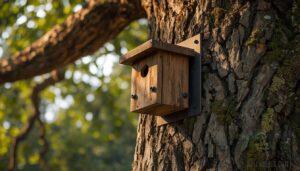
Bark damage is a real concern — a girdled tree helps no one, least of all the birds.
Use a wide mounting plate for Plate Load Distribution, and add Bark Protection Pads between hardware and trunk.
Non-invasive Brackets clamp without penetrating. Practice Gentle Screw Tension: snug, not crushing.
Schedule Periodic Bark Inspection each season.
Ropes and chains work too, provided they’re broad and padded.
Installing Predator Baffles or Guards on The Trunk
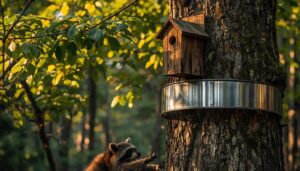
Stopping a raccoon mid-climb starts before the nest box goes up.
Follow the right installation sequence steps: slide your stovepipe baffle onto the pole first, seat it firmly above the bracket, then mount the box.
Baffle height standards require the top edge at least four feet above the ground.
For material corrosion resistance, galvanized steel holds up best.
A conical guard shape design prevents predators from stepping onto the rim.
Where Should You Not Put a Bird Box?
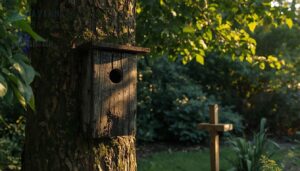
Picking the right spot matters just as much as how you mount the box. Some locations will quietly sabotage your efforts before a single bird even scouts the site.
Here’s where you should never put a bird box.
Locations With Dense Overhead Canopy Cover
Dense canopy is a deal-breaker for Bluebirds. When overhead cover exceeds 85 percent, light gap creation disappears, predator visibility drops, and the microclimate cooling effect actually works against you — trapping moisture and limiting a bird’s ability to spot approaching threats.
Wind buffering from closed crowns also masks warning sounds.
Keep boxes in open areas where sightlines are clear.
Areas Within 15 Meters of Pesticide-treated Zones
A pesticide-treated lawn is a feeding ground that stops feeding. Within 15 meters, chemical drift kills the insect prey cavity nesters depend on — and residual insecticides cling to bark for days.
- Maintain buffer zones of at least 15 meters from any treated area
- Schedule applications outside peak breeding season for regulatory compliance
- Monitor wind conditions; drift extends exposure well beyond the treated boundary
- Identify alternative sites upwind and away from spray zones
South-facing Positions in Hot Climates Without Shade
A south-facing box in a hot climate is basically an oven with an entrance hole. Without shade structures or reflective coatings, solar exposure for nests can spike interior temperatures by 30–60°F above ambient.
Microclimate considerations in box orientation matter here — thermal mass effects trap heat, and without ventilation strategies or orientation for thermal regulation, chicks overheat fast.
Shift east or northeast instead.
Branches Showing Rot, Cracks, or Instability
Heat isn’t the only threat to a well-placed box. A compromised branch fails the same way — quietly, then suddenly.
Skip any branch that shows:
- Moisture decay signs like soft, spongy wood or fungal growth near the collar
- Crack propagation risks — grain-aligned splits indicate internal separation
- Structural weakness from hollow sounds when tapped (internal rot)
- Visual rot indicators such as darkened wood or insect frass
A sturdy branch with confirmed load-bearing capacity is non-negotiable.
Sites With Heavy Foot Traffic or Frequent Human Disturbance
Even a structurally sound branch means nothing if birds won’t use the box. Heavy foot traffic generates constant vibrations, crowd noise impact disrupts mate-attraction behaviors, and pedestrian proximity stresses nesting pairs into abandoning clutches entirely.
Human feeding effects compound this — fed birds attract predators. Prioritize low human traffic, quiet areas at safe height for predator avoidance, with active litter management nearby.
| Disturbance Factor | Nesting Impact |
|---|---|
| Vibration mitigation failure | Shorter incubation bouts |
| Crowd noise impact | Disrupted mate signaling |
| Pedestrian proximity | Higher abandonment rates |
| Litter accumulation | Deters box occupancy |
| Human feeding effects | Increased predator pressure |
Seasonal Timing, Maintenance, and Legal Considerations
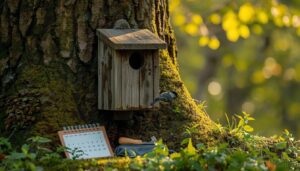
Getting the box up is only half the job. Knowing when to install it, how to keep it in good shape, and what the law says about active nests will determine whether your efforts actually pay off for the birds.
Here’s what you need to stay on track before, during, and after the breeding season.
Regional Installation Deadlines Before Breeding Season
Before the first nest is built, your window is already closing.
In southern regions, boxes should be up by February; northern areas have until mid-to-late March.
Think of your local wildlife agency’s deadline calendar as non-negotiable — climate shift adjustments get published annually, so verify it each year.
Regional permit rules vary, and compliance penalties are real.
Don’t wait.
Annual Cleaning With Mild Soap and Water
Once your box is up on time, keeping it clean is what makes it worth coming back to.
Clean the birdhouse once per breeding season using this protocol:
- Soap Selection – mild soap only; harsh chemicals repel birds
- Rinse Technique – flush all residue with clean water
- Drying Method – air-dry fully before reinstalling to stop mold
- Cleaning Schedule – annual cleaning and upkeep of bird nesting boxes during calm weather
Mold prevention starts here.
Inspecting Straps, Hardware, and Branches Each Season
Every season, run a Strap Wear Check before nesting begins — fraying, stiff spots, or cuts mean immediate replacement.
Your Hardware Corrosion Review should catch rust, pitting, or loose fasteners; weatherresistant hardware still needs a Fastener Tightness Audit after winter exposure.
Complete a Branch Integrity Test and Bark Damage Assessment to confirm branch strength analysis holds.
Log everything. Regular checks with adjustable straps prevent silent failures.
Migratory Bird Treaty Act Rules on Active Nest Disturbance
Under the Migratory Bird Treaty Act, Legal Nest Protection kicks in the moment eggs appear or adults begin tending young — that’s your Active Nest Definition, and it applies on your property too.
Permit Requirements are rarely granted, so Seasonal Work Restrictions matter: schedule nest box installation before breeding begins.
Penalty Enforcement is real — thousands per violation.
Ignorance won’t help you in court.
Frequently Asked Questions (FAQs)
Is it okay to mount a birdhouse on a tree?
Yes — hanging a birdhouse from a tree works well when you choose the right trunk, height, and orientation.
Done correctly, it facilitates thermal regulation, predator avoidance, and aesthetic integration without sacrificing long-term integrity.
Where should you not put a bird box?
Avoid low trunk height, south-facing sun traps, dense canopy, pesticide zones within 15 m, high wind exposure, road proximity, reflective windows, and heavy foot traffic.
Each breaks predator protection, nest box orientation, or clear flight path basics.
How far apart should two bird boxes be?
Space boxes at least 100–300 feet apart for territorial species like bluebirds. Wrens tolerate 20–30 feet. Match territorial spacing guidelines to your target species — tighter nesting density invites conflict, not occupancy.
What entrance hole size suits Eastern Bluebirds?
For Eastern Bluebirds, use a 1½-inch round hole — the standard. An oval entrance (1⅜" × 2¼") also works. Keep edges smooth to deter predators and avoid holes larger than 1⁹⁄₁₆ inches.
Can metal or plastic boxes replace wooden ones?
Metal and plastic might seem like smart swaps, but wood wins for thermal regulation — it won’t cook eggs in summer heat. Stick with cedar for material durability and natural insulation.
How does tree mounting affect bark over time?
Hardware disrupts sap flow and traps moisture against bark, accelerating crack propagation and fungal decay risk.
Bark healing rate slows with repeated mounting, especially on thin-barked species like birch or pine.
Which bird species benefit most from tree boxes?
Bluebirds, tree swallows, Carolina wrens, wood ducks, and barn owls gain the most from tree boxes.
Great Tit Occupancy rises near dense shrubs, while House Sparrow Suitability peaks at 2–3 meters on trunks.
Conclusion
Picture a nestbox fixed at the right height, entrance facing northeast, baffle locked around the trunk below—a system, not just a box.
Every mounting bird boxes on trees, from bark condition to hardware grade, either tightens that system or cracks it open for predators.
Get the details right, and the tree carries most of the load. The birds handle the rest.
That’s the whole job.