This site is supported by our readers. We may earn a commission, at no cost to you, if you purchase through links.
Most apartment birds eat like a college student surviving on ramen—seed-heavy diets that look filling but quietly drain the nutrients that keep feathers glossy, immunity sharp, and organs functioning.
Add glass windows that block over 95% of UVB radiation, and your bird’s vitamin D₃ synthesis basically shuts down, regardless of how sunny the windowsill looks.
Calcium absorption falters, feather quality slides, and the decline happens gradually enough that many owners miss it until the damage is done.
The right bird health supplements for apartment birds close those gaps precisely—and the five options ahead cover every major form, dosing method, and nutritional priority.
Table Of Contents
- Key Takeaways
- Why Apartment Birds Need Supplements
- Choosing The Right Supplement
- Safe Dosing and Daily Use
- Top 5 Bird Health Supplements
- Frequently Asked Questions (FAQs)
- What supplements are good for birds?
- What two supplements should not be taken together?
- When should I give my bird probiotics?
- Can apartment birds overdose on probiotic supplements?
- How do electrolytes help sick or stressed birds?
- Which amino acids support molting in cage birds?
- How soon should unused mixed supplements be discarded?
- Conclusion
Key Takeaways
- Indoor apartment birds quietly develop deficiencies in vitamin A, D₃, calcium, and omega‑3s because seed-heavy diets and glass windows block the UVB light needed for proper nutrient synthesis.
- Matching supplements to your bird’s actual diet gaps—rather than using a one-size-fits-all product—prevents double-dosing and addresses the specific shortfalls causing feather, immune, or bone issues.
- Fat-soluble vitamins (A, D, E, K) accumulate in tissue and liver, so sticking to weight-based dosing from a single supplement source is essential to avoid toxicity.
- Always discard unused mixed supplements within 24 hours, store products below 75°F, away from light, and request a Certificate of Analysis from any manufacturer to verify purity and heavy-metal testing.
Why Apartment Birds Need Supplements
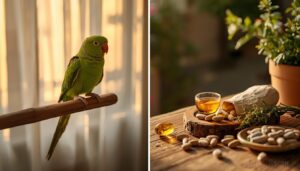
Apartment life isn’t exactly designed with birds in mind—no sunlight streaming through the canopy, no varied foraging, just four walls and whatever you put in the bowl. Most indoor birds quietly develop gaps in vitamin A, calcium, omega-3s, and vitamin D₃ long before you notice dull feathers or a sluggish disposition.
In fact, vitamin A and omega-3 deficiencies in indoor birds often go undetected for months, quietly undermining immunity well before feathers lose their sheen.
Here’s what’s actually driving those deficiencies, and why the right supplement can make a real difference.
Common Nutrient Gaps in Seed-heavy Indoor Diets
Seed-heavy diets look complete on the bag, but what your bird actually eats tells a different story. A lack of essential amino acids hampers keratin production during molt.
Birds pick their favorites, leaving real nutritional gaps behind:
- Protein deficiency slows feather regrowth and weakens body condition
- Poor micronutrient variety limits essential vitamins and minerals
- Fatty acid imbalance raises obesity and liver disease risk
- Mineral imbalance disrupts muscle and metabolic function
- Antioxidant shortfall increases vulnerability to oxidative stress
Vitamin A, Calcium, and Omega-3 Shortfalls
Those protein gaps from selective seed-eating ripple further than most owners realize. Vitamin A deficiency—affecting roughly 67% of indoor birds subclinically—quietly compromises epithelial integrity across respiratory and gut linings, weakening immune function before you notice symptoms.
Calcium-phosphorus ratios tip off-balance without leafy greens, and omega-3 fatty acids drop low enough to affect membrane fluidity and trigger feather-picking.
| Nutrient | Primary Risk |
|---|---|
| Vitamin A | Vision development, immune collapse |
| Calcium | Bone mineralization, muscle spasms |
| Omega-3s | Membrane fluidity, feather condition |
nutritional gaps don’t announce themselves loudly.
Limited UV Exposure and Vitamin D3 Needs
Glass blocks almost all UVB—UVB Window Transmission studies confirm less than 5% reaches your bird sitting near a sunny pane. Without UVB, vitamin D3 synthesis stalls completely, impairing calcium absorption regardless of dietary intake.
Seasonal UVB Variation makes winter months especially risky. For indoor birds, Dietary D3 Sources and UVB Lighting Solutions aren’t optional extras—they’re the practical fix when sunlight can’t do its job.
Feather Quality, Immunity, and Energy Support
Vitamin D3 shortfalls don’t stop at calcium—they ripple into feather health and immune response too. Keratin amino acids like methionine and cysteine need adequate mineral balance to build strong, vibrant feathers.
Antioxidant enzymes depend on selenium and vitamin E to prevent oxidative damage during molting. Omega-3 energy enhances cell membrane efficiency, while probiotic gut health improves nutrient uptake—because nutrient deficiencies in indoor birds compound quietly until you see dull, brittle feathers.
Choosing The Right Supplement
Not every supplement works for every bird, and picking the wrong one can do more harm than good. Your bird’s species, size, diet, and the form of supplement you choose all factor into what’s actually going to help.
When in doubt, start with research—bird health supplements for rescue and rehab birds offers a solid breakdown of what actually works for different needs.
Here’s what to look at before you buy.
Bird Species, Size, and Age Requirements
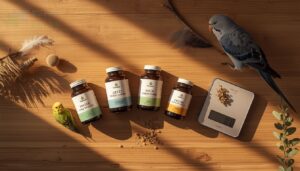
Not every bird on your shelf has the nutritional blueprint. A budgerigar hits sexual maturity around 6–8 months; an African grey won’t until roughly age 2—so growth-stage nutrition and maturity timing genuinely shape supplement selection based on species and life stage.
Species-specific dosing, sex-based dosage adjustments, and body condition metrics like weight, guarantee proper dosing and safety for avian vitamins throughout each life stage.
Liquid, Powder, and Food-based Supplement Forms
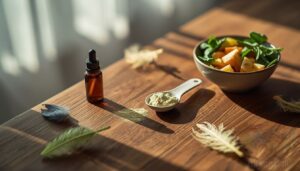
Liquid supplements suit most indoor birds well, but dropper calibration matters—volume can shift with dropper angle or inconsistent shaking.
Powders offer better shelf-life preservation and lower microbial contamination risks, though powder mixing consistency requires thorough stirring into moist food.
Food-based supplements simplify meal integration for reluctant birds.
Whichever daily administration method—liquid, powder, or food-based—you choose, consistency beats excellence every time.
Matching Supplements to Diet Gaps
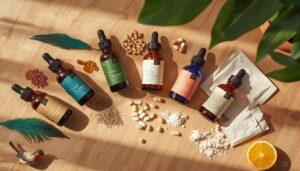
Think of supplement selection as filling specific holes — not plastering over the whole wall.
Start with a diet assessment to pinpoint your indoor birds’ actual nutritional gaps, then match precisely:
- Seed-heavy diets → multivitamin covering vitamin A
- Limited sunlight → Calcium-Vitamin D synergy formula
- No flax or chia → Omega-3 source pairing
- Lorikeets → Iron-low lorikeet formula
- Post-illness recovery → Probiotic-prebiotic balance
Supplement selection based on species and life stage prevents double-dosing nutrients already present in a balanced diet.
Checking Ingredient Purity and Heavy-metal Testing

Not all supplements are created equal — and for your bird, that gap matters. Request a Certificate of Analysis from any manufacturer you’re considering; reputable brands test finished batches using ICP-MS screening to quantify lead, cadmium, arsenic, and mercury against established heavy metal limits.
Third-party lab testing and purity verification methods confirm label accuracy. No documentation? Skip it.
Safe Dosing and Daily Use
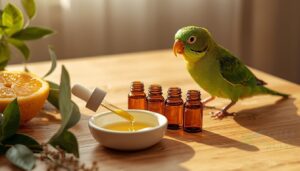
Getting the dose right matters just as much as picking the right supplement. Too little, and your bird misses the benefit; too much of a fat-soluble vitamin and you’re looking at real toxicity risk.
Here’s what you need to know before you open that bottle.
Weight-based Dosing for Small and Large Birds
Dosing your bird correctly starts with one non-negotiable step: weigh them in grams first. Weight-based dosing for small birds leaves almost no margin for error—a 10% miscalculation hits a 30g budgie far harder than a 500g Amazon.
Weigh your bird in grams first—a 10% dosing error hits a 30g budgie far harder than a 500g Amazon
allometric scaling when species-specific data is missing, match your product’s mg/mL concentration exactly, and do daily monitoring for any sudden weight loss.
Liquid Drops in Drinking Water
Water consistency is your first hurdle with liquid multivitamins for indoor birds. Drop size variability is real—viscosity and tip shape mean two "drops" rarely deliver identical volumes.
For products like Oasis Vita Drops, mixing uniformity techniques matter: swirl gently, dose fresh water, and replace every 24 hours.
Light degradation risk and bowl cleanliness affect potency directly, so keep bowls clean and shaded.
Powdered Vitamins on Moist Foods
Powder clumping is your biggest enemy with food-based supplements—uneven distribution means inconsistent bioavailability distribution across each serving.
Follow these four practices:
- Mixing Timing: Add powdered vitamin supplements right before serving, never ahead
- Break Up Clumps: Whisk powder into a small amount of moist food first
- Vitamin Stability: Skip reheating—moisture and warmth degrade fragile water-soluble vitamins fast
- Consistent Dosing: Feed only what your indoor birds finish immediately
Avoiding Fat-soluble Vitamin Toxicity
Fat-soluble vitamins—A, D, E, and K—don’t flush out like water-soluble ones; they accumulate in fatty tissue and the liver. That buildup is where things go wrong.
Stick to label dose adherence, use a single source, and avoid stacking multiple products.
Liver monitoring and kidney checks matter here, because hypervitaminosis A causes liver damage, while excess D drives hypercalcemia that strains renal function.
Storage, Shelf Life, and Freshness Checks
Once you’ve nailed dosing, storage becomes your next line of defense. Keep supplements below 75°F in a dark, dry spot—heat and light break down vitamins fast.
Seal containers immediately after use; moisture turns powders into clumps and undermines supplement stability. Check expiration dates monthly, discard anything past its "best before," and inspect each batch for color changes or off odors before every use.
Top 5 Bird Health Supplements
After everything you’ve covered — dosing, forms, storage — the real question is which products actually hold up in practice.
These five supplements are worth your attention because they’re formulated specifically for indoor birds, with transparent ingredient lists and clinically relevant nutrient profiles.
Here’s what each one brings to the table.
1. VITOFARMA Bird Multi Vitamin Supplement
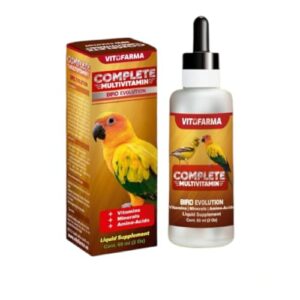
VITOFARMA’s liquid multivitamin packs vitamins, minerals, and essential amino acids into a compact 2 oz bottle—practical for apartment bird owners who don’t want a cluttered shelf.
For small birds, you’re looking at just 3–4 drops in drinking water or dry food daily.
It’s particularly useful during winter months when UV exposure drops and vitamin D synthesis stalls.
The formula also targets immune support and plumage quality, making it a solid choice after molting or illness recovery.
| Best For | Small bird owners—especially those with finches, canaries, or parakeets—who want an easy daily supplement to support feather health and immunity year-round. |
|---|---|
| Form | Liquid |
| Vitamin Count | Full spectrum |
| Vitamin C Included | Yes |
| Target Species | Small breed birds |
| Administration | Water or feed |
| Price Range | $17.99 |
| Additional Features |
|
- Super easy to dose—just 3–4 drops a day, straight into water or dry food, no fuss
- Great for winter when your bird isn’t getting much natural sunlight and vitamin D takes a hit
- Covers a lot of ground at once: immune support, plumage, appetite, and growth in younger birds
- The color can vary batch to batch, which might throw you off when a new bottle looks totally different
- Results are mostly anecdotal—don’t expect overnight changes; improvements can be slow and subtle
- Picky birds may flat-out refuse it, especially if they’re sensitive to flavored water or syringes
2. Oasis Multivitamin Drops For Small Birds
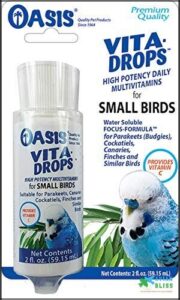
Oasis Vita Drops checks most of the boxes for small cage birds under 200 g—parakeets, canaries, finches, budgies. The liquid formula covers vitamins A, D₃, E, K₃, the full B‑complex, and added vitamin C as sodium ascorbate, which helps immune recovery after stress or molting.
Dosing is straightforward: 1 drop per ounce of water for hookbills, 1 drop per 2 oz for canaries and finches. Change the water every one to three days to keep potency and prevent bacterial buildup.
| Best For | Small cage birds under 200g—parakeets, budgies, canaries, finches, and similar species—especially during molting, illness recovery, or periods of stress. |
|---|---|
| Form | Liquid |
| Vitamin Count | All NRC-recommended |
| Vitamin C Included | Yes (sodium ascorbate) |
| Target Species | Birds under 200g |
| Administration | Water or food |
| Price Range | Mid-range |
| Additional Features |
|
- Covers all the essentials—vitamins A, D₃, E, K, full B-complex, plus added vitamin C for immune support
- Easy to use: just a drop or two in drinking water or soft food, no mixing or measuring headaches
- Made in the USA with almond-free ingredients, which matters for birds with sensitivities
- The bottle is small (about 2 oz), so if you’ve got multiple birds you’ll be reordering pretty often
- Exact vitamin concentrations aren’t listed, so you can’t dial in precise dosing if your vet needs that info
- Needs a clean, covered water source—open dishes can introduce bacteria that mess with the supplement’s effectiveness
3. Lafeber AviEra Bird Vitamin Powder
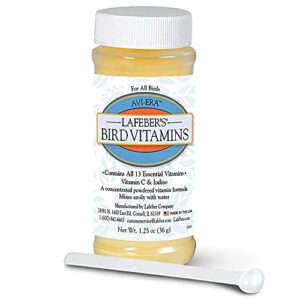
Thirteen vitamins in one scoop—that’s what Lafeber’s Avi-Era delivers, and for seed-heavy diets, that matters. The powder covers vitamins A and D₃, the two deficiencies most likely to silently erode your bird’s feather quality and immune function.
Mix 2 scoops per ounce of drinking water, or sprinkle it onto moist food if your bird ignores the water bowl. Prepare a fresh batch daily—potency drops fast.
No artificial colors or flavors, and it works across species, from budgies to African Greys.
| Best For | Bird owners whose pets are on seed-heavy or picky diets and need a simple, vet-developed vitamin boost to support feather health and energy. |
|---|---|
| Form | Powder |
| Vitamin Count | 13 essential |
| Vitamin C Included | Yes |
| Target Species | All bird ages |
| Administration | Water or moist food |
| Price Range | Mid-range |
| Additional Features |
|
- Covers all 13 essential avian vitamins plus A and D₃—the two most commonly missed on seed-only diets.
- Easy to use: just mix into water or sprinkle on food, no forcing it on your bird.
- Works for a wide range of species, from budgies and cockatiels to African Greys and doves.
- Powder can be slow to dissolve, so you may need to stir a bit or set out a second water bowl.
- The measuring scoop is sometimes missing from the package, which is a small but annoying problem.
- It’s a supplement, not a fix—you still need a balanced diet and regular vet checkups to keep your bird truly healthy.
4. Nekton S Bird Multi Vitamin
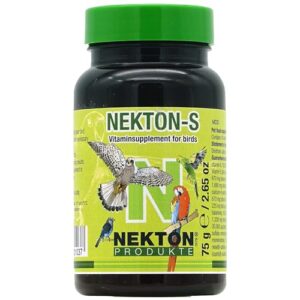
Nekton-S packs 13 vitamins, 18 free L-form amino acids, and key trace minerals into a single daily powder—making it one of the most extensive options for apartment birds stuck on seed-heavy diets. Mix 1 g per 250 ml of drinking water, or sprinkle it over soft food at the same ratio.
It’s especially useful during molting, breeding, or post-illness recovery.
One caution: the included scoop is tiny, so measure carefully to avoid overdosing fat-soluble vitamins.
| Best For | Bird owners who feed seed-heavy diets and want an easy, all-in-one daily supplement to keep their birds healthy across all life stages. |
|---|---|
| Form | Powder |
| Vitamin Count | 13 vitamins |
| Vitamin C Included | Yes |
| Target Species | All cage birds |
| Administration | Water or food |
| Price Range | Mid-range |
| Additional Features |
|
- Covers a lot of ground—13 vitamins, 18 amino acids, and trace minerals in one product
- Works for any cage bird, at any life stage, so you’re not buying multiple supplements
- Flexible to use—mix it in water or sprinkle it on food, whatever your bird prefers
- The included scoop is tiny, making it tricky to measure accurately without extra tools
- Using too much can turn the water an off-putting color and risk over-supplementing
- Not a substitute for vet care—if your bird is sick, this won’t replace a proper checkup
5. Hari Hagen Prime Parrot Vitamin Supplement
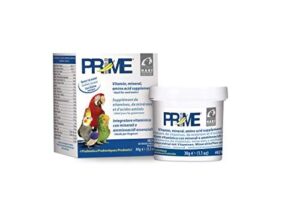
Hari Hagen Prime covers ground most powders don’t—14 vitamins, 9 minerals, lysine, methionine, digestive enzymes, and micro-encapsulated probiotics in a single 0.55 g daily dose. That’s a meaningful stack for parrots running on seed-heavy diets.
Sprinkle it over moist fruit or vegetables; the ultra-fine powder coats soft food without caking.
The added Lactobacillus acidophilus (3.85 MCFU per dose) helps gut recovery after stress or antibiotics.
At $14.40 for 40 g, reorder frequency matters in multi-bird households.
| Best For | Parrot and seed-eating bird owners looking to fill nutritional gaps in a seed-heavy diet without juggling multiple supplements. |
|---|---|
| Form | Powder |
| Vitamin Count | 14 vitamins |
| Vitamin C Included | Yes |
| Target Species | Parrots, seed-eaters |
| Administration | Seeds or soft food |
| Price Range | $14.40 |
| Additional Features |
|
- Packs a serious lineup—14 vitamins, 9 minerals, amino acids, enzymes, and probiotics all in one powder
- Easy to use; the fine texture coats fruit, veggies, and soft foods without clumping
- Probiotics support gut health, which is especially handy after stress or a round of antibiotics
- Small 40g container goes fast if you have more than one bird
- Some owners notice a banana-like scent despite the "banana-free" marketing, which not all birds love
- No third-party lab testing info, so you’re taking the label at face value
Frequently Asked Questions (FAQs)
What supplements are good for birds?
Good supplements cover what seeds miss — vitamin A, D3, calcium, and omega-3s. Multi-vitamin drops or powders work well for most indoor birds, with species-specific dosing for safe, consistent results.
What two supplements should not be taken together?
Don’t mix calcium and iron supplements at the same time — they compete for absorption in the gut, making both less effective.
Space them at least two hours apart for best results.
When should I give my bird probiotics?
Give your bird probiotics after antibiotic treatment, during stressful transitions like moving or breeding, and after any digestive upset.
They help restore healthy gut flora when the microbiome needs the most support.
Can apartment birds overdose on probiotic supplements?
Yes, they can. Too much probiotic overwhelms a small gut fast—think bloating, loose droppings, or appetite loss. Stick to label dosing, and stop immediately if symptoms persist beyond 48 hours.
How do electrolytes help sick or stressed birds?
When your bird is sick or stressed, electrolytes restore fluid balance, support nerve and muscle signaling, and stabilize acid-base chemistry — helping them recover faster and regain normal coordination.
Which amino acids support molting in cage birds?
Molting burns through amino acids fast. Methionine and cysteine build the keratin structure of new feathers, while lysine aids overall tissue growth.
Without adequate sulfur amino acids, you’ll notice dull, brittle regrowth even on a high-protein diet.
How soon should unused mixed supplements be discarded?
Discard any unused mixed supplement within 24 hours. Once blended, water-based solutions become a breeding ground for bacteria—potency drops fast, and what looked fine this morning won’t be by tonight.
Conclusion
What’s the point of a sunny windowsill if the glass strips away everything your bird actually needs from it?
Apartment life creates real, measurable gaps—blocked UVB, seed-heavy meals, subclinical deficiencies that don’t announce themselves until feather quality or immunity already shows the strain.
The right bird health supplements for apartment birds aren’t optional extras; they’re the difference between a bird that survives your living room and one that genuinely thrives in it.