This site is supported by our readers. We may earn a commission, at no cost to you, if you purchase through links.
Hummingbirds don’t care that you live 30 miles from the nearest garden center. They’ll show up on your fence post, dart through your field edge, and vanish before you’ve had your first coffee—whether or not you’re ready for them.
Out on a rural property, feeding these birds isn’t the casual weekend hobby it is in the suburbs; nectar spoils faster in the heat, pests find every leak, and a feeder that works on a city patio will fail you by August.
The right nectar hummingbird feeders for rural properties balance durability, capacity, and smart placement—and the options below make that easier than you’d expect.
Table Of Contents
- Key Takeaways
- Top 10 Nectar Hummingbird Feeders
- 1. Kaytee Ready Use Hummingbird Nectar
- 2. Pennington Electro Nectar Hummingbird Food
- 3. Feed Garden Red Hummingbird Feeder
- 4. Aspects Hummzinger Ultra Hummingbird Feeder
- 5. Aspects HummZinger Rose Hummingbird Feeder
- 6. First Nature Red Hummingbird Feeder
- 7. More Birds Big Gulp Hummingbird Feeder
- 8. Glass Hummingbird Feeder Set
- 9. Perky Pet Grand Master Hummingbird Feeder
- 10. Perky Pet Glass Hummingbird Feeder
- Choosing Rural Feeder Capacity
- Best Materials for Rural Durability
- Nectar Options and Preparation
- Placement for Rural Properties
- Pest Control and Cleaning Tips
- Frequently Asked Questions (FAQs)
- Conclusion
Key Takeaways
- Rural feeders need to handle heat, pests, and distance from supply runs, so durability and smart capacity planning matter way more than they do for a suburban patio setup.
- Match feeder size to your situation: small 8-12 oz glass feeders work best in hot weather to limit spoilage, while big 32-128 oz feeders are great for remote properties where you can’t refill often.
- Built-in ant moats, bee-resistant ports, and leak-proof seals are the real pest fighters, and glass feeders beat plastic long-term since they resist UV cracking and keep nectar cooler.
- Whether you go with ready-to-use nectar or mix your own 4-to-1 sugar water, skip the dye, refrigerate extras, and swap nectar daily once temps climb above 85°F to keep it safe for your birds.
Top 10 Nectar Hummingbird Feeders
Out on rural land, hummingbirds need feeders that can handle wide open space and real weather. You’ve got nectar mixes, glass models, and big-capacity options all worth a look. Here are ten picks built for that kind of property.
If you’re also weighing options beyond hummingbird setups, this guide to best bird feeders for backyard spaces covers sturdy picks that hold up well in open, exposed areas too.
1. Kaytee Ready Use Hummingbird Nectar
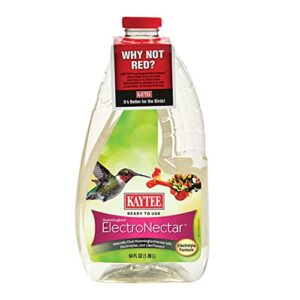
Kaytee Ready Use Hummingbird Nectar takes the guesswork out of feeding season. No mixing required — just shake, pour, and you’re done.
The 64-ounce, clear formula skips artificial dyes entirely, letting your feeder’s color do the attracting. It’s packed with electrolytes to keep birds hydrated through those high-energy wing beats.
At $9.99 a bottle, it’s a convenient option, though homemade sugar-water costs less. Refrigerate after opening and discard anything that looks cloudy or smells off.
| Best For | Busy bird enthusiasts who want a hassle-free feeding solution without the mess of mixing homemade nectar. |
|---|---|
| Capacity | 64 oz |
| Material | Plastic bottle |
| Color | Clear |
| Insect Deterrent | None |
| Feeding Ports | N/A (nectar liquid) |
| Cleaning Ease | N/A |
| Additional Features |
|
- No mixing needed — just shake, pour, and refrigerate after opening
- Clear, dye-free formula with added electrolytes to support bird health
- Made in the USA with a non-GMO recipe suitable for all life stages
- Pricier than DIY sugar-water, which costs just pennies per batch
- Some users have reported weak bottle seals leading to leaks during shipping
- Can attract ants, so you may need an ant moat or deterrent to keep feeders clean
2. Pennington Electro Nectar Hummingbird Food
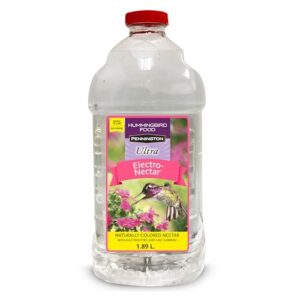
Pennington Electro Nectar pulls ahead of the pack with one feature Kaytee doesn’t offer — added electrolytes. That’s a real advantage when summer heat pushes your birds to their limits.
Like Kaytee, it’s dye-free and ready to use. Just shake, pour, and you’re done. The 64-ounce bottle holds several refills before you’re back at the fridge.
It costs a little more per bottle, but for rural setups with serious bird traffic, the hydration boost is worth it.
| Best For | Backyard birders in hot climates or high-traffic feeding setups who want a no-fuss, ready-to-use nectar with an extra hydration edge for their hummingbirds. |
|---|---|
| Capacity | 64 oz |
| Material | Plastic bottle |
| Color | Clear |
| Insect Deterrent | None |
| Feeding Ports | N/A (nectar liquid) |
| Cleaning Ease | N/A |
| Additional Features |
|
- Added electrolytes give hummingbirds a hydration boost that standard nectars don’t provide
- Completely ready to use — no mixing, boiling, or measuring required
- Dye-free and Cornell Lab-endorsed, so you know it’s safe and bird-friendly
- Pricier per ounce than homemade nectar or budget alternatives, which adds up with heavy feeder use
- Must be refrigerated after opening, and may need warming before use in colder weather
- Some bottles have been reported to look cloudy, suggesting inconsistent quality between batches
3. Feed Garden Red Hummingbird Feeder
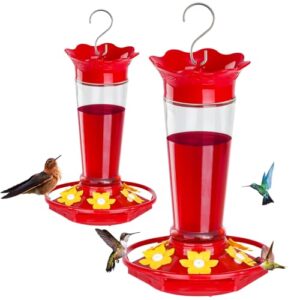
If nectar is what brings hummingbirds to your yard, the Feed Garden Red Hummingbird Feeder is what keeps them coming back. Its six flower-shaped ports and built-in ant moat tackle two of rural feeding’s biggest headaches — pests and mess — right out of the box.
At 10 oz, it’s compact enough to stay fresh between refills. BPA-free plastic, a leak-proof gasket, and a wide-mouth reservoir make cleaning quick and monitoring easy.
| Best For | Backyard birdwatchers who want a low-maintenance feeder that keeps bees and ants away while welcoming multiple hummingbirds at once. |
|---|---|
| Capacity | 10 oz |
| Material | BPA-free plastic |
| Color | Assorted |
| Insect Deterrent | Bee-resistant ports, ant moat |
| Feeding Ports | 6 |
| Cleaning Ease | Easy disassembly |
| Additional Features |
|
- Six flower-shaped ports let several hummingbirds feed simultaneously, making it great for active backyard watching
- Built-in ant moat and bee-resistant ports keep pests out and nectar cleaner for longer
- Wide-mouth reservoir and leak-proof gasket make refilling and cleaning quick and hassle-free
- The 10 oz capacity empties fast in hot weather, so frequent refills may be needed
- The ant moat only works if you remember to keep it filled with water — easy to overlook
- Prolonged sun exposure can degrade the plastic over time, so it may need replacing after a few years
4. Aspects Hummzinger Ultra Hummingbird Feeder
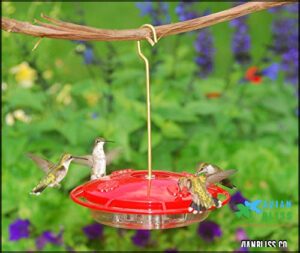
If the Feed Garden keeps pests at bay, the Aspects HummZinger Ultra takes protection further — and adds serious everyday convenience.
Its integrated ant moat and Nectar-Guard tips on all four ports block both crawling and flying insects without any extra accessories. The 12 oz polycarbonate reservoir stays clear so you can always see your nectar level, and the twist-off top makes refills fast. For rural properties where trips outside aren’t always quick, that simplicity genuinely matters.
| Best For | Backyard birders who want hassle-free pest protection and easy maintenance without relying on extra accessories. |
|---|---|
| Capacity | 12 oz |
| Material | Polycarbonate |
| Color | Red |
| Insect Deterrent | Nectar-Guard tips, ant moat |
| Feeding Ports | 4 |
| Cleaning Ease | Easy disassembly |
| Additional Features |
|
- Built-in ant moat and Nectar-Guard tips on all four ports keep ants, bees, and wasps out — no add-ons needed
- Clear polycarbonate reservoir lets you check nectar levels at a glance, so you never accidentally let it run dry
- Easy to disassemble and clean, with a twist-off top that makes refills quick and mess-free
- The feeder can tilt if the hanging hook isn’t perfectly centered, requiring a bit of fiddling to get it level
- The snap-fit between the top and bottom can be tricky to align when reassembling after a cleaning
- The ant moat may dry out in hot or arid climates, reducing its effectiveness unless you remember to top it up with water
5. Aspects HummZinger Rose Hummingbird Feeder
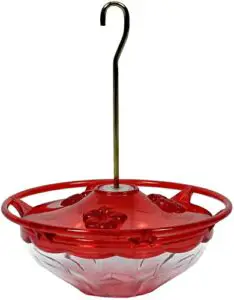
The Rose HummZinger isn’t just easy on the eyes — it genuinely earns its spot on a rural property. Its 12 oz clear reservoir lets you check nectar levels at a glance, and the lid lifts straight off for quick, no-fuss refills.
A built-in ant moat keeps crawling insects out without extra accessories.
UV-stabilized red components resist fading through harsh seasons, and the brass hanging rod won’t corrode when the weather turns rough.
| Best For | Gardeners and backyard enthusiasts who want to attract hummingbirds with a low-maintenance, visually appealing feeder — especially those setting up multi-feeder stations in smaller outdoor spaces. |
|---|---|
| Capacity | 4 oz |
| Material | Polycarbonate |
| Color | Red |
| Insect Deterrent | None built-in |
| Feeding Ports | 3 |
| Cleaning Ease | Dishwasher-safe |
| Additional Features |
|
- The raised, leak-proof feeding ports help keep nectar clean by diverting rain and deterring insects like wasps and bees
- Dishwasher-safe design makes cleanup quick and easy, so you spend more time watching birds and less time scrubbing
- The bright red finish doubles as a natural attractant, drawing hummingbirds in faster without any extra setup
- No built-in ant moat means you may need to buy a separate ant barrier if your yard has an ant problem
- The 4 oz capacity is small, so in peak season or hot weather you’ll be refilling more often than with larger feeders
- At a slightly higher price than comparable basic feeders, the value depends on how much you prioritize convenience and build quality
6. First Nature Red Hummingbird Feeder
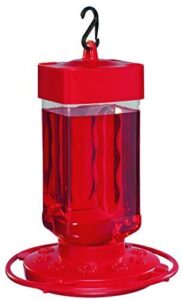
If you want a feeder that works hard without asking much in return, the First Nature Red delivers. Its 32 oz reservoir holds enough nectar to keep a busy yard humming for days, and the ten feeding ports mean you’re never watching birds compete for a single spot.
Pair it with a fresh batch of nectar using these simple homemade hummingbird nectar tips to keep every port flowing with safe, sugar-dissolved goodness.
The two-part base twists apart completely, so cleaning reaches every corner. Made in the USA from durable polymer, it endures outdoor seasons reliably — just stick to warm water when rinsing.
| Best For | Backyard enthusiasts who want to attract multiple hummingbirds at once with minimal upkeep. |
|---|---|
| Capacity | 32 oz |
| Material | Food-grade plastic |
| Color | Red |
| Insect Deterrent | Leakproof seal reduces insects |
| Feeding Ports | 10 |
| Cleaning Ease | Twist-apart base |
| Additional Features |
|
- Ten feeding ports let several hummingbirds feed side by side, cutting down on territorial squabbling
- The wide-mouth two-part base twists apart fully, making cleaning quick and thorough
- Leakproof seal keeps nectar off the ground, which helps deter ants and bees
- Refilling means unscrewing the bottom reservoir, which can spill leftover nectar
- The square bottle shape makes corner crevices trickier to scrub than round feeders
- Long-term UV exposure can cause cracking at the corners over time
7. More Birds Big Gulp Hummingbird Feeder
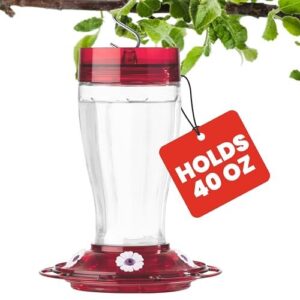
The More Birds Big Gulp earns its name with a generous 40 oz glass bottle — enough nectar to keep your yard buzzing through even the busiest migration days without constant refilling.
Seven perches let whole flocks settle in at once, and the built-in ant moat quietly takes care of pest problems before they start.
The detachable flat base makes cleaning straightforward, and the bold red design does the recruiting for you.
| Best For | Backyard birders in high-traffic areas who want a low-maintenance, large-capacity feeder that attracts multiple hummingbirds at once. |
|---|---|
| Capacity | 40 oz |
| Material | Glass/plastic |
| Color | Red |
| Insect Deterrent | Ant moat |
| Feeding Ports | 5 |
| Cleaning Ease | Hand-wash only |
| Additional Features |
|
- 40 oz glass bottle holds plenty of nectar, cutting down on how often you need to refill
- Built-in ant moat keeps pests out of the nectar without any extra effort on your part
- Five flower-shaped ports let several hummingbirds feed at the same time
- The plastic base and insert are fragile and can crack if dropped or handled too roughly
- Not dishwasher safe, so you’ll need to clean it by hand every time
- No hanging hardware included — you’ll need to supply your own hook or hanger
8. Glass Hummingbird Feeder Set
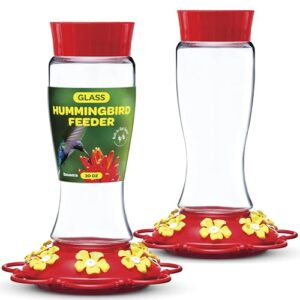
Sometimes the simplest design is the one that actually works. This glass hummingbird feeder set gives you two ready-to-hang feeders, each holding 20 oz of nectar — plenty for steady rural traffic without the overflow waste.
Four flower-shaped ports keep bees from muscling in, while the clear glass lets you check nectar levels at a glance. The three-piece teardown means cleaning doesn’t feel like a chore, and the rust-resistant metal cap withstands whatever your backyard weather throws at it.
| Best For | Backyard bird-watchers who want a low-maintenance, attractive feeder that keeps ants out and makes it easy to monitor and refill nectar. |
|---|---|
| Capacity | 30 oz |
| Material | Glass/plastic |
| Color | Red |
| Insect Deterrent | Ant moat |
| Feeding Ports | 5-7 |
| Cleaning Ease | Twist-apart base |
| Additional Features |
|
- Built-in ant moat keeps pests away from the nectar, so what you put out actually reaches the hummingbirds
- The clear viewing window lets you see at a glance when it’s time for a refill — no guessing or lifting required
- Glass construction holds up better to frequent cleaning than plastic, and the twist-apart base makes the whole process quick and easy
- Assembly needs careful attention — if the base isn’t seated just right, it can leak
- Perch hinges on some units have been reported to snap after light use, so it’s worth inspecting them early
- A number of buyers have received feeders with cracked bases or faulty lids straight out of the box, so check everything before your first fill
9. Perky Pet Grand Master Hummingbird Feeder
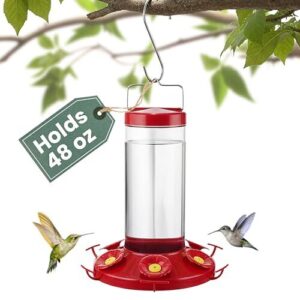
If you’re feeding a crowd, the Perky-Pet Grand Master was built for exactly that.
Its 48 oz clear reservoir keeps nectar flowing without constant refills — a genuine advantage when your property sits far from town.
Six flower-shaped ports let multiple birds feed at once, and the transparent walls mean you can check levels from across the yard.
The wide-mouth opening and detachable base make cleaning straightforward.
One heads-up: keep it shaded to protect the plastic from UV cracking.
| Best For | Busy birdwatchers or anyone with a large backyard hummingbird population who wants fewer refills and a front-row seat to multi-bird feeding action. |
|---|---|
| Capacity | 48 oz |
| Material | Shatter-proof plastic |
| Color | Clear/Red |
| Insect Deterrent | None built-in |
| Feeding Ports | 6 |
| Cleaning Ease | Wide-mouth, detachable |
| Additional Features |
|
- 48 oz reservoir means far less frequent refills, so you can enjoy the show without constant trips outside
- Six feeding ports let multiple hummingbirds eat at the same time — great for peak season crowds
- Clear walls and a wide-mouth detachable reservoir make monitoring and cleaning genuinely easy
- The two-piece base can leak if not assembled carefully or if cleaned with hot water
- Perches are on the fragile side and have been known to snap during shipping or heavy use
- The plastic can develop hairline cracks over time with direct sun exposure — a shaded spot will help it last longer
10. Perky Pet Glass Hummingbird Feeder
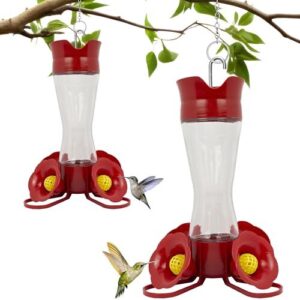
Glass has a way of making everything feel more intentional — and the Perky-Pet Glass Hummingbird Feeder brings that same quality to your backyard setup.
The tempered glass container resists impact and holds up better than plastic under sun exposure, while four flower-shaped ports with bee guards keep nectar clean. Its wide-mouth opening makes filling and cleaning genuinely convenient.
Keep it in partial shade, and you won’t have to worry about nectar spoiling too fast.
| Best For | Bird watchers who want a low-maintenance, stylish feeder that keeps nectar fresh and lets them enjoy a clear view of feeding hummingbirds from their patio or garden. |
|---|---|
| Capacity | 8 oz |
| Material | Glass |
| Color | Clear |
| Insect Deterrent | Ant moat, bee guards |
| Feeding Ports | 4 |
| Cleaning Ease | Pinch-waist disassembly |
| Additional Features |
|
- Four flower-shaped ports let multiple hummingbirds feed at once, making it great during peak season
- Built-in ant moat and bee guards help keep nectar clean and free from insects
- Wide-mouth glass bottle makes filling and cleaning quick and hassle-free
- Nectar can leak if the seals or O-rings aren’t seated perfectly
- Plastic components like bee guards and the ant moat can crack or become brittle with extended use
- The ant moat needs frequent refilling since the water evaporates quickly
Choosing Rural Feeder Capacity
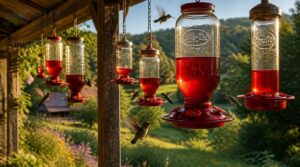
Picking the right feeder capacity for your rural property makes more difference than you’d think — too small and you’re refilling constantly, too large and the nectar spoils before the birds can finish it. Your location, the summer heat, and how many hummingbirds are actually showing up all play into that decision. Here’s what to keep in mind before you choose.
Small Feeders for Hot Weather
In peak summer heat, small feeders win. A 8–12 oz glass hummingbird feeder at your bird feeding station spoils far less nectar before you refill it. Remember to replace nectar frequently to curb bacterial growth. Place yours in partial shade — shade cuts nectar warming by up to 40%. Follow this rhythm:
- Refill every 1–2 days above 85°F
- Choose glass over plastic
- Check for leaks weekly
- Use dye-free nectar solution
- Rotate feeders to stay cool
Large Feeders for Remote Areas
When small feeders just don’t cut it, large feeders step up.
If you’re managing a remote rural property — far from town and easy supply runs — a 32 oz nectar feeder buys you roughly 20 hours of continuous feeding.
Step up to a jumbo 128 oz feeder, and you’re looking at a full week of sustained hummingbird visitation without touching it.
Matching Capacity to Bird Traffic
Bigger isn’t always better. Bird feeder capacity only matters if it matches actual traffic at your nectar feeder.
A 2-port model bottlenecks fast during peak feeding hours. A multiport feeder spreads birds out, preventing territorial bottlenecks.
Watch for:
- Dawn rushes draining ports
- One bird guarding the whole feeder
- Nectar depletion rates spiking in heat
- Quiet birds getting pushed away
Rotate feeding sites to ease the pressure.
Reducing Nectar Waste
Once traffic’s sorted, waste is the next leak to plug. A leakproof nectar feeder with sealed ports keeps drips off your porch and out of the grass.
Mix the standard 4-to-1 ratio and dissolve sugar fully — sludge gets dumped, not sipped. Add an ant moat, store extra nectar refrigerated, and clean with a bottle brush weekly to stop spoilage cold.
Refill Frequency Considerations
Rarely does refill schedule stay the same all season. Temperature impact on nectar drives most of it — above 85°F, sugar spoils fast and ferments within a day. Watch morning peak consumption too; that’s when birds drain ports quickest.
Humidity gums up ports, so pair refills with your feeder cleaning routine. Match nectar concentration and feeder capacity to actual migration traffic, not the calendar.
Best Materials for Rural Durability
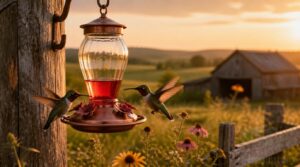
Out on a rural property, your feeder takes a beating from wind, sun, and curious critters. The material it’s made from decides whether it survives the season or ends up cracked in the grass. Here’s what to look for before you hang one up.
Glass Versus Plastic Feeders
Regarding feeder durability, glass wins the long game. A glass hummingbird feeder won’t warp, fade, or leach chemicals into your nectar. Plastic is lighter, but prolonged sun exposure causes cracking. Here’s what matters most:
- Nectar visibility — glass stays crystal clear
- Cleaning ease — non-porous surfaces resist mold
- Thermal stability — glass keeps nectar cooler longer
Metal Accents and Strength
Metal accents aren’t just decorative — they’re the backbone of a feeder that survives real rural conditions.
Stainless steel resists corrosion from nectar spills and humidity, while powder-coated finishes lock out moisture and UV damage. Copper develops a rich patina that actually strengthens over time.
On a glass-metal mason jar feeder, aluminum fittings keep overall weight low without sacrificing durability where it counts.
Sun Exposure Resistance
The sun doesn’t take a day off on rural properties, and your feeder shouldn’t either.
Look for UV coating longevity rated past 5 years, plus polypropylene parts holding strong at 120°C.
A weather‑resistant feeder fights material yellowing and slows nectar evaporation.
Glass durability beats plastic feeder durability long‑term, though both benefit from solar heat mitigation through reflective housing design.
Easy Nectar Visibility
When you’re checking your glass hummingbird feeder from across the yard, clarity isn’t a luxury — it’s the whole point.
Transparent reservoirs let you assess nectar levels instantly, while red port color contrast helps locate feeding spots without getting close.
Built-in level indicators and non-reflective surfaces cut glare, so even in bright rural sunlight, your hummingbird nectar feeders stay easy to read.
Weatherproof Hanging Designs
Wind and rain don’t care about your feeder schedule, so your hanging setup needs to hold its ground. Look for a weatherresistant feeder with sealed cores and corrosion-proof hooks built for rural exposure.
- UV-resistant garlands for nearby décor that won’t fade
- Corrosion-resistant lanterns lighting feeding zones at dusk
- Marine-grade sconces anchoring your glass hummingbird feeder reliably
Nectar Options and Preparation
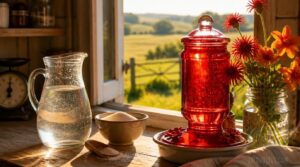
A feeder’s only as good as what’s inside it. Whether you grab a ready-made nectar or mix your own at the kitchen sink, what you fill it with matters as much as the feeder itself. Here’s what you need to know before you pour.
Ready-to-use Nectar Benefits
If you’ve ever fumbled with measuring cups beside a feeder in August heat, ready-to-use nectar is your shortcut to freedom.
Formulas like Kaytee Hummingbird ElectroNectar and Pennington ElectroNectar deliver consistent sugar ratios right out of the bottle — no guesswork, no dissolving, no risk of off‑balance mixes that disrupt hummingbird feeding behavior.
That convenience also means reduced microbial risk, keeping your nectar feeder cleaner between refills.
Electrolyte Nectar Formulas
Think of electrolyte-enhanced nectar as a sports drink for tiny wings. Pennington ElectroNectar goes beyond sugar water — it delivers potassium, magnesium, and sodium that helps muscle function and rapid hydration during peak migration. Kaytee Hummingbird ElectroNectar keeps things simpler but still dye-free. Both stay fresh longer when refrigerated after opening.
Electrolyte-enhanced hummingbird nectar works like a sports drink for tiny wings, fueling migration one sip at a time
- Potassium helps nerve signaling
- Sodium accelerates fluid absorption
- Magnesium fuels energy metabolism
Homemade Sugar-water Ratio
Skip the store run.
DIY hummingbird nectar comes down to 4 parts water, 1 part sugar — plain white sugar only, never honey or substitutes.
Heat water, dissolve sugar fully, then cool before filling.
Refrigerate leftovers and use within two weeks.
Watch for cloudiness or fizzing — those are fermentation signs telling you it’s time for a fresh batch.
Dye-free Nectar Importance
Red dye isn’t doing your hummingbirds any favors. A dye-free nectar solution skips artificial additives entirely, reducing the risk of gut irritation and allergic reactions in sensitive birds.
Clear sugar water also makes spoilage detection simple — cloudiness shows up instantly against a clean background. Your feeders stay stain-free longer too, which means less scrubbing between refills.
Safe Storage Practices
Store prepared nectar in a BPA-free or glass container with an airtight lid, labeled with the date. Refrigerate it promptly and use it within 14 days. Watch for fizziness, off smells, or cloudiness — those are spoilage red flags. Here’s what to avoid:
- Storing above 85°F
- Mixing old and fresh nectar
- Using cracked containers
- Leaving nectar unrefrigerated overnight
Placement for Rural Properties
Where you hang your feeder matters just as much as which one you choose. Rural properties give you plenty of options — and a few smart choices can mean the difference between a feeder that hummingbirds love and one they barely notice. Here’s what to keep in mind when picking your spot.
Partial Shade Locations

Full sun cooks nectar fast — and chases hummingbirds off, too. East-facing borders give morning light, then shelter by noon. Dappled canopy light under trees, or reflected light pockets near a barn, work just as well.
| Spot | Sun Hours | Bonus |
|---|---|---|
| East border | 4-6 hrs | Cool mornings |
| Dappled canopy | 2-5 hrs | Lower heat stress |
| Reflected pocket | 3-5 hrs | Wind shelter |
| Patio alcove | 2-4 hrs | Humidity boost |
| Pond edge | Varies | More birdwatching |
Shepherd’s Hooks and Poles
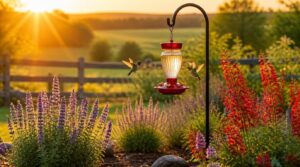
A shepherd’s hook is one of the smartest investments for your outdoor feeding station.
Five-prong ground stakes anchor solidly in soft rural soil, and powder-coated steel shafts resist rust through every season.
Heights from 48 to 84 inches let you position your hummingbird feeder exactly where birds feel safe — and you get the best view.
Window-mount Feeder Spots
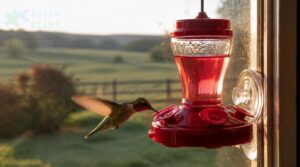
Mounting a window-mount hummingbird feeder transforms your living room into a front-row wildlife theater.
The North States WindowMount Hummingbird Feeder 20 oz locks firmly with suction cups across standard glass thicknesses.
Aim for 4–6 feet above ground, positioned near a shading shrub within ten feet — that keeps nectar cool and birds feeling bold enough to linger.
Flower Garden Placement

Tuck your feeder among nectar-rich blooms — salvias, bee balm, and cardinal flowers make natural landing zones that feel like home to hummingbirds.
Place tall plants at the back, shorter ones up front, so birds approach freely.
Group flowers with similar water needs nearby, and position in partial shade to keep nectar fresh longer.
Predator-safe Viewing Areas

A cat in the brush can end a feeding party fast, so think like a predator before you hang that feeder.
Clear ground cover for strategic sight lines, keep feeders away from dense shrubs, and consider an elevated platform height of 8 to 10 feet. Motion-triggered lights add backyard bird feeding security without spooking your guests.
Pest Control and Cleaning Tips
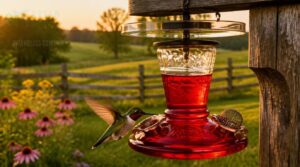
Out in the country, ants and bees show up to your feeder like they got an invite too. The good news is you’ve got real ways to keep your nectar for the hummingbirds and nobody else. Here’s what actually works to keep things clean and pest-free.
Ant Moats and Barriers
Once ants find your nectar feeder, they won’t quit. An ant moat is your simplest fix — a water barrier ants can’t cross, but hummingbirds ignore completely. Add a drop of dish soap to break surface tension and stop ants cold.
Check it weekly. Ant behavior means they’ll probe for cracks, so consistent moat maintenance beats any one-time barrier design or ant guard application.
Bee-resistant Feeding Ports
Bees are a whole different battle from ants. Where moats stop crawlers, bee-resistant feeding ports block fliers at the source.
Look for staggered petal designs that let hummingbird beaks through while keeping bees out, or honeycomb baffle technology that simply confuses larger insects.
Modular guard kits let you upgrade your existing nectar feeder without buying new.
Avoiding Sticky Nectar Drips
Drips are basically an open invitation for ants, bees, and wasps to crash your hummingbird setup.
Keep your vacuum seal tight — overfilling forces nectar past gaskets, so stop at the fill line. Clean ports weekly to prevent sugar crust buildup that breaks seals. A simple drip tray underneath catches spills before they become a pest magnet.
Hot-weather Nectar Replacement
Once that drip tray’s doing its job, turn your attention to the nectar itself. Heat spoils sugar water fast.
Above 85°F, swap nectar daily — fermentation and mold set in quick. Watch for cloudiness or dark spots, your cue to dump and rinse. Stick to a 4:1 water-sugar solution, skip dyes, and run smaller feeders so birds get fresh hydration without waste.
Routine Feeder Sanitation
Once you’ve beaten back ants and bees, the real work is keeping things clean. Wipe surfaces with hot water and mild detergent after every refill, rinsing well so no soapy film lingers.
Weekly, disassemble parts and scrub ports with a bottle brush to clear biofilm.
Monthly, sanitize with diluted bleach, then check gaskets each season.
Frequently Asked Questions (FAQs)
When should I install feeders in spring?
Hummingbirds can lose up to half their body weight overnight, so timing matters. Get your hummingbird feeder up two weeks before migration arrives, once temps hold steady above freezing — this seasonal feeding schedule boosts early season survival when flowers are still scarce.
How long should I keep feeders up in fall?
Keep feeders out through fall migration patterns, watching for cool snaps that signal travel. Remove feeders after last bird sighting, waiting two weeks. Resident species need ongoing support, while migrants build fat reserves before colder weather settles in.
Do hummingbirds need feeders year-round in some states?
Yes, in some spots. Coastal residency patterns in mild climates mean year-round feeding isn’t a myth—it’s survival. Unlike migratory species heading south, resident birds depend on your hummingbird feeder and fresh nectar solution when regional microclimates turn cold.
What hanging hardware works best for rural properties?
Go with swivel hooks rated for 150+ pounds, stainless steel fasteners, and braided steel cable instead of rope. These outdoor feeding stations resist wind, deter climbing predators, and keep your birdwatching equipment secure through every rural season.
How can I tell which brand feeder suits my yard?
Match the feeder to your yard by evaluating yard aesthetics, terrain, and local wildlife.
A glass hummingbird feeder suits flower borders, while sturdy hybrids handle open rural land—comparing brand styles and mounting needs keeps your pollinator garden practical and bird-friendly.
Conclusion
City feeders get to retire each evening, rinsed and tucked away from danger. Yours doesn’t get that luxury—it stands guard against heat, ants, and whatever else your land throws at it.
That’s the honest truth about nectar hummingbird feeders for rural properties: durability isn’t a bonus feature, it’s the whole job.
Pick the right capacity, place it smart, keep it clean, and you’ll earn something suburban yards rarely get—wild, fearless visitors who treat your fence post like home.