This site is supported by our readers. We may earn a commission, at no cost to you, if you purchase through links.
Most small parrot owners don’t realize that what looks like a healthy diet—colorful seed mixes, the occasional treat—can quietly leave their bird short on nutrients that matter. Budgies, cockatiels, and parrotlets have compact digestive systems and fast metabolisms, which means every bite carries more weight than it does for larger birds.
Choosing organic bird food for small parrots isn’t a trend-chasing decision; it’s a practical one that cuts out synthetic additives, GMO ingredients, and filler grains that small crops were never built to process well.
The six picks ahead cover the formulas worth trusting, matched by species, life stage, and the nutrient ratios that actually support long-term health.
Table Of Contents
- Key Takeaways
- Choosing Organic Food for Small Parrots
- Top 6 Organic Bird Foods
- Nutrients Small Parrots Need
- Transitioning Birds to Pellets
- Storage and Feeding Guidelines
- Frequently Asked Questions (FAQs)
- What is the best bird food for small parrots?
- How do I tell a parrot I love you?
- What is the best food for small parrots?
- What is the best wild bird food for small birds?
- What is the healthiest seed for parrots?
- Should I give my parrot seed or pellets?
- Can organic bird food expire if unopened?
- How to transition parrots to organic food?
- Does organic bird food reduce allergic reactions?
- Are organic bird foods safe for breeding parrots?
- Conclusion
Key Takeaways
- Small parrots have fast metabolisms and compact digestive systems, so every ingredient in their food carries more nutritional weight than it does for larger birds.
- USDA Organic certification, non-GMO verification, and corn-free labeling are the three label details worth checking before you buy any pellet formula.
- Matching pellet size and species-specific formulas to your bird’s life stage — juvenile, breeding, adult, or senior — makes a real difference in how well they absorb nutrients daily.
- Switching from seeds to pellets works best when you go slowly, starting with a seed-to-pellet mix and tracking weight, droppings, and appetite as your guide.
Choosing Organic Food for Small Parrots
Not all organic pellets are created equal, and the wrong choice can leave your bird under‑nourished despite your best intentions.
Label-reading matters more than most owners realize, so understanding what separates a quality formula from a mediocre one is worth your time before you buy — this guide to organic bird food pellets breaks down exactly what to look for.
A few key factors separate a truly solid food from one that just looks good on the label.
what to look for before you buy.
Match Pellets to Species and Life Stage
Not all pellets are created equal — species‑tailored formulas match small hookbills like budgies, parrotlets, and cockatiels to their specific dietary needs.
Life stage matters just as much:
- Juvenile growth pellets support higher protein demands
- Breeding energy boost formulas fuel reproductive effort
- Adult maintenance balances daily nutrients steadily
- Senior digestion support reduces excess calories
- Life‑stage mineral balance keeps calcium and phosphorus aligned
Choose accordingly.
Pick The Right Pellet Size
Size matters more than you’d think. For small hookbills like budgies and cockatiels, mini pellets in the 2–4mm range hit the sweet spot for swallowing safety and crop capacity considerations. Pellet shape preference plays a role too — rounded, cylindrical organic bird feed travels smoothly through tiny digestive tracts.
Watch droppings monitoring as your guide: consistent output signals good feeding efficiency metrics with nutrient-dense blends.
Look for USDA Organic Certification
Once you’ve sorted out pellet size, turn your attention to the label. The USDA Organic certified seal isn’t just a sticker — an Accredited Certifier issues it only after reviewing the Organic System Plan and Inspection Records.
Check the Certification Date to confirm it’s current.
For small hookbills, products like TOPs Parrot Food Mini Pellets offer reliable Certified Organic Bird Nutrition with verified Seal Verification on every bag.
The certification process includes an annual on-site inspection to verify compliance.
Prefer Non-GMO, Corn-free Formulas
Beyond certification, ingredient sourcing transparency matters just as much. Look for non-GMO verification and corn-free labels on your organic parrot pellets — corn sensitivities are common in small hookbills, and many quality mini pellets swap corn for millet or oat-based alternative protein sources.
Here’s what to check during your label interpretation:
- Confirm Non-GMO Project Verified status
- Verify the certification verification process covers full production batches
- Check that corn-free applies to both pellets and supplements
- Look for cross-contamination control statements on packaging
- Confirm no corn syrup, corn flour, or GMO soy appears in the ingredient panel
Avoid Artificial Colors, Flavors, and Preservatives
What goes into your bird’s food matters more than the bag’s branding.
Artificial colors like tartrazine, artificial flavors, and synthetic preservatives can trigger sensitivity in small parrots—so stick with USDA Organic certified options that rely on natural preservatives, natural colorants, and plant-based flavors instead.
Label transparency is your best tool here; synthetic additive risks are real, and organic preservation techniques keep things genuinely fresh.
Check Protein, Fat, Calcium, and Phosphorus Levels
Once you’ve ruled out synthetic additives, flip the bag over and actually read the numbers. Nutrient Ratio Analysis starts with Label Protein Comparison and Fat Content Screening — protein helps feathers and tissue repair, while fat drives energy balance.
For small to medium birds, Calcium-Phosphorus Balance matters just as much; a skewed mineral ratio quietly weakens bones over time.
Prioritize nutrient-dense blends with clear Mineral Ratio Monitoring on the label.
Top 6 Organic Bird Foods
Finding the right organic food for your small parrot doesn’t have to feel overwhelming. These six options cover a range of formulas, sizes, and price points—so there’s likely something that fits your bird’s needs and your budget.
Here’s a closer look at each one.
1. Tops Organic Parrot Hookbills Pellets
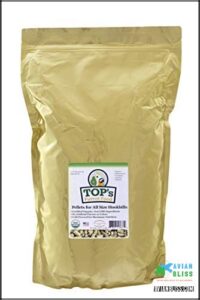
If you’re serious about what goes into your bird’s bowl, Tops Organic Parrot Hookbills Pellets are worth a close look. They’re USDA Organic certified, cold-pressed to preserve natural nutrients, and free from corn, soy, artificial colors, and flavors.
The ingredient list reads like a farmer’s market haul — alfalfa, quinoa, millet, pumpkin, sunflower seeds, and herbs.
At 4 lb per bag, it’s a solid daily staple for medium to large hookbills, including macaws and cockatoos.
| Best For | Medium to large parrots — especially Eclectus, macaws, and cockatoos — whose owners want a clean, organic diet free from common allergens. |
|---|---|
| Certification | USDA Organic, Non-GMO |
| Artificial Additives | None |
| Life Stage | All life stages |
| Product Form | Compressed pellet |
| Net Weight | 4 lb (1.81 kg) |
| Corn & Soy Free | Yes |
| Additional Features |
|
- USDA Organic certified and non-GMO, with no artificial preservatives, colors, or flavors
- Complete, balanced nutrition in one pellet — covers vitamins, minerals, amino acids, and whole food ingredients
- Corn- and soy-free, making it a great fit for sensitive species that react poorly to those ingredients
- Pellet size can be too bulky or crumbly for smaller birds that need finer pieces
- Pricier than most conventional pellet brands, which adds up fast for multi-bird households
- Picky eaters used to sugary or heavily flavored pellets may take weeks — sometimes months — to warm up to the taste
2. TOP Parrot Food Small Bird Pellets
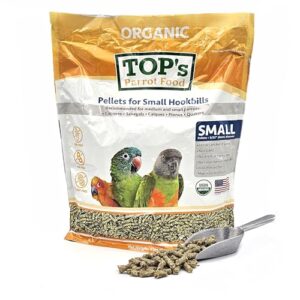
Tiny beaks need the right fit, and TOP Parrot Food Small Bird Pellets are built with that in mind. Each pellet measures just 5/32 inches — small enough for budgies, lovebirds, and parakeets to pick up cleanly.
They’re USDA Organic certified, non-GMO, and free from corn, artificial colors, and preservatives.
The crumbled texture makes eating easier and reduces waste at the bottom of the dish.
At $33.70 for a 4 lb bag, it’s a reliable daily staple for small hookbills at any life stage.
| Best For | Small hookbill owners — budgies, lovebirds, parakeets, and sun conures — who want a clean, organic daily diet without the guesswork. |
|---|---|
| Certification | USDA Organic, Non-GMO |
| Artificial Additives | None |
| Life Stage | All life stages |
| Product Form | Pellet |
| Net Weight | 4 lb (1.81 kg) |
| Corn & Soy Free | Yes |
| Additional Features |
|
- USDA Organic, non-GMO, and free from corn, soy, artificial colors, and preservatives — about as clean as bird food gets
- Works for all life stages, so you’re not swapping bags as your bird grows
- Easy to mix with fresh foods for a more varied diet
- Some birds take time to warm up to pellets, so the transition can be a bit of a patience game
- Crushed pellets tend to pile up at the bottom of the bag, and picky birds may ignore them
- At $33.70 for 4 lbs, it costs more than a standard seed mix
3. TOPs Organic Parrot Food Pellets
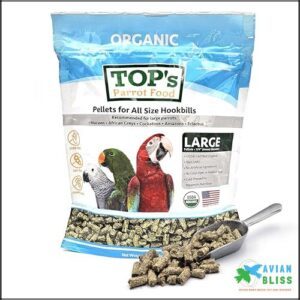
TOPs Organic Parrot Food Pellets are cold-pressed to a quarter-inch diameter, which helps lock in natural enzymes and nutrients that heat-based processing would otherwise destroy. Each pellet is USDA Organic certified, non-GMO, and free from corn, soy, artificial colors, and preservatives — just organic grains, seeds, vegetables, and herbs held together naturally.
Rosemary, rose hips, and citrus peel do the preserving here.
It’s a solid primary diet for cockatiels, conures, and similar mid-sized birds at any life stage.
| Best For | Parrot owners who want a clean, organic pellet for mid-to-large birds like African Greys, Amazons, or cockatiels — especially birds with sensitivities to artificial additives. |
|---|---|
| Certification | USDA Organic, Non-GMO |
| Artificial Additives | None |
| Life Stage | All life stages |
| Product Form | Cold-pressed pellet |
| Net Weight | 1 lb (453 g) |
| Corn & Soy Free | Yes |
| Additional Features |
|
- USDA Organic, non-GMO, and free from corn, soy, and synthetic preservatives — about as clean as parrot food gets.
- Cold-pressed pellets help preserve natural enzymes and nutrients that heat processing usually wipes out.
- Works for all life stages and a wide range of medium to large parrot species.
- Pricier than conventional corn-based pellets, so the cost adds up fast if you have multiple birds.
- Picky eaters used to sugary or flavored pellets may take weeks — or longer — to warm up to this one.
- Some users report crumbling, which can mean more mess and wasted food at the bottom of the cage.
4. TOP Organic Mini Bird Pellets
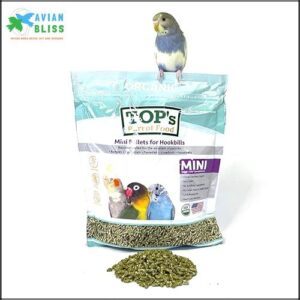
If your budgie or parrotlet keeps leaving pellets behind, size is probably the issue.
TOP’s Organic Mini Bird Pellets are cold-pressed to just 3/32 inches in diameter — small enough for tiny beaks to grip and crumble without wasting half the bowl. They’re USDA Organic, corn-free, and preserved naturally with rosemary and citrus peel.
No fillers, no artificial anything.
At roughly $19 per pound, they’re an investment, but the nutrient consistency per serving makes them worth it for small-species households.
| Best For | Small parrot owners — especially budgies, parrotlets, lovebirds, and parakeets — who want a clean, organic diet without the guesswork of seed mixes. |
|---|---|
| Certification | USDA Organic, Non-GMO |
| Artificial Additives | None |
| Life Stage | All life stages |
| Product Form | Cold-pressed pellet |
| Net Weight | 1 lb (454 g) |
| Corn & Soy Free | Yes |
| Additional Features |
|
- USDA Organic and free of corn, soy, fillers, and artificial preservatives — about as clean as bird food gets
- Cold-pressed mini pellets (3/32") are easy for tiny beaks to grip, which means less mess and less waste
- Works as a complete diet on its own or can be mixed in gradually during a food transition
- At around $19 per pound, it’s pricier than most conventional seed mixes
- Some budgie owners find the pellets still run a bit large for the smallest birds
- Packaging has had issues — a few buyers report punctured bags and spillage on arrival
5. Mycelium Organic Large Parrot Feed
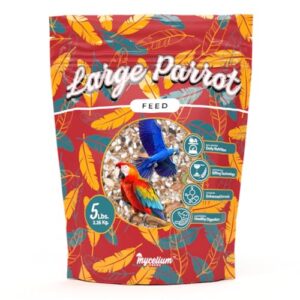
Now, if you’ve got a macaw, cockatoo, or amazon at home, this one’s worth a look.
Mycelium Organic Large Parrot Feed is built for big birds — a 5 lb blend of seeds, pellets, and kibble that covers foraging instinct and nutrition in one bag.
Safflower, hemp, buckwheat, and oat groats give your bird something to work through mentally and physically.
It’s fortified with vitamins A, D3, E, and B12, plus calcium and zinc.
Non-GMO, no artificial additives.
| Best For | Owners of large parrots like macaws, cockatoos, and amazons who want an organic, nutrient-rich staple diet that keeps their bird mentally engaged at mealtime. |
|---|---|
| Certification | Non-GMO, Organic Ingredients |
| Artificial Additives | None |
| Life Stage | All life stages |
| Product Form | Seed, pellet, kibble blend |
| Net Weight | 5 lb (2.27 kg) |
| Corn & Soy Free | No |
| Additional Features |
|
- Mixed seeds, pellets, and kibble in varied shapes encourage natural foraging and cut down on boredom
- USDA organic ingredients with no GMOs, artificial flavors, or synthetic preservatives
- Fortified with key vitamins and minerals (A, D3, E, B12, calcium, zinc) to support feathers, immunity, and energy
- Contains corn, soy, wheat, and peanuts — not ideal for birds with common food sensitivities
- High fat and protein content means portion control is needed for birds prone to weight gain or liver issues
- The 5 lb bag can feel like a lot if you only have one bird or don’t go through feed quickly
6. ZuPreem True Harvest Bird Pellets
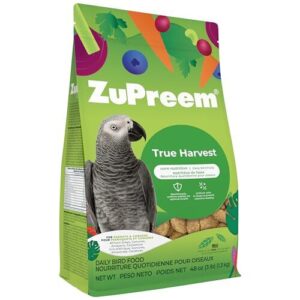
Not every bird owner has a large parrot, and ZuPreem True Harvest speaks directly to smaller species like cockatiels, budgies, and lovebirds.
It’s a grain-based pellet — corn, millet, wheat, and oat groats — with no artificial colors or flavors added.
You’ll also get a solid vitamin and mineral complex covering A, D, E, and the B group.
One thing to watch: sugar sits fairly high on the ingredient list, so it’s worth keeping portions measured for carb-sensitive birds.
| Best For | Medium to large parrot owners — African Greys, Eclectus, conures, and Amazons — who want a nutritionally complete daily pellet without relying on seeds alone. |
|---|---|
| Certification | Not USDA Organic certified |
| Artificial Additives | None |
| Life Stage | All life stages |
| Product Form | Pellet |
| Net Weight | 3 lb (1.36 kg) |
| Corn & Soy Free | No |
| Additional Features |
|
- Packed with real fruits, veggies, and herbs (carrots, blueberries, cranberries) alongside a full vitamin and mineral complex
- No artificial colors, flavors, or synthetic preservatives — natural stabilizers only
- Works across all life stages and a wide range of species, so it’s flexible if you have a mixed flock
- Sugar shows up pretty high on the ingredient list, which is worth watching for carb-sensitive birds
- Contains peanuts and tree nuts, so it’s not safe for birds with nut sensitivities
- Some users have noticed a stale oil smell as the bag nears its expiration date
Nutrients Small Parrots Need
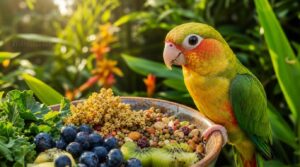
Good food does more than fill a tiny belly—it fuels everything from feather growth to immune defense.
Good food does more than fill a tiny belly — it fuels feather growth, immunity, and everything in between
Small parrots have specific nutritional needs that seeds alone can’t meet, which is exactly why what’s inside the bag matters as much as the certification on it.
Here’s a look at the key nutrients your bird needs and why each one earns its place in the bowl.
Balanced Vitamins and Minerals for Daily Health
Small parrots need more than just seeds to thrive — their bodies depend on precise Micronutrient Ratios to keep immunity strong and energy steady. Organic ingredients deliver a complete vitamin profile without synthetic fillers, supporting Vitamin Synergy across systems.
Key Daily Nutrient Targets include:
- Calcium-phosphorus balance for bone health
- Mineral Bioavailability from clean, non-GMO sources
- Balanced Micronutrient Profiles covering iron, zinc, and magnesium
- Vitamin A from organic red palm oil
- Balanced macronutrients to prevent obesity
Amino Acids for Growth and Maintenance
Beyond vitamins, your parrot’s body relies on amino acids to build and repair tissue. Think of them as the construction crew behind every feather and muscle.
Organic, nutrient-dense blends support both Essential Amino Balance and Nonessential Functions — together driving a healthy Protein Synthesis Rate. Without enough protein quality and Nitrogen Balance, Tissue Repair Mechanisms stall, leaving small parrots unable to maintain lean, healthy bodies.
Calcium Support for Strong Bones
Calcium does more than you might think — it’s the foundation of skeletal strength and bone density maintenance in small parrots. Organic certified bird nutrition promotes calcium phosphorus balance in bird diets, preventing metabolic bone health issues common in seed-heavy diets.
Look for nutrient-dense blends that include:
- Calcium absorption aid through Vitamin D synergy
- calcium-to-phosphorus ratios for ongoing skeletal strength
- organic bird feed free from fillers that block mineral uptake
Vitamin a Sources for Feather Health
Feathers don’t lie — dull, frayed plumage often signals a vitamin A gap. Since small to medium birds can’t produce vitamin A on their own, they rely on carotenoid-rich produce like beta carotene vegetables, dark leafy greens, and red palm oil.
An egg yolk supplement fills remaining gaps.
Nutrient-dense blends built from natural, organic ingredients keep vitamins and minerals balanced without guesswork.
Healthy Fats Without Excess Obesity Risk
Fat matters — but so does how much you offer. Small parrots need unsaturated fat sources like flaxseed and safflower oil for essential fatty acids, but calorie density adds up fast.
Follow these portion control strategies:
- Limit nuts to one or two pieces daily
- Prioritize nutrient-dense blends over loose seeds
- Balance omega guidance by rotating fat sources
- Choose low-calorie treats to avoid high-fat intake
Avoiding saturated fats keeps the protein-to-fat ratio healthy.
Natural Preservatives for Freshness and Safety
What keeps your pellets fresh without synthetic chemicals? Natural preservatives do the heavy lifting.
Rosemary extract and citrus peels slow lipid oxidation and inhibit mold, while green tea antioxidant compounds protect sensitive vitamins during storage.
Oregano essential oil, cinnamon antimicrobial agents, and clove extract fight spoilage fungi and bacteria effectively.
These natural preservatives protect organic ingredients, keeping food safe and nutritious for small to medium birds.
Transitioning Birds to Pellets
Switching your bird from seeds to pellets takes patience — most parrots don’t warm up to new foods overnight. The good news is that with the right approach, you can make the shift without stressing your bird out.
Here are six practical steps to help the change go smoothly.
Start With Familiar Textures and Flavors
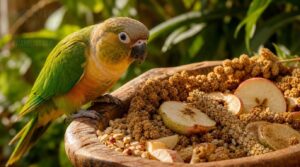
Think of the first week as a flavor handshake. Your bird already trusts seeds, so soft grain mimicry — pellets shaped and sized like familiar seeds — reduces rejection fast.
Gradual flavor layering works best when you add mild sweet accents like apple or pear. Texture pairing techniques, such as warming mini pellets slightly for warm aroma introduction, help organic ingredients and seed-based treats feel instantly familiar to small to medium birds.
Use High-potency Formulas for Conversion
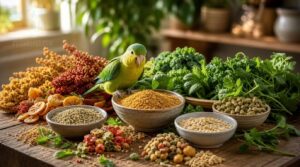
High Potency Fine and High Potency Super Fine formulas exist precisely for this moment.
Phase timing matters — these certified organic conversion diets for small to medium birds deliver consistent nutrient adjustment across protein, calcium, and phosphorus levels, supporting bone health support without gaps.
The palatability boost comes built in, and tracking weight monitoring weekly tells you whether your bird is truly accepting the shift.
Offer Treats to Encourage New Foods
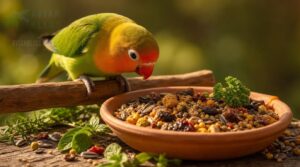
Once your bird starts recognizing the new routine, treats become your best tool. Organic seed-based treats like Nuggies work well because they offer familiar texture while delivering non‑GMO, small bird nutrition solutions without compromise.
treat timing and portion control basics:
- Offer one new item per session for clear variety exposure
- Give the treat immediately after your bird takes a first taste — that positive cue matters
- Keep portions bite‑sized to support foraging enrichment without replacing nutrient‑dense pellets
- Remove treats after a short window and watch for red flags like changed droppings
Mix Pellets With Seed-based Foods Gradually
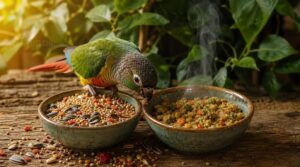
Gradual seed reduction is your friend here. Start with 90% seeds and 10% pellets, then shift the ratio week by week using a stepwise ratio increase until pellets dominate.
Texture softening techniques help too — soak pellets in warm water and mash them into the seed mix so your small parrot can’t sort around them.
Feeding schedule consistency makes the whole process stick.
Watch Appetite, Droppings, and Weight Changes
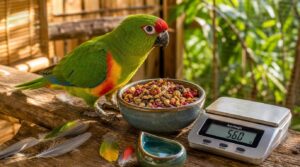
As the seed-to-pellet ratio shifts, keep a close eye on your bird’s daily signals. Appetite monitoring is straightforward — fewer pellets eaten or less dish activity matters.
Check droppings color and stool consistency after each meal change.
Weight trend tracking across several days, using the same scale and time, tells you far more than a single number. Activity correlation ties it all together.
Adjust During Breeding or Molting Seasons
Breeding and molting push your bird’s body hard — think of it as running a marathon while growing a new coat. These phases call for nutrient-dense blends with a Protein Boost and higher Energy Density to support Feather Regrowth and Hormonal Balance. Smart Supplement Timing matters too.
Shift toward organic bird food with vitamin enrichment that covers:
- Amino acid support for continuous feather rebuilding
- Calcium and vitamin A without over-supplementing an already complete pellet
- Consistent daily intake using small bird nutrition solutions and Bird Breeding and Molting Diets
Storage and Feeding Guidelines
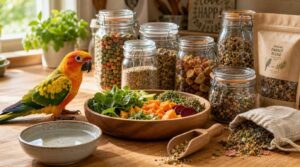
Even the best organic food loses its value if it’s stored or served the wrong way. A few simple habits keep your bird’s meals fresh, safe, and actually worth eating.
Here’s what you need to know.
Store Pellets in a Cool, Dark Place
Think of your pellet stash like a mini pantry — location matters. Keep your USDA Organic certified pellets in a cool, dark spot between 40–70°F, away from heat vents or sunny windows.
Light Exposure Reduction and Temperature Fluctuation Prevention protect nutrient integrity considerably.
Practice Humidity Monitoring by keeping areas below 60% humidity, adding a Desiccant Use pack, and marking bags for Shelf-life Tracking.
Use Airtight, BPA-free Containers
Once you’ve found the right spot for your pellets, the container you use matters just as much.
For USDA Organic certified organic parrot food, choose BPA-Free Material Safety containers made from polypropylene or Tritan — both FDA-compliant and chemical-inert.
A silicone gasket ensures Silicone Gasket Durability and strong Airtight Seal Performance across hundreds of open-close cycles.
Transparent Container Design lets you spot spoilage fast, and Stackable Space Efficiency keeps your Food Storage Solutions for Birds tidy.
Serve Fresh Fruits and Vegetables Safely
Fresh produce rounds out your small parrot’s diet, but how you handle it matters as much as what you choose. Always start with Hand Hygiene — 20 seconds of soap and warm water — before prepping anything. Use Separate Cutting Boards to keep produce away from raw meat, and practice smart Temperature Control by refrigerating cut pieces within two hours.
- Practice Mold Inspection before every serving — discard anything soft or discolored
- Keep Portion Size small to reduce waste and spoilage risk
- Pair produce with Organic Certified Parrot Pellet Options and nutrient-dense blends for balanced Small Bird Nutrition Solutions
- Rotate vegetables weekly to support vegetable foraging behavior and deliver varied natural ingredients
Wash Produce and Cut Bite-sized Pieces
Every piece of produce your parrot gets should start with a Running Water Rinse — no soap, just gentle rubbing under the tap to remove surface germs. Sanitize Cutting Board before each use, then Remove Bruised Sections before cutting.
Aim for Consistent Piece Size, so small beaks handle food easily.
Dry After Wash before serving to keep certified organic bird nutrition and small bird nutrition solutions fresh and safe.
Change Water Daily
Daily water changes are one of the simplest ways to protect your cockatiel or small parrot. Biofilm Prevention starts the moment you rinse the bowl before refilling — that sticky film builds fast. Bowl Hygiene and Routine Scheduling go hand in hand with serving certified organic, nutrient-dense blends.
- Room-temperature water helps Temperature Safety for delicate crops
- BPA-free containers reduce chemical leaching during daily refills
- Freshness Monitoring catches cloudiness or odors before they cause harm
- Organic bird food stays effective only when paired with clean hydration
Remove Moldy or Spoiled Food Quickly
Mold moves fast — and your parrot can’t tell you something’s off. Check food daily for fuzzy growth, musty odors, or soft spots. Those are your Mold Detection Signs. Follow Safe Disposal Methods: bag spoiled food immediately using BPA-Free, Food-Grade containers, then sanitize surfaces with hot, soapy water.
| Action | What to Do | Why It Matters |
|---|---|---|
| Bagging Spoiled Food | Seal in bag before trashing | Stops spore spread |
| Sanitizing Surfaces | Hot water + disinfectant | Kills stray mold |
| Spill Cleanup Protocol | Wipe immediately, dry fully | Prevents regrowth |
ShelfLife and Freshness of Organic Bird Feed depend on your bird feeding guidelines and organic certification standards.
Frequently Asked Questions (FAQs)
What is the best bird food for small parrots?
The best parrot diet centers on nutrient-dense blends with non-GMO, certified organic ingredients.
Prioritize pellets covering 60–70% of daily intake, backed by ingredient sourcing transparency, to support long-term bird health monitoring effectively.
How do I tell a parrot I love you?
Love is a two-way street, even with parrots. Use gentle touch, soft vocalization, and calm body language daily.
Training phrases paired with rewarded interaction help your bird recognize and return affection naturally.
What is the best food for small parrots?
For small parrots, the winning combo is pellets as your nutrient-dense base, fresh vegetables, and occasional fruit.
Texture preference and flavor variety matter too — rotating options keep mealtimes interesting and your bird eating well.
What is the best wild bird food for small birds?
For wild small birds like finches and sparrows, seed mix diversity is key.
Suet blocks, insect protein sources, and seasonal fruit offerings attract the widest variety while delivering nutrient-dense blends that they naturally crave.
What is the healthiest seed for parrots?
No single seed wins every round, but sesame calcium support, flax omega fatty acids, pumpkin vitamin content, and sprouted seed digestibility each earn their place.
seed variety and a seed and pellet blend keep parrot nutrition truly balanced.
Should I give my parrot seed or pellets?
Both have a place, but pellets win on nutrient consistency. Seeds invite selective eating risks, while pellets deliver balanced parrot nutrition in every bite—no cherry-picking allowed.
Can organic bird food expire if unopened?
Yes, organic bird food can expire even when unopened. Shelf life generally runs 6–12 months.
Packaging integrity, moisture impact, and temperature effects all matter. indicator signs like a rancid smell or crumbling texture.
How to transition parrots to organic food?
Switch gradually by mixing nutrient-dense pellets with seeds, using flavor enhancement and behavioral conditioning to ease stress.
Observe droppings and weight as key observation metrics while adjusting the conversion diet for birds slowly.
Does organic bird food reduce allergic reactions?
Organic bird food doesn’t automatically eliminate allergic reactions, but ditching artificial additives and ingredient triggers like corn or soy can ease sensitivities.
Non-GMO, natural ingredients support immune modulation — though sensitivity testing remains essential for your bird.
Are organic bird foods safe for breeding parrots?
For breeding parrots, organic bird food offers real advantages — ingredient purity, mycotoxin safety standards, and nutrient consistency matter most.
Veterinary endorsement backs nutrient-dense blends packed with vitamins and minerals that directly support breeding health impacts.
Conclusion
Every single meal your small parrot eats either builds toward a longer, healthier life—or quietly chips away at it. Choosing the right organic bird food for small parrots isn’t overthinking; it’s the one decision that touches everything else, from feather quality to energy levels to how many years you get together.
Start with one strong formula, adjust patiently, and store it properly.
Your bird can’t advocate for itself—but now, you can.
- https://www.helpguide.org/wellness/nutrition/vitamins-and-minerals
- https://www.betterhealth.vic.gov.au/health/healthyliving/Vitamins-and-minerals
- https://www.nccih.nih.gov/health/vitamins-and-minerals
- https://www.dnabasedwellness.com/resources/blog/2411187_the-complete-guide-to-daily-vitamin-and-mineral-requirements
- https://nutritionsource.hsph.harvard.edu/vitamins/