This site is supported by our readers. We may earn a commission, at no cost to you, if you purchase through links.
Most people walk past pigeon nests without recognizing them. That’s by design.
A pigeon nest looks like a loose pile of twigs someone accidentally dropped on a ledge—no careful weaving, no soft curves. But that messy little platform holds two white eggs and represents a breeding system so efficient that pigeons raise up to six broods a year in cities worldwide.
Once you know what pigeon nests actually look like and why pigeons build them the way they do, you’ll never look at a window sill or rooftop ledge the same way again.
Table Of Contents
- Key Takeaways
- What Pigeon Nests Look Like
- Where Pigeons Build Nests
- Why Pigeon Nests Stay Simple
- Pigeon Nest Building Steps
- Pigeon Breeding and Courtship
- Pigeon Eggs and Incubation
- Squab Growth and Feeding
- Nest Reuse and Growth Over Time
- Health Risks From Pigeon Nests
- Top 3 Pigeon Feeding Products
- Frequently Asked Questions (FAQs)
- Conclusion
Key Takeaways
- Pigeon nests look like a random pile of twigs, but that flat, shallow platform is a deliberate design that keeps eggs stable and lets pigeons raise up to six broods per year.
- Pigeons pick nesting spots — ledges, rooftops, fire escapes, bridge undersides — that mimic cliff faces, giving them shelter, stability, and low human disturbance all at once.
- Keeping nests simple isn’t laziness; it saves energy and lets pairs rebuild within days, which means more breeding cycles and better survival odds overall.
- Old pigeon nests are a real health hazard — dried droppings carry mold, parasites, and airborne bacteria, so always wear a respirator and gloves before you clean one up.
What Pigeon Nests Look Like
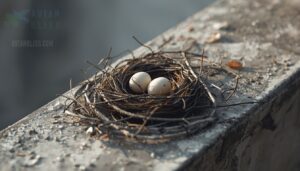
If you’ve ever spotted a pigeon nest, you probably thought, "That’s it?" They’re honestly pretty bare-bones compared to what most birds build.
Just a few twigs loosely stacked together—check out how wildly bird nesting styles vary to see what pigeons are up against.
Here’s a closer look at what makes them tick.
Flat Platform Shape
A pigeon nest looks almost laughably simple — just a flat surface, like a tiny wooden pallet. It’s a minimalist nest design that works through smart engineering:
- Uniform load distribution keeps eggs stable across the flat platform
- Slip-resistant surface from layered debris prevents rolling
- Modular edge design allows gradual expansion each season
Think of it as nature’s no-frills building ledge nesting solution.
Small Twigs and Grass Materials
That flat platform isn’t built from much — just small twigs, roughly 1 to 6 millimeters thick, layered using simple binding patterns and basic layering techniques. Material freshness matters here.
Fresh grass strands weave between twigs, creating a camouflage texture that blends into ledges naturally.
Pigeons rely on smart nesting material selection and nearby sourcing sources, gathering most materials within a few hundred meters.
It’s a simple platform nest that works.
Shallow Egg Depression
Once the twigs and grass are layered down, the real magic happens in the center. A shallow egg depression — just 2 to 4 millimeters deep — forms naturally as eggs settle in.
This minimalist nest design isn’t an accident. It’s an evolutionary adaptation, significance that you can actually see in action.
The material compaction effect creates a snug hollow, boosting thermal regulation benefit and egg stability mechanism during incubation.
Typical Size and Height
So how big is this simple platform, exactly? Most pigeon nests measure 10 to 15 centimeters in a diameter range, with a cup depth of just 1.5 to 2.5 centimeters.
The rim height sits only 2 to 4 centimeters above the base. Nest thickness stays minimal — compact enough to blend onto building ledges and rooftops, where nest site selection in urban environments favors flat, sheltered spots at 2 to 6 meters of platform elevation.
Where Pigeons Build Nests

Pigeons don’t nest just anywhere — they’re surprisingly picky about location. They look for spots that feel like cliff ledges: flat, sheltered, and off the ground.
Here are the most common places you’ll find them setting up home.
Building Ledges and Rooftops
Rooftops and building ledges are basically the urban version of a cliff face — and pigeons figured that out long ago.
These spots offer flat, sheltered surfaces made from concrete, stone, or metal, with built-in drainage design and thermal insulation that accidentally create ideal nest sites.
Urban roof integration across human-made environments gives pigeons stable platforms, and safety barriers along ledges only add more nesting appeal.
Window Sills and Fire Escapes
Window sills and fire escapes are prime real estate for urban pigeons. They offer the flat, sheltered ledges that mimic natural cliff faces — exactly what pigeons seek for nest site selection.
These spots sometimes raise real concerns, though. Nests can block egress clearance requirements, compromise obstruction-free escape paths, and even cover slip-resistant ledge design features meant to keep people safe during emergencies.
Under Eaves and Bridges
Tucked under eaves and beneath bridge overhangs, pigeons find some of their best nest locations in the city. These spots offer real microclimate benefits — shade, reduced moisture, and natural predator protection from above. Urban architecture basically does the work for them.
Material accumulation builds steadily over seasons, and human disturbance stays low. It’s smart, opportunistic nest site selection at its finest.
Installing eaves protection trays further reduces moisture buildup at nest sites.
Cliff-like Sheltered Surfaces
Pigeons are basically cliff birds wearing a city disguise. Long before buildings existed, rocky cliff crevices gave them everything — shelter, stability, and microclimate moisture control.
Urban ledges and overhangs just mimic that.
- Sheltered overhangs trap humidity, supporting moss lichen communities
- Mineral-rich drips create stalactite mineral deposits over time
- Erosion undercutting dynamics gradually reshape these natural recesses
- Cliff nesting instincts drive them under bridges, overpasses, and eaves today
Why Pigeon Nests Stay Simple

Pigeon nests aren’t built to impress — they’re built to work. There’s a smart logic behind keeping things bare-bones, and it comes down to energy, speed, and survival.
Here’s why simplicity is actually the whole point.
Low Energy Construction
Think of it like building a house with no insulation, no airtight envelope, no passive solar design—just the bare minimum. That’s pigeon construction. They skip complexity on purpose.
| Element | Bird Nest | High-Performance Home |
|---|---|---|
| Structure | Loose twigs | Engineered framing |
| Insulation | Minimal | Thermal layers |
| Energy cost | Near zero | Significant |
Minimalist nest design and materials aren’t laziness—it’s pure resource efficiency in avian reproduction.
Fast Nest Turnover
Here’s something that surprises most people: pigeons can replace a nest within days, not weeks. That rapid nest replacement keeps their breeding season humming along efficiently.
Three reasons high turnover rate works so well:
- Short construction time means less energy spent per cycle
- Frequent relocation disperses parasites naturally
- Food resource influence directly speeds up rebuilding when conditions are right
Efficient Survival Strategy
That fast turnover isn’t luck — it’s strategy. Every choice a pigeon makes, from Wind Shelter Placement to Energy-Minimizing Foraging, connects to one goal: survival with minimal waste. Minimalist nest design and materials free up energy for what matters most — feeding, breeding, and staying safe.
| Survival Strategy | What Pigeons Do | Why It Works |
|---|---|---|
| Microclimate Regulation | Nest on sheltered ledges | Cuts wind and cold exposure |
| Resource Redundancy | Use multiple nearby spots | Allows Rapid Relocation Strategy |
| Resource efficiency in avian reproduction | Reuse nests across broods | Reduces rebuilding energy |
| Urban adaptation of pigeons | Exploit city structures | Replaces natural cliff ledges |
| Energy expenditure in breeding | Share incubation duties | Keeps both parents viable |
Comparison With Other Bird Nests
Compare a pigeon nest to a robin’s, and you’ll notice the difference immediately. Robins build deep, tidy cups. Weavers create intricate woven pouches. Eagles stack massive platforms meters wide. Pigeon nest architecture comparison reveals something interesting — their minimalist nest design and materials aren’t a weakness. It’s smart editing. Less structure, less time, more broods. That’s a winning formula.
Pigeon Nest Building Steps
Building a nest is a team effort for pigeons — and each partner has a clear role. The process follows a predictable set of steps that keeps things efficient and surprisingly organized.
Here’s how it unfolds.
Male Site Selection

The male pigeon doesn’t just pick a random ledge — he’s running a quick safety checklist. He reads pheromone cues left by other pigeons, scans for visual signals like height and open sightlines, and checks for nearby escape routes.
Food proximity matters too, as does wind shelter.
Urban architecture as nesting sites suits his habitat flexibility perfectly, making the selection of nesting sites by feral pigeons surprisingly strategic.
Female Nest Arrangement
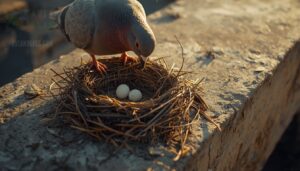
Once the male locks in a site, the female takes over. She arranges the nest material into a shallow cup — just deep enough to cradle the eggs without trapping moisture.
Cup depth matters here. She shapes the center through vibration shaping, gently pressing down to stabilize it.
Material insulation keeps eggs warm, while her positioning naturally manages egg shielding and moisture control as she incubates.
Material Gathering and Delivery
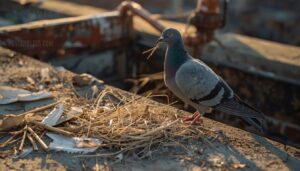
Think of it as a well-run supply chain — one bird gathering, one bird building. The male stays busy collecting twigs and grass within about 50–100 meters of the nest site, making multiple short trips.
Here’s what drives their Material Selection Criteria:
- Twigs — lightweight, rigid backbone for structure
- Dry grass — soft interior lining for warmth
- Urban material sources — lint, string, paper scraps fill gaps
- Feathers — final insulation layer
Gathering Flight Patterns stay tight and efficient, reflecting strong resource efficiency in avian reproduction.
Pair Cooperation During Breeding

Once a pigeon pair bonds, they don’t just share a nest — they share every responsibility that comes with it.
| Breeding Task | How They Share It |
|---|---|
| Vocal Coordination | Partners exchange soft calls during joint nest visits |
| Joint Nest Guarding | Both birds watch for threats together |
| Coordinated Foraging | Mates trade off food trips to protect the brood |
| Shared Material Transport | Males gather; females arrange and weave |
| Mutual Preening Rituals | Daily grooming reinforces their pair bonding |
This coparental care — from egg incubation to feeding — shows why monogamous pairs raise more chicks successfully. Incubation duty shifts keep eggs consistently warm, day and night.
Pigeon Breeding and Courtship

Pigeons don’t just pick a random spot and start stacking twigs — there’s a whole courtship story that happens first.
Before a nest even gets built, a pair has to find each other, bond, and commit. Here’s how that process actually unfolds.
Monogamous Pair Bonding
Pigeons don’t just pair up — they commit. Once bonded, monogamous pairs show strong Partner Preference, sticking together across multiple breeding seasons. Here’s what makes their bond work:
- They develop Attachment Signals fast — within days of pairing
- Selective Aggression keeps rivals away
- Biparental Cooperation covers incubation duties together
- Reproductive Synchronization aligns their breeding cycles
- Coparental care improves chick survival substantially
Cooing and Bowing Displays
Watch a courting pigeon long enough and you’ll catch something surprisingly elegant. The male drops his head into a bowing display, fans his tail, and delivers a steady coo — each sequence driven by precise vocal rhythm and posture synchronization.
These courtship dance moves aren’t random. Individual signature variation means each bird’s pattern is uniquely his own.
Display intensity peaks during spring, even amid urban noise influence.
Seasonal Breeding Patterns
Spring doesn’t just bring warmer days — it flips a biological switch in pigeons. Daylength hormones surge as light increases, signaling the body to prepare for breeding. Here’s what shapes seasonal breeding patterns of pigeons:
- Daylength hormones trigger egg production
- Temperature influence stabilizes incubation success
- Food availability peaks align with spring hatching
- Geographic variation shifts timing by region
- Urban light pollution extends breeding into winter
Multiple Broods Each Year
Most birds get one shot at raising chicks each year. Pigeons get four to six.
When food is abundant and temperatures stay warm, photoperiod effects keep the breeding engine running. Longer days trigger hormonal cycles that reset quickly after each brood.
This brood frequency isn’t reckless — it’s a calculated energy tradeoff. More cycles mean more juveniles survive, making year-round breeding one of the pigeon’s smartest survival tools.
Pigeon year-round breeding isn’t reckless — it’s a calculated survival strategy that turns more cycles into more lives
Pigeon Eggs and Incubation
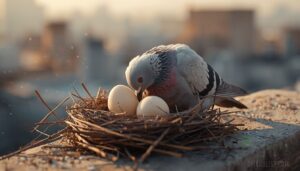
Once a pair bonds and the nest is ready, egg-laying begins pretty quickly.
There are a few things worth knowing about how pigeons handle this stage.
Here’s what the incubation process actually looks like.
Two White Eggs
Each clutch holds just two white eggs — small, smooth, and pure white, no matter what. A pigeon egg measures roughly 39 mm long and fits neatly in a shallow depression inside the nest. The egg shell structure is thin but tough.
Caloric value is modest, but the egg white proteins and yolk pack everything a growing squab needs during the 17–19 day incubation period.
Laying Interval Between Eggs
After laying that first egg, a pigeon waits roughly 24 to 48 hours before laying the second. That short gap isn’t random — it’s driven by hormonal regulation, food availability impact, and pair bond synchronization working together.
Warm weather and a well-fed female keep the egg laying cycle tight.
Stress induced delays or cold snaps can stretch it.
Either way, the two-egg clutch size completes quickly.
Shared Incubation Duties
Once those two eggs are settled in, both parents step up. Duty rotation kicks in fast — the male incubates through midday while the female incubates overnight.
They coincubate in short, predictable shifts, using vocal coordination and soft bowing to signal switches.
This rest-feeding balance keeps both parents healthy.
Weather adaptation matters too — on cold days, they extend stints to protect developing embryos through shared parental care and incubation duties.
17 to 19 Day Incubation
That 17–19 day window is where the real magic happens. Inside each shell, a full life is assembling itself — organs, limbs, heartbeat.
Three things keep development on track:
- Temperature stays around 37–38°C through steady parental shift coordination
- Humidity control prevents the embryo from drying out
- Egg turning dynamics guarantee even heat reaches every side
Most eggs hatch after about 18 days.
Squab Growth and Feeding

Once those eggs hatch, things move fast — surprisingly fast. Baby pigeons, called squabs, go through notable changes in just a few weeks.
Here’s a closer look at how they’re fed and how quickly they grow up.
Crop Milk Feeding
Here’s something most people don’t expect — pigeons make milk. Not from mammary glands, but from their crop lining.
Both parents produce this secretion, driven by prolactin, a key milk production hormone. Crop milk composition is rich in proteins, amino acids, and immune proteins that protect squabs early on.
| Crop Milk Feature | Detail | Why It Matters |
|---|---|---|
| Protein & Amino Acid Profile | High glutamic, aspartic acid | Fuels rapid organ growth |
| Immune Protein Benefits | Antibody-like proteins present | Enhances early squab immunity |
| Feeding Frequency Patterns | Highest in first 3 days | Maximizes nutrient delivery |
Rapid Early Growth
Squab development and feeding with crop milk happens fast — almost shockingly fast. These altricial nestlings arrive helpless, but that protein‑rich milk changes everything quickly.
Watch for these milestones in early nestling development:
- Rapid bone ossification begins around day 10
- Elevated heart rate sustains peak nutrient absorption in week one
- Early feather development appears by day 14
Feeding daily drives it all.
Transition to Seeds and Grains
Around day 10, something shifts. The squab’s gizzard strengthens, enzymatic shifts kick in, and crop milk gives way to seeds and grains.
Millet and cracked corn become staples. Seed texture matters here — ground seeds reduce crop impaction risk.
This feeding schedule maintains nutrient balance during rapid growth. It’s a quiet urban wildlife adaptation, and food waste attraction nearby often fills the gap.
Fledging Timeline
Fledging sneaks up fast. After the egg hatches in about 18 days, the squab development clock kicks into high gear. Here’s what the fledging period looks like:
- Days 14–21: Primary feathers emerge — juvenile flight skills begin forming.
- Days 25–28: Habitat exploration phase starts with short hops and flutter flights.
- Days 28–32: Post-flight conditioning builds as survival skill development accelerates.
Pigeon parental care and feeding behaviors continue even after fledging.
Nest Reuse and Growth Over Time
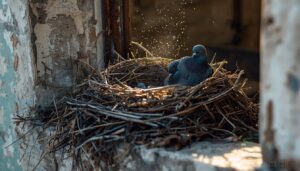
Pigeon nests don’t stay the same year after year — they grow. Each breeding cycle adds new layers, and the same spot can transform from a loose twig platform into a surprisingly solid mound.
Here’s how that happens, piece by piece.
Reused Nesting Sites
Pigeons are creatures of habit — and that works in their favor. Once a pair finds a good spot, they’ll return to it season after season. This site fidelity isn’t laziness; it’s smart survival.
Reusing a familiar ledge means less energy spent searching. Over time, material accumulation builds up, improving microclimate stabilization inside the nest and even boosting predator deterrence. Urban edge preference shapes where these loyal returners settle.
Enlarged Nests Across Seasons
Each season a returned nest gets a little bigger. Seasonal Material Shifts bring softer plant down and feathers in cold months — smart Thermal Insulation Strategies that protect eggs overnight. Warmer cycles swap in lighter grasses.
Structural Reinforcement Techniques and Moisture Management Adaptations keep the platform stable across year-round breeding. Site Fidelity Impacts compound this: nest reuse and accumulation over breeding cycles can grow nests 15–25% taller by late spring.
Droppings and Feathers as Binder
Think of droppings and feathers as nature’s glue. Through Moisture Softening, droppings hydrate dry fibers, letting them pack tighter.
Feathers weave between twigs, forming a flexible mesh — real Binder Chemistry at work.
This nest construction material resists seasonal stress, giving the platform Seasonal Durability and Thermal Insulation properties.
Just know: pigeon droppings health hazards are real, so Cleanup Safety gear matters.
Long-term Mound Formation
Over time, that sticky binder buildup becomes something bigger. Each breeding cycle adds fresh layers — twigs, droppings, feathers — through a process called Organic Binder Accumulation.
Microbial Binding locks particles together as microbes break down organic matter into humus. Seasonal Sediment Deposition widens the base.
Water Flow Patterns and Erosion Dynamics sculpt the outer edges. Some mounds eventually reach 8 inches tall and weigh five pounds.
Health Risks From Pigeon Nests
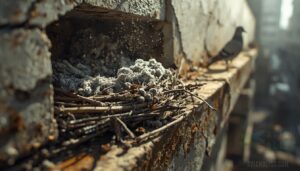
Pigeon nests aren’t just messy — they can actually create real health problems for people nearby. Droppings, mold, parasites, and airborne bacteria are all part of the picture.
Here’s what you need to know about the specific risks and how to handle them safely.
Droppings and Mold Buildup
When a nest sits untouched for months, droppings quietly become a bigger problem than you’d expect. Uric acid corrosion eats into stone and metal surfaces. Mold spore transmission happens quickly once moisture moves in. Here’s what you’re really dealing with:
- Dried droppings turn powdery — dust mitigation techniques matter here
- Mold thrives in shaded, poorly ventilated spots
- Mycotoxins create serious health impact prevention concerns
- Nest sanitation stops bacteria from spreading to nearby surfaces
Parasites and Arthropods
Beyond mold, pigeon nests hide something else — live parasites. Parasite load indicators include heavy preening and dull feathers.
Mite species diversity is surprisingly wide here. Dermanyssus mites feed at night, while Cheyletiella spreads across nest surfaces.
Flea infestation patterns follow warmth and humidity, peaking in summer.
Lice transmission routes run bird-to-bird fast.
Control and prevention start with removing old nests promptly.
Disease and Allergy Concerns
Dried droppings don’t just smell bad — they carry real health risks.
Dust from pigeon waste and nest debris can trigger allergic rhinitis triggers, like sneezing and a runny nose.
Mold spore exposure worsens things fast, causing asthma exacerbation in sensitive people.
Conjunctivitis symptoms — red, watery eyes — can follow too.
In rare cases, severe anaphylaxis risk is real.
The bird droppings health risk is nothing to ignore.
Safe Cleanup Precautions
Cleaning up a pigeon nest isn’t just a chore — it’s a health job. Hazard identification comes first, then follow these steps:
- PPE Requirements: Gloves, goggles, and a NIOSH respirator
- Ventilation Strategies: Open windows; avoid spreading dust
- Waste Disposal: Sealed bags, labeled, disposed properly
- Decontamination Procedures: EPA-approved disinfectant, then wash up thoroughly
Addressing pigeon droppings’ health risk early beats dealing with bigger problems later.
Top 3 Pigeon Feeding Products
If you enjoy watching pigeons up close, having the right feeder makes a real difference. These three products are worth keeping on your radar.
Here’s what we picked and why each one stands out.
1. Kiwibit Solar Bird Feeder Camera
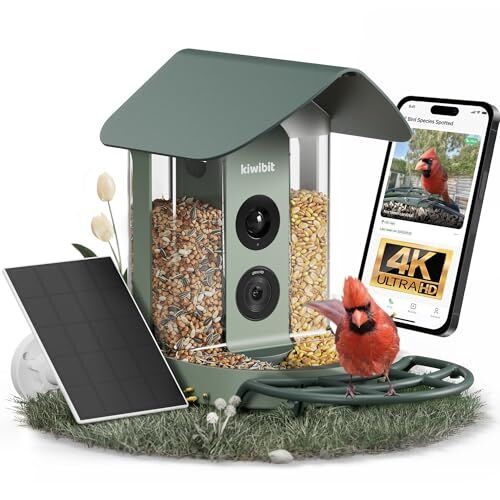
The Kiwibit Solar Bird Feeder Camera is a smart pick if you want to watch pigeons and other visitors up close.
It shoots 4K video, identifies 10,000+ bird species automatically, and runs on a built-in solar panel with a 5,200 mAh backup battery. You get night vision, live streaming, and motion alerts — all in one weather-resistant unit designed for your backyard.
| Best For | Backyard bird lovers who want a hands-off, high-tech way to spot, identify, and track visiting birds day or night. |
|---|---|
| Intended Use | Bird watching & feeding |
| Target Species | All backyard birds |
| Outdoor Suitability | Yes, weather-resistant |
| Capacity | 2 × 1.5 L seed compartments |
| Maintenance Needed | Seed refills, SD card mgmt |
| Wildlife Limitation | Nuisance animal alarm included |
| Additional Features |
|
- Crystal-clear 4K video with IR night vision means you won’t miss a thing, even after dark.
- The solar panel plus 5,200 mAh battery keeps it running without hunting for an outlet.
- Auto-identifies 10,000 species and logs visits, so your bird journal basically writes itself.
- The good AI features sit behind a paid Kiwibit Plus subscription — the free tier only saves a single day of footage.
- No 5 GHz Wi-Fi support, so 4K streaming can get choppy if your 2.4 GHz network is busy.
- The seed compartments are on the small side, so heavy bird traffic means more frequent refills.
2. Gray Bunny Bird Squirrel Feeder Tray
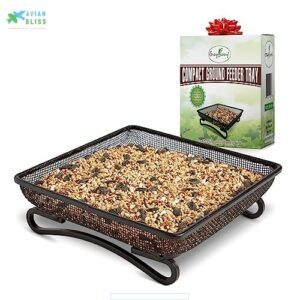
The Gray Bunny Bird Squirrel Feeder Tray keeps things simple — and that’s exactly what ground-feeding birds need. This compact 7×7-inch metal tray sits low, drains rain quickly through its mesh bottom, and holds about a cup of seed.
It weighs under a pound, so you can move it anywhere.
Doves, quails, and pigeons all use it comfortably without crowding each other out.
| Best For | Backyard bird lovers who want a simple, no-fuss feeding spot for ground-dwellers like doves, quails, and songbirds. |
|---|---|
| Intended Use | Bird feeding |
| Target Species | Ground-feeding birds |
| Outdoor Suitability | Yes, rust-resistant |
| Capacity | ~1 cup (~240 ml) |
| Maintenance Needed | Frequent refills, easy cleaning |
| Wildlife Limitation | Not squirrel-proof |
| Additional Features |
|
- Mesh bottom drains rain fast, so seed stays dry and doesn’t rot sitting in puddles.
- Super lightweight and easy to move around — deck, patio, garden edge, wherever works.
- Sturdy enough to handle a few birds at once without tipping or falling apart.
- Holds about a cup of seed, so if you’ve got a big flock showing up, you’ll be refilling it constantly.
- Squirrels can still get to it — determined ones will knock it around or carry it off.
- Too small if you’re trying to feed a large number of birds regularly; it’s really built for casual setups.
3. Vita Sunscript Dove Pigeon Food
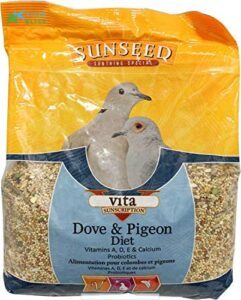
Vita Sunscription Dove and Pigeon Diet gives your birds exactly what they need in one bag. The 5 lb mix includes white millet, safflower seed, oat groats, and probiotics to support digestion and feather health.
Crude protein sits at 12.5 percent — solid for active birds. At $15.83, it’s a straightforward base diet you can supplement with extra seeds for pickier eaters.
| Best For | Dove and pigeon owners looking for a complete, all-natural base diet that supports digestion, feather health, and natural foraging behavior. |
|---|---|
| Intended Use | Bird nutrition |
| Target Species | Doves & pigeons |
| Outdoor Suitability | Limited, indoor recommended |
| Capacity | 5 lb (2.27 kg) bag |
| Maintenance Needed | Reseal for freshness |
| Wildlife Limitation | Species-specific formula |
| Additional Features |
|
- Packed with vitamins, chelated minerals, and probiotics — covers your birds’ nutritional bases without needing multiple products.
- Encourages natural foraging instincts, keeping birds active and mentally engaged.
- Made in the USA with all-natural ingredients, so you know what you’re feeding them.
- Only formulated for doves and pigeons — not a fit if you have other bird species.
- Picky eaters may need extra seeds or treats mixed in before they’ll take to it.
- No resealable bag, so you’ll want an airtight container to keep it fresh.
Frequently Asked Questions (FAQs)
What not to feed a dove?
Ever wonder what’s actually harmful to doves? Skip bread, chocolate, avocado, salty snacks, and moldy seeds. These foods cause dehydration, toxicity, and organ damage. Stick to fresh, appropriate seeds instead.
Why are pigeon nests so simple?
Pigeons keep things simple on purpose. Less time building means more energy for finding food and raising chicks. It’s survival logic — fast, practical, and surprisingly effective.
What is a pigeon nest?
A pigeon nest is a flat, shallow platform built from loose twigs, grass, and debris.
It’s more like a messy pile than a tidy bowl — just enough to cradle two eggs.
What nesting materials are suitable for pigeons?
Small dry twigs form the base, while grass stems and pine needles add cushioning. Soft plant fibers and clean shed feathers finish it off, keeping eggs warm and secure.
Why do pigeons nest?
Nesting is everything to a pigeon — it’s their entire survival strategy packed into a few twigs.
They nest to protect eggs, raise squabs, and repeat the cycle several times a year.
How do pigeons make a nest?
It’s a team effort. The male scouts the spot and gathers twigs, grass, and leaves one piece at a time. The female arranges everything into a shallow, saucer-shaped platform.
Why can’t pigeons build nests?
Actually, pigeons can build nests — they just keep things minimal. A loose pile of twigs and grass gets the job done.
Simple, fast, and surprisingly effective for raising multiple broods each year.
Where do pigeons make their nests?
Pigeons will nest practically anywhere that feels like a cliff.
You’ll find them on building ledges, rooftops, window sills, balconies, fire escapes, and under bridges or eaves — anywhere flat, dry, and sheltered.
What does a pigeon nest look like?
city pigeon’s nest looks surprisingly bare — just a flat, loose mat of twigs and dried grass.
It’s more like a tiny landing pad than a cozy home, with a shallow dip holding two eggs.
Should I remove pigeon nest?
You should only remove a pigeon nest if it’s inactive and poses a health risk. Always check local wildlife laws first — relocating active nests is illegal without a proper license.
Conclusion
Darwin once noted that survival belongs to those who adapt best—and pigeons have taken that lesson to heart. Those scruffy pigeon nests you’ve been overlooking aren’t failures of craftsmanship. They’re proof of a system that works. Simple materials, shared duties, six broods a year—that’s not laziness, that’s precision.
Now that you know what drives every twig and egg, the next ledge you pass won’t look like clutter. It’ll look like quiet, feathered genius at work.