This site is supported by our readers. We may earn a commission, at no cost to you, if you purchase through links.
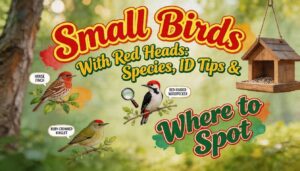
A flash of red at your feeder stops you mid-sip every time—something about that color triggers instant attention, even before your brain registers "bird." North America alone hosts over a dozen small birds with red heads, each one distinct enough that mistaking a House Finch for a Purple Finch has quietly embarrassed birders for decades.
The difference often comes down to a single field mark: the shape of a bill, a streak on the belly, or whether that red bleeds past the crown onto the breast. Knowing what to look for turns a frustrating blur of color into a confident, satisfying identification.
Table Of Contents
- Key Takeaways
- What Defines a Small Red-Headed Bird?
- Common Small Birds With Red Heads
- Less Common Red-Headed Small Birds
- Red Head Markings and Lookalikes
- Where to Spot Red-Headed Birds
- Frequently Asked Questions (FAQs)
- What little birds have a red head?
- Do birds remember if you feed them?
- What bird has a redhead?
- Does a bird have a red head?
- What does a red-headed bird look like?
- How many types of birds have red heads?
- What does a red-headed bird mean?
- What does a redpoll bird look like?
- What are the little birds with red heads?
- What bird looks like a sparrow but has a red head?
- Conclusion
Key Takeaways
- Telling small red-headed birds apart comes down to a few sharp field marks—how much of the head the red covers, the bill shape, and the belly pattern—rather than just the color itself.
- Most backyard sightings will be a House Finch, Northern Cardinal, Common Redpoll, or Purple Finch, each with a distinct look once you know what separates them.
- A bird’s red color isn’t fixed: it fades with feather wear, shifts with diet quality, and only males in most species wear it at all—females and juveniles often look completely different.
- Pairing the right feeder food with good habitat placement (shrubs nearby, clean stations, a shallow water source) is the most reliable way to draw red-headed species consistently to your yard.
What Defines a Small Red-Headed Bird?
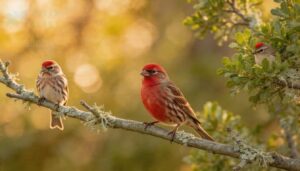
Not every bird with a flash of red on its head fits the same mold — size, pattern, and who’s wearing the color all matter more than you’d think.
A male House Finch, for instance, earns his rosy crown through diet — and brown and red birds with seed-based color variation show just how much what a bird eats shapes what you see.
Before you can confidently name what you’re looking at, it helps to understand what actually puts a bird in this category.
Here’s what to look for.
Key Size Range for Small Bird Species
Size matters more than you’d think when you’re scanning a feeder. Practicing size and shape assessment improves identification accuracy.
Most small red-headed birds fall into a body length range of 10–20 cm — that’s your small-bodied finches, hummingbirds, and redpolls. Weight thresholds help too; many weigh just 0.6–0.9 oz (16–27 g). Bill size indicators, tail length ratios, and wingspan variability round out the picture.
- Body length: 10–20 cm covers most small species
- Weight: generally under 30 g
- Short wings and compact frames are common
- House Finch and House Sparrow are nearly identical in size
- Wingspan variability: roughly 20–25 cm among small finches
Full Red Head Vs Partial Red Crown
Once you’ve got size locked in, the next thing to check is how much red you’re actually seeing.
A full red head — forehead, crown, the whole roof — is a different beast from a partial red crown, which often stops at the brow or fades into brown.
Genetic coloration and habitat lighting both shift your observer perspective quickly. That contrast is your quickest identification guide for redheaded birds.
Male, Female, and Juvenile Plumage Differences
Sex matters a lot in bird identification—and not just for trivia night. In most red-headed species, sexual dimorphism runs deep. The male’s bright red plumage signals dominance, while the female’s red plumage stays muted for nest concealment. Juveniles take it further with Juvenile Camouflage Plumage that mimics females entirely. Watch these field markers:
- Bill Color Variation — Juveniles often show dusky or brown bills versus adult orange.
- Eye Color Cues — Subtle but real, especially in finches.
- Dimorphism Intensity — Cardinals show stark contrast; House Finches, less so.
- Streaking Patterns — Streaked bellies usually mean juvenile, not female.
- Seasonal Molt Timing — Young males gradually patch into adult plumage coloration.
Your identification guide for redheaded birds gets sharper once you stop looking only at the head.
Seasonal Changes in Red Coloration
Red doesn’t stay the same year-round. A male House Finch looks most vivid right after his late-summer molt, when fresh feathers carry peak carotenoid pigments. Then feather wear and light effects gradually dull that brightness.
Since birds can’t produce carotenoids internally, carotenoid diet quality drives everything. Hormonal control also triggers molt timing shifts, making seasonal changes in red plumage one of the most evolving coloration patterns in redheaded birds.
Common Small Birds With Red Heads
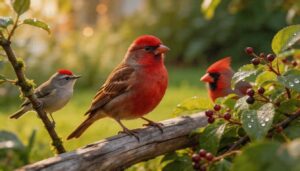
Once you start paying attention, red-headed birds turn up in more places than you’d expect — from busy feeders to backyard shrubs. A handful of species show up regularly enough that most birders will cross paths with them sooner or later.
Here are the ones worth knowing first.
House Finch
The House Finch is probably the red-headed bird you’re seeing right now. Males sport a rosy-red face, throat, and rump — females are streaked brown with no red at all.
If you’re curious whether it’s a House Finch or one of its look-alikes, this guide to red-headed birds in North America breaks down the subtle differences worth knowing.
These masters of urban adaptation nest in hanging planters and building ledges using grasses and soft nesting materials. Keep feeders clean; House Finch eye disease spreads fast at dirty stations.
Northern Cardinal
The Northern Cardinal is hard to miss — it’s the only crested red bird in North America.
Here’s what makes it a favorite for birdwatching tips for spotting redheaded birds:
- Bird identification: Solid red head, black mask, orange bill
- Habitat preferences: Thickets, shrubs, suburban gardens
- Feeder Preferences: Sunflower seeds draw them instantly
- Winter Diet & Territory Defense: Year-round residents, singing mating calls to hold ground
Anna’s Hummingbird
If you’re on the Pacific Coast, Anna’s Hummingbird is your best shot at spotting a glittering red-headed bird near backyard feeders. The male’s rose-pink crown and gorget — that’s the throat patch — shift from magenta to deep crimson depending on the light.
This tiny powerhouse relies on nectar feeding, but eats more insects than any other North American hummingbird.
Males are fiercely territorial, diving aggressively at rivals.
Common Redpoll
Think of the Common Redpoll as a tiny winter surprise — a small red bird that shows up uninvited and steals the show. That crimson forecrown pops against its streaky brown body, though only males add a rosy-pink breast flush.
Flock dynamics are chaotic and fun: dozens descend on feeders for seed feeding, then vanish.
Their nesting habitat sits deep in boreal shrubs, with a clutch size up to seven eggs and an incubation period of roughly 11 days.
Climate impact increasingly shapes their unpredictable southern movements — so for birdwatching tips, just keep your feeder stocked with nyjer.
They’ll find you.
Purple Finch
Meet the bird that fooled Roger Tory Peterson — he once called the Purple Finch “a sparrow dipped in raspberry juice,” and honestly, that nails it. Males aren’t truly purple; they wear a rich, rosy‑red wash across the head and breast that’s subtler than a cardinal but unmistakably beautiful.
The Purple Finch is not purple — it is a sparrow dipped in raspberry juice
- Red head: Raspberry‑rose, not scarlet — softer and more diffuse than a House Finch
- Breeding habitat: Coniferous and mixed forests across Canada and the Pacific coast
- Migration timing: Spreads loosely across spring and fall, often in small flocks
- Courtship displays: Males hop close, droop wings, puff up, and sing softly — genuinely charming
For birdwatching tips, watch the face: females show a bold whitish eyebrow stripe, a useful field mark. Habitat preferences for these redheaded birds skew toward forest edges and feeders stocked with sunflower seeds. Population trends remain stable, though predation threats and habitat loss quietly bear watching.
Less Common Red-Headed Small Birds
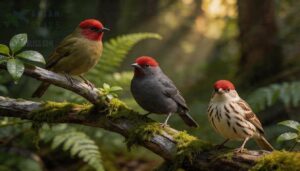
Not every red-headed bird makes the "usual suspects" list, and that’s actually what makes finding one so satisfying.
Beyond the common backyard visitors, there’s a whole group of species that reward a little extra patience and the right habitat.
Here are some of the lesser-known ones worth keeping on your radar.
Cassin’s Finch
Cassin’s Finch is one of those small finch species that rewards patience — and elevation. This rosy-red-headed mountain bird breeds in conifer forests between 3,000 and 10,000 feet, making elevational migration part of its annual routine as birds drift lower each winter. Males sport a concentrated rose-red crown rather than a full flush of color.
Watch notched tails and long wingtips — solid birdwatching tips for spotting red-headed birds in western highland habitat.
Red-Faced Warbler
If Cassin’s Finch got you scanning mountain slopes, the Red-faced Warbler will keep you looking up — but higher, and deeper into canyon forests.
This small bird’s habitat preferences lean dramatically sky-island: southern Arizona, southwestern New Mexico, elevations pushing 6,600–9,800 feet.
What makes it unmistakable:
- Blazing red face and upper breast against clean white underparts
- Hover-gleaning behavior — it literally hovers to snatch insects from leaf undersides
- Tail-flick foraging style that startles hidden bugs into movement
- Altitude clutch variation — females actually lay slightly more eggs at higher elevations
Its nest microhabitat is surprisingly humble: a ground-level cup tucked under rocks or logs. For birdwatching tips, spotting red-headed birds at elevation, watch mid-canopy movement and listen for its thin song — visual identification cues alone won’t always cut it.
The elevational distribution of this species makes it one of the more rewarding finds in the distribution of red-headed birds across North America.
Red Crossbill
From canyon forests to conifer canopies — the Red Crossbill operates on a completely different logic.
Its crossed bill isn’t a quirk; it’s a precision Cone Extraction Technique, purpose-built for prying open spruce and pine scales before other birds even get a shot at the seeds. Watching one work on a cone is genuinely satisfying, like seeing the right tool finally meet the right job.
What makes Red Crossbills tricky for birdwatching tips for spotting redheaded birds is that they’re nomadic. Nomadic Food Tracking means they follow cone crops across coniferous forest landscapes — here one winter, gone the next. Their habitat preferences for redheaded birds aren’t fixed to a territory; they’re fixed to food.
Males are brick-red with dark wings, females greenish-yellow. Juveniles? Streaked brown — no red at all, which trips up newer birders constantly.
| Feature | Detail | Why It Matters |
|---|---|---|
| Size | 14–16 cm, 31–42 g | Small but stocky |
| Nest Site Selection | High conifer branch, cup nest | Hard to spot from below |
| Clutch Size Variation | 2–6 eggs | Tied to food availability |
| Population Dynamics Trends | Irruptive, unpredictable | Range shifts with cone crops |
| Bill Shape | Crossed mandibles | Unique among North American finches |
Red-Crested Cardinal
Red Crossbills follow the food, while the Red-Crested Cardinal picks a spot and stays put. Native to South America, this 7.5-inch bird boasts a bright red head and crest rivaling the Northern Cardinal, though its gray back and white belly distinguish it swiftly. It has now established populations in Hawaii and Puerto Rico, offering a unique opportunity for birdwatchers to spot redheaded birds outside typical mainland habitats.
- Juvenile plumage is brown-headed — easy to misidentify in the field.
- Adults use crest-raising during courtship displays and territory defense.
- Feeding behavior often occurs in open parks and lawns.
Regional Species Birders May Overlook
Beyond the Western US’s well-known species lie genuinely overlooked gems. The Vermilion Flycatcher’s scarlet crest blazes along desert riparian zones, while climate-driven range expansion is nudging Red Crossbills into elevations they rarely touched before.
Regional differences in habitat and localized breeding phenology contribute to undocumented urban populations often going unrecorded. This makes your backyard a surprisingly valuable data point for any identification guide to noncardinal red birds.
Red Head Markings and Lookalikes
Spotting a red-headed bird is exciting — but telling them apart is where the real fun begins. Two birds can look almost identical at a glance, yet have completely different field marks once you know what to look for.
Here’s what to focus on when you’re trying to make a confident ID.
Bright Red Face Vs Red Cap
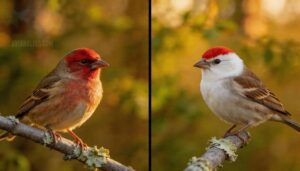
Not all red heads are created equal — and that difference is your secret weapon in the field. When you’re scanning small birds with red heads, ask yourself: does the color flood the whole face, or does it sit neatly on top like a little beret?
Here’s what to watch:
- Mask Edge Definition — A red face bleeds into the forehead, cheeks, and lores, creating softer boundaries around the eye.
- Crown Brightness Scale — A red cap stays high and compact, often popping against contrasting black or white below it.
- Facial Contrast Ratio — Cap-style birds keep their face a different color entirely, making the red patch shape cleaner and easier to read at distance.
Viewing Distance Impact matters too — caps catch light faster up high, while face masks only reveal themselves up close.
Finch Vs Cardinal Identification Tips
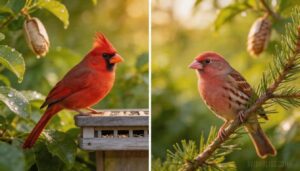
Spotting the difference between a House Finch and a Northern Cardinal comes down to a few quick checks.
Cardinals have a tall crest height and a chunky coral bill — hard to miss. Plumage coloration of the House Finch is streakier, and the head is flatter.
Watch feeder timing too: cardinals arrive early and late, finches linger midday.
Song rhythm seals it — cardinals whistle cleanly, finches ramble.
Bill Shape, Tail Shape, and Body Size
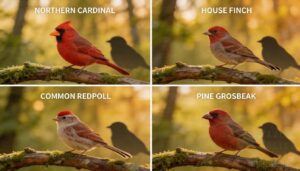
Three quick measurements will crack almost any ID puzzle: bill shape, tail shape, and body size.
- Bill Length Differences are huge — cardinals carry large beaks built for hard seeds; small-bodied finches pack a stubby conical seed-eating bill.
- Tail Notch Types matter: House Finches show a shallow notch; redpolls have a deeper cut.
- Bill Tail Ratio looks proportionally different on slim versus chunky birds.
- Size Dimorphism Patterns mean males often appear larger.
- A size comparison between House Finch and House Sparrow reveals nearly identical Body Mass Index — surprisingly easy to mix up.
Plumage Patterns Beyond The Head
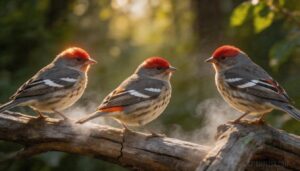
Once you pull your eyes off that flashy red head, the rest of the bird tells its own story. Wing Bar Patterns, Rump Flash Patches, and Tail Band Markings all work like secondary signatures in any good field guide.
Underparts Mottling separates finches that look nearly identical up top.
Feather Wear Effects can fade bright red plumage mid-season, shifting plumage coloration and variations enough to throw off even confident birders.
Calls and Songs for Accurate Identification
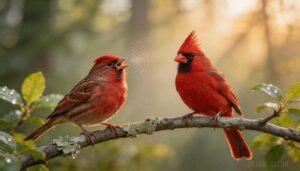
Your ears are just as useful as your eyes in visual and acoustic identification methods. Bird vocalizations carry the whole story — song rhythm patterns, pitch and tone, even habitat sound cues all narrow down your suspect list fast.
- Dawn chorus timing — small red-headed songbirds sing loudest just before sunrise
- Audio ID apps — Merlin Sound ID works offline and covers 2,000+ species
- Acoustic identification — House Finch songs ramble; Cardinal whistles feel clean and deliberate
Where to Spot Red-Headed Birds
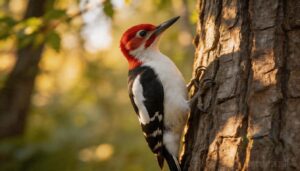
Knowing what to look for is only half the fun — knowing where to look is the other half.
Red-headed birds show up in some surprisingly predictable spots once you understand their habits. Here’s where to point your binoculars.
Backyards, Feeders, and Urban Areas
Your backyard is honestly one of the best places to start. Northern Cardinals gravitate toward hopper feeders stocked with safflower seed, while House Finch flocks crowd tube feeders almost daily.
Feeder placement near shrubs matters — higher shrub density means more cover and bolder visits.
Add a shallow water source, manage cats and hawks with smart positioning, and watch urban bird populations show up reliably.
Forests, Mountains, and Desert Edges
Step beyond the feeder, forest edges, mountain and canyon slopes, and desert fringes open up a whole new world.
Microclimate variability — sudden shifts in shade, wind, and moisture — shapes nesting behavior and seasonal resources dramatically.
Watch for Red Crossbills working conifer cones, Redheaded Woodpeckers claiming snags, and House Finches exploiting habitat connectivity between shrubby woodland borders and drier open terrain.
Best Seasons for Seeing Each Species
Timing matters as much as location.
Winter feeder activity peaks for House Finches and Common Redpolls — redpolls especially show up during irruption years, sometimes in flocks of hundreds.
Anna’s Hummingbirds follow a different rhythm, nesting as early as December along the Pacific Coast.
Cardinals stay year-round, while spring breeding surges make March through May the richest window for spotting vocal, colorful males across nearly every habitat.
Foods That Attract Red-Headed Birds
What you put in your feeder shapes who shows up. Seed preferences vary by species — house finches go straight for black oil sunflower seeds, while cardinals crack safflower with that powerful beak. Understanding the diet and feeding habits of red-headed birds makes all the difference.
- Seed eating favorites: Black oil sunflower for finches and cardinals
- Suet recipes: Peanut butter suet blends pull in Red-headed Woodpeckers all winter
- Nectar choices: A simple four-to-one sugar-water mix keeps Anna’s Hummingbirds coming back
- Fruit offerings: Apple slices and grape halves attract cardinals and finches naturally
- Feeder placement: Platform feeders suit ground-foraging cardinals; tube feeders serve finches best
Birdwatching Tips for Quick Identification
Once you’ve got the right food out, sharpen your eye with a few quick habits. Start with size and shape — a chunky Northern Cardinal differs from a slim House Finch before you ever see the red.
Use habitat cues, watch behavioral snapshots like foraging style, and note calls. Good lighting reveals true color; harsh sun washes out colors fast.
Frequently Asked Questions (FAQs)
What little birds have a red head?
Several small red birds turn heads at feeders — House Finch, Common Redpoll, Purple Finch, and Anna’s Hummingbird top the list.
Each species has distinct red head markings, from full caps to vivid facial patches.
Do birds remember if you feed them?
Yes — birds absolutely remember you. Through associative memory and face recognition, feeder birds learn who brings food.
Corvids especially, but even small songbirds, build surprisingly reliable mental maps of trusted feeders and familiar faces.
What bird has a redhead?
Nature never mislabels its own. Many birds sport a red head — House Finch, Northern Cardinal, Anna’s Hummingbird, and Common Redpoll top the list of small red birds worth knowing.
Does a bird have a red head?
Absolutely — quite a few birds sport red on their heads, from a full crimson helmet to a small rosy cap. The shade, size, and placement of that color vary wildly by species.
What does a red-headed bird look like?
Think of it as nature’s own stop sign — that flash of red plumage catches your eye instantly.
Red head, bold or patchy, often paired with wing bar presence and distinct bill color variation.
How many types of birds have red heads?
Globally, dozens of species across multiple taxonomic families sport red heads — well over 50 when regional endemics are counted. From woodpeckers to finches to hummingbirds, red-headed birds span nearly every continent.
What does a red-headed bird mean?
Red plumage signals health, vitality, and breeding fitness. It carries cultural symbolism across traditions — luck, remembrance, renewal.
For the bird itself, those carotenoid-based red feathers do something far more practical: they say, plainly, I’m worth choosing.
What does a redpoll bird look like?
A redpoll is a compact little bird — brownish back, heavy streaking on the sides, two white wingbars, and a neat red forehead cap.
That small splash of red plumage is your best field mark.
What are the little birds with red heads?
Most small birds with red heads fall into a few groups — finches, hummingbirds, woodpeckers, and warblers. In almost every case, only the adult male shows that bold, unmistakable color.
What bird looks like a sparrow but has a red head?
The bird you’re likely seeing is a House Finch — same size as a House Sparrow, with a red head and breast.
Males are the colorful ones; females are plain brown and streaky.
Conclusion
The more you watch, the more you notice. The more you notice, the more those small birds with red heads stop being a blur and start being individuals—this House Finch with his raspberry-soaked brow, that Purple Finch built like he meant it.
Field marks sharpen into habit. Habit sharpens into instinct.
Soon, a flash of red at the feeder won’t just stop you mid-sip—it’ll tell you exactly who dropped by for breakfast.