
This site is supported by our readers. We may earn a commission, at no cost to you, if you purchase through links.

A chickadee weighing less than half an ounce burns through calories like a furnace on a January night—and without water to drink and preen its feathers, that furnace starts to fail. Most rural property owners don’t realize a frozen bird bath can push a bird’s daily energy demand up by 20%, sending species you’d normally see daily into neighboring territories. That’s a quiet yard when you could have a thriving one.
Open water does more than attract birds. On rural acreage, it draws pollinators, helps amphibians, and can pull in two to three times the bird species compared to properties without a reliable water source. The right bird bath heater for rural property owners doesn’t need to be complicated or expensive—a thermostatically controlled 50W unit costs under $3 a month to run. Knowing which heater fits your climate zone, basin size, and installation setup makes all the difference between water that stays open all winter and one that ices over by dawn.
Table Of Contents
- Key Takeaways
- Why Rural Bird Baths Need Heaters
- Choosing Heater Wattage by Climate
- Safety and Installation Essentials
- Top 10 Bird Bath Heaters
- 1. API Bird Bath Heater
- 2. GESAIL Waterproof Birdbath Heater Thermostatically Controlled
- 3. GESAIL Thermostatic Heated Bird Bath
- 4. Farm Innovators Cast Aluminum Birdbath Heater
- 5. Thermostatic Outdoor Bird Bath Heater
- 6. KH Ice Eliminator Bird Bath Heater
- 7. K H Ice Eliminator Birdbath Deicer
- 8. Jvgoo 100W Bird Bath Heater
- 9. Saillong Bird Bath Heated Rock
- 10. Outdoor Bird Bath Heater Thermostat
- Running Costs and Maintenance
- Frequently Asked Questions (FAQs)
- How do I keep my bird bath from freezing without electricity?
- Do bird bath heaters really work?
- How to heat a bird bath in winter?
- Can bird bath heaters attract unwanted wildlife?
- Do heated baths require winterized water additives?
- How deep should a heated bird bath be?
- Can solar power run a bird bath heater?
- Do birds use heated baths during daytime only?
- Conclusion
Key Takeaways
- A frozen bird bath can spike a bird’s daily energy burn by 20%, pushing them out of your yard quickly — a thermostatically controlled heater fixes that for under $3 a month.
- Match heater wattage to your climate zone: 50W works for mild winters (zones 7–8), while harsh zones 3–4 need 120W or more to keep water reliably open.
- Safe installation matters as much as wattage — every outdoor heater must plug into a GFCI outlet, and most units need a heavy-duty extension cord since standard cords run only 18 inches or less.
- Open water in winter does not just help birds drink — it draws 2–3 times more species to your property and supports pollinators and amphibians year‑round.
Why Rural Bird Baths Need Heaters

Winter hits rural properties harder than most, and your bird bath is usually the first casualty. Without open water, birds burn precious energy they can’t afford to lose — and many simply stop visiting.
A heated bird bath for winter months keeps water liquid when everything else freezes, turning your yard into a reliable winter refuge.
Here’s what you need to know about keeping that water liquid all season long.
Winter Water Access for Backyard Birds
Even in winter, birds need liquid water every single day — not just for drinking, but for preening feathers that keep them insulated. Cold weather foraging burns serious calories, and dehydration compounds the stress fast.
Birds need liquid water daily in winter—not just to drink, but to preen the feathers that keep them alive
sunlit placement extends liquid periods.
Three things your rural yard can provide right now:
- Consistent water temperature above freezing
- Reliable ice melt timing before dawn activity peaks
- A safe, open surface birds can actually land on
How Frozen Baths Affect Bird Visits
frozen bath doesn’t just inconvenience birds — it drives them away. Visit frequency decline happens fast: species that relied on your yard shift territory when water disappears under ice.
That behavioral adaptation costs them real energy, up to 20% more daily, just finding alternatives.
Species diversity loss follows quickly after, as less adaptable birds stop returning altogether.
Benefits of Open Water on Rural Properties
Open water does more than solve bird hydration in winter — it transforms your rural property.
- Wildlife Habitat Creation draws amphibians, pollinators, and 2–3× more bird species year-round
- Property Aesthetic Boost adds scenic focal points, buyers genuinely notice
- Microclimate Moderation softens summer heat stress near your home
- Water Resource Security provides for livestock and irrigation during dry spells
Why Heated Baths Matter in Remote Yards
Remote yards offer fewer safe drinking spots, so bird hydration in winter becomes genuinely harder.
A heated bath solves that directly — it promotes species diversity by attracting finches, nuthatches, and sparrows, while predator safety improves because birds aren’t forced to search exposed ground for water.
That’s real wildlife support and solid birdwatching opportunities, right outside your window.
Choosing Heater Wattage by Climate
Not all bird bath heaters are built for the same winter. The wattage you need depends on how cold your zone actually gets and how big your basin is.
Here’s how to match the right heater to your climate.
Matching Wattage to USDA Hardiness Zones
Your USDA hardiness zone is the single best starting point for choosing heater wattage by climate. Think of it as a map telling you how hard your heater will have to work all winter.
- Zones 7–8: 50W serves most nights
- Zones 5–6: 60–80W covers colder snaps
- Zones 3–4: 120W+ for serious cold climate heating
- Wind chill considerations and humidity influence can push needs one zone higher
Selecting 50W, 60–80W, or 120W+ Units
Once you know your zone, picking the right wattage gets straightforward. A 50W unit manages mild winters well, running about 0.6 kWh daily.
Step up to 60–80W when wind chill or poor insulation requirements demand more. For serious cold, 120W+ with thermostatic control keeps water open without wasting energy.
Choosing heater wattage by climate means factoring in wind exposure and basin depth, not just temperature.
Heater Size for Small Vs Large Basins
Basin size matching matters more than most people expect. A small 5-liter bath needs just 10–25 watts to stay open — that’s solid wattage efficiency for the power ratio involved.
But scaling up to a 60-liter basin, your heat output requirements for large basins jump to 100–150 watts. Wattage scaling with basin size ensures temperature uniformity and real cost efficiency over winter.
Ice-free Opening Size and Water Capacity
Wattage shapes more than just freeze protection — it directly controls your opening diameter ratio and ice edge margin. A 50W unit holds roughly a 5–6 inch opening; step up to 120W and you’re clearing over 10 inches.
Match capacity vs wattage carefully: basins under 5 gallons hit their basin volume limits fast, so water level monitoring keeps water temperature stable and water circulation consistent.
Climate Factors That Affect Heater Performance
Your heater doesn’t work in a vacuum — the weather around it matters just as much as the wattage inside it.
- Wind Chill Impact can double heat loss at exposed rural sites, demanding higher wattage than your USDA hardiness zones suggest.
- Ambient Temperature Range swings between day and night affect how often thermostats cycle during cold months.
- Basin Heat Loss increases with surface area during subzero temperature heating, so larger baths need more freeze protection.
- Humidity Effects and Frost Accretion on the housing reduce weather resistance and overall efficiency.
Safety and Installation Essentials
Getting the wattage right is only half the job — safe installation is what keeps your birds, your property, and your wallet protected all winter long.
Rural setups come with their own quirks: uneven ground, distant outlets, and basins made from all kinds of materials.
Here’s what you need to know before you plug anything in.
GFCI Protection for Outdoor Bird Bath Heaters
Every outdoor bird bath heater must plug into a GFCI outlet — a ground fault circuit interrupter that cuts power within milliseconds if current leaks near water. Look for MET Labs safety certification on the unit itself.
If your rural yard lacks weatherproof GFCI outlets, portable GFCI adapters work well temporarily. Make monthly GFCI testing a habit — press the test button and confirm it trips reliably.
Cord Length and Extension Cord Needs

Once your GFCI protection is sorted, cord length becomes the next thing to get right. Most heaters include a 6-foot cord — barely enough for a well-placed outlet.
For longer runs, use a 12 AWG outdoor extension cord to prevent voltage drop. Choose weatherproof electrical connectors, UV-resistant cord durability, and proper weatherproof routing to avoid moisture damage and shock risk.
Submersible Versus Surface-mounted Designs

Once cords are routed safely, your next call is choosing between a submersible heater and a surface-mounted unit.
- Submersible heater: Direct Immersion Heat keeps water warm evenly from below
- Surface-mounted: Surface Ventilation Benefits prevent overheating in shallow basins
- Cord Management Risks: submerged cords reduce tripping hazards near feeders
- Wildlife Contact Safety: enclosed elements on both designs protect curious birds
Installation Flexibility depends on your basin depth and how often you want access for cleaning.
Material Compatibility for Plastic, Metal, and Concrete Baths
Your basin material matters more than most people realize.
Plastic birdbaths need UV stabilizer effects and flexible heater gasket materials to prevent warping.
Metal and concrete basins require corrosion-resistant coatings and thermal expansion matching, so joints don’t gap and leak.
Check mounting bracket compatibility before buying — a mismatched fit stresses the basin wall and shortens your heater’s life.
Placement Tips for Uneven Rural Landscapes

Where you set your birdbath matters just as much as what heater you choose.
On uneven rural ground, slope stabilization starts with a compacted gravel pad that resists frost heave.
Use an elevated base to handle runoff management, and drainage tilt to channel splashed water away from the stand.
Windbreak positioning on the south or east side cuts heat loss.
Deck rail mounting and similar mounting options simplify weatherproof, stormproof installation.
Enclosed Heating Elements and Wildlife Safety

Birds are naturally curious — and that curiosity can turn dangerous near exposed heating elements. That’s why fully enclosed heating elements matter so much.
Look for safety features in any heater you buy:
- Heat Guard Grills blocking beak and claw contact
- Insulated Enclosures with Wildlife-Friendly Seals keeping moisture out
- Low Surface Temperatures preventing burns on approach
- Noise-Reducing Housings that won’t spook resting birds
- Weather-resistant materials rated for freeze-thaw cycles
Thermal regulation keeps the water warm without dangerous spikes.
Top 10 Bird Bath Heaters
Finding the right heater comes down to your climate, your basin size, and how much you want to spend. Each option below has been matched to real-world conditions so you can spot the right fit at a glance.
Here are ten heaters worth considering for your rural property this winter.
1. API Bird Bath Heater
The API Bird Bath Heater punches well above its weight for cold-climate yards. At 250 watts, it manages temperatures down to –45 °C wind chill — serious cold that would leave a standard bath frozen solid by morning.
The built-in thermostat cycles on only when water nears freezing, so you’re not burning electricity all day.
A stainless-steel guard keeps birds away from the element.
It fits plastic, ceramic, and concrete baths, though the 15-inch cord means you’ll likely need an extension.
| Best For | Backyard bird lovers in cold climates who want a reliable, low-maintenance way to keep water available for wild birds through harsh winters. |
|---|---|
| Wattage | 250 W |
| Thermostat Control | Yes |
| Cord Length | 15 in |
| Housing Material | Plastic |
| Weight | 1.25 lb |
| Safety Certified | CSA/UL listed |
| Additional Features |
|
- Built-in thermostat only kicks on when temps drop near freezing, so it’s not running up your electric bill around the clock
- Works with just about any bath you already own — plastic, ceramic, or concrete
- Rated down to –45 °C wind chill, so it holds up in seriously brutal conditions
- The 15-inch cord is pretty short, so you’ll almost certainly need an extension cord nearby
- No low-water shutoff, meaning you have to keep an eye on the water level yourself
- Some users have had the thermostat or heating element fail after just one season
2. GESAIL Waterproof Birdbath Heater Thermostatically Controlled
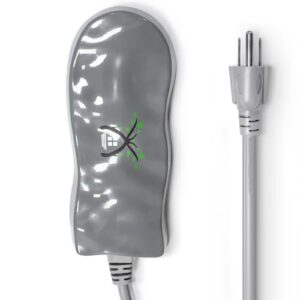
The GESAIL Waterproof Birdbath Heater keeps things simple without skimping on reliability.
Its built-in thermostat kicks on only when water temps drop near freezing, then shuts off automatically — so you’re not paying to heat water that doesn’t need it.
At 50 watts, it’s best suited for standard 14-inch basins in USDA zones 7–8, holding open a roughly 5-inch drinking spot.
Just note the 18-inch cord is short, so keep a heavy-duty outdoor extension cord handy.
| Best For | Bird lovers in mild winter climates who want a simple, low-cost way to keep a standard birdbath from freezing over. |
|---|---|
| Wattage | 50 W |
| Thermostat Control | Yes |
| Cord Length | 18 in |
| Housing Material | Cast aluminum |
| Weight | 1.01 kg |
| Safety Certified | MET Labs certified |
| Additional Features |
|
- Thermostat kicks on only when needed, so it’s not burning power around the clock
- Cast aluminum build with corrosion-resistant coating means it holds up season after season
- Plug-and-play setup — no tools, no fuss
- The 18-inch cord is short, so you’ll almost certainly need an extension cord
- Struggles to keep up when temps dip below 20°F for long stretches
- Only covers one standard-size basin — bigger setups may need two units
3. GESAIL Thermostatic Heated Bird Bath
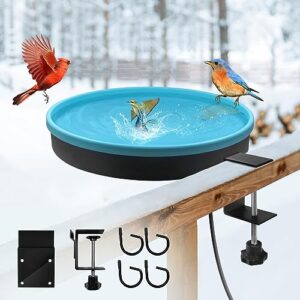
Think of this one as the full-package upgrade from the previous GESAIL model. The Thermostatic Heated Bird Bath is a complete unit — basin and heater built together — running at 75 watts and handling temperatures down to –22 °F.
That extra wattage opens a noticeably larger drinking spot than a 50 W unit.
Three mounting options (deck screws, rail clamp, or ground legs) make it adaptable to almost any rural yard layout.
The detachable basin slides off cleanly for scrubbing, which saves real time.
| Best For | Backyard bird lovers who want a reliable, set-it-and-forget-it water source through hard winters and need flexible placement options. |
|---|---|
| Wattage | 75 W |
| Thermostat Control | Yes |
| Cord Length | Not specified |
| Housing Material | Metal/plastic |
| Weight | 5.06 lb |
| Safety Certified | Not specified |
| Additional Features |
|
- Thermostatic control kicks in only when temps drop, so you’re not burning electricity around the clock
- Three mounting options mean you can stick it on a railing, deck, or straight on the ground — whatever works for your setup
- The basin detaches cleanly for quick scrubbing, no wrestling with the whole unit
- The cord is short — plan on picking up an outdoor extension cord before you even set it up
- Two inches of water depth sounds fine until you realize how fast it evaporates, especially with the heater running
- The clamp mount can be iffy on thin or metal railings and may need a little extra rigging to stay put
4. Farm Innovators Cast Aluminum Birdbath Heater
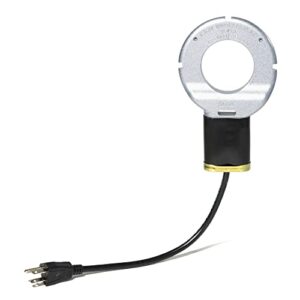
Cast aluminum is built for punishment — and that’s exactly what rural winters dish out.
Farm Innovators 150 W heater keeps water open down to –30 °F, enough for the coldest zones in the country. Its internal thermostat cycles on only when temperatures drop near freezing, which trims your electricity bill without you thinking twice about it.
At roughly 8 inches long and 1.2 lb, it drops right into most basins. Fair warning: the cord runs only 1.5 ft, so plan on an extension.
| Best For | Anyone in a cold-climate rural area who wants to keep birds, squirrels, or small poultry supplied with liquid water all winter without daily ice-breaking. |
|---|---|
| Wattage | 150 W |
| Thermostat Control | Yes |
| Cord Length | ~1.5 ft |
| Housing Material | Cast aluminum |
| Weight | ~1.2 lb |
| Safety Certified | Not specified |
| Additional Features |
|
- Handles brutal cold down to –30 °F, so it works even in the harshest northern winters
- The built-in thermostat cycles off when it’s not needed, keeping your electricity costs reasonable
- Tough cast-aluminum build holds up to rough weather and sits right in the water without extra housing
- The cord is only 1.5 ft, so you’ll almost always need an extension cord handy
- No dry-run protection, meaning you have to keep an eye on water levels or risk burning it out
- Hard water causes mineral buildup, and softened or salty water can eat at the aluminum — regular cleaning is a must
5. Thermostatic Outdoor Bird Bath Heater
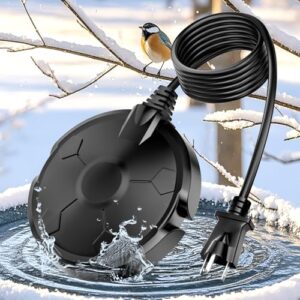
Sometimes simpler is better. This 120 W heater runs on 120 V and keeps your bath ice‑free down to –35 °F — serious cold coverage for rural winters.
Its built-in thermostat kicks on at 32 °F and shuts off at 95 °F, so it’s not burning electricity around the clock.
The enclosed aluminum housing resists rust and keeps birds safely away from the heating element.
At just over a pound, it fits most plastic, metal, or stone basins without fuss.
| Best For | Anyone in a cold climate who wants to keep a bird bath or small livestock waterer from freezing without babysitting it all winter. |
|---|---|
| Wattage | 120 W |
| Thermostat Control | Yes |
| Cord Length | 5 ft |
| Housing Material | Aluminum |
| Weight | 1.12 lb |
| Safety Certified | Not specified |
| Additional Features |
|
- The built-in thermostat only runs when temps drop below 32 °F, so you’re not wasting electricity on warmer days.
- Works in brutal cold down to –35 °F, so it holds up even through the worst winter stretches.
- Fits metal, plastic, stone, and glass basins, so you’re not locked into buying a new bath to use it.
- The 5 ft cord is pretty short — depending on your setup, you’ll likely need an extension cord.
- Water evaporates faster when the heater’s running, which means checking and topping it off regularly (sometimes daily).
- It needs to stay fully submerged in at least 2 inches of water, or it can overheat and burn out.
6. KH Ice Eliminator Bird Bath Heater
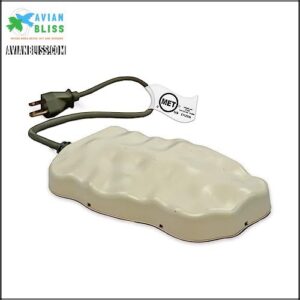
If you want something that blends into your birdbath without looking like a piece of equipment, the KH Ice Eliminator is worth a look. Its rock-style enamel finish can even be spray-painted to match your setup.
Running at 80 watts, it manages temperatures down to –20 °F with thermostat-controlled cycling, so it’s not running your meter up unnecessarily.
MET Labs certified, non-porous surface, easy to wipe clean.
Just note the short cord — you’ll need a GFCI-protected outdoor extension.
| Best For | Bird lovers and wildlife enthusiasts who want a low-profile, energy-efficient way to keep water accessible for birds and small animals through cold winters. |
|---|---|
| Wattage | 80 W |
| Thermostat Control | Yes |
| Cord Length | ~18 in |
| Housing Material | Enamel rock |
| Weight | 1.23 lb |
| Safety Certified | MET Labs certified |
| Additional Features |
|
- Thermostat does the thinking for you — kicks on when needed, shuts off when it’s not, so you’re not wasting electricity
- Rock-style enamel finish looks natural and can be spray-painted to match any birdbath
- MET Labs certified and built to handle temps down to –20 °F, so it holds up in serious winter climates
- Short 18-inch cord means you’ll almost certainly need a weatherproof outdoor extension and a GFCI outlet nearby
- Has to stay fully submerged — if any part hits air, it can overheat and burn out early
- Performance tends to slip after a few winters, with some users reporting paint chips and reduced output around year 3 or 4
7. K H Ice Eliminator Birdbath Deicer
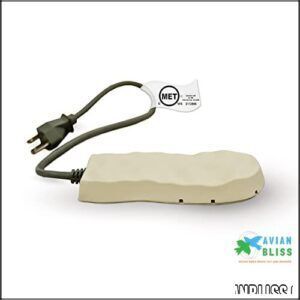
The 50-watt version of the KH Ice Eliminator is the lighter option for milder zones — think USDA zones 7–8 where temps rarely drop past –7 °F. It’s compact at 2.75 by 6.5 inches and weighs barely over an ounce.
The same rock-style enamel finish applies, so it won’t stick out in your bath.
One real-world caveat: the cord is short, enamel can peel over time, and a few users report it failing after a single season.
| Best For | Bird lovers in mild winter climates (USDA zones 7–8) who want a low-cost, low-energy way to keep their birdbath thawed on a budget. |
|---|---|
| Wattage | 50 W |
| Thermostat Control | Yes |
| Cord Length | Not specified |
| Housing Material | Enamel rock |
| Weight | 1.3 oz |
| Safety Certified | MET Labs certified |
| Additional Features |
|
- Only 50 watts, so it won’t spike your electric bill over a long winter
- The rock-style enamel finish blends right in — no eyesore sitting in your bath
- MET Labs certified, so it meets real U.S. and Canadian safety standards
- The cord is frustratingly short, and you’ll likely need an extension just to reach an outlet
- Enamel can peel after a season or two in standing water, which doesn’t look great
- A handful of users report it dying after just one winter, so longevity is a bit of a gamble
8. Jvgoo 100W Bird Bath Heater
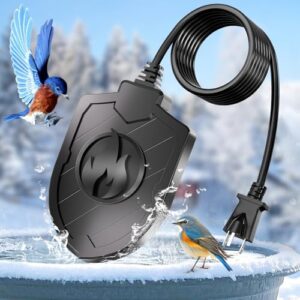
If longevity worries you after that single-season warning, the Jvgoo 100W steps up with a die-cast aluminum shell that resists corrosion better than enamel coatings. Its built-in thermostat kicks on below 32 °F and shuts off at 95 °F, so it’s not running constantly.
At 100 watts, it keeps small to medium basins ice‑free through moderate winters. The 5‑foot cord is a bit short, and high wattage can speed up evaporation — so top off your bath regularly.
| Best For | Anyone who wants a durable, low-maintenance bird bath heater that handles freezing temps without running all day. |
|---|---|
| Wattage | 100 W |
| Thermostat Control | Yes |
| Cord Length | 5 ft |
| Housing Material | Die-cast aluminum |
| Weight | 1.08 lb |
| Safety Certified | Not specified |
| Additional Features |
|
- Die-cast aluminum shell holds up to corrosion better than most coatings
- Built-in thermostat automatically cycles on and off, saving energy
- Works for bird baths, chicken waterers, small ponds, and livestock buckets
- Short 5-foot cord limits where you can place it
- High wattage speeds up evaporation, so you’ll need to top off the water often
- Metal housing can rust over time with prolonged water exposure
9. Saillong Bird Bath Heated Rock
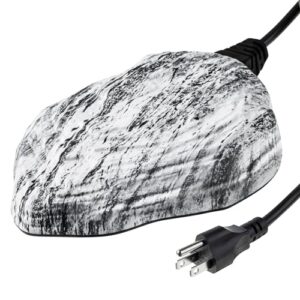
Not every heater has to look industrial. The Saillong Heated Rock blends right into your garden — it’s shaped like a natural stone, so birds don’t startle and neighborhood aesthetics stay intact.
Inside that weatherproof shell sits a 75-watt element with a built-in thermostat that activates near freezing and cycles off before overheating. It’s sized for basins 8–12 inches across and needs a GFCI outlet nearby.
Mineral buildup is the main maintenance task — rinse it regularly and it’ll last several winters.
| Best For | Backyard bird enthusiasts who want a heater that doesn’t stick out like a sore thumb in their garden setup. |
|---|---|
| Wattage | 80 W |
| Thermostat Control | Yes |
| Cord Length | Not specified |
| Housing Material | Aluminum |
| Weight | 1.19 lb |
| Safety Certified | Not specified |
| Additional Features |
|
- Looks like a natural rock, so it blends into your garden without scaring birds off
- Built-in thermostat does the thinking for you — kicks on when it’s cold, shuts off when it’s not
- Tough aluminum build resists rust, mineral buildup, and even curious birds pecking at it
- Some users have reported it dying within just a few weeks, which is frustrating for the price
- Water evaporates faster than you’d expect, so you’ll need to top it off pretty regularly
- Needs at least an inch of water above the heater to work properly — run it dry and you’ve got a problem
10. Outdoor Bird Bath Heater Thermostat
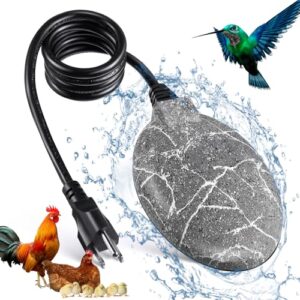
If you want something straightforward and reliable, the IED-620 is worth a look. This 60-watt unit manages temperatures down to 0°F — solid coverage for zones 5–6.
Its built-in thermostat kicks on at 35.6°F and shuts off at 95°F, so it’s not running unnecessarily on mild days. The 59-inch cord gives you flexibility in placement, and setup is genuinely plug-and-play.
It’s best suited for small birdbaths or chicken waterers, not large ponds. Simple, efficient, and built for consistent winter use.
| Best For | Anyone who wants a simple, low-maintenance way to keep a small birdbath or chicken waterer from freezing over winter. |
|---|---|
| Wattage | 60 W |
| Thermostat Control | Yes |
| Cord Length | 59 in |
| Housing Material | Aluminum |
| Weight | 14.9 oz |
| Safety Certified | Not specified |
| Additional Features |
|
- Built-in thermostat means it only runs when it needs to — no wasted energy on warm days
- Plug-and-play setup with a long 59-inch cord makes placement easy
- Handles temps down to 0°F, which covers most cold-weather climates
- Not powerful enough for larger ponds or deep water containers
- Can still let thin ice form around the edges in extreme cold below -10°F
- The cord, while generous, might still fall short for some outdoor setups
Running Costs and Maintenance
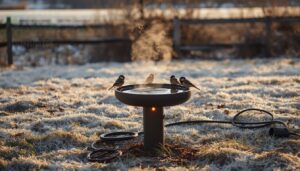
Running a bird bath heater through a cold winter doesn’t have to cost a fortune or take up your weekends. A little upfront knowledge about electricity use, cleaning habits, and material care goes a long way.
Here’s what you need to know to keep things running smoothly all season.
Thermostat Settings and Auto Shutoff
Thermostatic control is the quiet workhorse keeping your energy bill honest. Auto shutoff kicks in once water hits the target temperature, then restarts when it drops 2–5°F — that’s the Differential Settings gap doing its job. Frost Protection holds water just above freezing in brutal cold, while Power Saving Mode idles during mild spells.
| Feature | What It Does |
|---|---|
| Auto Shutoff | Stops heating at preset temp |
| Differential Settings | Defines restart temperature gap |
| Frost Protection | Maintains 32–40°F minimum |
| Scheduling Hold | Pauses heater during warm hours |
Sensor Accuracy keeps temperature regulation tight — within 2°F — so you’re not wasting electricity on already-warm water.
Estimating Winter Electricity Costs
Running a bird bath heater won’t break the bank — if you know the numbers.
Four Electricity Rate Factors shape your energy bill:
- Local kWh rate (your baseline cost)
- Hourly Usage Modeling based on daily runtime
- Climate Heat Loss from wind and cold
- Basin Size Costs for larger water volumes
A thermostat-controlled 50W unit generally costs under $3 monthly — proof that energy consumption reduction and power consumption awareness make the cost of operating bird bath heaters surprisingly manageable through smart, energy‑efficient Seasonal Cost Projection.
Cleaning Mineral Buildup and Algae
Hard water leaves a chalky crust on your basin fast — and that buildup cuts heater efficiency by insulating the element.
For bird bath maintenance, soak the bowl with a white vinegar solution for 15–30 minutes (Acidic Descaling), then use Soft-Bristle Scrubbing and Algae Brushing to lift biofilm. Use Material-Safe Cleaners for your basin type.
A Seasonal Deep Clean every few months keeps water quality management simple.
Preventing Freeze-thaw Cracking in Birdbaths
Freeze-thaw cracking is one of the sneakiest ways a birdbath fails on you. Each thermal cycling event puts real stress on basin walls.
Rubberized Coatings and Solar Heat Finishes slow that damage down, while Insulated Basin Sleeves cut heat loss overnight.
Modular Basin Design lets you swap cracked sections instead of replacing everything.
Add Thermal Expansion Joints and proper water temperature management through thermostatic control, and freeze protection lasts seasons longer.
Warranty, Durability, and Long-term Upkeep
A well-built heater is an investment — treat it like one.
- Register your warranty within 30 days; many brands void coverage without warranty registration.
- Check Seal Longevity each fall — degraded gaskets let moisture destroy the element.
- Follow a Seasonal Maintenance Checklist — rinse mineral deposits, inspect cords, clear debris.
- Choose cast aluminum for proven material corrosion resistance and long‑term durability.
Extended Service Plans add 2–3 extra years of peace of mind.
Frequently Asked Questions (FAQs)
How do I keep my bird bath from freezing without electricity?
Without electricity, you can slow freezing using solar exposure, thermal mass like dark rocks, shallow water, insulated surroundings, and windbreak placement — simple frost prevention strategies that genuinely extend open water time for birds in cold weather.
Do bird bath heaters really work?
Yes, they do. Field performance data and bird usage stats both back this up.
Thermostatic control keeps temperature stability reliable, and energy‑efficient models deliver steady freeze protection without running your bill up.
How to heat a bird bath in winter?
Drop a submersible de-icer in your bath, plug it into a GFCI outlet, and thermostatic control manages the rest — keeping water liquid even when temperatures crash below freezing.
Can bird bath heaters attract unwanted wildlife?
Raise your bath and secure nearby feeders to deter pests.
Do heated baths require winterized water additives?
No, heated baths don’t need winterized water additives. Thermostatic control provides freeze protection naturally.
Additives can alter water chemistry and harm bird health — clean tap water is the safest, most effective winter water source for birds.
How deep should a heated bird bath be?
Keep the edge depth at 1 to 2 inches, with a gentle gradient slope design leading to a 2 to 3 inches center depth limit — enough for robins to splash, safe enough for sparrows to stand.
Can solar power run a bird bath heater?
Solar power can run a bird bath heater, but weather-dependent performance is the catch. On cloudy winter days, output drops fast.
For reliable open water, a corded backup beats solar alone.
Do birds use heated baths during daytime only?
No, birds visit around the clock.
Morning Visit Patterns peak at dawn, Afternoon Bath Frequency stays steady, and Sunlight Influence draws activity midday.
Shade Preference and Temperature Thresholds shift timing — not eliminate it.
Conclusion
Winter doesn’t warn you before it locks your bird bath solid overnight. By morning, chickadees that trusted your yard have moved on—and winning back a bird’s routine takes weeks.
The right bird bath heaters for rural property owners change that equation before the cold sets in. A thermostatically controlled unit running under $3 a month is a small commitment.
What you get back—a yard alive with wings all winter—is worth every watt.