This site is supported by our readers. We may earn a commission, at no cost to you, if you purchase through links.

Most hikers walk past 20 birds before breakfast and name maybe two.
That gap between something small and brown and knowing you’ve just spotted a Hermit Thrush (Catharus guttatus) working the leaf litter—that gap is entirely closable.
The right bird identification guide for hiking trips doesn’t just put names to wings.
It trains your eye to read habitat, behavior, and field marks together, so identification becomes instinct rather than guesswork.
The eight guides ahead range from ultralight pocket editions to feature-rich references, and each one earns its place in a pack for different reasons.
Table Of Contents
- Key Takeaways
- Why Hikers Need Bird Guides
- Top 8 Bird Guides for Hikes
- 1. Peterson First Guide North America Birds
- 2. Concept Team Guessing Party Game
- 3. National Geographic Kids North America Bird Guide
- 4. Young Birder Guide to North American Birds
- 5. Sibley Birding Basics Field Guide
- 6. Kaufman North American Bird Field Guide
- 7. Florida Birds Field Guide by Stan Tekiela
- 8. Stokes Eastern Birds Field Guide
- Choose Portable Durable Formats
- Match Guide Coverage to Trails
- Read Field Marks Faster
- Combine Print Apps and Gear
- Frequently Asked Questions (FAQs)
- Conclusion
Key Takeaways
- The right trail guide teaches you to read habitat, behavior, and field marks together — so identification becomes instinct, not a page-flipping exercise.
- Match your guide to your actual trails: a regional or state-specific guide cuts out irrelevant species and gives you sharper local detail than any national edition can.
- Physical durability isn’t optional — waterproof lamination, strong bindings and sub-12-oz weight determine whether a guide actually makes it into your pack every time.
- Pairing a print guide with an offline app like Merlin and a solid pair of 8×42 binoculars closes the gaps no single tool can cover on its own.
Why Hikers Need Bird Guides

A good bird guide does more than name species — it sharpens how you read a landscape. Knowing what’s flying overhead, which habitat edge you’re standing in, and why that matters makes every hike more purposeful. Here’s what to look for in a guide that actually earns its place in your pack.
The right guide trains your eye over time — these bird field guides built for hiking are a solid place to start building that skill.
A great bird guide doesn’t just name species — it teaches you to read the landscape
Faster On-trail Identification
A bird doesn’t wait for you to find the right page. That’s why rapid ID tools matter on the trail. The best guides use color-coded tabs and minimal text layouts so you spend seconds — not minutes — on each species.
- Quick reference tabs mark common species instantly
- High-contrast illustrations highlight wing bars and eye rings
- Side-by-side charts separate lookalikes at a glance
Better Habitat Awareness
Knowing where a bird lives changes everything. A good guide tells you which species prefer riparian buffers, dense understory, or open canopy gaps — so you know where to look before you even raise your binoculars. That’s half the identification work done already.
Layered vegetation and deadwood attract different species at different heights. Guides that include habitat descriptors help you read the landscape like a map.
Offline Birding Confidence
Cell coverage disappears fast on the trail. That’s why compact waterproof bird identification books with built-in range maps and field marks matter — no signal needed. Practice mental species recall by matching what you see to guide illustrations without opening an app. Over time, these confidence building drills sharpen your guide-free identification instincts when it counts most.
- You spot a warbler mid-flight and name it cold — no phone, no hesitation.
- Your field mark memory kicks in at the exact moment the bird disappears into the canopy.
- You close the guide, trust your eyes, and get it right.
Safer Screen-free Learning
A physical guide keeps kids’ eyes off screens and hands on the real world. Reduced screen time of 60-plus minutes daily improves sustained attention by up to 15 percent.
A pack-sized field guide weighing under 12 ounces makes outdoor learning tangible — just flip, observe, and compare. That’s family guided learning at its most practical.
Top 8 Bird Guides for Hikes
Not every guide earns its place in your pack. The eight options below were chosen for their trail-ready size, clear visuals, and real identification value. Here’s what made the cut.
1. Peterson First Guide North America Birds

At just $9.24, the Peterson First Guide to North American Birds is hard to beat for beginners.
It covers 188 common species across the continental U.S. and Canada in a 4×7-inch, 128-page softcover you can slip into a jacket pocket.
Color illustrations highlight key field marks — wing patterns, beak shapes, plumage differences — so you’re scanning visuals, not dense paragraphs.
It won’t replace a full guide, but for learning the basics on the trail, it’s a solid starting point.
| Best For | Beginner birders, kids, and hobbyists who want a quick, no-fuss way to identify common backyard and trail birds. |
|---|---|
| Price | $9.24 |
| Page Count | 128 pages |
| Format | Softcover paperback |
| Audience | Beginners, children |
| Species Coverage | 188 common species |
| Publisher | Peterson Field Guides |
| Additional Features |
|
- At $9.24, it’s an easy buy — low stakes if you’re just dipping your toes into birding.
- Visual layout makes ID fast: illustrations and field marks are right there, no digging through paragraphs.
- Pocket-sized, so it actually goes where you go.
- No range maps or seasonal info, so you won’t know if a bird should even be in your area.
- Only 188 species — if you spot something uncommon, you’re out of luck.
- Too thin on detail for anyone ready to move past the basics.
2. Concept Team Guessing Party Game

Here’s an honest admission: the Concept Team Guessing Party Game doesn’t belong on a hiking trail. It’s a $44.99 party game built around icon boards and colored tokens — not field marks or range maps.
With a 40-minute playtime and a four-player minimum, it’s designed for living rooms, not trailheads. If bird identification is your goal, skip this one entirely. It won’t help you spot a warbler.
| Best For | Families, friend groups, and classrooms looking for a creative, team-based party game that gets people thinking and laughing together. |
|---|---|
| Price | $44.99 |
| Page Count | Not specified |
| Format | Board game set |
| Audience | Ages 10+, groups |
| Species Coverage | N/A |
| Publisher | Concept |
| Additional Features |
|
- Builds real teamwork — everyone’s guessing and communicating without saying a word
- Works for a wide crowd, from kids (10) to adults, making it great for mixed-age game nights
- Fast and repeatable, so you can easily fit in multiple rounds in one sitting
- Needs at least four players to work well, so it’s not great for smaller gatherings
- The icons can be vague, which sometimes leads to confusion or rounds that drag on
- At $44.99, it’s pricier than most party games in the same category
3. National Geographic Kids North America Bird Guide

Don’t let the "kids" label fool you. The National Geographic Kids Bird Guide of North America punches above its weight as a trail companion for families and beginners.
Its crisp photos and field notes make it easy to spot subtle details—like the eye rings described in this Wisconsin backyard bird identification guide—even for first-time birders.
It covers 150 North American species — 50 full profiles plus 100 mini profiles — with range maps, color photographs, and illustrations by Jonathan Alderfer. At 1.08 lb and 5.98 inches wide, it fits comfortably in a daypack. Price: $10.49.
Habitat-based organization means you can quickly find birds by where you’re standing, not just what they look like.
-centric — Canadian species and broader North American coverage get short shrift
- Only 50 birds get full profiles; the other 100 are mini write-ups, so less common species don’t get much depth
- Written for kids, so serious birders will outgrow it fast
| Best For | Families with young kids, homeschool parents, and beginners who want a friendly, hands-on introduction to birdwatching without getting overwhelmed by a dense field guide. |
|---|---|
| Price | $10.49 |
| Page Count | 208 pages |
| Format | Paperback |
| Audience | Children, families |
| Species Coverage | 150 North American species |
| Publisher | National Geographic Kids |
| Additional Features |
|
- Covers 150 species with range maps, photos, and Jonathan Alderfer’s illustrations — solid variety for a beginner’s book
- Organized by habitat, so kids can look up birds by where they actually are, not just what they spotted
- Packed with activities like building feeders and bird baths, which keeps learning hands-on and fun
- Leans heavily U.S.
4. Young Birder Guide to North American Birds

The Young Birder Guide to North American Birds covers 300 commonly spotted species — enough for most hikes without overwhelming you. At 1.05 lb and 4.5 inches wide, it rides easily in a side pocket.
Each entry pairs a color photograph with a pencil drawing, so you can cross‑check what you’re actually seeing. Range maps use color-coded seasonal zones, and short "Wow" facts help the details stick.
Price: $14.82.
| Best For | Kids and beginner birders who want a no-fuss, pocket-friendly guide they can actually take outside. |
|---|---|
| Price | $14.82 |
| Page Count | 368 pages |
| Format | Paperback |
| Audience | Beginner birders |
| Species Coverage | ~300 North American species |
| Publisher | Mariner Books |
| Additional Features |
|
- Covers 300 species with both photos and hand-drawn illustrations, so you can match what you’re seeing from multiple angles
- Compact and light enough to toss in a pack without thinking twice
- "Wow" facts and vocalization notes make learning stick, especially for younger readers
- 300 species sounds like a lot until you’re looking for something like the American Tree Sparrow and it’s not there
- The stiff binding makes it awkward to hold open when you’ve got binoculars in your other hand
- Migration seasons can get a bit thin — you may need a second book if you’re serious about spring and fall birding
5. Sibley Birding Basics Field Guide

David Sibley’s name carries serious weight in birding circles, and for good reason. The Sibley Birding Basics Field Guide isn’t a species-by-species encyclopedia — it’s a skills book. Its 16 structured chapters walk you through habitat, behavior, feathers, voice, and molt, building your eye systematically.
At 12 oz and 4.75 inches wide, it fits a jacket pocket. Over 100 illustrations highlight key field marks. Price: $9.97.
| Best For | Beginner birders who want to sharpen their identification skills, plus experienced birders who need a quick, no-fluff refresher on tricky species like sparrows, warblers, and gulls. |
|---|---|
| Price | $9.97 |
| Page Count | 168 pages |
| Format | Paperback |
| Audience | Novice to advanced |
| Species Coverage | Not species-specific |
| Publisher | Alfred A. Knopf |
| Additional Features |
|
- Teaches you how to identify birds, not just what they look like — a skills-first approach that actually sticks.
- Compact and lightweight at 12 oz, so it goes wherever you go without weighing down your pack.
- At $9.97, it’s an easy buy — great value for the depth of content packed into 168 pages.
- Not a full field guide — no range maps or detailed species accounts, so you’ll need a companion book in the field.
- Color illustrations don’t show up properly on Kindle’s black-and-white display without a separate app.
- Leans heavily on North American examples, which limits its usefulness for birders outside that region.
6. Kaufman North American Bird Field Guide
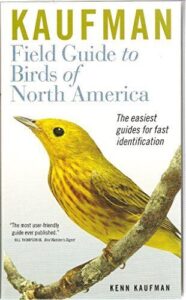
The Kaufman North American Bird Field Guide takes a different approach: it organizes species by appearance, not taxonomy. That means you’re comparing similar‑looking birds side by side, exactly how your brain works in the field.
Every entry includes range maps, behavior notes, and plumage variation by age and sex. The digitally enhanced photo illustrations closely resemble live birds. It’s compact, built for outdoor handling, and covers every regularly occurring North American species.
| Best For | Beginner birdwatchers, families, and casual outdoor enthusiasts who want a quick, visual way to ID birds without a steep learning curve. |
|---|---|
| Price | $12.99 |
| Page Count | 392 pages |
| Format | Hardcover |
| Audience | Novice, families |
| Species Coverage | All North American birds |
| Publisher | Mariner Books |
| Additional Features |
|
- Organized by appearance, so finding a bird you just spotted actually makes sense
- Compact and durable — it can take a beating in a backpack or glove box
- Covers all regularly occurring North American species with range maps and plumage variations included
- Thin on detail for serious birders who want deeper species info
- The photo-to-text layout trips some people up — matching images to descriptions isn’t always intuitive
- Newer editions run heavier (~570g), which takes some of the "pocket-friendly" shine off
7. Florida Birds Field Guide by Stan Tekiela

If your hiking trails stay within Florida, Stan Tekiela’s Florida Birds Field Guide is built for exactly that.
It covers 146 Florida-exclusive species, organized by color — yellow birds together, blue birds together — so you can flip straight to a match without scanning taxonomic lists.
The "Compare" sections flag look‑alike species side by side, which cuts confusion fast.
At 4.25 × 6 inches and vinyl‑coated covers, it manages field conditions reliably.
| Best For | Florida hikers, backyard birders, and beginners who want a compact, easy-to-use guide for identifying birds within the state. |
|---|---|
| Price | $10.68 |
| Page Count | 384 pages |
| Format | Paperback |
| Audience | Beginners, educators |
| Species Coverage | 146 Florida species |
| Publisher | Adventure Publications |
| Additional Features |
|
- Color-coded layout makes finding a match fast — no need to dig through taxonomic lists.
- "Compare" sections help you tell similar-looking species apart without second-guessing yourself.
- Pocket-sized with vinyl-coated covers, so it holds up on the trail without babying.
- Only covers Florida — useless the moment you cross state lines.
- 146 species is a solid start, but rare or vagrant birds probably won’t be in here.
- Small pages mean less detail per species compared to a full-sized field guide.
8. Stokes Eastern Birds Field Guide

Where Tekiela narrows to one state, the Stokes Eastern Field Guide spans the entire eastern U.S. and Canada — a broader net for hikers crossing multiple regions.
At 5.6 oz and 144 pages, it covers 100-plus species with full-color photos showing male, female, and seasonal plumages. Entries include voice, habitat, and nesting notes. The color-tab index mirrors Tekiela’s approach, so you’re not flipping blind. For $7.47, it’s hard to beat as a pack-friendly eastern companion.
| Best For | Beginner birdwatchers and hikers exploring the eastern U.S. and Canada who want a budget-friendly, easy-to-use field guide they can actually fit in a pocket. |
|---|---|
| Price | $7.47 |
| Page Count | 144 pages |
| Format | Paperback |
| Audience | Beginners, children |
| Species Coverage | ~100 eastern species |
| Publisher | Little, Brown and Company |
| Additional Features |
|
- Color-tab index makes spotting birds by color fast and intuitive — no guesswork
- Covers male, female, and seasonal plumages, so you’re not thrown off by a bird that looks "different"
- At $7.47, it’s genuinely affordable for what you get
- Only ~100 species, so rarer or region-specific birds will leave you guessing
- Published in 1996, meaning some range maps and population data are showing their age
- Useless if you’re birding west of the Mississippi — it’s strictly an eastern guide
Choose Portable Durable Formats

A bird guide that falls apart by mile three isn’t doing you any favors. The best ones are built to handle rain, mud, and the kind of rough handling that comes with real trail use. Here’s what to look for before you pack one in.
Pocket-friendly Guide Size
Most pocket guides measure 4×6 inches or 4.25×5.5 inches — small enough to slide into a jacket pocket without thinking twice. That slim profile means one-handed retrieval while you’re traversing uneven ground.
Pages usually run 64 to 160, keeping the compact layout tight without dropping essential field data.
A pack-sized field guide shouldn’t fight for space. It should disappear until you need it.
Lightweight Pack Considerations
Size gets you halfway there. Weight carries you the rest of the day.
A pack-sized field guide should stay under 12 ounces. That’s the difference between forgetting it’s there and resenting every uphill mile.
Guides using ultralight laminated pages and Dyneema-style composite materials trim significant bulk without sacrificing durability — keeping your trail-friendly weight exactly where it belongs.
Waterproof Laminated Covers
Rain doesn’t warn you before it arrives on the trail. That’s exactly why waterproof lamination matters on a field guide — not as a bonus feature, but as baseline protection.
Here’s what makes laminate worth trusting:
- A continuous water barrier using PVC or PET polymer blocks moisture from penetrating the cover surface entirely.
- UV stabilizer addition prevents color fade and material brittleness from extended sun exposure.
- Corner guard design reduces wear from repeated packing and rough handling on rocky terrain.
- Recycled content options let you choose field guide durability without sacrificing environmental responsibility.
Ultralight laminated covers bond to the board using heat or pressure — keeping the seal tight through repeated downpours. Field guide durability and weather-resistant design aren’t opposing forces. Done right, they’re the same thing.
Strong Bindings for Trails
Every opening and closing cycle puts stress on a binding — and most guides fail at the spine long before the pages wear out. Triple-stitched spines and heavy gauge thread at every joint prevent that exact failure.
An abrasion-resistant coating on the exterior withstands brush and rock contact.
Corner reinforcement distributes load when your pack shifts, and edge binding protection keeps moisture and mud out.
Mud-resistant Field Materials
Mud follows you everywhere on trail — your guide included. Hydrophobic fabric coatings repel water and mud contact up to 90 percent, keeping covers functional after wet scrambles.
- Ultralight laminated and vinyl covers shed mud with a quick wipe
- Mud wipe solutions use biodegradable formulas safe on treated surfaces
- Weatherproof reference materials pair best with mud-resistant footwear and a waterproof field guide for full kit protection
Match Guide Coverage to Trails

Not every guide covers the trails you actually hike. A national book packed with 900 species sounds impressive until you’re standing in a Colorado meadow flipping past birds you’ll never see there. Here’s what to look for when matching a guide to your specific region and season.
Regional Versus National Guides
Think of national guides as a wide lens, and regional guides as a zoom.
National guides cover continent-wide ranges with standardized illustrations and consistent taxonomy — useful anywhere, but thin on local detail.
Regional guides zoom into specific states or ecological zones, cutting page count by roughly 60% and highlighting local hotspots, microhabitats, and community-sourced tips that national editions simply can’t include.
State-specific Bird Ranges
State borders don’t care about bird habitat — and neither do the birds. A guide with state-specific range maps gives you real precision, showing exactly where a species concentrates within your region.
- California holds 78% of western scrub jays during breeding season
- Florida’s coastal wetlands support 62% of sandhill cranes in winter
- Texas carries 55% of northern mockingbirds through fall migration corridors
Match your guide’s county-level range detail to your trail state before you pack.
Seasonal Migration Windows
Birds don’t follow a calendar — they follow day length and food availability. Migration windows are predictable, but only if your guide maps them accurately.
Look for guides that specify peak arrival and departure dates by month, not just season. Spring windows align with insect emergence; autumn windows shift as food thins and temperatures drop.
A guide with these details tells you exactly when to show up.
Elevation and Habitat Details
Timing gets you to the trailhead. Elevation gets you the bird.
A good guide breaks habitat by elevation zone — valley riparian corridors, mid-elevation conifer belts, subalpine shrublands above 2,400 meters. Each layer holds different species. Vertical stratification matters too: creepers forage low, thrushes mid-canopy, flycatchers at the gaps.
Look for guides that include microclimate and habitat descriptors alongside range maps.
Local Species Relevance
Elevation narrows the field. But your trail’s specific plant community closes the deal.
A guide covering your local habitat — riparian alder groves, oak woodlands, conifer edges — tells you exactly which species to expect:
- Resident year-round species tied to native tree and shrub composition
- Passage migrants peaking during defined seasonal windows
- Local feeding niches like ground foragers in leaf litter
- Regional song dialects that differ from national recordings
Read Field Marks Faster
Reading field marks quickly comes down to knowing what to look for and where to find it in your guide. The right layout can cut your ID time from minutes to seconds. Here’s what actually makes the difference on the trail.
Wing Bars and Eye Rings

Two features cut through confusion faster than most: wing bar patterns and eye rings. Wing bars are light stripes crossing the wing’s surface, visible whether a bird is perched or in flight. Bar contrast and width vary by species — some broad and obvious, others narrow enough to miss in low light. Juvenile birds often show fainter bars that sharpen with age.
Eye rings work differently. That colored circle around the eye stays consistent across seasons and sexes, making it one of the most reliable field marks in your field guide. Ring thickness and color — from pale yellow to near-black — help separate species that otherwise look nearly identical at a glance.
Tail Shape and Patterns

Once you’ve clocked the eye ring, drop your gaze to the tail. Tail shape diversity tells you a lot fast. A forked tail tip points to swallows or kites; a rounded tail suggests warblers moving through dense cover. Check the tail length ratio against the body — species with tails exceeding half their body length stand out immediately.
Tail pattern identification is equally direct. Look for barring, white outer edges, or spotted patches — these plumage patterns are consistent field marks across seasons.
Color-coded Guide Sections
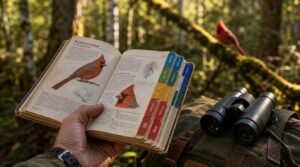
Flipping through a guide mid-trail wastes seconds you don’t have. That’s why color-coded tabs matter.
Guides arranged by color — like Stan Tekiela’s Florida Birds — let you jump straight to the right section based on what you’re seeing. Spine color grouping helps even faster when pages are flipping in the wind.
Check the color legend before you leave the trailhead.
Photo Versus Illustration Guides

Both formats have real strengths. Photo Detail Accuracy gives you authentic plumage, natural posture, and habitat context — exactly what the bird looks like in morning light.
But lighting impact cuts both ways: poor conditions wash out colors and make photos harder to read. Illustration clarity solves that. High-contrast illustrations standardize wing bars and eye rings for instant comparison, staying legible even in glare.
Side-by-side Comparison Charts

A good side-by-side comparison chart cuts the guesswork out fast. Parallel columns lock each species against the same field marks — wing bars, eye rings, tail patterns — row by row.
Row consistency means your eye never reorients. Pair that with a visual legend for icons and color codes, and even a beginner reads the chart at a glance.
Combine Print Apps and Gear
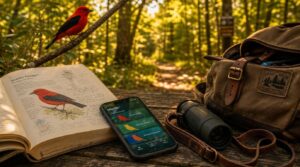
A great field guide only gets better when you pair it with the right tools. Print, apps, and gear each fill gaps the others can’t. Here’s what works together on the trail.
Offline Bird Identification Apps
A good digital bird guide app doesn’t need cell service to earn its keep. Apps like Merlin Bird ID store complete offline maps, range data, and species images directly on your device.
- Offline Image Matching identifies birds from photos using a local database
- Sound Recognition Engine matches calls without any network connection
- Battery Optimization reduces background processing during long hikes
- Taxonomy Updates sync automatically when you reconnect
- User Image Contributions expand the database over time
QR Codes for Bird Calls
Some printed guides now embed QR code links next to species illustrations. Scan one, and your phone plays the bird’s call instantly — no app login, no searching.
| Feature | Benefit | Trail Use |
|---|---|---|
| Offline sound links | Works without signal | Remote trails |
| Audio QR integration | Instant vocalization ID | Quick scanning |
| Adaptive call updates | Fresh audio remotely | No reprint needed |
Code scan reliability improves on laminated, high-contrast pages.
GPS Range Map Overlays
Live GPS Overlay technology layers bird range boundaries directly onto your hiking route. As you move, ranges shift in real time.
Seasonal range layers update automatically, showing breeding versus wintering status without manual input.
Offline range caching stores tile data before your hike, so identification works deep in signal-dead terrain.
Species range clustering keeps the map readable when multiple ranges overlap.
8×42 Hiking Binoculars
Once GPS locks your position on the map, your next tool is a solid pair of binoculars. 8×42 binoculars strike the right balance for hiking — eight times magnification keeps distant birds sharp without narrowing your field of view too much when tracking flight. The 42 mm objective lens pulls in enough light for reliable images at dawn and dusk.
Exit pupil size lands around 5.25 mm, comfortable for extended glassing with or without glasses. Roof prism designs with multi-coated lenses reduce glare and sharpen color contrast, so subtle field marks like wing bars read clearly instead of washing out.
Nature Journals for Sightings
Binoculars show you the bird. A nature journal helps you remember it.
Log date, location, species, and weather data on each entry. Add a quick habitat notes section — vegetation, terrain, water nearby. Sketch field marks like wing bars or eye rings using journal sketch integration techniques. Cloud-sync your notes to eBird afterward for a complete, searchable nature journaling record.
Frequently Asked Questions (FAQs)
What are the 5 S’s of birding?
The 5 S’s of birding are Size, Shape, Shade, Sound, and Space. Together, they give you a fast, repeatable framework for identifying any bird you spot in the field. Young birders can also explore free virtual birding lessons to reinforce these skills.
How do I attract birds to my campsite?
Set up shallow water in shade, plant native shrubs nearby, and keep noise low at dawn. Birds follow food, cover, and calm — give them all three.
What ethics apply when approaching nesting birds?
Stay at least 50 meters from active nests. Move slowly, keep voices low, and never peer into cavities. Bird welfare comes first — always retreat if birds show stress.
Can children safely participate in trail birding?
Yes, children can safely join trail birding with the right setup. Keep groups small, use a buddy system, and stay on marked paths. Lightweight kid-friendly binoculars and simple color-coded guides make it enjoyable.
How do I identify birds by sound alone?
Listen to pitch and rhythm first. High whistles suggest small passerines; low growls point larger. Songs are complex and melodic — calls are short and sharp. Habitat and season narrow it fast.
Which guides work best in low-light conditions?
Guides with matte low-light coatings, fluorescent edge tabs, and high-contrast illustrations work best. Look for 11–13pt sans-serif fonts and bold field-mark outlines. Sibley and Kaufman both deliver strong visual clarity at dawn.
Conclusion
Like a well-worn trail that reveals more detail the slower you walk, the right bird identification guide for hiking trips sharpens everything you already notice.
You stop seeing "small brown bird" and start reading posture, habitat, and behavior as a complete picture.
The eight guides here each close a different gap.
Pick the one that matches your trails, your pack weight, and your skill level—then go prove it works.