This site is supported by our readers. We may earn a commission, at no cost to you, if you purchase through links.
Florida hosts more than 30 duck species across its wetlands, coastal bays, and flooded fields—a number that surprises most people who only picture Mallards waddling around urban ponds.
The state’s geography makes it something of a waterfowl crossroads: year-round residents like the Mottled Duck share territory with Arctic migrants such as the Long-tailed Duck, which dives 200 feet for a single mollusk before surfacing like nothing happened.
Knowing who’s who out there sharpens your fieldwork, informs smarter conservation decisions, and honestly makes every marsh walk more rewarding.
This guide breaks down Florida ducks by group—dabblers, divers—and sea ducks, and whistling ducks—covering identification, habitat, and the conservation pressures shaping their populations right now.
Table Of Contents
- Key Takeaways
- Most Common Ducks in Florida
- Overview of Dbling Ducks
- Overview of Diving Ducks
- Sea Ducks in Florida
- Black-bellied Whistling-Ducks and Fulvous Whistling Ducks
- Mallards in Florida and Their Impact
- Waterfowl Hunting and Regulations
- Wood Ducks in Florida
- Duck Identification Tips
- Preservation and Management of Duck Populations
- Frequently Asked Questions (FAQs)
- What does a duck look like in Florida?
- Are there Ducks in Florida?
- Are wood ducks common in Florida?
- Why are ducks so popular in Florida?
- What kind of ducks are there in Florida?
- Do ducks like being hugged?
- Why are there so many Muscovy ducks in Florida?
- What ducks are native to Florida?
- How do ducks adapt to urban areas?
- Best time for duckwatching in Florida?
- Conclusion
Key Takeaways
- Florida’s 33 duck species span four distinct groups — dabblers, divers, sea ducks, and whistling ducks — each shaped by specific habitat needs, migration timing, and feeding strategies, you can learn to read in the field.
- The native Mottled Duck faces a quiet crisis: Mallard hybridization, wetland loss, and urban encroachment are eroding its genetic integrity and shrinking its range faster than most people realize.
- Cracking duck ID comes down to four reliable clues — beak shape, white patch patterns, vocalizations, and head or tail posture — details that reveal species, sex, and even season at a glance.
- Protecting Florida’s waterfowl isn’t just a government job; nest box programs, citizen science logging through eBird, and community wetland restoration efforts are actively moving the needle on population recovery.
Most Common Ducks in Florida
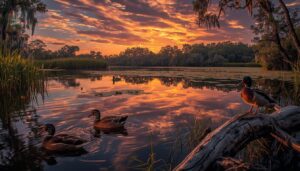
Florida hosts 33 waterfowl species, and you don’t need to travel far to find them. From urban retention ponds to coastal marshes, the Florida waterfowl identification guide starts with a handful of core species you’ll encounter regularly.
If you’re just starting out, brushing up on identifying small birds in Florida makes spotting the smaller waterfowl species much easier in the field.
The Mottled Duck stays year-round — over 180,000 individuals call this state home. Mallards have mastered urban adaptation, thriving wherever there’s open water.
Population trends vary sharply by species; Greater Scaup is declining, while Black-bellied Whistling-Duck holds steady near one million globally. Habitat loss from development and drainage compresses these birds into fewer Florida Waterfowl Hotspots, making every wetland count.
The state also offers a diverse array of Florida water birds such as the great blue heron and sandhill crane.
Overview of Dbling Ducks
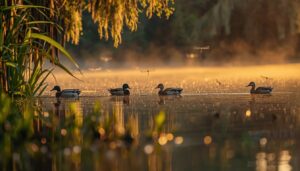
Dabbling ducks are the most commonly spotted waterfowl across Florida’s freshwater marshes, ponds, and flooded fields — and once you know what to look for, you’ll start recognizing them everywhere.
Unlike diving ducks, these species feed at the surface, tipping forward rather than fully submerging, which makes them easier to observe up close.
Here are the five dabbling ducks you’re most likely to encounter in Florida.
Gadwall
Often dismissed as plain, the Gadwall rewards patient observers with understated field marks and reliable wetland behavior. Its Habitat Preference runs toward vegetation‑rich freshwater marshes and brackish coastal ponds — exactly the mosaic of Florida wetlands that hosts diverse waterfowl year‑round.
- Species ID Guide: Gray body, black rear patch, white speculum in flight
- Breeding Behavior: Nests in dense upland vegetation; 7–13 eggs, 24–27‑day incubation
- Vocalization Patterns: Quieter than most dabbling ducks; females produce higher‑pitched calls
- Migration Timing: Winter numbers increase along Atlantic and Gulf Coast marshes
- Population Trends: Stable; no current high‑priority conservation concern
Green-Winged Teal Duck
Where the Gadwall blends in, the Green-winged Teal stands apart — compact, quick, and unmistakable once you know what to look for.
- Species ID Guide: Chestnut head, emerald eye patch, gray-barred flanks, and a bright green speculum in flight
- Breeding Habitat: Northern boreal wetlands; Migration Patterns bring wintering flocks to Florida’s shallow marshes and flooded fields
- Dietary Preferences: Seeds, aquatic plants, and invertebrates — dabbled from the surface in classic teal fashion
Mallard Duck
If the Green-winged Teal is Florida’s speed racer, the Mallard Duck is its most recognized face. Males display a glossy green head, yellow bill, and white neck ring — Identification and Natural History made easy. Females are mottled brown with orange bills. Habitat use of Florida wetlands by waterfowl shapes their year‑round presence across lakes and urban ponds, where Urban Foraging keeps them adaptable.
| Feature | Detail |
|---|---|
| Courtship Displays | Males tip, bob, and whistle to attract females |
| Nest Site Selection | Ground nests near water, lined with grass and down |
| Seasonal Migration | Northern birds winter in Florida; some locals stay year‑round |
| Population Monitoring | Wildlife agencies track numbers to manage hybridization concerns |
Mottled Duck
Unlike most waterfowl passing through seasonally, the Mottled Duck calls Florida home year‑round. Habitat use of Florida wetlands by waterfowl shapes this species entirely — coastal marshes, brackish flats, and shallow freshwater edges define its range.
Identification and Natural History start with its buff face, dark eye stripe, and orange‑yellow bill.
Breeding Phenology peaks in spring, Nest Site Selection favors low grasses near water, and Dietary Shifts move from invertebrates to aquatic vegetation as broods mature.
Population Monitoring remains critical, as Conservation concerns for Florida waterfowl — especially mallard hybridization — directly threaten Population trends and monitoring of Florida waterfowl long‑term.
Predation Pressure compounds habitat loss statewide.
Northern Pintail
Northern Pintail is one of Florida’s most visually striking winter visitors. Males arrive with a chocolate-brown head, sharp white neck stripe, and signature elongated tail feathers — a textbook case of Sexual Dimorphism among dabbling ducks. Females show mottled brown Plumage field identification cues: pale face, no bold stripe. Migration Routes bring them south from Alaskan and Canadian Nesting Sites each November, dispersing across shallow marshes and flooded agricultural fields through March.
Three reasons this species draws interest:
- Winter Foraging focuses on seeds, tubers, and rice field grains
- Seasonal distribution of ducks in Florida peaks here in large mixed flocks
- Population Trends reflect broader Conservation concerns for Florida waterfowl tied to wetland loss
Overview of Diving Ducks

Diving ducks are a different breed entirely — built for depth, speed, and serious underwater work. Unlike their dabbling cousins, these birds disappear beneath the surface to hunt, and Florida’s waters attract a fascinating mix of them each season.
Here are the key species you’re most likely to encounter.
Greater Scaup
The Greater Scaup is one of Florida’s most capable winter divers — and once you know what to look for, it’s surprisingly easy to pick out from a crowded bay. Males carry a dark iridescent head, pale blue-gray body, and bright white sides during breeding plumage. Females are brown with a pale patch at the bill base. Both show a white wing stripe in flight and a blue bill tipped with black.
Migration Timing peaks in fall as boreal lakes freeze, pushing flocks south to Florida’s coastal estuaries, bays, and deep offshore Wintering Habitats. Dietary Shifts follow: mollusks, clams, and benthic invertebrates replace the plant matter consumed on breeding grounds. Greater Scaup dives to roughly 23 feet to forage — fully submerged, unlike dabbling ducks that tip-feed at the surface.
Breeding Success and Disease Monitoring remain active conservation concerns, as populations show steep declines linked to habitat loss across wetland habitats for waterfowl throughout their range.
Lesser Scaup
Lesser Scaup are the compact powerhouses of Florida’s winter diving ducks — easy to spot once you catch their bright Wing Flash Identification signature across open water. Wintering lake use peaks from November through April on inland reservoirs and coastal bays. Their Mollusk Feeding Strategy drives deep, quick dives for snails and insect larvae.
Key Field Notes:
- Size: 15–18 inches, 24–33 inch wingspan
- Molt Timing: winter plumage arrives before Florida migration
- Population Decline Drivers: wetland habitat loss along waterfowl migration patterns
- Conservation: listed as high concern among Threats and Conservation Status of Florida Waterfowl
Redhead Duck
The Redhead Duck is one of Florida’s most recognizable winter diving ducks — that chestnut-red head on males is unmistakable across open water. Plumage Differences between sexes are sharp: males show a black neck and gray back; females wear soft brown with a pale eye stripe.
| Feature | Detail |
|---|---|
| Dive Depths | 1–4 meters |
| Wintering Hotspots | Coastal bays, inland marshes |
| Nesting Sites | Western Canada, Alaska |
Wetland habitats support their plant-heavy diet. Habitat loss remains a core Threats and Conservation Status of Florida Waterfowl concern.
Ring-Necked Duck
The Ring-Necked Duck is a master of freshwater, turning Florida’s winter lakes and ponds into its personal foraging ground. Despite its name, the visible field mark isn’t the neck — it’s the sharp white ring around the bill. Males show a black head, chest, and back with light gray flanks; females are brownish-gray with a pale eye ring.
- Wintering Range: November through April across Florida’s freshwater marshes and shallow lakes
- Nesting Preferences: Boreal wetlands with dense aquatic vegetation far north of Florida
- Flight Mechanics: Rapid wingbeats with a visible white speculum in good light
- Hybridization Risk: Low; species remains genetically stable with consistent population trends
- Molt Timing: Post-breeding plumage shift occurs before southward migration begins
As an identification guide for Florida ducks goes, this Ringnecked Duck bridges habitat preferences of diving versus dabbling ducks — diving for seeds, tubers, and invertebrates while occasionally surface-feeding. Conservation status of Florida waterfowl shows this species holding steady, though wetland habitat loss remains a constant pressure worth monitoring.
Ruddy Duck
Where the Ring‑necked Duck plays it cool on freshwater lakes, the Ruddy Duck brings unmistakable flair. Compact and low‑riding, this stiff‑tailed diver is one of Florida’s most visually distinct winter visitors — and once you know what to look for, you won’t mistake it.
Identification: Blue Bill Males carry bright cerulean bills during breeding season; females show mottled brown with a pale cheek patch. Stiff Tail Posture — held sharply upright — is your clearest field marker year‑round.
| Feature | Breeding Male | Female |
|---|---|---|
| Bill | Bright blue | Gray‑black |
| Body | Chestnut‑red | Mottled brown |
| Tail | Upright, stiff | Flat or angled |
Behavior: Courtship Drumming — males rapidly tapping bills against their necks to produce surface bubbles — is unlike any other Florida duck species.
Wetland Distribution: Seasonal Migration brings them to Florida’s coastal bays and inland marshes from October through March.
Conservation: Wetland habitat selection drives their survival. Protecting shallow, vegetated wetlands remains central to the conservation status of Florida waterfowl overall.
Sea Ducks in Florida
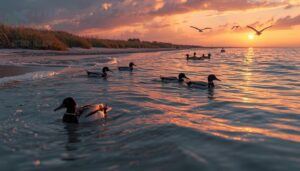
Sea ducks are a different breed from the dabbling and diving ducks you’ll find in Florida’s inland marshes — these birds are built for open water, coastal bays, and rougher conditions. They don’t show up in huge numbers here, but when they do, they’re worth paying attention to.
Here are the sea duck species you’re most likely to encounter in Florida.
Harlequin Duck
Among Florida’s sea ducks, the Harlequin Duck stands out as a rare winter visitor with unmistakable style. Males wear bold blue-gray plumage with white stripes and chestnut flanks; females stay subtly gray-brown.
They breed along fast-flowing streams in northern regions, then shift to rocky shorelines where invertebrate foraging drives their survival.
- Compact divers: males weigh ~650g, built for turbulent surf
- Monogamous pair bonds form during winter coastal stays
- Oil spill threats rank among their most serious conservation risks
Hooded Merganser
Where the Harlequin favors rocky surf, the Hooded Merganser claims Florida’s wooded swamps, slow rivers, and riparian habitat from November through March.
Its crest display — a bold white fan framed in black — signals courtship behavior that’s hard to miss.
The serrated bill grips fish and crayfish during 10–20‑second dives.
Tree cavity nesting ties this species to mature forest wetlands, making habitat loss a real conservation concern.
King Eider
Unlike the Hooded Merganser’s woodland haunts, the King Eider trades boreal forests for open Arctic breeding habitats and Florida’s coastal fringe. A rare winter visitor, this large sea duck measures 50–60 cm with a wingspan near 86 cm.
Plumage dimorphism is striking — males flash a multicolored head, orange bill, and white body; females stay mottled brown.
- Size: 50–60 cm length; wingspan ~86 cm
- Diet: Mollusks, crustaceans, bivalves via sea ice foraging
- Range: Arctic tundra to Florida’s offshore coastal waters
- Status: Rare winter visitor; contributes to Florida duck species diversity
Long-Tailed Duck
The Long-Tailed Duck arrives from Arctic breeding grounds each winter, trading tundra ponds for Florida’s coastal wetland habitats. Plumage change is dramatic — males shift from summer black to winter white with brown facial tones.
diving ducks reach depths of 60–200 feet, targeting mollusks and crustaceans.
Threats from oil spills and habitat loss make conservation of Florida waterfowl, including this species, critical across its wintering grounds.
Surf Scoter
The Surf Scoter is one of Florida’s most recognizable sea ducks, visiting wintering grounds along the coast from late fall through early spring.
Its Plumage Identification Marks are hard to miss:
- Black body with bold white forehead and nape patches
- Multi-colored Bill Color Pattern — dark at base, bright orange at tip
- Heavy, chunky Size and Form built for Marine Diving Behavior
- Forages on mollusks in nearshore wetland and coastal habitat
Black-bellied Whistling-Ducks and Fulvous Whistling Ducks
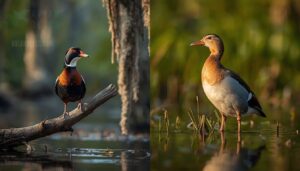
Whistling-ducks are unlike most ducks you’ll spot in Florida — they perch in trees, stand tall on long legs, and call out with surprisingly loud whistles.
Both the Black-bellied and Fulvous species have carved out a solid presence in the state, each with its own quirks worth knowing.
Here’s what sets them apart.
Behavior and Habitat
Both species thrive in Florida’s flooded agricultural fields and shallow marshes, feeding on seeds and aquatic plants at the water surface. Flock dynamics are especially social — large groups gather at dusk, moving with seasonal migration patterns tied to food availability rather than fixed routes. Wetland restoration directly helps their numbers by expanding reliable habitat.
- Nesting Sites: Black-bellied Whistling-Ducks use tree cavities; Fulvous Whistling-Ducks build ground-level nests near wetland edges — both face predation pressure during incubation.
Identification and Characteristics
Spot the difference fast. Black-bellied Whistling-Ducks display chestnut bodies, bright pink bills, and bold black bellies — duck morphological characteristics that make plumage field identification immediate.
Fulvous Whistling-Ducks run tawny-brown with blue-gray bills. Both show long-necked silhouettes, extended leg length ratios, and flat tail feather shapes.
Their sharp duck vocalizations and calls — a clear whistling note — reach you before the birds do.
Conservation Status
Black-bellied Whistling-Ducks are expanding steadily across Central and South Florida, showing strong annual population growth. Fulvous Whistling-Ducks hold stable numbers, though habitat fragmentation and invasive species impact both wetland quality and foraging range.
coastal marshes add pressure.
Population monitoring by wildlife agencies tracks these trends closely, ensuring genetic integrity and wetland habitat remain protected before either species reaches vulnerable status.
Mallards in Florida and Their Impact
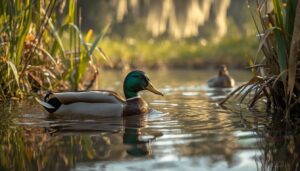
Mallards might look harmless gliding across a Florida pond, but their presence here is more complicated than it seems. They interact with native species in ways that have real consequences for Florida’s wetland ecosystems.
Here’s what you need to know about their impact.
Threats to Florida Mottled Duck
Florida’s mottled duck is under siege from multiple fronts.
Urban encroachment, wetland drainage, and salinity intrusion from rising seas are shrinking the habitats these birds depend on year-round.
Disease transmission risk climbs where degraded wetlands concentrate mixed-species flocks near developed areas.
Invasive predators compound the pressure near nesting sites.
Four threats stand out:
- Wetland Drainage — Eliminates core foraging and nesting habitat
- Salinity Intrusion — Degrades brackish marshes, reducing invertebrate prey
- Urban Encroachment — Fragments remaining wetland corridors statewide
- Disease Transmission — Rises sharply in overcrowded, compromised wetlands
Concerns About Hybridization
Hybridization cuts deeper than most people realize. When Mallards interbreed with Mottled Ducks, the result isn’t just a mixed-looking bird — it’s a Genetic Purity Threat that quietly unravels local adaptations built over generations.
Mallard interbreeding doesn’t just blur a feather pattern — it silently erases generations of native adaptation
Hybrid Fitness Uncertainty means these offspring may struggle in Florida’s marshes and mangroves where pure Mottled Ducks thrive.
Public Misidentification Risks complicate accurate counts, and Management Policy Gaps leave conservation status assessments incomplete.
Monitoring Funding Needs remain unmet, slowing research on interbreeding between Mallards and Mottled Ducks before hybrid ducks in Florida outnumber the real thing.
Florida Fish and Wildlife Conservation Commission (FWC) Efforts
That’s where the FWC steps in. Through Invasive Species Control, the agency actively removes feral and domestic Mallards before hybridization spreads further.
Habitat Restoration Programs and Nest Box Installation support native breeding populations, while Water Quality Monitoring tracks wetland health statewide.
Public Education Outreach helps you report hybrids accurately, and eBird data strengthens Conservation status assessments for vulnerable Florida duck species.
Importance of Wintering Areas
Protecting wintering areas isn’t just a seasonal concern — it’s year-round survival strategy.
Nutrient-rich wetlands across Florida’s lakes and coastal marshes rebuild energy reserves ducks need for successful spring breeding.
Habitat connectivity links these stopover protection zones to breeding grounds up north, and climate buffering from Florida’s mild winters keeps foraging viable when northern waters freeze.
These winter birding hotspots in the state matter deeply:
- Food Availability — Aquatic invertebrates and seeds fuel long return migrations
- Predator Cover — Emergent vegetation shields roosting birds
- Wetland Depth Variety — Accommodates habitat preferences of diving vs dabbling ducks simultaneously
- Climate Stability — Mild temperatures reduce daily energy losses
- Migration Continuity — Stable sites reinforce seasonal distribution and migration of Florida ducks annually
Waterfowl Hunting and Regulations
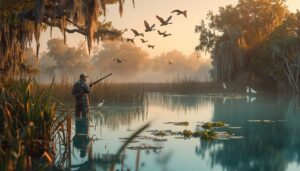
Waterfowl hunting in Florida comes with a set of rules that go beyond just knowing your seasons and bag limits.
The state has specific regulations designed to protect native species — especially where Mallards and Mottled Ducks share the same water. Here’s what you need to know before you head out.
Mottled Duck Hybridization
When mallards move into urban wetland contact zones, they don’t just compete — they interbreed. That’s the quiet threat driving one of Florida’s most pressing conservation concerns.
Genetic admixture between mottled ducks and feral mallards has been confirmed at roughly nine percent in some study populations, with rates climbing in habitat fragmentation effect zones like suburban lakes and golf course ponds. Backcrossing dynamics mean each generation drifts further from pure mottled duck ancestry.
Here’s what makes hybrid detection methods critical for conservation:
- Visual field ID often misses backcrosses with subtle plumage blending
- Microsatellite genetic analysis reveals true ancestry proportions
- Admixture concentrates in urban wetlands where mallards overwinter
- Fertile hybrids dilute breeding ecology and nesting habitat fidelity
- Ongoing monitoring guides habitat management to limit interspecific contact
Nuisance Waterfowl Control
Controlling urban domestic and feral ducks demands more than shooing birds away — it requires a layered system. Deterrence Techniques, like reflective tape, trained dogs, and predator decoys, disrupt landing patterns effectively. Habitat Modification — dense shoreline vegetation, removed shallow edges, and elevated landscaping — eliminates the conditions that attract nuisance flocks.
| Strategy | Method | Target Species |
|---|---|---|
| Habitat Modification | Shoreline vegetation buffers | All dabbling ducks |
| Deterrence Techniques | Trained dogs, reflective tape | Feral/urban ducks |
| Regulatory Measures | Feeding bans, reporting systems | Invasive Muscovy Duck |
Monitoring Protocols track monthly flock counts, while Community Outreach reduces anthropogenic food subsidies — the human impacts on wetland ecosystems that fuel population spikes.
Mallard Control Permit
Getting a handle on feral and urban mallards starts with one key tool — the Mallard Control Permit. This authorization covers lethal control and trapping of urban domestic and feral ducks on private lands, running annually from May 1 through August 31.
Those Seasonal Restrictions aren’t arbitrary; they align control efforts with breeding cycles to limit impact on non-target species.
The Application Process is straightforward: obtain the free state permit, print the required federal permit, and keep both on site. Subpermittee Authorization lets you designate contractors for hands-on work.
Data Reporting after each activity is mandatory — every bird, nest, or egg logged online. Management of feral and domestic waterfowl populations depends on this accountability chain staying intact.
Mallard Possession Permit
Before you legally keep a mallard in Florida, you’ll need a Mallard Possession Permit from the FWC. The Application Process requires personal identification, proof of address, and a clear lawful purpose — rehabilitation or relocation, not casual ownership.
Eligibility Requirements exclude those with recent wildlife-related convictions. Once approved, Compliance Monitoring means officers can inspect your setup anytime.
Welfare Standards govern your responsibilities:
- Proper enclosure size
- Documented nutrition
- Veterinary care records
- Humane transport methods
- Quarantine for new birds
Renewal Procedures update annually.
Mallard Possession Rule
Florida’s Mallard Possession Rule isn’t just paperwork — it’s a firewall protecting the native mottled duck from genetic erosion through hybridization.
Before you touch a live mallard, the Permit Application Process requires documented purpose, proper Enclosure Design Standards, and proof of humane care. Compliance Monitoring Procedures mean wildlife officers can inspect your setup unannounced.
| Requirement | Consequence of Violation |
|---|---|
| Transport Authorization Rules | Permit revocation, bird seizure |
| Enclosure standards met | Fines and criminal charges |
| Records kept current | Hunting privilege suspension |
Public Education Outreach reinforces why these duck hunting regulations matter — especially as population trends of Florida waterfowl reveal pressure on vulnerable species. Managing mallard possession directly helps the conservation status of vulnerable Florida duck species and the management of hunting pressure on game ducks statewide.
Wood Ducks in Florida
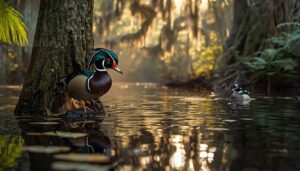
Wood Ducks are one of Florida’s most visually striking year-round residents, and once you know what to look for, you’ll spot them more often than you’d expect.
There’s actually a lot to unpack about this species — from how they look and act to where they live and how people are working to protect them.
Here’s what you need to know.
Appearance and Behavior
Wood Duck sexual dimorphism is hard to miss. Males wear iridescent green heads, white throat patches, and a red-white bill — striking plumage coloration that peaks during breeding plumages. Females stay muted brown with a white eye ring. Their courtship display rituals involve head-bobbing and wing-spreading, driven by seasonal plumage variation and molting patterns tied to the reproductive cycle. In flight, their agility through dense canopy stands out.
- Plumage: Males shift colors through seasonal variation; females stay cryptically brown year-round.
- Vocalizations: Territorial calls include a rising oo-eek from females, distinct duck vocalizations and calls used for pair bonding.
- Flight: Weaving through wooded corridors reflects their unique flight formation dynamics.
Preferred Habitats
Shallow freshwater wetlands are where Wood Ducks truly thrive. Their habitat preferences across Florida ecosystems center on flooded woodlands, marsh edge foraging zones, and lakes lined with aquatic vegetation.
Tree cavity nesting ties them directly to forested wetland edges. They’ll also use rice fields and managed pond water levels for feeding, making wetland ecosystems — from inland ponds to coastal estuary margins — essential year‑round.
Conservation Efforts
Protecting what the habitat section covered starts here — with action. Wetland Restoration Projects reestablish native marsh vegetation and shallow water zones critical for nesting success. Genetic Integrity Monitoring tracks hybridization pressure, particularly from invasive duck species. Community Stewardship Programs recruit volunteers for surveys and cleanups. Water Quality Improvements reduce nutrient runoff that degrades foraging grounds. Incentive Conservation Policies support landowners who maintain wetland buffers.
- Nest box programs offset cavity loss from development.
- Seasonal monitoring flags population shifts tied to climate change impacts.
Duck Identification Tips
Telling one duck from another can feel like a puzzle at first, but there are reliable clues hiding in plain sight. Once you know what to look for, even a quick glance can tell you a lot.
Here are four features that’ll sharpen your ID skills fast.
Beak Shape and Size
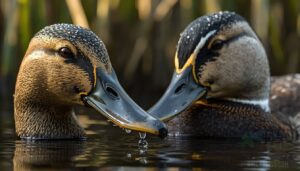
A duck’s beak tells you more than you’d expect.
Beak Length Variation across Florida species runs roughly 1.2 to 2.2 centimeters, while Beak Width Differences shift based on diet.
Dabbling ducks carry flatter, broader beaks — perfect for surface filtering — with lamellae around the edge of their beaks, straining vegetation and invertebrates.
Diving ducks show shorter, thicker profiles with steeper Culmen Curvature Patterns for gripping prey underwater.
Seasonal Beak Wear affects edge texture but not core geometry.
Mastering Beak Morphology Taxonomy sharpens every field ID instantly.
White Patches and Coloration
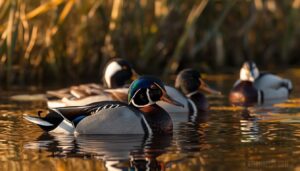
Once you’ve read a beak, shift your eyes to the feathers. White patches are one of the fastest shortcuts in any identification guide to Florida duck species.
Sexual dimorphism drives most of what you’ll see — males carry bolder, brighter markings, especially during breeding season. Watch for:
- Wing speculum patches flashing in flight
- Seasonal Brightness Changes tied to Molt Timing Effects
- Hybrid Patch Variability from Mallard crossbreeding
- Environmental Staining dulling white areas in silty habitats
UV Light Influence and duck plumage variation round out the full picture.
Vocal Calls and Sounds

Color gets you close — sound seals the deal. Florida’s duck vocalizations are surprisingly distinct once you tune in.
Female Mallards deliver that classic quack; males answer with softer rasps. Mottled Ducks blend into the marsh with high-pitched, hushed calls.
Morning Quack Patterns peak during early feeding hours, making dawn your best window. Seasonal Call Shifts and Sexual Call Differences sharpen your call identification guide skills fast.
Heads and Tails Features
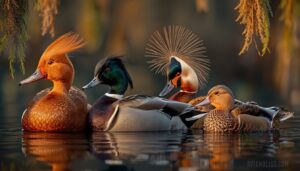
Head shape and tail posture tell you more than you’d expect once you know what to look for. Head Crest Patterns alone can split similar species instantly — the Redhead’s steep, peaked crown versus the Gadwall’s smoothly rounded profile. Tail Feather Shape seals it further: the Northern Pintail’s needle‑like extension versus the Ruddy Duck’s stubby, low‑carried tail.
For identifying duck plumage and sexual dimorphism, focus here:
- Bill Color Contrast: Yellow‑orange on male Mallards versus dark beak markings on ring‑necked ducks
- Head crests: Hooded merganser’s fan‑shaped crest versus Redhead’s clean dome
- Tail Spread Posture: Harlequin ducks spread wide during courtship; diving ducks tuck low while paddling
- Seasonal shifts: Duck plumage changes between breeding and non‑breeding seasons alter crown color and tail definition noticeably
Use these bird identification guide techniques consistently.
Preservation and Management of Duck Populations
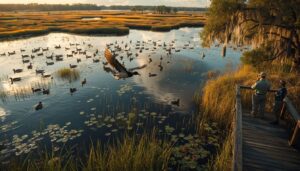
Keeping Florida’s duck populations healthy takes more than just good intentions—it takes real, coordinated action. From protecting critical wetlands to getting communities involved, there are several key strategies driving meaningful change.
Here’s what’s currently making the biggest difference.
Conservation of Endangered Species
Florida’s Mottled Duck and Fulvous Whistling-Duck are fighting an uphill battle. Habitat loss has wiped out over 44% of the state’s wetlands since the 1900s — and that’s a defining threat to wetland ecosystems and waterfowl statewide.
Captive Breeding Programs now supplement wild numbers, while Genetic Diversity Management prevents collapse through inbreeding. Anti-Poaching Enforcement patrols nesting zones during peak migration. Hydrological Water Management keeps water levels stable for nesting success.
Meanwhile, Citizen Science Monitoring and population monitoring efforts track avian conservation status in real time, turning everyday birdwatchers into frontline contributors.
Habitat Protection and Restoration
Protecting duck habitat starts with action, not just awareness. Native Plant Reestablishment rebuilds the marsh edges and floodplains that species like Mottled Duck and Wood Duck depend on year‑round. Wetland Water Management restores shallow foraging zones, while Invasive Species Control removes competitors that crowd out native aquatic plants.
Riparian Buffer Enhancement filters runoff before it reaches nesting waters.
Monitoring and Adaptive Management tie it all together — tracking results and adjusting when targets slip.
Community Engagement and Education Programs
You don’t have to be a biologist to make a difference. School Outreach programs reach over 1,500 students annually, while Volunteer Training certifies 200+ participants each season for wetland cleanups and field visits.
Habitat Workshops and Family Events build conservation literacy across 12 counties. Citizen Science contributions — logged through eBird and Avibase — sharpen checklist data statewide.
Public outreach and education on Florida waterfowl, combined with birdwatching field guides for Florida ducks, turn everyday observers into reliable conservation partners.
Frequently Asked Questions (FAQs)
What does a duck look like in Florida?
Like a living field guide, each duck tells its story through duck plumage coloration, eye ring patterns, tail shape, leg coloration, body size range, and seasonal plumage shifts that sharpen your duck identification skills instantly.
Are there Ducks in Florida?
Yes, absolutely. Florida hosts 33 duck species year-round and seasonally, shaped by Habitat Diversity, Seasonal Migration, and Climate Influence — making it one of North America’s leading birdwatching hotspots for waterfowl enthusiasts.
Are wood ducks common in Florida?
Wood ducks are indeed common in Florida, with stable populations distributed across forested wetlands statewide.
Cavity availability and seasonal distribution patterns shape where you’ll find them most reliably throughout the year.
Why are ducks so popular in Florida?
Florida’s warm climate, rich wetlands, and year-round duck activity make it a magnet for birdwatching tourism, family outdoor activities, and educational programs — drawing visitors to renowned birdwatching hotspots and viewing locations across the state.
What kind of ducks are there in Florida?
Over 33 species call Florida home — dabbling ducks, diving ducks, sea ducks, whistling ducks, geese, and swans — each shaped by distinct dietary adaptations, seasonal migration patterns, habitat diversity, and shifting population trends across the state’s varied wetlands.
Do ducks like being hugged?
Most ducks don’t enjoy hugging. Affectionate Duck Behaviors show trust through soft vocalizations and close following — not contact.
Handling Safety Guidelines are clear: restraint triggers Duck Stress Signals, risking wing injury and fear.
Why are there so many Muscovy ducks in Florida?
Like an uninvited guest who never leaves, the Muscovy duck thrives in Florida through pet release history, urban habitat adaptation, high reproductive rates, mild winter climate, and year-round food abundance — classic traits of a successful invasive duck species.
What ducks are native to Florida?
Four species call Florida home year-round: Mottled Duck, Wood Duck, Black-bellied Whistling-Duck, and Fulvous Whistling-Duck. Each occupies distinct wetland niches, from cavity-nesting hardwoods to coastal marshes and flooded agricultural fields.
How do ducks adapt to urban areas?
Think of Darwin’s finches — adaptation isn’t slow when survival demands it.
Urban ducks exploit artificial ponds, tolerate noise, nest on ledges, and rely on human food, bending city life to their ecological advantage.
Best time for duckwatching in Florida?
Winter is prime time.
From October through March — especially December and January — Seasonal Migration Peaks bring Blue-winged Teal, Ring-necked Duck, and Lesser Scaup south, with Dawn Activity Patterns along marsh edges delivering your best views.
Conclusion
Every marsh visit holds a question you won’t see coming—a silhouette low over the water, a dive too quick to track, a call that doesn’t match anything familiar. That’s exactly where Florida ducks reward patience over guessing.
The species are out there, shaped by migration pressure, hybridization risk, and shrinking habitat. What you do with that knowledge—whether you’re logging field notes or advocating for wetland protection—determines what future observers will actually find.