This site is supported by our readers. We may earn a commission, at no cost to you, if you purchase through links.
Few birds stop a walk dead in its tracks quite like a male hooded merganser mid-display—hood fanned wide, black and white blazing against a quiet forest pool.
It’s a bird that looks almost too designed, like something out of a naturalist’s sketchbook.
The hooded merganser occupies a narrow ecological niche, threading through boreal forests and wooded wetlands from Alaska to the Atlantic coast, relying on clear water and hollow trees in ways few ducks do.
Understanding how it hunts, nests, and moves through the seasons reveals a bird built with surprising precision—serrated bill, telescoping crest, and all.
Table Of Contents
- Key Takeaways
- What is a Hooded Merganser?
- How to Identify a Hooded Merganser
- Where Hooded Mergansers Live
- What Hooded Mergansers Eat
- Breeding, Nesting, and Conservation
- Frequently Asked Questions (FAQs)
- What is a hooded merganser?
- What does a hooded merganser eat?
- Where do hooded mergansers live?
- Does a hooded merganser have a sawbill?
- Where do hooded mergansers migrate?
- Are hooded mergansers any good to eat?
- How rare is a hooded merganser?
- Are hooded merganser good to eat?
- What is the difference between a bufflehead and a hooded merganser?
- Where can I find a hooded merganser?
- Conclusion
Key Takeaways
- The hooded merganser’s serrated "sawbill" and sharp underwater vision make it a precision hunter built specifically for clear, shallow water—murky ponds simply don’t cut it.
- It nests almost exclusively in tree cavities 10–50 feet off the ground, and nest box programs have been a genuine game-changer for populations where old-growth forest has been lost.
- Don’t let its small frame fool you—this bird ranges from Alaska to the Atlantic coast, shifting with ice rather than the calendar, and can handle everything from beaver ponds to brackish estuaries.
- Despite strong population growth (roughly 5% annually since 1966), climate projections suggest up to 65% of its winter range could disappear by 2080, making wetland protection more urgent than ever.
What is a Hooded Merganser?
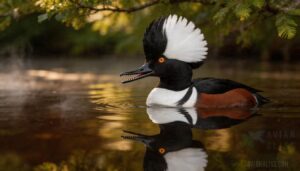
The hooded merganser is one of North America’s most striking small diving ducks, instantly recognizable by its collapsible fan-shaped crest and serrated bill. It belongs to a specialized group of fish-eating ducks built for underwater pursuit rather than dabbling at the surface.
Unlike the compact hooded merganser, Wisconsin’s waterways also host much larger species covered among the water birds of Wisconsin, including the Common Merganser.
Here’s what makes this bird stand apart from the rest.
Species Overview and Defining Traits
The hooded merganser is a compact cavity nester measuring 17 to 20 inches long, built for life on wooded wetlands. Its crest morphology and behavior in mergansers set it apart instantly — that fan-shaped hood raises and flattens on demand.
Males wear bold white-and-black plumage; females lean subtle brown.
Both share serrated bills, amber or brown eyes, and a flight pattern that’s fast and direct.
These traits illustrate shared derived characters that help define species.
Why It is Called a Merganser
The name itself tells the whole story. Merganser traces back to Latin: mergus (diver) and anser (goose) — naming these piscivorous birds by what they do, not just what they look like. That slender bill earned them the Sawbill origin nickname, too.
Here’s what the merganser family name really captures:
- A diving duck lifestyle built around underwater pursuit
- A serrated, slender bill evolved to grip fish
- An aquatic bird diet tied entirely to diving behavior link
How It Differs From Other Diving Ducks
What sets the Hooded Merganser apart isn’t just crest morphology and behavior — it’s the whole package. Compared to the Redbreasted Merganser, it’s noticeably smaller. Unlike the Bufflehead, it favors wooded wetlands over open water.
Its tail stabilization, compact wing morphology, and propulsion mechanics support short, agile dives. Flight maneuverability through forested edges? That’s where this bird truly outperforms its larger relatives.
Quick Facts for First-time Birders
Before you head out with your binoculars, here are a few Field Markers worth knowing. The male’s bold white hood and dark back make identification straightforward. Females show a warm cinnamon crest over gray-brown plumage.
Both favor Habitat Freshwater Wetlands — wooded ponds, beaver swamps, quiet streams. Body length runs 16–19 inches. Seasonal Calls are sharp and distinctive.
Keep your distance for clean looks.
How to Identify a Hooded Merganser
Spotting a hooded merganser for the first time feels like finding a hidden gem on the water. Once you know what to look for, you won’t mistake it for anything else.
Here’s what to focus on when you’re out in the field.
Adult Male Plumage and White Hood
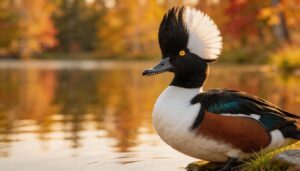
Few birds stop you in your tracks quite like the adult male hooded merganser. That striking white head patch sits bold against black head plumage, bordered by sharp facial mark contrast that draws the eye instantly.
The iridescent black back deepens the effect. Hood’s light reflection can shift the white toward creamy warmth in angled sunlight — a subtle but telling plumage variation worth noting.
Adult Female Plumage and Cinnamon Crest
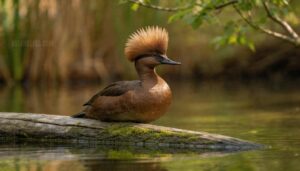
The adult female cuts a quieter figure than her mate. Her body wears dull brown plumage built for vegetation camouflage near dense shoreline cover.
Look closely though — plumage iridescence flickers subtly under bright light. That cinnamon crest gradient fades lighter at the tips, a soft color pattern worth studying.
Facial mask contrast around her dark eyes completes a look shaped by seasonal plumage molt.
Crest Shape, Posture, and Display
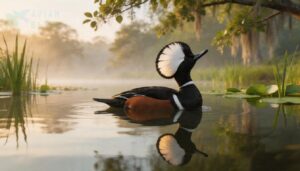
That fan-shaped collapsible crest is one of the hooded merganser’s most vivid field marks. Watch how crest motion patterns shift instantly — raised during courtship display crest moments, flattened during flight.
Posture dynamics matter too: the body stays low while the head lifts high, amplifying the white hood’s crest color contrast.
- Crest morphology and behavior in mergansers shows seasonal crest variation, peaking in spring.
- Movable crest feathers stiffen naturally to hold shape mid-display.
- Display timing favors calm morning water near nesting territories.
Bill Shape, Sawbill Features, and Eye Color
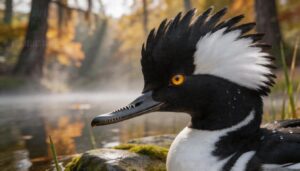
Look closely at that bill — it’s built like a precision tool. The thin straight bill sits at a slight downward angle, with Bill Edge Serrations running most of its length for gripping slippery fish. Bill Length Ratio stays proportionate to body size, roughly 2.5–3.5 cm.
Sexual Bill Dimorphism is subtle: males show dark gray‑black, females orange‑edged. Those amber to yellow eyes — adapted for good underwater vision via a third eyelid — make males unmistakable.
Body Length, Weight, and Wingspan

Measuring 15.8–19.3 inches (40–49 cm) and weighing 16–31 oz (453–879 g), these compact divers pack a lot into a small frame. Sexual size dimorphism is modest but real — males run longer and heavier.
Key morphometrics to note:
- Wingspan: 23.6–26.0 inches (60–66 cm), narrow for quick, agile flight
- Seasonal weight variation peaks pre‑winter as fat reserves build
- Wing loading enables rapid takeoffs from tight, wooded water
Size Comparison With Buffleheads and Other Mergansers
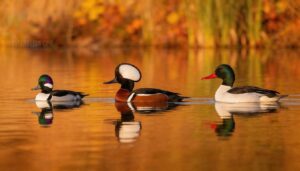
Think of the hooded merganser as the middle child of diving ducks. It sits noticeably larger than the chunky bufflehead — whose 13–15 inch length and stubby bill make the hooded’s overall silhouette and neck length contrast striking — yet smaller than the common merganser at ~25 inches.
Its wingspan of 23.6–26.0 inches and bill length ratio reinforce that mid-tier, agile build.
Where Hooded Mergansers Live

Hooded mergansers aren’t birds you’ll find just anywhere — they’re picky about where they set up shop. Their range stretches across a surprising mix of landscapes, from dense northern forests to coastal wintering grounds.
Here’s a closer look at the specific places you’re most likely to spot them throughout the year.
Breeding Range Across North America
Hooded Mergansers breed across a surprisingly broad stretch of North America — from Alaska and Newfoundland south through Boreal Forest Patches into the Rocky Mountains and beyond.
Western Expansion Trends show populations pushing into newer forested wetlands, while Climate Range Shifts are nudging breeding boundaries northward.
Their Habitat and distribution in North America spans:
- boreal and riparian forests near quiet water
- Elevational Breeding Zones from lowland ponds to mountain lakes
- Pacific coastal forests from Pacific coastal forests Atlantic shorelines
- freshwater marshes and beaver pond complexes
Winter Range in Ponds, Swamps, and Estuaries
When breeding season ends, these birds spread across a surprisingly flexible winter range. You’ll find them on woodland ponds, wooded swamps, and freshwater lakes and ponds — but don’t overlook coastal marshes and brackish estuaries.
Their salinity tolerance and tidal influence adaptation let them work tidal creeks and sheltered bays.
Ice‑edge foraging keeps them active wherever open water remains, with adequate pond depth and swamp vegetation nearby.
Preferred Habitat in Wooded Wetlands
From winter wetlands, it’s worth narrowing your focus to where these ducks truly thrive year-round. Hooded Merganser habitat and distribution centers on forested habitats where three conditions align:
- High Riparian Tree Density, offering cavity nesting opportunities and nest boxes
- Strong Water Clarity for visual hunting
- Emergent Vegetation and Deadwood Structure, creating Edge Habitat Complexity
Wetland habitat with wooded cover is their real home base.
Beaver Ponds, Forest Streams, and Calm Water
Calm water is where the magic happens. Beaver ponds check every box — sediment trapping creates rich, shallow edges packed with fish abundance, crayfish, and insects.
Shade cooling from overhanging trees keeps these forest pond ecosystems productive year‑round.
For duckling safety, there’s no better place.
| Habitat Feature | Why It Matters |
|---|---|
| Beaver pond edges | Concentrates prey, aids diet of merganser |
| Forest stream cover | Cover for predators reduced, safer foraging |
| Calm water surface | Allows precise underwater hunting |
| Wooded shoreline | Aids nesting habits of merganser ducks |
Migration Timing in Eastern and Western Populations
Migration timing follows ice, not the calendar. Eastern birds depart late September through October when wetlands freeze, while western populations shift toward the Pacific Coast waters on a tighter Regional Migration Window.
- Fall Migration: Ice‑Driven Departure triggers movement in northern areas first.
- Spring Arrival Peaks: March–April, aligned with ice breakup.
- Migration Route Overlap: Eastern United States and the Western half of the country share stopover wetland types.
Year-round Resident Areas and Seasonal Movements
Not every Hooded Merganser packs up and leaves when temperatures drop. In milder coastal zones — southern British Columbia, Washington, and temperate stretches of the eastern U.S. — Ice-free Water keeps birds anchored year‑round through Regional Climate Influence and Local Wetland Fidelity.
| Region | Seasonal Status | Key Habitat |
|---|---|---|
| Southern British Columbia | Year-round resident | Wooded ponds, slow streams |
| Eastern U.S. (temperate) | Partial resident | Forested wetlands, swamps |
| Gulf & Atlantic Coast | Winter influx zone | Coastal Estuary Use |
| Great Lakes | Breeding + winter overlap | Open inland lakes |
| Northern Canada | Short-distance Migration only | Beaver ponds, boreal streams |
What Hooded Mergansers Eat

Hooded mergansers are surprisingly selective eaters, and their diet reflects how well-adapted they are to life on the water. What they eat shifts depending on age, season, and whether they’re hunting alone or with company.
Here’s a closer look at exactly what’s on the menu.
Main Diet of Small Fish and Crayfish
The hooded merganser’s feeding ecology and diet center on two things: small fish and crayfish. Its prey detection vision is sharp enough to track quick-moving animals underwater, but only where water clarity is high. Fish size preference leans small — young, slender-bodied fish fit that narrow bill perfectly.
- Dives in shallow, clear water to spot prey by sight
- Targets small fish as the primary diet composition
- Crayfish handling relies on a serrated bill and muscular gizzard
- Crustacean prey shifts based on local freshwater abundance
- Energetic intake ratio favors fish, but crayfish fill gaps seasonally
Aquatic Insects, Mollusks, Tadpoles, and Plants
Fish and crayfish don’t tell the whole story. The feeding ecology and diet of this species runs deeper — aquatic insects as food, mollusks, tadpoles, and even aquatic plant structure all factor in.
Insect emergence timing and tadpole seasonal peaks create real prey availability shifts throughout the year.
Ducklings especially lean on insects early on, making crustacean prey more of an adult staple.
Diving Behavior and Underwater Hunting
Watch a hooded merganser work a clear forest pond, and you’re seeing precision in action. Dive duration averages around 30 seconds — short, focused bursts rather than marathon plunges.
Burst swimming closes the gap fast once prey detection locks on a target. Their eyes, adapted for good underwater vision, make water clarity preference a real factor: murky water isn’t just inconvenient; it’s a hunting disadvantage.
How The Serrated Bill Helps Catch Prey
Think of the bill as a built-in fish trap. Tiny serrations along the edges create grip mechanics that lock onto slippery fish prey, the moment contact is made—no second chances needed.
Prey pinning keeps wriggling crayfish and aquatic insects controlled before swallowing.
The narrow profile cuts water with minimal resistance, while tactile detection guides the bird through murky shallows.
Less fumbling means real energy efficiency per dive.
Duckling Diet Compared With Adult Diet
Ducklings aren’t born ready for fish. Insect-heavy hatchlings spend their first weeks in shallow-water foraging zones, snapping aquatic insects near the surface or just below it.
As diving skill maturation takes hold, prey size progression follows naturally — juveniles shift toward crayfish, then small fish. Fish-focused adults hunt by sight underwater, a feeding ecology shaped entirely by growth, mobility, and experience.
Solitary Feeding Versus Group Foraging
Hooded mergansers aren’t exactly social diners. They’re naturally solitary creatures, preferring to hunt alone where water clarity influences lets them spot prey without competition.
Prey patch selection drives the choice — scattered fish mean one bird per patch. Winter flock dynamics shift things slightly, drawing loose groups to shared open water.
Still, energetic efficiency wins: each bird dives on its own terms.
Breeding, Nesting, and Conservation

Breeding season is when hooded mergansers truly come alive — from flashy courtship displays to the moment tiny ducklings leap from their treetop nests. There’s a lot happening behind the scenes, and knowing what to look for makes every encounter more rewarding.
what you need to know about how they breed, nest, and where their populations stand today.
Courtship Behavior and Crest Displays
When courtship season kicks in by November, male hooded mergansers put on one of waterfowl’s most theatrical shows. The head-throwing display sends the head snapping backward until it nearly touches the back — crest fully fanned — paired with vocal croaking calls that echo across quiet wooded ponds.
Females respond with rapid head-bobbing and hoarse gack calls.
Multi-male competition is common, with several males displaying simultaneously to one female.
Tree Cavity Nests and Nest Box Use
After all that theatrical courtship drama, the real work begins — finding the right home.
Hooded Mergansers are committed cavity nesting birds, using both natural tree hollows and artificial nest boxes. Here’s what shapes their choices:
- Cavity Size Preference — openings around 3–5 inches wide filter out larger competitors
- Dead Tree Retention — snags in wooded wetlands supply critical natural hollows
- Box Placement Strategies — Wood Duck boxes near wetland edges work well
- Material Lining Choices — females add their own down after laying begins
- Predator Deterrence — elevated cavities keep eggs away from ground threats
Nest box usage and cavity nesting go hand in hand with the nesting habits of merganser ducks — and installing artificial nest boxes has genuinely helped populations recover where mature forest was lost.
Nest Height Above Water and Site Selection
Regarding nest site selection, height is everything. Tree cavities sit 10 to 50 feet above the ground — a range that balances predation risk height with duckling safety.
Water proximity importance can’t be overstated; the best nest site is a tree cavity positioned near calm, shallow water.
Artificial nest boxes thrive at 6 to 25 feet, making nest box programs flexible enough to support cavity nesters wherever mature trees are scarce.
Clutch Size, Egg Appearance, and Incubation
Once the nest site is secured, the real work begins.
Most clutches hold 10 to 12 eggs, though 7 to 13 aren’t unusual — clutch size variation depends largely on experience. First-time nesters average 9.6 eggs; repeat breeders push closer to 10.8.
Brood parasitism effects can inflate that number dramatically.
Egg shell thickness sets these nearly spherical white eggs apart.
Incubation timing strategies guarantee synchronous hatching: the female incubates for 26 to 41 days, starting only after the final egg appears.
Duckling Jump, Brood Care, and Fledging
Within 24 hours of hatching, young mergansers leap from nest hole to ground or water below — guided entirely by the female’s calls. Here’s what happens next:
- Nest Departure Timing — Broods leave at dawn to reduce predator exposure.
- Brood Movement Distance — The female leads ducklings up to 1.2 km overland.
- Precocial Diving Skills — Ducklings dive and feed independently almost immediately.
Fledging takes roughly 70 days.
Population Status and Recent Conservation Gains
The hooded merganser’s story is genuinely one of conservation success.
Listed as Least Concern by the IUCN, North American populations have grown roughly 5% annually since 1966 — Canada alone holds about 860,000 breeding birds, representing 78% of the global population.
Regional increases range from +75% along the Pacific Coast to over +1,000% in parts of the southern Prairies.
Nest box programs and community science monitoring through the Breeding Bird Survey and Christmas Bird Count have been central to population growth and habitat protection efforts.
Habitat Loss, Pollution, and Climate-related Threats
That conservation success story has a shadow side, though. Wetland drainage, cavity tree loss, and habitat fragmentation still chip away at breeding and wintering habitat. Chemical bioaccumulation from mercury and PCBs shows up directly in eggs. Climate‑induced drought shrinks feeding ponds, while sea level rise threatens coastal wintering grounds — with projections suggesting a 65% loss of winter range by 2080.
Despite conservation gains, wetland loss and climate change may erase 65% of the hooded merganser’s winter range by 2080
- Clearing mature trees removes irreplaceable nest sites
- Pollution concentrates through aquatic food chains into eggs and adults
- Altered water flow and drought reduce prey‑rich shallow habitat
- Coastal wetland loss tightens winter range considerably
Frequently Asked Questions (FAQs)
What is a hooded merganser?
Meet Lophodytes cucullatus — a compact, sawbill diving duck and North America’s smallest merganser. Its taxonomic placement sits uniquely within diving ducks, recognized instantly by that dramatic, fan-shaped hood.
What does a hooded merganser eat?
Don’t let the fancy crest fool you — this bird’s a carnivore through and through.
Small fish top the menu, with crayfish, aquatic insects, tadpoles, and mollusks rounding out a habitat-driven, seasonally shifting diet.
Where do hooded mergansers live?
You’ll find them in forested wetlands, beaver ponds, and forest pools across North America — from the Great Lakes to the Pacific Northwest, wintering along coastal estuaries and suburban water bodies when northern waters freeze.
Does a hooded merganser have a sawbill?
Like a steak knife built for speed, yes — it does.
That serrated edge function grips slippery fish mid-dive, making it a true sawbill, purpose-built for diving bill efficiency beneath the surface.
Where do hooded mergansers migrate?
Short-distance movement defines their migration. Eastern winter destinations span New England to Florida, while Western winter habitats stretch from Alaska to Baja.
Ice-free wetland reliance drives migration cue factors more than distance.
Are hooded mergansers any good to eat?
Their carnivorous diet of fish gives the meat a mild but noticeable fishy flavor. Younger birds taste milder.
Brining, marinating, or slow braising are your best cooking methods for a decent result.
How rare is a hooded merganser?
Not rare at all — hooded mergansers hold Least Concern IUCN Status, with population estimates reaching 300,000–400,000 birds.
Nest box influence has steadily boosted numbers, though regional monitoring reveals local declines tied to wetland loss.
Are hooded merganser good to eat?
Hooded mergansers are edible, but their fish-heavy diet creates a strong, liver-like flavor profile that surprises many hunters. Careful preparation techniques — brining, smoking, or slow cooking — make a real difference.
What is the difference between a bufflehead and a hooded merganser?
Bigger body, longer bill, raised hood — that’s the hooded merganser. The bufflehead is compact with a rounded white patch.
Size, crest shape, and bill length separate them instantly in the field.
Where can I find a hooded merganser?
You’ll find them at local birding hotspots, state wildlife refuges, and public pond surveys near wooded wetlands.
Check coastal marsh access points, urban park observations, and Great Lakes shorelines along the Mississippi Flyway for reliable sightings.
Conclusion
There’s no duck on the continent that draws attention quite like the hooded merganser—that fanned crest alone could stop time on a quiet winter morning.
Once you know what to look for, every detail clicks: the serrated bill built for pursuit, the hollow tree chosen with care, the dive executed with silent precision.
Spot one, and you won’t just see a duck—you’ll read a landscape the way this bird has for centuries.