This site is supported by our readers. We may earn a commission, at no cost to you, if you purchase through links.
A clean deck and a busy feeder rarely coexist—unless you’re choosing the right food. Most wild bird mixes leave behind a layer of shells, hulls, and filler seed that birds won’t touch, turning your outdoor space into a cleanup job.
No mess bird food for decks solves this by cutting the waste at the source: no hulls to crack, no filler corn to scatter, no sprouting millet pushing through deck boards.
The right blend draws cardinals, finches, and woodpeckers without the aftermath. These eight options deliver exactly that.
Table Of Contents
- Key Takeaways
- Top 8 No-Mess Deck Bird Foods
- Best Ingredients for Clean Decks
- Deck-Friendly Feeder Setups
- Compare Cost and Bird Appeal
- Storage and Cleanup Tips
- Frequently Asked Questions (FAQs)
- How to attract birds to a deck?
- Is there a bird seed that doesn’t make a mess?
- What is the least messy bird food?
- What is the least messy way to feed birds?
- How do you feed birds on a deck?
- How often should I replace old bird seed?
- Which no-mess seeds attract the most bird species?
- Do weather conditions affect no-mess seed performance?
- Are no-mess blends safe for birds year-round?
- Conclusion
Key Takeaways
- Shell-free seeds like sunflower hearts and hulled millet are the real backbone of no-mess feeding — no hulls means no cleanup, plain and simple.
- Fillers like cracked corn, wheat, and milo are the quiet culprits behind a messy deck — birds skip them, and the leftovers just rot.
- Even the cleanest seed blend can still make a mess if your feeder isn’t built right — tube feeders with narrow ports and seed-catch trays cut spillage by up to 70%.
- Storage matters just as much as what’s in the bag — keep seed in an airtight container below 50% humidity and swap it out every 5–7 days to block mold and keep birds coming back.
Top 8 No-Mess Deck Bird Foods
Not all no-mess blends are created equal, and the wrong one will leave your deck looking like a bird exploded on it. These eight options stand out for keeping things clean without skimping on bird appeal.
The difference really comes down to what’s inside—hull-free seed blends that reduce mess and mold can cut debris buildup by nearly half while keeping your backyard visitors genuinely healthy.
Each one brings something different to the feeder, so here’s what you need to know.
1. Kaytee Blueberry Seed Suet Blend

The Kaytee Blueberry Seed & Suet Blend is one of the cleaner options for deck feeding. Every component — seeds and suet nuggets alike — is fully edible, so birds leave nothing behind. No hulls, no greasy residue, no swept-up mess.
The blueberry-flavored suet pulls in woodpeckers and finches, and the 10 lb bag runs about $15.99.
It works with tube, hopper, and platform feeders without clogging.
| Best For | Backyard bird lovers who want more woodpecker visits and zero cleanup mess, especially in smaller outdoor spaces like patios or campsites. |
|---|---|
| Weight | 10 lb |
| Shell-Free | Yes |
| Feeder Compatibility | Tube, hopper, platform |
| Price | $15.99 |
| Attracts Woodpeckers | Yes |
| Allergen Warning | Peanuts, soy |
| Additional Features |
|
- Fully edible seeds and suet nuggets mean no hulls or greasy residue left behind — your feeding area stays clean
- Attracts a solid variety of birds, with field tests showing roughly 2× more birds and 3× more woodpeckers than plain sunflower seed
- Works with tube, hopper, and platform feeders, so no special setup required
- A bit pricier per pound than most standard seed mixes
- Larger pieces can get stuck in feeders with small dispensing holes
- Contains peanuts and soy, which can draw in squirrels and may be a concern for anyone watching what wildlife eats in their yard
2. Kaytee Wild Bird Nut Fruit Blend
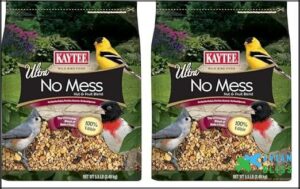
If you want variety beyond suet, the Kaytee Wild Bird Nut Fruit Blend covers a lot of ground. It’s shell-free — featuring hulled sunflower seeds, shelled peanuts, and real dried fruit like cranberries, cherries, and blueberries. This mix attracts cardinals, chickadees, finches, and woodpeckers without leaving hulls scattered across your deck.
The resealable zip-top bag keeps moisture out between fills, ensuring freshness.
Squirrels love it too, so consider using a weight-activated feeder to protect your investment.
| Best For | Bird watchers who want a clean, no-mess feeding setup that draws in a wide variety of backyard birds without dealing with shell cleanup. |
|---|---|
| Weight | 11 lb |
| Shell-Free | Yes |
| Feeder Compatibility | Tube, platform, scatter |
| Price | $19.99 (2-pack) |
| Attracts Woodpeckers | Yes |
| Allergen Warning | None listed |
| Additional Features |
|
- Shell-free blend means no hull mess on your deck or lawn — way less cleanup
- Attracts a solid mix of birds, including cardinals, woodpeckers, finches, and chickadees
- Resealable zip-top bag keeps the blend fresh between fills
- Squirrels and chipmunks love it too, so you may need a critter-proof feeder
- Fine dust and particles can bother allergy-sensitive folks — best to open it outside
- Pricier than basic seed mixes, which adds up if you’re filling feeders often
3. Wagner’s Gourmet Bird Seed Mix
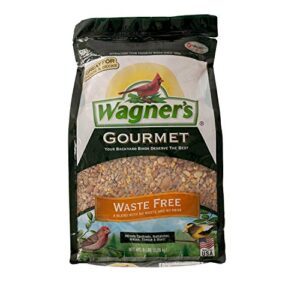
Wagner’s Gourmet Waste Free Wild Bird Food (Model 82056) is a solid step up for those seeking a proven, crowd-tested option. With nearly 4,000 buyers awarding it 4.5 stars, its waste-free design ensures zero hulls piling up on your deck, offering a clean feeding experience.
The sunflower nut blend reliably attracts cardinals, chickadees, jays, and wrens year-round, making it a versatile choice for bird enthusiasts.
Priced at $12.98 for 5 lbs, it costs more than standard mixes. However, its clean feeding payoff justifies the premium, earning it valuable shelf space.
| Best For | Bird lovers who want a clean, no-mess feeding setup on their deck or patio and don’t mind paying a bit more for quality. |
|---|---|
| Weight | 5 lb |
| Shell-Free | Yes |
| Feeder Compatibility | Tube, platform, hopper |
| Price | $12.98 |
| Attracts Woodpeckers | Yes |
| Allergen Warning | None listed |
| Additional Features |
|
- Waste-free formula means no hulls or sprouts making a mess around your feeder
- Draws a solid mix of birds — cardinals, chickadees, jays, wrens, and more, all year long
- High-energy blend of nuts and seeds supports bird health across every season
- Pricier than your average seed mix at $12.98 for 5 lbs
- Larger corn pieces and big peanuts may get ignored by smaller birds like mourning doves
- No best-by or packing date on the bag, so freshness is hard to verify
4. Audubon Park Sunflower Hearts and Chips
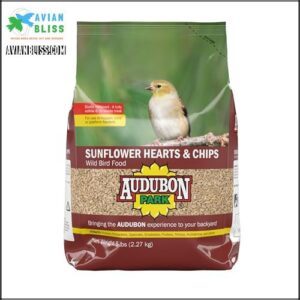
If zero hull waste is your goal, Audubon Park Sunflower Hearts and Chips delivers exactly that. Every seed is fully edible — no shells, no debris, nothing left rotting on your deck boards.
The 5 lb bag runs $12.99 and earns a 4.7-star rating, which says a lot given how picky birders can be. Finches, chickadees, nuthatches, and grosbeaks all show up consistently.
The one trade-off? High consumption means you’ll refill more often than with standard mixes.
| Best For | Backyard birders who want a clean, no-mess feeding setup that attracts a wide variety of birds without dealing with shell cleanup. |
|---|---|
| Weight | 5 lb |
| Shell-Free | Yes |
| Feeder Compatibility | Tube, hopper, platform |
| Price | $12.99 |
| Attracts Woodpeckers | Yes |
| Allergen Warning | Fish, peanuts, soy, tree nuts, wheat |
| Additional Features |
|
- Zero hull waste means no rotting debris on your deck or ground
- Attracts a solid mix of species — finches, chickadees, nuthatches, grosbeaks, and more
- Works in pretty much any feeder type and can be mixed into custom blends
- High consumption rate means more frequent (and costly) refills
- Leaves behind a fine dust and crumb residue that still needs occasional cleaning
- Packaging can tear, which may affect freshness if not stored carefully
5. Kaytee No Mess Seed Suet Bird Food
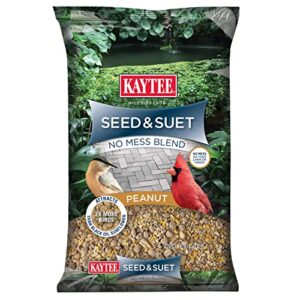
For deck feeders that pull double duty, this 10 lb Kaytee blend pairs hull-free seeds with solid suet nuggets — meaning less debris and more birds. The pre-mixed format eliminates direct handling of greasy suet blocks.
If you’re also feeding finches, pairing this blend with a dedicated setup from a top-rated finch feeder guide ensures the nyjer seed gets to the right beaks without competition.
It claims to attract twice as many birds as black-oil sunflower alone, plus three times the woodpecker visits. At $20.99, this offers solid value for its dual-purpose design.
However, the blend includes filler ingredients like ground corn and oats, which slightly reduce overall energy density.
| Best For | Bird enthusiasts who want more feeder action with less cleanup, especially those targeting woodpeckers and a variety of species. |
|---|---|
| Weight | 10 lb |
| Shell-Free | Yes |
| Feeder Compatibility | Tube, hopper, platform |
| Price | $20.99 |
| Attracts Woodpeckers | Yes |
| Allergen Warning | Beef, peanuts, soy |
| Additional Features |
|
- Hull-free seeds and solid suet nuggets mean barely any mess on the ground or in your feeder
- Pre-mixed blend saves time — no need to handle greasy suet blocks separately
- Pulls in a wide range of birds, with claimed 2x more birds and 3x more woodpeckers than sunflower seed alone
- Filler ingredients like ground corn and oats bring down the overall energy density
- Suet nuggets go fast, so expect to refill more often than you might like
- The 10 lb bag can be a bit much if you have a small feeder or limited storage space
6. Morning Song Sunflower Hearts Bird Seed
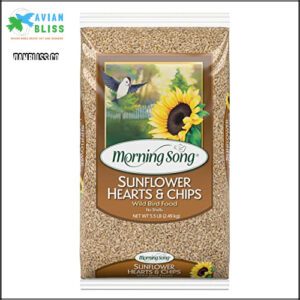
Morning Song Sunflower Hearts keeps things simple — and that’s exactly the point. Each 5.5 lb bag contains only 100% shelled sunflower hearts, so birds get straight to eating without leaving shells behind. Finches, chickadees, and cardinals all show up reliably. At $14.99, you pay a fair price for a genuinely clean feed.
One trade-off: chipped pieces can scatter lightly in wind, so pair this with a seed-catch tray to keep your deck spotless.
| Best For | Backyard bird enthusiasts who want a low-maintenance, no-mess feeding setup that draws in a wide variety of small songbirds. |
|---|---|
| Weight | 5.5 lb |
| Shell-Free | Yes |
| Feeder Compatibility | Tube, hopper, platform, smart |
| Price | $14.99 |
| Attracts Woodpeckers | No |
| Allergen Warning | Fish, peanuts, soy, tree nuts, wheat |
| Additional Features |
|
- No shells means no cleanup — what hits the ground is just seed, not debris.
- Attracts a solid mix of birds (finches, chickadees, cardinals, nuthatches) without any extra effort.
- Works in almost any feeder style — tube, hopper, platform, you name it.
- Chipped seeds can scatter in the wind, so a catch tray helps on breezy days.
- Only sunflower hearts — no nyjer or suet, so it won’t cover every species.
- At 5.5 lbs, a busy feeder will burn through this bag pretty quickly.
7. Kaytee No Mess Bird Seed Blend
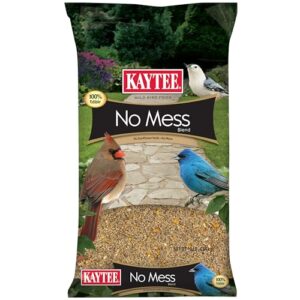
Kaytee No Mess Bird Seed Blend packs a lot into its 10 lb bag, offering hulled sunflower, shelled peanuts, white millet, and cracked corn. These ingredients are shell-free and edible down to the last piece, ensuring minimal waste.
The blend includes calcium carbonate, which promotes bird health year-round, and features a ‘No Grow’ formula to prevent spilled seeds from sprouting weeds under feeders. This combination prioritizes both avian nutrition and feeder cleanliness.
At $12.99, the product is budget-friendly. However, some birds skip the cracked corn entirely, leaving small piles behind, which buyers should note.
| Best For | Backyard bird lovers who want easy cleanup and don’t mind paying a little more for a shell-free, no-sprout seed blend. |
|---|---|
| Weight | 10 lb |
| Shell-Free | Yes |
| Feeder Compatibility | Tube, platform |
| Price | $12.99 |
| Attracts Woodpeckers | Yes |
| Allergen Warning | None listed |
| Additional Features |
|
- No shells means way less mess under your feeder — no hulls piling up on the ground
- The "No Grow" formula keeps spilled seeds from turning your lawn into a weed patch
- Attracts a solid variety of birds, from cardinals and finches to woodpeckers and sparrows
- A bit pricier per pound compared to bulk seed blends you’d find in larger bags
- Many birds ignore the cracked corn, so that portion can go to waste
- "No mess" isn’t totally mess-free — bigger birds like pigeons and doves can still scatter seed around
8. Morning Song Shell Free Bird Seed
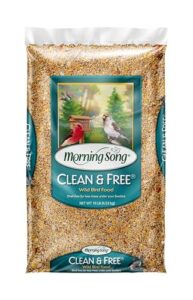
Shell-free doesn’t always mean scatter-free — but Morning Song comes close. This 10-lb blend combines sunflower chips, peanuts, white proso millet, canary seed, and cracked corn, all fully edible with no hulls to pile up beneath your feeder.
At $19.24, it costs more per bag than budget options. However, it draws finches, chickadees, cardinals, and nuthatches reliably.
One trade-off: Some birds skip the red millet, leaving small deposits on your deck surface.
| Best For | Backyard bird watchers who want a clean, no-mess feeding setup that pulls in a wide variety of species without the shell cleanup. |
|---|---|
| Weight | 10 lb |
| Shell-Free | Yes |
| Feeder Compatibility | Tube, tray, hopper, platform, smart |
| Price | $19.24 |
| Attracts Woodpeckers | Yes |
| Allergen Warning | Fish, peanuts, soy, tree nuts, wheat |
| Additional Features |
|
- No hulls means no messy debris piling up under your feeder — great for patios and decks.
- Attracts a solid range of birds including finches, cardinals, chickadees, and nuthatches.
- Works with just about any feeder type, so no need to swap equipment.
- At $19.24 for 10 lbs, it’s pricier than basic blends — adds up fast if you’re refilling often.
- Some birds ignore the red millet, so you’ll still find a little seed scattered on the ground.
- Contains peanuts and tree nuts, which could be a concern if anyone in your household has nut allergies.
Best Ingredients for Clean Decks
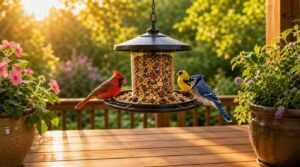
What goes into your bird food matters just as much as where you put the feeder. The right ingredients mean less mess underfoot and more of the birds you actually want to see.
Here’s what to look for — and what to skip.
Sunflower Hearts and Chips
Sunflower hearts are the backbone of no-mess bird foods for a reason. Hull-free and packed with linoleic acid and vitamin E, they support feather health and immune function.
Chips offer a low-mess particle size that small-beaked birds, like finches, handle easily. Both forms deliver serious winter energy and keep your feeding area clean.
These chips provide a high-energy bird food source.
Shelled Peanuts and Tree Nuts
Shelled peanuts punch above their weight — roughly 160 calories and 14 grams of healthy fats per ounce, with zero shell debris landing on your deck. Their nutrient density and high energy content pull woodpeckers straight to your feeder, especially in winter.
Shelled peanuts deliver 160 calories per ounce with zero shell debris — maximum energy, minimum mess
- Shelled peanuts leave no hulls behind
- TreeNutty Plus Blend combines nuts and dried fruit for broad bird attraction
- Nut and fruit blends target cardinals and woodpeckers
- High fat content meets cold-weather energy needs
- Allergy safety matters — check labels when buying mixed no-mess bird foods
Hulled Millet for Small Birds
Nuts bring the big birds — but hulled millet pulls in the small ones just as reliably. Finches and sparrows can’t resist it, and since it’s prehulled, mess-free feeding becomes automatic. No scattered hulls mean better deck cleanliness without extra effort.
| Benefit | Detail | Impact |
|---|---|---|
| Feather Health | B vitamins (B1, B3) | Aids molt cycles |
| Metabolic Support | 11–13% protein | Sustains daily activity |
| Winter Energy | Fast-digesting carbs | Fuels cold-weather foraging |
Use hulled millet in a custom blend design alongside sunflower hearts. Foraging stimulation stays high, and small birds work through every seed.
Fruit Blends for Variety
Small birds love millet — but fruit blends bring genuine variety to your deck setup. Wild Delight Nut N Berry Bird Food mixes dried fruit with a fruit and calcium blend that draws cardinals and finches consistently.
- Tropical flavor combos attract orioles and waxwings
- Citrus preservation tricks slow spoilage naturally
- Vitamin-rich pairings support bird health year-round
- Texture contrast ideas and color aroma balance reduce boredom at feeders
No-mess bird foods with fruit keep deck cleanliness intact.
Fillers to Avoid
Fruit blends add life to your setup — but the wrong fillers quietly undo all that work. Corn byproducts, wheat and milo, and low-calorie fillers rarely get eaten. You end up with a deck covered in empty hulls and rotting debris instead of happy birds.
| Filler | Problem | Better Swap |
|---|---|---|
| Corn Byproducts | Ignored by most songbirds | Sunflower hearts |
| Wheat & Milo | Creates scatter and sprouts | Shell-free seeds |
| Artificial Colorants | Attracts pests, zero nutrition | Natural nut blends |
| Safflower Hulls | Leaves cracked seeds behind | Hulled millet |
No-mess bird foods skip these entirely.
Deck-Friendly Feeder Setups
The right feeder makes a bigger difference than most people expect. Even the cleanest seed blend can leave a mess if your feeder isn’t built to contain it.
Here are five deck-friendly setups worth knowing about.
Tube Feeders for Less Waste
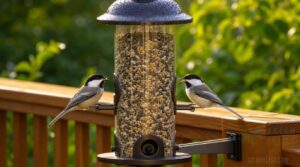
Tube feeders are your best defense against a messy deck. Narrow Port Design keeps seeds channeled directly to birds, cutting spillage by up to 70%. Transparent Tube Walls let you check seed levels at a glance — no guessing, no overfilling.
Key design features that support clean feeding area maintenance:
- Anti-Clog Ribbing prevents seed bridging in humid conditions
- Weatherproof Caps block rain and reduce clumping in no-mess bird foods
- Weight-Activated Deterrent closes the feeder when squirrels climb on
- Integrated drip guards catch stray fragments before they hit your deck
Smart bird feeder design means less cleanup, period.
Hopper Feeders With Trays
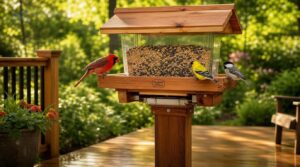
Hopper feeders with trays give you a clean feeding area without constant sweeping. The seed tray catch-all sits right below the dispensing opening, catching stray seed before it hits your deck boards.
| Feature | What It Does | Why It Matters |
|---|---|---|
| UV‑Resistant Plastics | Prevents cracking in sun | Longer feeder lifespan |
| Gasket Sealing | Keeps moisture out | Fresher no-mess bird foods |
| Drainage Features | Clears rainwater fast | Stops mold buildup |
The weight-activated shutter closes when squirrels climb on, providing solid prevention of seed spillage. Tray material choices range from coated metal to weatherproof resin, both supporting smart bird feeder design that actually works.
Mesh Feeders for Nuts
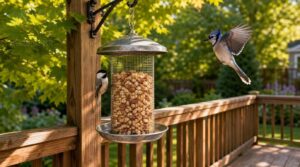
Mesh feeders handle nuts in a way tube and hopper designs simply can’t match. The mesh aperture controls nut size compatibility, allowing only pieces between 3–12mm to pass through — keeping your deck free from shell debris and staining. Corrosion-resistant hardware ensures durability through rain and cold without rusting onto boards.
- Metal mesh holds shelled peanuts and tree nuts securely
- Perch stability lets chickadees and blue jays cling and feed cleanly
- Feeder mesh size limits large nut chunks from dropping through
- Seasonal cleaning prevents mold buildup inside the mesh weave
Pair mesh feeders with no-mess bird foods and shell-free formulations to reduce nut consumption waste and eliminate deck staining from seeds entirely.
Seed Catchers and Trays
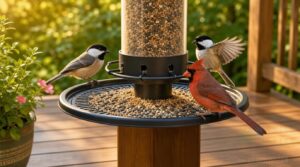
A seed tray catchall might be the simplest upgrade your deck setup is missing. Snap-on trays with adjustable rims redirect dropped seed back toward the feeder, effectively cutting the work of preventing seed spillage in half. Key features to prioritize include an anti-skid base, drainage design to avoid pooling, and material durability through wet seasons.
Easy cleaning ensures your no-mess formula keeps working, maintaining a smooth clean patio maintenance routine. This practical addition preserves both your outdoor space and feeding efficiency.
Squirrel-proof Feeder Features
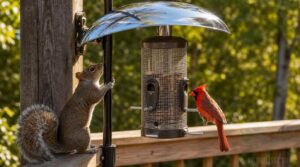
Squirrels will raid your feeder fast — and every stolen kernel breaks your no mess formula. Weight-Activated Perches shut seed ports when anything heavier than a cardinal steps on.
Caged Access Ports block larger animals entirely.
Baffle Shield Systems add another layer, and Chew-Resistant Construction keeps things intact.
Quick-Release Cleaning makes maintenance easy, keeping your squirrel-proof feeders working without interruption.
Compare Cost and Bird Appeal
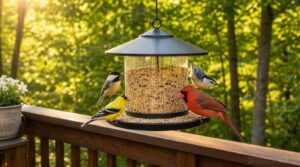
Not all no-mess blends are priced the same, and the difference shows up fast at the feeder.
Some birds are picky about what they’ll eat, which means the wrong blend wastes both seed and money.
Here’s how the top options stack up across cost, species appeal, and seasonal value.
Price Per Pound
No-mess bird foods typically cost $2–$5 per pound, but these prices fluctuate quickly. Bulk purchases significantly reduce the per-pound rate, making larger bags more economical.
Watch for Seasonal Discount Impact—savings of 5–20% off aren’t uncommon. Additionally, Retail Price Variance means prices often differ between online and in-store purchases.
Factors like Packaging Cost Influence and Ingredient Cost Breakdown—especially when nuts or shells are removed—also drive prices higher.
Premium Versus Budget Blends
Premium blends win on Ingredient Sourcing, Particle Uniformity, and Aroma Consistency — meaning less seed spillage, requiring less prevention work for you. They’re no mess bird foods with better Packaging Integrity and longer Shelf Life.
A budget-friendly mix costs less upfront but sheds more chaff, forcing your clean yard to pay the price.
Premium blends deliver steadier bird traffic with fewer trade-offs.
Best Foods for Finches
Finches are picky little birds — and honestly, that works in your favor. They thrive on Nyjer seed benefits like high fat and quick energy, making NoMess Blends a natural fit for tidy feeding stations.
Adding seasonal seed variations, fresh produce additions, or egg protein snacks occasionally enhances their diet. Calcium supplementation via cuttlebone keeps them healthy, ensuring balanced nutrition.
A Squirrel Buster Finch feeder locks in no-mess bird foods with zero drama, maintaining a clean and efficient feeding environment.
Best Foods for Cardinals
Cardinals aren’t as fussy as finches, but they do have strong preferences. They go straight for sunflower hearts and high-oil content seeds — both staples in quality No-Mess Blends. Toss in red fruit bites like blueberries or safflower, and you’ll keep them coming back.
High-fat suet and seasonal seed swaps round things out, cutting seed spillage prevention headaches while boosting visits.
Winter Feeding Value
Cold weather changes everything. Birds burn through energy fast, so energy density matters more than price.
A nutrient-dense seed mix reduces feeding frequency because birds get more from every visit.
- High-fat suet enhances weather resilience overnight
- Sunflower hearts boost nutrient retention through freeze-thaw cycles
- Shelled peanuts deliver winter bird nutrition without shell waste
- No-mess birdseed prevents deck durability concerns from husk buildup
- High-energy protein-rich mixes offer real seasonal savings long-term
Storage and Cleanup Tips
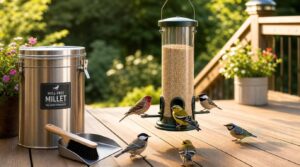
Good seed doesn’t stay good forever, and a messy deck can undo all the effort you’ve put into clean feeding.
How you store your blend and maintain your space matters just as much as what’s in the bag.
Here’s what actually works.
Use Airtight Seed Containers
Your seed storage setup matters more than most people realize. Use airtight containers with a rubber or silicone gasket — regularly check the seal, as cracked gaskets invite moisture and pests.
For material choice, UV-resistant or borosilicate glass offers robust light protection. Tuck in a desiccant pack to control moisture and extend shelf life.
Stackable organization optimizes storage space, while resealable packaging ensures debris-free feeding and peak freshness.
Keep Seed Cool and Dry
Temperature Control and Humidity Regulation are critical for maintaining shelf-stable bird food. Store seed between 2°C and 10°C—a basement or fridge drawer works well. Avoid temperature fluctuations to preserve freshness.
Target humidity under 50 percent and incorporate reliable Desiccant Use and Moisture Monitoring. Tuck in a desiccant pack to absorb excess moisture, particularly in damp environments.
Light Exclusion is equally vital; avoid sunny shelves to prevent nutrient degradation. Humid areas cause seed to sprout rapidly, significantly cutting shelf life. Prioritize cool, dark, and dry storage for optimal longevity.
Avoid Overfilling Feeders
Overfilling is one of the easiest ways to undo all your no-mess birdseed efforts. Good Portion Control means leaving an air gap at the top — just an inch — so seeds don’t clump or spill at the first gust.
- Match Refill Frequency to daily bird traffic, not habit
- Apply Weather Adjusted Fill on rainy or windy days
- Respect Feeder Capacity Limits printed on the feeder
- Use a funnel for precise fills and better feeder anti-spill design
- Small, frequent refills improve feeder hygiene and support cost versus cleanliness balance, cutting seed waste reduction losses fast
Sweep Decks Regularly
Even a well-chosen no-mess wild bird seed blend leaves fine debris behind. That’s why sweep frequency matters — every 2–3 days keeps your feeding area tidy and protects deck boards from seed oil stains.
| Task | How Often |
|---|---|
| Full deck sweep | Every 2–3 days |
| Corner and rail cleanup | Weekly |
| Post-storm bird feeding cleanup | Same-day |
Use an 18–24-inch push broom for proper technique and faster coverage. Broom maintenance — cleaning bristles weekly — keeps your de-cluttered outdoor space truly mess-free. Wear closed-toe shoes for basic safety gear. Good debris disposal means bagging husks and disposing of them away from plants.
Prevent Mold and Pests
Mold doesn’t need much—a damp corner and a few stray seeds are all it takes. Clean spills within 30 minutes, tuck desiccant packs near your feeder station for moisture monitoring, and ensure proper deck ventilation and routine leak repairs. These steps help your no-mess wild bird seed blend stay fresh longer.
- Squirrel deterrent measures keep shells off damp boards
- Sprouting seed prevention starts with hull-free blends
- Dry storage cuts mold risk by removing moisture at the source
Seal gaps to prevent pests, follow a deck maintenance schedule, and you’ll stop insect infestations before they start.
Frequently Asked Questions (FAQs)
How to attract birds to a deck?
Place a water feature, seasonal plantings, and decorative perches on your deck. Add nesting boxes and bird‑friendly lighting to signal safety.
These simple steps boost bird attraction rates before you ever set out seed.
Is there a bird seed that doesn’t make a mess?
Yes — shell-free formulations like sunflower hearts and hulled millet leave no husks behind. These nutrient-rich mixes mean cleaner decks, less sweeping, and more birds showing up consistently.
What is the least messy bird food?
Shell‑free blends and pelleted mixes leave almost nothing behind. Pure kernel blends, pre‑roasted nuts, and hydrophobic suet cakes give birds everything edible — so your decks stay genuinely clean.
What is the least messy way to feed birds?
Use hulled, shell-free seeds, pair them with a tube feeder, and set a maintenance schedule. Smart feeder placement and material choice cut debris fast — that’s mess-free bird feeding simplified.
How do you feed birds on a deck?
Mount your feeder at least 5 feet high, point openings away from prevailing winds, and set a maintenance schedule for decks every two to three days to keep things clean.
How often should I replace old bird seed?
Think of fresh seed as a short lease — it expires fast. Replace dry seed every 5–7 days normally, or every 2–3 days in humid conditions to block mold and maintain freshness.
Which no-mess seeds attract the most bird species?
Sunflower hearts deliver the widest multi-species draw — cardinals, finches, chickadees, and nuthatches all respond to these energy-rich kernels.
A no mess wild bird seed blend with shell-free seeds and high-fat seeds covers nearly every regular backyard visitor.
Do weather conditions affect no-mess seed performance?
Yes, weather affects no-mess seed performance. Humidity above 70% clumps shelled seeds, wind scatters lightweight kernels, and rain runoff accelerates seasonal mold.
Store seed blends in airtight containers to protect shelf life.
Are no-mess blends safe for birds year-round?
Like a well-stocked pantry, no-mess blends support avian nutrition year-round. Their no-waste formula, nutrient-dense seed mix, and calcium support promote digestive health while minimizing aflatoxin risk.
Proper storage ensures optimal shelf life, preserving the blend’s quality and safety.
Conclusion
A clean deck is quiet proof that small choices matter. When you switch to no-mess bird food for decks, you’re not just cutting cleanup—you’re removing every barrier between your space and the birds worth watching.
No cracked shells. No filler corn. No sprouting mess. Just cardinals at the feeder and finches working through sunflower hearts. That’s the whole trade.
Make it once, and your deck stops being a chore and starts being a front-row seat.