This site is supported by our readers. We may earn a commission, at no cost to you, if you purchase through links.
You hang a feeder full of premium sunflower seed, and two weeks later it’s still full. Meanwhile your neighbor’s yard sounds like a chickadee convention. The difference usually isn’t luck or location—it’s the feeder itself.
Squirrels raid open trays, rain turns cheap seed to mush, and the wrong port size shuts finches out entirely. Birds notice these details even when we don’t. Knowing what to look for in a bird feeder—the ports, the drainage, the build—determines whether you’re feeding songbirds or just restocking a squirrel buffet.
Get the fundamentals right, and the right species start showing up on schedule.
Table Of Contents
- Key Takeaways
- Match Feeders to Birds and Food
- Compare Bird Feeder Types
- Top 10 Bird Feeders to Consider
- 1. Woodlink Large Premier Bird Feeder
- 2. Woodlink cedar platform bird feeder
- 3. Woodlink Audubon Dome Top Seed Feeder
- 4. Droll Yankees Classic Sunflower Bird Feeder
- 5. Aspects 392 Medium Seed Tube Feeder
- 6. Aspects Round Seed Tray 8.5 Inch Diameter
- 7. Pine Tree Farms Peanut Butter Suet
- 8. Pine Tree Farms Peanut Suet Plugs 12 Pack
- 9. Songbird Essentials Whole Peanut Wreath Feeder
- 10. More Birds Blue Dish Bird Feeder
- Check Materials and Protective Features
- Evaluate Placement and Maintenance Needs
- Frequently Asked Questions (FAQs)
- What is the 5 7 9 rule for bird feeders?
- Why put a potato in your bird feeder?
- What to know before buying a bird feeder?
- How to pick a good bird feeder?
- How often should I clean my bird feeder?
- Where should I place feeders near windows?
- How do I keep squirrels off feeders?
- Whats the best height for hanging feeders?
- How many feeders should my yard have?
- Conclusion
Key Takeaways
- Match your feeder and seed to the birds you actually want—black oil sunflower works for most species, but nyjer needs tiny ports for finches only, and suet/peanut blends draw insect-eaters.
- Squirrel-proofing makes or breaks a feeder, so look for weight-activated ports that close under 4 ounces, plus a pole baffle set 4-5 feet up and 18+ inches wide.
- Drainage and easy cleaning matter as much as capacity—non-porous materials like polycarbonate or metal resist mold, and you should scrub feeders every 1-2 weeks with a diluted bleach solution.
- Placement prevents disasters: keep feeders within 3 feet or beyond 10 feet from windows to stop collisions, and give birds open sight lines with cover 10-15 feet away for quick escapes.
Match Feeders to Birds and Food
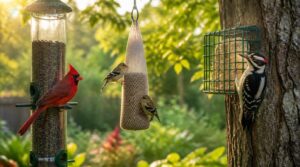
Not every bird wants the same setup, and that’s where most beginners get stuck. Cardinals, finches, and woodpeckers each have their own preferences for seed, space, and season. Here’s how to line up your feeder choices with the birds you actually want to see.
For a deeper dive into pairing each species with the right setup, this guide to choosing the best feeder types for backyard birds breaks down tube, hopper, and suet options in detail.
Identify Your Target Bird Species
Cardinals or chickadees? Your yard decides. Watch what’s already around: observe bird behavior, note physical traits, track seasonal patterns, and record feeding times over several days.
- Deciduous woods favor chickadees and nuthatches
- Open meadows draw finches and sparrows
- Water proximity attracts orioles
Confirm species presence before buying gear — matching feeders to actual visitors beats guessing every time.
Choose Compatible Seed Types
Once you know your visitors, match the seed. Black oil sunflower seeds suit almost any species, thanks to thin husks. Nyjer needs tiny ports for finches only. Suet and peanut blends feed insect-eaters — keep them dry. Sunflower chips cut waste since birds skip the shells. Store extra seed cool, dry, and sealed.
Consider Seasonal Feeding Needs
Storage sealed and stocked, but the calendar still matters. Birds need roughly 20% more energy once temperatures drop below freezing, so winter calls for sunflower and suet. Spring shifts toward protein for feather growth. Summer birds drink more than they eat. Rotate stock each autumn as natural seed dwindles.
Five seasonal swaps worth making:
- Winter fat boost
- Spring protein rise
- Summer hydration
- Autumn seed rotation
- Emergency weather backup
Observing behavioral changes helps identify seasonal nutritional needs early. Behavioral observation early is a key strategy for adapting feeding practices throughout the year.
Balance Capacity and Seed Waste
Rotating seed with the seasons helps, but a feeder that holds too much invites waste. Match capacity to visits: small yards do fine with 1–2 day supplies. Bigger flocks need portioned trays, not one giant reservoir. Tight ports and drift guards cut spillage, so less seed ends up moldy on the ground.
Support Bird Nutrition
Feeding birds well means more than dumping seed in a tray. Pair black oil sunflower seed with fresh water changed daily, plus occasional vitamin-rich fruit or calcium sources for laying females.
Dietary variety matters — feeder variety and rotating seed types keep nutrition balanced.
Skip pellet-only diets; wild birds thrive on energy-rich food matched to season and species.
Compare Bird Feeder Types
Once you know which birds and seeds you’re after, the feeder style itself makes or breaks your setup. Each design solves a different problem, from keeping seed dry to blocking out squirrels entirely. Here’s how the five main types stack up against each other.
Hopper Feeders
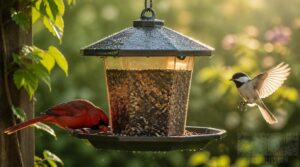
Think of a hopper feeder as a bird’s pantry: gravity does the work, feeding seed steadily into the tray below.
Look for a weather-resistant polycarbonate or coated-metal body, a translucent reservoir for checking levels, and a shallow base tray for metered dispensing.
Snap-on lids and removable trays make refills fast and keep seed dry between fill-ups.
Tube and Nyjer Feeders
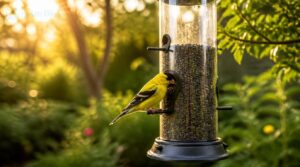
A vertical pantry, that’s a tube feeder: seed drops downward through 6 to 20 ports as birds empty each level.
Nyjer versions shrink those ports for tiny finch beaks. Look for:
- Polycarbonate housing (UV-resistant)
- Clear reservoir for seed monitoring
- Short perches blocking larger birds
- Removable base for easy cleaning
- Squirrelproof weight-activated ports
Platform and Tray Feeders
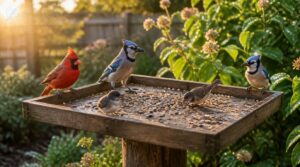
Ground zero for backyard birding — that’s a platform feeder, a flat, open tray drawing cardinals, jays, and juncos that tube feeders shut out.
Look for overflow guards, drainage holes, and weather-resistant coatings. Removable trays make cleaning simple.
| Feature | Benefit |
|---|---|
| Raised edges | Prevents spillage |
| Drainage holes | Stops waterlogging |
| Removable tray | Easy cleaning |
Suet and Peanut Feeders
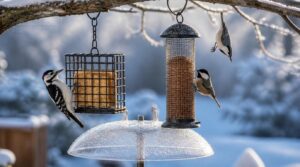
Winter fuel comes in cages, not trays. Suet feeders hold rendered fat cakes; peanut feeders offer shelled nuts. Both draw woodpeckers, chickadees, and nuthatches.
- Choose powder-coated, rust-resistant mesh
- Look for squirrel-proof feeders with weight-activated closures
- Store peanuts cool and dry, discard moldy suet
Clean every 1–2 weeks with mild soap.
Window and Nectar Feeders
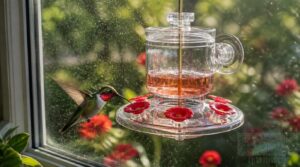
Six inches from your nose beats sixty feet through binoculars. A window feeder sticks straight to glass, giving you eye-level views of nectar feeders in action.
Look for Nectar Port Design with 2–4 ports, 2–6 oz reservoir capacity, and built-in ant moats.
| Feature | Why It Matters |
|---|---|
| Suction mount | Mounting security |
| Ant moat | Nectar freshness |
| Clear tank | Easy feeder cleaning |
Top 10 Bird Feeders to Consider
You know the types now, so let’s get specific. Below are ten feeders that hold up season after season, covering everything from hopper-style workhorses to suet stations for woodpeckers. Each one earns its spot for a reason, and you’ll see exactly why as we go.
1. Woodlink Large Premier Bird Feeder
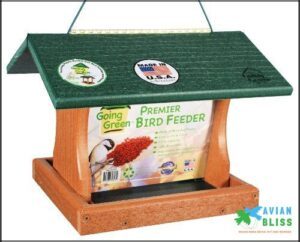
Cedar wood gives this feeder real staying power outdoors, and the nickel plated perching grid lets several birds feed at once. A clear splash guard keeps seed dry while you still see who’s visiting.
Capacity tops out at 2 pounds, with a wide, raised-edge tray cutting down on ground waste. The squirrel-resistant cap blocks surface nibbling, and stainless screws won’t rust.
At 9-10 inches tall, it mounts on walls, railings, or hangs from the included hook — flexible setup for almost any yard.
| Best For | This feeder is best for bird lovers who want a durable, eco-friendly option that can handle multiple birds feeding at once with minimal upkeep. |
|---|---|
| Material | Metal & Plastic |
| Weather Resistance | Yes |
| Easy Cleaning | Hinged roof |
| Bird Variety Attracted | Multiple species |
| Mounting Style | Hanging cable |
| Model Number | GGPRO1 |
| Additional Features |
|
- Made with up to 90% recycled plastic for an eco-conscious choice
- Ranch-style trough lets several birds feed together comfortably
- Hinged roof and metal screen bottom make cleaning and drainage simple
- Requires manual cleaning through the hinged roof
- Large size may need a sturdy support to handle heavy seed loads
- Holds only 5.5 pounds of seed, meaning more frequent refills for high-traffic feeding areas
2. Woodlink cedar platform bird feeder
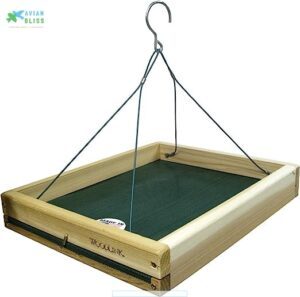
If the Leading feeder’s grid system feels like too much engineering, this one strips things back to basics — a wide-open tray, no frills.
Kiln dried inland red cedar controls weather without warping, and the powder coated metal screen bottom drains fast so seed doesn’t pool and rot.
Screws hold it together for the long haul. Set it up hanging, post-mounted, or right on the ground — mounting hardware sold separately, so grab that first.
| Best For | Backyard bird enthusiasts who want a simple, no-fuss platform feeder that welcomes a wide variety of mixed-seed-loving bird species. |
|---|---|
| Material | Cedar & Metal |
| Weather Resistance | Yes |
| Easy Cleaning | Screwed construction |
| Bird Variety Attracted | Mixed seed birds |
| Mounting Style | Hang or post |
| Model Number | PLAT2 |
| Additional Features |
|
- Kiln dried inland red cedar resists warping and holds up to the weather
- Powder coated metal screen bottom drains quickly, keeping seed dry and fresh
- Flexible setup — hang it, mount it on a post, or place it right on the ground
- Mounting hardware isn’t included, so you’ll need to buy it separately
- Open tray design offers less protection from squirrels and larger birds than enclosed feeders
- Holds up to 3 pounds of seed, which may mean more frequent refills for busy feeding stations
3. Woodlink Audubon Dome Top Seed Feeder
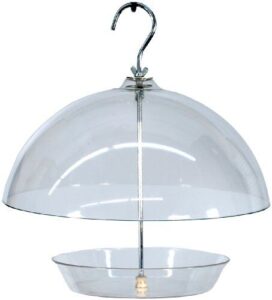
Want something you can actually see through? The Audubon Dome Top swaps cedar for clear polycarbonate, UV-resistant so it won’t yellow or fog with age.
That dome shields seed from rain and snow, while the wide tray holds enough sunflower or mixed seed for a busy morning rush. Multiple ports let several birds feed at once, with perches spaced to cut crowding.
One catch — the threaded collar cracks under stress, so tighten it often.
| Best For | Backyard bird watchers who want a clear-view feeder that attracts bluebirds, cardinals, and other small birds while offering a front-row seat to feeding activity. |
|---|---|
| Material | Polycarbonate |
| Weather Resistance | Yes |
| Easy Cleaning | Removable tray |
| Bird Variety Attracted | Bluebirds, cardinals |
| Mounting Style | Standard hook |
| Model Number | N/A |
| Additional Features |
|
- Clear UV-resistant polycarbonate lets you watch birds feed without yellowing or fogging over time
- Dome cover keeps seed dry through rain and snow
- Multiple feeding ports with spaced perches let several birds eat at once with less crowding
- Threaded collar is prone to cracking and needs frequent tightening
- Not squirrel-proof, so squirrels can still climb up and raid the seed
- Metal parts may rust quickly if not maintained in damp weather
4. Droll Yankees Classic Sunflower Bird Feeder
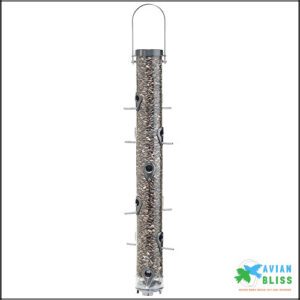
If cracks worry you, go classic instead. The Droll Yankees Classic Sunflower feeder skips the dome for a straightforward tube design — UV-stabilized polycarbonate, zinc-plated metal caps and ports, built to shrug off rust and sun fade for years.
Twelve ports spread across 30 inches give birds room to spread out, no elbowing at the buffet. A ring-pull mechanism lets you strip it down to bare parts for cleaning, no tools, no fuss — just pull and rinse.
| Best For | Bird lovers who want a simple, no-fuss feeder that attracts a wide variety of birds while standing up to years of outdoor wear. |
|---|---|
| Material | Polycarbonate & Steel |
| Weather Resistance | Yes |
| Easy Cleaning | Threaded base |
| Bird Variety Attracted | Goldfinches, others |
| Mounting Style | Hanging wire |
| Model Number | DROB72 |
| Additional Features |
|
- Large 4-pound capacity means fewer trips outside to refill
- 12 feeding ports let plenty of birds feed at once without crowding
- Ring-pull design makes cleaning quick and tool-free
- Base may leak seed unless you add the optional tray or plug
- Perches can be tough to install and sometimes need extra force
- Lid can be stiff and hard to lift when filling
5. Aspects 392 Medium Seed Tube Feeder
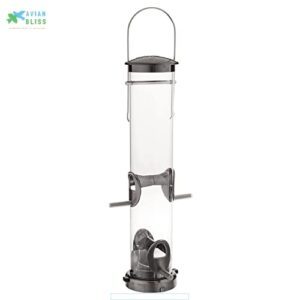
Eight ports and 1.25 quarts of capacity make this Aspects model a solid mid-size pick. The quick-clean removable base slides out by squeezing side tabs — no full teardown needed, even with a seed tray attached.
Die-cast metal caps and base pair with the polycarbonate tube for real durability against squirrel gnawing. That built-in seed deflector cuts waste, pushing seed toward the ports instead of letting it pile up uselessly at the bottom.
| Best For | Backyard birders who want a durable, easy-to-clean feeder that welcomes chickadees, cardinals, and woodpeckers without a hassle. |
|---|---|
| Material | Die-cast Metal & Polycarbonate |
| Weather Resistance | Yes |
| Easy Cleaning | Tool-free disassembly |
| Bird Variety Attracted | Chickadees, cardinals |
| Mounting Style | Hanging |
| Model Number | 392 |
| Additional Features |
|
- Die-cast metal caps and base with a UV-stabilized polycarbonate tube stand up to squirrels and rough weather
- Quick-clean removable base pops out tool-free for fast, thorough cleaning
- Built-in seed deflector cuts waste by guiding seed toward the feeding ports
- Doesn’t deter grackles, thanks to the perch size and station design
- Plastic perch covers can wear down or come loose with heavy bird activity
- Medium capacity means more frequent refills in busy feeding spots
6. Aspects Round Seed Tray 8.5 Inch Diameter
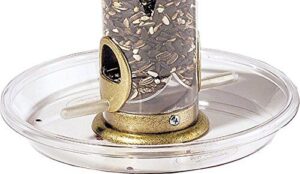
A simple upgrade turns any nyjer feeder into a magnet for bigger birds. This clear polycarbonate tray measures 8.5 inches across and screws onto Aspects feeders with a 2.75-inch base — no tools, no fuss.
Cardinals and blue jays get extra perching space they wouldn’t otherwise have, while spilled shells land on the tray instead of your lawn. It’s removable for quick cleaning, though drain holes can clog if you skip regular maintenance.
| Best For | Backyard birders who want to attract larger species like cardinals and blue jays to their nyjer feeder while keeping spilled seed off the lawn. |
|---|---|
| Material | Polycarbonate |
| Weather Resistance | Yes |
| Easy Cleaning | Removable tray |
| Bird Variety Attracted | Cardinals, bluejays |
| Mounting Style | Attaches to feeder |
| Model Number | 179121 |
| Additional Features |
|
- Attaches to compatible Aspects feeders in seconds with no tools required
- Creates extra perching room, drawing in bigger birds that can’t use the feeder ports alone
- Pops off easily for quick cleaning and keeps shell debris contained
- Doesn’t come with mounting hardware, so you may need zip ties for other feeder brands
- Drain holes can clog over time, leading to water pooling if not checked regularly
- Some birds, like mourning doves, may just perch and snack straight from the tray instead of the feeder itself
7. Pine Tree Farms Peanut Butter Suet
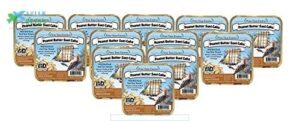
When woodpeckers and chickadees need a fat boost, this cake delivers. Rendered beef suet blends with peanut butter and chopped peanuts, packing dense calories into a 12-ounce square built for standard suet cages.
The 5 x 5 x 1-inch profile fits most feeders without trimming, and the formula works year-round, not just in winter cold snaps. It ships in bulk cases of twelve, so stocking up saves trips to the store — just keep cakes shaded so they don’t soften fast.
| Best For | Backyard bird enthusiasts who want to attract woodpeckers, chickadees, and other high-energy species year-round. |
|---|---|
| Material | Suet Blend |
| Weather Resistance | Year-round formula |
| Easy Cleaning | N/A |
| Bird Variety Attracted | Various birds |
| Mounting Style | Feeder required |
| Model Number | 1110 |
| Additional Features |
|
- Rich blend of rendered beef suet, peanut butter, and chopped peanuts for dense, high-energy nutrition
- Standard 5 x 5 x 1-inch size fits most suet feeders without any trimming needed
- Suitable for all bird life stages and works in every season, not just winter
- Suet feeder is not included and must be purchased separately
- Only sold in bulk cases of twelve, which may be more than casual feeders need
- Needs to be hung at least 5 feet off the ground and kept shaded so it doesn’t soften too quickly
8. Pine Tree Farms Peanut Suet Plugs 12 Pack
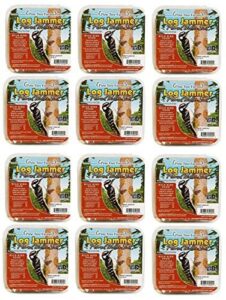
Own a Log Jammer feeder? These plugs are the refill made for it. Each 3.1-oz plug measures 1.125" x 4.25", sliding right into the feeder’s cylinder — no crumbling mess like loose suet cakes.
The mix peanuts, peanut butter, cracked corn, and sunflower hearts with rendered beef suet, giving woodpeckers, nuthatches, and titmice a calorie-dense snack. A 12-pack yields 36 plugs, so you won’t be restocking constantly. Just note: it only fits Log Jammer-style feeders.
| Best For | Bird enthusiasts who own a Pine Tree Farms Log Jammer feeder and want a mess-free, high-energy suet option for attracting woodpeckers, chickadees, and other backyard birds during colder months. |
|---|---|
| Material | Suet Blend |
| Weather Resistance | Year-round formula |
| Easy Cleaning | N/A |
| Bird Variety Attracted | Woodpeckers, chickadees |
| Mounting Style | Feeder required |
| Model Number | 5002 |
| Additional Features |
|
- Slides directly into Log Jammer feeders with no crumbling mess like loose suet cakes
- Calorie-dense mix of peanuts, peanut butter, cracked corn, and sunflower hearts attracts a wide variety of birds
- 12-pack yields 36 plugs, so you won’t need to restock often
- Only fits Log Jammer-style feeders, so you’ll need that specific feeder to use them
- Some users report inconsistent texture, with plugs crumbling or hardening over time
- Price has risen noticeably in recent years, making it less budget-friendly long-term
9. Songbird Essentials Whole Peanut Wreath Feeder
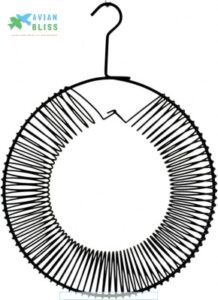
A wreath doesn’t look like a feeder at first glance — that’s the point. This 13-inch ring holds about 1 ¼ pounds of unsalted peanuts in shells, letting blue jays and woodpeckers peck straight through without you shelling anything first.
The spring-like ring stays open during refills, and the 7-inch inner gap keeps peanuts accessible even as the outer layer thins out. Several birds can feed at once, making it a solid pick for busy yards.
| Best For | yard owners who want to give squirrels and blue jays their own peanut spot while keeping the main bird feeders free for smaller songbirds. |
|---|---|
| Material | Metal |
| Weather Resistance | Yes |
| Easy Cleaning | Open design |
| Bird Variety Attracted | Blue jays, squirrels |
| Mounting Style | Hanging |
| Model Number | SE6019 |
| Additional Features |
|
- Holds whole peanuts in shells, so blue jays and woodpeckers can peck through with zero prep
- Spiral wire design slows down feeding, which cuts back on waste and stashing
- Basic black metal look blends into the yard and keeps wildlife from feeling spooked
- Smaller birds may have trouble prying peanuts out of the tight spiral wire
- Discarded shells pile up underneath, meaning regular cleanup in shared outdoor spaces
- Without a baffle or upkeep, it can end up drawing in rodents or other unwanted visitors
10. More Birds Blue Dish Bird Feeder
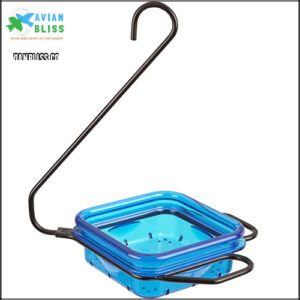
Blue dishes catch a bird’s eye fast, and that’s exactly why this feeder pulls in bluebirds, orioles, and finches so reliably. The polycarbonate tray holds mealworms, jelly, or suet chunks, with drainage holes keeping food from turning to mush after rain.
It’s dishwasher-safe, which makes cleanup painless. Just skip live mealworms — they’ll wriggle straight through those same drainage holes. Bring it in during storms, since there’s no dome to shield the open dish from weather.
| Best For | Bird lovers who want to attract bluebirds, orioles, finches, and hummingbirds with an easy-to-fill dish for jelly, suet, or seeds. |
|---|---|
| Material | Polycarbonate & Metal |
| Weather Resistance | Yes |
| Easy Cleaning | Dishwasher-safe |
| Bird Variety Attracted | Bluebirds, finches |
| Mounting Style | Hanging hook |
| Model Number | Dish |
| Additional Features |
|
- Dishwasher-safe blue tray makes cleanup quick and simple
- Drainage holes keep rain from soaking food and causing spoilage
- Sturdy powder-coated hanger and perches support regular visits from various bird sizes
- Drainage holes let live or dried mealworms escape, so they’re not a good fit here
- No dome or cover, leaving food exposed to rain and larger birds like starlings
- Small capacity means frequent refills in busy feeding spots
Check Materials and Protective Features
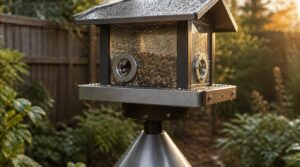
A good feeder isn’t just about looks—it’s about what happens when rain, squirrels, and daily wear test it over time. The materials and design choices you make now decide how much cleaning, repairing, or replacing you’ll do later. Here’s what actually holds up, and what to watch for before you buy.
Durable Weather-Resistant Construction
Weather beats up cheap feeders fast. Look for weatherresistant materials: aluminum cladding resists corrosion, powder-coated finishes fight UV fade for 10-15 years, and thermal breaks cut heat transfer.
Hidden fasteners block water at joints. High-impact polycarbonate domes shrug off hail. Combined, these features deliver durable construction and genuine impact resistance — the difference between a feeder that lasts one winter and one that lasts a decade.
Non-Porous Easy-Clean Materials
Surviving hail is one thing; surviving moldy seed is another. Non-porous materials like glass, stainless steel, and sealed polymer resist staining and won’t absorb odors or bacteria. Wipe them with dish soap and they come clean fast — no scrubbing, no residue.
Wood and clay soak up moisture, breeding mold. Skip them if easy feeder cleaning matters to you.
Drainage and Seed Protection
Clean materials only go so far if water keeps pooling at the base. Drainage design features matter just as much as what the feeder’s made of.
Look for:
- Sloped seed beds directing splash away
- Hinged, gasket-sealed hoppers blocking rain
- Elevated seed trays reducing ground contact
- Drip edges guiding moisture off ports
- Sub-surface drainage 3–5 feet below
Squirrel-Proof Feeding Features
Squirrels outsmart cheap feeders fast. Go with weight-activated perches—ports close when 4+ ounces lands, birds under that keep feeding.
Cage mesh encapsulation blocks paws while finches slip through. Add a squirrel baffle, 18+ inches wide, 4–5 feet up the pole. Weight-resistant feeder lines and access guard shields round out a truly squirrel-resistant setup—no more raided seed.
Safe Perches and Ports
Look closely at where birds actually grip. Perch texture safety matters—broad, textured perches stop small feet from slipping mid-meal. Rounded perch ends guard against claw injuries, while port size control keeps larger birds out.
Smooth port interiors stop seed crust buildup, and smart perch spacing design lets songbirds feed without crowding. Choose smooth feeder parts—they’re easier to clean and safer overall.
Evaluate Placement and Maintenance Needs
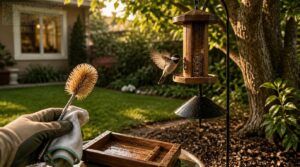
Buying the right feeder is only half the job — where you put it, and how you keep it clean, matters just as much. A great feeder in the wrong spot can turn into a squirrel buffet or a window hazard fast. So here’s what to check before and after you hang it up.
Choose a Safe Location
Where you hang a feeder matters as much as what’s in it. Give birds open sight lines with cover 10-15 feet away for quick escapes, not tucked beside brush piles.
Keep good ground visibility to spot predators early, add wind protection with a wall or hedge, and place feeders where daily foot traffic won’t send birds scattering.
Prevent Window Collisions
Since glass reflecting sky or plants tricks birds into flying straight at it, feeder distance adjustment matters most: shift feeders 3+ feet away, or push past 10 feet entirely.
Add outer decals spaced every 2 inches, UV reflective film, or exterior screens to break up reflective glass and disrupt flight paths before window collision prevention becomes an ER visit for your favorite cardinal.
Reduce Predator Access
Raccoons and snakes climb, so build your predator buffer with a 6-foot fence, buried 12 inches deep, using tight chain link mesh. Add an electric strand up top. While you’re fortifying the perimeter, don’t overlook feeder placement, since rat-resistant bird feeder setups also help keep smaller ground predators from being drawn into your yard.
Pair that with pole baffles and squirrelproof feeders for layered predator control. A guard dog patrolling the yard adds one more line of predator deterrence.
Prioritize Easy Disassembly
A feeder that fights you at cleaning time won’t get cleaned—simple as that.
If a feeder fights you at cleaning time, it simply won’t get cleaned
Look for quick release latches over screws, plus tool-free access panels. Modular subassemblies and removable trays should lift out with one hand.
Color-coded fasteners speed reassembly. Good bird feeder maintenance tips start with hardware you can actually disassemble for cleaning without a toolbox.
Prevent Mold and Disease
Wet seed breeds disease fast, so moisture control matters as much as scrubbing.
Scoop out clumped or musty seed immediately, and stick to a 10% bleach solution for your feeder cleaning routine every 1-2 weeks. Dry parts fully before refilling.
Store backup seed in airtight, elevated containers with desiccant packs. Keep humidity below 50%, and pull feeders entirely for two weeks if you spot sick birds nearby.
Frequently Asked Questions (FAQs)
What is the 5 7 9 rule for bird feeders?
Set feeders 5 feet high, 7 feet from structures, and 9 feet from branches—a simple mnemonic balancing feeder height spacing, squirrel jump prevention, and predator escape routes while lowering collision risk near windows and overhangs.
Why put a potato in your bird feeder?
Think of it as a farmhand’s snack break for wildlife. Cooked, unsalted potato gives crows, blackbirds, and starlings a quick energy boost—especially in cold months—when offered plain, cooled, and diced small once or twice weekly.
What to know before buying a bird feeder?
Before buying, match seed type to your target birds, check for sturdy, squirrel-resistant construction, and confirm it’s easy to clean. Look at placement safety, capacity versus waste, warranty coverage, and whether it keeps food dry with visible seed levels.
How to pick a good bird feeder?
Some say bright colors scare birds off — mostly myth. Focus on mounting stability, easy disassembly for cleaning frequency, squirrel-proof ports, and balancing budget vs quality. Run a quick seed freshness test before filling.
How often should I clean my bird feeder?
Give seed feeders a scrub every two weeks, weekly during wet spells. Hummingbird feeders need attention every 4 to 7 days in heat. Use diluted bleach, rinse well, and dry fully—mold and bacteria won’t wait around.
Where should I place feeders near windows?
Windows are a bird’s worst mirage — glass reads as open sky. Keep feeder placement either within 3 feet or beyond 10, mount 4–6 feet high, and add decals for real window collision prevention.
How do I keep squirrels off feeders?
Go squirrelproof with a pole-mounted squirrel baffle 4-5 feet up, a weight-activated perch that shuts under 4 ounces, safflower seed, and slick pole coating — set feeders 8-10 feet from jump points for real squirrel deterrence.
Whats the best height for hanging feeders?
Get the height wrong and you’ll feed squirrels instead of songbirds. Aim for 5 to 6 feet—ideal for finches and chickadees, safe from predators, and easy to refill without a ladder.
How many feeders should my yard have?
Match feeders to your yard size: small yards do fine with two, spaced 6 feet apart; medium yards handle three or four; large yards support five-plus without crowding or raising predator risk.
Conclusion
Consider it your telegraph to the backyard: build it right, and word travels fast among the birds.
Knowing what to look for in a bird feeder means checking ports, drainage, and squirrel defenses before you ever hang it up. Cheap seed and flimsy plastic invite waste, not wings. Invest in solid construction, place it thoughtfully, and clean it often.
Do that, and your yard stops waiting for visitors—it becomes the destination.