This site is supported by our readers. We may earn a commission, at no cost to you, if you purchase through links.
A black-tailed godwit can burn through 80% of its fat reserves in a single hard freeze. That’s not a slow drain, it’s a metabolic sprint, triglycerides mobilizing straight into the bloodstream to keep a heartbeat going through the night. Your feeder sits at the center of that survival math.
Not all seeds pull their weight here. Peanuts pack 45–50% fat; millet barely clears 4%. Get the fat content bird seeds mix wrong, and you’re feeding birds calories that won’t cover the metabolic bill when temperatures crash.
Species, season, and beak shape all factor into what actually works, and getting the ratios right separates a feeder that helps from one that just looks full.
Table Of Contents
Key Takeaways
- Fat is survival fuel, not filler—birds can burn up to 80% of their fat reserves in a single hard freeze, so your feeder’s fat content directly affects whether they make it through the night.
- Not all seeds pull their weight: peanuts (45–50% fat) and black oil sunflower (28–50%) deliver real energy, while millet (4%) and other fillers barely register and mostly go to waste.
- Match seed to species and season—cardinals need thick-hulled sunflower or safflower, finches need nyjer, and fat needs peak in winter, so a one-size-fits-all mix shortchanges someone.
- Storage matters as much as seed choice, since high-fat seeds turn rancid fast; keep them airtight, cool, and dry, and clean feeders every two weeks to avoid mold and disease.
Bird Seed Fat Content Explained
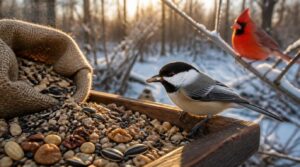
Fat isn’t just filler in a bird’s diet, it’s fuel for survival, and not every seed delivers it the same way. Some sources pack nearly triple the energy of others, which changes how you should feed depending on species and season. Here’s what you need to know before filling that feeder.
Understanding seasonal seed preferences by species can help you match feeder contents to what local birds actually need as temperatures shift.
How Birds Use Dietary Fat
Picture fat as your backyard birds’ fuel tank. They store it as triglycerides in adipose tissue, then mobilize it into the bloodstream for flight muscles during migration or cold snaps. Some species burn up to 80% of reserves in one freeze.
A bird’s fat reserves are its fuel tank, and some species burn up to 80% of it in a single freeze
High-fat seeds support fat metabolism, immunity, and sustained energy—critical when body mass can nearly double before migration. Experimental studies show that black-tailed godwits exhibit a higher fractional DNL rate when fed rice seeds compared to fly larvae, highlighting dietary influences on triglyceride synthesis. fractional DNL rate
Fat Versus Protein Content
Fuel is only half the story—your birds also need building blocks. Fat delivers 9 calories per gram versus protein’s 4, but protein helps breeding birds and feather growth. Balance matters:
- Fat = quick energy, migration fuel
- Protein = tissue repair, egg production
- Balancing fat-protein ratios prevents deficiencies
- Molt spikes protein needs by 25%
Seasonal Fat Requirements
Get the ratio right, then watch the calendar—fat needs swing hard by season. Fall demands migration fat loading, sometimes doubling body mass. Winter triggers cold snap energy burn, up to 80% of reserves in one freeze.
| Season | Fat Need | Why |
|---|---|---|
| Fall | High | Migration prep |
| Winter | Highest | Cold survival |
| Spring | Moderate | Breeding shift |
Why Seeds Need Supplements
Loading a feeder with pure fat isn’t enough. Seasonal fat reserves demand omega ratios and minerals seeds alone can’t supply. Calcium and phosphorus prevent deficiencies; vitamin E guards against fat oxidation. Supplements also aid digestive absorption of fatty meals and support fat metabolism in birds, rounding out bird seed nutrition advice with the micronutrients your feeder mix leaves out.
High-Fat Bird Seeds Compared
Not all seeds pull their weight for fat, and the gap between top and bottom performers is bigger than most people expect.
Some options pack enough energy to fuel migration or get a bird through a brutal cold snap, while others barely register.
Here’s how five common seed types stack up, ranked from richest to leanest.
Shelled Peanuts: 45–50% Fat
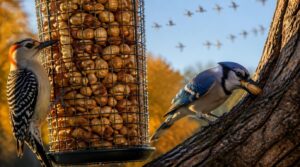
Nothing beats shelled peanuts for raw energy density: 45–50% fat, 24% protein, roughly 160–180 calories per ounce.
Since they leave no hulls behind, shelled peanuts are a top pick among no-mess bird foods for tidy deck feeding, especially when cold weather calls for extra fat.
- Woodpeckers hammering at a peanut-packed hopper
- Jays caching kernels for lean days
- Oleic and linoleic acids fueling flight muscle
- Migrating birds loading fat before the long haul
Store peanuts airtight, cool, and dark—heat and light trigger rancidity fast.
Nyjer Seeds: 35–40% Fat

A tiny seed, an outsized payoff: nyjer packs 35–40% fat, feeding finches, siskins, and redpolls through tube-feeder ports.
| Trait | Nyjer | Safflower |
|---|---|---|
| Fat % | 35–40% | 20% |
| Best For | Finches | Cardinals |
| Feeder | Tube | Platform |
Store it airtight, cool, and dry—rancid oil means wasted energy migrating birds can’t afford.
Black Oil Sunflower: 28–50%
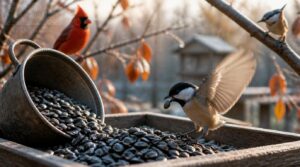
Fifty seeds a day—that’s what a chickadee needs, and black oil sunflower delivers with a 28–50% fat range, thin hulls, and high oil yield.
- Cracks easily for cardinals, nuthatches
- Fuels fat loading for migrating birds
- Stores well when kept airtight, cool, dry
That energy value makes it the backbone seed—adaptable, reliable, worth stocking year-round.
Safflower Seeds: 20% Fat
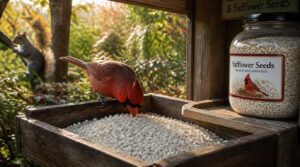
Squirrels avoid it, cardinals love it—safflower earns its keep at 20% fat, with 15–22% protein for balanced energy.
| Trait | Detail |
|---|---|
| Fat | 20% |
| Protein | 15–22% |
| Best for | Cardinals, finches |
| Bonus | Pest-resistant |
Store it cool and dry; that oil content stays stable, fueling thermoregulation without the mess.
White Proso Millet: 4% Fat

At just 4% fat, white proso millet is the lightweight of the bunch—but that’s its strength. Low-fat by design, it suits ground-feeders like juncos and doves without overwhelming their diet.
Mix it sparingly with high-fat seeds for balance. Store it cool and dry; stable fat content resists rancidity, making it a dependable, no-fuss addition to winter feeding strategies.
Top 5 High-Fat Bird Foods
Knowing the fat percentages is one thing, but finding products that actually deliver on them is another. Not every bag on the shelf lives up to its label, so you need picks you can trust. Here are five options worth stocking your feeder with.
1. CountryMax Black Oil Sunflower Seeds
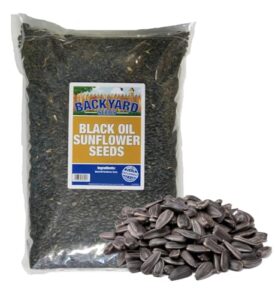
For sheer volume feeding, this 25-pound bag delivers thin-shelled sunflower seeds with no filler grains mixed in. That matters: birds spend less energy cracking husks and more calories absorbing kernel fat.
Cardinals, chickadees, and woodpeckers all take to it readily, and it works across tube, hopper, and platform feeders. US-sourced and processed, quality stays consistent bag to bag.
One catch — occasional sticks or debris turn up despite the sourcing claims, so a quick visual check before filling feeders is worth the thirty seconds.
| Best For | Backyard bird enthusiasts who want to attract a wide variety of species, from cardinals and chickadees to woodpeckers and goldfinches, across multiple feeder types. |
|---|---|
| Weight | 25 lbs |
| Primary Ingredient | Black oil sunflower seed |
| Feeder Type | Tube, hopper, platform |
| Target Birds | Cardinals, chickadees, goldfinches |
| Season Use | Year-round |
| Origin | USA-sourced |
| Additional Features |
|
- Thin shells make it easy for birds to access nutritious kernels with less effort
- No filler grains, so birds get more energy-dense nutrition per seed
- Works well in tube, hopper, and platform feeders for flexible setups
- Occasional sticks or debris may be mixed in despite quality sourcing
- Needs cool, dry storage to stay fresh and avoid spoilage
- Not suitable as a sole food source for captive birds without added supplementation
2. Audubon Park Wild Bird Seed 15 lb
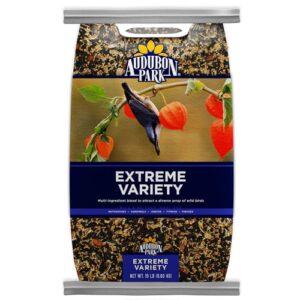
Where CountryMax bets on volume, Audubon Park bets on variety. This 15-pound mix mixes black oil sunflower with peanuts, safflower, millet, and nyjer, so cardinals, finches, juncos, and nuthatches all find something to eat at the same feeder.
That range means fat content swings seed to seed, but the mix leans toward high-energy components overall. It works in tube, hopper, or platform feeders, though whole nuts occasionally clog narrow-tube designs, so check compatibility first.
| Best For | Backyard bird enthusiasts who want to attract a wide variety of species—like cardinals, finches, juncos, and nuthatches—to a single feeder. |
|---|---|
| Weight | 15 lbs |
| Primary Ingredient | Black oil sunflower seed mix |
| Feeder Type | Tube, hopper, platform |
| Target Birds | Cardinals, finches, nuthatches |
| Season Use | Year-round |
| Origin | Not specified |
| Additional Features |
|
- Diverse seed and nut blend appeals to many different bird species at once
- Works across tube, hopper, or platform feeders for year-round flexibility
- Minimal waste, since birds tend to eat nearly every component of the mix
- Whole walnuts and almonds can clog narrow-tube or squirrel-proof feeders
- Contains common allergens (peanuts, tree nuts, soy, wheat, possible fish traces)
- Not recommended as a sole food source for pet birds without vet guidance
3. Kaytee Seed & Suet No Mess Blend Blueberry
 View On Amazon
Cleanup matters as much as fat percentage, and Kaytee’s No Mess mix targets both. Hulled sunflower, cracked corn, millet, ground peanuts, and rendered suet combine into 100% edible components, leaving nothing for you to sweep off the patio.
That suet delivers over 40% fat, dense fuel woodpeckers and cardinals need. Some users report crumbly, dusty nuggets, and cracked corn may draw sparrows, but for balconies or tidy yards, it’s a practical trade-off worth making.
| Best For | Bird lovers who want a low-mess feeding option for balconies, patios, or tidy yards while still attracting a wide variety of species. |
|---|---|
| Weight | 10 lbs |
| Primary Ingredient | Hulled sunflower seed blend |
| Feeder Type | Tube, hopper, platform |
| Target Birds | Cardinals, jays, woodpeckers |
| Season Use | Year-round |
| Origin | Not specified |
| Additional Features |
|
- 100% edible ingredients mean no seed shells or suet residue left behind
- Attracts two to three times more birds and woodpeckers than plain sunflower seed
- Works in tube, hopper, or platform feeders, appealing to both perching and ground-feeding birds
- Suet nuggets can be crumbly and dusty, leading to spillage during handling
- Filler ingredients like cracked corn and millet may attract unwanted species such as house sparrows
- Contains artificial cherry flavor that isn’t necessary for bird nutrition
4. Happy Wings Black Oil Sunflower Seeds 5 lb
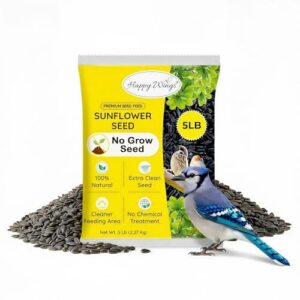
If mess-free feeding isn’t your priority, straight sunflower still wins on simplicity. Happy Wings’ 5 lb bag skips fillers entirely, delivering pure black oil sunflower for cardinals, chickadees, finches, and sparrows.
The no-grow formulation cuts down on sprouted husks under your feeder, and dust-reduced processing keeps platforms cleaner. It’s not a specialty mix, just a dependable, high-oil staple sized right for smaller feeder setups without straining your budget or storage space.
| Best For | Backyard bird enthusiasts who want a simple, no-frills, high-oil sunflower seed to attract cardinals, chickadees, finches, and sparrows without paying for a specialty blend. |
|---|---|
| Weight | 5 lbs |
| Primary Ingredient | Black oil sunflower seed |
| Feeder Type | Standard feeders |
| Target Birds | Cardinals, finches, chickadees |
| Season Use | Year-round |
| Origin | USDA/BRC-GS approved |
| Additional Features |
|
- Pure black oil sunflower seed with no fillers, offering high natural oil and fat content for year-round energy
- No-grow formulation and dust-reduced processing help minimize sprouted husks and mess beneath feeders
- Made in USDA- and BRC-GS–approved facilities that meet Wild Bird Feeding Institute standards
- Some birds may need time to adjust before accepting the seed
- Can attract squirrels and other wildlife along with the intended birds
- Not suitable for human consumption or non-avian pets
5. High Energy Wild Bird Suet
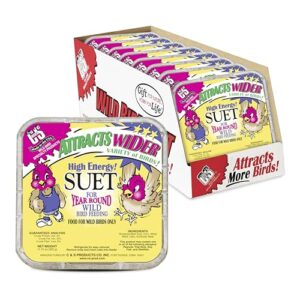
Straight sunflower is fine, but sometimes your birds need denser fuel—that’s where suet earns its place. This mixture renders beef fat with corn, white millet, oats, and sunflower meal into a five-ingredient cake woodpeckers, nuthatches, chickadees, and jays devour readily.
At roughly 40-60% fat by weight, it delivers concentrated calories standard seed can’t match. Keep it refrigerated before loading, since chilled cakes release cleaner from packaging. You’ll need a dedicated wire suet feeder—it won’t work loose on a platform.
| Best For | Backyard bird enthusiasts who want to attract woodpeckers, nuthatches, chickadees, and jays with a high-energy, easy-to-digest suet cake for year-round feeding. |
|---|---|
| Weight | 5.87 lbs |
| Primary Ingredient | Rendered beef suet blend |
| Feeder Type | Wire suet feeder |
| Target Birds | Woodpeckers, nuthatches, chickadees |
| Season Use | Year-round |
| Origin | Made in USA |
| Additional Features |
|
- High-energy fat base made from rendered beef suet for concentrated calories
- Simple five-ingredient blend of corn, white millet, oats, and sunflower meal that’s easy to digest
- Made in the USA and suitable for outdoor feeding in all seasons
- Requires refrigeration before use to release cleanly from packaging
- Needs a separate wire suet feeder, which isn’t included
- Contains animal fats, so it’s not a rawhide-free product despite how it’s labeled
Choosing and Storing Fat-Rich Seeds
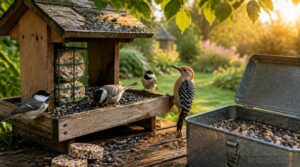
Buying high-fat seed is only half the job; using and storing it right is what actually keeps birds fed and healthy. The wrong feeder, filler, or forgotten storage bag can waste money and even harm the birds you’re trying to help.
Here’s what matters most when picking, feeding, and protecting fat-rich seed.
Match Seeds to Bird Species
A cardinal’s stout, cone-shaped beak cracks thick-hulled sunflower and safflower with ease, while a goldfinch’s slender beak is built for tiny Nyjer. Match beak shape to shell thickness and you’ll cut waste dramatically.
Woodpeckers and jays favor peanuts; doves and juncos work the ground for millet. Species-specific feeding isn’t guesswork—it’s biology.
Choose Compatible Feeder Types
Since fat-rich seeds spoil fast, your feeder’s design matters as much as the seed itself. Choose vented hopper feeders for peanuts, platform feeders with raised edges for sunflower and safflower, and narrow-port tube feeders for Nyjer.
Match port size to species, make sure weather-resistant materials, and mount feeders 5–7 feet high. Clean biweekly—rancid fat is genuinely dangerous.
Avoid Low-Value Seed Fillers
Not every seed in the bag earns its place. Milo, wheat, and flax dilute fat-rich seeds, raising cost per calorie while birds toss them aside as waste.
- Check labels for filler transparency
- Prioritize black-oil sunflower first
- Avoid mixes under 50% fat
- Look for named fat percentages
- Skip bargain blends heavy in chaff
Prevent Mold and Rancidity
High-fat seeds turn rancid fast—oxidation is chemistry, not bad luck. Keep moisture below 8%, store between 4-8°C, away from light and heat spikes.
Use airtight, opaque containers; oxygen and UV both accelerate spoilage. Weekly freshness checks matter: sniff for sourness, inspect for clumping or discoloration. Discard suspect batches immediately—moldy seed is genuinely dangerous to visiting birds.
Adjust Blends by Season
Birds don’t eat the same way year-round, so your mix shouldn’t either.
Spring breeding calls for a protein boost; summer molt pushes needs higher still.
Fall migration demands fat loading—energy provision for long flights.
Winter favors calorie-dense mixes, minimum 30% fat.
Shift your seasonal fat-to-protein ratio deliberately, and store surplus using proper bird seed storage methods between rotations.
Frequently Asked Questions (FAQs)
What are high fat seeds for birds?
Not just any seed qualifies. High-fat seeds mean black oil sunflower (28–50%), nyjer (35–40%), safflower (20%), and peanuts (45–50%) — fueling thermoregulation, migration, and winter survival, unlike low-fat cracked corn or millet fillers offering minimal energy value.
Which seeds contain the most fat?
Sesame tops the Fat Content Analysis near 60%, with shelled peanuts (45–50%) and black oil sunflower seeds (28–50%) close behind—reliable energy dense fuel for building fat reserves before cold snaps or migration hit hard.
What birdseed to avoid?
Fillers spell trouble: corn, red millet, wheat, barley, and rice offer little nutrition, invite pests, and spoil fast. Avoid seed fillers, rotate stock regularly, and store seeds dry to prevent rancidity and dangerous aflatoxin buildup.
Why put a potato in your bird feeder?
A plain cooked potato chunk delivers quick carbohydrate energy, no fats or oils involved. Ground feeders like doves and blackbirds peck it readily. Always cool pieces first, and pair with high-fat seeds for balanced nutrition.
How often should I clean bird feeders to prevent disease?
Clean feeders every two weeks, weekly in wet weather. Sanitize with a 1:9 bleach solution, scrubbing perches and trays where hulls and droppings collect, then dry completely before refilling to stop mold and salmonella spread.
How high should bird feeders be positioned outdoors?
Aim for 5 to 6 feet off the ground, with 3–4 feet of window clearance. This height deters cats and squirrels, prevents collisions, and keeps energy-rich seed accessible for winter survival and migrating birds.
Which foods are toxic and should never be fed?
Funny how "healthy" scraps kill faster than seeds ever could. Skip avocado, chocolate, onions, and moldy seed (aflatoxin concern). Unsafe scraps, harmful nuts, and rancid batches cause real damage—so freshness and clean storage genuinely matter.
Conclusion
Like a woodstove rationed through a long night, a bird’s fat reserve only warms as long as you’ve stocked it right. Getting fat content bird seeds matched to species and season isn’t decoration, it’s survival math written in triglycerides.
Peanuts and black oil sunflower earn their place; millet fillers don’t. Store seed dry, rotate stock often, and watch feeder traffic as your feedback loop. Get the ratios right, and that feeder becomes a lifeline, not just a pretty fixture in your yard.