This site is supported by our readers. We may earn a commission, at no cost to you, if you purchase through links.
Most people glance at a large black bird and call it a crow. Field biologists do the same thing—until they don’t. A raven perched on a cliff edge looks almost familiar, but something feels off: the bill curves like a small hook, the throat feathers ruffle into a shaggy beard, and when it calls, the sound rolls out low and resonant, nothing like the sharp caw you’d expect.
These two species share the same black plumage and opportunistic habits, yet they differ in size, structure, vocalizations, and habitat in ways that become obvious once you know what to look for. The distinct features—from the raven’s hooked bill to its deeper calls—contrast sharply with a crow’s more straightforward profile and sharper caw.
The raven vs crow comparison rewards patience and attention to detail. What begins as a casual observation transforms into a nuanced study of subtle yet significant distinctions, revealing how closely related species carve out unique ecological roles.
Table Of Contents
- Key Takeaways
- Raven Vs Crow at a Glance
- Size, Shape, and Plumage Differences
- Tail and Flight Identification
- Calls and Vocal Differences
- Behavior and Social Structure
- Habitat, Range, and Sightings
- Diet, Intelligence, and Field Tips
- Frequently Asked Questions (FAQs)
- How do you know if a crow is a raven?
- What is the difference between a raven and a crow?
- Are crows smarter than ravens?
- Do Crows sound like ravens?
- What US states have ravens?
- What is the difference between a crow and a raven?
- Can a crow turn into a raven?
- Is there a difference between a crow and a raven?
- What is a flock of ravens called?
- Do ravens hop or walk?
- Conclusion
Key Takeaways
- Ravens are noticeably larger than crows — longer, heavier, and wider-winged — with a wedge-shaped tail and thick, curved bill that make them easy to distinguish once you know what to look for.
- Sound is one of your sharpest field tools: a raven’s deep, resonant croak sounds nothing like the sharp, nasal caw of a crow, making vocal ID reliable even when visibility is poor.
- Flight behavior sets them apart in motion — ravens soar and glide on thermals with slow, deliberate wingbeats, while crows flap steadily at a higher frequency and rarely pause to soar.
- Both species rank among the most cognitively advanced birds on Earth, using tools, solving multi-step problems, and adapting their foraging strategies seasonally across overlapping but distinct habitats.
Raven Vs Crow at a Glance

At a quick glance, ravens and crows look like close cousins — and honestly, that’s exactly why people mix them up.
But once you know what to look for, telling them apart gets a lot easier. Here are the fastest ways to start.
A solid starting point is this guide to identifying hawks in Georgia, which breaks down the key markings and behaviors that separate similar species.
Quick Size Comparison
The size comparison between raven and crow is striking once you know what to look for. Ravens measure up to 27 inches long, while crows top out around 21 inches — a length difference you’ll notice immediately in the field.
| Feature | American Crow | Common Raven |
|---|---|---|
| Body Length | 15.8–20.9 in | 22.1–27.2 in |
| Weight | 11.2–21.9 oz | 24.3–57.3 oz |
| Wingspan | 33.5–39.4 in | 45.7–46.5 in |
That mass contrast is equally telling — a raven can outweigh a crow more than two to one.
Fastest Ways to Tell Them Apart
Once you know the shortcuts, identifying raven versus crow takes seconds.
Key physical traits include the tail shape and bill profile. When soaring, ravens display a wedge-pointed tail, while crows fan out flat. On a perched bird, the bill shadow of ravens curves noticeably downward, contrasting with the slim, straight profile of crows.
| Feature | Raven | Crow |
|---|---|---|
| Tail Shape | Wedge-pointed | Fan-rounded |
| Bill Profile | Thick, curved | Slim, straight |
During flight, observe the wingtip glint: ravens’ wingtips finger out, whereas crows’ remain blunt. Additionally, ravens possess a wingspan exceeding one meter that highlights their larger size.
Why People Confuse Them
Even with those quick ID shortcuts in hand, identifying raven versus crow still trips people up — and honestly, that’s fair.
Low light flattens bill curves, and silhouette ambiguity hits hard when birds perch in backlit trees. Observer experience matters too.
| Confusion Factor | Why It Happens |
|---|---|
| Low Light | Hides bill curve and throat texture |
| Distance | Erases size and morphology comparison cues |
| Human-Altered Settings | Both species use farms, roadsides, suburbs |
| Common Name Confusion | "Big black bird" gets labeled either way |
Size, Shape, and Plumage Differences
Up close, ravens and crows look surprisingly different once you know what to check. Their size, bill shape, feather texture, and wing profile each tells a clear story.
Here’s what to look for.
Body Size and Weight

When you put a raven and a crow side by side, the size difference is hard to miss. Ravens measure 24–27 inches in length with wingspans reaching 54 inches — closer to a red-tailed hawk than any crow. Crows average 17–21 inches. Their mass-to-size ratios also differ: ravens weigh up to 4.4 lb, nearly double the crow’s maximum of 1.4 lb.
Quick size comparison at a glance:
- Ravens stretch 7–9 inches longer than crows on average
- Raven wingspan exceeds crow wingspan by over a foot
- Ravens can weigh twice as much as the heaviest crow
- Scaling effects make ravens look bulkier even in flight silhouette
- Crow proportions are compact — think pigeon, not hawk
Bill Size, Thickness, and Curve
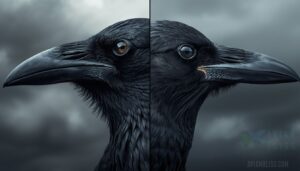
The bill reveals distinct differences between ravens and crows. Raven culmen lengths run 57–85 mm, roughly 20–30% longer than a crow’s 50–64 mm.
This size gap becomes one of the most reliable field markers, as covered in this raven vs crow identification guide alongside other tricky look-alikes like grackles.
This contrast in beak depth is equally striking: ravens possess a thick, curved bill with a pronounced hooked tip angle of 10–15 degrees, while crows have smaller, flat bills designed for precision probing.
Nasal bristle coverage also differs, with ravens having 5–8 mm bristles compared to crows’ 2–4 mm. These adaptations reflect their feeding functions: ravens’ bills are built for crushing bone and tearing carrion, whereas crows’ are suited for probing and precise insect picking.
Ravens crush bone and tear carrion; crows probe and pick — two bills built for entirely different lives
| Bill Feature | Raven |
|---|---|
| Culmen Length | 57–85 mm |
| Beak Depth | Noticeably deeper |
| Hooked Tip Angle | 10–15 degrees |
| Nasal Bristle Coverage | 5–8 mm bristles |
| Feeding Design Function | Crushing bone, tearing carrion |
| Bill Feature | Crow |
| ——————– | ———————— |
| Culmen Length | 50–64 mm |
| Beak Depth | Slender, narrow |
| Hooked Tip Angle | Minimal curve |
| Nasal Bristle Coverage | 2–4 mm bristles |
| Feeding Design Function | Probing, precise insect picking |
Throat Feathers and Facial Bristles
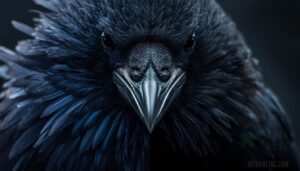
Look closely at a raven’s throat and you’ll spot shaggy throat feathers, called hackles, that flare dramatically during vocalizations — crows have smooth plumage there.
Rictal bristle placement also differs: ravens carry longer bristles at the base of the beak, reflecting bristle morphology variation tied to a sensory role in prey handling and protective feather adaptations against debris.
Wing Shape and Overall Silhouette
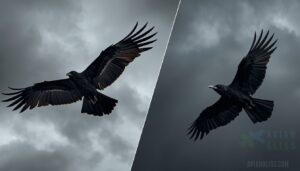
Wing morphology sets these two species apart before you even see a tail or bill. Ravens carry longer, narrower wings with dramatic fingered wingtips and a higher aspect ratio, giving them a stretched, angular silhouette in flight.
Crows show a tighter body-to-wing ratio and blunter tips. That wingspan contrast alone — roughly 46 inches versus 36 inches — makes the visual cue immediate.
Tail and Flight Identification
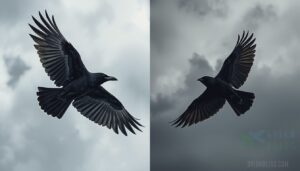
Once a raven and crow are in the air, the differences become a lot easier to spot. Their tails, wingbeats, and overall flight style each tell a distinct story.
Here’s what to look for when you’re watching them fly.
Wedge-shaped Vs Fan-shaped Tail
The tail is your single most reliable field marker. Ravens carry wedge-shaped tails, where the feather length gradient runs noticeably longer through the center — those middle feathers extend roughly 2–3 cm beyond the outer ones, forming a distinct V-point visible from over 200 feet. Crows show fan-shaped tails, uniform and rounded.
That iridescent tail gloss differs too: ravens gleam strongly, crows subtly.
Soaring Vs Steady Flapping
Once you’ve clocked the tail shape, watch how each bird actually moves through the air — that’s where the size comparison between raven and crow becomes obvious in motion.
- Ravens soar and glide on thermals, exploiting altitude selection to minimize muscle fatigue.
- Crows rely on steady flapping, a higher energy cost per mile.
- Ravens’ glide ratio lets them cruise with minimal wingbeats.
- Crows flap 3–4 times per second, even over distance.
The flight behavior of ravens and crows is night and day.
Wingbeat Rhythm and Flight Style
Ravens beat their wings slowly and deliberately, then settle into long glides — a flap-glide ratio built for energy efficiency over distance. Crows maintain a quicker, steadier wingbeat frequency, rarely pausing to soar.
That rhythm difference reflects each bird’s altitude preference and maneuverability patterns: ravens exploit thermal soaring, while crows stay lower, flapping through tighter spaces with short, controlled bursts.
In-flight Shape From a Distance
Once you catch that rhythm difference, silhouette becomes your next reliable tool. At 200 yards, a raven’s wedge-shaped tail point, heavier body bulk, and forward-projecting bill shadow outline set it apart clearly.
Finger-feather count and wingtip projection sharpen that distinction: ravens show four longer primaries, while crows reveal five shorter ones.
Tail point visibility alone makes thermal soaring behavior unmistakable in ravens.
Calls and Vocal Differences
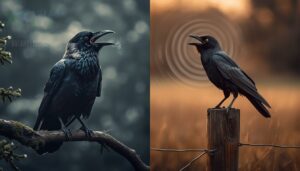
If you can’t see a raven or crow clearly, your ears can do the work for you. These two birds sound nothing alike once you know what to listen for.
Here’s a breakdown of the key vocal differences that’ll help you tell them apart in the field.
Raven Croaks, Knocks, and Deep Calls
Once you hear a raven’s deep throaty croak, you won’t mistake it again. Territorial croak patterns roll out in two to four resonant notes — low, hollow, almost chest-rattling.
Dominant females add a rhythmic knocking sound, tapping out 10–15 metronomic notes to mark boundaries.
Alarm croak dynamics shift sharper and faster near predators.
Juvenile gurgle development starts hoarse, deepening with age.
Crow Caws, Purrs, and Nasal Notes
Unlike the raven’s chest-deep croak, a crow’s caw vocalization is sharp, high-pitched, and unmistakably urgent. That weaker, more nasal, often 2-noted caw of fish crows sounds almost like a question.
Here’s what to listen for:
- Foraging nasal caws — brief, repetitive notes during group feeding
- Social caw patterns — softer contact calls maintaining flock cohesion
- Caw volume — amplifies near mates during territorial disputes
- Courtship purrs — low, gentle sounds exchanged during pair bonding
- Vocal signatures — individual crows produce unique calls neighbors recognize
These vocalization differences between raven and crow make sound your sharpest field tool.
Mimicry and Vocal Range
Both species are accomplished mimics, capable of reproducing other birds, mammals, and even human speech through acoustic learning and pitch modulation.
Their regional soundbanks shift based on local exposure, so a raven raised near wolves sounds different from one near highways.
This social echoing and mimicry functions as a secondary acoustic cue, expanding the vocalization differences between raven and crow well beyond their signature calls.
How to Identify Each by Sound
Identifying crows and ravens by sound gets easier once you tune into three key acoustic cues for bird ID:
- Pitch and Timbre — A raven call rolls deep and cavernous; a crow call cuts sharp and nasal.
- Call Duration — Raven croaks sustain longer; crow caws clip short.
- Perch Height Clues — Ravens project from treetops; crows dominate mid-level urban spaces.
Contextual sound cues like location and season reveal vocalization differences in corvid species quickly.
Behavior and Social Structure

Size and calls can get you pretty far with ravens and crows, but behavior is where the real differences show up.
The way each species moves through the world — who it hangs out with, how it defends its space, where it sleeps — tells a story that feathers alone can’t.
Here’s what to watch for when you’re studying them in the field.
Solitary Pairs Vs Large Groups
Ravens lean heavily on mate pair bonding, staying with a single partner year-round rather than joining crowds.
Crows flip that script entirely — a murder flock of crows can number in the thousands during winter. Group vigilance and social learning drive this behavior, with resource patchiness and seasonal cohesion pulling individuals together when food concentrations make gathering worthwhile.
Playfulness and Aerial Acrobatics
Both species treat the sky as a playground. Watch a raven long enough, and you’ll catch aerial somersaults, inverted glides, and courtship dive displays that seem purely joyful. Thermal soaring in ravens adds seamless drama. Crows join in too—their social behaviors reveal:
- Playful wing clapping during friendly encounters
- Juvenile flight drills testing balance and air pressure
- Aerial sport duels between birds practicing evasive coordination
- Adults reinforcing bonds through shared flight behaviors of ravens and crows
Aggression, Mobbing, and Territory Defense
Both birds defend their turf hard — but they do it differently. Crows rely on mobbing coordination, rallying groups to dive-bomb and harass intruders. Ravens favor territory displays, using dominant posturing and deep vocalizations.
Crows employ layered alarm signals: sharp caws, wing flashing, and tight aerial passes. Ravens focus on paired territory displays, emphasizing strength through synchronized movements and resonant calls.
During breeding season, male defense roles intensify, and seasonal patrols become relentless around nesting sites. Both species escalate aggression to protect offspring, ensuring territorial integrity when it matters most.
Roosting and Daily Movement Patterns
Crows end each day by gathering in communal roosts — sometimes thousands strong, while ravens typically return to a stable pair roost nearby. Crow roosting patterns shift seasonally, with urban disturbances pushing these groups toward quieter parks or tree-lined streets.
Ravens exhibit bimodal morning foraging bouts and rarely congregate in large numbers. Both species synchronize their movements with sunrise and sunset, adjusting for seasonal changes in daylight.
Habitat, Range, and Sightings

Knowing where each bird lives is one of the quickest ways to narrow down what you’re looking at before you even check the tail shape or listen for a call.
Ravens and crows don’t share the same territories equally — their ranges, preferred habitats, and tendencies around human development are surprisingly different.
Here’s a breakdown of where each species shows up most.
Where Ravens Are Most Common
Head west for the best chance of spotting a common raven. Alaskan boreal strongholds and Pacific Northwest hotspots—such as Washington’s Olympic Peninsula—host dense breeding populations.
Coastal cliff strongholds along rugged shorelines and high-elevation ridges in the Rockies are prime territory. These areas offer ideal breeding and foraging grounds.
Island raven populations remain stable year-round, sustained by consistent food sources near human activity and natural coastal resources.
Where Crows Are Most Common
Unlike ravens, which favor remote wilderness, crows thrive wherever people settle. The American Crow (Corvus brachyrhynchos) spans nearly all of North America — from Canadian farmlands to Gulf Coast shorelines.
- Urban park concentrations near food waste and mature trees
- Agricultural field presence along grain stubble and open edges
- Garbage-dump populations sustained by reliable scavenging opportunities
Their urban adaptability makes crows remarkably widespread.
Urban, Suburban, and Wild Habitats
Both species exploit microhabitat diversity differently. Crows rely heavily on urban food subsidies—trash, compost, and pet scraps—and thrive along green infrastructure corridors connecting parks and street trees. Ravens, in contrast, prefer wilderness edges, cliffs, and mountain terrain.
Artificial water resources, such as birdbaths, attract both species. Noise pollution effects can shift foraging timing, with crows adapting faster to human disturbance than ravens usually do.
Overlap Areas in North America
Overlap regions across North America reveal where both birds share the same sky. In the Pacific Northwest Coastline, ravens and crows forage side by side along estuaries and conifer-edged shorelines. The Great Lakes Corridor, Southwest Desert Oases, Prairie Grassland Interface, and Boreal Forest Edge all host both species.
These areas make size comparison between raven and crow, vocal cue differences for bird ID, and behavioral cues your sharpest identification tools.
Diet, Intelligence, and Field Tips

Once you know what a raven or crow looks like in flight, the next step is understanding how they live — what they eat, how they solve problems, and what to watch for in the field.
These birds are sharper than most people expect, and their behavior gives you some of the best clues for telling them apart. Here’s what you need to know.
What Ravens and Crows Eat
Both ravens and crows are true omnivores, with a corvid diet encompassing everything from carrion and small vertebrates to fruit, seed intake, insects, and human food waste.
Seasonal diet shifts guide their month-to-month targeting of food sources. Ravens exhibit bolder behavior in raiding nests and exploiting urban carrion, while crows depend more on plant matter and cached food reserves.
Foraging and Scavenging Behavior
Both species are remarkably resourceful foragers, and watching them work a landscape reveals much about corvid diet and omnivorous habits in action. Their foraging behavior adapts seasonally—tracking carrion in winter, hunting insects in summer, and scavenging urban areas year-round.
Key behaviors to observe include:
- Raiding dumpsters and roadkill for easy calories
- Probing carcasses for soft tissue and marrow
- Caching surplus food in hidden spots for lean periods
- Following other scavengers to locate reliable carrion sources
- Exploiting farm fields and orchard edges for seasonal crops
Tool Use and Problem-solving Abilities
Both crows and ravens rank among the most cognitively sophisticated birds on Earth. Their tool use and problem-solving abilities reflect genuine avian intelligence — not instinct, but learned, flexible thinking.
| Ability | Ravens | Crows |
|---|---|---|
| Multi-step planning | Excel in complex sequences | Solve sequential puzzles |
| Tool modification | Bend wires, shape sticks | Adjust grip and length |
| Social learning | Learn by watching adults | Share techniques across roosts |
Creative foraging emerges through trial, observation, and motor precision — showcasing cognitive ecology at its finest.
Best Birdwatching Tips for Accurate ID
When you’re in the field, a few smart habits sharpen every ID. Use ideal lighting — early morning side-light reveals tail shape clearly, your best cue for separating wedge from fan.
Field audio gear captures vocalization differences you can review later.
Seasonal timing matters too: winter roosts bring crows in numbers, while ravens stay paired.
Document both size comparison and behavior for confident corvid identification.
Frequently Asked Questions (FAQs)
How do you know if a crow is a raven?
You can tell by size, tail shape, and voice.
A raven is noticeably larger, shows a wedge-shaped tail, and produces a deep croak — not the sharp caw crows are known for.
What is the difference between a raven and a crow?
Both species belong to the genus Corvus, yet they differ meaningfully in size, morphology, vocalizations, and behavior —
differences sharp enough that experienced birders rarely confuse them once they know what to look for.
Are crows smarter than ravens?
Both ravens and crows rank among the most cognitively sophisticated birds, showing strong memory span, cognitive flexibility, and tool use.
Comparing their intelligence is less about a winner and more about different strengths.
Do Crows sound like ravens?
No, crows don’t sound like ravens. A crow’s sharp, high-pitched caw contrasts sharply with a raven’s deep, resonant croak.
Pitch perception alone makes comparing crow and raven vocalizations straightforward once you’ve heard both.
What US states have ravens?
You’ll find ravens across much of the western United States, from Alaska through California, Nevada, Utah, and Arizona.
Eastern expansion trends indicate growing populations in Appalachian states like Tennessee, North Carolina, and New York’s Adirondacks.
What is the difference between a crow and a raven?
Once you look past the all-black plumage, the differences between these two corvids are hard to miss — size, tail shape, vocalizations, and behavior all set them clearly apart.
Can a crow turn into a raven?
No. A crow can’t turn into a raven — species barriers and evolutionary divergence make that impossible. What looks like transformation is folklore metamorphosis, not biology. Genetically, they’re fixed, separate species.
Is there a difference between a crow and a raven?
Yes, there’s a real difference between a crow and a raven. Both belong to the genus Corvus, but they differ in size, calls, behavior, and habitat in ways that are consistently measurable and observable.
What is a flock of ravens called?
A group of ravens is called an unkindness or a conspiracy — terms rooted in medieval folklore reflecting their ominous reputation. In everyday field use, most birders simply say flock.
Do ravens hop or walk?
Ravens primarily walk on the ground, using a deliberate stride that reflects strong leg strength and energy efficiency.
They employ two-footed hops for quick obstacle navigation, but walking remains their default gait.
Conclusion
Picture a hiker spotting a large black bird circling above a canyon in Utah. Without knowing the raven vs. crow distinctions, it’s just another dark shape against the sky. But notice that wedge-shaped tail, the deep resonant croak, the graceful soar—suddenly, it’s a raven.
That shift from vague recognition to confident identification is exactly what this knowledge delivers. Once you know what to look for, perception transforms.
You’ll never see just a black bird again.
- https://www.semanticscholar.org/paper/cbea163da7dac2b8c64df4d59350ede4da905d27
- https://bioone.org/journals/journal-of-vertebrate-biology/volume-71/issue-21066/jvb.21066/Seasonal-differences-in-escape-behaviour-in-the-urban-hooded-crow/10.25225/jvb.21066.full
- https://doi.org/10.2173/bow.comrav.01
- https://web.archive.org/web/20041212040209/http://news.nationalgeographic.com/news/2004/12/1209_041209_crows_apes.html
- https://macaulaylibrary.org/asset/135405