
This site is supported by our readers. We may earn a commission, at no cost to you, if you purchase through links.

Walk past a suet feeder on a cold January morning and you’ll notice something: the birds don’t linger. They hit it hard, grab what they need, and go. That’s not indifference—that’s efficiency driven by biology.
Suet delivers roughly 9 kilocalories per gram of fat, nearly double what most seed mixes offer. For a chickadee burning through calories just to keep its body temperature above 100°F overnight, that math matters enormously. Seeds have their place, but fat is fuel in a way carbohydrates simply aren’t.
Understanding why birds prefer suet over seed feeders means understanding how different species are wired—which birds target fat first, which stick to seeds, and why the season changes everything.
Table Of Contents
- Key Takeaways
- What Are Suet and Seed Feeders?
- Birds Prefer Suet for Dense Energy
- Which Birds Choose Suet First?
- Seasonal Reasons Birds Choose Suet
- Suet Feeders Reduce Backyard Mess
- Frequently Asked Questions (FAQs)
- When should you stop putting suet out for birds?
- Why put a potato in your bird feeder?
- Do birds like suet or seed better?
- What is the 5 7 9 rule for bird feeders?
- How often should suet feeders be cleaned and disinfected?
- Can suet attract unwanted pests or predators to yards?
- What temperatures make suet unsafe or rancid outdoors?
- Are homemade suet recipes safe for wild birds?
- Should suet feeding stop during warmer spring months?
- Conclusion
Key Takeaways
- Suet delivers roughly 9 kcal per gram of fat — nearly double most seed mixes — making it the most efficient cold-weather fuel you can offer backyard birds.
- Fat-seeking species like woodpeckers, chickadees, and nuthatches are hardwired to hit suet first because high-fat food directly supports the thermoregulation they depend on overnight.
- Birds’ preference for suet shifts with the seasons — from winter heat production to spring breeding fuel to fall migration reserves — so suet earns its place at the feeder year-round.
- Suet feeders also solve the practical headaches of seed feeding: no hull mess, no sprouting weeds, faster refills, and cleaner stations that keep visiting birds healthier.
What Are Suet and Seed Feeders?
Not all bird feeders are created equal, and the type of food you offer shapes which species show up in your yard. Suet and seed feeders differ in design, content, and the birds they attract. Here’s a look at the key differences between them.
If you’re just getting started, this guide to suet bird feeders for beginners breaks down which feeder styles work best for attracting woodpeckers, nuthatches, and other suet-loving birds.
Suet Cakes and Blocks
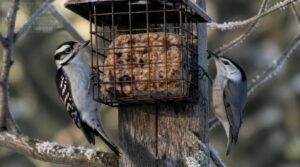
Suet cakes are solid blocks of rendered animal fat — usually lard or tallow — mixed with seeds, grains, and sometimes dried insects or fruit. The fat binds everything into a firm matrix birds can peck at without scattering.
Texture varies: some blocks are hard and waxy; others crumble slightly. Either way, no shell hulls, no mess — just concentrated fuel. These products provide essential dietary fat to support garden bird nutrition.
Seed Mixes and Kernels
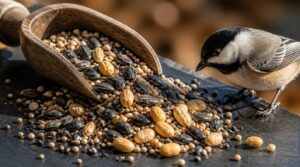
Where suet offers a single dense block, seed mixes spread nutrition across species.
A typical mix combines:
- Black oil sunflower seeds for fat and protein
- Nyjer for goldfinches and siskins
- White millet for ground feeders
- Hulled peanut kernels for calorie-dense bites
- Sorghum for carbohydrate energy
Fat content ranges 35–50% by weight, but seeds demand more effort per calorie than suet.
Feeder Style Differences
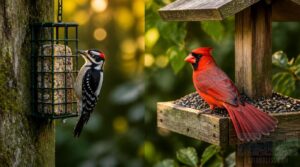
The physical design of the feeder shapes everything. A suet feeder usually uses a wire cage to hold a block firmly in place, while a bird seed feeder relies on hopper or tube designs that dispense seed as birds perch.
Those structural differences determine which bird species show up — and how efficiently they feed.
Food Texture and Access
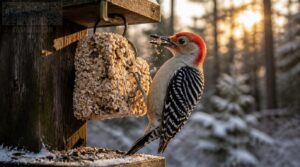
What you’re actually feeding birds comes down to texture. Suet cakes offer a dense, waxy block that birds peck at steadily, while seeds vary from hard shells to soft kernels depending on processing.
A woodpecker applies precise beak pressure to extract fat from suet far faster than cracking seed — less handling time per bite means more energy gained.
Birds Prefer Suet for Dense Energy
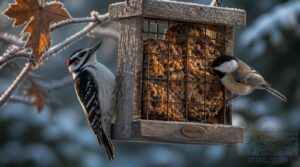
Suet isn’t just another food option birds happen to pick — it’s genuinely the higher-value choice when energy is on the line.
The reason comes down to fat content, caloric load, and how efficiently a bird can fuel up in the cold. Here’s what makes suet the denser, smarter fuel source across five key points.
Higher Fat Content
Fat is where suet earns its edge. Suet’s fat content usually runs 40 to 70 percent by weight, far outpacing most seed mixes.
That calorie-dense profile makes suet a winter lifeline for birds like woodpeckers and chickadees — learn which species rely on it most with this guide to backyard birds of North Dakota.
Those fats are primarily saturated — solid at cool temperatures and slow to oxidize — delivering long-chain triglycerides that birds store efficiently as usable energy reserves. Seed oils offer unsaturated fats, but they metabolize faster and don’t hold up as well in cold air.
More Calories Per Bite
Every bite of suet delivers more caloric content than seed. Here’s why that matters:
- Fats yield 9 kcal per gram — double carbs
- Peanut kernels add 5–7 kcal per bite
- Dried insects contribute 3–5 kcal with protein
- Oil-coated blocks spread steady fat energy evenly
- Compact suet beats low-fat bird food consistently
That’s nutrient-dense efficiency — fewer feeder visits, more fuel per bite.
Faster Winter Fuel
When temperatures drop overnight, birds don’t have the luxury of a slow breakfast. Suet’s high fat content triggers rapid fuel mobilization in the liver and muscles, generating metabolic heat far faster than seeds can.
That’s thermoregulation efficiency in action — fewer pecks, more warmth. Winter bird feeding with suet cuts foraging time, leaving birds more energy for staying alive.
Less Feeding Effort
Seed feeders make birds work hard for every calorie. Suet’s bite-sized accessibility cuts that effort considerably.
Why suet wins on effort:
- Zero extraction time — birds eat directly
- Foraging bout reduction throughout the day
- High-fat energy straight from quality bird food
- Rapid metabolism support kicks in after each bite
- Less sorting, more efficient energy recovery
That’s the smarter bird feeding strategy.
Better Cold-weather Survival
When the mercury drops hard, suet’s caloric density becomes a survival tool. Birds rely on metabolic heat production to regulate body temperature, and that process burns through energy fast.
High-fat suet — at 8–9 kcal/g — replenishes glycogen stores and sustains thermoregulation through fats far more efficiently than seed. That’s not a small edge in winter. It’s the difference between roosting safely and losing the cold-weather battle overnight.
High-fat suet at 9 kcal/g doesn’t just warm birds — it decides who survives the night
Which Birds Choose Suet First?
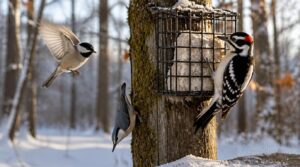
Not every bird that visits your yard is after the same thing. Some species are hardwired to seek out fat-rich food sources, making suet their first stop the moment they spot a wire cage feeder. Here’s a look at which birds tend to claim it before anything else.
Woodpeckers and Nuthatches
Woodpeckers and nuthatches are practically built for suet feeders. Woodpeckers use chisel-like beaks to hammer into bark for insect larvae, while nuthatches work headfirst downward — a posture that suits wire suet cages perfectly.
Both species need high-fat energy to fuel constant vertical climbing. Suet replaces the insect prey they’d naturally extract from dead wood throughout winter.
Chickadees and Titmice
Smaller than woodpeckers but just as bold, chickadees (Poecile spp.) and titmice (Baeolophus spp.) visit suet feeders with surprising confidence. Their caching memory skills let them store and retrieve fat-rich food across dozens of locations — so suet becomes part of a winter survival system, not just a snack.
Watch a chickadee at a wire cage: quick grab, fast exit. That foraging agility keeps calories moving efficiently through mixed flocks all season.
Wrens and Kinglets
Wrens (Troglodytes spp.) work leaf litter and tangled brush; ruby-crowned kinglets (Regulus calendula) barely exceed 4 grams. Both are insectivores — and suet fills the gap when prey disappears.
Five reasons they choose it:
- Cold-weather insects become nearly inaccessible
- Suet’s fat density matches their rapid metabolism
- Small, delicate bills access wire cages easily
- High-calorie bites reduce dangerous foraging time
- Overnight heat loss shrinks with every calorie gained
Bluebirds and Insect Eaters
Bluebirds (Sialia sialis) are sit-and-pounce hunters — they perch, spot movement, and drop on grasshoppers, beetles, and caterpillars below. When winter strips the ground bare, that strategy fails.
Suet steps in as a high-fat insect substitute, delivering the protein nestlings need and the calories adults burn just staying warm. It’s not their first choice — but it works when nature doesn’t cooperate.
Seed-loving Finches and Sparrows
Not every bird at your feeder wants suet. Finches and sparrows — built with conical beaks for cracking seeds — are the holdouts.
House sparrows (Passer domesticus) and goldfinches (Spinus tristis) will skip suet entirely when white proso millet or Nyjer is available. They’re seed specialists, and that’s where their loyalty stays.
Seasonal Reasons Birds Choose Suet
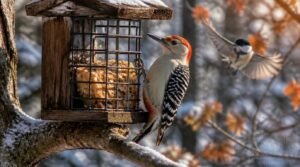
Birds don’t eat the same way in January as they do in July — their nutritional needs shift with every season. Suet meets those changing demands in ways that seed simply can’t match across the calendar year. Here’s how each season shapes why birds keep coming back to your suet feeder.
Winter Heat Support
When temperatures drop below freezing, birds face a simple equation: burn more calories than you lose. Suet delivers roughly 9 calories per gram — nearly double what most seed mixes offer — making it the most efficient winter fuel at your feeder.
That high-fat energy density helps with thermoregulation directly, releasing heat through fat metabolism far faster than carbohydrate-heavy seeds can manage.
Spring Breeding Demands
Spring flips the script on why suet matters. The caloric equation shifts from staying warm to fueling reproduction — and that’s a heavy load.
Breeding birds face sharply higher daily energy expenditure, provisioning nestlings with frequent foraging trips while insect abundance peaks but stays unpredictable. A protein-rich suet mix helps both muscle condition and chick growth during this demanding stretch of the breeding season.
Summer No-melt Options
Heat changes everything. Once temperatures climb past 70°F, standard suet turns soft, rancid, and messy — fast. Stabilized fat formulas solve this by blending heat-resistant ingredients like vegetable shortening and peanut butter to hold their shape well above 90°F.
Place no-melt suet in a shaded, ventilated feeder. Replace blocks every two to three days to prevent rancidity and keep woodpeckers and chickadees returning reliably.
Fall Migration Fuel
Fall migration demands fast fuel. Suet delivers 9 kcal per gram — far above seed’s average 4 kcal — helping birds hit fat targets fast.
- Fat reserves rise 4–6% of body mass weekly
- Woodpeckers often double caloric intake on suet
- Fat targets met in 3–7 days at stopovers
- Suet reduces thermoregulation cost on cool nights
- Migration range extends 15–25% with high-fat access
Natural Food Shortages
When drought slashes crop yields by up to 40 percent and pollinator populations collapse from habitat loss, birds lose more than convenience — they lose survival margin. Pest outbreaks disrupt insect prey. Climate scarcity compounds natural shortages fast.
Suet fills that gap with dense, high-fat energy when the wild pantry empties.
| Natural Shortage Cause | Suet’s Role |
|---|---|
| Drought reducing wild seed crops | Replaces lost caloric sources |
| Pollinator decline cutting fruit yields | Supplies fat birds can’t forage |
| Pest outbreaks eliminating insects | Bridges protein and energy gaps |
| Habitat loss shrinking foraging range | Concentrates nutrition in one spot |
| Climate variability disrupting food timing | Provides reliable year-round fuel |
Suet Feeders Reduce Backyard Mess

One overlooked reason to switch to suet is how much cleaner your yard stays. Seed feeders leave behind hulls, spilled kernels, and weeds that sprout where you don’t want them — suet largely sidesteps all of that. Here’s how suet feeders keep your feeding station tidier.
Fewer Seed Hulls
Seed hulls are pure overhead — birds crack them open but gain nothing nutritional from the shell itself.
- Faster bite efficiency — no hull processing slows foraging
- Better digestive comfort — no indigestible fragments to pass
- Lower choking risk — smooth suet requires minimal manipulation
- Cleaner garden surfaces — no scattered shell debris accumulates
Suet eliminates that friction entirely, making your bird feeder a low-mess option birds revisit consistently.
Less Ground Waste
Suet cakes stay locked inside wire cages, so birds peck clean without dropping crumble across your lawn. A bird seed feeder, by contrast, scatters hulls constantly.
| Factor | Suet Feeder | Seed Feeder |
|---|---|---|
| Ground debris | Minimal | Heavy |
| Cleanup effort | Low | Frequent |
| Spill prevention | Cage-contained | Requires baffles |
Low-mess feeding means less time sweeping, more time watching.
No Sprouting Weeds
Spilled birdseed doesn’t just sit there — it germinates. Millet, sunflower, and milo are all viable seeds, and seed spillage impact on lawns and garden beds can mean a fresh crop of unwanted seedlings every week.
With suet, that problem disappears. Fallen suet particles won’t root. No germination, no patchy grass, no rogue plants crowding your flowerbeds.
Easier Feeder Refills
Refilling a suet feeder takes seconds. Most wire suet cages swing open, drop in a fresh cake, and latch closed — no scooping, no funneling, no spills.
Seed feeders demand more: scoops, wide-mouth openings, and transparent reservoirs help, but bulk seed still makes a mess. Suet keeps backyard bird feeding straightforward and quick.
Cleaner Feeding Stations
Quick refills mean nothing if the station itself breeds disease. Suet feeders win here too — wire cage designs contain mess, while integrated drainage channels divert rain and runoff before mold takes hold.
- Smooth metal surfaces resist residue
- Removable trays simplify weekly washing
- Elevated platforms limit moisture contact
- Tight gaskets block pest entry
- Clear windows reveal cleanliness instantly
Cleaner stations mean healthier birds visiting yours.
Frequently Asked Questions (FAQs)
When should you stop putting suet out for birds?
Pull suet when nighttime temperatures stay above freezing for two weeks straight. Watch for a sustained drop in feeder visits — that’s your clearest sign natural food sources have returned.
Why put a potato in your bird feeder?
Cooked potato chunks deliver fast carbohydrate energy that birds convert quickly into heat and movement. Just avoid raw potato — it contains solanine, which is toxic. Plain, cooled, unseasoned pieces work best on a platform feeder.
Do birds like suet or seed better?
Both suet and seed have their place, but fat-rich suet wins on pure energy. Species like woodpeckers and chickadees choose it first. Seed suits finches and sparrows that prefer carbohydrates over concentrated fat.
What is the 5 7 9 rule for bird feeders?
The 5-7-9 rule suggests feeders 5 feet high, 7 feet from structures, and 9 feet from windows — deterring squirrels, blocking predator access, and preventing deadly bird-window collisions in one simple placement framework.
How often should suet feeders be cleaned and disinfected?
Clean suet feeders every 7–14 days. In heat above 70°F, go weekly. Discard any block showing white fuzz or a sour smell — that’s mold or rancidity, and it can harm birds.
Can suet attract unwanted pests or predators to yards?
Yes, suet can attract squirrels, raccoons, and rodents. Metal cage feeders and squirrel baffles reduce access. Clean up ground spills promptly to avoid baiting rats or mice overnight.
What temperatures make suet unsafe or rancid outdoors?
Even a single hot afternoon can ruin a full suet block. Above 70°F, traditional rendered animal fat softens and turns rancid within 2–5 days. Switch to no-melt blends when temps climb past 75°F.
Are homemade suet recipes safe for wild birds?
Homemade suet is safe when you use unsalted lard or beef fat and skip xylitol, added salt, or seasoned meat drippings. Keep batches small and refrigerated — rancid fat harms birds fast.
Should suet feeding stop during warmer spring months?
Like a medieval apothecary who kept remedies stocked well past the cold season, don’t pull suet too early — breeding birds still need it before insects fully return. Above 70°F, switch to no-melt formulations to prevent spoilage.
Conclusion
Think of suet as a battery pack, not a snack—dense, portable energy birds draw on when the margin between survival and freezing narrows to hours. Understanding why birds prefer suet over seed feeders isn’t just trivia; it shapes how you stock your yard through every season.
Woodpeckers, chickadees, and nuthatches aren’t being picky. They’re being precise. Give them reliable fat, and they’ll return the favor all winter long.
- https://www.kaytee.com/learn-care/wild-bird/wild-bird-suet
- https://www.wildbirdsuets.com/resources/blogs/understanding-suet-flavors-and-the-birds-they-attract
- https://www.nwf.org/Magazines/National-Wildlife/2010/Bird-seeds
- https://extension.illinois.edu/blogs/good-growing/2018-01-09-winter-bird-feeding-suet
- https://birdschoice.com/blogs/news/types-of-bird-food-what-to-feed-backyard-birds-and-when