
This site is supported by our readers. We may earn a commission, at no cost to you, if you purchase through links.

A bird’s skeleton weighs less than its feathers—a fact that stops most people cold when they first encounter it. That counterintuitive ratio emerges directly from pneumatization, the process through which air sac diverticula invade developing bone and replace dense marrow with hollow, air-filled cavities.
The result isn’t fragility; it’s a structural compromise so precise that engineers have borrowed its logic for aerospace design. Understanding why birds have hollow bones means tracing a system where skeletal architecture, respiratory mechanics, and metabolic demand converge into a single, weight-minimizing solution—one that makes sustained powered flight physiologically possible in the first place.
Table Of Contents
- Key Takeaways
- Why Do Birds Have Hollow Bones?
- Hollow Bones Make Flight More Efficient
- How Hollow Bones Stay Strong
- Hollow Bones Support Bird Breathing
- Hollow Bones Help Regulate Heat
- Not All Bird Bones Are Hollow
- Hollow Bones Aid Reproduction
- Frequently Asked Questions (FAQs)
- Why are bones in birds hollow?
- Why are bird bones hollow?
- Why do flight birds have fewer hollow bones?
- Why is a bird’s beak hollow?
- Why do migratory birds have hollow bones?
- Are hollow bones bad for birds?
- Why are bird bones so strong?
- Why do birds have bones?
- Are birds’ hollow bones good for reducing weight?
- Why do seabirds have hollow bones?
- Conclusion
Key Takeaways
- Bird bones are hollow not to be fragile, but because pneumatization—air sacs invading developing bone—creates a structure that’s lighter than feathers yet strong enough to handle the mechanical forces of powered flight.
- That hollow architecture connects directly to the respiratory system, with air-filled cavities acting as extensions of the air sac network, enabling the unidirectional airflow that drives birds’ metabolic rates 150–300% higher than comparable mammals.
- The internal honeycomb of trabeculae—tiny struts aligned along stress paths—means hollow bones redistribute bending and torsional forces the way a truss bridge does: through geometry, not mass.
- Not every bird bone follows this blueprint; diving species like penguins evolve denser bones for buoyancy control, and female birds temporarily fill marrow cavities with calcium-rich medullary bone during egg-laying, proving the skeleton adapts its structure to the demand at hand.
Why Do Birds Have Hollow Bones?
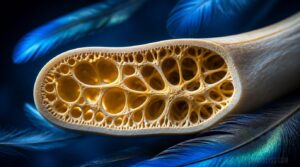
Bird bones aren’t just hollow for the sake of being light — there’s a lot more going on beneath the surface. The skeleton of a bird is a carefully engineered system that balances weight, strength, and even breathing all at once. Here’s what makes that design so effective.
In fact, the full picture of bird anatomy goes even deeper, with features that would seem almost implausible if evolution hadn’t figured them out first.
Lightweight Skeletal Design
Bird skeletons aren’t just light — they’re engineered. Hollow, pneumatic bones use thin-walled tubes reinforced by internal lattices, achieving high stiffness-to-weight ratios that solid bone simply can’t match. Adaptive remodeling continuously aligns bone mass along habitual load paths, eliminating material where it isn’t needed.
The result is a lightweight skeleton built for performance, not just survival. This biological efficiency mirrors topology optimization techniques used in modern engineering.
Flight Energy Savings
Lightweight skeletal architecture directly reduces the energy a bird spends sustaining powered flight. Because skeletal weight is minimized, gravity exerts less pull with every wingbeat, meaning the flight muscles work against a smaller load. Think of it like carrying a carbon-fiber backpack versus a steel one — the destination’s the same, but one costs you far less energy getting there.
- Reduced gravitational load lowers the mechanical work required per wingbeat cycle.
- Lighter body mass improves lift-to-weight ratio, shortening takeoff distance and reducing burst energy demand.
- Metabolic efficiency increases because less oxygen is diverted to sustaining posture and carrying mass aloft.
This matters because avian metabolic efficiency runs 150–300% higher than comparable mammals — a demand that lightweight skeletons help meet by keeping energy expenditure proportional to output.
Strong Internal Structure
Hollow bones don’t sacrifice strength — they redistribute it. A honeycomb-patterned trabecular system forms a 3D lattice of internal struts called trabeculae, connecting the outer cortical layer to the hollow core.
This stress distribution network channels bending and torsional forces across multiple load pathways, much like a truss bridge resists collapse not through mass, but through geometry. The result is impressive skeletal strength-to-weight ratio.
Air-filled Bone Spaces
What sets pneumatic bones apart isn’t just their hollowness — it’s what fills that space. Each cavity in the air cavity network connects directly to the air sac system, making these spaces functional, not empty.
This weight reduction mechanism, combined with a structural lattice design lining the interior, means air-filled spaces achieve skeletal aerodynamics without compromising integrity.
Hollow Bones Make Flight More Efficient

Hollow bones don’t just shave off weight — they fundamentally change how a bird moves through the air. Every gram less means a bird can take off faster, maneuver sharper, and stay airborne longer without burning out. Here’s how that lightweight skeleton works in a bird’s favor.
Easier Takeoff
Taking off is perhaps the most energy-demanding moment in a bird’s flight cycle.
Pneumatic bones and lightweight skeletons reduce overall body mass so dramatically that a bird’s wings reach the ideal angle of attack far sooner during the ground roll. Three mechanisms drive this advantage:
- Takeoff distance reduction — lower mass means less runway needed
- Quick velocity build-up — reduced inertia accelerates the bird faster
- Initial wingbeat frequency — lighter limbs allow rapid, forceful strokes from the first beat
Ground roll acceleration shortens because muscles don’t fight excess weight, and takeoff maneuverability improves as the skeletal strength-to-weight ratio lets birds redirect thrust almost instantly. These skeletal adaptations don’t just save energy — they buy precious seconds when clearing obstacles matters most.
Better Lift Control
Once a bird is airborne, hollow bones do something impressive: they keep the center of gravity precisely where it needs to be, making aerodynamic lift far easier to manage across changing speeds and angles. Lower skeletal mass allows adaptive CG tracking to stay aligned with lift forces, so pitch and roll corrections happen with minimal energy cost.
Faster Aerial Movement
Cutting through the air at speed demands more than just strong wings — it demands a skeleton that doesn’t fight back.
That’s where hollow bones come in — a quiet marvel of natural engineering covered in depth at bird skeletal adaptations and flight behavior.
Because hollow bones reduce overall body mass by up to 25 percent, birds can sustain rapid wingbeats without hemorrhaging energy to inertia. Less mass means faster stroke cycles, sharper acceleration dynamics, and the kind of agile maneuvering that tight aerial corridors require.
Improved Body Balance
Balance in flight isn’t accidental — it’s engineered into the skeleton itself.
Lightweight skeletons shift the center of gravity toward the thorax, the geometric anchor point for wing-powered lift. This positioning mirrors the principles behind foot arch stability and core muscle engagement in bipedal movement: when mass concentrates near the body’s mechanical center, corrective adjustments require less force.
Hollow bones contribute to balance through four measurable mechanisms:
- Skeletal weight reduction lowers rotational inertia, allowing rapid pitch and roll corrections mid-flight.
- Pneumatic bones redistribute internal air volume to fine-tune mass distribution across the body axis.
- Proprioceptive sensitivity in wing joints, equivalent to ankle and hip receptor feedback in walking, processes real-time positional data for micro-corrections.
- Visual-vestibular integration — already sharp in birds — operates more efficiently when skeletal mass isn’t creating competing mechanical demands.
Skeletal strength-to-weight ratios also matter here. Thin cortical walls and internal trabeculae maintain structural integrity without adding destabilizing mass, meaning balance corrections translate directly into movement rather than fighting the skeleton’s own momentum. Think of it as fluid gait coordination scaled to three dimensions: every adjustment is precise because the system carrying it weighs almost nothing.
Reduced Flight Fatigue
Sustaining flight for hours demands that every gram of body mass justify its place.
Lightweight skeletons reduce the continuous muscular output required to maintain lift, cutting energy expenditure the same way slender wing tips trim induced drag — small refinements that accumulate across thousands of wingbeats. Pneumatic bones extend this advantage by keeping skeletal strength-to-weight ratios high without added mass, so less engine load translates directly into less fatigue.
How Hollow Bones Stay Strong
Hollow doesn’t mean fragile — and a bird’s skeleton is proof of that. The secret lies in a set of internal engineering features that work together to keep bones light without sacrificing strength. Here’s what makes that possible.
Internal Bone Struts
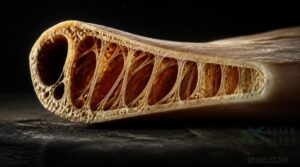
Inside a bird’s hollow bones, internal struts act like the load-bearing columns of a bridge — compact, precisely positioned, and essential. These vertical and diagonal reinforcements connect the inner cortex walls, forming a Strut Lattice Design that resists bending and torsion without adding bulk.
Their orientation aligns with the bone’s long axis, maximizing axial load resistance exactly where flight stresses concentrate most.
Trabecular Support Lattice
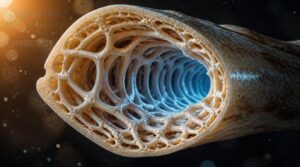
Those internal struts don’t work alone. They connect to a honeycomb-patterned trabecular system — a three-dimensional lattice of rods and plates aligned along primary stress directions.
This trabecular support lattice spreads mechanical forces across an internal matrix, so no single point bears the full load. The result is a skeletal strength-to-weight ratio that outperforms solid bone without the added mass.
Thin Outer Bone Walls
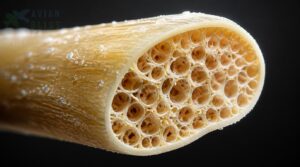
The trabecular lattice works precisely because the outer wall containing it is engineered to be thin. Wall thickness dynamics keep skeletal weight low while periosteal attachment anchors muscles and tendons directly to the surface, ensuring load transfers efficiently into the bone.
A collagen fiber alignment within the mineralized matrix resists torsional stress, while microspace arrangement and remodeling mechanisms continuously reinforce the wall against microdamage.
Resistance to Bending
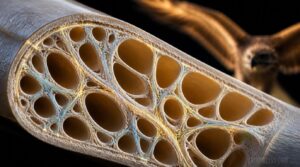
Hollow bones don’t just save weight — they’re built to bend without breaking.
Cross-sectional geometry, specifically oval and elliptical shapes, raises the moment of inertia, meaning the bone resists bending forces more effectively without adding mass. Redundant load paths through interconnected hollow compartments guarantee that stress redistributes when any single channel sustains micro-damage, protecting overall structural integrity.
Strength-to-weight Advantage
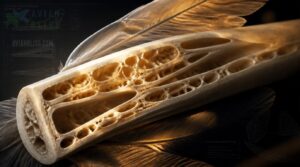
Bird bone architecture achieves skeletal strength-to-weight ratios that rival lightweight engineered metals — not by adding mass, but by optimizing how load distributes through hollow geometry. Pneumatic bones shed grams where solid tissue isn’t mechanically necessary, then redirect those savings into larger flight muscles.
The result is structural integrity without excess weight, and that balance is what keeps a bird airborne efficiently.
Hollow Bones Support Bird Breathing
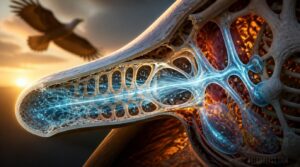
Bird bones don’t just reduce weight — they’re wired directly into the respiratory system in ways that go far deeper than most people expect. That connection between hollow bones and breathing is what allows birds to sustain the metabolic output that flight actually demands.
Here’s how that system works, piece by piece.
Connected Air Sacs
Think of a bird’s skeleton as more than just bones — it’s part of the air sac network, a system of seven to nine interconnected chambers extending directly from the lungs. These sacs drive Air Sac Ventilation by pushing air through the lungs continuously, and Skeletal Pneumatization links them to pneumatic bones, embedding the respiratory system throughout the skeleton itself.
A bird’s skeleton is not just bones — it is a living respiratory system, with air sacs woven directly through the hollow chambers within
- Cervical sacs ventilate the neck region
- Thoracic sacs connect to the mid-body airways
- Abdominal sacs regulate caudal airflow
Oxygen-rich Airflow
Once the air sac network sets air in motion, unidirectional flow ensures oxygenated air moves through the lungs in a single continuous direction — no back-and-forth mixing like in mammals. Acting as Air Sac Bellows, these chambers push fresh air across the gas-exchange surfaces constantly, enabling Alveolar Diffusion to occur at a higher rate and keeping oxygen flow steady even mid-wingbeat.
High Flight Metabolism
What does it actually take to power a bird through the sky? Powered flight imposes high metabolic demands that can run 150–300% higher than mammalian equivalents, requiring every biological system to operate at peak capacity.
- Aerobic Altitude Flight relies on elevated mitochondrial activity to sustain continuous wing movement
- Mitochondrial Muscle Density in flight muscles ensures rapid aerobic respiration without fatigue
- Mixed Fuel Strategy draws from carbohydrates, fats, and protein reserves during extended flight
- Oxygen Transport Efficiency depends on large lung capacity and high-performance hemoglobin binding
- Heat Production Metabolism generates warmth that helps birds maintain core temperature at altitude
Respiratory efficiency and skeletal strength-to-weight ratios work in concert here — hollow bones reduce mass so less energy gets spent on lift, freeing metabolic resources for sustained flapping. Bar-headed geese even reduce their flight metabolic rate in low-oxygen conditions, sustaining fully aerobic flight at extreme altitudes where most animals simply couldn’t cope.
Lung and Bone Integration
Here’s the Lung and Bone Integration section:
Hollow bones don’t just reduce weight — they’re wired into the respiratory system itself. Through a process called pneumatization, air sac diverticula extend directly into skeletal elements, creating what’s best described as a Respiratory Bone Interface that links the postcranial skeleton to active ventilation cycles.
| Integration Feature | Structural Component | Respiratory Function |
|---|---|---|
| Air Sac Connectivity | Abdominal & thoracic sacs | Drive unidirectional airflow through rigid lungs |
| Bone Ventilation System | Pneumatic foramina in humerus, vertebrae | Channel air through hollow cavities during flight |
| Gas Exchange Pathways | Parabronchi + capillary networks | Sustain oxygen delivery at peak metabolic demand |
This postcranial skeletal pneumaticity means broken pneumatic bones can directly disrupt breathing — a fact that underscores just how structurally merged these systems are. Aerodynamic Lung Support goes further still: inflation of certain air sacs increases the mechanical leverage of the pectoralis muscle, actively enhancing downstroke power during soaring. Respiratory efficiency, then, isn’t just about airflow — it’s about how deeply the skeleton and lungs have co-evolved into one unified system.
Efficient Gas Exchange
Bird lungs solve a problem mammals never could. Unidirectional airflow moves continuously through rigid parabronchi, keeping fresh air in near-constant contact with gas exchange surfaces — eliminating the stale-air mixing that limits mammalian lungs.
Thin barrier diffusion across air capillaries just cells thick, combined with ventilation-perfusion coupling, ensures oxygen crosses rapidly into blood exactly where and when flight demands it most.
Hollow Bones Help Regulate Heat
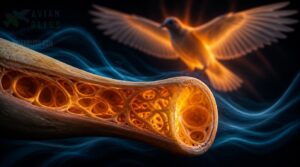
Flight burns serious energy, and all that effort generates a lot of heat inside a bird’s body. Hollow bones play a surprisingly active role in keeping that internal temperature in check. Here’s how that cooling system actually works.
Air Circulation Pathways
Think of a bird’s skeleton as a living ventilation system — pneumatic vascular network threaded with airflow routes that serve far more than structural purposes.
The bone ventilation system connects directly to the respiratory tract through air sacs, creating unidirectional airflow that cycles fresh air continuously through air-filled spaces, redistributing heat away from metabolically active tissue during sustained flight.
Flight Muscle Cooling
Flight muscles generate significant heat during wing flapping, raising core body temperature by roughly 1 to 2°C during sustained flight.
Air circulating through hollow bones and connected air sacs helps redistribute that excess heat away from active muscle tissue. Distal muscle cooling keeps wing-tip muscles operating at lower temperatures, preserving the rapid contraction cycles essential for precise, high-frequency wingbeats.
Internal Temperature Balance
Cooling active muscles is only part of the story.
Maintaining a stable core temperature requires blood vessel adjustments throughout the body — shifting circulation toward or away from the skin to precisely control how much heat escapes. This coordination between metabolic heat production and heat loss keeps internal organs functioning within their ideal range, regardless of how hard the bird is working.
Heat Stress Prevention
When the blood vessel adjustments described above aren’t enough, air-filled spaces within the bones provide a secondary buffer — circulating air through pneumatic cavities to draw away excess metabolic heat before it accumulates. This built-in thermoregulation through pneumaticity means the bird’s respiratory efficiency doubles as a cooling system, preventing heat stress even when metabolic rate spikes sharply during sustained flight.
Not All Bird Bones Are Hollow

Not every bone in a bird’s body follows the hollow blueprint — and that variation is actually by design. Different species have developed distinct bone structures depending on how they live, where they hunt, and what their bodies demand. Here’s what that looks like across the avian world.
Pneumatic Bones Explained
Not every bone in a bird’s body is hollow — and that distinction matters more than you might expect. Pneumatic bones are specifically those invaded by air sac diverticula during development, a process called pneumatic development that begins embryonically and continues as the bird matures.
Here’s what defines pneumatic bones structurally:
- Air channel network — continuous air pathways extend from the respiratory system directly into the bone cavity, maintaining active airflow rather than static air pockets.
- Structural load balance — internal trabeculae distribute mechanical stress across the hollow interior, preventing collapse despite reduced skeletal weight.
- Species-specific pneumatization — the humerus shows the greatest variation, while bones like the radius and ulna often retain marrow entirely.
Pneumaticity didn’t appear overnight. Its evolutionary origin story traces back to the Ornithodira clade, shared with ancestral theropod dinosaurs, suggesting hollow bones predate powered flight itself. This means the air sac–skeleton integration you see in modern birds is an ancient, deeply embedded solution — not a recent accident.
Marrow-filled Bird Bones
While pneumatic bones define much of a bird’s skeleton, marrow-filled bones play an equally critical role.
These non-pneumatic structures house red bone marrow, supporting Marrow Hematopoiesis — the continuous production of red blood cells essential for oxygen transport during high-exertion flight. Their Vascular Integration ensures nutrient-rich blood reaches bone surfaces efficiently, sustaining rapid cellular turnover during migration.
Diving Bird Adaptations
Diving birds take a different path — where flight demands lightness, underwater pursuit demands controlled negative buoyancy.
Species like penguins and auks have evolved denser bones that reduce the air-filled spaces typical of pneumatization, trading skeletal strength-to-weight ratios optimized for lift in exchange for the ability to descend without fighting constant upward resistance.
Flightless Bird Differences
Flightless birds like ostriches and cassowaries tell a completely different skeletal story. Without the demands of aerial lift, pneumatization decreases markedly, and bone density increases to support terrestrial locomotion. Their leg bones become sturdier, body mass grows larger, and wings shrink — a full locomotion style shift from sky to ground, where skeletal strength-to-weight ratios favor stability over lightness.
Species-specific Bone Density
No two bird species carry the same skeletal blueprint.
Leg bone density runs higher in ground-feeding passerines, while wing trabecular patterns grow denser near joint surfaces in parrots for shock absorption.
Waterfowl thicken pelvic bone walls for diving stress, and migratory species shift their seasonal density upward along the axial skeleton — proof that bone density is always negotiating between habitat, habit, and survival.
Hollow Bones Aid Reproduction

Hollow bones don’t just help birds fly — they play a surprisingly direct role in reproduction. When it’s time to lay eggs, a female bird’s skeleton actually becomes an active participant in the process. Here’s how that works across four key mechanisms.
Medullary Bone Formation
When a female bird enters her reproductive cycle, something notable happens inside her bones. Estrogen-driven formation triggers osteoblasts to flood the marrow cavities of long bones with a specialized tissue called medullary bone — a calcium-rich scaffold built specifically for reproduction.
This process follows a precise biological sequence:
- Estrogen signals osteoblasts to lay down a collagen matrix in the marrow cavity
- Rapid mineralization deposits calcium apatite crystals throughout that matrix
- The resulting tissue creates a calcium reservoir ready for eggshell formation
Unlike structural bone, medullary bone turns over quickly, governed by hormonal regulation mechanisms that tightly coordinate deposition with the laying cycle. Once eggshell formation ends, the bone resorption cycle reclaims those minerals, returning the tissue to baseline through active skeletal mineralization and bone remodeling until the next clutch begins.
Eggshell Calcium Storage
The eggshell itself is a notable calcium reservoir, storing roughly 95 percent of its mass as calcium carbonate — a mineral reserve that forms during a tightly controlled 18–28 hour window in the shell gland. During this window, eggshell deposition draws from both dietary calcium and medullary bone stores, with specialized transport proteins coordinating absorption to meet the shell’s precise mineralization demands.
Female Bird Calcium Needs
Meeting those demands isn’t passive — laying hens need roughly 4 to 5 grams of daily calcium at peak production, sourced through dietary calcium from feeds, oyster shell supplements, and vitamin D3, which drives intestinal absorption.
When diet falls short, medullary bone calcium reserves fill the gap, though heavy reliance on bone calcium risks weakening the skeleton over time.
Seasonal Calcium Mobilization
Calcium Reserve Timing shifts in sync with the breeding season — not by accident, but by design.
As day length increases, photoperiod calcium control triggers hormonal cascades that prime medullary bone for rapid resorption. Estrogen and parathyroid hormone–like signals rise together, accelerating bone remodeling cycles so calcium floods the bloodstream precisely when the shell gland demands it most.
Frequently Asked Questions (FAQs)
Why are bones in birds hollow?
Birds have hollow bones — a marvel of evolutionary engineering — that reduce skeletal mass while preserving structural strength through internal trabeculae, enabling efficient flight by lowering inertia, improving aerodynamic performance, and supporting the metabolic demands of sustained aerial movement.
Why are bird bones hollow?
Avian hollow bones evolved through pneumaticity — air sacs invading the skeletal framework — reducing mass while trabeculae maintain structural integrity. This skeletal strength-to-weight ratio provides a foundation for flight, respiration, and calcium storage simultaneously.
Why do flight birds have fewer hollow bones?
Not every bone in a flying bird’s skeleton is hollow. Bones like the radius and ulna often retain dense marrow, balancing structural demands where hollow cavities would compromise mechanical load distribution.
Why is a bird’s beak hollow?
A bird’s beak is partially hollow to reduce weight while maintaining structural integrity. Air spaces connect to skull cavities, supporting efficient feeding movements and heat dissipation through controlled blood flow in its keratin-covered core.
Why do migratory birds have hollow bones?
Migratory birds rely on hollow bones to stretch every calorie across thousands of kilometers, trimming skeletal mass so their aerodynamic lift ratio stays high even when fat reserves run low.
Are hollow bones bad for birds?
It’s not all sunshine and rainbows. Hollow bones increase fracture susceptibility and slow healing, but the skeletal strength-to-weight ratio and internal struts make these mechanical trade-offs worthwhile for flight.
Why are bird bones so strong?
Despite being hollow, bird bones are remarkably strong because dense cortical bone, internal struts, and a honeycomb trabecular system distribute loads efficiently — achieving unparalleled skeletal strength-to-weight ratios with minimal mass.
Why do birds have bones?
Bones give birds structure, support, and movement. Without them, muscles would have nothing to anchor to, organs would lack protection, and coordinated flight would be impossible — making the skeleton fundamental to every function in avian biology.
Are birds’ hollow bones good for reducing weight?
Yes — hollow bones reduce weight considerably. By replacing dense marrow with air, birds lower their bone density and overall mass, making lift far less energy-costly while preserving the structural integrity needed for flight.
Why do seabirds have hollow bones?
Seabirds like albatrosses ride the ocean winds for months without rest. Their hollow bones cut body mass by up to 25%, balancing buoyancy control with the demands of relentless, high-efficiency flight.
Conclusion
The bones that make birds lighter are, counterintuitively, what make them structurally sound—a paradox that reframes the entire story. When you understand why birds have hollow bones, you’re really tracing a blueprint where less material consistently delivers more function.
Each air-filled cavity doubles as a breathing chamber, a cooling duct, and a seasonal calcium reserve. What looks like absence is, by every measurable standard, the most purposeful design sustained flight has ever produced.