
This site is supported by our readers. We may earn a commission, at no cost to you, if you purchase through links.

Most people glance at an American coot and assume it’s a duck. It’s not. Not even close. Coots belong to the rail family, and once you know what to look for — that stark white bill, the blood-red eye, the lobed toes built like nature’s snowshoes — you won’t mix them up again.
These birds are everywhere across North America, from Alaskan wetlands down to Mexican coastlines, yet most people walk right past them. They swim like ducks, bob their heads like pigeons, and sprint across water like they forgot they can fly.
Everything about the coot is built for a life spent moving through the awkward edge between land and water — and the details are worth knowing.
Table Of Contents
Key Takeaways
- The American coot (Fulica americana) isn’t a duck — it’s a rail family bird with lobed toes, a white bill, and red eyes that make it unmistakable once you know what to look for.
- Its lobed toes are a multi-purpose adaptation: they generate thrust underwater, spread weight across soft mud, and grip uneven shorelines — all without a single patch of webbing.
- Coots thrive across an unusually wide range of habitats, from Alaskan boreal ponds to coastal saltmarshes, because their diet shifts just as flexibly — aquatic plants, algae, insects, and small fish all make the menu.
- With an estimated 3–7 million birds across North America and IUCN Least Concern status, the coot is one of the continent’s most abundant waterbirds — proof that quiet adaptability outlasts specialization.
American Coot Identification
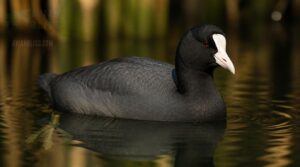
The American coot has a look that’s easy to remember once you know what to check. It belongs to the species Fulica americana, and a handful of physical traits set it apart from other waterbirds at a glance. Here’s what to look for when you spot one.
Its most striking features — jet-black plumage and vivid red eyes — make it one of the more distinctive black birds with red eyes you’re likely to encounter on North American waterways.
Scientific Classification
The American coot’s scientific name, Fulica americana, is rooted in the Linnaean system — a hierarchical framework built on shared traits and evolutionary relationships that has guided biology for centuries:
- Kingdom: Animalia
- Class: Aves
- Order: Gruiformes
- Family: Rallidae
- Genus: Fulica
In avian biology and ornithology, the Rallidae family links coots closely to rails. Phylogenetic clades also connect them to sandhill cranes. This categorization is part of a broader scientific classification of things used to organize the natural world.
Size and Weight
Taxonomy tells you what a coot is — size tells you what to look for in the field.
Adults measure 31 to 40 cm in length with a wingspan around 52 to 60 cm. Most weigh 400 to 500 grams, though fat reserves before migration push that higher. Think slightly smaller than a typical diving duck, compact and low-riding on the water.
Dark Plumage
Size gives you the shape — plumage seals the ID. The American coot wears dark-gray to black body feathers, with the head and neck going nearly all-black.
That depth comes from eumelanin pigment regulation, which drives color from charcoal gray to near-black depending on feather region. Melanin-rich feathers also resist wear and may aid thermoregulation by absorbing heat in cooler conditions.
White Bill
That near-black plumage makes the white bill pop like a beacon. Measuring roughly 1.5 to 2 inches, it’s broad, blunt-tipped, and slightly spoon-shaped — built for scooping vegetation, not tearing prey.
Visual contrast is the point: against dark feathers, that pale bill makes waterfowl identification a breeze, even across a busy pond.
Red Eyes
Those bright red eyes are one of the American coot’s most striking field marks. The vivid color comes from pigmentation in the iris itself — not inflammation or irritation.
That red-on-black contrast makes coots easy to confirm at a glance, even from a distance.
Distinctive Feet and Movement
The American coot’s feet are unlike anything you’d expect from a waterbird. Instead of the classic webbed toes you see on ducks, coots have something far more adaptable — and it shapes nearly everything about how they move. Here’s what makes their feet so distinctive, and how that design plays out across different environments.
Their lobed toes grip uneven terrain and sloped edges with surprising ease, much like the gentle gradients found in a shallow bird bath designed for wading birds.
Lobed Toes

The American coot’s lobed toes aren’t webbed — each toe carries fleshy flaps that open and close with every stroke, a sharp example of evolutionary adaptation in avian morphology.
These lobes serve five distinct functions:
- Generate thrust during the power stroke
- Retract to reduce drag on recovery
- Distribute weight across soft mud
- Grip wet, uneven shorelines
- Enable precise aquatic maneuverability
Bird identification doesn’t get more functional than this.
Swimming and Diving
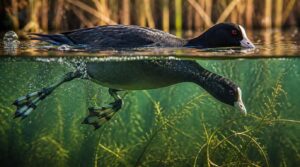
Watching a coot slip underwater looks easy — until you realize no webbing is involved.
Those lobed feet do the real work, sculling backward with each powerful stroke. Dives stay shallow and brief, just a few seconds, before the bird pops back up to breathe.
| Movement Type | Key Feature |
|---|---|
| Underwater propulsion | Lobed feet generate thrust |
| Dive duration | Seconds-long, oxygen-efficient |
| Submerged foraging | Bill grabs vegetation below surface |
| Air management | Rapid resurface, minimal apnea |
| Aquatic movement cues | Head aligned to reduce drag |
Short dives. Smart foraging. Clean execution.
Walking on Mud
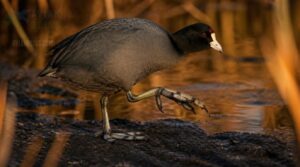
Those broad lobes of skin spread weight across mucky ground the way a snowshoe does — preventing the deep sinkage that traps narrower feet. Each step lands toe-first, breaking suction before the heel lifts free.
Short, deliberate strides keep balance steady on shifting wetland terrain. For a bird that splits time between water and land, that’s a quietly impressive adaptation.
Running Takeoffs
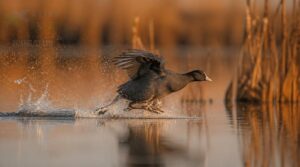
Getting airborne isn’t graceful for the American Coot. With a heavy, plump body and short wings, it needs a long running takeoff — sprinting across the water’s surface before lift happens. Three things make this work:
- Elastic recoil in the leg tendons stores energy with each stride
- Rapid impulse conversion launches momentum upward
- Ground contact timing shortens as takeoff velocity builds
Worth the effort, though.
Chickenlike Gait
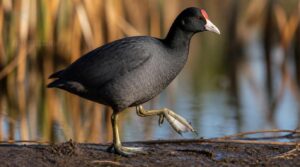
On land, the coot moves with a precise, upright stride that earns it the "chickenlike" label every time. Each step lifts cleanly — compact footfall, minimal lateral drift, weight kept tight over the feet.
Neck and trunk adjustments do the balancing work, so the bird stays nimble across muddy banks. For an aquatic bird, it walks with surprisingly quiet, controlled confidence.
American Coot Habitat and Range

The American coot isn’t picky about where it sets up camp — it’s one of the most adaptable waterbirds on the continent.
You’ll find it spread across a surprisingly wide range of environments, from quiet inland wetlands to bustling coastal bays. Here’s a look at the main habitat types and regions where American coots actually live.
Freshwater Wetlands
Freshwater wetlands are the American Coot’s home base. These ecosystems flood seasonally, peaking in spring from snowmelt, then slowly release water — attenuating flood peaks and filtering pollutants along the way.
Their soils store vast amounts of carbon and drive nutrient cycling that sustains the aquatic plants coots depend on. Wetland connectivity also links habitats, giving these birds room to move.
Lakes and Ponds
Lakes and ponds are two of the most reliable habitats you’ll find American Coots using year-round.
Lakes offer thermal stratification and deeper littoral zones teeming with rooted plants — prime foraging territory. Ponds trade depth for dense edge vegetation and nutrient accumulation, drawing coots into shallower margins. Both suit a bird equally comfortable paddling, diving, or grazing along a muddy shoreline.
Coastal Saltmarshes
Coots don’t stop at freshwater. Coastal saltmarshes — layered by tidal elevation zones and packed with halophytic vegetation — draw them in during migration and winter.
- Channels drain between tidal cycles, exposing invertebrates
- Sediment accretion builds stable foraging flats over time
- Halophytic cordgrass shelters aquatic birds from wind and predators
- Marshes provide carbon sequestration and coastal flood defense
Saltwater’s no obstacle for a bird this adaptable.
North American Range
From saltmarshes to boreal ponds, the American coot covers an impressive sweep of North America’s wetland landscape — Alaska and Canada down through the U.S. into northern Mexico.
Seasonal migration shifts push populations along river corridors as water availability changes. Wetland connectivity patterns matter here; coots concentrate where habitat chains hold. Latitudinal density trends show higher numbers across central and eastern regions, where extensive freshwater systems are most abundant.
Wintering Areas
When winter arrives, American coots scatter across a surprisingly wide range of wintering areas.
They favor three main habitat types:
- Coastal lagoon survival in sheltered bays with moderate salinity
- Inland reservoir foraging along ice-free coves rich in aquatic vegetation
- Delta habitat diversity, where mudflats and reed beds offer varied forage
Protected reserve fidelity is strong — birds return to the same managed wetlands year after year.
Diet and Feeding Behavior
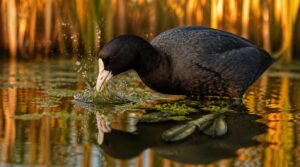
The American coot isn’t picky — it’ll eat just about anything the water offers up. Its feeding strategy shifts depending on what’s available, which is a big reason this bird thrives across so many different environments. Here’s a closer look at what’s on the menu and how it goes about getting it.
Aquatic Plants
Aquatic plants form the backbone of the American coot’s diet. These birds target emergent marsh vegetation like cattails, whose roots filter excess nutrients from wetland ecosystems. Submerged species produce oxygen and shelter invertebrates, making them doubly valuable.
Coots use several foraging methods to reach plant material — dabbling at the surface or diving to pull up stems anchored below.
Algae and Seeds
Algae might look like pond scum, but it’s a nutrient-rich food source coots actively seek out. It delivers proteins, omega-3s, and natural antioxidants — a compact nutritional package.
Seeds round out the picture. Their omnivorous feeding habits mean coots don’t pass up seeds drifting on the surface or tucked among vegetation, grabbing whatever the water offers.
Insects and Fish
Coots are opportunistic feeders — insects and small fish round out what’s already a varied menu.
Aquatic insect nutrition packs serious value: mayflies, caddisflies, and chironomid larvae deliver high protein, omega-3 fatty acids, and key minerals. When emergence events bring swarms to the surface, coots don’t miss the window. Small fish get taken too, easy targets for a bird comfortable both above and below water.
Surface Dabbling
Surface dabbling is the coot’s go-to move — tip forward, skim the surface, grab what’s there. It targets surface vegetation like duckweed and pondweed without a full dive, keeping foraging efficiency high.
For a Rallidae family bird that feeds constantly throughout the day, staying near the surface cuts energy costs while still delivering solid aquatic plant consumption.
Underwater Foraging
When a waterfowl dives below the surface, everything changes. Coots shift from dabbling to diving based on what water clarity reveals beneath them — clearer water means better prey detection, longer bottom time, and higher strike success against submerged plants and invertebrates.
- Rapid, repeated dives probe specific prey patches
- Bottom time targets the prey layer directly
- Clearer water boosts dive frequency
- Turbid conditions reduce foraging efficiency
- Prey density drives underwater strike success
Nesting, Chicks, and Conservation

Regarding raising their young, American coots are surprisingly deliberate about it. From choosing where to build their nests to how they share parenting duties, every step follows a clear pattern worth knowing. Here’s a closer look at what that process actually looks like.
Floating Nest Sites
Building a nest on water sounds risky, but American coots pull it off with surprising reliability. They weave dead cattails and sedges into a buoyant raft anchored to submerged stems — rising and falling with water levels automatically.
This design keeps eggs dry during floods and hides the nest within marsh vegetation, making it harder for predators to spot.
Clutch Size
Once the nest is built, egg-laying begins in earnest. A typical clutch holds 6 to 12 eggs, though many broods average closer to 9 or 10.
Conditions drive that range — food abundance before laying, predation pressure, and wetland quality all push the number up or down. Northern populations sometimes lay smaller clutches, reflecting the shorter, less predictable breeding window they’re working with.
Shared Incubation
Once those eggs are laid, both parents share incubation duties across 21 to 25 days. They swap shifts using vocal calls and subtle posture shifts — no dramatic displays, just quiet coordination.
This shared incubation keeps temperatures stable and reduces each bird’s energetic burden. Consistent nest coverage is what tips the scales toward a successful hatch.
Colorful Chicks
When those eggs finally hatch, the chicks look nothing like their parents. Newly hatched American coots sport striking orange-red feathers, beaks, and heads — a surprising splash of color for a largely dark-plumaged species.
That color isn’t random. It drives parental feeding bias, with more vividly colored chicks receiving more food during the breeding season — a clear evolutionary survival signal baked into waterfowl biology.
In American coots, brighter chick coloring earns more food — evolution’s way of rewarding survival signals
Least Concern Status
Adaptability tells its own story. The American coot holds an IUCN Least Concern status — meaning populations are stable, widespread, and well above decline thresholds. Its habitat versatility across freshwater wetlands, saltmarshes, and city ponds keeps numbers healthy continent-wide.
That’s why conservation resources flow toward more threatened species. Even so, monitoring continues, since environmental shifts can quietly change a species’ outlook.
Frequently Asked Questions (FAQs)
Is American coot rare?
Rare? Hardly. This waterbird enjoys Least Concern status, with stable populations spread across North American wetlands.
Wetland availability drives regional fluctuations, but overall wildlife population trends remain strong — you’ll spot one almost anywhere open water exists.
Can an American coot fly?
Yes, they can fly. Running takeoffs across water build the momentum their short, rounded wings need for lift. Once airborne, coots fly well enough to migrate across North America.
Do American Coots dive underwater?
Diving underwater is a regular part of how coots feed. They use their lobed feet to propel themselves beneath the surface, reaching several feet deep to access submerged vegetation — with water clarity dictating how far down they go.
What is a waterborne American coot?
Waterborne simply means on or in the water. For this wetland species, that’s home turf — swimming, diving, and foraging across open water with ease, thanks to those lobed toes built for aquatic life.
Where can I find American coots?
You’re in luck — these birds don’t play hard to find. Check freshwater wetlands, urban ponds, coastal saltmarshes, roadside ditches, and even sewage treatment ponds. They’re practically everywhere open water exists.
What does American coot mean?
The name "coot" traces back to Middle English and refers to a waterbird in the rail family — Fulica americana specifically. That nickname "mud hen" stuck regionally, reflecting how often you’ll spot them wading through wetland muck.
Are American coots a duck?
No, despite their duck-like lifestyle, they’re rail family birds — Rallidae, not waterfowl. Their lobed toes, not webbed feet, and chickenlike gait set them apart from any true duck species.
Where do you find American Coots?
Freshwater marshes, ponds, and lakes are their main territory across North America. You’ll also spot them in coastal estuaries and city park ponds — pretty much anywhere shallow, open water exists.
Are American Coots good to eat?
Some game birds surprise you at the table — this one’s no exception. The meat is lean and protein-rich, but its bold, gamey flavor rewards slow braising and careful fat trimming to get it right.
Are American Coots rare?
No, they’re far from rare. With an estimated 3 to 7 million birds across North America, American Coots rank among the continent’s most abundant waterbirds, holding a Least Concern conservation status.
Conclusion
The coot doesn’t ask permission to belong. It shows up on lakes, marshes, and muddy shorelines — and makes itself at home with zero fanfare. The American coot is proof that the most overlooked creature in any wetland is often the most interesting one.
White bill, red eye, lobed toes — once you see those details, you can’t unsee them. Next time one bobs past your dock, you’ll finally know exactly what you’re looking at.
- https://projectupland.com/waterfowl/american-coot-identification-habitat-conservation-hunting
- https://holdenfg.org/nature-profiles/american-coot
- https://birdsoftheworld.org/bow/species/y00475/cur/foodhabits
- https://www.audubon.org/field-guide/bird/american-coot
- https://fieldguide.mt.gov/speciesDetail.aspx?elcode=abnme14020