This site is supported by our readers. We may earn a commission, at no cost to you, if you purchase through links.
A Snowy Owl perched on a rooftop in suburban Boston stops traffic—not because owls don’t belong in cities, but because most people never expect one.
Rare winter bird sightings work that way: they arrive unannounced, reshape a whole morning, and remind you that migration is far stranger than any field guide suggests.
Lemming crashes in the Arctic push Bubo scandiacus south. Storm tracks deposit Siberian vagrants on North American coastlines. Sea-ice shifts nudge Ross’s Gull into landlocked provinces.
Each sighting tells a story about something bigger happening out there—and knowing what to look for means you won’t miss the next one.
Table Of Contents
Key Takeaways
- Rare winter birds like Snowy Owls (Bubo scandiacus) and Ross’s Gull (Rhodostethia rosea) show up far outside their normal range because of real ecological triggers—lemming crashes, sea‑ice shifts, and storm tracks—not random chance.
- Coastal corridors, wetlands, and estuaries are your best bets for rare sightings because these habitats consistently deliver the food and shelter that displaced birds are looking for.
- A solid ID comes down to a handful of field marks—size, bill shape, wing pattern, and call—so document everything with photos and audio the moment you spot something unusual.
- Every sighting you report through eBird or submit with proper documentation doesn’t just feed your life list—it becomes real data that researchers and conservationists build on.
Rare Winter Birds to Watch
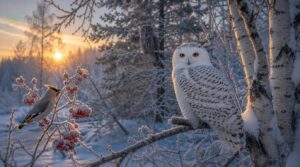
Winter has a way of surprising even seasoned birders with species you’d never expect to see outside their normal range.
Brushing up on identifying birds across different seasons gives you a solid baseline, so those unexpected winter visitors stand out immediately rather than leaving you second-guessing.
A handful of birds consistently steal the show during the cold months, showing up far from home and drawing crowds with binoculars from miles around.
Here are the ones worth keeping an eye out for this season.
Snowy Owl Irruptions
When the Arctic teems with lemmings, Snowy Owl broods boom — and that surplus pushes juveniles hundreds of miles south.
These irruption years aren’t random. They follow prey cycles closely.
You’ll spot Bubo scandiacus on open coastlines, farm fields, even city rooftops.
Check eBird alerts regularly — population peaks can appear fast and move faster.
Recent studies link the high lemming abundance to these massive irruptions.
Ross’s Gull Sightings
If Snowy Owls follow prey cycles south, Ross’s Gull (Rhodostethia rosea) follows something harder to predict — sea ice. Alberta’s first confirmed sighting landed in 2025, proving these birds turn up far inland.
Breeding mainly in northeast Siberia, they’re rarely seen outside high latitudes.
Check your bird sighting database and submit photos immediately — clear documentation makes every record count.
Whooping Crane Reports
From ice-edge rarities to open sky giants — the Whooping Crane (Grus americana) is a different kind of thrill. Spot one and you’re witnessing a conservation comeback.
- Satellite tags track exact migration corridor routes
- Aerial counts confirm wintering numbers in Texas
- Breeding pair monitoring measures annual recovery progress
Use eBird alerts to catch reported sightings fast.
Eurasian Wigeon Vagrants
After the Whooping Crane’s dramatic comeback story, the Eurasian Wigeon offers a quieter but equally exciting puzzle. This Old World duck occasionally rides cross-continental storm tracks all the way to North American wetlands.
Males show a pale yellow crown and chestnut head — hard to miss in a mixed flock.
Log your sighting on eBird alerts immediately.
Rare Gulls and Terns
Gulls and terns are easy to overlook, but a few rare species make winter birding genuinely exciting. The Gull-billed Tern (Gelochelidon nilotica) is one to know — its short, stout black bill sets it apart fast.
Missouri logged its first confirmed sighting in 2025.
Spot unusual bill shapes or non-breeding white foreheads, and document everything with photos immediately.
Why Rare Winter Sightings Happen
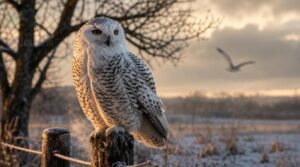
Rare winter birds don’t just show up by accident — there’s always a reason they’re far from home. A handful of forces push them off their usual paths and into your backyard or local patch. Here’s what’s actually driving those unexpected sightings.
Every rare winter bird has a reason for being far from home
Storm-Driven Vagrancy
Think of a major storm as nature’s slingshot. Storm-driven vagrancy happens when powerful low-pressure systems push birds hundreds — sometimes thousands — of kilometers off course in days.
Younger birds are displaced most often. These storm-carved highways redirect vagrant bird sightings toward unexpected coastlines.
Use real-time vagrant alerts on eBird to catch weather-driven displacement as it unfolds.
Arctic Food Shortages
When food runs short in the Arctic, birds move. Subsistence hunting challenges and warming winters push species like Snowy Owls far beyond their usual range, straight into your binoculars’ reach. Supply chain disruptions reduce prey availability, triggering irruptions that the birdwatching community eagerly tracks.
Keep your bird identification guides ready — Arctic food shortages are quietly one of winter’s best gifts to birders.
Shifting Migration Routes
Migration routes aren’t fixed — they shift with conditions year after year.
Birds moving inland corridors dodge coastal storms, following rivers and lake systems south instead.
Temperature detours nudge species further north during mild winters, then snap them southward fast when cold hits.
Food supply shifts redirect whole flocks to new wetlands.
Your birding community reports often catch these changes first.
Extreme Weather Patterns
Extreme weather doesn’t just change the forecast — it rewrites the map for rare birds. Here’s what’s pushing unusual species into your binoculars:
- Heat wave displacement pushes species north into unfamiliar territory
- Tropical cyclones scatter birds like flamingos hundreds of miles off course
- Heavy rainfall floods traditional habitats, forcing birds to relocate fast
- Arctic warming destabilizes winter movements across entire flyways
- Drought stress redirects flocks toward any available wetland
Long-Staying Winter Vagrants
Some rare birds don’t just pass through — they settle in. Long-staying winter vagrants like Eurasian Wigeon and Ross’s Gull can occupy the same coastal bay or estuary for an entire season.
They pick spots where food holds steady and habitat stays stable. During the winter birding doldrums, these reliable returners give you something real to chase.
Best Winter Birding Hotspots
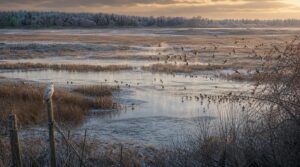
Some places just hold birds the way a good harbor holds ships — reliably, year after year. Winter rarities don’t show up randomly; they gravitate toward specific landscapes that deliver food, shelter, and the right geography. Here are the hotspots worth putting on your map.
Coastal Migration Corridors
The coastline isn’t just scenery — it’s a migration highway. Tidal flats, salt marshes, and nearshore channels form a linked system that guides shorebirds and waterfowl along predictable seasonal paths.
Upwelling zones near caps create reliable feeding stops, while shelfbreak currents funnel species toward favored travel lanes.
Log what you see in the eBird database to help map these corridors accurately.
Wetlands and Estuaries
Wetlands and estuaries are some of the best places to find rare winter birds. Estuary migration stopovers attract species like herons, egrets, and rare gulls.
Salt marshes offer salt marsh invertebrates that keep shorebirds feeding all season.
Log your sightings in the eBird database to support winter birdwatching records and help track rare bird sightings across wetland habitats.
Pacific Pelagic Routes
The open Pacific is a different world entirely. Central North Pacific corridors funnel pelagic seabirds like albatrosses and shearwaters between Hawaii and the mainland — following oceanographic fronts where prey concentrates.
Satellite tracking now maps these routes precisely.
Storm-blown Pacific wanderers occasionally appear along the West Coast, making real-time eBird alerts your best tool for catching rare pelagic sightings before they disappear.
Southern Winter Refuges
While the Pacific pushes birds north and west, the South pulls them in quietly.
Southern winter refuges — salt marshes, riparian corridors, citrus groves, and offshore islands — act as thermal buffers when cold snaps hit. Birds like rare gulls and wading species settle into these stable microhabitats, where unfrozen water and prey stay accessible all winter long.
Arctic Stopover Zones
Arctic stopover zones are some of the most productive birding hotspots on the continent. Here, shorebird refueling happens fast — birds pack intertidal flats, timing feeds to tidal cycles. Watch for these key features:
- Shallow mud flats for intertidal feeding
- Sheltered bays as tidal roosting sites
- Ice edge zones for ice edge foraging
- Conservation monitoring stations tracking rare birds
How to Identify Rare Birds
Spotting a rare bird is one thing — knowing what you’re actually looking at is another. A solid ID comes down to a handful of reliable steps, and each one builds your confidence fast. Here’s what to focus on when you’re in the field.
Field Marks to Check
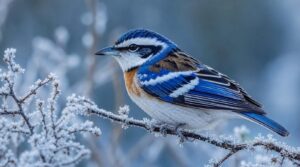
Every rare bird tells its story through field marks — you just need to know where to look.
Start with size and silhouette: does the bird’s overall shape match what your field guide shows? Then move to color patterns on the head, back, and wings.
Check beak shape and length carefully. Note wing markings, tail shape, and leg color.
These details separate a genuine rarity from a lookalike.
Compare Similar Species
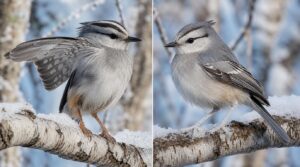
Once you’ve spotted a rarity, the real test begins: does it actually match the species you think it is?
Similar species can fool even experienced birders.
Check wingspan — one species may be 10% larger than its lookalike. Compare crown patterns, leg color, and underwing markings.
A sharp screech versus a soft chatter often settles the ID fast.
Photograph Key Features
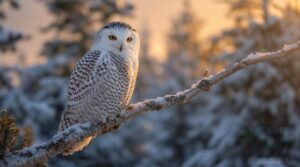
A good photo is your strongest proof. Light exposure shapes everything — shoot in soft morning light to avoid blown-out whites on a Snowy Owl’s plumage. Use focus depth to isolate your subject sharply against a blurred background.
Keep these priorities in mind:
- Rule of thirds — position the bird off-center for natural framing
- Color contrast — highlight field marks against the background
- Image noise — use lower ISO settings in dim conditions
- Capture multiple angles for thorough photographic documentation
Record Calls and Behavior
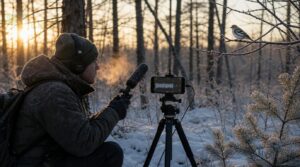
Sound is half the story. A bird’s vocalization patterns can confirm what your eyes alone can’t.
Use a directional microphone at dawn, when calls peak. Tag each field recording with GPS coordinates and the time. Then cross-reference against field guides for call analysis.
Behavioral signals matter too — watch for alarm calls, which spike near predators.
Note Weather and Habitat

Weather shapes where rare birds show up just as much as wings do. Snow depth patterns push ground feeders toward exposed riverbanks, while thermal refuge spots near springs draw mixed congregations when lakes freeze solid. Open water bends along rivers concentrate waterfowl mid-winter.
- Log wind direction
- Note cloud cover
- Record temperature
- Mark habitat type
Reporting Rare Winter Bird Sightings
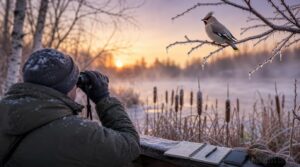
You’ve done the hard work of finding and identifying a rare bird—now it’s time to make that sighting count. Reporting it the right way gets your data into the hands of researchers, conservationists, and fellow birders who can act on it. Here’s how to do it properly.
Use EBird Alerts
Once you’ve spotted something unusual in the field, eBird Alerts are your fastest way to share it — and to find out if others have too. Set up an account, pick your regions, and choose a daily email cadence so fresh reports land in your inbox every morning.
Enable photo target alerts for species you haven’t documented yet. Real-time birding data, right in your pocket.
Check ABA Rarity Codes
Once eBird flags something unusual, cross-check it against ABA rarity codes to understand what you’re actually dealing with. A Code 3 means the bird shows up annually but rarely — that’s already worth reporting fast. Codes 4 and 5 signal something genuinely notable.
- Code 3 – rare but annual
- Code 4 – casual, few records
- Code 5 – accidental occurrence
- Code 6 – extinct or unrecorded
Submit Clear Documentation
Once you’ve confirmed the rarity code, documentation is your next move. Submit within 48 hours — memories fade and details blur fast.
| Field | What to Include |
|---|---|
| Observer Info | Name, contact, affiliation |
| ISO Timestamp | Date and time in ISO 8601 format |
| Photo Naming | Species, date, photographer initials |
| Location Data | Decimal-degree coordinates |
| Confidence Flag | Certainty level, any missing fields |
Use a Standardized Data Template and back up everything locally before uploading to eBird.
Join Local Birding Groups
Once your documentation is submitted, connect with your local birding community. Local clubs publish Club Meeting Schedules and welcome all skill levels.
Community Bird Walks sharpen your bird identification skills fast. Many groups share birding alerts and run Volunteer Conservation Projects together.
A Guided Field Trip with an expert can turn a rare sighting experience into a real learning moment.
Support Conservation Records
Every rare sighting you record becomes part of something bigger. Your notes feed citizen science databases that track population trends and flag declining species. Follow these four steps to support strong conservation records:
- Log metadata consistently — date, location, weather, behavior
- Include photos with secure backup copies
- Share data through platforms with access controls
- Support audit procedures by verifying your submissions
Your record could help confirm a state first.
Frequently Asked Questions (FAQs)
Which apps send alerts for rare winter sightings?
Want to stay ahead of every rare sighting? eBird’s alert system and Merlin Bird ID push real-time notifications straight to your phone, while BirdAlertPRO lets you customize filters by species rarity and distance.
How do storms create unexpected bird vagrancy events?
Storms knock birds off course fast. Magnetic field disruption scrambles their internal compass, while wind drift effects push them hundreds of kilometers sideways. Forced landfall patterns then strand them far from home.
Which states record the most rare winter birds?
Alaska leads the flock — followed by California, Texas, Florida, and the Pacific Northwest. These states dominate rare winter records thanks to coastal corridors, Gulf habitats, and Arctic irruption pathways tracked through eBird and state birding data.
How do researchers track snowy owls during irruptions?
Researchers fit Snowy Owls (Bubo scandiacus) with solar-powered GPS transmitters that log thousands of location fixes per bird.
Movement state modeling then separates hunting bouts from travel, revealing how irrupting owls use habitats across winter landscapes.
Conclusion
Most birders spend winters glued to heated feeders, convinced nothing interesting happens until April. Nature, as usual, disagrees.
Rare winter bird sightings don’t wait for convenient weather or predictable schedules—they show up on the coldest mornings, in the least-expected places, for the birders paying attention.
So grab your binoculars, check eBird before you assume the marsh is empty, and document what you find. The field notes you submit today become the science someone builds on tomorrow.
- https://a-z-animals.com/articles/you-may-have-the-chance-to-see-a-snowy-owl-this-winter
- https://www.nvbirdalliance.org/news/winter-irruptions
- https://blog.nature.org/2017/01/18/what-northern-birds-your-feeder-year-irruption-snowy-owls
- https://mountainbluebirdtours.com/blog/f/the-thing-with-winter-finches
- https://www.audubon.org/news/keeping-track-these-boreal-nomads-notoriously-difficult