This site is supported by our readers. We may earn a commission, at no cost to you, if you purchase through links.
A warbler flits through dense canopy for three seconds—maybe four—before vanishing. That window is all you get, and whether you nail the ID often comes down to one thing: what your glass shows you in that moment.
Birders obsess over field marks, but cheap optics muddy the very details you’re hunting for. Color halos bleed across feather edges. White underparts flatten into gray wash. Wing bars disappear near the frame’s edge.
The connection between binocular lens quality and accurate bird identification runs deeper than most birders realize, touching everything from glass chemistry to prism geometry to how light actually reaches your eye.
Table Of Contents
Key Takeaways
- Cheap optics blur the exact feather edges, wing bars, and color patches you need for a confident ID—your glass quality decides the call before the bird even moves.
- 8×42 setup hits the sweet spot for all‑day birding: steady enough to track fast movers, bright enough for dawn light, and light enough to carry without fatigue.
- ED glass and fully multi‑coated lenses push light transmission above 95%, keeping colors true and wing bar detail crisp—especially critical on distant small birds in backlit conditions.
- Wide field of view, close focus under 2.5 meters, and edge‑to‑edge sharpness work together as a system—miss any one of them and you’ll lose the bird at the worst moment.
How Lens Quality Shapes Bird Identification
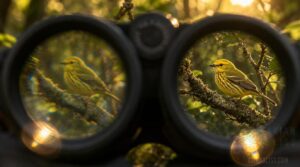
The glass inside your binoculars does more work than most birders realize. When you’re trying to nail a split-second ID on a distant warbler, lens quality is often the difference between a confirmed sighting and a frustrating maybe. Here’s how optical clarity shapes what you actually see in the field.
If you’re shopping for your next pair, this guide to binoculars for bird watching in forest habitats breaks down exactly which optical features matter most when light is low and the canopy is dense.
Why Optical Clarity Matters for Birders
When you’re trying to pick out a Black-throated Blue Warbler from a cluttered understory, optical clarity is everything. Blurry edges and washed-out color don’t just look bad — they actively hide the field marks you need.
Your binoculars have one job: to show you the bird as it actually is. The 8×42 design with a field-flattener lens system provides the widest field of view for tracking fast‑moving birds.
The Link Between Glass Quality and Field ID
Glass quality directly shapes what you see in the field.
Uniform glass thickness keeps color consistent from center to edge, so subtle plumage differences — like the bluish gloss on a grackle’s back — stay accurate. Fully multi-coated lenses push light transmission to 90–95%, maintaining true feather colors even at dawn.
Without that, your field identification suffers before the bird even moves.
How Poor Optics Mask Key Field Marks
Poor optical quality costs you the ID before you even raise your bins.
Ghost image interference duplicates features, light scatter masking flattens white underparts, and color fringe blur smears diagnostic patches into noise. Vignetting edge obscuration hides wing bars near the frame boundary, while contrast loss effects erase the subtle plumage tones that separate similar species.
Magnification and Objective Lens Size Explained
Two numbers define almost every binocular decision you’ll make: magnification and objective lens diameter. Get them right, and you’ll spot field marks faster with less eye strain. Here’s what those numbers actually mean for birding.
8× Vs. 10× for Identifying Birds
Magnification choice is one of the most practical decisions you’ll make as a birder. 8× vs. 10× isn’t just a number gap — it shapes how you experience every session in the field.
Here’s how each performs across four key situations:
Each situation tells a different story, and how long chickens actually live often comes down to exactly these kinds of day-to-day factors.
- Handheld stability — 8× delivers a noticeably steadier image without support, while 10× amplifies every hand tremor, making tracking erratic birds frustrating.
- Low light performance — At dawn or dusk, 8× produces a brighter, more usable image thanks to a wider exit pupil.
- Scanning speed — 8×’s wider field of view helps you reacquire fast-moving birds quickly, ideal for open skies or mixed flocks.
- Close range detail — 10× rewards you when a warbler perches nearby, revealing rufous eyebrow stripes or subtle wing bars that 8× can miss.
For all-day birding, eye strain matters more than you’d expect. Prolonged 10× use demands steadier technique and causes more fatigue, especially with frequent panning. If you’re covering ground for hours, 8× keeps identification sharp without wearing you out.
How Objective Lens Diameter Affects Brightness
The diameter of your objective lens is what determines how much light actually enters the binocular — and that directly controls image brightness.
| Objective Diameter | Light Gathering Ability |
|---|---|
| 32 mm | Moderate — suits bright conditions |
| 42 mm | ~50% more photons than 32 mm |
| 50 mm | Maximum low-light gain, heavier |
At dawn or dusk, a 42 mm lens pulls in noticeably more light than a 32 mm, making plumage details readable when smaller lenses produce muddy, low-contrast images. That difference isn’t subtle — it’s often the gap between a confident ID and a frustrating guess.
Bigger diameter also affects exit pupil size — the small circle of light reaching your eye. A wider exit pupil means brighter, more comfortable viewing, especially in dim conditions. However, the diameter-weight tradeoff is real: 50 mm lenses add bulk that wears on you during long sessions.
Best Configurations for All-Day Birding
The 8×42 configuration is the sweet spot for all-day birding. It balances magnification, brightness, and weight under 700 grams.
Fully multi-coated lenses and ED glass preserve color accuracy across habitats. Weather sealing keeps optics functional in dew or rain.
Add 15–20 mm eye relief and an ergonomic grip, and you’re set for hours without fatigue.
Prism Types, Coatings, and Light Transmission
The glass and magnification matter, but what happens to light inside your binoculars matters just as much. A few key components — prisms, glass types, and coatings — quietly determine how bright, sharp, and true-to-life your view actually is. Here’s what you need to know about each one.
Roof Vs. Porro Prisms Compared
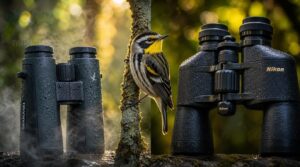
The internal shape of your binoculars matters more than most birders realize. Roof prisms use straight, parallel barrels — slim, compact, easy to grip one-handed. Porro prisms offset the barrels in a zigzag, which naturally boosts depth perception and gives a more pronounced 3D view of perched birds.
Porros deliver strong brightness through total internal reflection with fewer coatings needed. Roof designs need phase-correction coatings to compensate for light loss, and their tighter housings make weather sealing more straightforward. If durability matters on wet field days, roof prisms generally win.
How BaK-4 Glass Improves Contrast
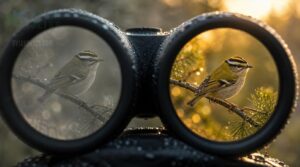
The glass inside your prism does quiet but critical work. BaK-4 prisms have a higher refractive index than BK7, meaning light passes through with fewer internal scattering events. That translates directly into uniform field brightness and sharper silhouettes — especially useful at dawn when a warbler’s crown stripe is the only clue you’ve got.
Better light passage also means enhanced color fidelity. Greens stay green. Browns don’t shift gray.
Why Fully Multi-Coated Lenses Matter

Every lens surface you look through steals a little light. Fully multi-coated lenses fight that loss by applying multiple anti-reflective layers to every air-to-glass surface, pushing light transmission above 95%.
That extra brightness reveals subtle plumage shades at dawn.
FMC also kills ghosting and flare, so sunlit foliage stays crisp.
Hardened top coats add scratch resistance, keeping your optical quality field-ready longer.
Dielectric Coatings and Color Fidelity
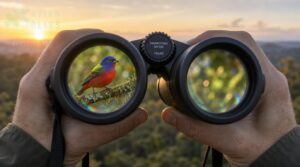
Dielectric coatings take color fidelity further than fully multi-coated lenses alone. Built from ultra-thin layers of materials like SiO2 and TiO2, they minimize wavelength-dependent light loss across the entire visible spectrum.
Here’s what that means for you in the field:
- True plumage colors render accurately, even at dawn or dusk.
- Off-axis hues stay consistent — no misleading color shifts at the edges.
- Brightness holds steady, reducing ghosting in bright conditions.
Field of View, Close Focus, and Edge Sharpness
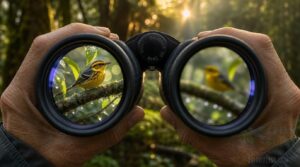
Magnification and glass quality get a lot of attention, but how your binoculars handle real field conditions matters just as much. Three optical traits quietly shape how well you identify birds in the moment. Here’s what to know about each one.
Wide Field of View for Tracking Fast Birds
When a warbler darts through dense undergrowth, your reaction window is tiny. A wide field of view — around 380 ft at 1,000 yards — gives you the Rapid Detection Range you need to spot and lock on fast.
Lower magnifications like 8× deliver broader Panoramic Bird Tracking coverage, making Adaptive Scanning Speed and Flock Movement Monitoring far more manageable.
Close-Focus Distance for Small Species
Once you’re tracking fast movers, the next challenge flips — small species up close.
Close-focus distance is the minimum range your binoculars can still render sharply. For warblers and hummingbirds, you want under 2.5–3 meters. Beyond 4 meters, fine details like eye rings and bill shape disappear.
Lower magnification, like 8×, covers Minimum Focus more cleanly than 10×.
Edge-to-Edge Sharpness for Peripheral ID
Close focus brings small birds into frame — but edge-to-edge sharpness keeps the full picture honest.
- Peripheral sharpness reveals wing and tail outlines that center-only focus misses.
- Corner clarity catches subtle field marks when birds drift to the image edge.
- Uniform image sharpness reduces misidentification from peripheral blur.
- Edge contrast preservation maintains plumage hues accurately across the field.
- Peripheral resolution testing during QA ensures consistent performance corner to corner.
Fully multi-coated lenses and ED glass together support reliable peripheral ID in any light.
ED Glass, Aberration Correction, and Color Accuracy
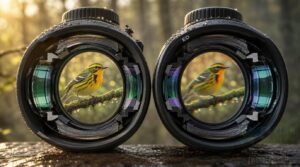
The glass inside your binoculars does more than magnify — it either reveals or hides the details that make identification possible. Color accuracy, sharpness, and aberration control all come down to the type of elements used in the optical design. Here’s what you need to understand about each factor.
How Chromatic Aberration Hides Plumage Detail
Chromatic aberration is like a ghost sitting on your image — slightly out of phase, blurring what should be sharp. It happens because glass bends different wavelengths of light at slightly different angles, a problem called Wavelength Focus Mismatch. Red, green, and blue don’t land at the same focal point, so fine feather edges smear into color halos instead of crisp lines.
| Optical Issue | What You See | ID Impact |
|---|---|---|
| Color Fringe Effects | Purple/green halo on feather edges | Masks wing bar boundaries |
| Chromatic Blur Masking | Throat patches appear washed out | Misread age or sex cues |
| Edge Contrast Loss | Eye rings fade into background | Species confusion at distance |
That Plumage Color Blur hits hardest on distant small passerines — exactly when you need your optics to perform. A bird’s subtle wingbars or facial markings lose definition fast. Backlighting makes it worse, amplifying color halos around plumage edges and destroying the image clarity you’re counting on for feather pattern analysis. Without color accuracy, even a familiar species can look unfamiliar.
Chromatic blur hits hardest on distant small birds, turning crisp wingbars and facial marks into unreadable halos
Extra-Low Dispersion Glass Benefits Explained
ED glass fixes the core problem that cost you that warbler ID last spring. By aligning multiple light wavelengths to a single focal point, it delivers True Plumage Hues without halos.
You get Reduced Chromatic Blur, sharper wing bars, cleaner eye rings, and real Detail Clarity Boost — exactly where species identification depends on it most.
Mid-Range Vs. Premium Glass Quality
Spending $400–$600 on mid-range binoculars with ED extra-low dispersion glass and fully multi-coated optics gets you reliable field marks in good light. But the cost clarity balance shifts noticeably when conditions turn harsh.
Here’s where the gap shows:
- Veiling haze reduction — premium optics cut backlit glare; mid-range can look washed out
- Chromatic aberration control — premium glass keeps wing bars crisp; mid-range shows subtle fringing
- Durability build contrast — premium metal bodies hold alignment longer under daily use
- Maintenance longevity gap — premium coatings resist wear; mid-range degrades faster without careful cleaning
When Aspherical Elements Improve Identification
Most birders don’t realize how much aspherical lens elements change what they see at the edges of the frame. Instead of blurring wing bars or rufous crescents into soft smudges, aspheres correct off‑axis distortion precisely — keeping peripheral detail crisp right to the boundary.
That’s where tricky IDs often hide.
Frequently Asked Questions (FAQs)
How does eye relief affect birding accuracy?
Proper eye relief keeps the full field of view visible. For eyeglass wearers, 15 mm minimum prevents edge blackout. Correct relief means you won’t miss wing bars or tail shapes on fast-moving birds.
Which weather conditions degrade binocular optical performance?
Fog, rain, dust, and smoke all degrade optical performance. Humidity causes internal fogging, rain streaks lenses, dust scatters light, and smoke reduces contrast. Nitrogen-purged, waterproof housings defend against most of these conditions.
Do ergonomics influence how long birders observe?
Yes — ergonomics directly shape how long you stay in the field. Lightweight binoculars with proper eye relief and balance reduce fatigue, letting you observe comfortably for hours instead of minutes.
How do warranties reflect overall binocular build quality?
A warranty is a manufacturer’s handshake promise. Longer coverage signals confidence in build quality, while transferable warranties add resale value — both reflecting durable construction, tight sealing, and reliable optics you can count on for years.
Conclusion
Better glass finds the field marks. Better coatings reveal true color. Better edge sharpness tracks the bird before it disappears into the canopy.
Understanding how binocular lens quality affects bird identification isn’t just technical knowledge—it’s the difference between a confirmed sighting and a frustrating maybe. Your optics are your primary field tool.
Invest in glass that keeps up with the birds you’re chasing, and you’ll start seeing what you’ve been missing all along.
- https://www.birdcollective.com/blogs/news/why-binoculars-matter-and-how-to-choose-the-right-pair
- https://www.bestbinocularsreviews.com/birdwatching-binoculars.php
- https://www.nytimes.com/wirecutter/reviews/the-best-binoculars
- https://www.audubon.org/gear/binocular-guide
- https://hawkwatch.org/how-to-select-the-right-binoculars-for-birdwatching